
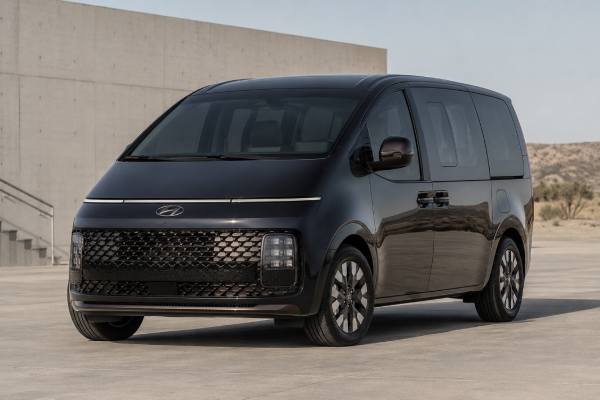
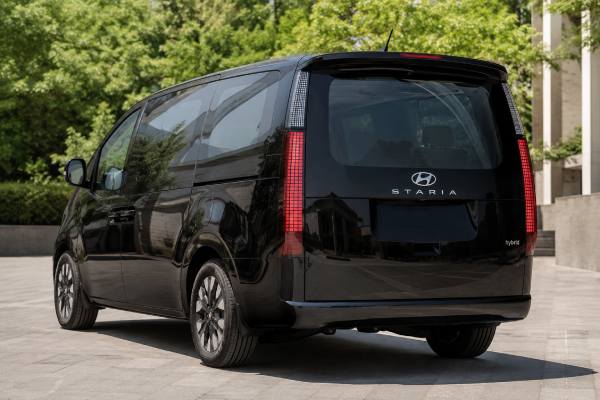
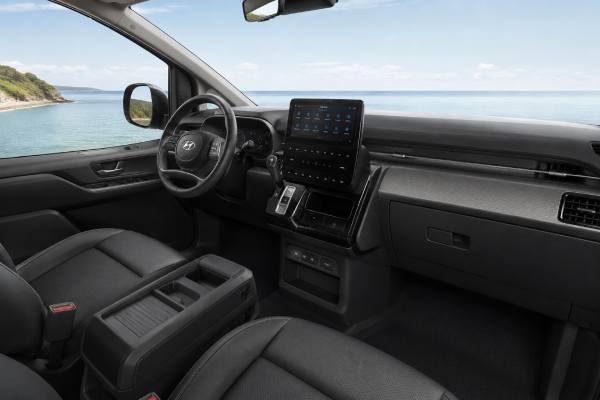
The Hyundai STARIA Hybrid brings a full-hybrid petrol powertrain to Hyundai’s large US4 people mover, giving buyers a more efficient alternative to older diesel versions without moving to a plug-in setup. It keeps the STARIA’s main appeal: a huge cabin, futuristic styling, sliding-door practicality, and a flexible 7- or 9-seat layout. The important question is whether the 1.6 T-GDi HEV has enough strength, economy, and durability for family, shuttle, taxi, hotel, and business use. The answer is mostly yes, with one important condition: this is still a heavy, tall van, so the hybrid system helps most in town and mixed driving, not at fast motorway speeds.
Final Verdict
The 2025–present Hyundai STARIA Hybrid 1.6 T-GDi HEV is a strong choice for buyers who need van-level space, proper passenger comfort, and better city efficiency than a large petrol MPV normally offers. It suits large families, shuttle operators, hotels, and private-hire users who spend a lot of time in urban or suburban traffic. Its main tradeoff is high-speed economy: the heavy body and large frontal area reduce the hybrid advantage on motorways. Buy it only with clear service records, completed software and recall checks, and a healthy hybrid battery and cooling-system inspection.
| Pros | Cons |
|---|---|
| 225 hp hybrid system feels strong in city driving | Motorway fuel use rises sharply at higher speeds |
| Huge cabin with useful 7- and 9-seat layouts | 7-seat luxury layout sacrifices rear cargo volume |
| No plug-in charging routine or public charging dependence | Small battery gives no meaningful EV-only range |
| Six-speed automatic feels more natural than many CVTs | Engine can sound busy under hard acceleration |
| Strong safety and driver-assistance equipment availability | Hybrid variant may not share every older crash rating |
| Good warranty coverage in many European markets | Early used examples need careful hybrid-system checks |
Table of Contents
- STARIA Hybrid Overview
- Specs and Technical Data
- Trims, Options, Safety and Assistance
- Reliability, Common Issues and Service Actions
- Maintenance and Buyer’s Guide
- Driving, Performance and Efficiency
- How the STARIA Hybrid Compares to Rivals
STARIA Hybrid Overview
The STARIA Hybrid is best understood as a large passenger van with a modern full-hybrid drivetrain, not as a compact hybrid car stretched into MPV shape. Its cabin space, tall seating position, and sliding doors are the main reasons to buy it, while the hybrid system mainly improves low-speed refinement and urban fuel use.
The US4 STARIA platform has been on sale since 2021, but the 1.6 T-GDi HEV version arrived for the 2025 model year in many markets. It pairs Hyundai’s turbocharged Smartstream 1.6-litre petrol engine with an electric motor, a small lithium-ion polymer battery, and a conventional 6-speed automatic transmission. Because it is a self-charging full hybrid, it does not plug in. The battery is recharged by regenerative braking and by the engine when needed.
That makes the ownership experience simple. There is no home wallbox to install, no public charging plan to manage, and no EV range to protect. Around town, the STARIA Hybrid can creep, coast, and manoeuvre with the engine off for short periods. At higher speeds, the petrol engine does most of the work, helped by the motor when extra torque is needed.
The biggest difference between the STARIA Hybrid and a smaller hybrid SUV is weight. Depending on seating and trim, this vehicle sits around 2.3 tonnes before passengers and luggage. It is also nearly two metres wide and almost two metres tall. That gives it excellent space, visibility, and presence, but it also means physics matters. The hybrid system can recover braking energy in traffic, but it cannot make a large van behave like a small hatchback on the motorway.
For private buyers, the STARIA Hybrid makes the most sense when a normal SUV is simply too small. Three child seats, adults in the third row, airport luggage, sports gear, or shuttle work are the situations where it feels properly useful. For business users, the appeal is a mix of passenger capacity, image, comfort, warranty cover, and lower city fuel use compared with a non-hybrid petrol van.
The 7-seat Premium or Signature-style versions feel more like executive transport, with second-row relaxation seats and a more luxurious cabin. The 9-seat wagon versions are more practical for families, schools, hotels, and private-hire operators. Choosing between them is not just about price; it changes the vehicle’s character.
Specs and Technical Data
The 2025 Hyundai STARIA Hybrid uses a front-mounted 1.6-litre turbocharged petrol engine, a 54 kW electric motor, a compact 1.49 kWh lithium-ion polymer battery, and front-wheel drive. It is a full hybrid rather than a plug-in hybrid, so charging is automatic through regenerative braking and normal hybrid operation. The key technical story is strong combined torque for city use, a simple no-plug ownership pattern, and large-van size and weight.
| Item | Hyundai STARIA Hybrid 1.6 T-GDi HEV |
|---|---|
| Engine | Smartstream 1.6 T-GDi petrol, turbocharged inline-4 |
| Displacement | 1,598 cc |
| Valvetrain | 16 valves with CVVD technology |
| Bore x stroke | 75.6 x 89.0 mm |
| Compression ratio | 10.5:1 |
| Petrol engine output | 118 kW / 160 PS at 5,500 rpm |
| Petrol engine torque | 265 Nm from 1,500–3,500 rpm |
| Electric motor output | 54 kW / 73 PS |
| Battery | 1.49 kWh lithium-ion polymer, 270 V |
| System output | 165 kW / 225 PS |
| System torque | 367 Nm from roughly 1,000–4,000 rpm |
| Timing drive | Timing chain |
| Item | Value |
|---|---|
| Transmission | 6-speed automatic |
| Drive type | Front-wheel drive |
| Hybrid type | Full parallel hybrid, self-charging |
| Official combined fuel economy | 7.6 L/100 km WLTP, about 31 mpg US / 37 mpg UK |
| CO₂ emissions | 172 g/km WLTP |
| Emissions standard | Euro 6e in European specification |
| Fuel tank | 65 litres |
| Petrol particulate filter | Fitted on European versions |
| Item | Value |
|---|---|
| Body style | Large MPV / passenger van, 5 doors |
| Seating | 7-seat Premium layout or 9-seat wagon layout |
| Length | 5,253 mm |
| Width | 1,997 mm excluding mirrors |
| Height | 1,990 mm |
| Wheelbase | 3,273 mm |
| Ground clearance | 186 mm |
| Turning circle | About 12.5–12.6 m in tested European specifications |
| 9-seat cargo volume | 831–1,303 litres by published VDA figures |
| 7-seat cargo volume | 117–431 litres by published VDA figures |
| Item | Value |
|---|---|
| 9-seat curb weight | About 2,275–2,355 kg |
| 9-seat gross vehicle weight | 3,050 kg |
| 7-seat curb weight | About 2,345–2,413 kg |
| 7-seat gross vehicle weight | 2,950 kg |
| 0–100 km/h | 10.2 seconds |
| Top speed | 167 km/h |
| Roof load | 100 kg in some European specifications |
| Towing | Market-dependent; confirm by VIN before fitting a tow bar |
| Item | Practical reference |
|---|---|
| Routine service interval | 15,000 km or 12 months in published European data |
| Engine oil interval | 15,000 km or yearly in published European data |
| Engine oil grade | Use the VIN-specific Hyundai-approved low-viscosity oil |
| Wheel nut torque | 11–13 kgf·m, about 108–127 Nm |
| Air-conditioning refrigerant | R-1234yf in European test data |
| Hybrid safety voltage | 270 V high-voltage system |
Trims, Options, Safety and Assistance
The STARIA Hybrid trim structure varies by country, but the core split is simple: practical 9-seat wagon versions and more luxurious 7-seat Premium versions. The best value is usually a mid-trim 9-seater if you need passenger capacity; the 7-seater is the choice when comfort matters more than luggage volume.
In German-style European specification, the range has been shown as Trend, Prime, and Signature. Other markets use names such as Exclusive, Premium, and Luxury, but the pattern is similar.
Trim and equipment highlights
The 9-seat entry or mid-level versions usually focus on passenger carrying, LED lighting, digital displays, driver-assistance systems, and practical cabin equipment. Higher 9-seat trims add more comfort and convenience.
The 7-seat flagship version is easy to identify because it has two second-row relaxation seats instead of a three-person bench. This is the version to choose for VIP transfers, hotel use, and long family journeys where second-row comfort is the priority. It is not the best layout if you need maximum boot volume with all seats in place.
Common equipment and option identifiers include:
- 9-seat wagon layout: three rows plus extra passenger capacity, more useful for shuttles and large families.
- 7-seat Premium layout: second-row relaxation seats, more comfort, less maximum seating.
- Prime or mid trim cues: 18-inch alloy wheels, power sliding doors, power tailgate, upgraded trim, and rear sliding windows in some markets.
- Signature or Luxury cues: surround-view monitor, blind-spot view monitor, BOSE audio, Nappa-style upholstery, ambient lighting, and premium LED headlights.
- Park package: usually adds surround-view and blind-spot display equipment where not standard.
- Panoramic roof package: attractive for passenger comfort, but check for noise, water sealing, and headroom preferences before buying used.
Year-to-year changes are limited because the hybrid is a recent addition. The major change is the arrival of the 1.6 T-GDi HEV powertrain for the 2025 model year, together with updated infotainment, OTA map and software support in many specifications, and a stronger focus on Hyundai Smart Sense assistance features.
Safety ratings
The STARIA has a strong safety story, but buyers need to read the rating carefully. ANCAP awarded a five-star rating to the STARIA introduced from 2021 in Australia and New Zealand, with published scores of 85% adult occupant protection, 86% child occupant protection, 65% vulnerable road user protection, and 74% safety assist. That rating applied to petrol and diesel eight-seat variants tested under the relevant ANCAP protocol.
The hybrid version may be listed as unrated by some safety bodies or market databases. That does not mean it is unsafe; it means the exact hybrid variant has not always been crash-rated separately. For a buyer, the practical takeaway is to check the safety rating in the country where the vehicle is registered and confirm which seating configuration and build date the rating covers.
Airbags, child seats and ADAS
European Hyundai material lists six airbags as standard for the STARIA Hybrid. Some non-European STARIA versions have been advertised or tested with different airbag counts, including a front-centre airbag, so do not assume every market has identical passive safety equipment.
Useful safety and assistance features can include:
- Forward Collision-Avoidance Assist with junction-turning support.
- Lane Keeping Assist and lane-following functions.
- Highway Driving Assist on higher trims.
- Blind-Spot Collision-Avoidance Assist and Blind-Spot View Monitor.
- Rear cross-traffic assistance.
- Safe Exit Assist for sliding-door passenger safety.
- Surround-view monitor for tight parking.
- Multi-Collision Brake and stability control systems.
- Three-point seatbelts and headrests for all seating positions.
For child seats, inspect the actual vehicle rather than relying only on a brochure. ISOFIX and top-tether positions can vary by seating layout and market. The 9-seat version is often the more practical family tool because it gives more seating flexibility, while the 7-seat luxury layout may be less convenient for multiple child seats and bulky luggage at the same time.
ADAS calibration matters on a vehicle like this. Windscreen replacement, front radar repairs, wheel alignment work, bumper repairs, and suspension changes can affect camera and radar accuracy. A used STARIA Hybrid that has had accident repairs should come with proof that the driver-assistance systems were recalibrated correctly.
Reliability, Common Issues and Service Actions
The STARIA Hybrid is too new to have a deep long-term reliability record, so the best approach is to combine early ownership checks with what is known about Hyundai’s 1.6 T-GDi hybrid architecture. The core hardware is familiar, but this application is demanding because the engine and hybrid system are moving a very large vehicle.
| Area | Prevalence | Severity | Symptoms | Likely remedy |
|---|---|---|---|---|
| 12 V battery weakness | Occasional | Medium | No-start, warning lights, random electronic faults | Battery test, charge-system check, software update if applicable |
| Brake corrosion from regen use | Occasional | Low to medium | Grinding, pulsing, rusty rear discs | Brake service, cleaning, pad/disc replacement if worn |
| Turbo GDI carbon buildup | Occasional over time | Medium | Rough idle, hesitation, misfire codes | Diagnosis, intake cleaning, correct oil and service pattern |
| Hybrid cooling issues | Rare so far | High | HEV warning, reduced power, overheating message | Dealer diagnosis, coolant leak check, pump or sensor repair |
| Sliding door and tailgate faults | Occasional | Low to medium | Beeping, refusal to close, slow operation | Latch adjustment, sensor check, software or motor service |
| ADAS warnings after repair | Occasional | Medium | Camera/radar warnings, lane assist unavailable | Calibration and alignment by trained workshop |
Engine and hybrid-system concerns
The 1.6 T-GDi is a direct-injection turbo engine. It needs clean oil, proper warm-up habits, and regular servicing. Short-trip shuttle work is not gentle service, even if mileage looks modest. Repeated cold starts, idling, low-speed stop-start operation, and heavy cabin loads can age oil faster than easy motorway use.
The timing chain is not a scheduled belt replacement item. That does not make it maintenance-free forever. On a used example, listen for cold-start rattles, check for cam/crank timing correlation faults, and investigate any persistent rough running. A healthy engine should start cleanly, idle smoothly once settled, and pull without knocking, heavy vibration, or repeated warning lights.
Hybrid battery degradation should be modest in normal use because the battery is small and managed within a narrow operating range. The bigger concern is not range loss, because there is no EV range to depend on. The real concern is warning lights, cooling faults, contactor faults, sensor issues, or 12 V system weakness that causes confusing hybrid-system messages.
The high-voltage battery, inverter, DC–DC converter, and hybrid control electronics should be checked with proper diagnostic equipment. A pre-purchase inspection should include a scan of all hybrid, engine, transmission, brake, and ADAS modules, not just a generic OBD check.
Transmission and driveline
The 6-speed automatic is a useful feature because it feels more conventional than many hybrid eCVT systems. On a test drive, it should shift smoothly, engage Drive and Reverse cleanly, and avoid flares, thumps, or shuddering. Harsh low-speed shifts may be software-related, fluid-related, or caused by driveline wear, so do not dismiss them on a nearly new used vehicle.
Because the STARIA Hybrid is front-wheel drive, the front tyres, driveshafts, engine mounts, and lower suspension arms do a lot of work. Listen for clicking on full-lock acceleration, clunks over speed bumps, and vibration under load. Heavy passenger use can accelerate wear even when the odometer is not very high.
Recalls, service campaigns and software
At this early stage, the STARIA Hybrid does not have the same long list of well-established public fault patterns as older models. That can change as fleets build mileage. The sensible buying step is to run the VIN through the official Hyundai recall or service campaign checker in the vehicle’s market and ask a Hyundai dealer to print completed campaign history.
Software updates matter on modern Hyundai hybrids. They may address infotainment behaviour, OTA functions, battery-management logic, transmission behaviour, driver-assistance warnings, or diagnostic sensitivity. A vehicle that has missed dealer visits may run older software even if it looks nearly new.
Before buying, request:
- Full Hyundai service history with dates and mileage.
- Proof of completed recalls and service campaigns.
- Diagnostic scan report from all major control modules.
- Battery state-of-health or hybrid-system health report where available.
- Evidence of ADAS calibration after windscreen, bumper, radar, or suspension repairs.
- Tyre wear report and alignment readings.
Maintenance and Buyer’s Guide
The STARIA Hybrid should be maintained more like a hard-working van than a light-use family hatchback. The official European service interval is commonly listed as 15,000 km or 12 months, and that is the interval to treat as the normal baseline.
| Interval | Work to prioritize |
|---|---|
| Every 10,000–15,000 km or yearly | Engine oil and filter, general inspection, tyre rotation, brake inspection |
| Every service | Check oil level, coolant level, brake fluid level, tyres, lights, wipers |
| Every 15,000–30,000 km | Cabin filter, engine air filter inspection or replacement by conditions |
| Every 2 years | Brake fluid replacement unless local service book states otherwise |
| Every 45,000–60,000 km | Detailed brake service, alignment check, suspension and bushing inspection |
| Every 60,000–100,000 km | Spark plugs, ATF, fuel-system service and belt inspection by VIN schedule |
| Every 4–5 years | 12 V battery testing and likely replacement depending on use |
| As specified by Hyundai | Engine coolant, inverter coolant, hybrid checks, and software updates |
For severe use, shorten the interval. Severe use includes taxi or shuttle operation, repeated short trips, heavy traffic in hot weather, dusty roads, mountain driving, long idling, and frequent full-load passenger work. Many STARIA Hybrids will live exactly that kind of life.
Fluids, filters and torque values
Use Hyundai-approved fluids by VIN. This is especially important because the 1.6 T-GDi HEV uses a petrol particulate filter in European trim and hybrid-specific cooling and electrical systems.
| Item | What to check |
|---|---|
| Engine oil | Low-viscosity Hyundai-approved oil; many 1.6 HEV applications use 0W-20 class oil |
| Oil capacity | Confirm exact fill quantity by service manual and engine code |
| Brake fluid | DOT 4 or Hyundai-approved equivalent by market |
| Transmission fluid | Hyundai automatic-transmission fluid specification by VIN |
| Engine and inverter coolant | Use only compatible Hyundai coolant; do not mix coolant types |
| Wheel nut torque | 11–13 kgf·m, about 108–127 Nm |
| Tyre size | Common European test fitment: 235/55 R18 |
The brake system deserves special attention. Hybrids use regenerative braking, so the friction brakes may work lightly in normal city use. That saves pad wear but can allow corrosion, especially in wet, salted, or coastal regions. A regular brake clean and inspection is often money well spent.
Used buying checklist
A good STARIA Hybrid should feel tight, smooth, and consistent. Walk away from a vehicle with unexplained hybrid warnings, missing service history, accident repairs without calibration proof, or uneven tyre wear that suggests heavy kerb strikes or poor alignment.
Check the following before purchase:
- Engine starts smoothly and does not rattle heavily when cold.
- No HEV, engine, ABS, airbag, or ADAS warning lights remain on.
- The automatic transmission engages cleanly and shifts without flare.
- Regenerative braking feels smooth, not grabby or inconsistent.
- The sliding doors, power tailgate, locks, and keyless entry all work.
- Air conditioning cools front and rear zones properly.
- Tyres match by axle and are correctly load-rated.
- Brake discs are not deeply scored or heavily corroded.
- Underbody, seams, suspension arms, and rear hardware show no serious corrosion.
- Interior rails, seats, belts, ISOFIX points, and trim are not damaged from shuttle use.
The 9-seat versions are usually the better buy for practical work. The 7-seat Signature or Luxury versions are more desirable for comfort, but they cost more, weigh more, and give less luggage flexibility with all seats occupied. For many buyers, the mid-trim 9-seater is the sweet spot.
Long-term durability should be good if the vehicle is serviced properly and not treated as a maintenance-free shuttle. The powertrain is not exotic, but hybrid faults can be expensive if ignored. The best ownership strategy is simple: oil on time, hybrid diagnostics at every major service, brake cleaning, software updates, and early attention to cooling or battery warnings.
Driving, Performance and Efficiency
The STARIA Hybrid drives better than its size suggests in town, but it never hides the fact that it is a tall, heavy van. The hybrid system gives useful low-speed smoothness and torque, while the body size defines parking, braking distance, and motorway fuel use.
Around town, the electric motor helps the STARIA move away smoothly. The petrol engine cuts in and out with reasonable polish, and the 6-speed automatic avoids the droning feel some drivers dislike in CVT-style hybrids. At low speeds, the vehicle feels calm and easy. The elevated view, large glass area, and available camera systems make it less intimidating than the dimensions suggest.
Steering is light rather than sporty. That is the right tuning for a people mover because the STARIA spends much of its life in car parks, school zones, hotels, airports, and city streets. Body roll is present if you push through corners, but the chassis feels secure when driven normally. It is not a vehicle that encourages fast cornering, and passengers will appreciate smoother inputs.
Ride comfort is one of its strengths. The long wheelbase helps it settle on main roads, and the cabin feels more relaxed than many commercial-derived vans. Wheel choice matters: 18-inch wheels look better and are common on higher trims, but tyres, pressure, and load rating have a big effect on comfort and noise.
Powertrain character
The 225 PS hybrid system is enough for normal use. It feels strongest from low to medium speeds, where electric assistance fills in torque before the turbo engine has to work hard. The official 0–100 km/h time of 10.2 seconds is respectable for a vehicle this large.
The engine can become louder on steep hills, full-load acceleration, or fast motorway overtakes. That is not a fault; it is the result of asking a 1.6-litre turbo petrol engine to move a large, upright body with passengers and luggage. The 6-speed automatic generally behaves smoothly, but an extra higher cruising gear would help reduce revs and noise at sustained high speeds.
Instrumented European testing has shown useful mid-range response, with 60–100 km/h passing in about 6.1 seconds and 80–120 km/h in about 7.8 seconds. That means the STARIA Hybrid is not slow in real traffic. It is simply happier at measured speeds than at repeated high-speed overtaking.
Real-world fuel economy
Official WLTP consumption is 7.6 L/100 km, equal to about 31 mpg US or 37 mpg UK. In real use, expect a wider spread:
- City use: about 7.0–8.5 L/100 km, or 28–34 mpg US / 33–40 mpg UK.
- Mixed family use: about 8.0–9.5 L/100 km, or 25–29 mpg US / 30–35 mpg UK.
- Fast motorway use: about 10.0–12.5 L/100 km, or 19–24 mpg US / 23–28 mpg UK.
- Cold weather, roof loads, or full passenger loads: add a noticeable penalty.
The hybrid system is most effective when the vehicle slows down often and can recover energy. Airport transfers, city commuting, school routes, and suburban work suit it well. Long motorway trips at 120–130 km/h are where the STARIA’s weight and frontal area take over.
Braking, traction and load use
Braking feel is generally smooth, but buyers should remember that regenerative braking and friction braking share the job. A good example should not feel grabby, pulsing, or inconsistent. If it does, inspect the discs, pads, calipers, and brake-by-wire control behaviour.
Front-wheel drive is adequate for normal conditions, but tyres are important. Cheap or worn front tyres can make a heavy hybrid van feel vague in wet weather. For shuttle or family use, choose quality tyres with the correct load rating rather than chasing the cheapest replacement.
When fully loaded, the STARIA Hybrid remains usable, but acceleration, braking distance, and fuel use all change. Drive it like a large passenger vehicle, not a tall hot hatch. Smooth throttle inputs, early braking, and sensible motorway speeds make it quieter, safer, and cheaper to run.
How the STARIA Hybrid Compares to Rivals
The STARIA Hybrid’s main advantage is that it offers true large-MPV space with a simple self-charging hybrid system. Many rivals either use diesel, plug-in hybrid systems, smaller cabins, or more commercial-feeling interiors.
| Rival | Where it beats STARIA | Where STARIA fights back |
|---|---|---|
| Kia Carnival Hybrid | More car-like in some markets, strong family focus | STARIA has more futuristic van-style space and visibility |
| Volkswagen Multivan eHybrid | Plug-in electric driving and clever modular seating | STARIA avoids charging dependence and can be better value |
| Ford Tourneo Custom PHEV | Plug-in capability and commercial network strength | STARIA feels more distinctive and passenger-focused |
| Mercedes-Benz V-Class | Premium badge, refinement, executive image | STARIA usually offers stronger equipment value |
| Toyota Proace Verso | Practical van roots and fleet familiarity | STARIA has a more modern cabin and hybrid option |
Against the Kia Carnival Hybrid, the STARIA feels more like a futuristic shuttle and less like a traditional family minivan. The Carnival may be easier to place on the road in some markets and can feel more car-like, but the STARIA wins on visual drama, upright space, and passenger-van presence.
Against the Volkswagen Multivan eHybrid, the choice depends on charging. If you can plug in daily and most trips are short, the VW’s plug-in system can be more efficient. If you cannot charge reliably, the STARIA’s self-charging hybrid setup is easier to live with.
Against diesel vans, the STARIA Hybrid is quieter and smoother in town. Diesel still makes sense for constant high-speed motorway work, towing, or heavy long-distance fleet duty. The STARIA Hybrid makes more sense for mixed-use passenger transport, especially where urban refinement and low-speed economy matter.
For most private buyers, the question is not whether the STARIA Hybrid is the most efficient hybrid on sale. It is not. The better question is whether any normal SUV or smaller MPV can do the same job. If you truly need the space, the STARIA Hybrid is one of the more interesting and practical large passenger vehicles available.
References
- The new STARIA Hybrid | Highlights | Hyundai Motor Europe 2026 (Manufacturer Model Page)
- The new STARIA Hybrid | Features | Hyundai Motor Europe 2026 (Manufacturer Features Page)
- Hyundai STARIA Hybrid 2025 (Specifications and Price List)
- Hyundai Staria | Safety Rating & Report 2021 (Safety Rating)
- Hyundai Owner’s Manual 2025 (Owner’s Manual)
Disclaimer
This article is for informational purposes only and is not a substitute for professional diagnosis, repair, or official Hyundai service information. Specifications, torque values, service intervals, fluid requirements, software actions, safety equipment, and procedures can vary by VIN, market, trim, production date, and equipment. Always verify critical data against the official owner’s manual, service manual, warranty booklet, dealer records, and VIN-specific Hyundai documentation.
If this guide helped you, please consider sharing it on Facebook, X/Twitter, or another platform to support our work.