
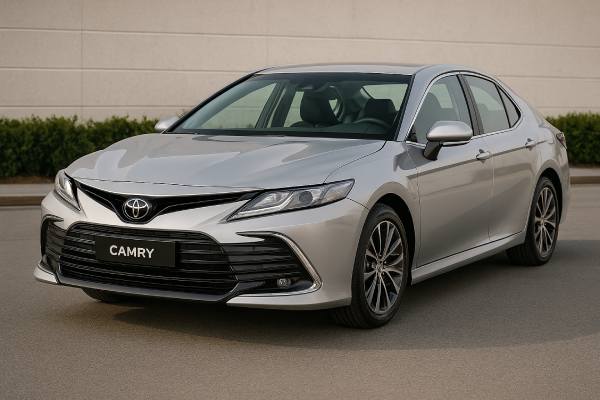
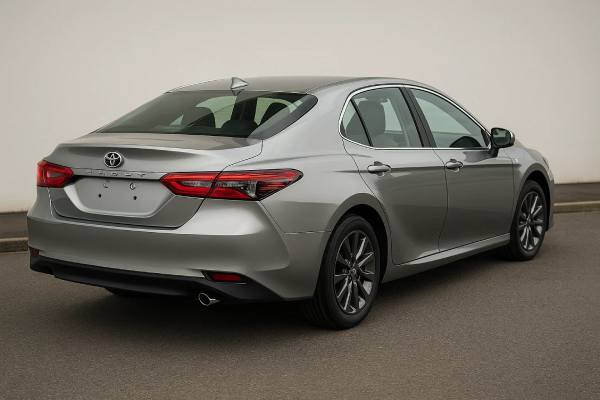
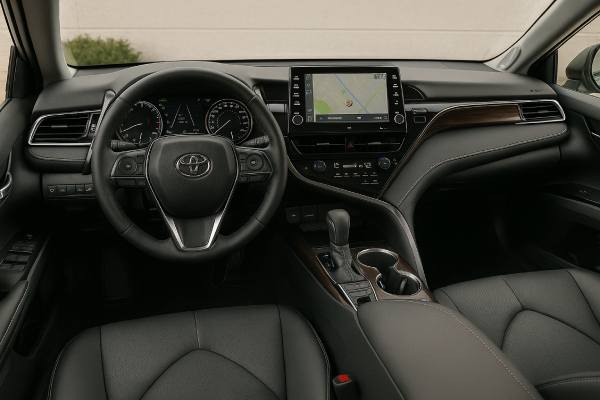
The 2021–2024 Toyota Camry facelift refines a proven formula with quieter road manners, updated safety tech, and small-but-useful cabin upgrades. Under the hood, the A25A-FKS 2.5-liter four pairs with an 8-speed automatic to deliver 203 hp in most FWD LE/SE trims, balancing brisk everyday pace with strong fuel economy. The mid-cycle update introduced a cleaner dash layout with an available 9-inch “floating” touchscreen, simpler climate controls, and improved driver assistance (Toyota Safety Sense 2.5+). Ride comfort and body control remain standouts on the TNGA-K chassis, while maintenance stays straightforward: long-life iridium plugs, 0W-16 oil, and big service intervals. Shoppers deciding between LE, SE, XLE, and XSE will find real differences in wheel/tire packages and suspension tuning, not just cosmetics. If you want a midsize that still feels unflappable after years of commuting—and you prefer a naturally aspirated engine’s linear response—the facelifted AXVA70 should be on your shortlist.
Top Highlights
- Calm, composed ride with precise steering; 203 hp 2.5-liter engine is smooth and efficient.
- Thoughtful facelift: better screen placement, cleaner controls, and expanded driver assistance (TSS 2.5+).
- Cabin and trunk space remain competitive; LE/SE tires favor comfort and low running costs.
- Watch for head unit/phone compatibility quirks—keep infotainment software current.
- Oil and filter: every 10,000 miles / 12 months (16,000 km / 12 months) in normal service.
Navigate this guide
- Facelift Camry AXVA70 overview
- Camry AXVA70 specs and data
- Camry trims, options and safety
- Reliability and service actions
- Maintenance and buyer’s guide
- Driving and performance
- Camry rivals and alternatives
Facelift Camry AXVA70 overview
The eighth-generation Camry (AXVA70 for the 2.5-liter inline-four) received a mid-cycle update for model year 2021 that sharpened both design and usability. Externally, you’ll spot a tidier front fascia and revised grille details that differ by trim, plus wheel design changes. Inside, Toyota moved the infotainment screen higher into your natural sightline and simplified the surrounding controls. Material quality and assembly feel are consistent with the pre-facelift car—solid and squeak-free—while road noise is well controlled, especially on the LE/SE’s smaller wheel/tire combinations.
Mechanically, the headline remains the A25A-FKS 2.5-liter engine. It uses Toyota’s D-4S dual-injection system (both port and direct) and variable valve timing to run efficiently at low load and respond keenly when you ask for more. In this 203-hp specification, it’s a sweet-spot powertrain: quick enough for confident passing, happy on regular unleaded, and simple to maintain. The 8-speed direct-shift automatic is tuned for early torque-converter lockup and low rpm cruising; choose the SE/XSE if you prefer snappier shift logic.
Safety and assistance jump a step with Toyota Safety Sense 2.5+. It broadens pedestrian detection, refines lane-keeping, and adds curve speed management to adaptive cruise on most builds. The facelift also expands availability of features like a 9-inch touchscreen, a larger driver info display, and smartphone mirroring (Apple CarPlay/Android Auto). Practical details remain very Camry: a roomy back seat, a wide trunk opening, and an easygoing driving position that suits long days behind the wheel.
If you’re coming out of a 2018–2020 car, the facelift’s daily-use upgrades are immediately noticeable—less reach for the screen, clearer menus, and more natural driver assistance behavior. If you’re new to the nameplate, you’ll find a midsize sedan that rides quietly, steers predictably, and doesn’t nickel-and-dime you with surprise service needs.
Camry AXVA70 specs and data
Engine and Performance (ICE)
| Item | Specification |
|---|---|
| Code | A25A-FKS |
| Layout and valvetrain | Inline-4, DOHC, 4 valves/cyl, D-4S dual injection, variable valve timing |
| Bore × stroke | 87.5 × 103.4 mm (3.44 × 4.07 in) |
| Displacement | 2.5 L (2,487 cc) |
| Compression ratio | ~13.0:1 |
| Max power | 203 hp (151 kW) @ ~6,600 rpm (LE/SE FWD) |
| Max torque | ~250 Nm (184 lb-ft) @ ~5,000 rpm |
| Induction | Naturally aspirated |
| Timing drive | Chain |
| Emissions / efficiency std. | Tier 3 / SULEV30 (typical) |
| Rated efficiency (combined) | ~7.1–7.6 L/100 km (33–31 mpg US / 40–37 mpg UK), trim dependent |
| Real-world highway @ 120 km/h (75 mph) | ~6.5–7.3 L/100 km (36–32 mpg US / 43–39 mpg UK) |
| Aerodynamics | Cd ≈ 0.27–0.29 (wheel/tire dependent) |
Transmission and Driveline
| Item | Specification |
|---|---|
| Transmission | 8-speed automatic (Direct-Shift) with lockup |
| Gear ratios | 1st 5.250 · 2nd 3.029 · 3rd 1.950 · 4th 1.457 · 5th 1.220 · 6th 1.000 · 7th 0.808 · 8th 0.673 · Rev 4.014 |
| Final drive ratio | ≈ 2.80 (varies slightly by trim/wheel) |
| Drive type | FWD (AWD versions exist; outputs differ) |
| Differential | Open |
| Refuel to full | ≈ 5 minutes |
Chassis and Dimensions
| Item | Specification |
|---|---|
| Platform | TNGA-K |
| Suspension (front/rear) | MacPherson strut / Multi-link |
| Steering | Electric power assist; ~2.8–3.0 turns lock-to-lock |
| Brakes | Front 305 mm (12.0 in) ventilated; rear 281 mm (11.1 in) solid |
| Wheels/Tires (common) | LE: 205/65 R16 · SE: 235/45 R18 · XSE: 235/40 R19 |
| Ground clearance | ~145 mm (5.7 in) |
| Length / Width / Height | ~4,880–4,900 × 1,840 × 1,445 mm (192.1–192.9 × 72.4 × 56.9 in) |
| Wheelbase | 2,825 mm (111.2 in) |
| Turning circle (curb-to-curb) | ~11.0 m (36.1 ft) |
| Curb weight | ~1,500–1,560 kg (3,305–3,440 lb), trim dependent |
| GVWR | ~1,980–2,050 kg (4,365–4,520 lb) |
| Fuel tank | 60 L (15.8 US gal / 13.2 UK gal) |
| Cargo volume (SAE) | ~428 L (15.1 ft³) |
Performance and Capability
| Metric | Value |
|---|---|
| 0–100 km/h (0–62 mph) | ~7.8–8.2 s (0–60 mph ~7.5–7.9 s) |
| Top speed | ~210–215 km/h (130–134 mph), limited |
| 100–0 km/h braking | ~37–39 m (62–0 mph ~121–128 ft) with quality tires |
| Towing capacity | Not rated in North America |
| Payload | Typically ~400–430 kg (880–950 lb) |
| Roof load | Per accessory spec; verify by VIN/accessory guide |
Fluids and Service Capacities
| System | Specification / Capacity |
|---|---|
| Engine oil | 0W-16 (preferred); 0W-20 acceptable if 0W-16 unavailable; ≈ 4.5–4.8 L (4.8–5.1 US qt) with filter |
| Coolant (engine) | Toyota Super Long Life Coolant (pink) 50/50; ≈ 6.5–7.5 L (6.9–7.9 US qt) |
| Transmission ATF | Toyota ATF WS; drain/fill ≈ 3.5–4.5 L (3.7–4.8 US qt) |
| A/C refrigerant | R-1234yf on most 2021+; confirm under-hood label; typical 400–550 g (14.1–19.4 oz) |
| A/C compressor oil | ND-OIL 12 (R-1234yf systems); ~120–150 mL (4.1–5.1 fl oz) |
| Key torque specs | Wheel lugs 103 Nm (76 lb-ft); oil drain plug ~39–40 Nm (29–30 lb-ft); spark plugs ~18–22 Nm (13–16 lb-ft) |
Electrical
| Item | Specification |
|---|---|
| Alternator | ~130–150 A |
| 12V battery | ~55–65 Ah (CCA varies), group size by supplier |
| Spark plugs | Long-life iridium; gap ~1.0–1.1 mm (0.039–0.043 in) |
Safety and Driver Assistance
| Item | Details |
|---|---|
| Crash performance | Top-tier structure/restraints for the class; side and moderate overlap results are strong |
| Headlight rating | Best with LED projectors; halogen reflectors may rate lower on some trims |
| ADAS suite (TSS 2.5+) | Pre-collision with pedestrian detection (enhanced), lane departure with steering assist, lane tracing assist, full-speed adaptive cruise with curve speed management, road sign assist, automatic high beams; blind-spot and rear cross-traffic available/standard by trim |
Camry trims, options and safety
Trims at a glance (FWD, 203 hp focus):
- LE: Comfort baseline. 16-inch wheels with taller sidewalls for a quieter ride, cloth seats, and the smaller screen standard with the 9-inch unit available. Great value if you prioritize isolation and tire longevity.
- SE: Subtle sport tune. 18-inch wheels, firmer springs/dampers, and a thicker steering wheel. Transmission mapping feels slightly more assertive in moderate throttle.
- XLE/XSE (2.5-liter variants): More features and technology (bigger driver display, available JBL audio, leather on XLE). XSE pairs luxury content with sport calibration and typically larger wheels (up to 19-inch). Note that 2.5-liter outputs vary on dual-exhaust models; this guide concentrates on the 203-hp baseline.
Packages and identifiers:
- Audio/infotainment: 7-inch screen standard on lower trims; the facelift’s 9-inch “floating” screen sits higher and is worth seeking for visibility. Apple CarPlay and Android Auto are present; JBL audio elevates clarity without heavy bass boom.
- Driver assistance: Toyota Safety Sense 2.5+ is standard. Blind-spot monitoring with rear cross-traffic alert is widely fitted or bundled; Rear Cross-Traffic Braking and parking sonar appear in convenience/tech packages.
- Visual tells: LE’s 16-inch alloys and calmer fascia; SE adds a subtle decklid lip and sport bumper accents; XSE features mesh grille and low-profile tires.
Year-to-year notes (facelift window):
- 2021: Facelift arrives with TSS 2.5+, refreshed front fascia, revised cabin controls, optional 9-inch screen.
- 2022: Minor package reshuffles; connectivity and color/trim tweaks.
- 2023: Small feature alignment changes; availability of certain safety features increases by trim.
- 2024: Final year before the next generation; equipment rationalized to streamline builds.
Safety ratings (summary):
The facelifted Camry continues to score at or near class-leading levels in major crash tests, with excellent occupant protection and strong crash-avoidance tech. Headlight performance depends on the unit—LED projectors paired with upper-trim packages typically earn the best marks; base halogens on certain builds rank lower. Rear-seat space and LATCH anchor access are strengths for family use.
Child-seat fit:
Outboard lower anchors are easy to reach, the middle seat allows a booster without belt-buckle crowding on LE/SE cushions, and the front passenger space remains generous with a rear-facing seat installed behind it. Always test your specific seat for recline angle and base contact; 19-inch tire packages can make buckles slightly tighter against bolsters.
Calibration considerations:
Replacing the windshield or front bumper cover requires camera/radar aiming. After any structural repair, plan for ADAS calibrations and a thorough road test to verify lane tracing and adaptive cruise behavior.
Reliability and service actions
The A25A-FKS/8-speed pairing is generally low-drama. Most issues that surface are either software/adjustment items or wear-and-tear as mileage climbs.
Common (low cost):
- Infotainment quirks: Intermittent Bluetooth or smartphone-mirroring hiccups. Fix: Update head-unit software; use OEM-spec USB cables; reset paired phones.
- Brake pulsation after light bedding: Pad material transfer on gently driven cars. Fix: Re-bed pads properly; if needed, resurface or replace rotors with quality parts.
- Tire noise/cupping (18–19 in): Aggressive factory alignments or long intervals between rotations. Fix: Rotate 5–7.5k miles (8–12k km); annual alignment recommended on SE/XSE.
Occasional (medium cost):
- Water-pump seep as years pass: Coolant residue near pump weep hole; faint sweet smell. Fix: Replace pump and serpentine belt together; refill with Toyota SLLC.
- Front end links/bushings: Light knocks over broken pavement at higher mileage. Fix: Replace wear items; perform a four-wheel alignment.
Rare (higher cost/importance):
- Low-pressure fuel pump campaign on select vehicles: Symptoms include hesitation or stalling. Action: Run the VIN through the official recall portal and confirm completion before purchase.
- Sensor alignment/ADAS false alerts after glass/body work: Action: Professional calibration of camera/radar/sonar to spec.
Software and calibrations:
Updated engine/transmission logic improves low-speed smoothness and kickdown timing, particularly noticeable on early facelift builds. Many vehicles received reflashes during routine service—verify the latest calibration with a dealer if your test drive shows busy shifting.
Corrosion and body:
The shell and subframes hold up well in rust-belt regions, but annual inspections of brake lines and rear subframe seams are good practice. Door seals, under-trays, and splash shields should be checked after winter.
Pre-purchase checks:
- Full dealer service history and recall printout by VIN.
- Evidence of coolant service leaks addressed (or none present).
- Clean ADAS operation on a 10-minute mixed drive (lane tracing, adaptive cruise, emergency alerts).
- Even tire wear and smooth braking from highway speeds.
- No windshield replacements without proof of camera calibration.
Maintenance and buyer’s guide
Practical maintenance schedule (typical use)
- Engine oil and filter: 10,000 miles / 12 months (16,000 km / 12 months) with 0W-16; halve distance for severe duty (short trips, extreme temps).
- Engine air filter: Inspect 15,000 miles (24,000 km); replace ~30,000 miles (48,000 km), sooner in dust.
- Cabin filter: 15,000–20,000 miles (24,000–32,000 km) or annually.
- Coolant: Toyota SLLC first at 100,000 miles/10 years (160,000 km/10 years), then every 50,000 miles/5 years (80,000 km/5 years).
- Spark plugs (iridium): ~120,000 miles (192,000 km).
- ATF (8-speed): Not on the official schedule; optional drain-and-fill at 60,000–100,000 miles (96,000–160,000 km).
- Brake fluid: Replace every 3 years; keep moisture below 2%.
- Brake pads/rotors: Inspect every 10,000–15,000 miles (16,000–24,000 km); bed new pads properly.
- Belts/hoses: Inspect at every service; replace at pump service or on condition.
- Tire rotation: Every 5,000–7,500 miles (8,000–12,000 km).
- Alignment: Annually on 18–19 in packages or after any impact.
- 12-V battery: Test annually after year 4; typical life 5–7 years.
Fluid quick-reference
- Engine oil: 0W-16 (preferred); API/ILSAC to spec.
- Coolant: Toyota Super Long Life (pink).
- Transmission: Toyota ATF WS.
- Brakes: DOT 3 or DOT 4 to spec.
- A/C: R-1234yf (most 2021+); confirm label.
Essential torque values
- Wheel lugs: 103 Nm (76 lb-ft).
- Oil drain plug: ~39–40 Nm (29–30 lb-ft).
- Spark plugs: ~18–22 Nm (13–16 lb-ft).
Buyer’s checklist
- Exterior and glass: Look for OEM windshield; if replaced, request camera calibration proof. Grill emblem for radar should be undamaged.
- Undercarriage: Dry engine/transaxle; no coolant streaking; intact splash shields.
- Brakes/tires: No steering shimmy at 70–75 mph (113–120 km/h); even pad wear; recent rotation history.
- Electronics: Test CarPlay/Android Auto, all USB ports, and the backup camera lines; check for the latest infotainment update.
- Driving aids: Verify lane tracing and adaptive cruise behavior on a multilane highway.
- Records: Oil changes at or before 10k intervals; coolant interval respected; recall/TSB paperwork on file.
Which trims/years to target
- 2022–2024 LE/SE for the best blend of ride comfort, tire cost, and updated connectivity.
- XLE/XSE if you want larger screens, JBL audio, and more feature content—budget for 18–19 in tires.
- AWD note: If you need AWD, power and economy shift slightly; confirm outputs/MPG separately, as this guide centers the 203-hp FWD.
Durability outlook
A well-maintained A25A-FKS routinely goes beyond 200,000 miles (320,000 km) without major internal work. The biggest cost variables are tire choice/size and brake quality; alignments and rotations pay for themselves in tread life and quietness.
Driving and performance
Ride, handling, and noise
The facelifted Camry remains composed and quiet. LE’s 16-inch tires filter sharp edges, while SE’s firmer tune feels more tied down without becoming harsh. Straight-line stability is excellent; small steering inputs track accurately on crowned two-lanes and windy interstates. On coarse surfaces, 19-inch XSE tires add some texture, but cabin boom is still well controlled.
Powertrain character
Throttle response is clean and predictable, with a little extra urge above 3,500 rpm. The 8-speed short-shifts gently in normal driving; in Sport mode it holds gears longer and responds quicker to partial throttle. Passing from 50–80 mph (80–129 km/h) is confident with an early kickdown to 4th or 5th. Converter lockup happens early at cruise, keeping engine noise low.
Braking feel and consistency
Pedal travel is natural, with easy modulation in stop-and-go traffic. Repeated highway-speed stops remain stable as long as rotors are bedded correctly. SE/XSE pads are a touch more aggressive and resist glazing better under spirited use.
Real-world efficiency
- City: ~8.7–9.8 L/100 km (27–24 mpg US / 32–29 mpg UK), depending on traffic and tire package.
- Highway (60–75 mph / 100–120 km/h): ~6.5–7.3 L/100 km (36–32 mpg US / 43–39 mpg UK).
- Mixed: ~7.4–8.4 L/100 km (32–28 mpg US / 38–34 mpg UK).
Cold weather, short trips, and 19-inch performance tires can lower results; careful driving on 16–18 in touring tires typically beats the window-sticker combined figure on long runs.
Traction and winter manners
FWD traction is strong with quality all-season tires; stability control steps in smoothly. In snowbelt regions, true winter tires transform take-off, braking, and steering feel. If you often start on unplowed grades, consider AWD variants (with their own power/economy specs) or commit to winter rubber.
Load and grades
With four adults and luggage, the Camry remains settled, and transmission temps stay reasonable if you downshift early on long descents. Expect a 2–3 mpg US (1–3 L/100 km) penalty when fully loaded across hilly interstates.
Camry rivals and alternatives
Honda Accord 1.5T/2.0 hybrid (2021–2024): Accord feels lighter on its feet and offers excellent packaging; hybrid variants dominate its lineup from 2023 onward. The Camry counters with simpler ICE ownership, calmer highway ride on LE/SE tires, and a traditionally strong long-term reliability record.
Hyundai Sonata (2020–2024): Eye-catching design and value-rich trims. Ride and noise levels have improved, but the Camry’s steering precision and residual values typically edge it. If you like features per dollar, Sonata is tempting; if you want the quietest commute, Camry LE/SE has the advantage.
Nissan Altima 2.5 (2019–2024): Available AWD in many trims and a comfortable driving position. The Camry’s cabin feels more upscale after the facelift, and the 8-speed’s behavior is more natural than Altima’s CVT under brisk acceleration.
Subaru Legacy 2.5/2.4T (2020–2024): Standard AWD and excellent wet/snow traction. The 2.4T moves well but drinks more in town. If you prioritize winter capability above all, the Subaru merits a look; for long-term running costs and cabin serenity, the Camry remains compelling.
Kia K5 (2021–2024): Sharp styling and strong value; GT-Line AWD offers traction similar to Legacy/Altima AWD. Camry’s interior durability and quieter baseline tune make it a better bet for high-mileage commuters.
References
- 2021 Camry – Toyota Manuals and Warranties | Toyota Owners 2021 (Owner’s Manual)
- Fuel Economy of the 2021 Toyota Camry 2021 (EPA Ratings)
- 2021 Toyota Camry 4-door sedan 2021 (Safety Rating)
- Check for Recalls: Vehicle, Car Seat, Tire, Equipment 2025 (Recall Database)
Disclaimer
This guide is for informational purposes and is not a substitute for professional diagnosis, repair, or safety advice. Specifications, torque values, fluid types, and service intervals can vary by VIN, market, model year, and equipment. Always verify details against your vehicle’s official service documentation, owner’s manual, and current technical bulletins.
If this article was helpful, please consider sharing it on Facebook or X/Twitter to support xcar’s work.