
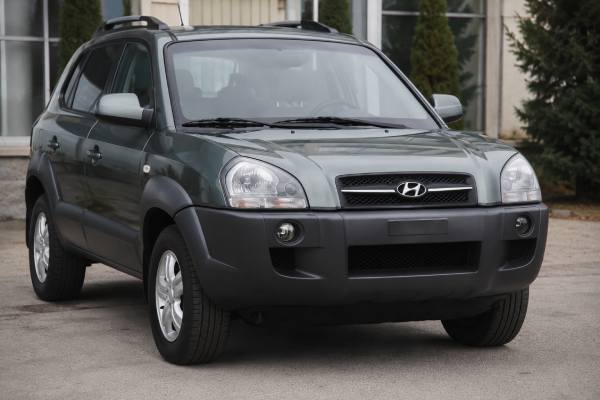
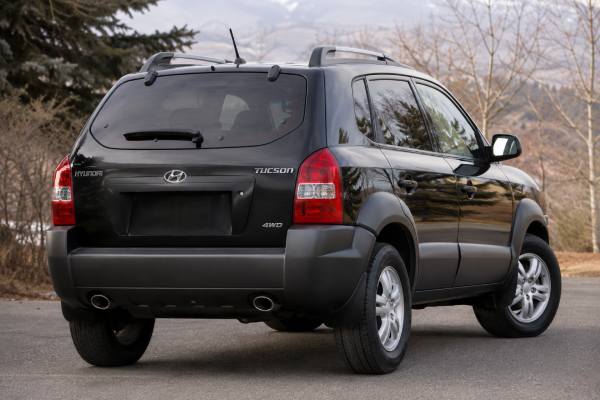
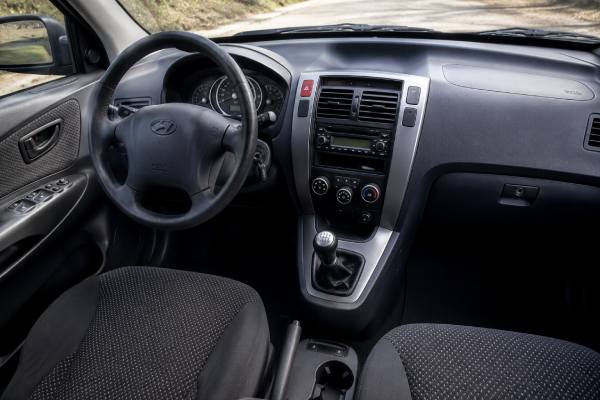
The first-generation Hyundai Tucson 4WD with the 2.7-liter Delta V6 is a compact SUV from the era before small crossovers became highly polished and turbocharged. It is simple by modern standards, but that simplicity is part of its appeal. You get a naturally aspirated V6, a conventional 4-speed automatic, useful on-demand four-wheel drive, a practical cabin, and strong standard safety equipment for the mid-2000s.
The main question is not whether this Tucson feels modern. It does not. The real question is whether a well-kept 2005–2009 Tucson V6 4WD can still make sense as a cheap used SUV for winter roads, light utility work, and short-family-duty driving. The answer depends heavily on rust, timing-belt history, transmission condition, and whether the 4WD system has been maintained rather than ignored.
Final Verdict
The 2005–2009 Hyundai Tucson 4WD (JM) with the Delta 2.7 V6 is a good used-SUV choice for buyers who want simple mechanicals, decent traction, a roomy small footprint, and low purchase cost. Its strongest appeal is the smooth, unstressed V6 paired with a conventional automatic and lockable on-demand 4WD. It suits drivers who need winter confidence and practical cargo space more than fuel economy or modern refinement. The main tradeoff is age-related maintenance: timing belt service, rust inspection, suspension wear, and 4WD fluid history matter more than mileage alone. Buy only with clear service records and a clean underbody.
| Pros | Cons |
|---|---|
| Smooth 2.7 V6 gives easier passing than four-cylinder rivals | Fuel economy is modest for a compact SUV |
| On-demand 4WD includes a useful manual lock function | Not built for serious off-road use or heavy towing |
| Six airbags, ABS, traction control, and ESC were strong equipment | No modern ADAS such as AEB, lane keeping, or adaptive cruise |
| Simple automatic and port-injected V6 are generally understandable to repair | Timing belt neglect can turn into expensive engine damage |
| Compact outside, with useful passenger and cargo volume inside | Rust, rear suspension wear, and brake-line condition need careful inspection |
Table of Contents
- 2005–2009 Tucson JM V6 4WD Overview
- Tucson 2.7 V6 4WD Specifications
- Trims, Safety and Driver Assistance
- Reliability, Common Issues and Service Actions
- Maintenance and Buyer’s Guide
- Driving, Performance, Efficiency and Towing
- How the Tucson V6 Compares to Rivals
2005–2009 Tucson JM V6 4WD Overview
The JM Tucson V6 4WD is best understood as a durable, affordable, early compact crossover rather than a refined modern SUV. It has enough power for everyday driving, useful traction for poor weather, and a cabin that is easier to live with than its modest exterior size suggests.
This generation was sold in many markets with different trim names, but the core recipe stayed familiar: unibody construction, five doors, five seats, front-biased 4WD, independent suspension, and either four-cylinder or V6 power. The article focuses on the gasoline 2.7-liter Delta V6 with four-wheel drive, covering the 2005–2009 period most buyers will see in used listings.
The V6 is the reason this version stands apart. Four-cylinder Tucsons are cheaper to run, but the 2.7 gives the vehicle a more relaxed feel, especially with passengers, hills, or highway merging. It is not fast by today’s standards, but it avoids the strained character common in older compact SUVs with small engines and automatic transmissions.
The 4WD system is another key part of the appeal. In normal driving it behaves mostly like a front-wheel-drive SUV, then sends torque rearward when conditions demand it. A 4WD Lock button allows a temporary 50:50 front-to-rear split for low-speed slippery conditions such as snow, mud, wet grass, or rough tracks. This is not a low-range off-road system, but it is genuinely helpful for winter starts and loose surfaces.
Age is now the biggest factor. A 2005 Tucson may be more than two decades old, while a 2009 model is still well into classic used-car territory. Mechanical design is fairly straightforward, but deferred maintenance changes the ownership picture quickly. The best examples are owned by people who changed the timing belt on time, serviced fluids, fixed oil leaks early, and kept the underbody clean in winter climates.
Tucson 2.7 V6 4WD Specifications
The Tucson 2.7 V6 4WD uses Hyundai’s Delta-series naturally aspirated gasoline V6 mounted transversely, paired with a 4-speed SHIFTRONIC automatic. The chassis is a unibody compact SUV layout with MacPherson struts in front, a multi-link independent rear suspension, and electronic on-demand 4WD.
| Item | Specification |
|---|---|
| Engine family | Hyundai Delta 2.7 V6, commonly identified as G6BA |
| Fuel type | Regular unleaded gasoline |
| Layout | Transverse naturally aspirated V6 |
| Displacement | 2,656 cc, marketed as 2.7 liters |
| Valvetrain | DOHC, 24 valves |
| Fuel system | Multi-port fuel injection |
| Power | 173 hp at 6,000 rpm |
| Torque | 178 lb-ft at 4,000 rpm, about 241 Nm |
| Bore × stroke | 86.7 × 75.0 mm |
| Compression ratio | 10.0:1 |
| Timing drive | Timing belt |
| EPA fuel economy, 2005 4WD V6 | 17 city / 23 highway / 19 combined mpg US |
| EPA fuel economy, 2009 4WD V6 | 18 city / 23 highway / 20 combined mpg US |
| Item | Specification |
|---|---|
| Transmission | 4-speed automatic with SHIFTRONIC manual selection |
| Final drive ratio | 4.407 with V6 automatic |
| Drive type | Electronic on-demand four-wheel drive |
| Normal torque behavior | Mostly front-drive until rear torque is needed |
| 4WD Lock function | Low-speed 50:50 split for slippery conditions |
| Low range | Not fitted |
| Item | Specification |
|---|---|
| Body style | Five-door, five-seat compact SUV |
| Construction | Unibody |
| Length | 4,325 mm (170.3 in) |
| Width | 1,831 mm (72.1 in) on many V6 US trims |
| Height with roof rails | 1,730 mm (68.1 in) |
| Wheelbase | 2,630 mm (103.5 in) |
| Curb weight | About 1,609 kg (3,548 lb) for US V6 4WD automatic |
| Turning circle | 10.8 m (35.4 ft) |
| Suspension | Front MacPherson strut, rear multi-link |
| Brakes | Power-assisted four-wheel discs with ABS |
| Common tire size | P235/60R16 on V6 GLS/LX, SE, and Limited-type trims |
| Fuel tank | 65 liters (17.2 US gal) |
| Cargo volume | 22.7 cu ft seats up, 65.5 cu ft seats folded |
| Item | Specification |
|---|---|
| 0–100 km/h | About 10.5 seconds |
| Top speed | About 180 km/h (112 mph) |
| Australian V6 AWD towing rating | 1,500 kg braked, 750 kg unbraked |
| Best use of 4WD Lock | Low-speed snow, mud, gravel, and slippery starts |
| Item | Useful reference |
|---|---|
| Preferred engine oil viscosity | SAE 5W-20 or 5W-30 in many North American manuals |
| Engine oil refill | About 4.5 liters with filter in many service references |
| Automatic transmission fluid | Hyundai SP-III specification |
| Automatic transaxle capacity | About 7.8 liters total capacity |
| Manual transaxle fluid spec | 75W/85 API GL-4 where manual-equipped variants apply |
| Wheel nut torque | Commonly 65–80 lb-ft; verify by market manual |
Trims, Safety and Driver Assistance
The V6 4WD Tucson was generally positioned above the base four-cylinder model, so most examples have better equipment than entry Tucsons. The exact names vary by market and year, but the mechanical pattern is easy to identify: 2.7 V6 badge, 4-speed automatic, 4WD badge or 4WD Lock switch, and wider 235-section tires on many trims.
In the United States, early 2005 models used GL, GLS, and LX trim names. The GL was usually the four-cylinder entry model, while GLS and LX brought the V6. Later US models moved toward GLS, SE, and Limited naming. In practical used-car terms, SE/Limited-type versions are the ones most likely to have leather, heated front seats, upgraded audio, sunroof, and extra convenience equipment.
Trim and option identifiers
Useful identifiers when inspecting a car include:
- 2.7 or V6 engine badging, depending on market.
- 4WD badge on the rear or a 4WD Lock switch inside.
- P235/60R16 tires on V6 trims in many markets.
- Dual chrome-tipped exhaust outlets on some GLS/LX, SE, and Limited versions.
- Leather seating, heated front seats, sunroof, and upgraded audio on higher trims.
- Windshield wiper de-icer on some cold-weather or 4WD packages.
Mechanically, the major difference is not the leather or audio system; it is the combination of V6, automatic transmission, and electronic 4WD. A base-looking Tucson can still be worth buying if it has the right maintenance history. A loaded Limited with rust, a slipping transmission, and no timing-belt record is the worse purchase.
Safety ratings and crash-test context
Safety was a strong selling point when the JM Tucson arrived. In many markets it offered six airbags, ABS, traction control, and electronic stability control at a time when some rivals still treated stability control as optional or unavailable on lower trims.
The IIHS rated the 2005–2009 Tucson Acceptable in the original moderate-overlap front test and Acceptable in the original side test. Roof strength was rated Poor under the later IIHS roof-strength evaluation that also applied to the structurally related Kia Sportage. This matters for today’s buyers because it shows the Tucson was strong for its time in some crash areas but not comparable with newer compact SUVs in rollover-related roof-strength performance.
ANCAP’s 2006 assessment of the old Tucson applied to the Australian Elite variant and noted the 2.7-liter petrol model. It achieved a four-star result under that era’s protocol, with strong side-impact scoring but poor pedestrian protection and no modern safety-assist assessment.
Safety systems and ADAS
The Tucson’s safety equipment is mostly passive and stability-related rather than driver-assist based. Typical equipment includes:
- Dual front airbags.
- Front seat-mounted side airbags.
- Front and rear roof-mounted side-curtain airbags.
- Three-point belts for all seating positions.
- Front belt pretensioners and force limiters.
- ABS with electronic brake-force distribution on many versions.
- Traction control and electronic stability control in many markets.
- Rear LATCH or ISOFIX-style child-seat anchor provisions, depending on market.
Do not expect automatic emergency braking, adaptive cruise control, blind-spot monitoring, lane keeping, rear cross-traffic alert, or camera-based assistance. Parking sensors may appear on some market-specific or accessory-equipped cars, but they are not part of the core safety package. After suspension, steering, or crash repairs, basic alignment and ABS/ESC sensor health matter more than ADAS calibration because the vehicle predates camera- and radar-heavy safety systems.
Reliability, Common Issues and Service Actions
The 2.7 V6 Tucson can be reliable, but it is no longer a low-effort used car. The biggest risks are age-related: timing belt neglect, cooling-system wear, oil leaks, rusty underbodies, tired suspension parts, and ignored transmission or 4WD fluids.
Common and important issues
| Issue | Typical signs | Severity | Recommended action |
|---|---|---|---|
| Overdue timing belt | No records, belt noise, age over interval | High | Replace belt, tensioner, idlers, and often water pump |
| Valve-cover or cam/crank seal leaks | Burning-oil smell, oily engine sides | Medium | Repair leaks before they contaminate belts or mounts |
| Cooling-system aging | Coolant smell, overheating, crust around hoses | High | Inspect radiator, hoses, thermostat, cap, and water pump |
| 4-speed automatic wear | Harsh shifts, flare, delayed engagement | Medium to high | Check fluid condition and scan for transmission codes |
| Rear suspension and bushing wear | Clunks, wandering, uneven rear tire wear | Medium | Inspect arms, bushings, links, struts, and alignment |
| Rear wheel bearing noise | Humming that rises with road speed | Medium | Replace noisy hub or bearing assembly |
| Underbody corrosion | Rusty brake lines, tank straps, subframes, seams | High | Inspect on a lift before purchase |
| Stop-lamp switch faults | Brake lights stuck on/off, shifter stuck in Park | Medium | Check recall history and replace switch if needed |
The timing belt is the maintenance item that should shape the purchase decision. A seller saying “it looks fine” is not enough. The belt is hidden, the engine is interference-prone enough that a failure can be very expensive, and the labor overlaps with water-pump and front-seal work. A complete invoice is worth money.
Oil leaks are usually manageable if caught early. Valve-cover gaskets, front engine seals, and oil-pan seepage can appear with age. The danger is not only oil loss; leaking oil can soften rubber, contaminate the timing-belt area, create burning smells on hot exhaust parts, and make future diagnosis harder.
The automatic transmission is not a sophisticated modern unit, which is good for durability, but fluid choice matters. Use SP-III specification fluid rather than random universal ATF. On a test drive, the transmission should engage Drive and Reverse cleanly, shift without a large flare, and downshift predictably without a harsh bang.
4WD and chassis concerns
The 4WD system is useful but often neglected because many owners treat it as maintenance-free. Listen for rear differential whine, binding on tight turns, and clunks during on-off throttle transitions. Different tire sizes or mismatched wear depths can stress the system. A used Tucson 4WD should ideally wear four matching tires of the same size, brand, and similar tread depth.
Suspension wear is normal at this age. Front control-arm bushings, sway-bar links, struts, rear links, and alignment hardware can all be tired. In rust-prone areas, seized adjusters and corroded rear suspension hardware can turn a basic alignment into a more expensive repair.
Service actions and recall checks
Several recall and campaign items affected first-generation Tucsons by year, production range, or region. Headline items include early stability-control concerns, driver airbag module replacement on some 2005–2007 vehicles, stop-lamp switch recalls on certain Hyundai models, and fuel tank band corrosion campaigns on some 2005–2007 JM vehicles.
The key buying step is simple: run the VIN through the official recall checker for the market where the vehicle was sold, then ask for dealer records. Recalls and service campaigns are VIN-specific. A general online list can tell you what might apply, but it cannot prove your vehicle has been repaired.
Maintenance and Buyer’s Guide
A good Tucson V6 4WD is usually one with boring paperwork: oil changes, timing belt, coolant, transmission fluid, brakes, tires, and recall completion. A cheap one with missing records can become expensive quickly.
Practical maintenance schedule
Use the official schedule for the vehicle’s VIN and market, but this is a practical planning guide for an older 2.7 V6 4WD:
| Item | Practical interval | Why it matters |
|---|---|---|
| Engine oil and filter | Every 5,000–7,500 miles or yearly | Protects camshafts, seals, and hydraulic components |
| Engine air filter | Inspect yearly, replace about 15,000–30,000 miles | Dirty filters reduce power and fuel economy |
| Cabin air filter | Yearly or when airflow drops | Improves HVAC flow and cabin air quality |
| Timing belt system | About 60,000 miles or age-based interval | Failure can cause severe engine damage |
| Spark plugs | About 60,000 miles, verify plug type | Misfires can damage catalysts and coils |
| Coolant | Every 3–5 years depending on coolant used | Protects radiator, heater core, and water pump |
| Automatic transmission fluid | Every 30,000–60,000 miles on older vehicles | Old ATF worsens shift quality and wear |
| Rear differential and transfer fluids | About 30,000–60,000 miles, more often if towing | Protects 4WD components |
| Brake fluid | Every 2–3 years | Moisture causes corrosion and lower boiling point |
| Tire rotation | Every 5,000–7,500 miles | Helps protect 4WD system and tire life |
| 12 V battery | Test yearly after 3 years | Weak batteries cause starting and electrical issues |
At timing-belt service, it is sensible to replace the belt, tensioner, idlers, front seals if leaking, accessory belts, and often the water pump. The extra parts cost is usually smaller than paying the same labor twice.
Use Hyundai SP-III-type automatic transmission fluid. This is not a good vehicle for mystery ATF, especially if the transmission already shifts poorly. The same goes for 4WD fluids: use the correct gear oil and capacity for the rear differential and transfer components specified by the service manual.
Pre-purchase inspection checklist
Before buying, inspect these areas carefully:
- Cold start: listen for belt noise, tapping, misfire, or uneven idle.
- Engine bay: check valve covers, front cover area, radiator, hoses, and coolant tank.
- Transmission: test Drive and Reverse engagement from cold and warm.
- 4WD: confirm the 4WD Lock switch works and no warning lights remain on.
- Tires: look for four matching tires with even wear.
- Brakes: check brake-line rust, pedal feel, rotor condition, and ABS lights.
- Suspension: listen for clunks and inspect rear links, bushings, struts, and alignment hardware.
- Rust: check subframes, rocker panels, rear arches, fuel tank straps, floor seams, and brake/fuel lines.
- Interior electronics: test windows, locks, mirrors, sunroof, blower speeds, radio, and instrument warning lights.
- Records: confirm timing belt, coolant, transmission fluid, recalls, and regular oil service.
The best years are generally the latest clean examples you can find, especially 2008–2009 cars with good equipment and proof of maintenance. However, a low-rust 2005 or 2006 with full service history can be a better buy than a newer neglected one. Trim level should come after condition.
Driving, Performance, Efficiency and Towing
The Tucson V6 4WD drives like a simple, tall, mid-2000s compact SUV: easy to place, reasonably comfortable, and more relaxed than quick. Its strengths are traction, visibility, and straightforward controls, not sporty handling or luxury refinement.
The V6 gives decent low- and mid-range response. Throttle response is smooth, and the engine does not need high revs for normal city driving. When pushed, it sounds busier and less refined than modern six-cylinder engines, but it is still more pleasant than many four-cylinder automatic SUVs from the same period.
The 4-speed automatic is the limiting factor in performance. With only four ratios, it can feel wide-spaced on hills and during passing. Kickdown is noticeable, and highway revs are higher than in newer 6-, 8-, or CVT-equipped crossovers. A healthy transmission should still feel predictable and smooth, not hesitant or slipping.
Ride quality is acceptable on smaller wheels and sensible tires. Rough pavement can bring suspension noise, especially if bushings and links are worn. Steering is light enough for parking and city use, but feedback is limited. Body roll is normal for an older tall crossover, so it rewards smooth inputs rather than aggressive cornering.
Real-world fuel economy is the main daily compromise. Expect city driving in the mid-to-high teens mpg US, highway driving in the low 20s mpg US, and mixed use around 18–21 mpg US depending on tires, terrain, temperature, and maintenance. In metric terms, many owners should expect roughly 11–14 L/100 km in mixed use, with worse results in short winter trips.
The 4WD system works best as winter and bad-road traction help. It is not a rock-crawling setup, because there is no low range and ground clearance is only moderate. The lock mode is useful below suburban-road speeds when pulling away on snow or crossing a slippery track, but it should not be treated like a part-time truck transfer case for dry pavement.
Towing depends on market rating and equipment. In markets where the V6 AWD was rated up to 1,500 kg braked, the Tucson can handle a small trailer, lightweight camper, or utility load when properly equipped. Still, this is an older compact SUV with modest brakes and cooling capacity by modern standards. Keep loads conservative, service the transmission and cooling system, and avoid using a tired high-mileage example as a regular tow vehicle.
How the Tucson V6 Compares to Rivals
The Tucson V6 4WD sits between budget small SUVs and slightly larger V6 crossovers. It is cheaper and simpler than many alternatives, but it gives up refinement, fuel economy, and modern safety tech.
Compared with a second-generation Honda CR-V, the Tucson’s V6 feels stronger in a straight line, but the Honda is usually more efficient, more refined, and easier to resell. The CR-V also has a strong reliability reputation, though used prices often reflect that. The Tucson can be the better value if the Hyundai is much cheaper and has better maintenance records.
Compared with the Toyota RAV4 of the same era, the Tucson is usually less expensive to buy. A V6 RAV4 is much quicker and more modern-feeling, while four-cylinder RAV4s are more efficient. Toyota ownership costs can be lower over time, but purchase prices are often higher. The Tucson fights back with equipment value and a simpler used-market price point.
Compared with the Ford Escape and Mazda Tribute, the Tucson feels less truck-like and more compact inside the city. The Ford/Mazda twins can offer useful V6 power too, but rust and transmission condition are also major concerns. The Tucson’s standard safety equipment in many trims is a strong advantage for its era.
Compared with the Kia Sportage, the difference is mostly branding, equipment, styling, and individual condition. The Sportage shares much of the same platform and mechanical thinking. Buy whichever has the cleaner underbody, better service records, and fewer warning lights.
Compared with newer compact SUVs, the Tucson’s weaknesses are obvious: no modern driver assistance, weaker fuel economy, fewer gears, more road noise, and older crash-test structure. Its advantage is cost and mechanical simplicity. For a buyer who wants a basic winter-capable runabout and can do careful maintenance, that can still be enough.
The smart purchase is not “any cheap Tucson V6.” It is the rust-free, properly serviced one with a recent timing belt, clean transmission behavior, matching tires, working 4WD, no airbag or ABS lights, and proof that recall work has been checked.
References
- Hyundai Tucson 2005 2005 (Brochure)
- HYUNDAI 2006 TUCSON OWNER’S MANUAL Pdf Download 2006 (Owner’s Manual)
- Gas Mileage of 2005 Hyundai Tucson 2005 (Fuel Economy)
- 2005 Hyundai Tucson 2005 (Safety Rating)
- Hyundai Tucson | Safety Rating & Report 2006 (Safety Rating)
Disclaimer
This article is for informational purposes only and is not a substitute for professional diagnosis, repair, or inspection. Specifications, torque values, service intervals, fluids, capacities, recall applicability, and procedures can vary by VIN, market, production date, trim, and equipment. Always verify critical information against the official owner’s manual, service manual, parts catalog, recall database, and a qualified technician before buying, repairing, or servicing a vehicle.
If this guide helped you, consider sharing it on Facebook, X/Twitter, or your favorite automotive community to support our work.