
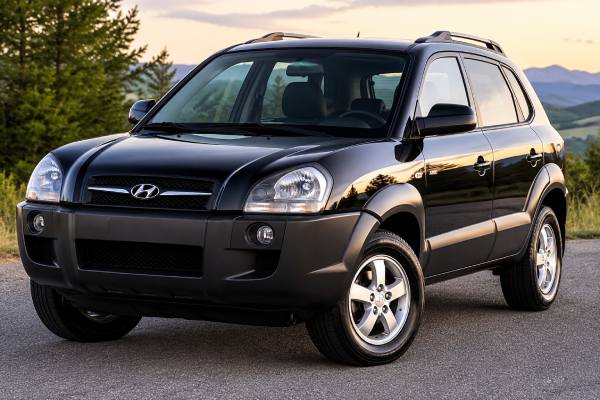
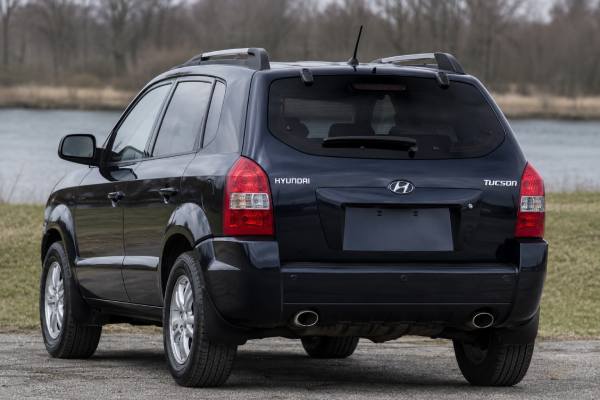
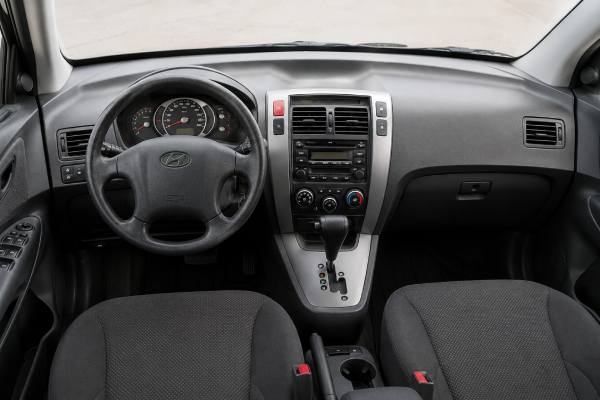
The 2006–2008 Hyundai Tucson FWD 2.0 CRDi VGT is a compact diesel SUV from the first-generation JM model line. It is not a modern crossover in refinement, infotainment, or driver-assistance technology, but it remains an honest used buy when the service history is strong. The 140 hp variable-geometry turbo diesel gives it enough torque for everyday driving, the front-wheel-drive layout keeps running costs lower than the 4WD version, and the cabin is simple, roomy, and easy to live with.
Its appeal depends heavily on condition. At this age, timing-belt proof, rust inspection, diesel fuel-system health, clutch condition, suspension wear, and recall completion matter more than mileage alone.
Final Verdict
The Hyundai Tucson JM FWD 2.0 CRDi VGT is a sensible choice for buyers who want a simple, practical diesel SUV without the extra weight and driveline cost of 4WD. Its strongest appeal is the useful 305 Nm diesel torque, spacious cabin, and generally straightforward mechanical layout. It suits commuting, family use, light towing, and rough-road driving better than fast motorway work or premium refinement. The main tradeoff is age-related maintenance: timing belt, EGR/turbo soot, clutch wear, suspension joints, and corrosion can turn a cheap Tucson into an expensive one. Buy only with documented belt service, clean cold starts, and a solid underside.
| Pros | Cons |
|---|---|
| 140 hp CRDi has strong low-rpm pulling torque | Turbo lag and diesel noise are noticeable by modern standards |
| FWD layout avoids rear differential and prop-shaft upkeep | Less slippery-road traction than the 4WD Tucson |
| Simple cabin and controls age better than complex infotainment | Safety tech is basic, with no modern ADAS |
| Good cabin height, rear-seat space, and SUV practicality | Interior plastics and road noise feel budget-grade |
| Parts availability is usually good across Europe | Rust, timing-belt neglect, and EGR faults are key risks |
Table of Contents
- Tucson JM FWD Diesel Overview
- Tucson 2.0 CRDi VGT Specifications
- Trims, Options, Safety and ADAS
- Reliability, Common Issues and Service Actions
- Maintenance and Buyer’s Guide
- Driving, Performance and Efficiency
- How the Tucson Compares to Rivals
Tucson JM FWD Diesel Overview
The Tucson JM FWD 2.0 CRDi VGT is best understood as a practical, old-school compact SUV with a useful diesel engine and modest ownership costs. It is not especially sharp, quiet, or sophisticated, but it is simple enough to inspect properly and durable enough when serviced on time.
This version uses Hyundai’s 2.0-litre D-series CRDi diesel, commonly identified as the D4EA family. The VGT label means it has a variable-geometry turbocharger, which helps the engine deliver stronger torque from low revs than the earlier lower-output CRDi. In European-market tune, the key numbers are 140 PS, 103 kW, and 305 Nm of torque.
The front-wheel-drive version is the more cost-conscious Tucson. It gives up the extra grip of 4WD, but it also avoids the rear differential, prop shaft, rear coupling, and extra driveline wear points. For owners who mainly drive on roads, light gravel, or in mild climates, FWD is often the smarter used buy.
The Tucson is also shorter and more upright than many later SUVs. That makes it easy to park and gives it a useful seating position. The rear bench is adult-friendly for the class, and the boot is practical because of the tall body shape. The tradeoff is refinement: there is more wind noise, more diesel clatter, and more body movement than in newer rivals.
The 2006–2008 period matters because this is the stronger 140 hp CRDi VGT era rather than the earlier 113 hp diesel. Many examples are now old enough that condition varies widely. A tidy, well-serviced car can still feel dependable. A neglected one can need a timing belt kit, clutch and dual-mass flywheel, turbo work, suspension parts, brake pipes, tyres, and rust repair in quick succession.
For buyers, the best Tucson is not necessarily the lowest-mileage one. It is the one with clear timing-belt records, regular oil changes, clean coolant, no warning lights, smooth boost delivery, a solid clutch, and a rust-free underside.
Tucson 2.0 CRDi VGT Specifications
The 2.0 CRDi VGT FWD combines a transverse four-cylinder diesel engine, common-rail injection, a variable-geometry turbocharger, and either a manual or market-dependent automatic transmission. The most desirable version for economy and control is usually the 6-speed manual FWD, because it suits the diesel torque and avoids the extra fuel use of the automatic.
| Item | Specification |
|---|---|
| Model generation | Hyundai Tucson JM, first generation |
| Engine | 2.0 CRDi VGT diesel, D4EA family |
| Displacement | 1,991 cc / 2.0 litres |
| Layout | Transverse inline-four, 16 valves |
| Induction | Variable-geometry turbocharger with intercooler |
| Fuel system | Common-rail direct diesel injection |
| Bore × stroke | 83.0 × 92.0 mm |
| Compression ratio | About 17.3:1 |
| Maximum power | 140 PS / 138 hp / 103 kW at 4,000 rpm |
| Maximum torque | 305 Nm / 225 lb-ft at about 1,800–2,500 rpm |
| Timing drive | Timing belt |
| Item | Specification |
|---|---|
| Drive type | Front-wheel drive |
| Manual transmission | 6-speed manual |
| Automatic transmission | 4-speed automatic in some markets |
| Front suspension | MacPherson struts with coil springs |
| Rear suspension | Multi-link with coil springs |
| Steering | Hydraulic power-assisted rack and pinion |
| Front brakes | Ventilated discs |
| Rear brakes | Solid discs |
| Common tyre size | 235/60 R16 |
| Item | Specification |
|---|---|
| Body style | 5-door compact SUV |
| Seats | 5 |
| Length | 4,325 mm / 170.3 in |
| Width | 1,795 mm / 70.7 in |
| Height | About 1,680–1,730 mm, depending on roof equipment |
| Wheelbase | 2,630 mm / 103.5 in |
| Ground clearance | About 195 mm / 7.7 in |
| Kerb weight | About 1,570 kg / 3,460 lb for FWD manual |
| Fuel tank | 58 litres / 15.3 US gal / 12.8 UK gal |
| Luggage volume | Up to about 644 litres, rear seats raised |
| Maximum cargo volume | Up to about 1,856 litres, rear seats folded |
| Item | Specification |
|---|---|
| 0–100 km/h | About 11.1 seconds with 6-speed manual |
| Top speed | About 179 km/h / 111 mph |
| Urban economy | About 8.8 L/100 km / 27 mpg US / 32 mpg UK |
| Extra-urban economy | About 5.9 L/100 km / 40 mpg US / 48 mpg UK |
| Combined economy | About 7.0 L/100 km / 34 mpg US / 40 mpg UK |
| CO₂ emissions | About 184 g/km for the FWD manual |
| Typical braked towing rating | Up to about 1,600 kg, depending on market and VIN plate |
Trims, Options, Safety and ADAS
Trim names changed by country, so equipment matters more than the badge. Across European markets, this Tucson appeared under labels such as Comfort, Style, GLS, and similar local grades, with higher trims adding comfort and safety equipment rather than major mechanical changes.
Trims and equipment identifiers
The easiest way to identify the correct version is to look for the CRDi VGT badging, the 2.0 diesel engine plate, and the front-wheel-drive layout. A true FWD Tucson will not have the 4WD lock switch, rear prop shaft, rear differential, or rear driveline hardware found on 4WD versions.
Common equipment on better-equipped 2006–2008 diesel models may include:
- 16-inch alloy wheels with 235/60 R16 tyres
- roof rails
- front fog lamps
- climate control or upgraded air conditioning
- leather or part-leather upholstery on higher grades
- heated front seats in colder markets
- upgraded CD audio
- sunroof on some cars
- rear parking sensors on some trims or dealer-fit packages
Mechanically, the main used-buy distinction is FWD manual versus FWD automatic. The 6-speed manual is usually better for economy and engine braking. The 4-speed automatic is easier in traffic, but it feels older, raises fuel use, and needs clean fluid to shift well.
Safety ratings
The Tucson JM was respectable for its time but should not be judged like a modern SUV. The European diesel left-hand-drive model was tested in the older Euro NCAP era, and ANCAP’s published report for the related rating lists an overall score of 29.24 out of 37, with good side-impact scoring but weak pedestrian protection.
IIHS ratings for the structurally related North American Tucson also show the age of the design. It received acceptable results in the original moderate-overlap front and side tests, but roof strength and head restraint ratings were poor. That does not make it unsafe by 2006 standards, but it does mean a modern Tucson, RAV4, CR-V, or Tiguan has a major safety advantage.
Safety equipment and driver assistance
Most JM Tucsons have the basics: front airbags, ABS, electronic brake-force distribution, three-point rear belts, and ISOFIX/LATCH-style child-seat anchor provisions depending on market. Side airbags and curtain airbags were standard in some markets and trims but not universal everywhere.
Electronic stability control is another market-sensitive item. North American models were notable for standard stability control, while some European-market cars varied by trim and year. Check the dashboard warning-lamp sweep and the equipment list for the individual car.
Modern ADAS is effectively absent. Do not expect automatic emergency braking, adaptive cruise control, lane keeping, blind-spot monitoring, traffic-sign recognition, or reversing camera integration from the factory. Any parking sensors, Bluetooth units, cameras, or navigation systems on used cars may be aftermarket or dealer-installed, so they should be tested rather than assumed.
Reliability, Common Issues and Service Actions
The Tucson 2.0 CRDi VGT can be reliable, but only if the diesel maintenance has been kept up. The biggest ownership risks are timing-belt neglect, soot-related intake and EGR problems, turbo-control faults, clutch and dual-mass flywheel wear, suspension wear, and corrosion.
| Issue | Prevalence | Severity | Typical signs | Best remedy |
|---|---|---|---|---|
| Timing belt overdue | Common on poorly documented cars | High | No proof, belt noise, age over interval | Replace belt kit, tensioners, idlers, water pump |
| EGR and intake soot | Common on short-trip diesels | Medium | Hesitation, smoke, limp mode, rough idle | Clean or replace EGR, inspect intake and sensors |
| Turbo VGT sticking | Occasional | Medium to high | Overboost, underboost, limp mode, poor pull | Check vacuum control, actuator, boost leaks, turbo |
| Dual-mass flywheel wear | Occasional at high mileage | High | Rattle at idle, vibration, clutch judder | Replace clutch and flywheel together if worn |
| Suspension bushes and links | Common with age | Low to medium | Knocks, wandering, uneven tyre wear | Replace worn links, bushes, ball joints, align |
| Brake pipe and underside corrosion | Common in salted climates | Medium to high | Rusty lines, weak MOT/inspection history | Repair lines, treat rust, inspect subframes |
Diesel engine and fuel-system concerns
The D4EA diesel is not a fragile engine, but it dislikes neglected oil changes, poor diesel fuel, clogged filters, and repeated short trips. A healthy one starts cleanly from cold, settles into a steady idle, pulls smoothly from about 1,800 rpm, and does not leave heavy smoke under normal acceleration.
Black smoke can point to EGR clogging, boost leaks, dirty intake plumbing, a tired mass-airflow sensor, injector issues, or a turbo-control problem. White smoke on cold start can be glow plugs, injector leak-back, low compression, or poor fuel. Blue smoke suggests oil burning through turbo seals or engine wear.
Fuel filters deserve special attention. Water or dirt in the diesel system can shorten injector and high-pressure pump life. On a pre-purchase inspection, ask whether the fuel filter has been changed regularly and check for hard starting, uneven idle, diesel knock, and stored fuel-pressure codes.
Turbo, EGR and emissions hardware
The variable-geometry turbocharger is the key difference between this 140 hp version and the weaker early diesel. It gives better torque, but soot and actuator problems can cause boost control faults. Before blaming the turbo itself, a good mechanic should check vacuum hoses, boost pipes, intercooler connections, solenoids, MAP/MAF sensor readings, and exhaust restrictions.
Some markets had diesel particulate filters; others did not. If the car has a DPF, short trips and poor regeneration history make it more vulnerable to blockage. If the car does not have a DPF, smoke testing and local emissions rules still matter, especially in low-emission-zone areas.
Transmission, clutch and chassis wear
The 6-speed manual should shift cleanly without crunching, whine, or clutch slip. A high biting point, shudder when pulling away, or rattling at idle can point toward clutch and dual-mass flywheel wear. This is one of the more expensive jobs on a cheap Tucson, so do not ignore it during a test drive.
The automatic is simple compared with modern gearboxes, but old fluid can cause harsh engagement, delayed shifts, and flare between gears. Any automatic Tucson should be driven cold and hot. If the fluid smells burnt or the gearbox bangs into Drive or Reverse, budget for diagnosis or walk away.
Suspension wear is normal by this age. Listen for anti-roll-bar link knocks, front lower-arm bush movement, ball-joint play, rear bush noise, and wheel-bearing hum. These are usually manageable repairs, but a long list of worn parts can quickly exceed the value of a rough car.
Recalls and service actions
For 2005–2007 Tucson models, a driver airbag module recall was issued in some markets after testing showed the margin of compliance for small-stature, unbelted driver airbag deployment could be improved. The remedy was replacement of the driver airbag module.
Another important Hyundai campaign covered stop lamp switch replacement. A faulty stop lamp switch can affect brake lights and related functions, including systems that depend on brake-pedal status. Any used Tucson should have its recall status checked by VIN, not just by model year, because campaign scope can vary by country and production date.
Ask for dealer records, recall printouts, or a current Hyundai VIN check. A dashboard with no warning lights is not enough proof that campaigns were completed.
Maintenance and Buyer’s Guide
Preventive maintenance is the difference between a good Tucson diesel and a money pit. The service priorities are oil quality, timing-belt proof, clean fuel filtration, cooling-system health, brake fluid, suspension inspection, and corrosion control.
| Item | Suggested interval | Practical note |
|---|---|---|
| Engine oil and filter | 15,000 km / 12 months | Use shorter 10,000 km intervals for old or city-driven diesels |
| Engine air filter | 15,000–30,000 km | Replace sooner in dusty use |
| Cabin filter | 15,000–30,000 km | Cheap fix for weak airflow and odours |
| Fuel filter | About 30,000 km | Critical for injector and pump protection |
| Timing belt system | 90,000–120,000 km or age limit by market | Replace immediately if proof is missing |
| Coolant | About 90,000 km / 5 years | Inspect radiator, hoses, heater output, water pump |
| Brake fluid | Every 2 years | Old fluid increases corrosion and reduces braking consistency |
| Manual gearbox oil | 90,000–120,000 km | Change if shifting is stiff or history is unknown |
| Automatic transmission fluid | 60,000–90,000 km in old used examples | Use the correct Hyundai specification |
| Auxiliary belts and hoses | Inspect every service | Replace cracked belts, swollen hoses, weak tensioners |
| Tyre rotation and alignment | 10,000–15,000 km | Essential if suspension bushes have been replaced |
| 12 V battery | Test annually after 4 years | Weak batteries can trigger misleading warning lights |
| Item | Reference value |
|---|---|
| Engine oil service fill | About 5.9 litres |
| Engine oil total capacity | About 6.5 litres |
| Common oil viscosity | 5W-30 or 5W-40 diesel-rated oil |
| Coolant capacity | About 8.7 litres |
| Manual transaxle oil | About 2.1 litres |
| Fuel tank | 58 litres |
| Wheel-nut torque | About 90–110 Nm; verify by service manual |
The timing belt deserves its own rule: if there is no invoice, no date, no mileage, and no parts list, treat it as not done. A complete job should include the belt, tensioner, idlers, and usually the water pump. On an interference diesel engine, belt failure can mean major engine damage.
The engine does not normally need routine valve-clearance adjustment in the way some older mechanical engines do. If there is valvetrain noise, misfire, poor compression, or timing-correlation fault codes, diagnose the cause rather than adjusting by habit.
Pre-purchase inspection checklist
Before buying, inspect the Tucson cold, not after the seller has warmed it up. A good check should cover:
- cold start quality, glow-plug light behaviour, idle smoothness, and smoke
- boost delivery from 1,800–3,500 rpm
- EGR, turbo, fuel-pressure, and air-metering fault codes
- timing-belt invoice with mileage and date
- coolant colour, oil leaks, radiator condition, and heater output
- clutch biting point, flywheel rattle, gearshift feel, and gearbox noise
- brake pipe corrosion, caliper condition, handbrake operation, and ABS warning light
- front and rear suspension knocks, tyre wear, and wheel-bearing hum
- sills, subframes, wheel arches, rear suspension mounts, brake lines, and fuel tank straps
- all windows, central locking, air conditioning, lights, wipers, and dashboard warning lamps
- recall completion through Hyundai or an official VIN checker
The best trim is usually the cleanest, best-documented one rather than the most heavily optioned. Higher trims can be nicer, but sunroofs, leather, and electrical extras are not worth much if the underside is rusty or the diesel system is unhealthy.
For long-term durability, a well-kept FWD CRDi can still be useful and inexpensive. The weak point is that many examples are now cheap cars, and cheap cars often receive delayed maintenance. Budget for catch-up work even when the test drive feels acceptable.
Driving, Performance and Efficiency
The Tucson 2.0 CRDi VGT FWD feels stronger than its 140 hp figure suggests at everyday speeds. The reason is torque: 305 Nm gives it relaxed pull in the mid-range, especially with the 6-speed manual.
Powertrain character
Below about 1,500 rpm, the engine can feel flat. From around 1,800 rpm, the turbo wakes up and the Tucson pulls with useful confidence. It is happiest between 1,800 and 3,200 rpm, where it can overtake, climb hills, and carry passengers without needing constant gear changes.
The manual gearbox suits this engine. It lets the driver keep the diesel in its torque band and makes motorway cruising more relaxed than a 5-speed would. The automatic is smoother in town but feels older on faster roads, where the wide ratios can make the engine work harder.
Noise is part of the package. Cold diesel clatter, vibration at idle, and a coarse note under load are normal to a point. Excessive knocking, heavy smoke, siren-like turbo noise, or a sudden lack of boost is not normal.
Ride, handling and braking
The Tucson rides with a soft, practical character. It handles broken roads, speed bumps, and rough surfaces well for its age, and the tall tyres help absorb impacts. On the motorway it feels stable enough, but it is not especially quiet.
Cornering is safe rather than sharp. There is body roll, the steering is light, and the front tyres will push wide if driven hard. The FWD version is predictable in normal use, but it does not have the extra wet-grass, snow, or muddy-lane traction of the 4WD model.
Braking feel is generally straightforward when the discs, pads, fluid, tyres, and suspension are in good condition. On old cars, braking performance often depends more on maintenance than factory specification. Rusty rear discs, old brake fluid, sticking calipers, and budget tyres can make a Tucson feel much worse than it should.
Real-world fuel economy
Official combined economy is about 7.0 L/100 km, equal to roughly 34 mpg US or 40 mpg UK. In real use, expect the FWD manual to land in these broad ranges:
| Driving type | Typical use | Approximate economy |
|---|---|---|
| City driving | Short trips, traffic, cold starts | 8.5–10.0 L/100 km / 24–28 mpg US / 28–33 mpg UK |
| Highway driving | 100–120 km/h steady cruising | 6.2–7.2 L/100 km / 33–38 mpg US / 39–46 mpg UK |
| Mixed driving | Suburban, rural, and motorway use | 7.2–8.4 L/100 km / 28–33 mpg US / 34–39 mpg UK |
Cold weather, roof bars, underinflated tyres, old injectors, dragging brakes, and a clogged EGR system can all raise consumption. A healthy Tucson should not feel breathless and should not need constant heavy throttle to keep pace with traffic.
Load and towing
The diesel torque makes the Tucson better suited to load carrying than the 2.0 petrol. It can tow light trailers, small caravans, or utility loads when the local VIN plate and regulations allow it. The FWD layout is fine on dry roads but less ideal on wet ramps, grass, snow, or loose surfaces.
When towing, watch coolant temperature, clutch smell, brake condition, and tyre load rating. A Tucson with an old clutch, weak cooling system, or rusty brake pipes is not a good towing candidate, even if the headline tow rating looks acceptable.
How the Tucson Compares to Rivals
The Tucson’s main advantage over many rivals is value. It is usually cheaper than a similar-age Toyota RAV4 or Honda CR-V, simpler than a newer Volkswagen Tiguan, and closely related to the Kia Sportage, which means shared parts and similar mechanical behaviour.
| Rival | How it compares | Best choice for |
|---|---|---|
| Kia Sportage 2.0 CRDi | Very similar platform, engines, space, and faults | Buy whichever has better condition and history |
| Toyota RAV4 D-4D | More polished and stronger resale, often pricier | Buyers prioritising reputation and refinement |
| Honda CR-V | Excellent cabin practicality, but diesel availability varies by market | Family use and long-term quality feel |
| Nissan X-Trail dCi | Roomier and more rugged, but diesel issues can be costly | Outdoor use and larger cargo needs |
| Land Rover Freelander 2 TD4 | More capable and premium, with higher repair costs | Rural users needing real all-weather traction |
| Volkswagen Tiguan 2.0 TDI | More modern and refined, but more complex | Drivers wanting sharper road manners |
Against the Kia Sportage, the Tucson is mostly a matter of styling, price, and service history. They share enough engineering that one is not automatically better than the other. A clean Sportage can be a better buy than a tired Tucson, and the reverse is equally true.
Against the RAV4, the Tucson usually wins on purchase price and loses on perceived quality and resale strength. The Toyota often feels tighter and more refined, but buyers pay for that. The Tucson is a good alternative when the budget is lower and the inspection checks out.
Against the CR-V, the Tucson feels more utilitarian. The Honda is usually better finished inside and more car-like on the road. The Hyundai counters with diesel torque and often lower used prices.
Against the X-Trail and Freelander, the Tucson FWD is less capable off road. That matters if you regularly use muddy tracks, fields, boat ramps, or snow-covered roads. For normal road driving, however, FWD is simpler and cheaper to keep alive.
The final choice should be based on condition, not badge loyalty. A well-serviced Tucson 2.0 CRDi VGT FWD with a fresh timing belt, clean underside, smooth clutch, and no diesel warning signs is still a useful compact SUV. A neglected one is worth avoiding, even at a tempting price.
References
- Hyundai Owners manuals | Hyundai Motor UK 2026 (Owner’s Manual)
- Hyundai Tucson 2.0 CRDi VGT 2WD Specs, Performance, Comparisons 2026 (Technical Data)
- Hyundai Tucson | Safety Rating & Report | ANCAP 2006 (Safety Rating)
- 2006 Hyundai Tucson 2006 (Safety Rating)
- Check for Recalls 2026 (Recall Database)
Disclaimer
This article is for informational purposes only and is not a substitute for professional diagnosis, repair, or inspection. Specifications, torque values, service intervals, fluids, equipment, towing limits, emissions hardware, and repair procedures can vary by VIN, market, production date, and trim. Always verify details against the official owner’s manual, service documentation, VIN plate, and qualified repair information for the exact vehicle.
If this guide helped you, please consider sharing it on Facebook, X/Twitter, or your preferred automotive community to support our work.