
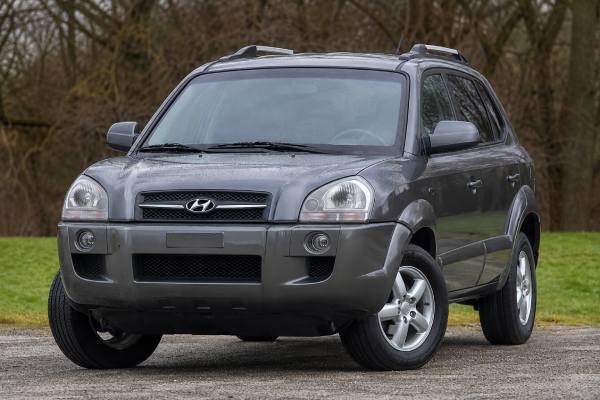
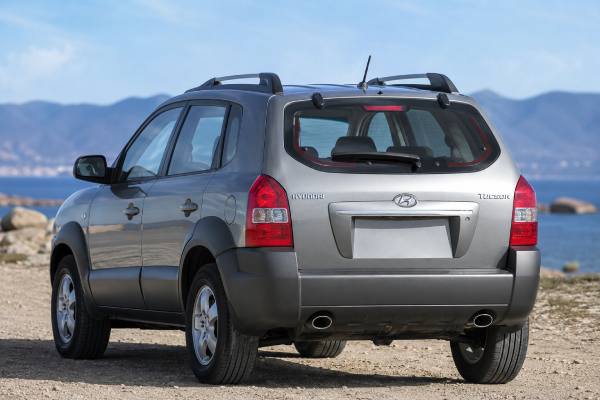
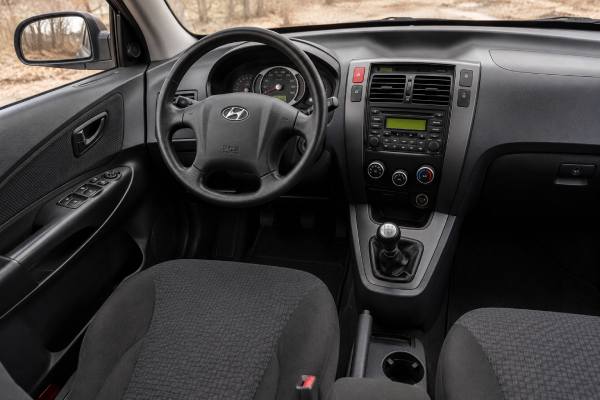
The 2008–2009 Hyundai Tucson FWD with the 2.0 CRDi VGT diesel sits at the end of the first-generation JM model’s life. It is a compact, simple, upright SUV rather than a modern tech-heavy crossover, and that is a big part of its appeal. The 2.0-litre D4EA diesel gives useful low-rpm torque, the front-wheel-drive layout keeps weight and maintenance down, and parts availability remains good because the Tucson shares much with the Kia Sportage of the same era.
The main thing to understand is that this is now an older diesel SUV. A clean, well-serviced example can still make sense as a practical family car, rural runabout, or budget tow-capable crossover. A neglected one can quickly become expensive because timing belt work, diesel fuel-system faults, corrosion, clutch wear, and turbo/EGR issues are common age-related inspection points.
Final Verdict
The Hyundai Tucson FWD (JM) 2.0 CRDi VGT 150 hp is a sensible used buy for someone who wants a tough, simple diesel SUV with good torque, easy parts supply, and lower running complexity than an AWD model. It suits mixed road use, longer commutes, light towing, and owners who value practicality over refinement. Its main tradeoff is age: rust, timing belt neglect, diesel intake soot, and worn suspension can matter more than mileage alone. Buy only with proof of timing belt service, clean cold starting, no limp-mode faults, and a solid underside.
| Pros | Cons |
|---|---|
| Strong diesel torque makes daily driving easy | Turbo, EGR, and intake soot need careful checks |
| FWD layout avoids rear-differential and propshaft costs | Less traction on snow, mud, and wet grass |
| Simple cabin and controls age better than complex systems | Interior refinement feels dated by modern SUV standards |
| Good parts supply through Tucson and Sportage overlap | Corrosion can make cheap examples poor value |
| Comfortable upright seating and useful cargo space | Safety tech is mostly passive, with no modern ADAS |
Table of Contents
- Late JM Tucson Diesel Overview
- Tucson 2.0 CRDi 150 Specifications
- Trims, Options, and Safety Equipment
- Reliability, Issues, and Service Actions
- Maintenance Schedule and Buying Checklist
- Driving, Performance, and Real-World Economy
- How the Tucson Compares to Rivals
Late JM Tucson Diesel Overview
The JM Tucson is a compact SUV built on a straightforward front-engine platform shared closely with the second-generation Kia Sportage. In FWD 2.0 CRDi VGT form, it is best understood as a practical road-biased crossover with a diesel engine, not a serious off-road vehicle.
The 150 hp version belongs to the later D4EA diesel family listings and is often associated with 2009-era European parts catalogues. Some markets and listings mix 140 hp and 150 hp descriptions for late VGT models, so a buyer should confirm the exact output from the registration document, VIN data, engine code, and local type-approval record.
What makes this version appealing is balance. The 2.0 CRDi is not especially quiet or silky, but it has useful mid-range pull. The FWD setup avoids the extra weight, rear differential, transfer components, and viscous-coupling concerns of AWD models. For owners who drive mainly on paved roads, that is a real advantage.
The Tucson’s shape is also part of the charm. It is short, tall, easy to park, and easy to see out of. The rear seat is adult-usable, the tailgate opening is practical, and the cabin does not rely on complicated screens or electronic controls. Compared with newer crossovers, it feels old-fashioned. Compared with many newer diesels, it is easier to understand, easier to inspect, and usually cheaper to keep on the road when bought well.
The biggest buying risk is not the basic design. It is condition. These vehicles are now old enough for underside rust, perished hoses, tired suspension, worn engine mounts, aging injectors, and incomplete service history to decide the ownership experience. A good Tucson can be a dependable workhorse. A cheap one with no belt history and visible corrosion is usually a false economy.
Tucson 2.0 CRDi 150 Specifications
This Tucson uses Hyundai-Kia’s 2.0-litre D4EA common-rail diesel in variable-geometry turbo form. The exact published output varies by market records, but the late 110 kW / 150 hp D4EA listing is the focus here. The most important technical points are the timing belt, common-rail injection, front-wheel drive, and the age-sensitive diesel emissions and intake hardware.
| Item | Hyundai Tucson FWD (JM) 2.0 CRDi VGT |
|---|---|
| Engine family | D4EA 2.0 CRDi diesel |
| Displacement | 1,991 cc / 2.0 L |
| Layout | Inline-four, transverse-mounted |
| Valvetrain | 16-valve diesel cylinder head |
| Fuel system | Common-rail direct injection |
| Induction | Variable-geometry turbocharger with intercooler |
| Power | 150 hp / 110 kW at about 4,000 rpm |
| Torque | About 305 Nm / 225 lb-ft in the low-to-mid rpm range |
| Bore × stroke | 83.0 × 92.0 mm |
| Compression ratio | About 17.3:1 |
| Timing drive | Timing belt |
| Item | Specification |
|---|---|
| Drive type | Front-wheel drive |
| Common gearbox | 6-speed manual on many VGT diesel FWD listings |
| Front suspension | MacPherson struts, coil springs, anti-roll bar |
| Rear suspension | Multi-link arrangement with coil springs |
| Front brakes | Vented discs |
| Rear brakes | Solid discs |
| Common tyre size | 235/60 R16 |
| Wheel-nut torque | About 88–108 Nm / 65–80 lb-ft |
| Item | Value |
|---|---|
| Body style | 5-door compact SUV |
| Seats | 5 |
| Length | About 4,325 mm / 170.3 in |
| Width | About 1,795 mm / 70.7 in |
| Height | About 1,720 mm / 67.7 in |
| Wheelbase | 2,630 mm / 103.5 in |
| Turning circle | About 10.8 m / 35.4 ft |
| Fuel tank | 58 L / 15.3 US gal |
| Braked towing rating | Up to about 1,400 kg where market-rated |
| Item | Typical published figure |
|---|---|
| 0–100 km/h | About 10.5–11.5 seconds for manual FWD VGT versions |
| Top speed | About 178–180 km/h / 111–112 mph |
| Combined economy | About 7.0 L/100 km / 34 mpg US / 40 mpg UK |
| CO₂ emissions | Commonly listed around 184–210 g/km depending version |
| Emissions class | Usually Euro 4-era diesel specification |
| Service item | Useful reference |
|---|---|
| Engine oil grade | 5W-30 or 5W-40 diesel-suitable oil, market dependent |
| Engine oil capacity | About 6.5 L with filter |
| Brake fluid | DOT 3 or DOT 4, according to service documentation |
| Manual gearbox oil | 75W-85 gear oil specification, confirm by gearbox code |
| Automatic transmission fluid | Hyundai/Kia SP-III type on 4-speed automatic versions |
| Timing belt interval | Commonly treated as 90,000–120,000 km or time-based |
Trims, Options, and Safety Equipment
Trim names changed by country, so the badge on the tailgate is less important than the equipment actually fitted. For this generation, mechanical differences are modest, while airbags, stability control, wheels, interior trim, and comfort features can vary meaningfully.
In many European markets, Tucson JM grades used names such as GLS, Comfort, Style, Executive, or country-specific equivalents. A higher trim may add alloy wheels, automatic climate control, leather or part-leather upholstery, heated seats, a sunroof, roof rails, upgraded audio, fog lamps, and extra airbags. The diesel FWD drivetrain itself is usually not transformed by trim level.
Quick identifiers are simple. A CRDi VGT badge suggests the variable-geometry turbo diesel. A six-speed gear lever confirms the common manual pairing. FWD cars do not have the rear differential, propshaft, and related rear driveline parts of AWD models. A vehicle data sticker, VIN lookup, registration record, and engine-plate information are the best way to confirm whether the car is the 110 kW / 150 hp version rather than a 103 kW / 140 hp listing.
Safety is respectable for its age but clearly dated now. The first-generation Tucson was tested under older crash-test protocols and achieved four-star adult occupant protection in the 2006 Euro NCAP-era assessment, with three-star child occupant protection and weak pedestrian protection by modern standards. Those results should not be compared directly with current five-star ratings because the tests, scoring, and safety expectations changed substantially.
Airbag equipment can vary. Dual front airbags and ABS/EBD were widely available, while front side airbags and head-protecting curtain airbags were often fitted to higher trims or specific markets. Some base versions did not have the same protection package as better-equipped models. For a family car, look for the full airbag set, proper three-point rear belts, working seat-belt pretensioners, and ISOFIX/LATCH child-seat anchor points where fitted.
Do not expect modern driver assistance. There is no factory AEB, adaptive cruise control, lane keeping, blind-spot intervention, or camera-based lane support in the modern sense. Stability control may be fitted depending on market and trim, and it is worth seeking because it improves emergency control on wet roads. After accident repair or steering/suspension work, make sure the ABS and stability-control warning lamps illuminate at key-on and go out after startup.
Reliability, Issues, and Service Actions
The 2.0 CRDi Tucson can be durable, but most problems now come from age, short-trip diesel use, missed belt work, and rust rather than a single catastrophic design flaw. The best examples are usually boring: they start cleanly, pull smoothly, have matching tyres, no warning lights, and a folder of invoices.
Common medium-to-high-cost issues include timing belt neglect, turbo control faults, injector problems, clutch and dual-mass flywheel wear, and corrosion. Occasional issues include sensors, alternator pulley noise, window regulators, air-conditioning leaks, and central-locking faults. Rare but serious problems include severe fuel-system contamination, runaway corrosion around structural points, and overheated engines from ignored coolant leaks.
The timing belt is the first service question. The D4EA uses a belt, not a chain. If the seller cannot prove when the belt, tensioners, idlers, and usually the water pump were replaced, budget for the job immediately. A failed belt can cause major internal engine damage. On an older diesel, time matters as much as mileage because rubber, tensioner bearings, and seals age even when annual mileage is low.
The EGR system and intake tract suffer when the car does repeated short trips, idles often, or rarely reaches full temperature. Symptoms include rough running, smoke, reduced power, poor fuel economy, and limp mode. The likely cause is carbon build-up around the EGR valve, intake manifold, boost pipes, or MAP sensor. Cleaning may help, but heavily worn valves, split hoses, and failed sensors need replacement.
Turbo problems are usually linked to soot, vacuum control faults, boost leaks, or actuator wear rather than the turbocharger alone. Whistling, black smoke, overboost codes, underboost codes, and sudden limp mode are warning signs. A proper diagnosis should check vacuum lines, the actuator, intercooler hoses, boost-control solenoids, intake leaks, and exhaust restriction before condemning the turbo.
Fuel-system health matters. A diesel that cranks for a long time, smells of fuel, misfires cold, smokes heavily, or has uneven idle may have injector leak-back, poor glow-plug performance, fuel-filter restriction, air ingress, or low rail pressure. Fresh fuel filters are cheap compared with injectors and pumps. Water-contaminated diesel is especially damaging, so service history and fuel-filter changes are not small details.
Manual cars should be checked for clutch slip, pedal heaviness, vibration at idle, and rattling from the gearbox area. These signs can point to clutch and dual-mass flywheel wear, especially on cars used for towing or urban driving. Automatics, where fitted on related VGT models, need clean fluid and smooth engagement. Shift flare, harsh selection, or delayed drive can mean neglected ATF, solenoid issues, or internal wear.
The chassis is generally simple but not immune to old-SUV problems. Expect worn anti-roll-bar links, lower-arm bushes, ball joints, rear suspension bushes, tired dampers, and wheel bearings. Knocks over small bumps are common. Uneven tyre wear points to alignment problems, bent suspension parts, or old bushings that can no longer hold geometry.
Corrosion is one of the most important checks. Inspect the rear subframe area, suspension mounting points, brake pipes, sills, wheel arches, tailgate edges, fuel tank straps, front subframe, and underbody seams. Surface rust is normal on an older vehicle. Flaky structural rust, patched sills, heavily corroded brake lines, or seized suspension bolts can turn a cheap Tucson into an uneconomic repair.
A known service action to verify is the stop-lamp switch recall affecting various Hyundai models, including Tucson JM in some markets. A faulty switch can cause brake lights not to work correctly, cruise-control cancellation problems, shift-interlock problems on automatic cars, or stability-control warning lights. Completion should be checked by VIN through the official local Hyundai recall system or a dealer record.
Before buying, request proof of:
- Timing belt kit and water pump replacement
- Regular engine oil and filter changes
- Fuel-filter replacement
- Brake fluid changes
- Coolant renewal
- Gearbox oil or automatic fluid service
- Recall and campaign completion
- Recent underside inspection
- Clean diagnostic scan with no hidden diesel or ABS faults
Maintenance Schedule and Buying Checklist
The safest maintenance plan for this Tucson is more conservative than the bare minimum. It is an older diesel with a belt-driven engine, so regular fluids, clean filters, and early investigation of warning signs are cheaper than waiting for hard failures.
For normal mixed use, use the following practical schedule as a planning guide, then verify it against the official service booklet for the exact VIN and market.
| Interval | Service work |
|---|---|
| Every 10,000–15,000 km or yearly | Engine oil and filter; inspect leaks, belts, hoses, brakes, tyres |
| Every 15,000–30,000 km | Engine air filter; cabin filter; check intake and boost hoses |
| Every 30,000 km | Fuel filter; brake inspection; suspension and steering check |
| Every 2 years | Brake fluid; air-conditioning drain and condenser inspection |
| Every 60,000–90,000 km | Manual gearbox oil; accessory belts; coolant condition check |
| Every 90,000–120,000 km or time-based | Timing belt kit, tensioners, idlers, and usually water pump |
| Every 4–5 years | Coolant renewal; inspect radiator, thermostat, hoses, expansion tank |
| Every 4–6 years | 12 V battery test or replacement depending condition |
The engine oil choice should match climate, emissions equipment, and the vehicle’s service documentation. A good-quality 5W-30 or 5W-40 diesel-rated oil is commonly used. The capacity is around 6.5 litres with filter, so check the dipstick after filling rather than relying only on a fixed number. Avoid extended oil intervals on cars used for short trips because soot loading and fuel dilution are harder on older diesels.
The timing belt service should not be treated as just a belt. A proper job includes the belt, tensioner, idlers, and close inspection of the water pump, cam/crank seals, auxiliary belt system, and coolant leaks. Many owners replace the water pump at the same time because the labour overlap is significant.
Brake maintenance matters because older Tucsons can sit outdoors, tow, or do winter road use. Inspect rear calipers for sticking, discs for corrosion, brake hoses for cracking, and brake pipes for rust. A soft pedal, uneven braking, or hot wheel after a drive needs attention before more miles are added.
Tyres affect this car more than many buyers expect. The Tucson is tall and relatively softly suspended, so old budget tyres make it feel vague and noisy. Rotate tyres periodically, keep pressures correct, and align the car after suspension work. Matching tyres are especially important on AWD versions, but they still matter on FWD for stability and braking.
A strong buyer’s inspection should include a cold start. The engine should start without excessive cranking, settle cleanly, and avoid heavy white or blue smoke. A short puff on a cold diesel is not unusual, but persistent smoke is not normal. On the road, boost should build smoothly without flat spots or limp mode.
Use this checklist before agreeing a price:
- Look underneath before admiring the paint.
- Confirm the timing belt date and mileage.
- Scan the ECU, ABS, and airbag modules.
- Test every window, lock, heater control, and dashboard light.
- Check the clutch bite point and flywheel noise.
- Drive at motorway speed and listen for wheel-bearing hum.
- Brake firmly and check for vibration or pulling.
- Look for damp carpets, tailgate leaks, and musty cabin smells.
- Inspect the rear arches, sills, subframes, and brake pipes.
- Confirm the exact engine output and emissions equipment from VIN data.
The best trim to seek is not automatically the highest one. A well-kept mid-trim FWD diesel with stability control, full airbags, working air conditioning, and clear service history is usually better than a tired top-trim car with leather, a sunroof, and rust underneath. Avoid cars with missing belt proof, warning lights, heavy smoke, poor cold starting, or fresh underseal hiding corrosion.
Long-term durability is good when the basics are done. The D4EA can cover high mileage with clean oil, fresh filters, proper belt service, and healthy cooling. The body and chassis are more likely to decide the car’s remaining life than the engine block itself.
Driving, Performance, and Real-World Economy
The Tucson 2.0 CRDi VGT feels stronger than its modest horsepower suggests because the torque arrives low in the rev range. It is not sporty, but it is easy to drive, relaxed in town, and capable enough on the motorway when the turbo system is healthy.
Throttle response is slightly old-school diesel. There can be a moment of turbo lag at low rpm, followed by a useful shove in the mid-range. The engine prefers being driven on torque rather than revved hard. Above about 3,500 rpm, noise increases and progress does not improve much. A clean car should pull steadily without surging, hesitation, or sudden loss of boost.
The six-speed manual suits the engine well because it gives a low enough first gear for hill starts and relaxed cruising in top gear. Shift quality is not especially slick, but it should not crunch, baulk, or jump out of gear. A vague shift can come from worn linkage parts or old gearbox oil; a heavy clutch points toward clutch hydraulics or clutch assembly wear.
Ride comfort is one of the Tucson’s strengths. It has a tall tyre sidewall and soft suspension tuning, so it handles rough roads, potholes, and rural surfaces better than many low-profile modern crossovers. The tradeoff is body roll. It leans in corners and does not enjoy sudden direction changes. Steering is light and easy rather than detailed.
At highway speed, straight-line stability is acceptable when the suspension and tyres are fresh. Wind noise and diesel noise are more noticeable than in newer SUVs. Road noise depends heavily on tyre quality. A humming rear or front corner is often a wheel bearing rather than normal tyre noise, so do not dismiss it during a test drive.
Braking is adequate for the vehicle’s age and performance. The pedal should feel firm, and the vehicle should stop straight. Vibration through the pedal or steering wheel usually points to warped or corroded discs, seized slider pins, or worn suspension joints. Rear brake condition deserves extra attention because older SUVs often accumulate corrosion at the back.
Real-world economy depends heavily on use. On steady roads at 100–120 km/h, a healthy FWD manual diesel can often return about 6.5–7.5 L/100 km, equal to roughly 31–36 mpg US or 38–43 mpg UK. Mixed use is usually closer to 7.2–8.5 L/100 km, or about 28–33 mpg US and 33–39 mpg UK. Heavy city use, winter temperatures, short trips, roof bars, worn tyres, or towing can push consumption toward 9–10 L/100 km.
Towing is possible where the vehicle is rated for it, but this is not a heavy tow vehicle. The diesel torque helps, and the FWD layout is lighter than AWD, but traction on wet ramps, grass, or loose gravel is limited. For regular towing, inspect the clutch, cooling system, rear suspension, brakes, tyres, and towbar wiring carefully. Expect a large fuel-economy penalty with a box trailer, caravan, or heavy load.
The FWD Tucson is at its best as a practical road car. It is comfortable enough for longer trips, high enough for easy entry, simple enough for budget maintenance, and torquey enough not to feel strained. It is least convincing when treated like a modern performance SUV or a proper off-roader.
How the Tucson Compares to Rivals
The Tucson’s strongest rival is the Kia Sportage of the same era because the two share major engineering. Compared with the Sportage, the Tucson often feels very similar mechanically, so condition, equipment, and price matter more than badge preference. Parts overlap is helpful for both.
Against the Toyota RAV4 diesel, the Hyundai usually wins on purchase price and simplicity of cabin controls. The RAV4 generally feels more polished on road and has a stronger brand reputation, but diesel RAV4 repairs can be expensive, especially if injectors, emissions equipment, clutch parts, or engine issues appear. A clean RAV4 may be nicer; a neglected one is not automatically safer money.
The Honda CR-V 2.2 i-CTDi is more refined, roomier in some areas, and better to drive on long trips. It also tends to hold value better. The Hyundai counters with lower prices and a more basic feel that some owners prefer. The Honda’s clutch, dual-mass flywheel, air-conditioning, and diesel fuel-system repairs can still be costly, so the CR-V is not risk-free.
The Nissan X-Trail 2.2 dCi is boxier and more outdoorsy. It offers a more utilitarian cabin and, in many versions, better bad-road usefulness. The downside is age-related rust, diesel faults, and sometimes rougher refinement. Buyers who want maximum practicality may like the X-Trail; buyers who want simpler road use may prefer the FWD Tucson.
The Suzuki Grand Vitara diesel has more genuine SUV character, especially in 4×4 form. It is tougher-feeling and better suited to rough tracks, but it is less refined, often thirstier, and can have its own diesel and corrosion concerns. For paved-road use, the Tucson FWD is easier and usually cheaper.
The Tucson’s best argument is value. It is not the sharpest, safest by modern standards, or most refined. But a rust-free, well-maintained 2.0 CRDi FWD can still be a useful older diesel SUV with strong parts support and manageable mechanical complexity. In this age group, buy the best condition and history, not the cheapest advert.
References
- Hyundai Owners Manuals | Hyundai Motor UK 2026 (Owner’s Manuals)
- Hyundai Tucson | Safety Rating & Report | ANCAP 2006 (Safety Rating)
- Hyundai Tucson 2004 2.0 CRDi VGT 2WD (2005 – 2009) reviews, technical data, prices 2026 (Technical Data)
- Hyundai Tucson 2.0 CRDi VGT 2WD Specs, Performance, Comparisons 2026 (Technical Data)
- KMA Draft ver 2017 (Recall / TSB)
Disclaimer
This article is for informational purposes only and is not a substitute for professional diagnosis, repair, or vehicle inspection. Specifications, torque values, service intervals, fluid requirements, emissions equipment, recall eligibility, and repair procedures can vary by VIN, market, transmission, trim, and production date. Always verify details against the official service documentation for the exact vehicle and consult a qualified technician before repair work.
If you found this guide useful, please consider sharing it on Facebook, X/Twitter, or another platform to support our work.