
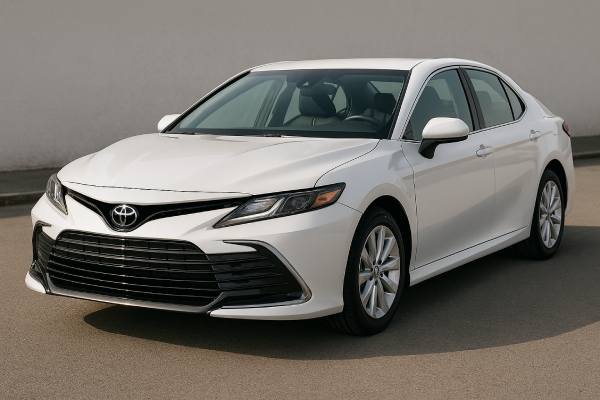
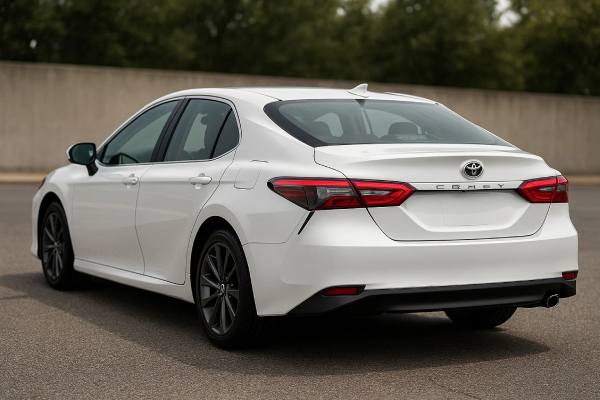
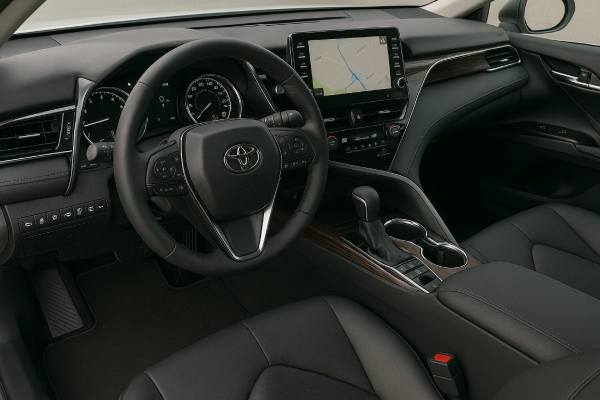
The facelifted 2021–2024 Toyota Camry AWD (AXVA75) brings year-round traction to a nameplate known for quiet dependability. The Dynamic Force 2.5-liter A25A-FKS pairs with an 8-speed automatic and Toyota’s Dynamic Torque Control AWD, which can decouple the rear axle to save fuel and re-engage instantly when slip is sensed. Output is rated at 202 hp (205 hp on XSE AWD with dual exhaust). Beyond the hardware, the facelift added a cleaner fascia, a floating touchscreen interface, and the Toyota Safety Sense 2.5+ suite that broadened crash-avoidance capability. Despite the added driveshaft and rear differential, packaging remains practical: trunk space stays generous and rear-seat comfort is intact. Efficiency trails the front-drive Camry only modestly, and road manners remain composed even on winter-scarred pavement. This guide zeros in on the AWD four-cylinder—what it is, how it drives, and what to check when buying—so you can make a confident, data-backed decision.
Fast Facts
- Confident all-weather traction with quick-reacting torque transfer; minimal fuel-economy penalty versus FWD.
- Strong safety story: robust crash-test results and a comprehensive standard driver-assist suite.
- Cabin ergonomics and ride comfort remain standouts; 19-inch XSE wheels add grip without much harshness.
- Caveat: ensure ECU/TCU and ADAS software are current after any dealer service; verify via service records.
- Typical care: rotate tires every 5,000 miles (8,000 km); oil and filter every 10,000 miles/12 months with 0W-16.
What’s inside
- Camry AWD 2021–2024 Overview
- Camry AWD Specs and Data
- Camry AWD Trims, Options and Safety
- Reliability, Issues and Service Actions
- Maintenance Plan and Buyer Guide
- Driving Impressions and Efficiency
- Camry AWD vs Rivals
Camry AWD 2021–2024 Overview
Toyota’s all-wheel-drive Camry targets drivers who face snow, steep driveways, or slick spring/fall shoulder seasons but still want a quiet, efficient midsize sedan. The AWD hardware integrates cleanly with the TNGA-K platform: a prop shaft to the rear, an electronically controlled coupling ahead of the rear differential, and smart control logic that sends torque rearward when front slip or rapid throttle application is detected. When cruising steadily, the system disconnects the rear driveline to reduce parasitic losses. Up to 50 percent of engine torque can be directed to the rear axle in transient events, and the system re-engages so quickly that most drivers will simply feel calm traction rather than a noticeable “kick.”
The engine is Toyota’s long-stroke A25A-FKS, a 2.5-liter inline-four with combined direct and port injection (D-4S), a 13.0:1 compression ratio, dual VVT-i (with VVT-iE on the intake), and a focus on thermal efficiency. In AWD grades the output is quoted at 202 hp (151 kW) and 184 lb-ft (249 Nm); the XSE AWD’s dual-outlet exhaust yields 205 hp (153 kW) and 186 lb-ft (252 Nm). The 8-speed Direct Shift automatic uses short lower gears for step-off and tall cruising ratios for low rpm at highway speeds. Later software calibrations further smoothed low-speed downshifts and kickdown logic.
The 2021 refresh modernized the cabin and safety stack. A “floating” 7- or 9-inch center display replaced the previous integrated unit, and Toyota Safety Sense 2.5+ became standard, adding improved intersection support and lane-centering. Headlights vary by trim and option, but the lineup performed well in aggregate safety testing. Chassis tuning remains split: LE/XLE prioritize isolation, while SE/XSE get firmer springs and dampers, additional roll control, and larger wheels (up to 19 inches on XSE). AWD adds roughly 165 lb versus comparable FWD trims; the steering ratio and geometry are unchanged, though the AWD turning circle grows slightly to about 39.3 ft (12.0 m).
Packaging is a strong point. Unlike some AWD retrofits, Camry retains a flat, useful trunk (about 15.1 ft³/428 L, SAE) and easy child-seat fitment thanks to wide rear door openings and accessible LATCH anchors. Driver fatigue on long trips is low; Toyota’s seats and sound deadening help the Camry feel calmer than many rivals on coarse asphalt. As a used buy, AWD cars from 2021–2024 benefit from mid-cycle refinements and broad parts availability, while avoiding the complexity of turbocharging or hybrid high-voltage systems.
Camry AWD Specs and Data
Engine and Performance (ICE)
| Item | Detail |
|---|---|
| Code | A25A-FKS (“Dynamic Force”) |
| Layout & cylinders | Inline-4, DOHC, 16 valves; Dual VVT-i/VVT-iE |
| Bore × stroke | 87.5 × 103.4 mm (3.44 × 4.07 in) |
| Displacement | 2.5 L (2,487 cc) |
| Induction | Naturally aspirated |
| Fuel system | D-4S (combined direct + port injection) |
| Compression ratio | 13.0:1 |
| Max power (AWD) | 202 hp (151 kW) @ ~6,600 rpm |
| Max torque (AWD) | 249 Nm (184 lb-ft) @ ~5,000 rpm |
| Max power (XSE AWD) | 205 hp (153 kW) with dual-outlet exhaust |
| Max torque (XSE AWD) | 252 Nm (186 lb-ft) |
| Timing drive | Chain |
| Rated economy (AWD LE/SE) | 29 mpg US combined (25/34 city/hwy) = 8.1 L/100 km combined (9.4/6.9 city/hwy) |
| Rated economy (AWD XLE/XSE) | 28 mpg US combined (25/34) = 8.4 L/100 km (9.4/6.9) |
| Real-world highway @ 120 km/h (75 mph) | ~7.3–8.0 L/100 km (33–29 mpg US / 40–35 mpg UK), tire and weather dependent |
| Aerodynamics | Cd typically ~0.28 (trim/wheel dependent) |
Transmission and Driveline
| Item | Detail |
|---|---|
| Transmission | 8-speed “Direct Shift” automatic (ECT-i) with manual mode/paddles (SE/XSE) |
| Drive type | Dynamic Torque Control AWD (electronically controlled rear coupling; FWD decoupling during steady cruise) |
| Final drive ratio | Trim-calibrated; overall gearing optimized for low-rpm cruising |
| Differential | Open front and rear; brake-based torque management |
| Refuel to full | ~2–4 minutes at pump (15.8-gal tank) |
Chassis and Dimensions
| Item | Detail |
|---|---|
| Platform | TNGA-K unibody; extensive high-strength steel; adhesive bonding/laser screw welding |
| Suspension (front/rear) | MacPherson strut / multi-link; SE/XSE with sport tuning |
| Steering | Electric power assist; turning circle 39.3 ft (12.0 m) AWD |
| Brakes (typical 2.5 trims) | Ventilated front discs 12.0 in; solid rear discs ~11.0 in |
| Wheels/Tires | 17–19 in by trim; XSE AWD commonly 235/40 R19 |
| Ground clearance | ~5.7 in (145 mm) |
| Length / Width / Height | 192.1 / 72.4 / 56.9–57.1 in (4,879 / 1,839 / 1,446–1,451 mm) |
| Wheelbase | 111.2 in (2,825 mm) |
| Track (F/R) | Up to ~63.0 / 63.2 in with 19-in package (trim dependent) |
| Curb weight (AWD) | Approx. 3,480–3,585 lb (1,580–1,625 kg) by trim/options |
| Fuel tank (ICE) | 15.8 gal (59.8 L / 13.2 UK gal) |
| Cargo volume | 15.1 ft³ (428 L) — SAE |
Performance and Capability
| Metric | 2.5 AWD (typical) |
|---|---|
| 0–60 mph / 0–100 km/h | ~8.0–8.5 s (tire, surface, and test method dependent) |
| Top speed | Electronically limited; class-typical |
| Braking 62–0 mph (100–0 km/h) | Competitive; tire compound and rotor condition dominate outcomes |
| Towing | Not rated for braked towing in baseline market (verify local guidance) |
| Roof load | Check roof-rack system rating; avoid overloading panoramic-roof cars |
Fluids and Service Capacities (essentials)
| System | Specification | Capacity (typical) |
|---|---|---|
| Engine oil | SAE 0W-16, API-rated; Toyota Genuine recommended | ~4.8–5.1 qt (4.5–4.8 L) incl. filter (verify by VIN) |
| Coolant | Toyota Super Long Life Coolant (pink) | Factory fill; first exchange 100,000 miles / 120 months, then 50,000 miles / 60 months |
| Automatic transmission | Toyota WS ATF | Sealed; inspect/fluid service only as conditions warrant |
| AWD rear diff / transfer | Toyota spec gear oils | Inspect routinely; replace under severe use |
| A/C refrigerant | R-1234yf | Charge per under-hood label |
| Key torque values | Wheel nuts 103 Nm (76 lb-ft); oil drain plug typical 39 Nm (29 lb-ft) — confirm for VIN |
Electrical (service items)
| Item | Typical detail |
|---|---|
| 12-V battery | Flooded/AGM by build; test annually after year 3–4 |
| Spark plugs | Long-life iridium; inspect at major intervals; gap pre-set at factory |
Safety and Driver Assistance (headlines)
| Item | Detail |
|---|---|
| Crash tests (IIHS) | Overall Top Safety Pick+ status across the range with Good crashworthiness; updated side test varies by year/trim; headlight ratings vary by equipment |
| Front crash prevention | Standard system rated Superior (vehicle-to-vehicle and daytime pedestrian) |
| ADAS suite | Toyota Safety Sense 2.5+: Pre-Collision with Pedestrian Detection, Lane Departure Alert with Steering Assist, Lane Tracing Assist, Road Sign Assist, Dynamic Radar Cruise Control; Blind Spot Monitor with Rear Cross-Traffic Alert standard on XLE/XSE, optional LE/SE; Rear Cross-Traffic Braking and parking sonar available |
Camry AWD Trims, Options and Safety
AWD availability: LE, SE (and SE Nightshade), XLE, and XSE grades offer the 2.5-liter AWD. The XSE AWD is the sole four-cylinder AWD variant quoted at 205 hp thanks to its dual-outlet exhaust; other AWD grades are 202 hp.
Core trim differences that affect ownership
- Chassis tuning and wheels
- LE/XLE: Comfort-oriented springs/dampers; 17–18-in wheels; calm NVH.
- SE/XSE: Sport tuning with firmer body control; 19-in wheels available/standard on XSE; slightly sharper steering feel.
- Exterior tells
- XSE AWD: unique 19-in wheel designs, dual exhaust finishers, and available two-tone roof (select years).
- SE Nightshade: darkened badges/trim and black wheels; mechanics unchanged.
- Cabin and infotainment
- 7-in touchscreen standard; 9-in upgrade bundled with Audio Plus/Premium Audio.
- JBL® 9-speaker system optional on upper trims.
- Heated front seats common with cold-weather packages; heated steering wheel availability rises with trim.
- Cold Weather Package (AWD focus): Adds heated mirrors and seats on LE, heated seats/mirrors/steering wheel on SE, and a heated steering wheel on XLE/XSE (where heated seats/mirrors are already standard). This is a smart pick for snowbelt buyers.
Safety content and ratings
- Standard across all AWD trims: Toyota Safety Sense 2.5+, 10 airbags, stability/traction control, hill-start assist, tire-pressure monitoring with individual readouts.
- Blind Spot Monitor with Rear Cross-Traffic Alert: Standard on XLE/XSE, optional elsewhere.
- Parking sonar with rear automatic braking: Optional bundle; useful for tight garages and winter visibility days.
- Headlights: Performance varies by package (projector LED vs adaptive/upgraded units). Trims with enhanced headlights typically scored better in formal headlight tests.
- Child seats: LATCH anchors are accessible and rate well for ease of use; Camry’s rear bench fits two child seats plus a booster in many configurations thanks to shoulder-room and anchor spacing.
Year-to-year notes (facelift span)
- 2021: Facelift styling; floating 7-/9-in displays; TSS 2.5+ standard; AWD content aligned with FWD grade features; Nightshade returns on SE.
- 2022–2023: Minor color/option reshuffles; multimedia and ADAS calibration improvements rollout via production and service updates.
- 2024: Final year of the gasoline-only AWD run before the next generation transitioned the lineup; equipment rationalized to streamline ordering.
Shopping cues and identifiers
- Build tags/VIN: The AWD platform code for this four-cyl variant is AXVA75. Dealer window stickers list “Dynamic Torque Control AWD.”
- Quick tells on test drives: In snow or gravel, smooth pull-aways without front-wheel scrabble and a slightly larger turning circle than FWD; otherwise, behavior mirrors FWD Camry.
Reliability, Issues and Service Actions
The AWD four-cylinder Camry has a strong reliability record, aided by a simple naturally aspirated engine and a conventional 8-speed automatic. Still, patterns exist—most are minor and easy to correct if you know what to ask for.
Common (low → medium cost)
- Brake shudder or squeal after sitting or gentle use → Light rotor corrosion, pad imprinting, or uneven lug torque. Fix: Perform several firm 60→10 mph stops to clean rotors; measure thickness/run-out; resurface/replace if out of spec. Always torque wheels to spec (103 Nm / 76 lb-ft).
- Infotainment glitches (Bluetooth/camera/CarPlay) → Early software builds. Fix: Update multimedia firmware; confirm with service records that the latest calibration is installed.
- Road noise on 19-inch tires → Some all-seasons transmit more roar on coarse asphalt. Fix: Choose a quieter touring tire in the same size; rotate on time to prevent cupping.
Occasional (medium cost)
- Low-speed shift feel (lugging/abrupt downshift) → Transmission/engine calibration sensitivity and adaptive learning after battery disconnect or service. Fix: Verify current ECM/TCM software; ensure throttle body and MAF are clean; allow a relearn period with mixed driving.
- A/C odor in humid climates → Evaporator microbial growth. Fix: Replace cabin filter on schedule; use HVAC after-run (vent/fan) to dry core; apply an approved evaporator cleaner through the condensate drain.
AWD-specific watch-items
- Rear coupling or differential seep (rare) → Seals aging or off-road debris damage. Fix: Inspect during services; replace seals if weeping progresses; confirm breather function.
- Front hub/bearing growl (in salt states at high miles) → Corrosion exposure. Fix: Replace hub assembly; verify alignment and wheel balance to protect new parts.
Recalls and service actions (headline examples)
- Front passenger Occupant Classification System (OCS) sensor recall affecting specific 2020–2021 production windows. Symptom/concern: Potential misclassification of passenger weight in rare sensor failure scenarios. Remedy: Dealer inspection and sensor replacement as needed; no-charge.
- Software campaigns appear periodically (e.g., ADAS re-tuning, multimedia stability). These are quick dealer updates; always ask for a printout of completed campaign numbers with dates.
How to verify before purchase
- Run an official VIN recall check and request printed campaign completion proof.
- Ask for ECU/TCU software level confirmation on the repair order.
- Inspect brake measurements and rotor run-out values.
- Check for matching tires with even wear; mis-matched sets can upset AWD logic and ABS calibration.
- Request a 12-V battery test (especially on short-trip cars).
- For snowbelt vehicles, look underbody for surface corrosion on subframes, brake shields, and AWD housings.
Long-term outlook: With fresh fluids, timely filters, and software kept current, the A25A-FKS/8-speed/AWD combination delivers high-mile durability. Dual-injection reduces intake valve deposit risk versus older DI-only designs, and the mechanical AWD avoids hybrid high-voltage maintenance while materially improving foul-weather confidence.
Maintenance Plan and Buyer Guide
Practical maintenance schedule (2.5 AWD)
- Every 5,000 miles / 6 months: Rotate tires (front-to-rear); inspect brakes, steering/suspension joints, driveshaft boots, exhaust, and fluid condition; check wipers and exterior lighting.
- Every 10,000 miles / 12 months: Replace engine oil and filter (0W-16). Inspect cabin air filter (replace sooner in dusty or urban environments).
- Every 30,000–45,000 miles: Replace engine air filter; measure brake rotors (thickness/run-out); inspect coolant leaks and belt condition.
- Every ~60,000–75,000 miles: Four-wheel alignment check; shock/strut evaluation; thorough underbody corrosion inspection; AWD coupling and seals visual check.
- Coolant: First exchange at 100,000 miles / 120 months, then every 50,000 miles / 60 months.
- Spark plugs: Long-life iridium—inspect at major services; replace when out of spec or per VIN-specific guidance.
- Brake fluid: Replace about every 3 years or when moisture/boiling-point tests fail.
- AWD rear differential/transfer case: Inspect routinely; replace gear oils under severe service (frequent snow use, dirt roads, heavy stop-and-go in extreme cold).
- 12-V battery: Load-test annually after year 3–4; typical life 4–6 years.
- Tires and alignment: Rotate every 5,000 miles; maintain door-jamb pressures; realign at first sign of edge wear or drift. Keeping a matched set with even tread depths preserves AWD behavior.
Fluid specifications and quick decision points
- Engine oil: SAE 0W-16 meeting current API standard; use quality filters and replace drain-plug gasket.
- Transmission: Toyota WS ATF; the unit is “sealed”—service only for contamination, overheating events, or severe duty; use leveled fill procedures.
- Coolant: Toyota Super Long Life Coolant (pink).
- A/C: R-1234yf refrigerant only; service by weight with certified equipment.
- Torque essentials: Wheel nuts 103 Nm (76 lb-ft); verify drain-plug torque, and always use a torque wrench on wheel installs to prevent brake shimmy.
DIY notes
- Under-tray removal is required for oil changes; invest in proper ramp/jack stands. Cabin and engine air filters are accessible with basic tools. If disconnecting the battery, consider a memory saver to avoid radio/ADAS relearn hassles.
Pre-purchase checklist (AWD focus)
- Underside: Check rear coupling, differential housings, and fasteners for seepage or gouges.
- Suspension: Listen for clunks over speed bumps; common culprits are stabilizer links/top mounts.
- Driveline feel: From a standstill on gravel or a wet surface, the car should pull away cleanly with no excessive front-wheel scrabble; steering should self-center and track straight.
- Brakes: Firm, linear pedal with straight stops from 60 mph; no steering shake.
- Electronics: Confirm all cameras/sensors initialize; test adaptive cruise and lane-tracing on a straight, well-marked road.
- Paperwork: Complete service history, printed recall campaign completions, and any software update records.
Which models to target
- Best all-rounder: XLE AWD for comfort features plus standard blind-spot monitoring and strong headlight performance in many builds.
- Sporty look/feel: XSE AWD (205 hp) with 19-inch wheels; consider touring-oriented all-season tires if your roads are rough.
- Value pick: SE AWD with Cold Weather Package for winter-state use; simpler spec, easy to maintain.
Durability outlook: Expect long service life from the 2.5-liter and 8-speed when fluids are clean and software is current. The AWD hardware is robust and largely maintenance-free aside from periodic inspections.
Driving Impressions and Efficiency
Ride and handling: The AWD Camry keeps the same calm, mature demeanor that defines the line. LE/XLE ride quality is supple, absorbing expansion joints without secondary body motions. SE/XSE add roll control and sharper turn-in—noticeable in quick lane changes and cloverleaf on-ramps—while remaining quiet on the highway. Compared with FWD, the AWD car feels slightly more planted in wet or slushy conditions when accelerating out of a corner, with stability control staying in the background unless provoked.
Steering and braking: Steering weight is natural and consistent off center. You won’t get sports-sedan feedback, but you will get precision and stability at speed. The brake pedal is easy to modulate and resists fade in typical family-car use. As always, tire compound matters—a quality all-season transforms confidence in cold rain and shoulder-season snow.
Powertrain character: The A25A-FKS is tuned for efficiency and smoothness. There’s adequate low-rpm torque for city drivability, and the engine is happiest above 3,500 rpm when merging or passing. The 8-speed shifts early in Normal/Eco; selecting Sport or using the paddles on SE/XSE wakes the car up for hills and quick merges. Later calibrations reduce the odds of an awkward low-speed downshift; if the test drive reveals hesitation, ask the dealer to confirm software level.
Real-world economy: EPA ratings put AWD LE/SE at 25/34/29 mpg and XLE/XSE at 25/34/28 mpg (that’s 9.4/6.9/8.1–8.4 L/100 km). In practice, gentle suburban use lands in the low 30s mpg US, while steady 120 km/h (75 mph) highway cruising yields 29–33 mpg US (7.3–8.0 L/100 km) depending on temperature, wind, and tire choice. Winter conditions and short trips can trim economy by 10–20%, typical for naturally aspirated gasoline cars with AWD.
Traction and control: The AWD system is most obvious on steep, slick starts and when powering out of snowy corners. Rather than flashing traction lights and cutting power, the car meters torque rearward and moves off cleanly. Stability control is well-tuned; the car stays neutral with a slight front bias, and the rear engages smoothly without a pushy, tail-happy feel.
Noise, vibration, and harshness: Road roar depends on tire model, but cabin boom is low and wind noise is well-managed. The powertrain is hushed at cruise; at wide-open throttle, the 2.5-liter sounds busy but not coarse. On grooved concrete, switching from aggressive all-seasons to a quieter touring tire significantly reduces cabin hash.
Load and road trips: With four adults plus luggage, the AWD Camry stays composed over grades and rough interstate seams. Cooling and transmission temps are not a concern in normal use; expect a modest economy penalty (a few mpg) when fully laden or climbing at speed.
Camry AWD vs Rivals
Nissan Altima AWD (2.5 NA / VC-Turbo): The Altima’s available AWD is a direct competitor. The Camry counters with a richer safety suite standard, a more polished cabin, and a long-proven naturally aspirated engine. The Altima’s VC-Turbo option is quicker but more complex; the Camry’s 2.5 has fewer moving parts and consistent highway economy on regular fuel.
Subaru Legacy (standard AWD): Legacy offers standard AWD and a comfortable ride, with the 2.4T XT trims bringing strong thrust. Camry’s interior materials, infotainment responsiveness, and resale values tend to be stronger. The Toyota’s 8-speed automatic is also more conventional in feel than Subaru’s CVT at heavy throttle.
Kia K5 (AWD on select trims): K5’s AWD availability is narrower and tied to specific grades; the cabin is stylish and feature-rich. Camry’s crash-test pedigree and long-term reliability reputation tilt the equation in Toyota’s favor for buyers planning to keep a car past 100,000 miles (160,000 km).
Honda Accord (FWD only in this span): Without AWD, Accord leans on chassis poise and turbo torque. It’s engaging to drive, but snow-belt shoppers who want built-in traction without switching to a hybrid e-AWD might prefer the Camry AWD. The Toyota’s naturally aspirated engine also avoids turbo hardware and delivers steady real-world economy at U.S. highway speeds.
Hyundai Sonata (FWD; AWD not broadly offered in this run): Sonata packs tech and value, with punchy turbo options, but Camry’s residuals and breadth of safety content remain hard to beat.
Bottom line: If you want the security of AWD, the durability of a naturally aspirated engine, and an ownership experience designed to be low-drama for a decade or more, the Camry AWD stands at the top of the segment short list. Its closest AWD alternatives either trail in long-term value or rely on more complex turbocharging to achieve similar pace.
References
- Clear-Cut Leader: The 2021 Toyota Camry Adds More Variants While Advancing Safety 2020 (Press Release)
- Gas Mileage of 2021 Toyota Camry 2024 (EPA Ratings)
- 2021 Toyota Camry 4-door sedan 2024 (Safety Rating)
- MY21 Camry eBrochure 2021 (Specifications)
- Part 573 Safety Recall Report 23V-865 2024 (Recall)
Disclaimer
This article is for informational purposes only and is not a substitute for professional diagnosis or repair. Specifications, torque values, fluid capacities, intervals, and procedures vary by VIN, market, and equipment. Always confirm details against your vehicle’s official owner’s manual, service documentation, and dealer records before performing work or making a purchase decision.
If this guide helped, please consider sharing it on Facebook or X/Twitter to support xcar’s independent work.