
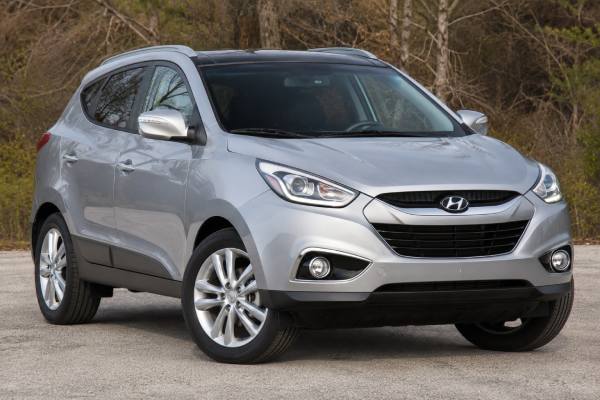
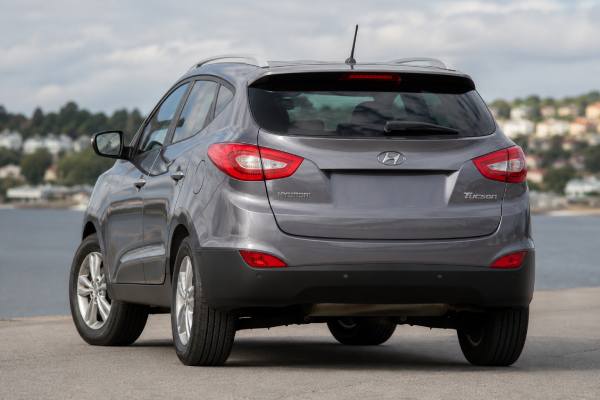
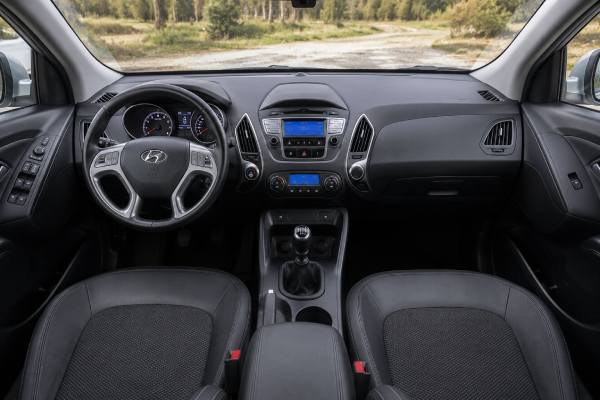
The 2014–2015 Hyundai Tucson FWD with the Nu 2.0 GDi engine sits in a useful part of the used-SUV market: compact enough for city parking, simple enough to maintain without luxury-SUV costs, and practical enough for small families. This facelifted LM-generation Tucson brought gasoline direct injection, revised equipment, improved ride tuning, and sharper styling, but it is still an older compact crossover with older safety technology and a naturally aspirated engine that needs revs when fully loaded.
For buyers comparing it with a Honda CR-V, Toyota RAV4, Mazda CX-5, Nissan Rogue, or Kia Sportage, the Tucson’s appeal is not class-leading space or performance. Its appeal is value, easy daily use, a conventional drivetrain, and a manageable ownership profile when the service history is solid.
Final Verdict
The 2014–2015 Hyundai Tucson FWD 2.0 GDi is a sensible used compact SUV for drivers who want a simple five-seat crossover with good parts availability, tidy dimensions, and lower purchase prices than many Japanese rivals. Its strongest appeal is easy urban ownership: decent visibility, compact length, a practical cargo bay, and a conventional 2.0-liter engine without turbo complexity. The main tradeoff is performance; the 164 hp Nu GDi feels adequate rather than strong, especially with passengers or highway hills. Buy one only after confirming recall completion, clean oil-change history, smooth transmission behavior, and no signs of oil consumption, engine noise, or neglected cooling-system maintenance.
| Pros | Cons |
|---|---|
| Compact LM body is easy to park and maneuver | Rear seat and cargo space trail roomier CR-V and RAV4 rivals |
| Nu 2.0 GDi gives acceptable economy in FWD form | Passing power is modest when loaded or climbing grades |
| Conventional six-speed automatic is easier to live with than many CVTs | Direct injection can mean intake deposits and oil sensitivity over time |
| Good standard stability, ABS, side-airbag, and curtain-airbag coverage | Small-overlap crash result is a notable weakness for this generation |
| Strong used value and broad Hyundai/Kia parts availability | Recall completion and service history matter more than mileage alone |
Table of Contents
- 2014–2015 Tucson FWD Overview
- Nu 2.0 GDi Specs and Dimensions
- Trims, Safety, and Driver Assistance
- Reliability, Issues, and Service Actions
- Maintenance and Used Buying Guide
- Driving, Performance, and Fuel Economy
- Tucson FWD vs. Key Rivals
2014–2015 Tucson FWD Overview
The 2014–2015 Tucson FWD 2.0 GDi is best understood as a practical, value-focused compact SUV rather than a sporty or premium one. The facelift gave the LM-generation Tucson a newer direct-injection engine, updated lighting, revised cabin features, and improved ride tuning, but the basic package remained a small, road-biased crossover.
In North America, the 2.0-liter Nu GDi was mainly associated with the lower Tucson trim, while the 2.4-liter GDi powered higher grades. In some markets, the same 2.0 GDi FWD configuration could be paired with a six-speed manual, while U.S.-market Tucsons used a six-speed automatic with SHIFTRONIC manual control. This matters when comparing specifications, because fuel economy, curb weight, and driving feel can vary slightly by market and transmission.
The facelift is easy to spot. Look for the updated front lighting with projector-style headlights and LED accent elements, revised alloy wheels, and a slightly fresher interior layout. The cabin is not large by modern compact-SUV standards, but it is easy to use. The rear seats fold flat enough for typical household cargo, and the upright hatch makes the vehicle more useful than a compact hatchback.
The 2.0 GDi engine suits commuting, school runs, and moderate highway use. It is naturally aspirated, so there is no turbocharger to worry about, but it does not have the low-rpm shove of newer turbocharged SUVs. The engine works best with regular maintenance, clean oil, and a driver who does not expect strong acceleration from low revs.
As a used buy, condition matters more than trim badge. A clean base or mid-grade Tucson with complete service records is usually a better purchase than a higher-spec example with overdue fluids, budget tires, warning lights, or missing recall paperwork.
Nu 2.0 GDi Specs and Dimensions
This Tucson uses a transverse 2.0-liter Nu-family gasoline engine driving the front wheels. The key technical points are direct fuel injection, a timing chain, four-cylinder simplicity, and a compact SUV body that keeps weight reasonable.
The figures below focus on the facelifted LM Tucson FWD 2.0 GDi. Some rows differ slightly by market and transmission, so the most useful values are shown with practical notes rather than unsupported exactness.
| Item | Specification |
|---|---|
| Engine family | Hyundai Nu 2.0 GDi, G4NC |
| Configuration | Inline-four, front transverse |
| Displacement | 1,999 cc / 2.0 liters |
| Fuel system | Gasoline direct injection |
| Induction | Naturally aspirated |
| Valvetrain | DOHC, 16 valves, dual continuously variable valve timing |
| Power | 164 hp at 6,200 rpm |
| Torque | 205 Nm / 151 lb-ft at 4,000 rpm |
| Timing drive | Timing chain |
| Fuel type | Regular unleaded gasoline in North American specifications |
| EPA economy, 2WD automatic | 23 city / 28 highway / 25 combined mpg US |
| Item | Specification |
|---|---|
| Drive type | Front-wheel drive |
| Automatic transmission | Six-speed automatic with SHIFTRONIC manual mode |
| Manual transmission | Six-speed manual in some non-U.S. FWD applications |
| Front differential | Open differential integrated with transaxle |
| AWD hardware | Not fitted to this FWD variant |
| Item | Specification |
|---|---|
| Body style | Five-door compact SUV |
| Seating | Five seats |
| Length | 4,400 mm / 173.2 in |
| Width | 1,820 mm / 71.7 in |
| Height | About 1,655 mm / 65.2 in |
| Wheelbase | 2,640 mm / 103.9 in |
| Ground clearance | About 170 mm / 6.7 in |
| Turning diameter | About 10.6 m / 34.7 ft |
| Curb weight | About 1,443–1,466 kg / 3,181–3,232 lb |
| Cargo volume | 728–1,580 L / 25.7–55.8 cu ft |
| Fuel tank | 58 L / 15.3 US gal |
| Towing rating | Up to about 907 kg / 2,000 lb where rated |
| Item | Specification |
|---|---|
| Front suspension | MacPherson struts with anti-roll bar |
| Rear suspension | Independent multi-link with stabilizer bar |
| Front brakes | Ventilated discs |
| Rear brakes | Solid discs |
| Common tire size | 225/60 R17 on many 2.0 GDi versions |
| Engine oil capacity | About 4.0 L / 4.2 US qt with filter |
| Common oil viscosity | 5W-20 or 5W-30, selected by climate and manual guidance |
| Coolant capacity | About 6.7 L / 7.1 US qt |
| Oil drain plug torque | About 39 Nm / 29 lb-ft |
| Wheel-nut torque | 107–127 Nm / 79–94 lb-ft |
Trims, Safety, and Driver Assistance
The 2.0 GDi FWD Tucson was generally the entry or value-focused powertrain, so equipment depends heavily on market and trim. The safest way to shop is to identify the exact trim, check the VIN, and confirm whether the car has a rearview camera, navigation, Blue Link, heated seats, roof rails, and the wheel package you want.
Trim and equipment identifiers
In the U.S., the 2.0 GDi was most closely tied to the GLS grade, while SE and Limited models commonly used the stronger 2.4 GDi. In Canada and other markets, GL, GLS, and Limited naming may differ, and a manual gearbox may appear on some FWD versions. Do not assume equipment by engine alone.
Useful identifiers include:
- 2.0 badging or VIN build data: Confirms the Nu 2.0 GDi rather than the 2.4 GDi.
- Wheel size: Many 2.0 versions use 17-inch wheels; higher trims may use larger or more styled alloys.
- Interior screen: A 4.3-inch display with rearview camera was available on SE/Limited-style equipment levels, while navigation used a larger touchscreen.
- Seat trim: Cloth is common on lower trims; leather seating surfaces point toward higher grades.
- Blue Link buttons: These indicate telematics equipment, though subscription status and network support should be checked separately.
- Panoramic sunroof and LED taillights: Usually found on upper trims or option packages.
Mechanically, the FWD 2.0 GDi is the simpler configuration. It avoids AWD coupling, rear differential, and prop-shaft maintenance, but also gives up all-weather traction and the AWD lock function offered on some Tucson variants.
Safety ratings and crash protection
For its era, the Tucson offered a reasonable standard safety package, but crash-test results are mixed by modern standards. NHTSA government testing gave the 2014–2015 Tucson a four-star overall result in commonly reported summaries, with stronger side-impact performance than frontal performance. IIHS results are more nuanced: moderate-overlap front, side, roof-strength, and head-restraint tests were rated Good, but the driver-side small-overlap result for 2010–2015 models was Poor.
That small-overlap weakness is important. It reflects a more demanding crash configuration that became a major design focus after this generation was engineered. It does not make the Tucson unusually unsafe for its age, but it does mean a later-generation compact SUV may offer better structural performance in certain front-corner crashes.
Standard safety equipment includes:
- Electronic Stability Control and traction control
- Anti-lock brakes with brake assist and electronic brake-force distribution
- Front airbags
- Front seat-mounted side-impact airbags
- Roof-mounted side-curtain airbags for front and rear occupants
- Front seatbelt pretensioners and load limiters
- Three-point belts for all seating positions
- LATCH child-seat anchors
- Tire-pressure monitoring
Driver assistance and calibration notes
Do not expect modern ADAS. This Tucson predates the widespread use of standard automatic emergency braking, adaptive cruise control, lane centering, blind-spot intervention, and surround-view cameras in mainstream compact SUVs. Depending on trim, it may have a rearview camera, Bluetooth, navigation, Blue Link emergency functions, and parking-friendly visibility, but it is not a semi-assisted driving vehicle.
Because ADAS hardware is limited, calibration after windshield replacement or bumper repair is usually less involved than on newer vehicles. Still, any car with a rearview camera, steering-angle sensor, ABS module, or stability-control repair should be checked with proper diagnostic equipment. After alignment, steering, wheel-speed sensor, or ABS work, warning lights should clear normally and stability control should operate without false activation.
Reliability, Issues, and Service Actions
A well-maintained 2014–2015 Tucson 2.0 GDi can be a durable daily driver, but neglect shows up quickly in engine, transmission, suspension, and brake condition. The main ownership rule is simple: choose service history over low price.
| Issue | Prevalence | Severity | Typical clues |
|---|---|---|---|
| Oil consumption or low-oil operation | Occasional | High | Low dipstick, ticking, burning smell, poor service records |
| Direct-injection intake deposits | Occasional | Medium | Rough idle, hesitation, reduced response at higher mileage |
| Automatic shift flare or harsh engagement | Occasional | Medium | Delayed Drive/Reverse, harsh 2–3 shifts, old ATF |
| Suspension wear | Common with age | Low to medium | Clunks, uneven tire wear, wandering, torn bushings |
| Brake corrosion and sticking calipers | Common in wet/salt areas | Medium | Hot wheel, pulsing, poor parking-brake feel, rusty rotors |
| ABS module recall exposure | VIN-dependent | High | Open recall, ABS warning, park-outside instruction before remedy |
Engine and fuel-system concerns
The Nu 2.0 GDi uses a timing chain, not a routine timing belt. That helps long-term running costs, but it does not make the engine maintenance-free. Low oil level, long oil-change intervals, heavy short-trip use, and cheap filters can increase wear risk. Listen for chain rattle on cold start, ticking that does not settle, rough idle, misfires, or a check-engine light with timing-correlation codes.
Because this is a gasoline direct-injection engine, fuel is sprayed directly into the combustion chamber rather than over the back of the intake valves. Over many miles, especially with short trips and weak crankcase ventilation maintenance, intake deposits can build. Symptoms include rough idle, hesitation, or reduced high-rpm breathing. Cleaning is not usually needed as routine maintenance at low mileage, but it is a reasonable diagnostic path if misfires persist after plugs, coils, air leaks, and fuel issues are ruled out.
Oil consumption should be checked seriously. A seller who says “it only needs topping up sometimes” may be describing normal aging, but could also be hiding a worn engine. Check the dipstick cold, check it again after the test drive, inspect the tailpipe, and look under the oil cap for sludge. A clean engine bay is good, but a freshly detailed engine with no paperwork can hide leaks.
Transmission and driveline
The six-speed automatic is generally more predictable than many early CVTs in rival SUVs, but it needs clean fluid and proper operation. During a test drive, the Tucson should engage Drive and Reverse promptly, shift smoothly when cold and warm, and kick down without a flare. A mild programmed downshift is normal; a bang, slip, or delayed engagement is not.
FWD versions avoid the rear differential and AWD coupling issues that can appear on all-wheel-drive crossovers. That lowers service complexity, but front tires, engine mounts, CV joints, and lower control-arm bushings do more work. On a lift, check for cracked CV boots, fluid seepage around the transaxle, and knocking from the front suspension.
Chassis, brakes, and corrosion
By age rather than mileage, many Tucsons now need normal reconditioning: struts, sway-bar links, control-arm bushings, brake pads, rotors, tires, and a 12-volt battery. In snow-belt climates, inspect the rear subframe area, brake lines, fuel-line brackets, suspension arms, lower door seams, tailgate edges, and exhaust hangers. Surface rust is common; flaking structural rust or swollen brake lines are reasons to negotiate hard or walk away.
Brake corrosion is especially common on vehicles that sit, do short trips, or live near road salt. A good road test includes several moderate stops from highway speed. The pedal should stay firm, the vehicle should stop straight, and there should be no strong pulsing, scraping, or dragging after the drive.
Recalls, campaigns, and verification
Two recall areas matter most for this facelifted LM Tucson:
- ABS module / multi-fuse recall: Certain 2014–2015 Tucson vehicles were recalled because the ABS module could malfunction internally and create an electrical short, with fire risk while parked or driving. The remedy involves dealer inspection and a revised ABS multi-fuse, with further action as required.
- Driver airbag module bolt recall: Certain 2011–2014 Tucson vehicles built through late 2013 were recalled because the driver airbag assembly could loosen from its mounting. Dealers inspect and tighten the securing bolts.
Recall status is VIN-specific. Before buying, ask for printed dealer records and run the VIN through the official Hyundai and NHTSA recall tools. A verbal “all recalls were done” is not enough on a vehicle where an open fire-related recall can change the ownership decision.
Maintenance and Used Buying Guide
The best maintenance plan for this Tucson is slightly more conservative than the bare minimum. These vehicles are now old enough that time-based service, fluid age, corrosion, and rubber deterioration matter as much as odometer mileage.
| Interval | Service item |
|---|---|
| Every 5,000–7,500 miles / 8,000–12,000 km | Change engine oil and filter; use shorter intervals for short trips or heat |
| Every 12 months | Inspect brakes, tires, suspension, lights, wipers, belts, hoses, and leaks |
| Every 15,000–30,000 miles / 24,000–48,000 km | Replace cabin air filter and inspect engine air filter |
| Every 30,000–45,000 miles / 48,000–72,000 km | Replace engine air filter sooner in dusty areas |
| Every 45,000–60,000 miles / 72,000–96,000 km | Replace brake fluid if moisture content or age warrants it |
| Every 60,000 miles / 96,000 km | Service automatic transmission fluid under severe use |
| Every 60,000–100,000 miles / 96,000–160,000 km | Replace spark plugs according to plug type and market schedule |
| Every 90,000–100,000 miles / 145,000–160,000 km | Renew coolant if not already replaced by time |
| At every tire service | Rotate tires, check alignment wear, and torque wheel nuts correctly |
| Every 4–6 years | Test or replace the 12-volt battery before slow cranking appears |
The timing chain should be inspected by symptom, not replaced on a fixed belt-style interval. Warning signs include persistent start-up rattle, timing-correlation fault codes, cam/crank sensor codes that return after diagnosis, or metal debris in oil. If the chain system is out of specification, replace the chain, guides, tensioner, and related seals as a set.
The automatic transmission fluid deserves attention. Hyundai may not require frequent fluid replacement under normal use, but a used Tucson with city driving, heat, hills, or unknown history benefits from careful fluid service using the correct specification. Avoid aggressive flushing on a neglected, high-mileage transmission unless a technician has assessed it.
Used-buy inspection checklist
Before purchase, inspect these items in person or through a trusted mechanic:
- Cold-start noise from the timing chain area
- Oil level, oil leaks, sludge, and oil-change receipts
- Smooth idle with air conditioning on and off
- Transmission engagement into Drive and Reverse
- Full-throttle downshift and part-throttle shift quality
- Coolant color, radiator condition, hose swelling, and fan operation
- Brake-line rust, caliper drag, rotor condition, and parking brake
- Front control arms, sway-bar links, struts, and rear suspension bushings
- Uneven tire wear that suggests alignment or suspension problems
- ABS, airbag, ESC, TPMS, and check-engine warning lights
- Water leaks around sunroof drains, hatch seals, and floor carpets
- Recall completion through VIN records, not seller memory
Recommended examples are clean FWD cars with documented oil changes, no warning lights, quality tires, and smooth gearbox behavior. Be cautious with vehicles that have mismatched tires, overdue fluids, heavy underbody rust, repeated battery problems, or unexplained engine noise. The 2.0 GDi is not rare, so there is little reason to rescue a rough one unless the price leaves room for repairs.
Long-term durability is best when the Tucson is treated as a simple daily driver, not a tow rig or neglected winter beater. With good maintenance, the body and cabin often age reasonably well. The expensive risks are usually engine neglect, open recalls, corrosion, and deferred suspension or brake work.
Driving, Performance, and Fuel Economy
The Tucson FWD 2.0 GDi drives like a compact crossover from the early 2010s: easy, light, and predictable, but not especially quick. It is better as a commuter and small-family SUV than as a long-distance passing machine.
Around town, throttle response is clean enough because the engine is naturally aspirated and the six-speed automatic is conventional. There is no turbo lag and no CVT-style droning. The downside is torque. Peak torque arrives at 4,000 rpm, so the Tucson often needs a downshift when merging, climbing hills, or carrying passengers. Drivers coming from a larger V6 SUV may find it busy; drivers coming from an economy car will likely find it normal.
Ride quality is one of the facelift’s stronger points. Hyundai’s revised damping gives the Tucson a controlled feel without making it harsh. On 17-inch wheels, it handles broken pavement better than versions with larger wheels and lower-profile tires. Steering is light, parking is easy, and the short turning circle helps in tight streets.
Handling is safe rather than playful. The Tucson corners with expected SUV body roll, and the front tires do most of the work. In wet weather, good tires matter more than engine output. Because this version is FWD, traction on steep snowy roads is not as confident as AWD, but a quality winter tire set can make a larger difference than many buyers expect.
Noise levels are acceptable for the class and age. Engine noise rises under hard acceleration, tire noise depends heavily on tread choice, and wind noise is more noticeable at highway speeds than in newer compact SUVs. The cabin feels solid enough when the suspension is healthy; rattles often point to worn strut mounts, sway-bar links, loose cargo trim, or old hatch seals.
Real-world fuel economy
Official EPA economy for the 2015 Tucson 2WD 2.0 automatic is 23 mpg city, 28 mpg highway, and 25 mpg combined. In metric terms, that is about 10.2 L/100 km city, 8.4 L/100 km highway, and 9.4 L/100 km combined.
In real use, expect:
- City driving: about 10.5–12.5 L/100 km, or 19–22 mpg US
- Steady highway driving: about 8.0–9.5 L/100 km, or 25–29 mpg US
- Mixed driving: about 9.0–10.5 L/100 km, or 22–26 mpg US
- Cold weather or short trips: often 10–20 percent worse
A manual FWD version in markets where it was sold can feel slightly more direct and may return better open-road economy in careful hands. The automatic is easier in traffic and more common in North America.
Towing should be modest. Even where rated up to about 2,000 lb, the 2.0 GDi FWD Tucson is not the ideal choice for frequent towing. Keep loads light, use proper trailer brakes where required, watch coolant temperature on hills, and expect fuel use to rise sharply. For regular towing, the 2.4 GDi or a larger SUV is the more relaxed choice.
Tucson FWD vs. Key Rivals
The 2014–2015 Tucson FWD 2.0 GDi competes best on value, compact size, and equipment for the money. It is not the roomiest, fastest, or safest-in-every-test option, but it can be a smart buy when priced below the strongest rivals.
| Model | Main advantage | Main tradeoff |
|---|---|---|
| Hyundai Tucson FWD 2.0 GDi | Good value, compact footprint, conventional drivetrain | Modest power and weaker small-overlap result |
| Kia Sportage 2.0/2.4 | Similar platform with sportier styling | Condition varies widely; same age-related inspection needs |
| Honda CR-V | Roomier cabin and excellent everyday practicality | Usually costs more in the used market |
| Toyota RAV4 | Strong reliability reputation and resale value | Higher prices and plain driving feel |
| Mazda CX-5 | Sharper steering and better driver appeal | Rear space and ride comfort depend on trim and tires |
| Nissan Rogue | Soft ride and family-friendly packaging | CVT condition is a major buying concern |
| Ford Escape | Stronger turbo options and modern-feeling cabin | Turbo, cooling, and electronics issues need careful checks |
Against the Honda CR-V and Toyota RAV4, the Tucson usually wins on price. It may also offer more equipment for the same money. The tradeoff is that Honda and Toyota rivals often feel more spacious and tend to command stronger resale values.
Against the Mazda CX-5, the Tucson is less engaging but softer and simpler in character. The Mazda is the better driver’s SUV; the Hyundai is the easier bargain if maintenance records are good.
Against the Nissan Rogue, the Tucson’s conventional automatic is a real advantage for buyers who are nervous about high-mileage CVTs. Against the Ford Escape, the Hyundai is less powerful but avoids turbocharger complexity in this 2.0 GDi form.
The closest rival is the Kia Sportage, which shares much of the same underlying era and engineering. Choose between them by condition, price, service history, and ergonomics rather than badge loyalty. A well-kept Sportage is better than a neglected Tucson, and the reverse is equally true.
The final buying logic is straightforward: choose the Tucson if you want a compact, affordable, easy-to-park SUV and you find one with clean records, completed recalls, and no engine or transmission warning signs. Choose a CR-V or RAV4 if maximum space and resale value matter more. Choose a CX-5 if driving feel matters more. Skip any Tucson that needs major catch-up work unless the purchase price is low enough to pay for it immediately.
References
- Refreshed 2014 Hyundai Tucson Ups Fun And Value Quotients 2013 (Manufacturer Release)
- Gas Mileage of 2015 Hyundai Tucson 2015 (Official Fuel Economy)
- 2015 Hyundai Tucson 2015 (Safety Rating)
- IMPORTANT SAFETY RECALL 2022 (Recall Notice)
- Manuals & Warranties | Hyundai Resources | MyHyundai 2026 (Owner’s Manual Portal)
Disclaimer
This article is for informational purposes only and is not a substitute for professional diagnosis, repair, or inspection. Specifications, torque values, service intervals, fluids, procedures, and equipment can vary by VIN, market, trim, transmission, production date, and previous repairs. Always verify maintenance work, recall status, and repair procedures against official Hyundai service documentation and a qualified technician.
If this guide helped you compare or inspect a used Tucson, please consider sharing it on Facebook, X/Twitter, or your favorite automotive community to support our work.