
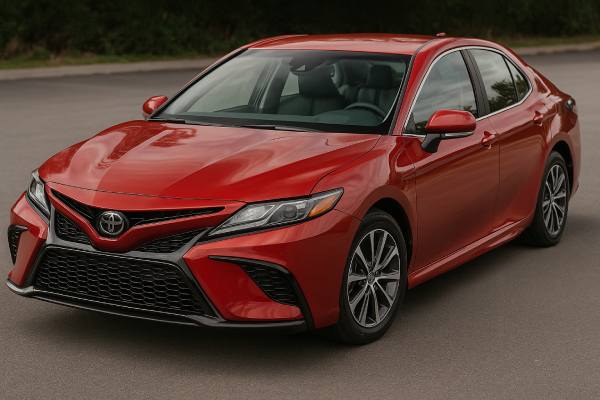
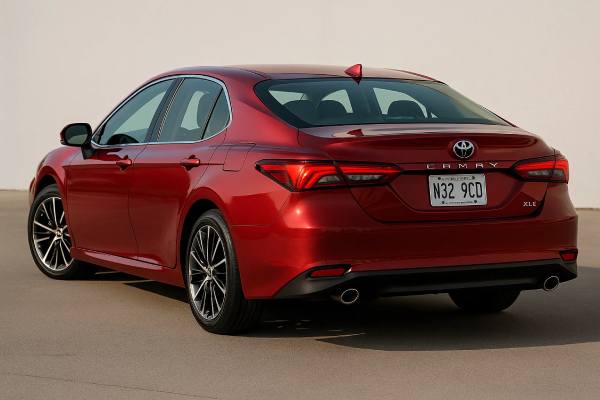
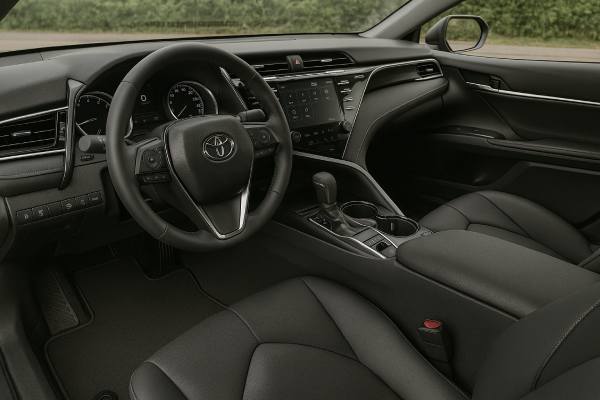
The facelifted 2021–2024 Toyota Camry V6 is the rare midsize sedan that still delivers effortless, naturally aspirated power with everyday comfort. Built on Toyota’s TNGA-K platform, the GSV70 pairs the 301-hp 2GR-FKS 3.5-liter V6 to an 8-speed automatic and front-wheel drive. Owners prize its long-haul refinement, roomy cabin, and excellent safety record, while enthusiasts appreciate a broad torque curve and quick real-world pace. Facelift updates brought a cleaner dash layout, larger infotainment screens, and Toyota Safety Sense 2.5+ across the board. The V6 was limited to the uplevel XLE and XSE grades (plus the track-leaning TRD), all with richer materials, bigger brakes or wheels, and premium audio options. Fuel economy is solid for the output, and service needs are simple—oil, filters, and periodic inspections—thanks to a timing chain and durable driveline. If you want a smooth, quiet, long-lasting sedan that can also sprint, this Camry V6 sits near the bull’s-eye.
Top Highlights
- Smooth 301 hp V6 with quick highway passing and relaxed cruising.
- Quiet ride, confident braking, and outstanding active safety features.
- Simple ownership: timing chain, long-life coolant, extended spark plug interval.
- Watch for passenger-seat OCS recall completion on 2020–2023 builds.
- Oil change every 10,000 miles/12 months with 0W-20; rotate tires at 5,000 miles.
Explore the sections
- Camry V6 GSV70 overview
- Camry V6 specs and data
- Camry V6 trims and safety
- Reliability and common issues
- Maintenance and buyer’s guide
- Driving experience and performance
- How the Camry V6 compares
Camry V6 GSV70 overview
The 2021–2024 Camry V6 (chassis code GSV70) represents the last generation of Toyota’s naturally aspirated V6 in the Camry line, a configuration phased out when the next model year moved to hybrid-only power. In this facelift period, the 3.5-liter 2GR-FKS delivers 301 hp and 267 lb-ft through a Direct Shift 8-speed automatic, tuned for quiet, low-rpm cruising and decisive kickdown. The TNGA-K structure, with its stiffer subframes and low center of gravity, lets the Camry ride comfortably yet corner with more control than earlier models. All V6 cars are well-equipped; the XLE focuses on comfort, the XSE adds a sport tuning and bigger wheels, and the TRD (when offered in your market) layers stiffer springs, unique bracing, larger front brakes, and aggressive 19-inch tires for flatter cornering.
Cabin updates introduced during the facelift include a tablet-style display (7- or 9-inch), simplified HVAC/infotainment controls, and expanded driver-assistance features bundled under Toyota Safety Sense 2.5+. Seating is broadly supportive with generous legroom, and trunk space remains practical at over 15 cubic feet. Owners stepping up from a four-cylinder Camry will notice the V6’s mature character: it starts softly, stays quiet around town, and surges cleanly above 3,000 rpm, with minimal vibration and no turbo lag.
Typical running costs are friendly: extended oil-change intervals with 0W-20, long-life spark plugs, and no scheduled timing-belt replacement because the engine uses a chain. The automatic transmission has no fixed replacement interval under normal service, though proactive fluid refreshes are common among long-term keepers. For shoppers, the most important admin check is recall/TSB completion—particularly the occupant-classification sensor campaign on certain 2020–2023 vehicles—plus routine evidence of fluid and filter changes. With those boxes ticked, the GSV70 V6 is an easy car to recommend, blending reliability, safety, and genuine performance.
Camry V6 specs and data
Engine and Performance (ICE)
| Item | Value |
|---|---|
| Code | 2GR-FKS |
| Layout & cylinders | 60° V6, DOHC, 24 valves (4 per cyl) |
| Valvetrain | Dual VVT-i (VVT-iW on intake), chain-driven cams |
| Bore × stroke | 94.0 × 83.0 mm (3.70 × 3.27 in) |
| Displacement | 3.5 L (3,456 cc) |
| Induction | Naturally aspirated |
| Fuel system | D-4S (direct + port injection) |
| Compression ratio | 11.8:1 |
| Max power | 301 hp (224 kW) @ 6,600 rpm |
| Max torque | 362 Nm (267 lb-ft) @ 4,700 rpm |
| Emissions/efficiency standard | Meets current EPA/LEV requirements for the period |
| Rated efficiency (EPA, typical V6 trims)* | City/Highway/Combined: 22/31–33/25–26 mpg (10.7–7.6–9.0 L/100 km) |
| Real-world highway @ 120 km/h | ~7.5–8.0 L/100 km (31–29 mpg US) depending on wheels/tires and grade |
| Aerodynamics | Cd ≈ 0.27–0.29 (varies with trim, wheel, and aero package) |
*EPA figures vary slightly by trim and wheel/tire (e.g., XSE vs. XLE; TRD typically a touch lower on highway due to aero/wheel choices).
Transmission and Driveline
| Item | Value |
|---|---|
| Transmission | Direct Shift-8AT (8-speed automatic, torque converter) |
| Drive type | Front-wheel drive |
| Final drive ratio | ~2.56–3.00 (varies by trim; sport grades typically shorter) |
| Gear ratios (typical) | 1st 5.25, 2nd 3.03, 3rd 1.95, 4th 1.46, 5th 1.22, 6th 1.00, 7th 0.81, 8th 0.67, Rev 4.01 |
Chassis and Dimensions
| Item | Value |
|---|---|
| Platform | TNGA-K (unibody) |
| Suspension (front/rear) | MacPherson strut / Multi-link; TRD with stiffer springs and unique tuning |
| Steering | Electric rack-and-pinion; quick on-center response |
| Brakes | 4-wheel discs, ABS, EBD, Brake Assist; TRD with larger front rotors |
| Wheels/Tires | XLE 18 in; XSE 19 in; TRD 19 in performance package |
| Ground clearance | ~145 mm (5.7 in) |
| Length/Width/Height | ~4,910/1,840/1,445 mm (193.3/72.4/56.9 in) |
| Wheelbase | 2,825 mm (111.2 in) |
| Turning circle (curb-to-curb) | ~11.6 m (38.0 ft) |
| Curb weight | ~1,620–1,660 kg (3,570–3,660 lb) |
| GVWR | ~2,050–2,100 kg (4,520–4,630 lb) |
| Fuel tank | 60 L (15.8 US gal / 13.2 UK gal) |
| Cargo volume (trunk) | ~428 L (15.1 ft³) SAE |
Performance and Capability
| Item | Value |
|---|---|
| 0–100 km/h (0–62 mph) | Typically ~6.0–6.3 s depending on trim/tires and test method |
| Top speed | Electronically limited; typical ~210+ km/h (~130+ mph) |
| 100–0 km/h braking | ~36–39 m (118–128 ft) with performance tires; add distance on all-seasons |
| Towing/Payload/Roof load | Not factory-rated for towing in many markets; payload and roof load per door-jamb label |
Fluids and Service Capacities (approximate; verify by VIN)
| System | Spec & Capacity |
|---|---|
| Engine oil | SAE 0W-20, API SN Plus or later; ~5.7–6.1 US qt (5.4–5.8 L) with filter |
| Engine coolant | Toyota Super Long Life (pink), premixed 50/50; ~8–9 L (8.5–9.5 US qt) total fill |
| Automatic transmission | Toyota WS ATF; service fill typically ~3–5 L (3.2–5.3 US qt) during drain/fill |
| A/C refrigerant | R-134a or R-1234yf (by market/model year); charge mass per under-hood label |
| A/C compressor oil | ND-OIL 12 (for R-1234yf) or equivalent; volume per service manual |
Key torque specs (selected)
| Fastener | Torque |
|---|---|
| Wheel lug nuts | 103 Nm (76 lb-ft) |
| Engine oil drain plug | ~40 Nm (30 lb-ft) |
| Spark plugs | ~18 Nm (13 lb-ft) on clean, dry threads (always confirm by plug manufacturer) |
Electrical
| Item | Value |
|---|---|
| 12V battery | Maintenance-free; common group sizes include 24F (spec varies by trim/climate) |
| Spark plugs | Long-life iridium; gap ~1.1 mm (0.043 in) |
Safety and Driver Assistance (highlights)
| Item | Detail |
|---|---|
| Crash ratings | Strong results across the period; headlights determine top awards on some years |
| Headlights | Trim-dependent (projector/LED; adaptive on upper trims) |
| ADAS suite | Toyota Safety Sense 2.5+: Pre-Collision (pedestrian/cyclist), Intersection Assist, Full-Speed Dynamic Radar Cruise Control, Lane Tracing Assist, Lane Departure Alert with Steering Assist, Road Sign Assist, Auto High Beams |
| Airbags | Front, side, curtain, driver’s knee, passenger seat-cushion; advanced OCS for passenger classification |
| Child-seat provisions | Lower anchors (LATCH) outboard rear; three top tethers |
Camry V6 trims and safety
Trims and Options (2021–2024)
- XLE V6: Comfort-oriented suspension, 18-inch wheels, leather-trimmed seats, 9-inch touchscreen on most builds, available panoramic roof, premium JBL audio option, and a full suite of driver aids.
- XSE V6: Sport-tuned suspension, 19-inch wheels, bolder exterior trim, available two-tone roof, paddle shifters, and a slightly firmer ride; EPA highway numbers may be a tick lower than XLE due to wheels/aero.
- TRD V6 (availability varies): Stiffer springs and dampers, unique bracing, larger front rotors with performance pads, cat-back exhaust, red-accented interior, fixed rear seatback for extra bracing, and summer/performance-oriented 19-inch tires in some packages.
Quick identifiers
- Badging: “V6” no longer appears on the tail in all markets—look for trim (XLE/XSE) and dual exhausts. TRD has a decklid spoiler, front splitter, and red calipers (market-dependent).
- Interior tells: XLE wood-tone or satin accents; XSE darker metallic trim with sport seats; TRD gets red stitching, seat belts, and unique cluster graphics.
- VIN build codes: Engine family 2GR; transmission 8-speed; the tenth VIN character denotes model year (M=2021, N=2022, P=2023, R=2024).
Year-to-year notes
- 2021 facelift: Revised front fasciae, new tablet-style screens (7 or 9 in), updated seat patterns, expansion to Toyota Safety Sense 2.5+.
- 2022–2023: Minor color and package changes, continued safety-tech refinements; Nightshade appearance was four-cylinder-focused.
- 2024: Final V6 model year in this generation.
Safety ratings (summary)
The Camry four-door sedan earned top crashworthiness marks across the period, with headlight performance varying by trim and option packages. Vehicles equipped with the best LED/adaptive units achieved top-tier awards. If you’re shopping, verify the specific car’s headlight rating and build date, as later builds often received hardware/software revisions that improved test outcomes.
Safety systems and ADAS (what to know)
- Standard: Forward collision mitigation (with pedestrian and cyclist detection and intersection support), dynamic radar cruise with stop-and-go, lane tracing assist, lane departure alert with steering assist, road sign assist, and automatic high beams.
- Available: Blind-spot monitoring with rear cross-traffic alert (often standard on XLE/XSE V6), surround view on certain packages, and parking sensors with automatic braking.
- Calibration: After windshield replacement, bumper repair, or airbag/SRS work, radar and camera calibration may be required; plan for extra technician time and a suitable alignment surface.
Reliability and common issues
Big picture
The 2GR-FKS V6 and Direct Shift 8-speed are proven, with strong longevity given routine fluids and filters. Most owners experience years of quiet service. Below is a practical map of what to look for, organized by prevalence and cost.
Common or notable (generally low-to-medium cost)
- Passenger seat OCS recall (2020–2023 builds) → Symptoms: SRS light on, “Passenger Airbag OFF” indicator lit with an occupied seat; Cause: Certain occupant-classification sensors may short; Remedy: Dealer inspection and sensor replacement if needed at no cost. Always confirm recall completion by VIN.
- Brake vibration under hard use (sport wheels/tires) → Symptoms: Steering wheel shake on high-speed stops; Cause: Pad deposits or heat-related rotor variation; Remedy: Proper bedding, rotor resurfacing or replacement, use of high-quality pads (TRD package already upgrades).
- Road-noise boom with worn tires → Symptoms: Cabin droning on coarse asphalt with 19-inch tires; Remedy: Rotate at 5,000 miles, maintain pressures, consider touring-oriented tires if comfort is the goal.
Occasional (medium cost)
- 8-speed shift feel complaints → Symptoms: Low-speed firmness or downshift hesitation; Context: Largely addressed by calibration refinements over the generation; Remedy: Ensure latest TCM/ECM software is installed; adaptive relearn after battery disconnect.
- EVAP/charcoal canister faults → Symptoms: Check-engine light with EVAP codes; Remedy: Smoke test, hose/valve inspection; replace canister/valves as required.
Rare (higher cost)
- Water pump seep → Symptoms: Coolant smell, pink residue near pump; Remedy: Replace pump and belt, restore SLLC coolant.
- A/C condenser stone damage → Symptoms: Gradual loss of cooling; Remedy: Leak test and replacement; consider fine-mesh grille protection in stone-heavy regions.
Wear and environment factors
- Short urban trips and winter use increase moisture and fuel dilution; stick to shorter oil intervals (5,000–7,500 miles).
- Large-diameter wheels (19 in) ride more firmly and can accelerate inner-edge tire wear if alignment isn’t checked.
- Road-salt climates: inspect rear subframe seams and fasteners each spring; apply cavity wax/underbody protection as needed.
TSBs/Software
- Powertrain and ADAS updates appear periodically; many resolve drivability feel (shift mapping, idle smoothness) or add detection capability. During pre-purchase or annual service, ask the dealer to check for outstanding calibration updates by VIN.
Pre-purchase requests
- Full maintenance records (oil changes by time/miles, coolant age, brake-fluid history).
- Proof of recall completion and any TSB-related updates.
- Tire tread-depth report and alignment printout (especially on 19-inch wheels).
- Brake thickness, rotor condition, and any signs of overheating.
- Battery test (12 V), and HVAC performance test on a hot day.
Maintenance and buyer’s guide
Practical maintenance schedule (typical North American guidance)
- Engine oil/filter: 10,000 miles/12 months with 0W-20 full synthetic under normal use; severe use (short trips, extreme cold/heat, dusty roads) 5,000–7,500 miles.
- Tire rotation: Every 5,000 miles; check pressures monthly.
- Engine air filter: Inspect 15,000 miles; replace ~30,000 miles (sooner in dusty areas).
- Cabin filter: Replace 15,000–20,000 miles or 12 months.
- Spark plugs (iridium): 120,000 miles or 12 years.
- Coolant (SLLC): First replacement at 100,000 miles/10 years, then every 50,000 miles/5 years.
- Brake fluid: Test moisture annually; replace about every 2–3 years for consistent pedal feel.
- Automatic transmission (WS ATF): No fixed interval in many schedules; inspect for leaks; optional drain-and-fill at 60,000–100,000 miles if towing, mountainous driving, or taxi/rideshare duty.
- Drive belts/hoses: Inspect each service; replace on condition or 100,000-mile horizon.
- Alignment: Check annually or after impacts; essential with 19-inch tires.
- 12 V battery: Load test yearly after year three; typical life 4–6 years.
Fluid specs (quick reference)
- Engine oil: SAE 0W-20, API SN Plus or later; capacity ~5.7–6.1 qt with filter.
- Coolant: Toyota Super Long Life (pink), premixed 50/50.
- ATF: Toyota WS (World Standard).
- Brake fluid: DOT 3 or DOT 4 (as labeled).
- A/C refrigerant: R-1234yf or R-134a per under-hood label; do not mix.
Essential torques
- Wheel lug nuts 103 Nm (76 lb-ft).
- Oil drain plug ~40 Nm (30 lb-ft).
- Spark plugs ~18 Nm (13 lb-ft).
Buyer’s checklist
- Service paperwork: Oil and filter changes by time as well as mileage; coolant age; any brake-fluid flushes.
- Recalls/TSBs: Confirm occupant-classification sensor campaign status and any software updates.
- Tires and wheels: Even wear across tread; avoid mismatched sets; check date codes.
- Brakes: Smooth stops from highway speed; no pulsation; even pad thickness.
- Suspension/steering: No clunks on sharp bumps; straight-line tracking without correction.
- Driveline: Transmission engages smoothly when cold; no harsh downshifts in traffic.
- Electronics: Test all ADAS functions, camera views, and infotainment; check for windshield replacements and confirm ADAS calibrations.
- Body/underbody: Look for chip-prone lower fascia (especially TRD), undertray damage, and corrosion in salted regions.
Which years/trims to target?
- Best all-rounder: XLE V6 for comfort, efficiency, and equipment balance.
- Sporty daily: XSE V6 with 19-inch wheels and JBL, provided roads are decent.
- Weekend fun: TRD V6 for its chassis feel and brake upgrades—budget for performance tires and slightly firmer NVH.
- Avoid? None categorically—just prioritize cars with complete records, even wear items, and verified recall/software status.
Durability outlook
With routine fluids and gentle warm-ups, the 2GR-FKS/8-speed pairing commonly runs 200,000+ miles (320,000+ km) without major internal work. Consumables—tires, pads/rotors, 12 V battery—are the primary cost drivers.
Driving experience and performance
Ride, handling, and noise
The Camry V6 prioritizes calm at a cruise: wind noise is low, the V6 hums quietly at highway rpm in 8th, and the body stays settled over long undulations. On city streets, the XLE’s 18-inch setup filters sharp edges best; the XSE’s 19s sharpen response but transmit more texture. TRD tuning flattens body roll and firms impacts—sporty without being harsh on clean pavement. Brake feel is consistent, with strong initial bite and predictable modulation; repeated hard stops benefit from the TRD hardware and high-quality pads.
Powertrain character
Without a turbo to spool, response is immediate and linear. The broad torque plateau between ~3,000 and 5,000 rpm makes passing feel effortless. The 8-speed favors low revs in normal driving and steps down decisively when you ask for more. Sport mode quickens kickdown, while paddles (XSE) give manual control for ramps or two-lane passes.
Real-world efficiency
Expect mid-20s mpg combined in mixed driving, with 30+ mpg on steady highway trips in XLE trim and high-20s in XSE/TRD. Cold weather, short trips, and roof racks knock a few mpg off; gentle warm-ups and timely tire rotations help maintain numbers. Converting to L/100 km, many owners see ~9.0 combined, ~7.6–8.0 highway depending on wheels and speed.
Key performance metrics
- 0–60 mph (0–97 km/h): Commonly in the high-5 to low-6-second range in independent instrumented tests, quicker with stickier summer tires and lighter fuel loads.
- 50–80 mph (80–129 km/h) passing: Strong; the transmission drops 2–3 gears and the V6 surges without drama.
- 100–0 km/h (62–0 mph) braking: Short, consistent stops with quality tires; TRD hardware maintains performance better when hot.
- Turning circle: A tidy ~38 ft makes parking straightforward; steering weight is natural and reassuring on highway crosswinds.
Traction and control
Front-drive traction is excellent on dry roads; wider 19-inch tires add lateral grip. In snow, quality all-seasons or dedicated winters transform behavior—traction control intervenes progressively and the chassis remains predictable. Stability control rarely feels intrusive in normal use.
How the Camry V6 compares
Honda Accord (2.0T, prior gen): The turbo-four Accord is quick and lighter on its feet, but the Camry V6 counters with silkier power delivery, a calmer ride, and typically lower NVH at high speed. Long-term, the naturally aspirated V6 avoids turbo/DI thermal complexity.
Nissan Altima/Maxima: Maxima’s V6 is smooth but paired to a CVT; some drivers prefer the Camry’s conventional 8-speed for shift feel and durability. Altima’s VC-Turbo offers efficiency but lacks the Camry’s refinement and resale strength.
Kia K5 GT/Hyundai Sonata N Line: Both are charismatic and quick with strong chassis tuning; the Camry V6 feels more mature day to day and generally carries higher residuals. The Toyota’s safety suite is also broader in base configuration.
Subaru Legacy (2.4T): Standard AWD and a cushy ride draw snow-belt buyers; the Camry’s V6 is smoother and its transmission more engaging. If you need AWD, consider Camry four-cylinder AWD in the same generation; if you want silky thrust and quiet composure, the V6 wins.
Near-lux alternatives (Lexus ES 350): Platform sibling with a similar V6; the ES leans luxury-soft. The Camry V6 delivers 90% of the serene experience with lower ownership costs, sportier XSE/TRD options, and a larger dealer network for mainstream service pricing.
References
- Warranty & Maintenance Guide — 2021 Camry 2021 (Owner’s Manual)
- 2021 Toyota Camry 4-door sedan 2021 (Safety Rating)
- Gas Mileage of 2021 Toyota Camry 2021 (EPA Fuel Economy)
- TOYOTA 2023 (Recall Report)
Disclaimer
This guide is for informational purposes only and is not a substitute for professional diagnosis, safety inspections, or factory repair procedures. Specifications, torque values, capacities, and service intervals can vary by VIN, model year, equipment, and market. Always verify details against your official owner’s manual, service literature, and under-hood labels before performing work or making a purchase decision.
If you found this helpful, please consider sharing it with friends and enthusiasts on Facebook or X/Twitter to support xcar’s work.