
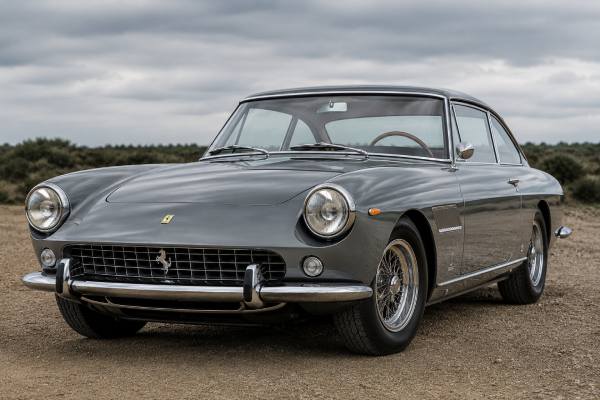
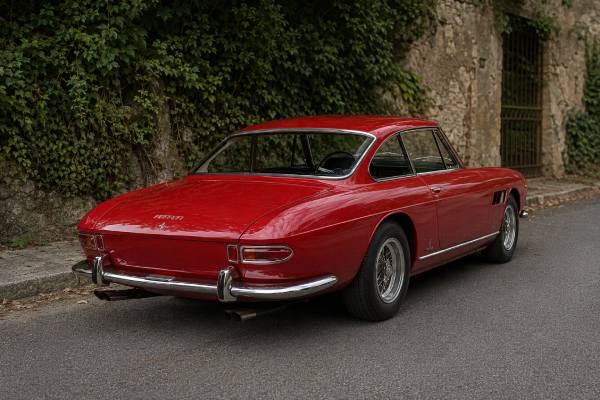
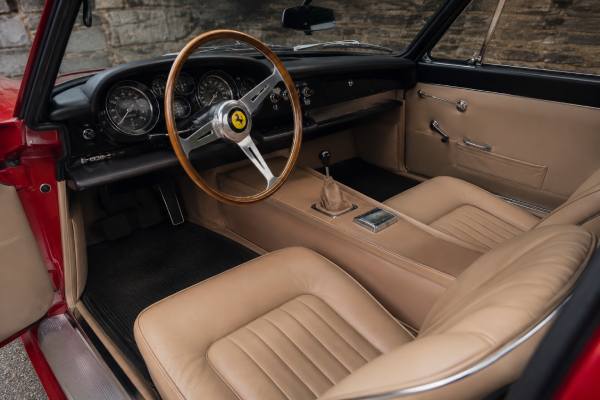
The Ferrari 330 GT 2+2 Series I is the early four-headlight version of Ferrari’s 4.0-litre V12 grand tourer, built for the 1964 and early 1965 production period on the Tipo 571 chassis and powered by the Tipo 209 engine. It replaced the transitional 330 America and moved Ferrari’s four-seat road car line from the 250 GT/E era into a larger, stronger, more mature grand touring package.
This was not the most glamorous Ferrari of the mid-1960s, and that is part of its appeal today. The 330 GT 2+2 Series I was built for owners who wanted V12 performance, Pininfarina coachwork, real touring ability, and usable rear seats rather than a stricter two-seat berlinetta. Its canted quad-headlight nose divided opinion when new, but it now gives the Series I its clearest visual identity. For buyers, the big questions are not simply speed or beauty. They are originality, matching numbers, corrosion, restoration quality, documentation, and whether the car is a pure Series I or one of the later interim cars that kept the early body style while gaining several Series II mechanical features.
Quick Take
The Ferrari 330 GT 2+2 Series I is best understood as a refined, fast, coachbuilt V12 touring Ferrari with genuine 1960s usability and a very specific identity: Tipo 571 chassis, Tipo 209 4.0-litre Colombo-derived V12, four-speed gearbox with overdrive, and the distinctive four-headlight Pininfarina body. Its strongest appeal is the combination of grand touring pace, four-seat practicality, and lower market entry than many two-seat Ferraris of the same era. The main caution is condition sensitivity; corrosion, tired mechanicals, missing trim, incorrect details, and old restorations can turn an apparently affordable car into a very expensive project.
Table of Contents
- History, Role and Collector Importance
- Tipo 209 Engine and Tipo 571 Specs
- Production, Series Changes and Options
- Pininfarina Design and Engineering Details
- Road Manners, Speed and GT Character
- Maintenance, Weak Points and Restoration Risk
- Values, Buying Checks and Alternatives
History, Role and Collector Importance
The 330 GT 2+2 Series I matters because it was Ferrari’s first fully developed 4.0-litre four-seat grand tourer, not just a bigger-engined continuation of the 250 GT/E. It gave Ferrari customers more torque, more space, a longer wheelbase, and a more modern touring character while keeping the front-engine V12 formula that defined the company’s best road cars of the period.
Ferrari had already learned that a 2+2 could be commercially important. The 250 GT/E proved that buyers would accept a Ferrari with occasional rear seats, a larger cabin, and genuine long-distance comfort. The 330 America briefly bridged the gap by placing a 4.0-litre engine into a body closely related to the 250 GT/E. The 330 GT 2+2 went further. It brought a new Pininfarina body, a longer 2,650 mm wheelbase, a stronger chassis, and the Tipo 209 V12, which was related to the Colombo engine family but developed for the larger 4.0-litre role.
The Series I debuted in 1964 and is immediately recognizable by its four-headlight front end. The outer lamps are larger than the inner lamps, and the canted arrangement gave the car a more international, almost American-influenced face. Some Ferrari traditionalists preferred the later Series II single-headlight treatment, but the early car’s “Chinese eyes” are now central to its collectability.
The car sat in an interesting place in Ferrari’s range. It was more practical than a 275 GTB, less exotic than a 500 Superfast, and less expensive today than many two-seat V12 Ferraris of the same period. Yet it still has the essential ingredients collectors care about: Pininfarina design, hand-built construction, a front-mounted V12, classic Ferrari odd-numbered chassis sequencing, and enough rarity to feel special without being unobtainable.
For modern collectors, the Series I has three main identities:
- The driver’s GT: a car meant for fast road use, long journeys, and regular exercise rather than static display.
- The early design statement: the only main production 330 GT 2+2 form with the distinctive quad-headlight nose.
- The value-sensitive classic Ferrari: still costly to restore and maintain, but often priced below the more celebrated two-seat models.
It is not a competition Ferrari, and buyers should not judge it as one. Its significance lies in Ferrari’s road-car business becoming broader, more comfortable, and more commercially mature in the 1960s. The 330 GT 2+2 helped prove that a Ferrari could be both a high-speed V12 car and a usable luxury grand tourer.
Tipo 209 Engine and Tipo 571 Specs
The key mechanical identity of the Series I is the pairing of the Tipo 209 4.0-litre V12 with the Tipo 571 tubular steel chassis. The result is a front-engine, rear-drive Ferrari GT with strong period performance, a long-legged overdrive transmission, and mechanical simplicity compared with later luxury Ferraris.
| Category | Specification |
|---|---|
| Production focus | 1964 to early 1965 Series I 2+2 coupé |
| Chassis type | Tipo 571 tubular steel chassis |
| Engine type | Tipo 209 front-mounted longitudinal 60-degree V12 |
| Displacement | 3,967.44 cc |
| Bore x stroke | 77 mm x 71 mm |
| Valve gear | Single overhead camshaft per bank, two valves per cylinder |
| Fuel system | Three twin-choke Weber carburettors, commonly 40 DCZ/6 or related period fitments |
| Compression ratio | 8.8:1 |
| Maximum power | 300 hp at 6,600 rpm |
| Lubrication | Wet sump |
| Transmission | Four-speed manual with electric overdrive |
| Drivetrain | Rear-wheel drive |
The engine is often described as Colombo-derived, but the 4.0-litre unit is not simply a bored-out small V12. The block was developed with wider bore spacing and better cooling capacity for the larger cylinders. That matters for both authenticity and maintenance. A proper rebuild requires knowledge of this engine family, not just general classic-car V12 experience.
The gearbox is one of the Series I’s defining features. Instead of the later five-speed used in Series II and interim cars, the early car uses a four-speed manual with overdrive. In good condition, the overdrive gives the car relaxed high-speed cruising. In neglected condition, it adds another layer of electrical and mechanical troubleshooting.
| Area | Specification |
|---|---|
| Front suspension | Independent unequal-length wishbones, coil springs, telescopic dampers, anti-roll bar |
| Rear suspension | Live rear axle with twin radius arms, semi-elliptic springs and coil-assisted telescopic dampers |
| Brakes | Four-wheel disc brakes |
| Steering | Worm-and-sector steering |
| Wheelbase | 2,650 mm |
| Length | 4,840 mm |
| Width | 1,715 mm |
| Height | 1,360 mm |
| Dry weight | About 1,380 kg |
| Fuel capacity | 90 litres |
| Tyres | 205 x 15 period specification |
| Top speed | About 245 km/h |
The suspension layout is typical of a high-quality GT from the period. The front end is sophisticated, while the rear live axle is robust and predictable when correctly set up. The car is not a lightweight sports racer, but its 300 hp V12 and long-legged gearing give it serious road pace. A healthy example should feel smooth, strong and flexible rather than peaky or nervous.
Production, Series Changes and Options
The most important identification point is the difference between a pure Series I, an interim car, and a Series II. For buyers, this distinction affects originality, parts correctness, driving feel, and market positioning.
Pure Series I cars are generally identified by the four-headlight Pininfarina body, Tipo 571 chassis reference, four-speed gearbox with overdrive, floor-hinged pedal layout, and early dashboard and trim details. Public auction descriptions and marque references commonly separate these from the later interim cars, even though interim cars keep the Series I front-end appearance.
The commonly cited production split is:
| Version | Main identifying traits | Collector notes |
|---|---|---|
| Series I | Four headlights, four-speed gearbox with overdrive, early cabin and pedal layout | About 503 pure Series I cars are commonly cited, including a small right-hand-drive subset |
| Series I “Interim” | Four-headlight body with later five-speed gearbox and several Series II-type mechanical updates | Usually treated separately because it blends early styling with later mechanical specification |
| Series II | Single headlights, five-speed gearbox, revised vents, updated cabin and later equipment | Often preferred by buyers who want the later look and usability upgrades |
For the article’s focus, the pure Series I is the important car. It is the early Tipo 571, Tipo 209, 4.0-litre, 300 hp version with the canted quad-headlight nose and four-speed overdrive transmission. Chassis and engine numbers are especially important because many cars went through periods of low values, deferred maintenance, incomplete restoration, or partial dismantling when they were worth far less than the cost of major work.
Numbers, documentation and authenticity
Ferrari road cars of this period used odd-numbered chassis numbers. On a 330 GT 2+2 Series I, buyers should verify the chassis number, engine number, body number if visible or documented, gearbox identity, rear axle identity, and any factory or Classiche-related paperwork available. Matching-numbers claims should be supported by documents, not just seller wording.
Useful documentation can include:
- Ferrari Classiche certification or marque expert reports
- factory build information where available
- old registrations and title history
- invoices from recognized Ferrari specialists
- restoration photos showing bare-metal and chassis work
- engine, gearbox, carburettor and brake rebuild invoices
- original manuals, pouch, tool roll and jack kit
- period color and trim information
A car with tired paint but strong documentation can be a better long-term buy than a glossy car with unknown structure and missing history. The 330 GT 2+2 is valuable enough to justify proper research, but not always valuable enough to recover the cost of a poorly planned restoration.
Factory colors and equipment
Series I cars were available in period Ferrari and Pininfarina colors, with leather interiors and a variety of special-order details. Surviving examples may have been repainted more than once, and color changes are common. Original colors such as darker greens, blues, silvers, greys, reds and whites can all suit the shape, but value depends more on correctness, quality, and documentation than on fashion alone.
Equipment can vary. Some cars were delivered with details such as a luggage shelf and straps, radios, different instruments for market requirements, and specific trim combinations. Power steering and air conditioning are more strongly associated with later development of the model, so a buyer should treat claims about unusual early equipment carefully and ask for proof.
Pininfarina Design and Engineering Details
The Series I is defined visually by Pininfarina’s four-headlight front end and mechanically by Ferrari’s attempt to make a larger V12 GT feel fast, refined and usable. It is a car of contrasts: traditional tubular construction underneath, but with a more spacious and modern road-car mission than earlier Ferrari 2+2s.
The body is longer and more formal than a two-seat Ferrari berlinetta. The cabin roofline, glass area and rear quarters were shaped around real touring use, not just occasional luggage space. The long bonnet still signals a front-mounted V12, while the upright cabin and generous rear section make the car feel more mature than the smaller 250 GT/E.
The nose is the part everyone remembers. The Series I uses two lamps per side, with the outer lamp larger than the inner. The lamps are canted within sculpted front wings, creating a face that some period observers found awkward and others found modern. Today, it is what separates the Series I from the more conservative Series II at first glance.
Pininfarina’s design also carried practical goals. The wide grille helped cooling, the long engine bay accommodated the 4.0-litre V12, and the cabin layout gave the car a usable driving position for long journeys. The design is not as delicate as a 250 Lusso and not as dramatic as a 275 GTB, but it has presence. In darker colors especially, a well-restored Series I can look elegant rather than merely unusual.
Coachbuilt character
Like many Ferraris of its era, the 330 GT 2+2 was not built with modern mass-production uniformity. Panel fit, trim detail and small body features can vary, and restoration quality matters enormously. A correct car should not be judged by modern production-car gap standards, but uneven doors, distorted sills, poor bonnet alignment, and mismatched trim can still signal deeper problems.
Important visual and structural areas include:
- lower front wings and headlight surrounds
- door bottoms and sill areas
- rear wheel arches and lower quarters
- boot floor and spare-wheel area
- bonnet, boot lid and hinge fit
- chrome quality and bumper alignment
- windscreen and rear-window surrounds
- lower nose and front chassis extensions
Good restorers preserve the coachbuilt feel without making the car look over-smoothed or modernized. Over-restoration can remove useful originality, while cheap cosmetic work can hide corrosion and old collision damage.
Engineering personality
The engineering is conservative in the best sense. The engine is naturally aspirated, carburetted, and mechanically direct. There are no electronic systems to mask a weak state of tune. The chassis is strong when healthy, the brakes are effective when properly rebuilt, and the overdrive gearbox suits high-speed road work.
The rear live axle is not a flaw by period standards. It gives the car durability and predictable behavior, especially on open roads. The key is condition. Worn rear location components, tired dampers, weak springs, old tyres, or incorrect alignment can make a 330 GT feel loose and heavy. A fresh car feels far more composed than its specification might suggest.
Road Manners, Speed and GT Character
A good 330 GT 2+2 Series I should feel like a fast, flexible 1960s V12 touring car rather than a razor-sharp sports car. Its best qualities are engine smoothness, long-distance pace, stable high-speed cruising, and the sense that the car was built to cover real miles.
The Tipo 209 V12 is the centre of the experience. It should start cleanly when properly set up, settle into a refined mechanical rhythm, and pull strongly from moderate revs. The 300 hp headline is important, but the more useful trait is flexibility. The car does not need to be thrashed to feel special. It gathers speed with a cultured, expensive sound that suits its grand touring role.
Carburettor condition changes the entire character. A correctly tuned car feels crisp and progressive. A poorly tuned one may hesitate, smell rich, foul plugs, run hot in traffic, or feel flat despite the impressive specification. Buyers should drive the car from cold and hot, because warm-start behavior, idle quality, fan operation, fuel delivery and heat soak problems often appear only during a proper inspection drive.
Gearbox and overdrive feel
The four-speed gearbox with overdrive gives the Series I a distinct driving feel compared with the later five-speed cars. The basic gearbox should feel mechanical and deliberate, not vague or obstructive. Synchromesh must be treated with respect, especially when cold. Once warm, a healthy unit should shift cleanly with an unhurried hand.
The overdrive is useful on faster roads. It lowers engine speed and makes the car feel more relaxed at touring pace. It also needs to work reliably. Hesitation, failure to engage, electrical faults, noisy operation, or slipping under load should be investigated before purchase. The system is part of what makes the Series I correct, so deleting or bypassing it is not a desirable solution for a collector-grade car.
Steering, brakes and ride
The steering is heavier than a modern car at low speeds and more natural once moving. It should not feel loose, notchy or excessively vague. Play at the wheel can come from the steering box, linkages, suspension wear, wheel bearings, or old tyres. Correct tyres make a large difference; modern rubber with unsuitable construction or size can spoil the steering weight and ride.
The disc brakes are capable for period fast-road use, but expectations must be realistic. There is no ABS, no stability control, and no modern brake assist calibration. A properly rebuilt system should stop the car straight and confidently. Pulling, long pedal travel, binding calipers, fluid leaks, servo weakness or vibration under braking are warning signs.
Ride quality is one of the car’s strengths. The wheelbase and touring suspension give it a settled feel over flowing roads. It is not as agile as a short-wheelbase two-seat Ferrari, but it should not feel clumsy. On mountain roads, the 330 GT rewards smooth inputs, measured braking, and early throttle application. It is a car to guide rather than throw.
Usability and limitations
The cabin is more usable than many classic Ferraris, with better space, luggage capacity and visibility than stricter sports models. Rear seats are best for smaller adults or children, but they are meaningful in a way many “2+2” rear seats are not. Ventilation, heat management and noise depend heavily on restoration quality, sealing, exhaust condition and climate.
The safety limitations are period-correct. Seatbelts may vary by market and later installation, and there are no modern crash structures, airbags, traction systems or electronic driver aids. That does not make the car unusable, but it does mean speed should be treated with respect, especially on old tyres or unfamiliar roads.
Maintenance, Weak Points and Restoration Risk
The 330 GT 2+2 Series I is durable when exercised and maintained by the right specialists, but neglect is expensive. The main ownership risk is not one famous defect; it is the combined cost of V12 engine work, corrosion repair, gearbox and overdrive attention, brake rebuilding, trim restoration, and missing Ferrari-specific parts.
A pre-purchase inspection by a classic Ferrari specialist is essential. General classic-car knowledge is not enough. The inspector needs to understand 1960s Ferrari chassis construction, Colombo-family V12s, Weber carburettors, Dunlop brake systems, Borrani wheels, overdrive gearboxes, coachbuilt body repair and documentation standards.
Engine and fuel system
The Tipo 209 V12 is a high-quality engine, but it is expensive to rebuild correctly. Warning signs include low or unstable oil pressure, smoke, coolant contamination, overheating, uneven compression, noisy valve gear, poor hot starting, persistent oil leaks, fuel smells, and uneven carburettor response.
Key maintenance and inspection points include:
- compression and leak-down testing
- oil pressure hot and cold
- cooling-system condition, including radiator, hoses and water passages
- correct carburettor type and linkage condition
- fuel pumps, filters, tanks and lines
- ignition components, coils, distributor condition and plug fouling
- exhaust leaks and manifold condition
- evidence of proper valve adjustment and regular oil changes
Cars that have spent years on static display often need recommissioning even if they look excellent. Fuel varnish, stuck brakes, hardened seals, weak hoses, stale coolant, flat-spotted tyres and electrical faults can appear quickly once the car returns to real use.
Transmission, overdrive and driveline
The four-speed-plus-overdrive transmission is part of the Series I’s authenticity. A weak gearbox can be expensive, but a faulty overdrive can be equally frustrating. During a road test, check shift quality when cold and warm, clutch take-up, driveline vibration, differential noise, overdrive engagement, and whether the unit stays engaged under load.
Clutch replacement is not just a parts bill; access and labor matter. Universal joints, propshaft balance, rear axle mounts and differential condition should also be checked. A rumble or whine may not be urgent, but it should affect the price.
Brakes, suspension and wheels
The braking system needs careful attention because long storage is hard on hydraulic components. Rebuilt calipers, fresh hoses, a sound master cylinder, good discs, correct pads and a working servo transform the car. A car that “just needs bleeding” may actually need a full brake-system overhaul.
Suspension wear is also common. The buyer should inspect wishbone bushes, ball joints, dampers, rear axle location, springs, anti-roll-bar mounts, wheel bearings and steering links. A tired car can feel heavy and imprecise. A properly sorted car feels calm and expensive.
Borrani wire wheels need close inspection. Look for worn splines, loose spokes, corrosion, rim damage and poor balancing. Old tyres are a safety risk even when tread looks good. Tyre date codes and correct sizing should be part of the inspection.
Corrosion and body restoration
Corrosion is one of the largest cost drivers. The body may present well while the structure underneath needs major work. Inspect the sills, floorpans, lower wings, rear arches, boot floor, battery area, door bottoms, front chassis extensions, suspension pickup areas and window surrounds. Use a lift. A magnet and paint-depth gauge can help, but they do not replace expert inspection.
Poor repairs are common because the 330 GT 2+2 spent years as a relatively undervalued Ferrari. Some cars were patched rather than properly restored. Others were dismantled and later reassembled with missing or incorrect parts. A thick history file, restoration photos and specialist invoices can be more valuable than a fresh shine.
Values, Buying Checks and Alternatives
The 330 GT 2+2 Series I remains one of the more accessible classic V12 Ferraris, but “accessible” is relative. Purchase price is only one part of the decision; restoration exposure, engine health, corrosion, documentation and originality can outweigh a tempting auction result.
Recent public market data shows a broad spread. Project-level or long-static cars can sell well below strong drivers, while well-documented, matching-numbers cars with good colors, known history and correct presentation can move into a much stronger price band. Series I values often sit below the most desirable two-seat Ferraris of the period and usually below the 330 GTC, but the best examples are not cheap to buy or restore.
What drives value
The strongest cars usually have a combination of correct identity, strong history and proven mechanical health. Buyers should pay close attention to:
- matching-numbers engine and documented chassis identity
- confirmed Series I specification rather than vague “early 330” wording
- original or documented factory color and trim
- long-term ownership history
- Ferrari Classiche or respected marque-expert documentation
- high-quality restoration by known specialists
- recent mechanical invoices, not just cosmetic work
- complete tools, jack, manuals and owner’s pouch
- correct carburettors, wheels, instruments and trim
- clean body structure with evidence of proper metalwork
A car without these strengths can still be enjoyable, but it should be priced honestly. The most dangerous purchase is a shiny car with uncertain structure, no recent mechanical sorting, missing original parts and a story that changes under questioning.
Inspection checklist
A serious buyer should treat the inspection as a staged process:
- Confirm identity: chassis number, engine number, registration history and any factory or specialist records.
- Separate the version: pure Series I, interim, or Series II-style updates.
- Inspect the structure on a lift, especially sills, floors, suspension points and lower bodywork.
- Test the engine hot and cold, including oil pressure, cooling behavior and carburettor response.
- Road test the gearbox, clutch, overdrive, brakes, steering and rear axle.
- Review invoices for real work, not just storage, detailing or light servicing.
- Price the car against the cost of making it safe, correct and enjoyable.
Avoid cars that cannot be inspected properly, cars with unclear numbers, cars that overheat during a short drive, cars with fresh paint over unknown metal, and cars presented as “fully restored” without invoices or photos. Be careful with long-static collection cars. They may have excellent provenance, but they often need careful recommissioning before road use.
Rivals and alternatives
The closest Ferrari alternatives are the 250 GTE 2+2, 330 America, 330 GT 2+2 Series II, 365 GT 2+2, and 330 GTC. The 250 GTE is earlier and more delicate in feel. The 330 America is rarer but more transitional. The Series II is more conventional-looking and has the five-speed gearbox. The 365 GT 2+2 is larger, softer and more luxurious. The 330 GTC is far more sporting and much more expensive.
Non-Ferrari rivals include the Maserati Sebring, Maserati 3500 GT, Aston Martin DB5 or DB6, Lamborghini 400 GT 2+2, Iso Rivolta, and other high-end European GTs from the same period. The Lamborghini 400 GT 2+2 is probably the closest in concept: front V12, Italian style, four-seat usability, and collector interest. The Aston Martins offer stronger British GT recognition and elegant touring manners. The Maseratis can be beautiful and charismatic, often at a lower entry price, but they do not carry the same Ferrari V12 market pull.
For the right buyer, the 330 GT 2+2 Series I is compelling because it offers the sound, engineering and presence of a 1960s Ferrari V12 in a car that can genuinely be driven. It is not the car to buy for quick profit or cheap ownership. It is the car to buy when the documentation is strong, the structure is sound, the engine is healthy, and the four-headlight identity feels like character rather than compromise.
References
- Ferrari 330 GT 2+2 Specifications 2025 (Specifications)
- 1966 Ferrari 330 GT 2+2 Series II 2024 (Market and Model History)
- 1964 Ferrari 330 GT 2+2 Series I by Pininfarina | Paris 2026 | RM Sotheby’s 2026 (Auction Record)
- Ferrari 330 GT 2+2 Series I Market – CLASSIC.COM 2026 (Market Data)
- Price Guide: Ferrari 330 GT 2+2 [UPDATED 2026] 2026 (Market Data)
Disclaimer
This article is for informational purposes only and is not a substitute for professional diagnosis, inspection, maintenance or repair. Specifications, torque values, service intervals, factory details and procedures can vary by chassis number, market, equipment, production changes and restoration history. Always verify any technical work against official service documentation and consult a qualified classic Ferrari specialist before buying, repairing or restoring a vehicle.
If this guide helped you, please consider sharing it on Facebook, X/Twitter or your preferred enthusiast community to support our work.