


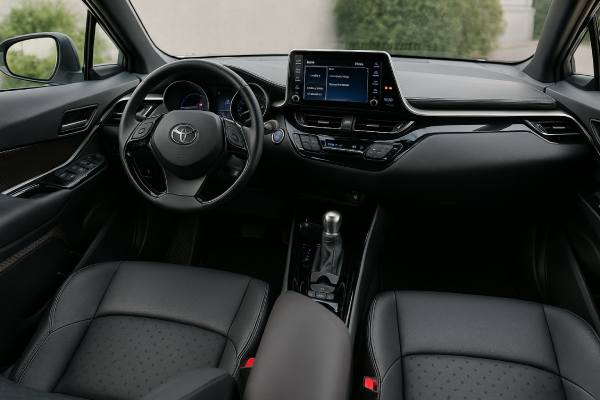
The all-wheel-drive Toyota C-HR (NGX50) pairs the sharp TNGA-C chassis with a compact 1.2-litre turbo petrol and an on-demand AWD system designed for poor weather confidence rather than trail work. It looks bold, but the engineering is quietly sensible: a rigid body with multi-link rear suspension, careful noise isolation, and predictable controls. The 8NR-FTS engine majors on flexibility, delivering a broad torque plateau that suits urban slopes and wet junctions. Importantly, the AWD hardware is compact and efficient: a multi-plate clutch sends torque to the rear axle only when needed, keeping cruising losses low. Compared with 2WD, AWD brings extra mass and slightly higher consumption, but also calmer step-off on slippery surfaces and fewer traction-control cut-ins. If you live with winter, steep driveways, or muddy lanes, the NGX50 strikes a practical balance—secure, economical for a petrol AWD, and straightforward to maintain with widely available fluids and parts.
Quick Specs and Notes
- Secure on bad roads: TNGA-C chassis, multi-link rear, and on-demand AWD for confident wet/snow starts.
- Easy daily torque: 8NR-FTS turbo four with 185 Nm (136 lb-ft) from low revs; smooth CVT pairing.
- Safety-first: strong crash protection and Toyota Safety Sense with effective AEB and lane assist availability.
- Watch item: direct-injection intake valve deposits on higher mileage; plan periodic induction cleaning if symptoms appear.
- Typical service: oil and filter every 12 months or 10,000–15,000 km; brake fluid every 2 years.
What’s inside
- C-HR AWD overview 2016–2019
- Specifications and technical data
- Trims, safety, and driver assistance
- Reliability, issues, and service actions
- Maintenance and buyer’s guide
- Driving and performance
- How the C-HR AWD compares
C-HR AWD overview 2016–2019
The NGX50 all-wheel-drive C-HR was engineered for European climates where wet cobbles, frost, and steep village lanes are routine. It uses Toyota’s on-demand Dynamic Torque Control AWD—an electronically controlled multi-plate clutch ahead of the rear differential—to vary front/rear torque from 100:0 in normal cruising to a meaningful rear assist when the front wheels slip or when the system anticipates loss of grip. This approach preserves the car’s tidy front-drive character in the dry, yet calms wheelspin on greasy starts without heavy-handed stability control. The rear suspension remains a proper multi-link (unusual in the class), so mid-corner bumps don’t knock the car off line, and the cabin stays impressively quiet for a small crossover.
Power comes from the 8NR-FTS 1.2-litre direct-injection turbo four. Rather than chasing a peak number, it spreads 185 Nm from roughly 1,500 to 4,000 rpm; paired exclusively to a well-calibrated CVT in AWD form, it feels stronger in the real world than its 116 hp (85 kW) suggests. You won’t win sprints, but you will glide through traffic, handle hills without fuss, and merge confidently if you plan your throttle. The TNGA-C body is stiff and uses extensive high-strength steel, so the suspension can be tuned for both compliance and control. The result is a crossover that rides like a mature hatchback: composed, with little float or heave even on wavy B-roads.
Practicality is honest. The front seats are supportive, the driving position is natural, and noise levels at 120 km/h (75 mph) are low for the class. The styling’s high rear quarters reduce over-shoulder visibility; standard parking sensors or a camera mitigate that. AWD adds weight and a prop shaft, nudging economy upward by roughly half a litre per 100 km versus 2WD in like-for-like trims. In return you get surefooted step-off in sleet and fewer interventions from traction control on wet roundabouts. If you regularly face icy mornings or muddy pull-outs, the AWD’s calmer, more progressive traction is the real benefit you feel every week.
Specifications and technical data
Figures below cover the Toyota C-HR AWD (NGX50), 1.2-litre 8NR-FTS petrol, model years 2016–2019 in Europe. Values vary slightly by wheel/tyre package and local homologation.
Engine and Performance
| Item | Specification |
|---|---|
| Engine code | 8NR-FTS (D-4T direct-injection turbo) |
| Layout & valvetrain | Inline-4, DOHC, Dual VVT-i/VVT-iW, 4 valves per cylinder |
| Bore × stroke | 71.5 × 74.5 mm (2.81 × 2.93 in) |
| Displacement | 1.197 L (1,197 cc) |
| Induction | Single-scroll turbocharger with intercooler |
| Compression ratio | 10.0:1 |
| Max power | 116 hp (85 kW) @ ~5,200–5,600 rpm |
| Max torque | 185 Nm (136 lb-ft) @ 1,500–4,000 rpm |
| Fuel system | Direct injection (D-4T) |
| Emissions/efficiency std. | Euro 6 |
| Rated combined economy (NEDC/WLTP) | ~5.9–6.7 L/100 km (40–35 mpg US / 48–42 mpg UK) |
| Real-world highway @ 120 km/h | ~7.2–7.9 L/100 km (33–30 mpg US / 40–36 mpg UK) |
| Aerodynamics | Cd ≈ 0.32 with under-covers |
Transmission and Driveline
| Item | Specification |
|---|---|
| Transmission | CVT (AWD cars are CVT-only) with step-shift logic |
| Final drive ratio | ~3.8 (varies slightly by wheel/tyre) |
| Drive type | On-demand AWD (Dynamic Torque Control) |
| Rear drive coupling | Electronically controlled multi-plate clutch |
| Differentials | Open front and rear; brake-based torque vectoring via VSC/TRC |
Chassis and Dimensions
| Item | Specification |
|---|---|
| Platform | TNGA-C |
| Front suspension | MacPherson strut, coil, stabiliser |
| Rear suspension | Double-wishbone/multi-link with stabiliser |
| Steering | Electric power steering; ~2.7 turns lock-to-lock |
| Brakes (front/rear) | Ventilated disc / solid disc; ABS, EBD, brake assist |
| Wheels/tyres | 17–18 in factory packages; 215/60 R17 or 225/50 R18 typical |
| Ground clearance | ~142 mm (5.6 in) |
| Length × width × height | ~4,360 × 1,795 × 1,565 mm (171.7 × 70.7 × 61.6 in) |
| Wheelbase | 2,640 mm (103.9 in) |
| Turning circle (kerb-to-kerb) | ~10.6–10.8 m (34.8–35.4 ft) |
| Kerb (curb) weight | ~1,380–1,420 kg (3,042–3,131 lb), spec-dependent |
| Fuel tank | 50 L (13.2 US gal / 11.0 UK gal) |
| Cargo volume (VDA) | ~377 L seats up; ~1,164 L seats down |
Performance and Capability
| Metric | Figure |
|---|---|
| 0–100 km/h (0–62 mph) | ~11.2–11.4 s |
| Top speed | ~180–185 km/h (112–115 mph) |
| Braking 100–0 km/h | Class-typical; stable with quality tyres |
| Towing (braked/unbraked) | Market-dependent; confirm VIN plate |
| Payload | Trim-dependent; check door-jamb label |
| Roof load | Typically 50–75 kg (110–165 lb) with approved bars |
Fluids and Service Capacities
| System | Spec / Grade | Capacity* |
|---|---|---|
| Engine oil | 0W-20, API SN+/SP, ILSAC GF-5/6 | ~4.0 L (4.2 US qt) |
| Engine coolant | Toyota Super Long Life Coolant (pink) | ~6.4–6.7 L (6.8–7.1 US qt) |
| CVT | Toyota CVT Fluid FE (temperature-set level) | ~7.4–7.9 L (7.8–8.3 US qt) incl. service |
| Rear differential | API GL-5 75W-85 (Toyota Hypoid Gear Oil) | ~0.8–1.0 L (0.8–1.1 US qt) |
| Rear coupling/transfer | Typically GL-5 75W-85; check VIN-specific spec | ~0.6–0.9 L (0.6–1.0 US qt) |
| A/C refrigerant | R1234yf; ND-11/ND-12 oil | ~470 g (16.6 oz), verify bonnet label |
| Spark plugs | Long-life iridium; gap ~0.7–0.8 mm | 4 plugs |
| Wheel lug torque | ~103 Nm (76 lb-ft)** | — |
*Workshop-typical; verify by VIN before service.
**Accessory wheels may differ—use the owner’s manual value.
Electrical
| Item | Specification |
|---|---|
| 12 V battery | 45–60 Ah AGM/EFB (equipment-dependent) |
| Alternator | Compact, high-output; sized for LED/ADAS load |
| Ignition | Coil-on-plug; ECU-controlled knock strategy |
Safety and Driver Assistance
| Area | Notes |
|---|---|
| Crash ratings | This C-HR generation achieved five stars under Euro NCAP protocols of the period |
| Headlights | Halogen or LED by grade; LED with AHB improves reach and cut-off |
| ADAS suite | Toyota Safety Sense: AEB (vehicle/pedestrian), Lane Departure Alert with steering assist, Road Sign Assist; Adaptive Cruise availability by trim |
| Child seats | ISOFIX/LATCH outboard rear with top-tethers |
| Structure | High-strength TNGA shell; multiple airbags including head curtains |
Trims, safety, and driver assistance
Trim walk (names vary by country; content pattern is consistent)
- Icon/Active (entry): 17-inch alloys, reversing camera, Toyota Safety Sense, 7–8 in touchscreen (Touch 2), cloth seats, manual or dual-zone climate by market.
- Design/Mid: Adds parking sensors (often via pack), privacy glass, richer interior trim, additional USB points, and optionally upgraded wheels.
- Excel/Dynamic (high): LED headlamps/DRLs, keyless entry/start, heated front seats, power lumbar, blind-spot monitor and rear cross-traffic alert (often in a Tech Pack), JBL audio option, 18-inch wheels.
Mechanical or functional differences by trim
- AWD hardware is standard across NGX50 variants; there are no low-range or locking differentials.
- Wheel/tyre packages subtly shift the ride/noise balance: 18s look sharp but transmit more texture; 17s give the best comfort and winter-tyre availability.
- Lighting is a real-world safety upgrade—factory LED lamps meaningfully improve night confidence over halogen reflectors.
Year-to-year changes (2016–2019)
- 2016 launch (MY2017 in many markets): AWD introduced with the 1.2T, CVT only; Toyota Safety Sense widely fitted.
- 2018: Minor infotainment and trim updates.
- 2019 (pre-facelift end): Packaging tweaks; markets begin pivoting to hybrid focus post-2019.
Safety ratings and ADAS
- The C-HR platform secured a strong five-star result with robust adult and child protection and effective active-safety support. Toyota’s tuning for AEB and Lane Departure Alert with steering assist is notably unobtrusive. Adaptive Cruise Control is grade-dependent on early cars; confirm presence during a test drive. After windscreen work or front-end repairs, camera/radar calibration is required for proper lane-keeping and AEB performance.
Reliability, issues, and service actions
Overall the NGX50 is a durable, low-drama daily when serviced annually with the correct fluids. The few patterns owners encounter are common to small direct-injection turbos and compact CVTs rather than unique flaws.
Engine and induction (8NR-FTS)
- DI intake valve carbon build-up — Occasional / Medium
Symptoms: Rough cold idle, light misfires (P0300 series), hesitation on small throttle, typically beyond 60,000–100,000 km with short-trip use.
Root cause: No fuel wash over valve backs in DI; oil mist/EGR particulates adhere.
Remedy: Walnut-shell blasting or chemical clean; refresh iridium plugs; check PCV operation and perform MAF/throttle cleaning. - Wastegate/actuator rattle or intermittent under-boost — Occasional / Low–Medium
Symptoms: Metallic buzz on lift-off, sporadic under-boost code, soft mid-range.
Cause: Linkage wear or sticking; occasionally vacuum routing or solenoid control.
Fix: Inspect linkage play, vacuum lines, and learn values; adjust/replace actuator; apply relevant calibration updates if available. - Coolant hose/tee seep — Rare / Low
Symptoms: Slow reservoir drop, faint sweet smell.
Fix: Pressure test; replace the culprit hose/clamp; refill with Toyota S-LLC premix and bleed correctly.
Fuel/ignition
- Coil-on-plug ageing — Occasional / Low–Medium
Symptoms: Load-related misfire on one cylinder.
Fix: Replace affected coil and plugs; verify plug gap and heat range.
Transmission and AWD driveline
- CVT fluid ageing (Toyota CVT FE) — Occasional / Medium
Symptoms: Brief flare on brisk throttle, light take-off shudder around 80,000–120,000 km, or a faint whine.
Fix: Drain/fill with CVT FE; set level at temperature; perform adaptation where applicable. Check engine/gearbox mounts. - Rear coupling/diff service neglect — Rare / Low–Medium
Symptoms: Driveline hum or chatter at low speeds after severe use.
Fix: Replace rear diff and coupling/transfer oils with VIN-correct GL-5 75W-85; inspect for uneven tyre diameters (AWD systems dislike mismatches).
Chassis and body
- Rear brake corrosion ridges (salted climates) — Common / Low
Symptoms: Light scraping, reduced handbrake bite.
Fix: De-lip or replace discs/pads; clean and lube sliders; rotate wheels at each service. - Subframe/fastener surface corrosion — Occasional / Low
Fix: Clean, treat, and rinse the under-body after winter; monitor brake and fuel lines near clips.
HVAC/electronics
- Cabin microfilter neglect → blower noise — Common / Low (replace yearly).
- ADAS calibration drift after glass work — Occasional / Medium (perform camera/radar calibration; verify thrust angle/alignment).
Recalls/service campaigns (high-level)
- Electric Parking Brake (EPB) logic update: On certain early vehicles, skid-control ECU software could inhibit EPB application/release; remedy is a dealer software update.
- Market-specific minor campaigns: Labels or seatbelt component updates in defined VIN ranges. Always run an official VIN recall check and confirm dealer records before purchase.
Pre-purchase checks that pay off
- Full annual oil service history with the correct 0W-20 spec.
- Proof of CVT drain/fill by time/mileage and any software updates.
- Ignition/induction work (plugs/coils/valve clean) on higher-mileage urban cars.
- ADAS calibration certificate if the windscreen was replaced.
- Rear brake condition and even tyre wear (AWD benefits from matching tyre sets).
- A printed VIN recall check with proof of completed actions.
Maintenance and buyer’s guide
Practical maintenance schedule (verify by VIN and local booklet)
- Engine oil & filter: Every 12 months or 10,000–15,000 km. 0W-20 API SN+/SP, ILSAC GF-5/6. ~4.0 L service fill.
- Engine air filter: Inspect 20,000 km; replace 30,000–45,000 km (earlier in dusty use).
- Cabin filter: Replace annually (more often in urban/pollen seasons).
- Spark plugs (iridium): 90,000–120,000 km or 6–7 years; gap ~0.7–0.8 mm.
- Coolant (S-LLC): First change at 10 years/160,000 km, then 5 years/80,000 km thereafter.
- CVT fluid (Toyota CVT FE): Inspect by 60,000–90,000 km; drain/fill if oxidised/dark or on shift-quality symptoms.
- Rear diff & coupling/transfer oils: Inspect 60,000–90,000 km; replace if discoloured or after deep-water/winter abuse (VIN-correct GL-5 75W-85).
- Brake fluid: Replace every 2 years; confirm moisture content.
- Brakes (pads/rotors): Inspect each service; de-lip rears in salted climates; lube pins.
- Serpentine belt & hoses: Inspect 60,000 km/4 years; replace on noise/cracking or at cooling-system service.
- PCV/induction: Inspect 60,000–90,000 km; clean MAF and throttle; consider valve clean if rough idle/misfires appear.
- 12 V battery: Test annually after 4 years; ADAS is voltage-sensitive.
- Tyres and alignment: Rotate 10,000–12,000 km; keep identical brands and tread depths axle-to-axle for AWD health.
Fluid specifications and essential torques
- Oil: 0W-20, API SN+/SP, ILSAC GF-5/6 (low-speed pre-ignition protection).
- Coolant: Toyota Super Long Life Coolant (pink premix).
- CVT: Toyota CVT Fluid FE only; set level at specified temperature.
- AWD oils: VIN-correct GL-5 75W-85 in rear diff and coupling/transfer housings.
- A/C: R1234yf; charge mass on bonnet label (~470 g typical).
- Essential torques: Wheel lugs ~103 Nm (76 lb-ft); spark plugs ~20–25 Nm (follow plug maker).
Buyer’s checklist (quick, effective)
- Cold start & idle: Settles quickly; DI tick is normal, no stumble.
- AWD behaviour: Smooth, drama-free launches on wet gravel; no clunks from the rear coupling.
- CVT feel: No “rubber-band” flare on modest throttle; quiet cruise at 120 km/h.
- Ride/noise: 17-inch tyres are the refinement sweet spot; listen for hums that rise with speed (tyres/wheel bearings).
- Brakes: Progressive pedal; rear discs free of rust lips; even inner pad wear.
- ADAS & lighting: Verify AEB/LDW/ACC functions; check LED beam aim where fitted.
- Under-body: Look for surface corrosion on subframes and fasteners; brake lines secure at clips.
- Paperwork: Oil services, brake fluid changes, any AWD oil service, CVT drain/fill, software updates, and a recent VIN recall check.
Durability outlook
Serviced on time with correct fluids, the NGX50 proves a calm, durable commuter that shrugs off winter. The AWD hardware is simple and stout; tyres and alignment matter most for long-term smoothness. Plan for periodic DI valve cleaning as mileage and short-trip use accumulate, and keep the CVT fluid healthy; do that and ownership is pleasantly uneventful.
Driving and performance
Ride, handling, NVH
The TNGA-C chassis gives the C-HR an unusually mature feel for a small crossover. It glides over sharp edges without crashiness and stays settled over undulating surfaces. The multi-link rear absorbs mid-corner bumps cleanly, so you can keep a steady throttle on imperfect roads. Steering is accurate rather than chatty, with tidy self-centring and predictable weight. Noise levels on 17-inch tyres are low at motorway speeds; 18s sharpen initial turn-in but add tyre roar on coarse asphalt.
Powertrain character
The 8NR-FTS is tuned for everyday torque, not drama at the redline. It pulls early, so you seldom need more than 3,000–3,500 rpm for brisk town work. The CVT calibration keeps revs modest under light–medium throttle and uses “step-shift” behaviour under firmer inputs to avoid the droning many people associate with CVTs. For overtakes, a decisive pedal press calls up a lower virtual ratio smartly. Turbo lag is minimal in normal use; response off idle is consistent and repeatable, even on cold mornings.
AWD traction and control
Dynamic Torque Control AWD mainly helps in the first car-length on slippery surfaces and when one front tyre is on a poor patch. Instead of a sudden traction-control cut, you get a smooth launch and a calm EPS feel. There is no low-range or locking diff—this is a road-biased system—but with sensible tyres it makes winter journeys far less stressful. Stability control is well judged; it trims excess without shutting the party down.
Braking and consistency
Pedal tuning offers a natural bite point and linear build-up; repeated hard stops are limited by tyre grip more than hardware fade in normal road use. With winter tyres fitted, ABS logic remains refined; the car stops straight without nervous pulsing.
Efficiency in the real world
Expect ~7.2–7.9 L/100 km at 120 km/h depending on conditions and wheel size. Mixed commuting in temperate weather typically returns ~6.3–7.1 L/100 km (37–33 mpg US / 44–40 mpg UK). Cold starts, short hops, and roof bars raise consumption; gentle throttle and 17-inch tyres help.
Loads and light towing
With two adults, kids, and luggage, the C-HR remains composed and resists crosswind wander. If your registration permits towing, stay within the VIN plate figure, use a dedicated wiring kit, and budget extra fuel. Under moderate trailer load, consumption increases noticeably; plan a conservative following distance to preserve brake feel on long descents.
How the C-HR AWD compares
Nissan Qashqai 1.2/1.3 with AWD (market-dependent)
Roomier rear bench and boot, and the later 1.3 turbo is stronger on paper. The Toyota counters with subtler ride control and quieter cruising. C-HR cabin materials and switchgear tactility feel more premium over time.
Mazda CX-3/CX-30 AWD (2.0 NA)
Mazda’s naturally aspirated engine is smooth but needs revs; Toyota’s turbo torque is more relaxed in hills and overtakes. Both steer accurately; the C-HR’s motorway hush and secondary ride isolation are standouts.
Hyundai Kona 1.6 T-GDi AWD (where offered)
Kona is quicker and often keener on price. The Toyota brings a calmer long-trip gait, a more polished multi-link rear, and excellent perceived durability. If you live on coarse-chip roads, the C-HR’s NVH tuning pays daily dividends.
Renault Captur AWD alternatives
Captur focuses on front-drive; where AWD options exist in class, Toyota’s hardware integration and calibration feel more seamless. ADAS tuning in the C-HR is notably unobtrusive.
SEAT Ateca small-engine AWD
Ateca offers space and lively TSI engines. The Toyota trades some outright pace for finish quality and all-weather composure in a smaller footprint, which many urban buyers prefer.
References
- C-HR Gen1 Press Information (Nov 2016) 2016 (Press Kit)
- Toyota C-HR Technical Specifications 2021 (Technical Specifications)
- Toyota C-HR (2017) – Euro NCAP Result 2017 (Safety Rating)
- Toyota Recall Checker 2023 (Recall Database)
Disclaimer
This guide is for informational purposes and does not replace professional diagnosis or repair. Specifications, torque values, service intervals, and procedures vary by VIN, model year, market, and equipment. Always verify against your vehicle’s official service and owner documentation and the latest manufacturer publications before servicing or purchase decisions. If this article helped, please consider sharing it with fellow owners on Facebook or X (Twitter) to support xcar’s work.