

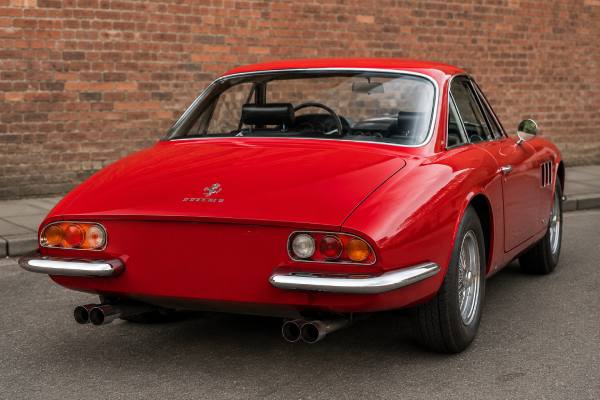

The Ferrari 500 Superfast Series I was Ferrari’s ultra-exclusive flagship grand touring coupé of 1964–1965, powered by the Tipo 208 5.0-liter V12 rated at 400 hp. Built by Pininfarina on Ferrari’s front-engine V12 grand touring architecture, it sat above the regular 330 GT 2+2 and carried forward the spirit of the America and Superamerica line: high speed, luxury, custom specification, and very low production.
The Series I matters because it joined two sides of Ferrari history that rarely met in one car. It had the long-distance elegance expected by royalty, industrialists, and celebrity clients, but it also had one of Ferrari’s strongest road-car engines of the period. With a claimed top speed of about 280 km/h, it was not simply a formal coachbuilt Ferrari. It was a genuinely fast, expensive, and technically serious grand tourer.
Today, people search for the 500 Superfast Series I because it is rare, complicated, beautiful, and difficult to buy well. A correct car depends on provenance, factory records, body authenticity, engine identity, restoration quality, and the condition of parts that can be extremely expensive to repair or recreate.
Quick Take
The Ferrari 500 Superfast Series I is most appealing as a hand-built Pininfarina flagship with a 400 hp Tipo 208 V12 and the calm, aristocratic speed of a mid-1960s Ferrari GT. Its identity is not that of a lightweight racer, but of a coachbuilt, high-speed road car made for a tiny group of privileged clients. The main caution is ownership complexity: body repairs, engine work, gearbox details, trim restoration, and missing documentation can change the real value by a huge margin. For buyers, originality, Classiche-style documentation, matching components, and restoration quality matter more than mileage alone.
Table of Contents
- History, Position, and Collector Significance
- Engine, Chassis, and Key Specifications
- Production, Series Changes, and Factory Options
- Design, Engineering, and Special Features
- Driving Feel and Period Performance
- Reliability, Maintenance, and Restoration Reality
- Market Value and Collector Buying Guide
History, Position, and Collector Significance
The 500 Superfast Series I was Ferrari’s most prestigious road-going grand tourer when it arrived in 1964. It replaced the 400 Superamerica as the top expression of Ferrari’s wealthy-client GT tradition, combining Pininfarina coachwork with a large-displacement V12 and very limited production.
Ferrari introduced the 500 Superfast at a time when the company’s road-car range was changing quickly. The 250 GT Lusso was nearing the end of its run, the 275 GTB would soon bring a more modern sporting character, and the 330 GT 2+2 gave Ferrari a more usable four-seat grand tourer. The 500 Superfast sat above them all. It was bigger, rarer, more powerful, and far more expensive.
Its place in Ferrari history is tied to the America and Superamerica cars of the 1950s and early 1960s. Those cars were not mass-market models. They were built for a small circle of clients who wanted the fastest and most luxurious Ferrari road cars available. The 500 Superfast continued that idea but with cleaner Pininfarina styling, a more mature cabin, and the final flourish of the coachbuilt flagship coupé era.
The car also arrived before the modern language of “supercars” became common. Its role was different from later mid-engine Ferraris. It did not shout through wings, scoops, or exposed racing hardware. Instead, it used a long hood, a powerful front-mounted V12, and a carefully tailored body to deliver high speed in a discreet form. For the period, that was a very Ferrari solution: speed without losing elegance.
Pininfarina was central to the model’s identity. The 500 Superfast was not merely a Ferrari chassis with a body placed on top. Its design was part of a line of aerodynamic Ferrari coupés developed through the 400 Superamerica and Superfast show cars. The result was low, long, and smooth, with a fastback roofline and a rear section that gave the car real presence without making it look heavy.
The customer list is part of the car’s lasting reputation. Examples were associated with international figures, royal families, major collectors, film stars, and powerful business owners. That history still matters because provenance can strongly influence value. A 500 Superfast with known original ownership, factory paperwork, and a continuous history is far more compelling than one with missing records or unclear restoration work.
For collectors, the Series I is especially interesting because it shows the original form of the production model. It normally has the early front-fender vent treatment and, on many cars, the four-speed gearbox with overdrive rather than the later standardized five-speed layout. Some late Series I cars blur the line, which makes careful chassis-by-chassis research essential.
The 500 Superfast’s importance does not come from racing success. It was not a competition car, and judging it like a 250 GTO or 275 GTB/C misses the point. Its significance comes from exclusivity, engineering ambition, hand-built construction, and the fact that it represents one of the final front-engine Ferrari flagship coupés built in tiny numbers for individual clients.
Today, the car sits in a specialist collector category. It is rarer than many better-known Ferraris, but its size, restoration cost, and formal GT character make it less obvious to casual buyers than a two-seat berlinetta. Serious collectors value it for what it is: one of Ferrari’s ultimate coachbuilt V12 grand tourers.
Engine, Chassis, and Key Specifications
The heart of the 500 Superfast Series I is the Tipo 208 V12, a 4,962.96 cc front-mounted engine rated at 400 hp at 6,500 rpm. The chassis is a tubular steel Ferrari grand touring frame, closely related to the 330 GT 2+2 layout but strengthened and adapted for the larger, more powerful engine.
The engine is one of the car’s defining features. It is often described as a Colombo-family V12 with special large-displacement architecture and influences from Ferrari’s larger-engine traditions. In plain language, it was not just a bored-out ordinary road engine. It was a special unit created to give Ferrari’s flagship coupé effortless speed and serious top-end performance.
The V12 used a 60-degree layout, single overhead camshaft per cylinder bank, wet-sump lubrication, and carburetion through Weber twin-choke carburetors. The 5.0-liter displacement gave the car strong torque, while the 6,500 rpm power peak preserved the free-revving character expected from a Ferrari V12.
| Item | Specification |
|---|---|
| Production period | 1964–1965 for Series I |
| Body style | Pininfarina grand touring coupé |
| Engine code | Tipo 208 |
| Engine layout | Front-mounted 60-degree V12 |
| Displacement | 4,962.96 cc |
| Induction | Naturally aspirated, Weber twin-choke carburetors |
| Maximum output | 400 hp at 6,500 rpm |
| Drive | Rear-wheel drive |
| Top speed | About 280 km/h |
The Series I gearbox specification deserves careful treatment. Early cars are generally associated with a four-speed manual gearbox with electric overdrive. Later production moved toward a five-speed manual, and some late Series I cars may have factory five-speed equipment or transitional details. This is one reason buyers should never rely only on broad model descriptions. The individual chassis file matters.
The chassis used welded steel tubes rather than a modern monocoque. This was typical for Ferrari GTs of the era and allowed low-volume coachbuilt production. The front suspension used independent control arms with coil springs and dampers, while the rear used a live axle located by links and springs. Four-wheel disc brakes gave the car the stopping technology expected of a high-performance Ferrari road car in the mid-1960s.
| Area | Details |
|---|---|
| Chassis type | Welded tubular steel Ferrari GT chassis |
| Front suspension | Independent wishbones, coil springs, telescopic dampers, anti-roll bar |
| Rear suspension | Live rear axle with locating arms, springs, and telescopic dampers |
| Brakes | Four-wheel disc brakes |
| Wheelbase | 2,650 mm |
| Length | 4,820 mm |
| Width | 1,730 mm |
| Height | 1,280 mm |
| Dry weight | About 1,400 kg |
The numbers show why the car was unusual. It was not light by Ferrari berlinetta standards, but 400 hp was an exceptional output for a road car in the mid-1960s. The 500 Superfast could cover long distances at very high speed, which was exactly the point. It was made for the autostrada, the autoroute, and the private client who wanted Ferrari performance without sacrificing refinement.
Production, Series Changes, and Factory Options
The 500 Superfast was built in tiny numbers, with most accepted records placing total production at about 36 cars and Series I at roughly two dozen examples. Some references count the split slightly differently because late Series I and transitional cars can carry equipment normally associated with later production.
That uncertainty is not a trivial detail. For a normal used car, a minor production change may not matter much. For a Ferrari 500 Superfast, the exact chassis number, build date, gearbox type, body details, original color, interior trim, and factory equipment can all affect authenticity and value.
Series I and Series II differences
The Series I is the earlier and purer form of the model. Its most familiar visual identifier is the early front-fender vent treatment, often described as multiple narrow slots behind the front wheels. The later Series II cars are commonly identified by three larger louvers and a standardized five-speed gearbox.
The broad differences are useful, but individual cars can complicate them:
- Early Series I cars are generally linked with the four-speed-plus-overdrive transmission.
- Later cars may show transitional features.
- Series II cars generally adopted a five-speed manual gearbox as standard.
- Some cars received power steering, power windows, air conditioning, or special interior appointments.
- Body details, lamps, trim, and cabin layouts can vary because these were low-volume coachbuilt Ferraris.
The key lesson is simple: inspect the car, not just the label. “Series I” is a useful starting point, but the factory file is the real authority.
Coachwork and identification
All production 500 Superfast coupés were bodied by Pininfarina, and their bodies were not stamped out like high-volume cars. Hand finishing and client specification mean two cars can differ in small but important ways. Buyers should look closely at panel fit, door gaps, hood alignment, lamp openings, trim placement, vent shapes, and evidence of past body repair.
Important identification areas include:
- chassis number and stamping style
- engine number and Tipo 208 identity
- gearbox type and number
- rear axle and differential details
- body number and Pininfarina tags where present
- original color and upholstery records
- factory options listed in period paperwork
- correspondence, invoices, restoration photos, and ownership chain
Factory colors and interiors were often chosen to suit the original buyer. Many cars were ordered in elegant dark or metallic colors with leather interiors, but there was no single standard personality. A sober dark blue over tan car, a silver car with black leather, or a special-order green car may all be correct depending on the build record.
Documentation that matters
For this model, documentation is not decoration. It is part of the car’s value. The strongest examples usually have a clear chain of evidence that connects the current car to its original build.
Useful documentation includes:
- original factory build information
- old registration records
- period sales invoices or dealer correspondence
- Ferrari Classiche-style certification or equivalent marque documentation
- engine, gearbox, and body-number confirmation
- restoration records with photographs
- concours judging records
- specialist service invoices
- ownership history from new or near-new
A beautiful restoration without supporting documents can still be a desirable car, but it carries more questions. A less freshly restored car with outstanding provenance may be more valuable than a shinier car with uncertain identity.
Design, Engineering, and Special Features
The 500 Superfast Series I is distinctive because it looks formal and restrained while hiding one of Ferrari’s strongest road-car engines of the period. Pininfarina gave it a long, smooth body that emphasized speed, status, and balance rather than racing aggression.
The shape grew from Ferrari’s earlier aerodynamic coupé themes. The long hood was necessary for the V12, but it also created the car’s dramatic proportion. The roofline swept back into a long rear deck, giving the 500 Superfast a flowing profile that looked expensive without needing dramatic ornament.
The front end used a simple oval intake, exposed headlamps on most cars, and slim chrome detailing. The rear carried a clean, sloping form with a generous luggage area. This was a car meant for fast travel, not only short weekend drives.
Body construction and materials
The body used steel for the main structure, with aluminum for opening panels such as the hood, doors, and trunk lid. That combination was typical of high-end Italian coachbuilding of the era. It gave strength where needed and saved weight where practical, but it also creates restoration challenges today.
Steel and aluminum age differently. Steel can rust in hidden seams and lower body sections. Aluminum can suffer from dents, stress cracks, and corrosion where it interacts with other metals. Repairing either material correctly requires specialist skill, but repairing both together on a hand-built Pininfarina body is even more demanding.
The car’s chrome trim, glass, lamps, handles, window frames, and interior fittings are also highly important. Some pieces are rare or specific to the model. Missing trim can be more serious than it first appears because replacement may require restoration, fabrication, or long searches through specialist suppliers.
Cabin character
Inside, the 500 Superfast was a luxury Ferrari, but still a Ferrari of the 1960s. The driver faced a large steering wheel, clear instruments, and a long hood. The cabin could be trimmed richly, and many cars had high-grade leather, carpets, and comfort equipment. Still, this was not a silent luxury car in the modern sense. The engine, driveline, and road surface are part of the experience.
Seating layouts and rear accommodation should be checked car by car. The model is often described as a two-seat coupé, though some examples have rear seats or luggage platforms depending on specification. Buyers should verify what the car had originally before judging any interior as correct or incorrect.
Engineering personality
The engineering is old-school Ferrari in the best sense: a large V12, carburetors, manual gearbox, rear-wheel drive, disc brakes, and a chassis that relies on good geometry rather than electronics. There are no drive modes, no stability control, no active dampers, and no computer safety net.
That simplicity is part of the appeal, but it is not the same as easy ownership. Carburetor setup, ignition timing, cooling efficiency, brake condition, and suspension alignment all have a direct effect on how the car feels. A well-sorted 500 Superfast can feel smooth, strong, and surprisingly usable. A tired one can feel heavy, hot, vague, and expensive from the first mile.
The sound is another major feature. The Tipo 208 V12 does not need the sharp, frantic character of a smaller racing-derived engine to feel special. It delivers a deeper, more substantial V12 note, with the intake and exhaust building as the revs rise. It suits the car’s identity: fast, rich, and muscular rather than nervous.
Driving Feel and Period Performance
A properly sorted Ferrari 500 Superfast Series I feels like a high-speed grand tourer first and a sports car second. Its performance comes from torque, gearing, and V12 smoothness rather than lightweight agility.
The headline figure is the claimed top speed of about 280 km/h. For the mid-1960s, that was extraordinary for a road-going luxury coupé. Period acceleration figures vary, and modern testing data is limited, so exact 0–100 km/h numbers should be treated with caution. The more useful point is that the car had enough power to cruise at very high speeds with authority.
At low speeds, the driver must treat it as a large classic Ferrari. The steering can feel heavy when parking, the clutch requires care, and the gearbox rewards deliberate shifts. The engine should be warmed properly before hard use. Carbureted V12s do not like being rushed from cold, especially after long storage.
Once warm, the car’s character changes. The V12 pulls strongly from modest revs and builds with a smooth, confident surge. The 500 Superfast does not need constant gear changes to make progress. That is one reason it suited wealthy clients who wanted to travel quickly over long distances without the busy nature of a smaller, more focused sports car.
The four-speed-with-overdrive layout in many Series I cars gives the car a relaxed high-speed personality. It is different from a close-ratio sports gearbox. The overdrive helps long-distance cruising and suits the car’s grand touring role. Cars with five-speed gearboxes may feel more modern in shift spacing, but originality matters more than personal preference when judging value.
Braking performance depends heavily on condition. Four-wheel discs were advanced and appropriate for the car, but old hoses, tired servos, worn calipers, aged fluid, and poor pad choice can make any classic Ferrari feel less secure than it should. A freshly serviced brake system can transform confidence.
Cornering balance is best understood in period terms. The 500 Superfast has a long wheelbase, a large front engine, and a live rear axle. It can be composed and stable at speed, but it is not a small mountain-road weapon. The driver should expect weight transfer, steering effort, and a need for smooth inputs. It rewards planning rather than sudden corrections.
Ride quality is one of the car’s strengths when properly set up. The long wheelbase and GT suspension can make it more comfortable than many sporting Ferraris of the era. Tire choice is important. Correct-style tires help steering feel, ride height, and breakaway behavior. Overly modern rubber can sometimes make an old chassis feel heavier or less progressive.
Visibility is better than many later exotic cars. The greenhouse is relatively open, and the driver has a clear sense of the front corners once familiar with the long nose. The size still matters, especially on narrow roads or in modern traffic. This is a valuable, hand-built car with expensive bodywork, so relaxed confidence is more useful than bravado.
The difference between a restored, sorted 500 Superfast and a tired example is enormous. A good car feels expensive in motion. A poor car feels like a collection of deferred maintenance: heat, fuel smell, weak brakes, reluctant shifts, vague steering, and carburetor imbalance. That gap is exactly why pre-purchase inspection is so important.
Reliability, Maintenance, and Restoration Reality
The 500 Superfast is not unreliable in the ordinary sense, but it is a complex, rare, hand-built Ferrari that punishes neglect. Maintenance must be specialist-led, regular, and documented, because small problems can become very expensive when rare engine, body, or trim parts are involved.
The Tipo 208 V12 is robust when properly rebuilt, tuned, cooled, and lubricated. The issue is not basic weakness. The issue is age, storage, incorrect repairs, and the cost of doing work properly. A poorly tuned carbureted V12 can run hot, foul plugs, dilute oil with fuel, or feel flat. A cooling system with old radiators, weak fans, tired hoses, or internal corrosion can turn a high-speed GT into a fragile showpiece.
Important mechanical inspection points include:
- cold-start behavior and oil pressure
- hot idle stability after a long drive
- carburetor synchronization and fuel leaks
- ignition timing, distributor condition, and coil health
- radiator condition and cooling fan operation
- signs of overheating or coolant contamination
- oil leaks from cam covers, sump, and seals
- exhaust smoke under acceleration or overrun
- clutch take-up and gearbox synchromesh
- overdrive function on early gearbox cars
- differential noise and driveline vibration
The fuel system deserves special attention. Old tanks, lines, pumps, filters, and carburetor components can suffer from age and modern fuel blends. Ethanol can attack older rubber parts if they have not been updated. Fuel smell in the cabin or trunk should never be dismissed as “normal classic car character.”
The gearbox is another value-sensitive area. If the car has the early four-speed with overdrive, the overdrive system must operate correctly and consistently. Electrical faults, worn components, or incorrect adjustment can make the car unpleasant to drive. If the car has a five-speed, buyers should confirm whether it is factory-correct for that chassis or a later change.
Brakes and suspension are straightforward in concept but not cheap to restore properly. Calipers, servos, master cylinders, brake lines, dampers, bushings, wheel bearings, and wire wheels all age. Borrani wire wheels should be inspected for spoke tension, rim condition, spline wear, and evidence of impact damage. Old tires can look fine while being unsafe for a high-speed V12 Ferrari.
Body and corrosion concerns
The body is often the largest restoration risk. Rust can hide in lower panels, sills, floors, wheel arches, door bottoms, trunk areas, windshield surrounds, rear-window areas, and seams where moisture sits. Aluminum panels can be distorted by poor repairs or damaged by corrosion around mounting points.
A proper body inspection should include:
- underside condition and chassis tube integrity
- evidence of accident repair or replaced sections
- door, hood, and trunk fit
- paint thickness readings where appropriate
- signs of filler in lower panels
- corrosion around glass and trim
- condition of aluminum opening panels
- authenticity of vents, lamp openings, and chrome trim
- quality of past metalwork beneath the paint
Fresh paint is not proof of good restoration. On a hand-built Ferrari, paint can hide both excellent work and serious shortcuts. Restoration photos and invoices are extremely valuable because they show what was done before the final finish went on.
Interior, trim, and electrical systems
Interior restoration can be deceptively costly. Leather, carpets, instruments, switches, handles, window mechanisms, air conditioning equipment, and power accessories all need expert attention. A missing or incorrect detail may be difficult to replace. Originality also matters: an interior restored in a plausible but incorrect style may hurt the car’s value.
Electrical issues are common in older coachbuilt cars. Wiring insulation, grounds, relays, switches, gauges, lighting, power windows, and accessory circuits should be tested carefully. A car that has been restored cosmetically but not electrically can be frustrating and unreliable.
Restoration economics
A 500 Superfast restoration is not priced like a normal classic GT restoration. Engine work, body correction, chrome, interior trimming, wheel restoration, gearbox repair, and parts sourcing can quickly become major six-figure projects. A car bought cheaply because it “only needs finishing” may become the most expensive car in the garage.
The safest approach is to buy the best-documented, best-sorted car the budget allows. A car with older paint but excellent structure, known history, and strong mechanicals can be a better buy than a freshly restored car with unclear identity or weak paperwork.
Market Value and Collector Buying Guide
The Ferrari 500 Superfast Series I occupies a thin, specialist market where individual history matters more than average pricing. As of May 2026, recent public auction results show many cars trading around the low-to-mid seven-figure range in U.S. dollars, with stronger or more important examples capable of more.
This is not a model with enough sales volume to support a simple price guide. One car may sell for less because of color, condition, timing, incomplete records, or buyer hesitation. Another may bring a premium because it has special ownership history, a concours restoration, rare factory equipment, or unusually complete documentation.
Recent public sales and estimates suggest a practical market band that often sits around the mid-$1 million to low-$2 million area for many examples, while the best historical results have reached higher. Older auction peaks above $3 million should not be applied automatically to every car. The market has become more selective, and buyers are increasingly careful about restoration quality and authenticity.
| Value factor | Why it matters |
|---|---|
| Original identity | Matching engine, gearbox, body, and chassis details support authenticity |
| Factory documentation | Confirms original color, trim, equipment, and production details |
| Provenance | Important first owners or continuous history can add collector appeal |
| Restoration quality | Correct metalwork, mechanical rebuilding, and trim accuracy are expensive |
| Mechanical condition | A sorted Tipo 208 V12 and correct gearbox reduce ownership risk |
| Color and specification | Elegant original colors and desirable factory options can help value |
| Completeness | Missing trim, tools, books, and unique parts can be costly to replace |
What to seek
The best 500 Superfast Series I to buy is not necessarily the shiniest one. It is the car with the clearest identity, the strongest paper trail, the best specialist inspection, and the fewest expensive unknowns.
A strong candidate usually has:
- known ownership history from new or early life
- original or well-documented engine and gearbox
- factory build information confirming color and trim
- documented restoration by recognized specialists
- recent mechanical service by a Ferrari V12 expert
- correct Series I body details
- sound chassis and high-quality metalwork
- complete instruments, trim, glass, and lighting
- evidence of regular use after restoration
- tools, books, records, and certification where available
A car that has been driven and maintained may be safer than a long-static concours display car. Storage creates its own problems: dried seals, stale fuel, stuck brakes, old tires, weak hydraulics, and electrical faults.
What to avoid
Avoid cars with unclear identity, missing numbers, poor bodywork, vague restoration claims, or a seller who cannot explain major changes. A 500 Superfast is too rare and valuable for guesswork.
Warning signs include:
- missing or inconsistent chassis, engine, or gearbox information
- no credible restoration records
- fresh paint without metalwork photos
- poor panel fit on doors, hood, or trunk
- incorrect vents or trim for the claimed series
- overheating during inspection
- weak oil pressure when hot
- difficult gearbox shifts or non-working overdrive
- fuel smell, brake pull, or electrical faults
- incomplete interior details or unavailable original parts
- market pricing based only on rarity, not condition
Specialist inspection is essential. It should include a road test, compression or leak-down testing when appropriate, cooling-system evaluation, brake inspection, chassis review, paint and body assessment, and documentation review. For this model, the inspector should know coachbuilt Ferraris of the 1960s, not just modern exotic cars.
Ownership expectations
The 500 Superfast is best for an owner who understands classic Ferrari stewardship. It needs proper warm-up, regular exercise, expert servicing, and climate-controlled storage. It also needs patience. Parts sourcing, specialist scheduling, and restoration work can take time.
Safety expectations should also be period-correct. This car does not have airbags, modern crash structures, stability control, anti-lock brakes, or modern driver assistance systems. Its safety comes from careful maintenance, good tires, sound brakes, responsible driving, and respect for the car’s age and value.
Long-term collectability is strong because the ingredients are difficult to repeat: tiny production, Pininfarina coachwork, a special 5.0-liter Ferrari V12, high historical status, and association with the final era of the coachbuilt Ferrari flagship. The market may move up or down, but excellent examples are likely to remain important to serious Ferrari collectors.
The right 500 Superfast Series I is a magnificent object and a demanding one. Buy it as a documented, specialist-supported collector Ferrari, not as a casual classic. The reward is one of the most elegant and powerful front-engine Ferraris of the 1960s.
References
- Ferrari 500 Superfast (1964) – Ferrari.com 1964
- Ferrari 500 Superfast: Ferrari History 1964
- 1964 Ferrari 500 Superfast Series I by Pininfarina | Cavallino Palm Beach | RM Sotheby’s 2026
- 1966 Ferrari 500 Superfast Series II by Pininfarina | Monterey 2024 | RM Sotheby’s 2024
- Ferrari Classic Car Auction Results – Collector Car Auction Prices – Glenmarch 2026
Disclaimer
This article is for informational purposes only and is not a substitute for professional diagnosis, repair, valuation, or restoration advice. Specifications, torque values, service intervals, factory equipment, and repair procedures can vary by chassis number, market, production date, and individual vehicle history. Always verify details against official service documentation, factory records, and a qualified Ferrari specialist before buying, servicing, or restoring a Ferrari 500 Superfast.
If this guide was helpful, please consider sharing it on Facebook, X/Twitter, or your preferred enthusiast community to support our work.