
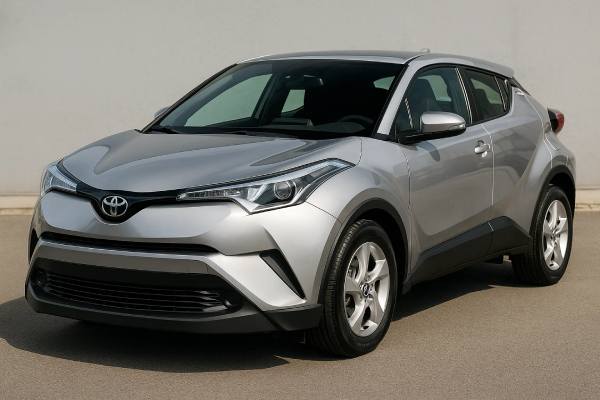
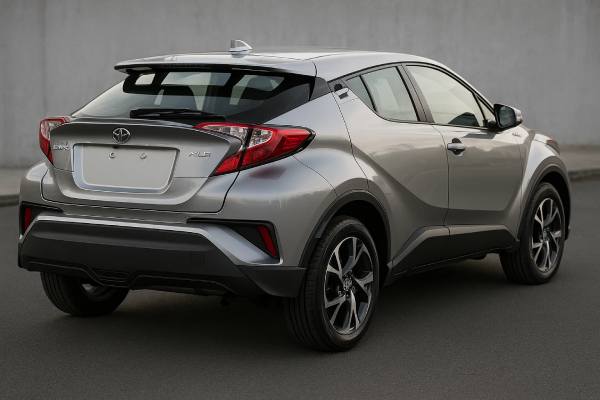
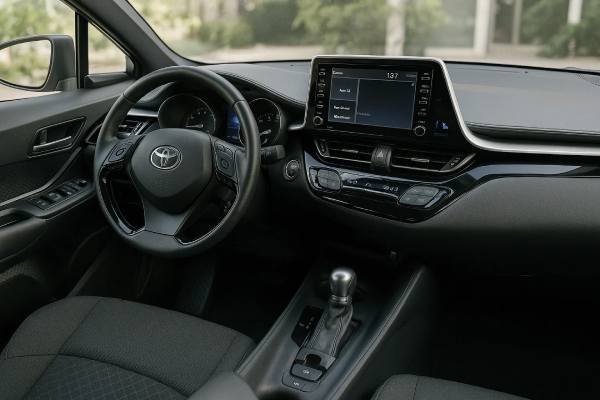
The 2018–2019 Toyota C-HR 2WD (ZGX10) pairs expressive styling with a dependable 2.0-litre 3ZR-FAE four-cylinder and a well-tuned CVT for smooth city and highway driving. Built on Toyota’s TNGA-C platform, it feels solid over rough pavement and confidently stable at speed. The naturally aspirated engine prioritizes reliability and predictable response over outright speed, while standard Toyota Safety Sense brings forward-collision mitigation and lane support to every trim. Inside, you get supportive front seats, simple controls, and a versatile cargo hold for the class. Compared with many small crossovers of the period, the C-HR emphasizes refinement and low running costs; it is front-wheel drive only in this configuration, which helps keep weight down and fuel economy competitive. For shoppers, the sweet spot is a car with documented annual servicing, healthy tyres, and a clean brake inspection—small maintenance details that make this platform feel tight and quiet for the long haul.
Fast Facts
- Composed ride and low cabin noise on TNGA-C chassis; reassuring stability at 120 km/h (75 mph).
- Proven 3ZR-FAE 2.0-litre engine with simple maintenance and long-life spark plugs.
- Toyota Safety Sense standard across trims; solid crash performance for the class.
- Watch for rear brake lip corrosion in salted regions; keep sliders lubricated.
- Oil and filter every 12 months or ~10,000–12,000 km (~6,000–7,500 miles) for conservative, easy ownership.
Navigate this guide
- C-HR 2.0 2WD overview
- C-HR 2.0 specs and data
- Trims, options, and safety
- Reliability and service actions
- Maintenance and buyer’s guide
- Driving and performance
- How C-HR compares to rivals
C-HR 2.0 2WD overview
Toyota’s first North American C-HRs (2018–2019) landed with a single, focused recipe: front-wheel drive, a naturally aspirated 2.0-litre 3ZR-FAE, and a CVT calibrated for smoothness more than snap. That simplicity is a feature. Without the added weight and complexity of AWD, the C-HR turns in crisply and keeps road noise low. The TNGA-C body is stiff for the segment, so bumps don’t echo through the cabin; the multi-link rear end helps the car stay settled on mid-corner ripples and highway expansion joints.
The 3ZR-FAE emphasizes longevity and efficiency. Valvematic variable lift and DOHC timing make the engine tractable at low rpm with clean emissions. There’s no turbo to heat-soak or feed carbon into intake valves, and regular 0W-20 oil keeps friction down. The CVT features a wide ratio spread and “step-shift” behaviour under throttle to reduce sustained droning; in daily driving it holds revs near the engine’s torque sweet spot and quickly drops to a quiet cruise.
Inside, the C-HR punches above its price. The driver’s seat offers generous height and tilt, the steering wheel telescopes adequately for taller drivers, and visibility is better than the roofline suggests once you lean on the standard backup camera and parking sensors where fitted. Rear space suits two adults for shorter trips; cargo capacity is competitive, enhanced by a flat load floor with the rear seats folded. Materials are hard-wearing and easy to clean, with switchgear that feels consistent over time. For safety, Toyota Safety Sense (pre-collision, lane departure alert with steering assist, automatic high beams, and adaptive cruise availability by package/market) brings meaningful driver assistance even on the entry trim.
On the road, the C-HR’s character is calm, predictable, and confidence-inspiring—an ideal commuter that still feels composed when you pick up the pace. It’s not a rocket, but it is a car that ages gracefully when owners stick to annual services and keep tyres, brakes, and alignment in good order.
C-HR 2.0 specs and data
Figures below reflect typical North American 2018–2019 Toyota C-HR 2WD, 3ZR-FAE 2.0-litre petrol with CVT. Small variations occur by trim, wheel package, and test methods.
Engine and Performance (ICE)
| Item | Specification |
|---|---|
| Engine code | 3ZR-FAE (Valvematic, DOHC, 16-valve) |
| Layout & cylinders | Inline-4; DOHC; 4 valves/cyl |
| Bore × stroke | 80.5 × 97.6 mm (3.17 × 3.84 in) |
| Displacement | 1.987 L (1,986–1,998 cc range by doc) |
| Induction | Naturally aspirated |
| Compression ratio | ~10.0–10.4:1 (market documentation ranges) |
| Max power | 144 hp (107 kW) @ ~6,100 rpm |
| Max torque | ~188 Nm (139 lb-ft) @ ~3,900 rpm |
| Fuel system | Port injection with Valvematic variable lift |
| Timing drive | Chain |
| Emissions/efficiency std. | EPA Tier 3 / LEV III compliant |
| Rated economy (EPA)* | ~27 mpg city / 31 mpg highway / 29 mpg combined |
| Rated economy (L/100 km)* | ~8.7 city / 7.6 highway / 8.1 combined |
| Real-world highway @ 120 km/h | ~7.6–8.3 L/100 km (31–28 mpg US / 37–34 mpg UK) |
| Aerodynamics | Cd ≈ 0.32–0.34; underbody covers |
*EPA methodology; wheel/tire choices and options affect results.
Transmission and Driveline
| Item | Specification |
|---|---|
| Transmission | CVT with step-shift simulation |
| Gear ratios | Continuously variable; broad ratio span |
| Final drive | ~3.94 (varies slightly by calibration) |
| Drive type | Front-wheel drive (2WD) |
| Differential | Open; brake-based torque control via VSC/TRAC |
| Refuel to full | ~5–7 minutes typical petrol station turnaround |
Chassis and Dimensions
| Item | Specification |
|---|---|
| Platform | TNGA-C |
| Front suspension | MacPherson strut, coil, stabilizer |
| Rear suspension | Double-wishbone/multi-link, coil, stabilizer |
| Steering | Electric power steering; ~2.7–2.9 turns lock-to-lock |
| Brakes (front/rear) | Ventilated disc / solid disc; ABS, EBD, brake assist |
| Wheels/tyres | 17 in (215/60 R17) or 18 in (225/50 R18) |
| Ground clearance | ~145–150 mm (5.7–5.9 in) |
| Length × width × height | ~4,360–4,380 × 1,795 × 1,565 mm (171.7 × 70.7 × 61.6 in) |
| Wheelbase | 2,640 mm (103.9 in) |
| Turning circle (kerb-to-kerb) | ~10.6–10.8 m (34.8–35.4 ft) |
| Kerb (curb) weight | ~1,470–1,500 kg (3,240–3,307 lb) by trim |
| GVWR | ~1,900–1,960 kg (4,189–4,321 lb) |
| Fuel tank | 50 L (13.2 US gal / 11.0 UK gal) |
| Cargo (SAE, seats up/down) | ~19.0 ft³ / ~36–37 ft³ (approx. 538 L / 1,020–1,050 L VDA-adj.) |
Performance and Capability
| Metric | Figure |
|---|---|
| 0–100 km/h (0–62 mph) | ~10.9–11.4 s (typical road tests) |
| Top speed | ~185–190 km/h (115–118 mph) |
| Braking 100–0 km/h (62–0 mph) | Class-typical; tyres dominate results |
| Towing capacity | Often not rated in North America; check VIN plate |
| Payload | Label dependent; verify door-jamb sticker |
| Roof load | 50–75 kg (110–165 lb) with approved bars |
Fluids and Service Capacities
| System | Specification | Capacity* |
|---|---|---|
| Engine oil | 0W-20, API SN+/SP, ILSAC GF-5/6 | ~4.1–4.4 L (4.3–4.6 US qt) |
| Engine coolant | Toyota Super Long Life Coolant (pink premix) | ~6.6–6.9 L (7.0–7.3 US qt) |
| CVT | Toyota CVT Fluid FE (temp-set level) | ~7.4–7.9 L (7.8–8.3 US qt) |
| A/C refrigerant | R1234yf or as per under-bonnet label | Mass per label |
| Spark plugs | Long-life iridium; gap ~0.7–0.8 mm (0.028–0.031 in) | 4 plugs |
| Key torque specs | Wheel lugs ~103 Nm (76 lb-ft); plugs ~20–25 Nm | — |
*Always confirm by VIN/service manual and follow the temperature/level procedure for CVT.
Electrical
| Item | Specification |
|---|---|
| Alternator output | High-efficiency compact unit sized for LED/ADAS loads |
| 12 V battery | ~45–60 Ah EFB/AGM equivalent (market/trim dependent) |
| Ignition | Coil-on-plug, knock-controlled timing |
Safety and Driver Assistance
| Area | Notes |
|---|---|
| Crash ratings | Strong performance in IIHS/NHTSA testing for this generation; headlight ratings vary by trim and lamp type |
| Headlights | Halogen or LED by grade; Automatic High Beams commonly included |
| ADAS suite | Pre-collision with pedestrian detect, Lane Departure Alert with steering assist, Dynamic Radar Cruise (availability by package/market), Road Sign Assist on some later units |
| Child seats | LATCH/ISOFIX outboard rear; top tethers provided |
| Structure | High-strength TNGA shell with multiple airbags (front, side, curtain, driver knee) |
Trims, options, and safety
Trim structure and identifiers (North America, 2018–2019)
Naming and packaging evolved slightly across these two years, but the pattern below captures the core content:
- Entry (LE or XLE, by year): 17-inch alloys, dual-zone climate, cloth seats, 7–8 inch touchscreen, backup camera, Toyota Safety Sense active safety, and basic audio. Look for standard AHB and lane assist; adaptive cruise and blind-spot monitoring may be package-dependent.
- Mid (XLE / XLE Premium): Adds proximity key with push-button start, blind-spot monitor and rear cross-traffic alert, heated outside mirrors, leather-wrapped wheel, additional driver lumbar support, fog lights where equipped.
- Top (Limited or Premium package): Upgraded seat materials (leather-trim or SofTex depending on market), LED headlamps/DRLs in many builds, larger wheels (18-inch), available premium audio, and additional cosmetic details (distinctive wheel designs, interior trim).
Mechanical differences by trim
Powertrain and suspension tune are consistent across trims; dynamic personality hinges mainly on wheel/tyre choice. The 17-inch setup offers the best ride and noise isolation. The 18-inch package adds initial turn-in bite but increases tyre roar on coarse-chip surfaces. Brake hardware is common; pad compound and rotor size remain class-typical.
Feature notes that matter when buying used
- Lighting package: LED headlamps (where fitted) significantly sharpen low-beam cut-off and high-beam reach versus halogen reflectors.
- Driver aids: Cars with blind-spot monitor and rear cross-traffic alert reduce parking stress; confirm sensor function after any rear bumper repair.
- Infotainment: Screen size and smartphone integration vary by the exact build; later software tends to respond faster and support more apps. If this matters, verify the head unit by part number at purchase.
Safety ratings and variations
The C-HR’s crash-energy management and occupant protection score well for the class, contributing to strong overall ratings. Headlight performance varied: trims with basic halogens may score lower for glare/cut-off than LED-equipped models. When inspecting a used car, verify headlamp type, aim, and lens clarity; a proper aim makes a noticeable difference on rural roads.
Calibration implications after service
If the windscreen, front bumper cover, or grille emblem (radar) was replaced, camera/radar calibration must be completed with OEM targets and alignment verification. After front subframe or steering work, ensure the EPS thrust angle is centered; otherwise lane-keeping assistance can feel inconsistent.
Reliability and service actions
The ZGX10 C-HR with 3ZR-FAE has a reputation for low drama when serviced annually. Below are patterns seen across mileage, climate, and usage.
Engine and induction (3ZR-FAE)
- Oil dilution/consumption — Rare / Low
Most examples consume negligible oil between services. If you see rising consumption after 120,000 km, inspect PCV function, check for seepage at the timing cover, and verify oil grade (0W-20). - Intake cleanliness — Rare / Low
Port injection greatly reduces intake-valve deposit build-up compared with DI engines. A gentle throttle-body and MAF clean at 60,000–90,000 km keeps idle quality crisp. - Water pump weep — Occasional / Low
Look for dried pink residue at the pump weep hole around higher mileages. Replace the pump and renew coolant if seepage is visible; it’s typically a quick job on this engine layout.
Ignition and fuel
- Coil-on-plug ageing — Occasional / Low
Single-cylinder misfire under load suggests a weak coil; replace the affected unit and consider replacing spark plugs if they’re near end of life.
Cooling and HVAC
- Cabin filter clog → blower noise — Common / Low
Replace yearly. A clogged filter strains the blower and reduces demist performance.
CVT and driveline
- CVT fluid ageing (Toyota CVT FE) — Occasional / Medium
Symptoms include faint whine or flare under firm throttle around 100,000–150,000 km. Drain/fill with CVT FE using the temperature-based level set. Reset adaptations if specified. Smoothness usually returns immediately. - Engine/transmission mounts — Occasional / Low–Medium
Extra vibration at idle or clunk on tip-in can come from ageing mounts. Replace as needed; alignment and NVH improve markedly.
Chassis and brakes
- Rear rotor corrosion ridges (salted climates) — Common / Low
The lightly loaded rear axle builds rust lips. De-lip or replace rotors/pads; clean/lube sliders and ensure proper pad return to avoid uneven wear. - Wheel-bearing hum — Occasional / Medium
More common on cars with frequent pothole hits or oversized wheels. A steady pitch that grows with speed suggests a bearing. Replace promptly to protect hubs and ABS sensors.
Electrical and ADAS
- 12 V battery sensitivity — Occasional / Low
Weak batteries cause odd ADAS or infotainment behaviour. Test annually after four years; replace before winter in cold regions.
Recalls, TSBs, and campaigns (themes)
- EPB control logic updates on certain VIN ranges to ensure reliable electronic parking brake apply/release.
- Sensor/label campaigns addressing minor compliance items.
- Always run an official VIN recall check and ask for a dealer printout showing completed actions.
Pre-purchase documents to request
- Annual oil service history with the correct 0W-20 oil.
- Any CVT drain/fill records and relevant calibration notes.
- Brake service records (particularly rear) and recent brake-fluid replacement.
- Alignment reports after tyre/suspension work.
- Windshield or front-end repair invoices with ADAS calibration proof.
- A fresh VIN recall check.
Maintenance and buyer’s guide
Practical schedule (distance/time)
Use this as a decision-making guide and verify against the booklet for your VIN and market:
- Engine oil & filter: Every 12 months or ~10,000–12,000 km (6,000–7,500 miles) for conservative use; 0W-20 API SN+/SP, ILSAC GF-5/6.
- Engine air filter: Inspect 20,000 km; replace 30,000–45,000 km (sooner in dust).
- Cabin filter: Replace annually (more often in pollen/urban conditions).
- Spark plugs (iridium): 90,000–120,000 km (55,000–75,000 miles).
- Coolant (Toyota S-LLC): First at 10 years/160,000 km (100,000 miles), then 5 years/80,000 km.
- CVT fluid (CVT FE): Inspect by colour/odour at 90,000–120,000 km; drain/fill if oxidised, or earlier after severe service.
- Brake fluid: Replace every 2 years; test for moisture.
- Brakes: Inspect at each service; de-lip rear rotors as needed; lube sliders.
- Aux/serpentine belt and hoses: Inspect 60,000 km / 4 years; replace on visible wear or at cooling service.
- 12 V battery: Test yearly after 4 years; voltage stability matters for ADAS.
- Tyres & alignment: Rotate 10,000–12,000 km; maintain matched sets; check alignment annually or after impacts.
Fluids and specifications
- Engine oil: 0W-20 API SN+/SP, ILSAC GF-5/6; ~4.1–4.4 L service fill.
- Coolant: Toyota Super Long Life Coolant (pink premix).
- CVT: Toyota CVT Fluid FE; set level using the specified temperature method.
- A/C: R1234yf (or as under-bonnet label states); charge mass per label.
- Torque basics: Wheel lugs ~103 Nm (76 lb-ft); spark plugs ~20–25 Nm (per plug maker).
Buyer’s inspection checklist
- Cold start and idle: Should settle quickly without hunting. Valvematic tick at idle is normal; uneven shake is not.
- CVT behaviour: Smooth, low-rpm launches; no flare or shudder. A short test on a mild incline exposes weak fluid or mounts.
- Brakes: Predictable bite; check rear disc inner faces for ridges. Verify parking-brake operation.
- Steering/ride: Straight tracking, no tramlining on ruts. Listen for front-end clunks over speed bumps.
- Tyres: Even wear across the tread; mismatched sets can hurt ride quality and braking feel.
- Lighting/ADAS: Confirm headlamp type and aim; ensure pre-collision warnings and lane assist behave sensibly.
- Under-body: Light surface rust is typical in salted regions; avoid heavy scaling on subframes or hydraulic lines.
- Paperwork: Oil, brake-fluid, and any CVT services; alignment printouts; recall completion proof.
Durability outlook
The 3ZR-FAE/CVT pairing is a “long game” powertrain. With yearly services and basic brake/tyre care, owners report quiet, predictable operation well past 150,000 km. Keep the CVT fluid healthy, the rear brakes clean, and the battery strong, and this C-HR maintains its tight, well-damped feel long into second ownership.
Driving and performance
Ride, handling, and NVH
The TNGA-C platform delivers an unusually mature ride for a subcompact crossover. Over small chatter the suspension breathes rather than thumps; bigger compressions are well controlled, avoiding wallow. On 17-inch tyres the C-HR is one of the quieter cabins in its class at motorway speed, with wind noise modest and tyre rumble contained. Body motions are tidy on undulating highways, and the car shrugs off mid-corner bumps with little steering kickback.
Steering and braking feel
Electric power steering is light in parking and gains reassuring weight on the move; self-centering is natural. The brake pedal is progressive with a clear initial bite and linear build-up. Fade resistance in street use is limited more by tyre grip than hardware.
Powertrain character
Throttle response is clean and direct at low to medium inputs. The CVT’s step-shift logic under heavy throttle helps avoid sustained high-rpm droning, while relaxed driving keeps revs near the engine’s torque plateau for quiet progress. For passes from 50–80 mph (80–130 km/h), a firm pedal press prompts an immediate ratio change; acceleration is adequate and predictable.
Real-world efficiency
Expect ~7.6–8.3 L/100 km (31–28 mpg US / 37–34 mpg UK) on steady 120 km/h (75 mph) motorway runs, with mixed commuting landing near the EPA combined figure. Cold starts, short trips, roof racks, and 18-inch wheels will add consumption; gentle throttle and timely tyre rotations help keep numbers strong.
Loads and light towing
With four adults and luggage, the C-HR remains planted and brakes confidently. North American cars are often not tow-rated; where towing is permitted, stay strictly within the VIN plate limits and anticipate increased stopping distances and higher consumption on grades.
How C-HR compares to rivals
Honda HR-V (2WD)
The HR-V offers a roomier rear seat and extremely versatile “Magic Seat” cargo tricks. The C-HR counters with a calmer highway ride, tighter body control, and a more substantial cabin feel. If you value motorway refinement, the Toyota stands out.
Hyundai Kona 2.0 (2WD)
Kona’s base 2.0 is frugal and often priced sharply, but road noise and ride quality vary with wheel size. The C-HR feels more planted and quieter over distance; however, Kona’s feature packaging (and warranty) can be compelling value.
Mazda CX-3 / CX-30 (2WD)
Mazda delivers sharper steering and a more eager engine character at higher revs. The Toyota’s strengths are steadier NVH, softer secondary ride, and typically lower owner-reported squeaks/rattles over time.
Nissan Kicks
Light and efficient with generous tech for the money, but no available AWD and a simpler rear axle. The C-HR’s multi-link rear and stiffer structure pay off in composure and brake feel.
Kia Seltos (early models)
Space and features impress; ride and cabin hush vary by wheel/trim. The C-HR feels denser and more refined on long trips, with a more consistent brake/steering tune across conditions.
References
- 2019 Toyota C-HR Product Information 2019 (Press/Specifications)
- Fuel Economy of the 2019 Toyota C-HR 2019 (EPA Data)
- Toyota C-HR 2019 Owner’s Manual 2019 (Owner’s Manual)
- 2019 Toyota C-HR 2019 (Safety Rating)
Disclaimer
This article is for informational purposes only and is not a substitute for professional diagnosis or repair. Specifications, torque values, intervals, and procedures vary by VIN, model year, market, and equipment. Always verify details against your vehicle’s official owner and service documentation before maintenance or purchase decisions. If this guide helped, please consider sharing it on Facebook or X (Twitter) to support xcar’s work.