
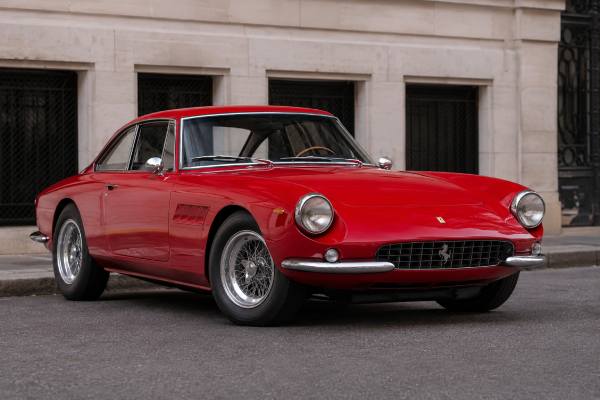

The Ferrari 500 Superfast Series II was the final, most refined version of Ferrari’s 1960s flagship coachbuilt grand tourer: a Pininfarina-bodied two-seat coupé with the 4,963 cc Tipo 208 V12, around 400 bhp, and a 1966 Series II specification centered on the five-speed gearbox. It mattered because it sat above ordinary Ferrari GT production. This was not a smaller, sharper 275 GTB-style sports car, but a long-legged, hand-finished, very expensive Ferrari for clients who wanted speed, discretion, and comfort in one of the rarest road cars Maranello offered.
The Series II is especially important because it represents the end of the 500 Superfast line and the last chapter of Ferrari’s old America and Superamerica tradition. Only a small handful were built, and each car’s identity now depends heavily on chassis history, engine matching, factory documentation, restoration quality, and individual specification. For enthusiasts, the appeal is the huge front-mounted V12 and elegant Pininfarina form. For buyers, the main question is whether a particular car has the originality and paper trail to justify its market position.
Quick Take
The Ferrari 500 Superfast Series II is a rare, formal, very fast Enzo-era grand tourer whose strongest appeal is its combination of Pininfarina elegance, 400 bhp Tipo 208 V12 power, and ultra-low production. Its identity is tied less to racing and more to Ferrari’s most exclusive coachbuilt road-car tradition. The main caution is that no two examples should be judged casually: engine originality, body condition, restoration history, Classiche certification, and documented provenance can change both value and ownership risk dramatically.
Table of Contents
- History and Significance of the Series II
- Tipo 208 V12, Chassis and Specifications
- Production, Variants and Factory Details
- Pininfarina Design and Special Engineering
- Driving Experience and Real-World Performance
- Reliability, Maintenance and Restoration Risk
- Market Value and Buying Guide
History and Significance of the Series II
The 500 Superfast Series II matters because it was Ferrari’s top roadgoing grand tourer at the moment when the company was moving away from tiny-series coachbuilt luxury models toward more standardized production GTs. It was a high-speed luxury Ferrari, not a homologation special, and its place in Ferrari history comes from rarity, engineering ambition, and status.
The 500 Superfast was introduced in the mid-1960s as the ultimate development of the Superamerica idea. Earlier Ferrari America and Superamerica models were built for wealthy clients who wanted large-displacement V12 power, custom-level finish, and exclusivity beyond the regular sports-car range. By the time the 500 Superfast arrived, Ferrari already had a growing range of V12 GTs, including the 250 and 330 lines, but the Superfast stood above them in price, presence, and engine size.
Pininfarina shaped the car as a formal two-door coupé with smooth sides, a long bonnet, a low roofline, and a restrained tail. The body drew from the 400 Superamerica Aerodinamico style, but the 500 Superfast had its own more mature identity. It was cleaner and less flamboyant than many 1950s coachbuilt Ferraris. That restraint is part of its appeal today. It looks expensive without shouting.
The Series II version appeared near the end of production, generally associated with 1966 cars. Its key mechanical identity is the later five-speed gearbox, replacing the earlier four-speed with overdrive arrangement used on much of the first series. That makes the Series II feel slightly more modern and more usable at speed, although the car remains a large, valuable, hand-built 1960s Ferrari rather than a casual classic for everyday use.
The 500 Superfast also had a reputation for attracting prominent owners. Cars of this type were bought by royal families, industrialists, entertainers, and major collectors. That ownership pattern still affects the market. A 500 Superfast with known early ownership, factory records, concours history, and Ferrari Classiche documentation can carry a level of desirability far beyond a car with a thin file.
Its significance is not motorsport-driven. Unlike a 250 GTO, 250 LM, or competition 275, the 500 Superfast was not created to win races. Its importance is that it shows what Ferrari could build for the richest road-car clients of the era: a powerful front-engine V12 coupé with genuine long-distance pace, expensive materials, and hand-finished Pininfarina coachwork.
That also explains why modern collectors take the model seriously. The car combines three traits that rarely align: very low production, a special engine, and direct connection to Ferrari’s coachbuilt luxury tradition. It is not the easiest Ferrari to maintain, nor the most agile, but it is one of the clearest expressions of Ferrari’s 1960s grand touring peak.
Tipo 208 V12, Chassis and Specifications
The Series II’s central technical feature is the Tipo 208 V12, a nearly five-liter front-mounted engine rated at about 400 bhp at 6,500 rpm. Around it, Ferrari used a tubular steel chassis, Pininfarina coupé bodywork, disc brakes, and a later five-speed manual gearbox that defines the Series II specification.
The Tipo 208 is often described as a special Ferrari V12 because it blended ideas associated with both major Ferrari engine families of the period. In plain terms, it gave the 500 Superfast the capacity and effortless torque expected of a flagship, while retaining the rev-happy character and mechanical complexity of a classic Ferrari V12.
| Item | Specification |
|---|---|
| Model | Ferrari 500 Superfast Series II |
| Chassis type | Tipo 578/65 tubular steel chassis |
| Engine | Tipo 208 60-degree V12 |
| Displacement | 4,963 cc, commonly described as 5.0 liters |
| Bore x stroke | 88 mm x 68 mm |
| Valve gear | Single overhead camshaft per bank, two valves per cylinder |
| Fuel system | Three Weber 40 DCZ/6 twin-choke carburetors |
| Output | About 400 bhp at 6,500 rpm |
| Transmission | Five-speed manual gearbox on Series II cars |
| Drive | Rear-wheel drive |
| Front suspension | Independent unequal-length wishbones, coil springs, telescopic dampers, anti-roll bar |
| Rear suspension | Live axle with radius arms, semi-elliptic springs, and telescopic dampers |
| Brakes | Four-wheel servo-assisted disc brakes |
| Steering | Worm-and-sector type, with power assistance on many cars |
| Wheels and tires | 15-inch Borrani wire wheels, typically with 205-section tires |
The engine’s character was very different from smaller Ferrari V12s. The 500 Superfast did not need to be worked constantly to make progress. Its size gave it relaxed high-speed ability, which suited the car’s purpose. It was built for rapid continental travel, not tight-road nervousness.
The chassis was related in concept to Ferrari’s contemporary grand touring practice rather than a pure racing structure. The long wheelbase helped ride quality and cabin space, while the live rear axle reflected Ferrari GT engineering of the period. This is important for buyers because the car should not be assessed like a modern supercar. A properly restored 500 Superfast should feel stable, strong, and composed, but not razor-sharp in the modern sense.
| Measure | Figure |
|---|---|
| Length | About 4,820 mm |
| Width | About 1,730 mm |
| Height | About 1,280 mm |
| Wheelbase | 2,650 mm |
| Front track | About 1,397 mm |
| Rear track | About 1,389 mm |
| Dry weight | About 1,400 kg, depending on equipment and source |
| Fuel capacity | About 100 liters |
| Top speed | Usually quoted around 280 km/h |
Period performance data varies because very few cars were tested under consistent conditions. The important point is not whether one source quotes a few kilometers per hour more or less. The 500 Superfast was genuinely among the fastest and most powerful luxury GT cars of its day, with a performance envelope well beyond most road traffic of the mid-1960s.
Production, Variants and Factory Details
The Series II is rare even by classic Ferrari standards, with the model’s total production usually cited at only 36 cars and the second series accounting for roughly 12 examples. Because the production run was so small and hand-built, individual chassis history matters more than broad model-year assumptions.
The first-series 500 Superfast cars were built from 1964 into 1965. They are generally associated with the four-speed gearbox with overdrive, although late first-series cars may show transitional details. The Series II cars arrived later and are best known for their five-speed manual gearbox, revised detail specification, and final-production status.
| Area | Series I | Series II |
|---|---|---|
| Typical production period | 1964–1965 | 1966 |
| Transmission | Four-speed manual with overdrive on most cars | Five-speed manual |
| Production scale | Larger share of the run | Very small final-series group |
| Front wing vent detail | Early cars often associated with 11-slot vents | Later cars commonly associated with triple louvres |
| Collector appeal | Original launch specification and early chassis importance | Final specification, five-speed usability, extreme rarity |
The 500 Superfast was not a mass-produced car with a simple option sheet. Ferrari and Pininfarina built these cars for individual clients, so color, trim, equipment, and interior details can differ. Air conditioning, power windows, power steering, special upholstery, special paint, and bespoke cabin finishes are all part of the ownership conversation.
For buyers, the key is not simply whether an option is attractive. It is whether the car still matches its original build configuration or whether changes were made later. A color change may be visually appealing, but a documented original color can be more valuable. A retrimmed interior may look beautiful, but the material, pattern, stitching, instruments, dashboard timber, and hardware should be checked against factory records and period photographs when possible.
The model designation also deserves care. The “500” in 500 Superfast refers to the total engine capacity in a broad five-liter sense, not the per-cylinder displacement naming logic used on many earlier Ferraris. The “Superfast” name had appeared on earlier design studies, but the production 500 Superfast is its own defined model.
Important identification points include:
- Chassis number and engine number, checked against Ferrari records.
- Correct Tipo 208 V12 installation.
- Gearbox type, especially for confirming Series II specification.
- Pininfarina body number and evidence of original coachwork.
- Original exterior color and interior trim.
- Factory equipment such as power steering, power windows, and air conditioning.
- Ferrari Classiche certification or equivalent factory documentation.
- Continuous ownership history and records of major restoration work.
A one-off Superfast-style body on a 330 GT 2+2 chassis is often discussed around this model, but it should not be confused with a standard production 500 Superfast Series II. That distinction matters because collectors value the actual chassis identity, not only the outward appearance.
Pininfarina Design and Special Engineering
The 500 Superfast Series II is distinctive because it combines restrained Pininfarina luxury styling with one of Ferrari’s most powerful road-car engines of the period. Its engineering was not radical in the modern hypercar sense, but its package was exceptional for a mid-1960s Ferrari road car.
The front end is long, smooth, and formal. The bonnet length makes sense because the Tipo 208 V12 is a large engine, and the car’s identity depends on that grand touring layout. The cabin is set back, the roofline is elegant, and the rear is clean rather than heavily decorated. The result is a car that looks expensive and fast without relying on vents, wings, or racing references.
The body was built by Pininfarina, and the coachbuilt nature matters. Hand-built panels can vary from car to car, and restoration work must respect the original shape. A 500 Superfast that has been over-restored with poor panel definition, incorrect gaps, or an overly modern finish can lose some of the character that makes the model valuable.
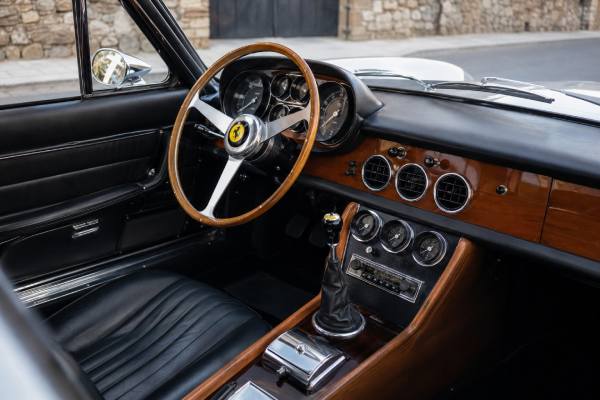
The cabin is equally important. This was a luxury Ferrari, so the interior should feel rich, spacious for two, and carefully finished. Leather upholstery, a wood-accented dashboard, classic instruments, and electric equipment give it a more formal character than a smaller sports Ferrari. The lack of a practical rear seat in many descriptions underlines the car’s purpose: it was a two-person express, not a family GT.
The Series II’s five-speed gearbox is one of its most useful engineering changes. It gives the driver better ratio spacing and makes the car feel more naturally matched to the engine. In a car with this much power and such a long-legged purpose, the gearbox matters. It helps preserve the relaxed but rapid character that defines the model.
Cooling, carburetion, and ignition were all period Ferrari systems, which means they require expert setup. Three twin-choke Weber carburetors can provide excellent throttle response when synchronized correctly, but a poorly tuned car may hesitate, run rich, foul plugs, or feel flat. Likewise, ignition condition has a major effect on starting, idle quality, and high-rpm smoothness.
Notable design and engineering features include:
- Pininfarina two-seat coupé bodywork with a formal grand touring profile.
- Large front-mounted Tipo 208 V12 with outside-the-vee spark plug layout.
- Three Weber twin-choke carburetors.
- Five-speed manual gearbox on Series II cars.
- Long 2,650 mm wheelbase for stability and ride quality.
- Servo-assisted disc brakes for high-speed touring use.
- Borrani wire wheels retained despite the wider move toward alloy wheels.
- Luxury features such as power windows, power steering, and air conditioning on many examples.
The car’s sensory identity is also part of the design. The 500 Superfast should sound deep, smooth, and expensive rather than raw and frantic. The V12 note is present, but the whole car is tuned around effortless speed. It is less a racing car for the road and more a private express built by Ferrari at the top of its old-world coachbuilding period.
Driving Experience and Real-World Performance
A healthy 500 Superfast Series II should feel powerful, stable, and remarkably fast for a 1960s luxury GT, but it should not be expected to behave like a later mid-engine supercar. Its best environment is open-road touring, where the five-liter V12, long wheelbase, and five-speed gearbox make sense.
The engine is the main event. With about 400 bhp, the Tipo 208 gives the car effortless acceleration by period standards. The torque and displacement mean the driver does not need to chase every last rpm, although the V12 should still pull cleanly toward the upper range when properly tuned. A tired car may still sound impressive, but it will not have the smoothness, crispness, or heat control that defines a good example.
Throttle response depends heavily on carburetor condition and synchronization. When the Webers are right, the engine should respond cleanly and progressively. When they are wrong, the car can feel heavy, woolly, or difficult in traffic. Buyers should pay attention to cold starting, warm idle, hot restart behavior, fuel smell, and any hesitation under load.
The five-speed gearbox makes the Series II more satisfying than earlier four-speed/overdrive layouts for many drivers. Shifts should be deliberate rather than modern-light. Like many classic Ferraris, the gearbox may feel best once warm. Weak synchros, difficult engagement, or noise under load should be taken seriously because transmission work on a 500 Superfast is specialist and costly.
Steering feel is more grand touring than sports racing. With power assistance, the car should be manageable despite its size. Without proper setup, worn components, tired tires, or incorrect alignment can make it vague or heavy. The front-engine layout and long bonnet mean the driver is always aware of the car’s size, especially on narrow roads.
The ride should be one of the model’s strengths. The long wheelbase and GT suspension tuning give the 500 Superfast a composed, dignified feel over distance. It should not crash over bumps or wander badly at speed. If it does, the cause may be worn dampers, tired suspension bushings, wheel issues, incorrect tires, or chassis damage.
Braking expectations must be realistic. Servo-assisted discs were serious equipment in the period, but a 500 Superfast is still a heavy, valuable classic with 1960s tires and systems. Brake feel should be firm and confidence-inspiring, not spongy, pulling, or grabby. Repeated hard use requires more sympathy than in a modern performance car.
In traffic, the car demands patience. Heat management, clutch weight, visibility over the long bonnet, and the value of every panel make urban driving more stressful than romantic. On an open road, however, the car’s original purpose becomes clear: it can cover ground quickly and smoothly with a level of mechanical richness few modern cars can copy.
A restored example and a tired example can feel like different models. A properly set-up Series II should feel expensive, cohesive, and strong. A neglected one may feel hot, noisy, heavy, and imprecise. That difference is why a test drive by a specialist familiar with Enzo-era Ferrari GTs is not a luxury; it is part of the buying process.
Reliability, Maintenance and Restoration Risk
The 500 Superfast Series II can be reliable in the way a carefully maintained hand-built 1960s Ferrari can be reliable, but it is not forgiving of neglect. Its main ownership risks are engine originality, corrosion, old restoration quality, carburetion, cooling, electrical systems, brakes, suspension wear, and the cost of specialist labor.
The Tipo 208 V12 is valuable and complex. Any engine work must be treated as major conservation work, not routine used-car repair. A rebuild can involve rare parts, careful machining, correct carburetor and ignition setup, and deep knowledge of period Ferrari V12s. A non-matching or replacement engine can also affect value, even if the replacement is technically correct.
Cooling deserves close attention. Large front-engine V12 Ferraris can suffer if radiators, hoses, fans, water pumps, thermostats, and coolant passages are not maintained properly. A car that overheats in traffic, pushes coolant, or runs inconsistently may need more than a simple adjustment. Heat can also accelerate electrical and fuel-system problems.
The fuel system is another key area. Old lines, tired pumps, dirty tanks, worn carburetor shafts, incorrect jetting, and poor synchronization can all make the car difficult to start or unpleasant to drive. Because the car is so valuable, any fuel smell should be taken seriously.
Electrical systems are age-sensitive. Power windows, lighting, instruments, ignition components, charging systems, and period accessories can all create faults. A tidy wiring harness matters not just for convenience, but for safety and reliability. Previous repairs should be inspected carefully, especially if the car has passed through several restorations over decades.
Body and chassis condition are critical. The Pininfarina bodywork is expensive to repair correctly, and corrosion can hide in structural and lower-body areas. Accident history matters because a coachbuilt Ferrari can be made to look good while still having incorrect structure, poor panel shape, or compromised alignment.
Key inspection areas include:
- Engine number, gearbox number, and chassis identity.
- Evidence of engine rebuilds, including who performed the work.
- Hot and cold oil pressure behavior.
- Carburetor condition and fuel-system safety.
- Cooling system performance in traffic and at speed.
- Gearbox synchros, clutch operation, and driveline noise.
- Brake servo, calipers, lines, discs, and master cylinder.
- Steering box, suspension bushings, dampers, and wheel condition.
- Corrosion in sills, floors, lower wings, door bottoms, and chassis tubes.
- Quality of past paintwork, panel fit, and aluminum repairs.
- Correct cabin materials, instruments, switches, and trim hardware.
- Documentation for all major restorations and parts replacements.
Restoration decisions are complicated. Some upgrades can improve usability, such as hidden cooling improvements or carefully rebuilt electrical systems, but visible deviations from factory specification can reduce collector appeal. The best work is usually sympathetic: it improves reliability while preserving original identity.
Parts availability is possible through specialist networks, but not simple. Many items must be rebuilt, remanufactured, or sourced through Ferrari specialists. This affects both cost and timing. A buyer should assume that a car with deferred maintenance will require significant money even if it looks beautiful.
The safest ownership approach is preventive. Regular fluid service, carburetor checks, ignition tuning, brake inspection, battery maintenance, tire-age monitoring, and proper storage can prevent small problems from becoming major ones. A 500 Superfast should be exercised enough to stay healthy, but it should be warmed, driven, and cooled down with mechanical sympathy.
Market Value and Buying Guide
The 500 Superfast Series II sits in a rarefied collector market where public auction results are useful but not complete. Recent public sales and valuation trackers place good Series II examples broadly in the low-to-mid seven-figure range, but individual value depends heavily on provenance, originality, certification, restoration quality, and exact chassis story.
Because so few cars exist, there is no deep, liquid market. One sale does not define the model. A car with its original engine, strong early ownership, factory colors, concours history, and Ferrari Classiche certification can justify a significant premium. A car with a replacement engine, uncertain body repairs, color changes, or thin documentation may lag even if it presents well.
The strongest value factors are:
- Matching-numbers engine and gearbox.
- Verified Tipo 208 V12 and correct Series II five-speed specification.
- Ferrari Classiche certification or factory-supported documentation.
- Known ownership chain from new.
- Original color and trim, especially if attractive or unusual.
- High-quality restoration by recognized Ferrari specialists.
- Original Pininfarina body integrity.
- Concours awards or major event history.
- Complete service and restoration invoices.
- No major unresolved accident or corrosion questions.
A buyer should avoid judging a 500 Superfast by photographs alone. These cars can look magnificent in catalog images while hiding expensive problems. The inspection should be carried out by someone who knows classic Ferrari construction, not just general exotic cars.
| Priority | Why it matters |
|---|---|
| Identity and numbers | Determines whether the car is truly the chassis, engine, gearbox, and body it claims to be. |
| Factory documentation | Confirms original colors, equipment, build details, and delivery history. |
| Body structure | Coachbuilt panel and corrosion repairs can be extremely expensive to correct. |
| Engine health | Tipo 208 V12 rebuild quality has major cost and value implications. |
| Gearbox condition | Series II five-speed specification is central to desirability and usability. |
| Restoration quality | A poor restoration can cost more to correct than a visibly tired but honest car. |
| Originality of interior | Trim, instruments, switches, and dashboard details affect authenticity. |
| Service history | Recent specialist care reduces immediate ownership risk. |
The best examples to seek are cars with a clear story. Ideally, the car should have original or documented-correct mechanical components, known ownership history, build-sheet support, restoration invoices, and evidence that its current presentation matches its factory identity. A car restored many years ago can still be excellent if it has been maintained properly and has aged honestly.
Examples to approach carefully include cars with missing early history, major undocumented color changes, unclear engine replacement history, visible body inconsistencies, or long storage without recent recommissioning. A dormant car may be tempting, but recommissioning a 500 Superfast can become expensive quickly.
Safety expectations should remain period-correct. The 500 Superfast predates modern crash structures, airbags, stability control, anti-lock brakes, and advanced driver assistance. That does not reduce its collector appeal, but it affects how it should be driven and insured. Tire choice, brake condition, and driver judgment are part of safe ownership.
Long-term collectability looks strong because the car has the ingredients collectors continue to value: rarity, a special Ferrari V12, Pininfarina coachwork, Enzo-era production, and elite period positioning. The risk is not lack of importance. The risk is buying the wrong car or underestimating the cost of making a good-looking car mechanically and historically correct.
References
- Ferrari 500 Superfast (1964) – Ferrari.com 1964 (Manufacturer Model Page) ([Ferrari][1])
- Ferrari 500 Superfast Specifications – SBR Engineering 2025 (Technical Specifications) ([SBR Engineering][2])
- 1965 Ferrari 500 Superfast | Gooding Christie’s 2024 (Auction Technical Specs) ([Gooding & Co.][3])
- 1966 Ferrari 500 Superfast Series II by Pininfarina | Monterey 2024 | RM Sotheby’s 2024 (Auction History and Provenance) ([RM Sotheby’s][4])
- Price Guide: Ferrari 500 Superfast Series II [UPDATED 2026] 2026 (Market Data) ([The Classic Valuer][5])
Disclaimer
This article is for informational purposes only and is not a substitute for professional diagnosis, inspection, repair, appraisal, or restoration advice. Specifications, torque values, service intervals, procedures, equipment, and originality details can vary by VIN, market, build configuration, and later history. Always verify information against official Ferrari documentation, factory records, and a qualified marque specialist before buying, repairing, restoring, or valuing a Ferrari 500 Superfast.
If this guide was useful, please consider sharing it on Facebook, X/Twitter, or your preferred enthusiast community to support our work.