
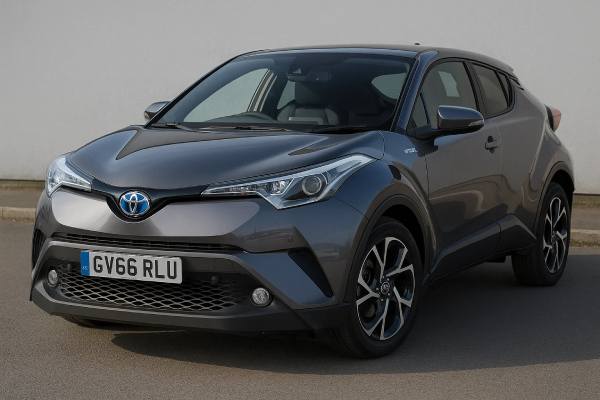
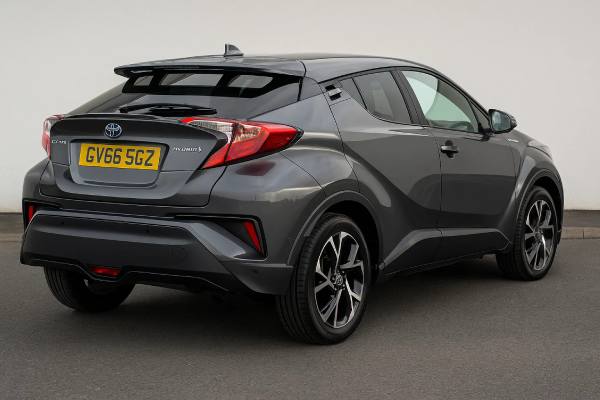
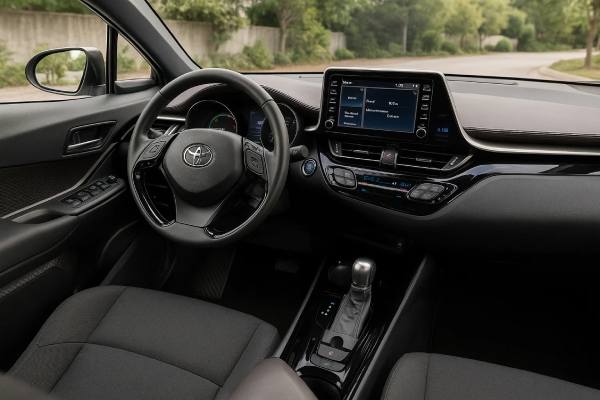
The first-generation Toyota C-HR Hybrid (ZYX10) pairs a 1.8-litre Atkinson-cycle petrol engine with Toyota’s proven hybrid system to deliver city-friendly efficiency and a calm, grown-up ride. On the TNGA-C platform, it uses independent rear suspension and careful body tuning to feel tighter than many small crossovers, yet it remains easy to park and cheap to run. The hybrid drivetrain is front-wheel drive with an e-CVT (planetary power split); there’s no AWD in this 2016–2019 configuration for Europe. Real strengths are everyday frugality, passive and active safety, and long-term parts availability. The caveats are modest acceleration, boot space that varies with wheel choice, and the need to keep the hybrid cooling system healthy. If you want a compact, reliable commuter with credible comfort and equipment, the C-HR Hybrid is still a savvy buy.
Fast Facts
- Strong real-world economy, especially in urban traffic; supple ride and quiet cruising.
- Robust 1.8 hybrid system with NiMH battery and well-documented service procedures.
- Comprehensive safety tech and 5-star crash rating for the generation.
- Watch for brake pad glazing on gentle-use cars; keep inverter/battery cooling clean.
- Engine oil change every 10,000 miles (15,000 km) or 12 months, whichever comes first.
Navigate this guide
- Detailed Overview
- Specifications and Technical Data
- Trims and Options, Safety and Driver Assistance
- Reliability, Common Issues and Service Actions
- Maintenance and Buyer’s Guide
- Driving and Performance
- How Toyota C-HR Hybrid Compares to Rivals
Detailed Overview
The 2016–2019 Toyota C-HR Hybrid (model code ZYX10) sits on Toyota’s TNGA-C architecture shared with the Prius and later Corolla. That matters because TNGA brought lower mounting points for major components, a stiffer body-in-white, and a multi-link rear suspension that gives the C-HR a planted feel rare in small crossovers. Packaging is tidy: a relatively short overall length with a 2,640 mm wheelbase, pronounced hip point for easy ingress, and good forward visibility. The sloping roofline trades some rear three-quarter visibility and marginal headroom for style, but the rear bench accommodates two adults comfortably once seated.
The hybrid system combines the 2ZR-FXE 1.8-litre Atkinson-cycle four-cylinder (variable valve timing, cooled EGR, low-friction internals) with a permanent-magnet traction motor and a nickel-metal hydride (NiMH) battery. System output is 122 hp (90 kW). Around town the car often runs EV-only for short bursts, using the electric motor’s instant torque to step off smoothly. At steady motorway speeds, the e-CVT balances engine load to keep revs calm unless you demand full power; sound insulation and aero work (Cd about 0.32 on this generation) help keep cabin noise in check.
Practicality is better than it looks: VDA-measured boot capacity around 377 L (seats up) is usable, with a near-square floor and split-fold rear backrests. Interior styling is driver-centric; mid-cycle updates improved infotainment responsiveness and smartphone integration in some markets. Standard safety and driver aids were strong for the time, including automatic emergency braking and lane departure alert with steering assist; higher trims added adaptive cruise control and blind-spot monitoring. In day-to-day use, the C-HR Hybrid excels at low operating costs, predictable handling, and stout resale values. The trade-offs are modest acceleration (0–100 km/h about 11 seconds) and a towing rating that is restricted or set to zero in many markets for the 1.8 Hybrid—so verify on the specific car’s documentation if towing matters.
Specifications and Technical Data
Engine and Performance (Hybrid Powertrain)
| Item | Detail |
|---|---|
| Code | 2ZR-FXE (ICE) + permanent-magnet synchronous traction motor |
| Layout & cylinders | Inline-4, DOHC, 4 valves/cyl, Atkinson cycle |
| Displacement | 1.8 L (1,798 cc) |
| Induction | Naturally aspirated (ICE) |
| Fuel system | Electronic fuel injection |
| Compression ratio | 13.0:1 |
| ICE max power | 97 hp (72 kW) @ 5,200 rpm |
| ICE max torque | 142 Nm (105 lb-ft) @ 3,600–4,000 rpm |
| Traction motor | PMSM, max output 53 kW; max torque 163 Nm |
| Hybrid battery | NiMH, 201.6 V nominal, 6.5 Ah |
| System output | 122 hp (90 kW) |
| Aerodynamics | Cd ≈ 0.32 |
| Rated economy (period figures) | Combined from ~3.8–4.9 L/100 km (≈ 49–62 mpg US / 59–74 mpg UK), wheel/tire dependent |
| Real-world highway @ 120 km/h (75 mph) | Typically 5.0–6.0 L/100 km (≈ 39–47 mpg US / 47–56 mpg UK), climate/terrain dependent |
Transmission and Driveline
| Item | Detail |
|---|---|
| Transmission | e-CVT (planetary power-split device), electronic control |
| Drive type | Front-wheel drive |
| Final drive | Hybrid transaxle reduction with differential (fixed), ratio per spec |
| Differential | Open (front) |
| Drive modes | Normal, Eco, Power; EV mode for low-load short distances |
Chassis and Dimensions
| Item | Detail |
|---|---|
| Platform | TNGA-C |
| Suspension (front/rear) | MacPherson strut / Double wishbone (multi-link) |
| Steering | Electric power steering; ratio ~13.6:1; 2.8 turns lock-to-lock |
| Brakes | Front 298.5 mm ventilated discs; rear 281 mm solid discs |
| Wheels/Tyres | 215/60 R17 or 225/50 R18 |
| Ground clearance | ~142–155 mm (5.6–6.1 in), tyre/market dependent |
| Length / Width / Height | ~4,360 mm / 1,795 mm / 1,555–1,565 mm (171.7 / 70.7 / 61.2–61.6 in) |
| Wheelbase | 2,640 mm (103.9 in) |
| Turning circle (kerb/tyre to kerb) | 10.4 m (34.1 ft) / 11.0 m (36.1 ft) |
| Kerb weight | ~1,380–1,420 kg (3,042–3,131 lb), equipment dependent |
| GVWR | ~1,800–1,860 kg (3,968–4,101 lb), market dependent |
| Fuel tank | ~43–45 L (11.4–11.9 US gal / 9.5–9.9 UK gal) |
| Cargo volume (VDA) | ~377 L (13.3 ft³) seats up; significantly more seats folded |
Performance and Capability
| Metric | Value |
|---|---|
| 0–100 km/h (0–62 mph) | ~11.0 s |
| Top speed | ~170 km/h (105 mph) |
| Braking 100–0 km/h | Competitive for class; ABS/ESP tuning prioritises stability |
| Towing capacity | Often not approved (0 kg) on 1.8 Hybrid in many EU markets; verify per VIN |
| Roof load | Typically 75 kg (165 lb), check vehicle label |
Fluids and Service Capacities
| System | Specification | Approx. Capacity |
|---|---|---|
| Engine oil | 0W-20 meeting Toyota spec | ~4.2 L (4.4 US qt) with filter |
| Engine coolant | Toyota Super Long Life Coolant (SLLC) | ~6–7 L (6.3–7.4 US qt) total loop |
| Inverter/e-motor coolant | Toyota SLLC (separate loop) | ~2–3 L (2.1–3.2 US qt) |
| Transaxle (hybrid) | Toyota ATF WS (no routine change in many schedules) | ~3–4 L (3.2–4.2 US qt) |
| A/C refrigerant | R-134a | ~0.5 kg (18 oz) typical charge |
| A/C compressor oil | ND-11 (hybrid-safe) | per label; small measured fill |
| Wheel lug torque | ~103 Nm (76 lb-ft) typical for size; confirm label |
Note: Capacities vary by VIN/market and should be verified on the exact car’s service data and under-bonnet labels.
Electrical
| Item | Detail |
|---|---|
| 12 V battery | ~45 Ah AGM (auxiliary), compact form factor |
| Alternator | Not fitted (hybrid DC-DC converter supplies 12 V) |
| Spark plugs | Iridium; gap ~0.7–0.8 mm (0.028–0.031 in); long-life |
Safety and Driver Assistance
- Crash performance: This generation achieved a 5-star rating in period testing, with strong adult occupant protection, effective whiplash seats, and stable passenger cell integrity.
- Headlights: Projector or LED units depending on trim; automatic high beam widely available.
- ADAS suite (availability by trim/year): Pre-Collision System (vehicle/pedestrian), Lane Departure Alert with steering assist, Adaptive Cruise Control, Road Sign Assist, and Blind-Spot Monitor with Rear Cross-Traffic Alert on higher grades. Camera/radar sensor calibration is required after windshield replacement or front-end repairs.
Trims and Options, Safety and Driver Assistance
Trim structure (Europe, 2016–2019): Naming varies by country, but a typical ladder runs Icon/Active → Excel/Dynamic → Design/Style with special editions slotting between. All hybrids are FWD with e-CVT. Mechanical differences between trims are minimal; performance is essentially identical. Where they diverge is equipment: wheel size (17 vs 18 in), lighting (halogen vs LED), driver aids (blind-spot monitoring and rear cross-traffic alert often bundled on upper trims), and infotainment/speakers.
Quick identifiers:
- 17-inch wheels usually correspond with the best official economy/CO₂ figures and a slightly more compliant ride.
- 18-inch wheels deliver sharper initial turn-in and a fuller look, at a small comfort and economy penalty.
- Interior tells: Piano-black vs coloured dash appliqués; seat fabrics/leather mix; JBL audio branding on higher trims.
- VIN/build: ZYX10 denotes the 1.8 Hybrid; production stickers carry month/year and paint code; option codes show wheel/audio/safety packs.
Year-to-year highlights (pre-facelift, Europe):
- 2016 launch (MY2017): Strong safety spec out of the gate with Toyota Safety Sense, multi-link rear suspension, and comprehensive insulation.
- 2018: Running software refinements to the infotainment unit; options reshuffled in some markets.
- 2019 (pre-facelift runout): Package changes; Apple CarPlay/Android Auto availability starts appearing with the facelift later in 2019 for MY2020 cars—earlier cars may not have factory smartphone mirroring.
Safety ratings (summary):
- The C-HR of this generation achieved a top overall rating with high scores in adult occupant protection and safety assist. Isofix/LATCH points are fitted on the rear outboard seats. Front, side, curtain, and driver’s knee airbags are standard in most markets. Child-seat top-tether anchorages are readily accessible behind the rear seatbacks.
ADAS calibration and service notes:
- After a windscreen replacement, front radar bracket work, or front bumper repairs, the pre-collision system and cruise-control radar require static or dynamic recalibration.
- Wheel alignment after suspension work influences lane-keeping assistance functionality; ensure a thorough 4-wheel alignment.
- For cars with blind-spot monitoring, bumper replacements need correct sensor aiming and bracket integrity checks.
Reliability, Common Issues and Service Actions
Toyota’s 1.8-litre hybrid powertrain is one of the most durable systems in mainstream use, but best practice matters. Below is a practical map of issues by prevalence and cost along with clear remedies.
Common (low to medium cost):
- Cabin brake judder or squeal after long light-duty use → mild pad glazing or corrosion film on rear discs because regen does most of the work at low speeds. Remedy: Perform several firm stops from ~60–80 km/h to heat-cycle pads; if pulsing remains, clean hub faces and measure disc runout; replace pads/discs as needed.
- 12 V battery weakness (short trips, heavy accessory use) → AGM auxiliary battery aging. Remedy: Load test annually after year 4; replace proactively at 5–6 years, retain venting and battery type (AGM).
- Infotainment lag or Bluetooth quirks on early software → early head-unit builds. Remedy: Update head-unit firmware to the final release for the platform; verify microphone and antenna grounds.
Occasional (medium cost):
- HV cooling path restriction → cabin air filter neglected or rear quarter vent area dusty; reduced airflow across the battery intake can trigger fan noise or warm-weather power reduction. Remedy: Replace cabin filter on schedule; inspect and clean battery intake grille; ensure cargo items don’t block it.
- Front suspension knocks over sharp edges → drop-link or top-mount wear around higher mileage, especially on 18-inch wheels. Remedy: Replace stabiliser links/top mounts in pairs; re-check torque at ride height.
- Parking brake cable stretch or sticking (cars parked outdoors) → corrosion at the rear cable ends. Remedy: Inspect annually; lubricate or replace cables; check rear caliper sliders.
Rare (higher cost):
- Water pump seep (engine mechanical pump) → weep hole staining and coolant smell. Remedy: Replace water pump and gasket; refill with SLLC and bleed both ICE and inverter loops as specified.
- Inverter coolant pump noise/failure (high mileage) → audible whine, reduced cooling flow. Remedy: Confirm with bleed test and flow; replace pump; ensure correct hybrid-safe coolant and full purge of air.
- Transaxle bearing noise (very rare) → high-frequency whine independent of engine rpm. Remedy: Specialist inspection; fluid examination; repair/replacement of transaxle.
Software and calibrations:
- Periodic hybrid ECU updates address drivability edge cases (idle flare, EV/ICE transition smoothness) and diagnostic robustness. Dealers can check via campaign lookup and apply reflashes where applicable.
- ADAS updates improve camera object detection and false positive suppression; ensure latest calibration maps after windshield work.
Recalls/field actions (representative for the generation):
- Airbag or sensor campaign(s): Check by VIN; completion is critical for restraint timing.
- Parking brake ECU logic: Some early cars received updates to brake-hold or warning strategies.
- Software-related campaigns: Applied as dealer updates; always request a printout of completed campaigns.
Pre-purchase checks (ask the seller for proof):
- Full service history with hybrid health reports (battery self-test).
- Evidence of coolant service integrity (no mixed fluids), cabin filter changes, and brake servicing that includes slider lubrication.
- Confirmation of recall/TSB completion via official VIN check.
- Tyres of the correct load/speed rating and matching sets; verify even wear—misalignment can blunt the car’s economy and lane-keeping performance.
Maintenance and Buyer’s Guide
Core schedule (typical European practice for this generation):
- Engine oil & filter: Every 10,000 miles (15,000 km) or 12 months (0W-20).
- Cabin air filter: Every 12 months; sooner in dusty climates (protects HV battery intake airflow).
- Engine air filter: Every 20,000–30,000 miles (30,000–45,000 km); inspect annually.
- Brake fluid: Replace every 2 years regardless of mileage.
- Coolant (engine and inverter loops): Long-life SLLC; first change around 10 years/100,000 miles (160,000 km) and then at shorter intervals—verify by VIN.
- Spark plugs (iridium): ~100,000 miles (160,000 km).
- Hybrid transaxle fluid (ATF WS): Often “inspect only” in official schedules; many owners choose a preventative drain/fill at ~60,000–100,000 miles.
- 12 V battery: Test annually after year 4; expect 5–6 year service life.
- Tyre rotation and alignment: Rotate every 10,000 miles (15,000 km); check alignment annually or after impacts.
- HV system health check: Annually as part of hybrid service for warranty continuity (where offered).
Essential fluid and torque references (decision-making):
- Oil: 0W-20 meeting Toyota spec; drain/fill ~4.2 L with filter—confirm on the dipstick after warm refill.
- Coolant: Toyota SLLC only; never mix. Bleed both engine and inverter loops; heater core must purge fully for stable EV-ICE transitions.
- A/T drain plug torque: Refer to service manual; always use a new washer and verify fill level at the specified temperature.
- Wheel lugs: ~103 Nm (76 lb-ft) unless the car’s label states otherwise.
Buyer’s inspection checklist:
- Exterior/underbody: Look for stone-chipping on rocker panels, bumper bracket integrity (affects radar alignment), and any previous windscreen work (ADAS calibration proof). Check for corrosion at subframe bolts in salted-road regions.
- Brakes and tyres: Uneven tyre wear or lipped discs suggest alignment or slider neglect. Verify matching tyres across each axle.
- Cooling and HVAC: Confirm strong A/C performance (R-134a system) without compressor noise; inspect coolant colour (SLLC pink) and reservoir levels in both loops.
- Hybrid essentials: Request the hybrid health report; listen for inverter coolant pump tone changes; make sure the battery intake isn’t blocked.
- Electrics: Confirm all ADAS features operate (test adaptive cruise, lane assist, and parking sensors); check for dashboard warning lights on start and after a short drive.
- Documentation: Service stamps/invoices, recall completion report, two keys, owner’s literature, and tyre inflation kit/jack as supplied.
What to buy (and why):
- 17-inch wheel cars ride best, wear tyres more evenly, and post the strongest economy.
- Higher-trim with full Toyota Safety Sense adds real-world value, especially ACC and LED headlights.
- Later-build 2018–2019 cars benefit from small NVH and infotainment refinements.
Long-term outlook: With routine fluids, brake care, and filter changes, the 1.8 Hybrid commonly runs well past 150,000 miles (240,000 km) with minimal degradation in economy. Parts support is excellent, and independent specialists understand the platform.
Driving and Performance
Ride and NVH: The TNGA-C chassis gives the C-HR Hybrid unusually composed manners for a small crossover. The multi-link rear calms mid-corner bumps, and the body feels cohesive over broken city streets. Wind rustle is low by class standards, helped by careful mirror placement and sealing. Engine noise is muted in gentle driving; full-throttle climbs raise revs (typical of e-CVTs) but Toyota’s sound insulation and power management keep it more refined than earlier hybrids.
Handling and steering: Steering is light at parking speeds and gains reassuring weight as speed rises. The quick ratio (about 13.6:1) helps the car feel eager to point, and the centre holds steady at motorway pace. On 18-inch tyres you’ll feel a bit more road texture and hear more slap on coarse asphalt; 17s are the comfort choice. Brake feel is predictable for a hybrid: initial pedal travel blends regen and friction smoothly, with consistent modulation once the discs take over.
Powertrain character: Around town, the electric motor does quiet, effortless work up to neighbourhood speeds. The Atkinson-cycle engine cuts in unobtrusively under moderate load—only steep grades or assertive overtakes pull the tachometer skyward. Throttle response in Power mode sharpens enough for confident merges; Eco mode softens the pedal map and HVAC to maximise economy.
Real-world efficiency: Expect 4.5–5.5 L/100 km (≈ 43–52 mpg US / 52–62 mpg UK) in mixed use, better in urban cycles where regenerative braking shines, and 5.0–6.0 L/100 km (≈ 39–47 mpg US / 47–56 mpg UK) at steady 120 km/h (75 mph). Cold weather and winter tyres can add 0.5–1.0 L/100 km (2–4 mpg US) to those figures.
Key metrics that shape the verdict:
- 0–100 km/h (0–62 mph): ~11.0 s. Adequate for the class; the payoff is efficiency and refinement.
- 50–80 km/h (30–50 mph) and 80–120 km/h (50–75 mph) passing: Respectable when you anticipate and keep the engine in its sweet zone; plan motorway overtakes rather than relying on a last-second kickdown.
- Braking consistency: Strong, with good stability and short, repeatable stops when the discs are warm.
- Traction: FWD only; winter tyres transform snow performance. Traction control is conservative but effective on wet cobbles or painted lines.
Load and towing: The hybrid’s towing approval is limited or absent in many markets for this period—verify on the car’s paperwork. With passengers and luggage, the car remains stable and efficient; do expect a small economy penalty at full holiday load.
How Toyota C-HR Hybrid Compares to Rivals
Against Nissan Juke (first gen and early second gen): The C-HR’s hybrid system delivers far better urban economy and quieter low-speed running. It also rides more maturely thanks to the multi-link rear. Juke counters with lighter weight and punchier turbo options, but its earlier platforms can’t match the Toyota’s refinement or active-safety breadth.
Against Honda HR-V (Mk1/Mk2 non-hybrid): HR-V packaging is clever (Magic Seats), giving more flexible cargo solutions. The C-HR answers with lower fuel use in traffic, stronger safety spec, and a more solid long-trip demeanour. Later HR-V e:HEV is closer on efficiency but arrives after this C-HR’s timeframe.
Against Renault Captur/PHEV alternatives: Captur’s cabin storage and infotainment variety appeal, and PHEV versions can beat the C-HR in short-trip EV running—if you charge nightly. The Toyota’s hybrid is simpler to own, suffers less winter range swing, and is typically more robust long-term.
Against Kia Niro (HEV): Niro HEV matches the Toyota’s efficiency and adds a boxier cargo area. The C-HR feels more substantial on the motorway and has a tighter, more premium cabin vibe. Ownership costs are broadly similar; availability and condition should guide the choice.
Bottom line: If you value low running costs, quiet commuting, and a tight, confidence-building chassis wrapped in distinctive styling, the C-HR Hybrid remains one of the most balanced picks in the small-SUV class. Choose 17-inch wheels for the best daily experience, and prioritise cars with complete hybrid health records.
References
- C-HR gen1 Nov 2016 2016 (Technical Specifications)
- Toyota C-HR – Euro NCAP Results 2017 2017 (Safety Rating)
- Toyota Service Pricing 2025 (Service and Warranty Information)
- 2021 Toyota C-HR – Technical Specifications 2021 (Hybrid System and Dimensions)
Disclaimer
This article is for informational purposes only and is not a substitute for professional diagnosis or repair. Specifications, capacities, torque values, intervals, and procedures vary by VIN, market, model year, and equipment. Always confirm details against the vehicle’s official service documentation, under-bonnet labels, and the latest manufacturer publications.
If you found this guide useful, please consider sharing it on Facebook or X/Twitter to support xcar’s work. Thank you!