
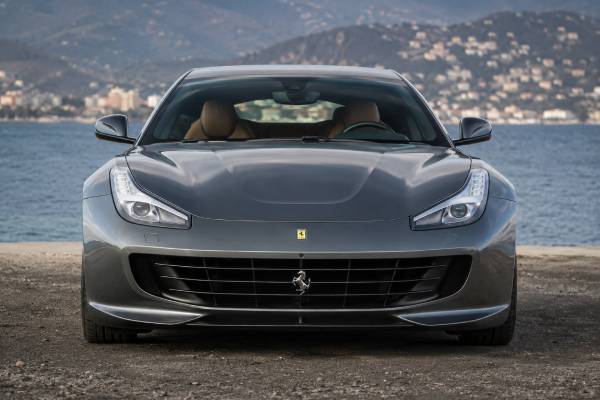
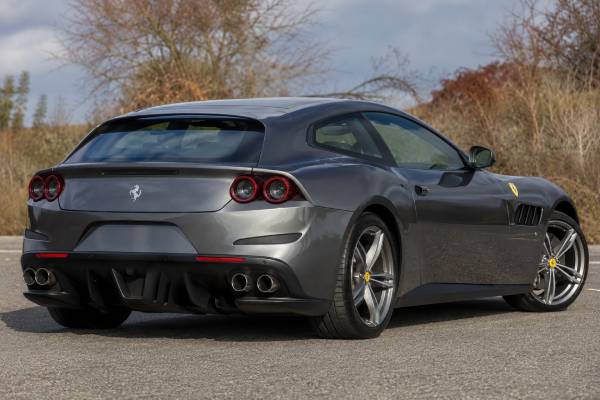
The Ferrari GTC4Lusso T is the rear-wheel-drive, V8-powered version of Ferrari’s four-seat shooting-brake grand tourer. Introduced after the V12 GTC4Lusso, it gave the F151M platform a different personality: less weight over the nose, no front-drive hardware, stronger low-rpm torque, and a more relaxed long-distance character. Its F154 BD 3.9-liter twin-turbo V8 made 610 cv, often rounded in market language as 610 hp, and turned Ferrari’s most practical modern GT into a sharper, lighter-feeling car.
It matters because it sits at an unusual point in Ferrari history. The GTC4Lusso T was the first four-seat Ferrari powered by a turbocharged V8, yet it kept the dramatic roofline, real rear seats, usable luggage space, rear-wheel steering, and luxury cabin that made the Lusso family distinctive. For buyers, it is now a serious used-Ferrari proposition: exotic enough to feel special, practical enough to use, and complex enough to demand careful inspection.
Table of Contents
- Why the GTC4Lusso T Still Matters
- F154 BD V8 Specs and Chassis Data
- Production, Variants, and Factory Options
- Shooting-Brake Design and GT Engineering
- Road Feel, Performance, and Everyday Character
- Maintenance, Reliability, and Specialist Costs
- Values, Market Position, and Buying Checks
Why the GTC4Lusso T Still Matters
The GTC4Lusso T is important because it reworked Ferrari’s four-seat GT formula around a lighter, turbocharged V8 rather than the traditional front-mounted V12. It did not replace the V12 Lusso emotionally, but it gave the same body and cabin a more agile, rear-drive character.
Ferrari launched the GTC4Lusso family as the successor to the FF. The FF had already been unusual: a Ferrari shooting brake with four seats, a large tailgate, and all-wheel drive. The GTC4Lusso refined that idea with sharper styling, updated cabin technology, four-wheel steering, and a more polished grand-touring brief. The V12 car was the flagship. The T version, introduced for the 2017 model year and sold through 2020, was the more focused alternative for owners who did not need the V12’s all-wheel-drive system.
The “T” matters because it changed the way the car felt. By using a 3.9-liter twin-turbo V8 and rear-wheel drive, Ferrari removed weight and mechanical complexity from the front of the car. The result was not a budget Lusso. It was a different type of Lusso: less theatrical at the top end than the V12, but more muscular in everyday driving and more responsive to weight transfer.
It also arrived during a key period for Ferrari. Turbocharged V8s were becoming central to the brand’s modern performance range, from the California T to the 488 GTB and Portofino. The GTC4Lusso T took that engine family and placed it in Ferrari’s most usable body style. For some buyers, that made it the most sensible modern Ferrari. For others, it made it less collectible than the V12. Both views are understandable.
Today, the T has three main points of appeal:
- Usability: Four seats, a large hatch, good visibility, and a 91-liter fuel tank make it more usable than most Ferraris.
- Character: The rear-drive layout gives it a more traditional sports-car balance than the all-wheel-drive V12 model.
- Value: It often trades below the V12 GTC4Lusso, which makes it tempting for buyers who want a modern Ferrari GT without paying V12 premiums.
Its reputation is still forming. The V12 version has the stronger collector story because naturally aspirated Ferrari V12s have obvious long-term appeal. The T, however, has its own historical claim: Ferrari’s first four-seat turbo V8 production car, wrapped in one of the brand’s most practical modern shapes.
F154 BD V8 Specs and Chassis Data
The GTC4Lusso T’s key technical story is simple: a front-mid-mounted F154 BD twin-turbo V8, a seven-speed dual-clutch gearbox, rear-wheel drive, and rear-wheel steering. It is a large GT, but its drivetrain layout makes it feel lighter and more rear-biased than the V12 Lusso.
| Category | Specification |
|---|---|
| Model code | F151M |
| Engine code | F154 BD |
| Engine type | 90-degree twin-turbocharged V8 |
| Displacement | 3,855 cc |
| Bore x stroke | 86.5 mm x 82.0 mm |
| Compression ratio | 9.4:1 |
| Maximum output | 610 cv at 7,500 rpm |
| Maximum torque | 760 Nm from 3,000 to 5,250 rpm |
| Transmission | 7-speed F1 dual-clutch automatic |
| Driven wheels | Rear-wheel drive |
The F154 BD is related to Ferrari’s wider 3.9-liter turbo V8 family, but it was tuned for a GT role. In the mid-engined 488, the same broad engine family feels urgent and aggressive. In the GTC4Lusso T, the power delivery is shaped for long-distance speed, strong mid-range response, and easier use in traffic.
The gearbox is Ferrari’s seven-speed F1 dual-clutch unit. In normal use, it shifts smoothly enough for a luxury GT. In Sport mode or manual paddle operation, it becomes much sharper. The T also uses Ferrari’s electronic differential, Side Slip Control logic, magnetorheological dampers, and four-wheel steering. That last feature is important. It helps the long-wheelbase Lusso feel less bulky in tight bends and more stable during high-speed lane changes.
| Item | Data |
|---|---|
| Length | 4,922 mm |
| Width | 1,980 mm |
| Height | 1,383 mm |
| Wheelbase | 2,990 mm |
| Front track | 1,674 mm |
| Rear track | 1,668 mm |
| Dry weight | 1,740 kg |
| Kerb weight | 1,865 kg |
| Weight distribution | 46 percent front, 54 percent rear |
| Fuel tank | 91 liters |
| Boot capacity | 450 liters |
| Front tires | 245/35 ZR20 |
| Rear tires | 295/35 ZR20 |
| Front brakes | 398 mm x 38 mm carbon-ceramic discs |
| Rear brakes | 360 mm x 32 mm carbon-ceramic discs |
| Measure | Figure |
|---|---|
| 0–100 km/h | 3.5 seconds |
| 0–200 km/h | 10.8 seconds |
| Top speed | Over 320 km/h |
| EPA economy, 2018 model | 17 mpg combined, 15 city, 21 highway |
The numbers show why the T should not be dismissed as the lesser Lusso. It is only slightly slower to 100 km/h than the V12 version, and its torque peak arrives much earlier. The V12 is more dramatic and faster at the top end. The T is easier to exploit more often.
Production, Variants, and Factory Options
The GTC4Lusso T was a regular-production Ferrari, not a numbered limited edition. Its desirability depends less on build number and more on specification, condition, mileage, documentation, and whether the car still feels factory-correct.
The T was sold alongside the V12 GTC4Lusso. The basic body shell, cabin layout, hatchback practicality, and four-seat concept were shared, but the mechanical identity was different.
| Area | GTC4Lusso T | GTC4Lusso V12 |
|---|---|---|
| Engine | 3.9-liter twin-turbo V8 | 6.3-liter naturally aspirated V12 |
| Power character | Strong low and mid-range torque | High-revving naturally aspirated drama |
| Drive layout | Rear-wheel drive | All-wheel drive with rear-wheel steering |
| Weight balance | More rear-biased | Slightly more front-biased |
| Collector appeal | Rarer concept as a four-seat turbo V8 Ferrari | Stronger traditional Ferrari V12 appeal |
Ferrari did not treat the GTC4Lusso T as a stripped-down version. Buyers could specify it with a wide range of luxury, carbon-fiber, paint, wheel, audio, technology, and interior options. Many cars were ordered through Ferrari’s personalization channels, so two examples can feel very different in person.
Important options and specification areas include:
- Passenger display: A desirable Ferrari feature that lets the front passenger view performance and navigation information.
- Panoramic roof: Popular on GT-focused cars and useful for making the cabin feel brighter.
- Suspension lift: Valuable for steep driveways, city ramps, and daily use.
- Carbon-fiber trim: Available for interior and exterior areas, often valued by sportier buyers.
- Forged wheels: Important for appearance, resale appeal, and originality.
- Apple CarPlay: Useful but often expensive when new, so buyers look for it on used cars.
- Upgraded audio: More relevant on the T than on many Ferraris because owners often use these cars for long trips.
- Daytona-style or special-design seats: A major visual and value factor.
- Special-order paint and leather: Can make a car more desirable, but only when the combination suits the market.
Factory documentation matters. A good GTC4Lusso T should have service invoices, warranty records, recall completion evidence, option list, books, tools, battery conditioner, keys, and ideally Ferrari dealer history. A car with unusual colors or expensive personalization should have paperwork proving the original specification.
Market-specific differences are worth checking. U.S., European, Middle Eastern, and Asian cars may differ in lighting details, emissions equipment, navigation maps, service documentation, and warranty transfer history. Imported cars can be excellent, but they need extra paperwork review.
Originality is also important. Mild cosmetic changes can be reversed, but buyers should be cautious with aftermarket exhaust tuning, ECU remaps, lowered suspension, non-factory wheels, or interior retrims. A modified T may sound better or look more aggressive, but the buyer pool for modern Ferraris usually rewards clean factory specification.
Shooting-Brake Design and GT Engineering
The GTC4Lusso T looks unusual because it combines Ferrari performance proportions with a practical shooting-brake roofline. That shape is not decoration; it gives the car rear-seat space, luggage room, and a long-distance GT identity that a normal two-seat supercar cannot offer.
The front-mid-engine layout places the V8 behind the front axle line as much as packaging allows. This helps balance, while the transaxle-style layout and rear-biased mass distribution support traction and stability. Compared with the V12 Lusso, the T loses the front-wheel-drive hardware. That reduces weight and gives the steering a cleaner feel.
The exterior keeps the main GTC4Lusso themes: a long hood, swept roof, muscular rear haunches, and a large hatch. The rear is one of the car’s most recognizable angles, with four round taillights and a broad stance. It is not a conventional wagon, and it is not a normal coupe. That is exactly why it has a following.
Aerodynamics and cooling are integrated without making the car look like a track special. The grille, side surfacing, underbody management, and rear diffuser all support engine cooling and high-speed stability. The T has to manage turbocharger heat, front-mounted engine heat, brake heat, and cabin comfort while remaining refined enough for daily use.
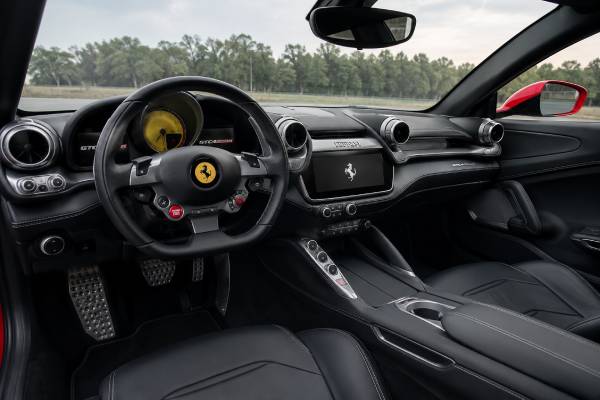
Inside, the “dual cockpit” idea gives the passenger more involvement than in older Ferrari GTs. The dashboard wraps around the driver, but the front passenger can be given a dedicated display. The rear seats are real by exotic-car standards. Adults can fit for shorter trips, and children or smaller passengers are comfortable. Fold the rear seats and the car becomes genuinely practical for luggage.
The sensory character is different from the V12. The V12 sings, builds, and rewards revs. The T surges. Its sound is deeper and more muted, with turbocharged urgency rather than naturally aspirated theatre. Some buyers see that as a drawback. Others prefer the quieter, more relaxed tone on long journeys.
The engineering choice that gives the car much of its personality is rear-wheel steering. At lower speeds, it helps the large body rotate more naturally. At higher speeds, it adds stability. It cannot make the car small, but it makes the long wheelbase less obvious. Combined with Ferrari’s fast steering and electronic differential, it gives the T a level of agility that surprises people expecting a heavy luxury wagon.
Road Feel, Performance, and Everyday Character
The GTC4Lusso T feels like a fast, torque-rich Ferrari GT rather than a softened supercar. Its best quality is how easily it covers distance: quick in traffic, stable on highways, and far more practical than its performance figures suggest.
Acceleration is immediate once the turbos are awake. The 760 Nm torque plateau gives the car a strong push from ordinary road speeds, so it does not need to be worked hard to feel fast. The 7,500 rpm power peak still gives it a Ferrari-style upper range, but the engine’s real strength is the middle. Overtaking is effortless.
The gearbox suits the car well. In automatic mode, it can behave smoothly enough for commuting. Use the paddles, and it responds with the crispness expected from a modern Ferrari dual-clutch. The shift character changes noticeably with the manettino setting. Comfort mode keeps the car calm. Sport mode sharpens throttle response, damping, gearbox logic, and stability-control behavior.
Steering is quick and light by traditional GT standards. Drivers coming from older Ferraris may need time to adjust because the front responds with little delay. The rear-wheel steering helps the car rotate, but the driver still feels the size and weight when pushing hard on narrow roads. This is not a 488 GTB with rear seats. It is a large grand tourer with very high limits.
Ride quality is one of its strongest ownership arguments. With the dampers in their softer setting, the T can handle poor roads better than many expect, especially on good tires. The 20-inch wheels and low-profile tires still mean sharp impacts can be felt, but the chassis is not punishing. This is a Ferrari that can make sense for long weekends, airport runs, and cross-country drives.
Braking performance is strong, but carbon-ceramic brakes need proper inspection. On the road they can last a long time, especially when not abused. On track, or after repeated hard mountain use, wear can become expensive. Pedal feel should be firm, consistent, and free of vibration. Any warning lights, brake-fluid concerns, or uneven wear should be investigated before purchase.
The T is not the best Lusso for snow or poor-weather traction. The V12’s all-wheel-drive system gives it a clear advantage in cold or slippery conditions. The T is better suited to dry climates and drivers who prefer rear-drive balance. Tire choice matters greatly. Old, hardened, mismatched, or budget tires can make the car feel nervous and reduce the benefit of Ferrari’s chassis systems.
In daily use, the strengths are clear:
- Good forward visibility for an exotic GT
- Usable rear seats
- Useful cargo space
- Strong highway range
- Comfortable cruising manners
- Easier low-speed behavior than many mid-engined Ferraris
The weaknesses are also clear:
- Large exterior width
- Expensive tires and brakes
- Turbocharged sound is less special than the V12
- Rear-drive layout is less confidence-inspiring in poor weather
- Cabin electronics and trim need careful checking as the car ages
The best way to understand the T is not as the “cheap Lusso.” It is the Lusso for drivers who want torque, rear-drive balance, and usability more than V12 drama.
Maintenance, Reliability, and Specialist Costs
The GTC4Lusso T can be a dependable modern Ferrari when serviced correctly, but it is still a complex exotic car. The biggest ownership risks are deferred maintenance, worn consumables, electronic faults, accident history, and expensive items that a normal used-car inspection can miss.
Scheduled servicing is generally annual or mileage-based, depending on market and documentation. Many cars originally benefited from Ferrari’s seven-year genuine maintenance program, but early examples are now aging beyond that period. A buyer should confirm what coverage remains, if any, and whether every annual service was completed on time.
Important maintenance areas include:
- Engine oil and filters: Must be changed on schedule, even for low-mileage cars.
- Brake fluid: Critical because of the carbon-ceramic braking system and recall history.
- Transmission service: The dual-clutch gearbox should shift cleanly with no harsh engagement, slipping, or warning lights.
- Cooling system: Turbocharged engines generate heat, so inspect radiators, hoses, fans, and coolant condition.
- Turbo system: Listen for abnormal whine, smoke, boost leaks, or poor response.
- Battery health: Weak batteries cause many modern Ferrari electrical warnings.
- Suspension lift and dampers: Check for leaks, uneven ride height, warning lights, and slow lift operation.
- Rear-wheel steering: Any warning message or alignment irregularity needs specialist diagnosis.
- Tires: Correct size, matching specification, date codes, and even wear are essential.
- Carbon-ceramic brakes: Inspect disc condition, pad life, surface damage, and service records.
The F154 engine family is generally respected, but that does not make neglect harmless. Heat, old fluids, low battery voltage, and infrequent use can create issues. Cars that sit for long periods may need more recommissioning than their mileage suggests.
Known ownership concerns and inspection points include:
| Area | What to check |
|---|---|
| Recalls | Confirm completion of brake-fluid reservoir cap and door-lock campaigns where applicable |
| Battery and modules | Check for low-voltage faults, stored codes, and correct battery-conditioner use |
| Brakes | Inspect carbon-ceramic discs, pads, brake fluid, and pedal feel |
| Suspension | Test lift system, adaptive dampers, bushings, tire wear, and alignment |
| Drivetrain | Check DCT shifts, differential behavior, leaks, and service records |
| Interior electronics | Test infotainment, passenger display, cameras, sensors, seat motors, and climate controls |
| Body and paint | Look for accident repairs, paint mismatch, undertray damage, and cracked carbon trim |
A proper pre-purchase inspection should be performed by a Ferrari dealer or a specialist with Ferrari diagnostic equipment. A generic inspection is not enough. The technician should scan all modules, verify recall status, inspect the underside with panels removed where appropriate, check brake wear with the correct method, and review service history against the VIN.
Parts availability is generally good through Ferrari channels, but prices can be high and some trim pieces are costly. The car’s size also means body repairs are expensive. Front bumper, undertray, wheel, and carbon-fiber damage can turn a seemingly minor scrape into a large invoice.
The best ownership strategy is preventive. Keep the battery conditioned, use the car regularly, service it annually, replace aging tires regardless of tread depth, and address small warning lights early. A well-kept GTC4Lusso T feels polished and robust. A neglected one can become expensive quickly.
Values, Market Position, and Buying Checks
The GTC4Lusso T is usually valued below the V12 model, but the best examples are not bargain cars. Buyers should focus on specification, service history, condition, and total ownership risk rather than simply chasing the lowest advertised price.
As a current used-Ferrari proposition, the T sits in an interesting place. It is newer and more practical than many two-seat Ferraris at similar money, but it lacks the V12’s obvious collector magnetism. That makes it attractive to drivers who actually want to use the car. It also means resale values can be more sensitive to mileage, color, and options.
Value is influenced by:
- Mileage: Very low-mileage cars bring premiums, but ultra-low use can create its own recommissioning needs.
- Color: Classic Ferrari colors help liquidity, while subtle GT colors can suit the car but narrow the buyer pool.
- Interior specification: Daytona seats, attractive leather combinations, carbon trim, and passenger display help.
- Options: Suspension lift, panoramic roof, Apple CarPlay, upgraded wheels, and premium audio can matter.
- Service history: Annual Ferrari dealer or recognized specialist records are essential.
- Warranty status: Ferrari Power warranty or recent dealer inspection can support value.
- Recall completion: Missing recall documentation is a negotiation point and a safety concern.
- Originality: Factory-correct cars are easier to sell than modified examples.
- Condition: Sticky interior controls, worn bolsters, damaged wheels, old tires, and brake wear all affect real cost.
A strong car should have a clean history, no unexplained paintwork, matching tires, healthy brakes, no warning lights, full documentation, and a specification that suits the model’s GT character. A weak car may look cheap but need tires, brakes, annual service, battery, suspension work, cosmetic correction, and software updates immediately.
Use this buying sequence:
- Confirm the VIN, model year, market, and original specification.
- Review service invoices year by year, not just stamped books.
- Verify recall completion and warranty history with Ferrari.
- Check tire age, tire match, brake condition, and wheel damage.
- Scan all control modules with Ferrari-capable diagnostics.
- Inspect the underside, undertrays, bumper edges, and suspension lift.
- Road test from cold and confirm smooth idle, clean shifts, stable braking, and no warning lights.
- Price the car after estimating immediate maintenance, not before.
Cars to seek are clean, original, well-optioned examples with annual service history, good tires, healthy brakes, and no stories. Cars to avoid are those with patchy history, unresolved warning lights, heavy modifications, unexplained accident repairs, missing keys or manuals, poor battery care, or suspiciously cheap asking prices.
Long-term collectability is nuanced. The V12 GTC4Lusso is likely to remain the purist favorite. The T may never match that emotional pull, but it has a strong identity of its own: Ferrari’s practical shooting brake with the brand’s first four-seat turbo V8 formula. If the market continues to value usable modern Ferraris, the best T examples should remain desirable, especially in tasteful specifications.
For an owner-driver, the GTC4Lusso T may be the smarter car. It gives up some theatre but gains torque, range, and a lighter front end. For a collector, the safest approach is to buy the best-condition, best-documented, most original example available and avoid cars that need expensive catch-up work.
References
- GTC4Lusso T: the Other Side of Lusso 2016 (Manufacturer Specifications)
- Sporty, agile and versatile: the new GTC4Lusso T 2016 (Manufacturer Press Release)
- Gas Mileage of 2018 Ferrari GTC4Lusso 2018 (EPA Fuel Economy)
- Vehicle Detail Search – 2018 FERRARI GTC4LUSSO T | NHTSA 2026 (Recall Database)
- Part 573 Safety Recall Report 22V-536 2022 (Recall Report)
Disclaimer
This article is for informational purposes only and is not a substitute for professional diagnosis, inspection, repair, or valuation. Specifications, torque values, service intervals, recall status, procedures, and equipment can vary by VIN, market, model year, and option package. Always verify details against official Ferrari service documentation and have any car inspected by a qualified Ferrari specialist before purchase.
If you found this guide useful, please consider sharing it on Facebook, X/Twitter, or your preferred car community to support our work.