
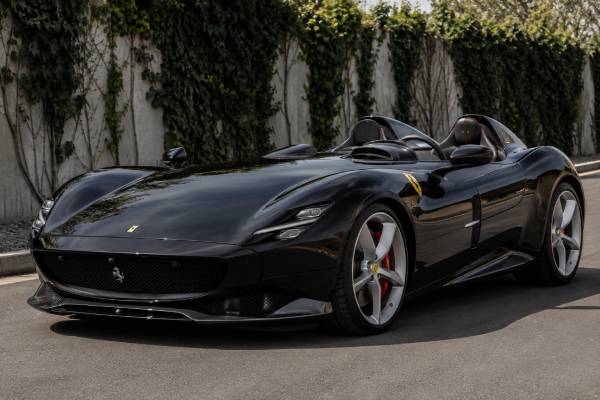
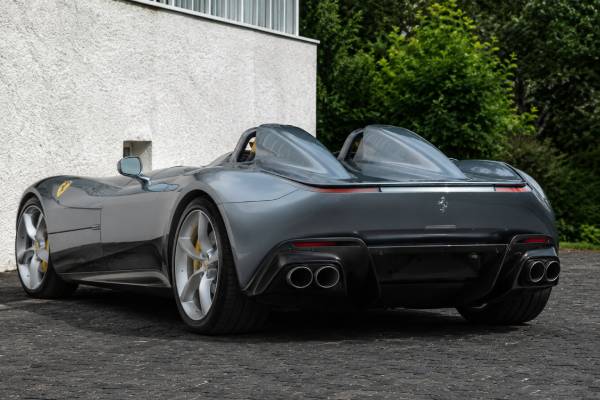

The Ferrari Monza SP2 is the two-seat version of Ferrari’s first modern Icona model, a limited-run barchetta inspired by the company’s 1950s sports racers but built around modern front-mid-engine V12 hardware. Introduced in 2018 with deliveries generally associated with the 2019–2022 period, it pairs the F140 GC 6.5-liter naturally aspirated V12 with a roofless, windscreen-free carbon-fiber body and extreme open-cockpit driving character. Ferrari quoted 810 cv, which is commonly rounded in English-language use as 810 hp, with 719 Nm of torque and 0–100 km/h in 2.9 seconds. The SP2 matters because it is not simply a special body on an 812-derived base. It launched the Icona idea, revived Ferrari’s barchetta language, and became one of the most collectible modern naturally aspirated V12 Ferraris.
Table of Contents
- Why the Monza SP2 Matters
- V12 Specs, Chassis, and Performance Data
- Production Numbers, Options, and Identification
- Barchetta Design, Carbon Body, and Virtual Windscreen
- Road and Track Driving Character
- Maintenance, Reliability, and Ownership Risks
- Market Values and Buying Strategy
Why the Monza SP2 Matters
The Monza SP2 is important because it began Ferrari’s modern Icona series and proved that a new Ferrari could be both technologically current and openly nostalgic. It was not designed as a mass-production supercar, a track special, or a normal Spider. It was built as a collector-grade statement car for highly selected clients.
The SP2 sits in a rare part of Ferrari history. It follows the spirit of the 166 MM, 750 Monza, 860 Monza, and other open sports racers, but it does not copy any one car directly. Instead, it uses the idea of the 1950s barchetta: a low, open, competition-flavored body, minimal weather protection, a dramatic long bonnet, and a cockpit that puts the driver close to the mechanical experience.
Ferrari unveiled the Monza SP1 and SP2 in 2018, and the cars are generally treated as 2019–2022 models in market and specification guides. The SP1 is the single-seat version. The SP2 adds a passenger seat and is the more usable of the two, although “usable” is relative. There is no roof, no normal windscreen, and no ordinary grand-touring comfort. That is part of the point.
The car’s place in Ferrari’s model line is unusual. It shares engineering DNA with the 812 Superfast era, especially the front-mid-mounted F140 V12 family and the seven-speed dual-clutch transaxle layout. But the Monza is not just an 812 without a roof. Its body, cockpit treatment, aero concept, and client positioning move it into a separate collector category.
The SP2 also arrived at the right time. As Ferrari, Lamborghini, McLaren, Porsche, and others moved deeper into turbocharging, hybrid systems, and active electronics, the Monza celebrated a naturally aspirated V12 with an almost theatrical level of exposure. The engine is not hidden behind refinement. It dominates the car.
Collectors care because the Monza SP2 combines several value signals in one package:
- Limited production across the SP1 and SP2 family.
- First model in Ferrari’s Icona line.
- Naturally aspirated front-mounted V12.
- Carbon-fiber coachwork with a very specific visual identity.
- Invitation-only or highly selective allocation history.
- Strong connection to Ferrari’s sports-racing heritage.
- Low-mileage collector ownership pattern from new.
Its reputation today is that of an instant collectible rather than a conventional used exotic. Buyers are not cross-shopping it like a normal 812 GTS, SF90 Spider, or Roma Spider. They are usually comparing it with other modern Ferrari flagships, special-series V12s, limited-production Icona models, LaFerrari-era halo cars, and the highest-grade Tailor Made specifications.
The Monza SP2 is also significant because it made the later Daytona SP3 easier to understand. The Daytona SP3 continued the Icona theme with a different historical reference and a mid-engine V12 layout, but the Monza established the formula: heritage inspiration, modern engineering, extreme rarity, and a design brief aimed as much at collectors as at drivers.
V12 Specs, Chassis, and Performance Data
The Monza SP2’s core technical appeal is its 6.5-liter naturally aspirated F140 GC V12, an 812-derived engine tuned for 810 cv and a very high-revving character. The chassis and gearbox are modern Ferrari supercar hardware, but the open body makes the performance feel more raw than the figures alone suggest.
| Category | Specification |
|---|---|
| Model | Ferrari Monza SP2 |
| Internal reference | F176 project family, SP2 two-seat Icona variant |
| Production era | 2019–2022 model-period references |
| Engine code | F140 GC |
| Engine type | 65-degree naturally aspirated V12 |
| Displacement | 6,496 cc |
| Maximum output | 810 cv / 603 kW at 8,500 rpm |
| Maximum torque | 719 Nm at 7,000 rpm |
| Specific output | 125 cv per liter |
| Maximum engine speed | 8,900 rpm |
| Compression ratio | 13.6:1 |
| Transmission | F1 seven-speed dual-clutch gearbox |
| Drivetrain | Rear-wheel drive |
The F140 engine family is one of Ferrari’s defining modern V12 lines. In the Monza SP2, the engine is tuned to feel urgent at the top end, with peak power at 8,500 rpm and torque arriving high in the rev range. That does not mean it is weak at low speed. A large-displacement Ferrari V12 has plenty of response at normal road revs. But the car’s character clearly rewards drivers who let the engine climb.
| Item | Ferrari Monza SP2 data |
|---|---|
| Length | 4,657 mm |
| Width | 1,996 mm |
| Height | 1,155 mm |
| Wheelbase | 2,720 mm |
| Dry weight | Approximately 1,520 kg |
| Fuel tank | 90 liters |
| Front tires | 275/30 ZR21 on 10J wheels |
| Rear tires | 315/30 ZR20 on 11.5J wheels |
| Front brakes | 398 x 38 mm carbon-ceramic discs |
| Rear brakes | 360 x 32 mm carbon-ceramic discs |
| 0–100 km/h | 2.9 seconds |
| 0–200 km/h | 7.9 seconds |
| Top speed | Over 300 km/h |
The car’s construction uses extensive carbon fiber for the body and cockpit elements, while the underlying engineering is tied to Ferrari’s front-mid-engine V12 architecture. That distinction matters for buyers. The Monza is not a carbon-tub hypercar in the same way as a LaFerrari. Its exotic value comes from the body concept, engine, rarity, and Icona positioning more than from a racing-style monocoque.
The brake and tire setup is serious but also expensive to maintain. Carbon-ceramic discs can last a long time under careful road use, but track use, heat cycling, stone damage, or poor washing practices can make inspection essential. The staggered 21-inch front and 20-inch rear tire setup is also part of the car’s steering and traction balance, so matching the correct tire type, age, and specification matters more than simply fitting the right size.
Production Numbers, Options, and Identification
Ferrari built the Monza SP1 and SP2 as a combined limited family, with the commonly cited total being 499 examples across both seating configurations. Exact public split figures between SP1 and SP2 are not always consistent, so buyers should rely on factory documentation rather than registry estimates when judging rarity.
The easiest visual difference is the seating layout. The SP1 has one seat and a covered passenger-side area, giving it a more extreme single-seat sports-racer feel. The SP2 has two seats, two head fairings, and enough passenger accommodation to make it more appealing for road events, rallies, and shared drives.
That two-seat layout is one reason the SP2 often has broader market appeal. A single-seat Ferrari is more unusual, but a two-seat barchetta is easier to enjoy and easier to justify for collectors who actually drive their cars.
What documentation should come with the car
A serious Monza SP2 should have a complete ownership file. Low mileage alone is not enough. The best cars usually come with:
- Original purchase and allocation paperwork where available.
- Factory build specification.
- Tailor Made or Atelier records if the car was specially configured.
- Ferrari service history in the official network.
- Warranty and maintenance program records.
- Owner’s manuals and books.
- Battery conditioner and accessories.
- Original helmet or driving equipment supplied with the car, where applicable.
- Import, registration, and tax documentation for the current market.
- Clear evidence of recall or service-campaign checks by VIN.
For modern limited Ferraris, originality is not only about paint and trim. It is about the story matching the paperwork. A car with unusual paint, a stripe, special leather, custom headrest embroidery, exposed carbon options, or painted head fairings should have records showing that those details were factory-specified rather than added later.
Options that affect desirability
The Monza SP2 was frequently configured through Ferrari’s higher-end personalization channels. Some cars are restrained and elegant; others are deliberately theatrical. Value depends on taste, originality, and how well the specification suits the car’s barchetta shape.
Desirable or notable equipment can include:
- Tailor Made paint or historical livery references.
- Exposed carbon-fiber exterior parts.
- Painted or contrast-color head fairings.
- Scuderia Ferrari shields.
- Forged wheels in special finishes.
- Colored brake calipers.
- Four-point harnesses.
- Carbon-fiber racing seats.
- Special leather, Alcantara, or contrast stitching.
- Colored tachometer.
- Front suspension lift.
- Parking cameras and useful driver-assistance equipment.
- Model-specific luggage or accessories if supplied.
Some options help usability, especially suspension lift and cameras. Others help presentation, especially carbon exterior packages and special liveries. The most valuable specifications are not always the loudest. A subtle, historically informed spec with excellent documentation can be stronger than a busy spec chosen only for visual impact.
Market-specific details
Because the Monza SP2 is rare and internationally traded, buyers need to check market compliance carefully. A car offered in Europe, the Middle East, the United Kingdom, or North America may have different registration, lighting, emissions, warranty, tax, and import considerations. Temporary import status is common at international auctions and must be understood before bidding.
A buyer should confirm:
- Whether the car can be road registered in the intended country.
- Whether taxes, duties, and VAT have already been paid.
- Whether the car is being sold on temporary import.
- Whether the warranty or maintenance coverage transfers.
- Whether the car has local-market emissions and safety compliance.
- Whether all accessories can legally be transferred with the car.
For this level of Ferrari, the cleanest purchase is often not the cheapest car. It is the car with the least paperwork risk.
Barchetta Design, Carbon Body, and Virtual Windscreen
The Monza SP2’s design is its main event: a roofless, windscreen-free Ferrari with a long bonnet, compact cockpit, twin fairings, and a body made to recall sports racers rather than modern convertibles. Its engineering supports that visual drama instead of hiding it.
The exterior was developed by Ferrari’s in-house design team, Ferrari Centro Stile. The result is clean but not simple. The front is broad and low, the bonnet appears almost endless, and the cockpit is pushed rearward. The head fairings behind the occupants are essential to the shape. Without them, the car would look like a stripped-down roadster. With them, it becomes a modern barchetta.
The carbon-fiber body is a major part of the car’s identity. Carbon is used not only for weight control but also to allow the sculptural surfaces and complex detailing that define the Monza. Many panels are large, expensive, and highly finished. That is beautiful for collectors and worrying for repair specialists. A small impact or careless loading incident can become a major carbon repair conversation.
The doors are another signature element. They open upward and add theater, but they also require careful inspection. Alignment, hinge function, gas struts, seals, and paint edges matter. On a car this low and wide, even minor misalignment can suggest past handling damage, transport damage, or poor repair work.
The most unusual engineering feature is the Virtual Windscreen. Since the Monza has no conventional windscreen, Ferrari used airflow management to reduce the direct blast into the occupants’ faces. It does not make the SP2 behave like a normal convertible. It simply makes the concept more usable at speed. Drivers still need the right eyewear, and at higher speeds many owners prefer helmet-style protection.
Inside, the cockpit is minimal by Ferrari GT standards but rich in material quality. The carbon-fiber seats, low seating position, focused controls, and exposed driving environment make the car feel special before the engine starts. The passenger area in the SP2 adds a social quality that the SP1 does not have, but both occupants are exposed to wind, heat, noise, and weather.
The sound design is not artificial. The lack of roof and windscreen puts the driver directly in the intake and exhaust experience. The V12’s induction noise, gearbox shifts, exhaust note, and mechanical vibration become part of the cabin environment. That is why many owners describe the Monza less like a normal supercar and more like a controlled event.
Road and Track Driving Character
The Monza SP2 feels faster and more dramatic than its numbers because there is almost nothing between the occupants and the environment. The 2.9-second 0–100 km/h figure is impressive, but the sound, wind, seating position, and exposed cockpit are what define the drive.
The V12 is the centerpiece. At low revs, it is smooth and flexible enough for gentle driving, but the car comes alive as the revs rise. The engine’s response is immediate because there are no turbochargers to wait for. The power builds with speed, and the final part of the rev range is where the Monza feels most like a special Ferrari rather than an open 812 relative.
The seven-speed dual-clutch gearbox shifts quickly and suits the engine well. In automatic mode, it can behave smoothly enough for slow traffic, although using the Monza in dense city conditions misses the point. In manual paddle mode, it gives the driver more control over the V12’s sound and response. Upshifts near the top of the rev range are a major part of the car’s theater.
Steering is quick and precise, with modern Ferrari assistance and rear-wheel-drive agility. Because the car is wide, low, and extremely valuable, it is not relaxing on narrow roads. The front end needs careful placement, and the exposed cockpit makes speed feel more intense than it would in a closed GT.
Ride quality depends heavily on road surface, tire condition, and whether the car is in a more relaxed damper setting. The Monza is not a soft grand tourer, but it is not a crude track car either. It was built for fast, memorable road use and special events rather than daily driving.
Braking performance is very strong when the carbon-ceramic system is healthy and warm enough to work at its best. On gentle road use, pedal feel may seem firm and slightly less progressive than iron brakes to drivers unfamiliar with carbon ceramics. On hard use, the system’s strength is heat resistance and repeated stopping power.
The Monza’s limits are high, but the driving environment changes the way a driver uses them. On track, the SP2 is fast but not as practical as a closed track-focused Ferrari. Wind, helmet choice, tire temperature, brake temperature, and cockpit exposure matter. On the road, the best use is a clear, dry, flowing route where the engine can be worked without needing maximum speed.
Usability is the compromise. There is no roof to raise when weather changes. Wind protection is limited. Cargo space is minimal. Security and parking need thought. Long motorway drives can become tiring. The Monza is best treated as a destination car, event car, or special-moment Ferrari rather than a conventional touring machine.
Maintenance, Reliability, and Ownership Risks
The Monza SP2’s main ownership risks are not ordinary reliability problems; they are age, storage, carbon-fiber damage, brake condition, tire age, electronics, and incomplete Ferrari service documentation. A low-mileage car can still need expensive recommissioning if it has sat unused.
The F140 GC V12 is part of a respected Ferrari engine family. It is not known as a fragile engine when maintained properly, warmed carefully, and serviced by specialists who understand modern Ferrari V12s. The risk is that some Monza examples spend more time displayed than driven. Cars that sit can develop battery, fluid, seal, tire, and fuel-system issues even when the odometer looks attractive.
Ferrari’s seven-year Genuine Maintenance program is an important part of the ownership picture. Depending on market, VIN, in-service date, and transfer status, scheduled maintenance may have been covered during the car’s early life. That does not remove the need for inspection. It simply means there should be a clear factory-network service record.
Important maintenance and inspection areas include:
- Annual service records, even for very low-mileage cars.
- Engine oil, brake fluid, coolant, and gearbox service history.
- Battery condition and battery conditioner use.
- Software updates and campaign completion.
- DCT operation at low speed and under load.
- Suspension lift function, if fitted.
- Carbon-ceramic brake disc condition and measured wear.
- Brake fluid history and warning-light checks.
- Tire date codes, flat-spotting, and correct specification.
- Cooling system hoses, clamps, and signs of seepage.
- Carbon-fiber panel condition underneath and around the nose.
- Door alignment and hinge function.
- Interior leather, harness, and exposed cockpit wear.
- Evidence of water exposure or poor storage.
Carbon body and accident repair
Carbon-fiber body damage is one of the largest cost risks. A Monza SP2 has a very low front, wide bodywork, and expensive exposed surfaces. Scrapes under the front, cracks near mounting points, repairs around the doors, and mismatched paint or weave can all affect value.
A buyer should never rely only on a clean visual walkaround. The car needs to be lifted and inspected by a Ferrari specialist familiar with carbon repair standards. Paint depth readings are helpful on painted panels but do not tell the full story on carbon. Panel gaps, fasteners, underside marks, and documented repair invoices are often more important.
Brakes, tires, and storage
Carbon-ceramic brakes are durable but costly. Disc replacement is expensive, and a car used hard on track may have more brake wear than its mileage suggests. The only safe approach is inspection by measurement and condition, not mileage.
Tires are equally important. A low-mileage 2020 car can still have old tires. Flat spots, cracking, hardened rubber, or incorrect replacement tires can change the car’s steering and braking. On a car capable of more than 300 km/h, tire condition is not a detail.
Electronics and low-use problems
Modern Ferraris rely heavily on control modules, sensors, battery health, and software. A weak battery can create warning messages that look more serious than they are, but it can also hide real issues. Cars kept on proper conditioners and serviced annually are usually safer bets than cars stored as static art.
The Monza’s open cockpit also means interior condition needs extra attention. Sun exposure, heat, leather shrinkage, harness fading, and moisture can all matter. A car that has been shown outdoors or driven in poor weather should be inspected carefully for water-related marks and corrosion on exposed hardware.
Market Values and Buying Strategy
The Monza SP2 sits at the top end of the modern Ferrari collector market, with public results ranging from the mid-$2 million area to nearly $5 million depending on timing, specification, mileage, venue, and buyer appetite. The spread is wide because these cars trade infrequently and each example’s story matters.
Recent public sales show how sensitive the market is. A 2022 Monza SP2 sold at RM Sotheby’s Abu Dhabi in December 2025 for $2,536,250. A 2021 Monza SP2 sold at Broad Arrow’s Amelia Auction in March 2026 for $4,955,000. Those two figures do not mean every SP2 is either a $2.5 million car or a $5 million car. They show that provenance, specification, sale location, bidding competition, and market timing can move the result dramatically.
| Value factor | Why it matters |
|---|---|
| Factory specification | Tailor Made, historic colors, carbon options, and tasteful personalization can add appeal. |
| Mileage | Very low mileage helps, but only if the car has been serviced and stored correctly. |
| Documentation | Factory build records, service history, books, accessories, and warranty records reduce risk. |
| Condition | Carbon body, brakes, tires, cockpit materials, and underside condition are crucial. |
| Ownership history | Single-owner, known-collector, or dealer-maintained cars are easier to trust. |
| Market eligibility | Registration, import duties, taxes, and local compliance can change the real cost. |
| Accessories | Original helmet, charger, manuals, and special equipment can matter more than expected. |
The best buying strategy is to treat the SP2 as a collector asset first and a car second. That means due diligence should be more like buying an important artwork than buying a normal supercar.
A serious pre-purchase process should include:
- Confirm the VIN, build specification, and market identity with Ferrari documentation.
- Review all ownership, service, campaign, and warranty records.
- Check whether the car is fully imported and tax-paid in the sale location.
- Have a Ferrari-authorized or highly specialized independent inspection.
- Measure carbon-ceramic brake wear and inspect tires by date and condition.
- Inspect the carbon body, underside, doors, lift system, and cockpit materials.
- Confirm all accessories, manuals, keys, charger, and special equipment are present.
- Verify that the specification matches factory records.
- Understand future service access in the buyer’s region.
- Budget for recommissioning even if the mileage is extremely low.
Cars to seek are complete, well-documented, factory-original examples with strong specifications, proper service history, careful storage, and no import complications. Cars to avoid are those with missing accessories, unclear registration status, weak service records, undocumented repainting, carbon repairs without factory-level paperwork, or suspiciously cheap pricing.
Long-term collectability looks strong because the Monza SP2 combines rarity, first-series Icona status, naturally aspirated V12 character, and one of Ferrari’s most distinctive modern designs. The main risk is not desirability. It is overpaying for the wrong example, underestimating ownership costs, or buying a car whose paperwork is weaker than its presentation.
For the right collector, the Monza SP2 is one of the most emotionally direct modern Ferraris: a front-engined V12 barchetta with almost no filter between driver, machine, and air. For the wrong buyer, it is impractical, exposed, expensive, and difficult to use often. That split is exactly why it is special.
References
- Ferrari Monza SP2 – Ferrari.com 2018 (Manufacturer Specifications)
- Ferrari Monza SP1 and SP2: the first in a new concept of ‘Icona’ cars 2018 (Manufacturer Press Release)
- Warranties And Official Ferrari Maintenance 2026 (Manufacturer Service Program)
- 2022 Ferrari Monza SP2 | Abu Dhabi | RM Sotheby’s 2025 (Auction Result)
- 2021 Ferrari Monza SP2 | The Amelia Auction 2026 2026 (Auction Result)
Disclaimer
This article is for informational purposes only and is not a substitute for professional diagnosis, inspection, repair, valuation, or legal import advice. Specifications, torque values, service intervals, procedures, campaign eligibility, equipment, and compliance requirements can vary by VIN, market, production date, and individual configuration. Always verify details against official Ferrari service documentation and a qualified Ferrari specialist before buying, servicing, or operating a Ferrari Monza SP2.
If you found this guide useful, please consider sharing it on Facebook, X/Twitter, or your preferred automotive community to support our work.