
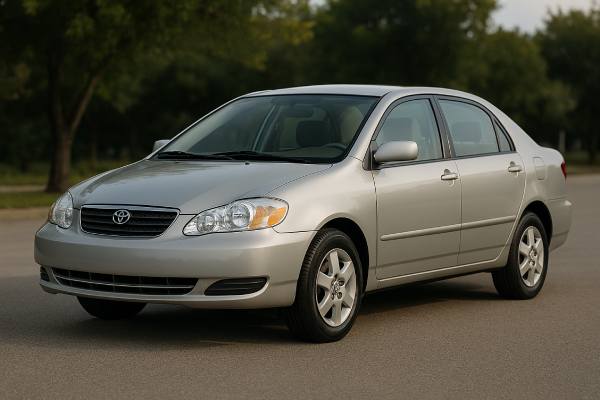
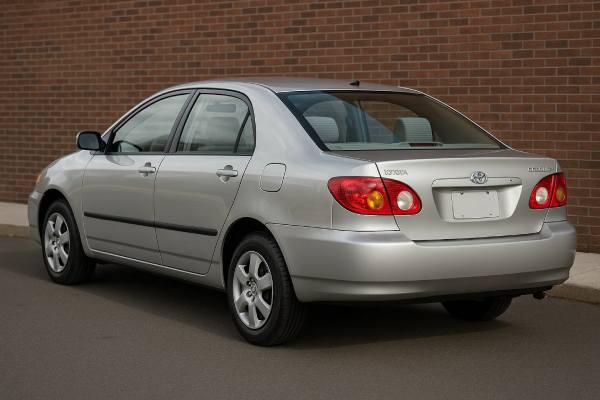
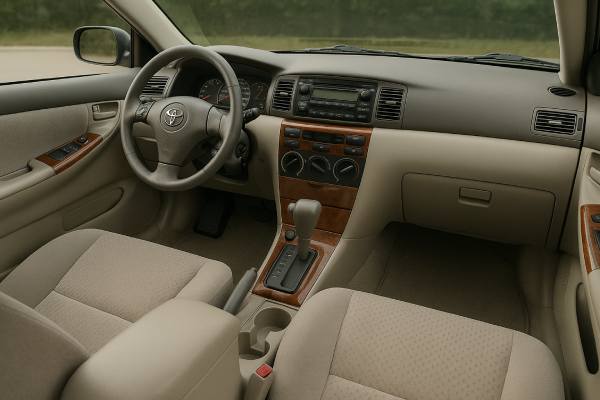
The 2002–2004 Toyota Corolla (chassis code ZZE130 for the North American sedan) is the early half of the E120 generation—quietly engineered for low running costs, high efficiency, and long-haul durability. Its 1ZZ-FE 1.8-liter four-cylinder and robust four-speed automatic or five-speed manual made simple work of commuting while returning top-tier fuel economy for its day. A long-stroke design, chain-driven cams, and VVT-i (variable valve timing) give it usable torque at everyday rpm with minimal maintenance. Inside, the cabin is straightforward, with excellent outward visibility and simple controls. Safety performance improved notably for cars built after December 2002, and side airbags were available; in 2005 the line added curtains, but those are outside this 2002–2004 scope. If you want an inexpensive, honest small sedan that rewards regular maintenance, this era of Corolla remains a smart buy.
At a Glance
- Strong real-world economy (manual: ~31 mpg combined; automatic: ~28 mpg) and low operating costs.
- Proven 1ZZ-FE engine, timing chain (no belt), easy DIY serviceability.
- Comfortable ride and durable cabin materials for high-mileage use.
- Watch for 1ZZ oil consumption on neglected engines; verify with a long test drive and dipstick check.
- Typical service cadence: engine oil every 5,000–7,500 miles (8,000–12,000 km) or 6 months, whichever comes first.
Guide contents
- Corolla ZZE130 Overview
- Corolla (ZZE130) Technical Data
- Trims, Options, and Safety
- Reliability and Service Actions
- Maintenance and Buyer’s Guide
- Driving and Performance
- How It Compares to Rivals
Corolla ZZE130 Overview
The 2002–2004 Corolla sedan (E120 series; ZZE130 in North America) arrived larger, quieter, and more efficient than its predecessor. It shares its fundamental platform with Matrix/Vibe and prioritizes low ownership cost and reliability over flash. The sole engine for this North American focus is Toyota’s 1ZZ-FE: an all-aluminum, chain-driven DOHC inline-four with VVT-i. Power is modest (about 130 hp / 97 kW) but well-matched to its curb weight, and the long-stroke geometry delivers useful mid-range torque for city driving. Gearboxes are either a slick five-speed manual or a four-speed automatic (with overdrive and lock-up) tuned for economy and smoothness.
Cabin packaging is a Corolla hallmark: excellent front headroom, adult-friendly rear knee room for the class, and a squared-off trunk that swallows luggage better than some larger sedans. Noise isolation improved over the prior generation, with more firewall insulation and better door seals; on the highway, the car feels stable and relaxed at 65–75 mph (105–120 km/h). The ride is compliant, helped by tall-profile 15-inch tires and a suspension calibrated for comfort rather than ultimate cornering grip.
Safety is a tale of two halves in this window. Cars built after December 2002 incorporate an improvement to lower-leg protection in the moderate overlap crash; side airbags were optional across the span. If a 2002 build is on your list, confirm its production date from the driver-door jamb and, ideally, check for side airbags. As with all 2002–2004 small cars, advanced driver-assistance features weren’t yet commonplace; you’ll find ABS on many trims, traction control rarely, and no stability control this early.
The big ownership story is the drivetrain’s simplicity. There are no timing belts to replace, and fluids are widely available at discount prices. The most cited caution is oil consumption in neglected 1ZZ engines due to stuck oil control rings. Well-maintained examples with consistent oil changes typically avoid the issue and run well past 200,000 miles (320,000 km). For a budget commuter, student car, or high-mileage courier, this Corolla is hard to fault.
Corolla (ZZE130) Technical Data
Below are core specifications for the 2002–2004 Corolla sedan with the 1ZZ-FE 1.8-liter engine, based on North American market equipment. Values may vary slightly by model year, transmission, and options.
Engine and Performance
| Item | Specification |
|---|---|
| Code | 1ZZ-FE |
| Layout & cylinders | Inline-4, DOHC, VVT-i; 4 valves/cyl |
| Bore × stroke | 79.0 × 91.5 mm (3.11 × 3.60 in) |
| Displacement | 1.8 L (1,794 cc) |
| Induction | Naturally aspirated |
| Fuel system | Multi-point fuel injection |
| Compression ratio | ~10.0 : 1 |
| Max power | ~130 hp (97 kW) @ ~6,000–6,400 rpm |
| Max torque | ~169 Nm (125 lb-ft) @ ~4,200 rpm |
| Timing drive | Chain (no scheduled replacement) |
| Rated economy (EPA) | Manual: 28/36 mpg US (8.4/6.5 L/100 km); Automatic: 25/34 mpg US (9.4/6.9 L/100 km) |
| Real-world highway @75 mph (120 km/h) | ~34–37 mpg US (6.9–6.4 L/100 km), wind/tires dependent |
| Emissions standard | Tier-2/LEV (varies by state and year) |
| Aerodynamics | Cd ~0.30–0.31 (model/trim dependent) |
Transmission and Driveline
| Item | Specification |
|---|---|
| Transmission | 5-speed manual; 4-speed automatic (OD/lock-up) |
| Drive type | FWD |
| Final drive ratio | ~4.31 (M/T), ~3.94 (A/T) typical |
| Differential | Open |
(Gear ratios vary slightly by year; economy-biased overall.)
Chassis and Dimensions
| Item | Specification |
|---|---|
| Front suspension | MacPherson strut, coil springs, anti-roll bar |
| Rear suspension | Torsion beam axle, coil springs |
| Steering | Rack-and-pinion, power-assisted |
| Brakes | Front ventilated discs; rear drums (most trims) |
| Wheel/tire packages | 185/65R15 (typical); some S/LE packages 195/65R15 |
| Ground clearance | ~150 mm (5.9 in) |
| Length/Width/Height | ~4,530 / 1,700 / 1,485 mm (178.3 / 66.9 / 58.5 in) |
| Wheelbase | ~2,600 mm (102.4 in) |
| Turning circle | ~10.4–10.8 m (34–35.5 ft) |
| Curb weight | ~1,125–1,210 kg (2,480–2,665 lb) |
| GVWR | ~1,650–1,700 kg (3,637–3,748 lb) |
| Fuel tank | 50 L (13.2 US gal / 11.0 UK gal) |
| Cargo volume (SAE) | ~365–370 L (12.9–13.1 ft³) |
Performance and Capability
| Metric | Manual | Automatic |
|---|---|---|
| 0–60 mph (0–97 km/h) | ~8.8–9.4 s | ~9.8–10.5 s |
| Top speed (governed/typical) | ~185–190 km/h (115–118 mph) | ~180–185 km/h (112–115 mph) |
| 100–0 km/h braking | ~39–43 m (128–141 ft), tire-dependent | |
| Payload | ~385–430 kg (850–950 lb), trim-dependent | |
| Roof load | ~45–50 kg (100–110 lb) with proper crossbars |
Fluids and Service Capacities
| System | Specification | Capacity |
|---|---|---|
| Engine oil | API SL/SN, 5W-30 (typical); quality synthetic permitted | ~3.7–4.2 L (3.9–4.4 US qt) with filter* |
| Coolant | Toyota Super Long Life Coolant (SLLC), 50/50 | ~6.5–7.0 L (6.9–7.4 US qt) |
| Manual transmission | API GL-4/GL-5 75W-90 (per service manual) | ~1.9–2.0 L (2.0–2.1 US qt) |
| Automatic transmission | Toyota Type T-IV ATF | ~6.8–7.7 L (7.2–8.1 US qt) total fill; drain/fill ~3.0–3.5 L |
| A/C refrigerant | R-134a | ~430–500 g (15–18 oz), trim-dependent |
| A/C compressor oil | ND-Oil 8 | ~120–150 mL (4–5 fl oz) |
| Fuel | Regular unleaded (87 AKI) | 50 L tank |
- Capacity variation stems from an early dipstick revision and drainback differences; always verify on the dipstick after refill and warm run-up.
Essential torque references (typical):
- Oil drain plug: ~30–40 Nm (22–30 lb-ft)
- Wheel lug nuts: ~103 Nm (76 lb-ft)
- Spark plugs: ~18–22 Nm (13–16 lb-ft) on aluminum head (use anti-seize sparingly or not at all if plated plugs)
Electrical
| Item | Specification |
|---|---|
| Alternator | ~80–90 A |
| 12 V battery | ~45–55 Ah (CCA varies), Group 35 commonly used |
| Spark plugs | Nickel/copper or iridium, 1.1 mm (0.043 in) gap (verify by plug type) |
Safety and Driver Assistance
| Item | Detail |
|---|---|
| Crash ratings | Moderate-overlap frontal: Good (built after Dec 2002); earlier builds improved later. Side impact (without optional side airbags): Poor; models with side airbags fare better. Head restraints & seats: Acceptable. |
| Airbags | Dual front standard; front side-torso optional. Curtain airbags not offered until MY2005. |
| ABS | Available/optional depending on trim and year. |
| Traction/Stability control | Rare/mostly unavailable for 2002–2004 sedans. |
| Child-seat anchors | LATCH lower anchors in rear outboard positions; top tethers 3-point across the rear shelf. |
| Headlights | Halogen reflector; output and beam pattern vary by bulb condition and aiming. |
Trims, Options, and Safety
Trims and equipment (North America, 2002–2004)
Lineup typically comprised CE (base), S (sport-appearance), and LE (well-equipped). All use the same 1ZZ-FE engine and FWD layout.
- CE: Steel 15-inch wheels with covers, cloth seats, manual mirrors/locks on early cars, AM/FM/CD head unit, rear drum brakes, and hub-friendly tires (185/65R15). ABS often optional.
- S: Cosmetic body kit, fog lamps, tachometer, leather-wrapped wheel on some, same drivetrain. Occasional wheel/tire step to 195/65R15; suspension calibration broadly similar to CE/LE.
- LE: Power windows/locks, remote keyless entry, nicer seat fabric/trim; options could include alloy wheels, upgraded audio, and ABS. Leather and moonroof packages were available in select configurations.
Option packages and identifiers
- Side airbags (front torso): Separate option on most 2003–2004 cars—highly recommended. Look for “SRS AIRBAG” labels on the seat sides and confirm via VIN build sheet.
- ABS: Often bundled; check for the ABS lamp lighting briefly at key-on.
- Wheels/tires: 15-inch across the board; factory alloys present on many LE/S.
- Audio: Single-CD head units standard; some cars have six-speaker setups. Aftermarket compatibility is excellent.
Year-to-year changes affecting equipment and safety
- Late 2002 build change: Padding added beneath the carpet improved lower-leg injury measures in the moderate-overlap frontal test. Cars built after December 2002 benefit; verify production date on the driver’s door jamb label.
- Side airbags availability (2003–2004): Optional; cars without them show weaker side-impact protection.
- Curtain airbags (from 2005): Out of this article’s scope but worth noting for cross-shopping.
Safety ratings (summary)
- Frontal moderate overlap: Good for cars built after Dec 2002; early production also scored well overall but showed higher lower-leg loads.
- Side impact: Poor without side airbags. With the optional torso airbags, head injury measures improve; full protection still trails modern designs.
- Head restraints & seats: Acceptable.
Active safety and ADAS
These years predate today’s ADAS. There’s no automatic emergency braking, lane keeping, or adaptive cruise. ABS is the key active feature; tire choice and brake condition have a big effect on stopping performance. If you live in a snowy region, dedicated winter tires transform confidence and reduce stopping distances significantly.
Important safety campaigns
- Airbag inflator recalls (Takata): Certain 2003–2004 Corollas are affected by the industry-wide inflator recall. Some vehicles carry an explicit Do Not Drive advisory until repaired. Always check the VIN with an official recall tool before purchase and insist on completion paperwork.
- Other recalls: Minor campaign counts vary by year and state emissions package. A quick VIN search will show whether any remain open.
Reliability and Service Actions
The 2002–2004 Corolla’s reputation for reliability is largely deserved. Drivetrains regularly surpass 200,000 miles (320,000 km) with basic care. Below is a practical map of issues by prevalence/severity, including symptoms and remedies.
Common (frequent) / Low–Medium severity
- Oil consumption (1ZZ-FE):
- Symptoms: Dipstick level falls between oil changes; blue puff on start-up after long idle; oily tailpipe residue.
- Likely cause: Stuck or coked oil control rings and/or drain-back holes, aggravated by extended oil intervals or poor oil quality.
- Remedy: Short-interval oil changes (e.g., 3,000–5,000 miles) with a high-detergent oil may stabilize mild cases. Severe cases require revised pistons/rings or an Optifit short block. Compression and leak-down tests help separate ring issues from valve-stem seals.
- Prevention: Timely oil service and a quality PCV valve.
- Engine mounts (age-related):
- Symptoms: Cabin vibration at idle, clunk on take-off.
- Remedy: Replace worn mounts; the dog-bone and right-hand mount are common.
- Suspension wear (bushings/struts):
- Symptoms: Front-end clunk over bumps, floaty ride, uneven tire wear.
- Remedy: Front sway-bar links/bushings and struts typically need replacement by 100–150k miles (160–240k km). An alignment afterward is essential.
Occasional / Medium severity
- Wheel bearings (front):
- Symptoms: Growl that rises with speed; faint change in pitch when turning.
- Remedy: Replace the hub/bearing assembly; verify tire noise first.
- Starter or alternator aging:
- Symptoms: Slow crank or charging light at idle with accessories.
- Remedy: Test battery/charging; replace the failing unit. Heat-soak can accelerate wear.
- A/C performance losses:
- Symptoms: Warm air at idle, weak cooling.
- Root causes: Low refrigerant from age-related seepage; condenser fin corrosion; sticking condenser fan relay.
- Remedy: Leak test, repair, evacuate, and recharge to spec.
Rare / High severity
- Severe oil consumption leading to misfire/catalyst damage:
- Symptoms: P030X misfires, sulfur smell, elevated oil use (>1 qt/1,000 miles).
- Remedy: Internal engine repair (pistons/rings) and catalyst replacement if efficiency is below threshold. Performing an engine rebuild with the later-spec parts is the durable fix.
- Serpentine accessory pulley failures (age):
- Symptoms: Belt squeal, sudden loss of charging or power steering.
- Remedy: Inspect pulleys/tensioner; replace as needed with the belt.
ECU/TCU software and calibrations
The 1ZZ-FE/4-speed automatic combo is simple; software flashes were uncommon in these early years relative to later Corollas. When present, updates typically address drivability (shift hesitation, idle quality) rather than hardware defects. If the car feels “busy” in top gear at 65–70 mph, ensure the torque-converter clutch is locking up (tach drop at light throttle) and fluid is in good condition.
Recalls, TSBs, warranty extensions
- Takata airbag inflators: Affected cars must receive new inflators. Some 2003–2004 cars are under “Do Not Drive” until repaired.
- Oil consumption service guidance: Toyota issued technical procedures specifying revised pistons/rings or short-block replacements for engines that fail consumption tests. Proof of completion is a plus when shopping.
- Power window switch (later years): More applicable to later E120s; not a headline item for 2002–2004 sedans.
Pre-purchase checks to request
- Full service history with oil change intervals and viscosity used.
- VIN-based recall report showing zero open items and inflator replacement completed.
- Documentation of recent coolant/ATF/brake fluid services.
- Tire age (DOT date), even tread wear, and alignment printouts.
- For manual cars: clutch engagement height and any gear grind on the 2–3 upshift when cold.
- Underbody corrosion status—rear subframe, fuel/brake lines, and pinch welds.
Maintenance and Buyer’s Guide
Practical maintenance schedule (distance/time = whichever comes first)
- Engine oil & filter: 5,000–7,500 miles (8,000–12,000 km) / 6 months. If consumption is present or drives are mostly short-trip/cold weather, err toward 5,000 miles. Use API-rated 5W-30; many owners prefer synthetic for cleanliness.
- Engine air filter: Inspect every 12 months/12,000 miles; replace 30,000–45,000 miles (48,000–72,000 km), sooner in dusty climates.
- Cabin air filter: 12 months/12,000–15,000 miles (19,000–24,000 km).
- Spark plugs: Conventional nickel plugs ~30,000 miles (48,000 km); long-life iridium ~90,000–120,000 miles (145,000–193,000 km). Gap ~1.1 mm.
- Coolant (SLLC): Toyota SLLC typically 100,000 miles (160,000 km) first change, then 50,000 miles (80,000 km) or 5 years thereafter. Inspect hoses annually.
- Serpentine belt & tensioner: Inspect at every oil change after 60,000 miles (96,000 km); replace on cracking/noise.
- PCV valve: Inspect at 60,000 miles (96,000 km); replace if sticky or clogged.
- Manual transmission fluid: 60,000–90,000 miles (96,000–145,000 km) if shifting feel degrades; otherwise inspect.
- Automatic transmission fluid (Type T-IV): Drain/fill every 50,000–60,000 miles (80,000–96,000 km) is a conservative strategy for longevity; full fluid exchange only with proper equipment.
- Brake fluid: Replace every 2–3 years regardless of mileage.
- Brake pads/rotors: Inspect each tire rotation; typical pad life 30,000–60,000 miles (48,000–96,000 km) based on driving.
- Wheel alignment & rotation: Rotate every 5,000–7,500 miles with oil service; align annually or when tire wear patterns appear.
- Fuel filter: Integrated with in-tank assembly on most trims; no routine replacement unless pressure/flow issues occur.
- Valve clearances: Not routinely adjustable (shim/bucket); inspect if ticking develops.
- 12 V battery: Load test annually after year 4; typical life 4–6 years.
- Timing chain: No mileage interval; inspect only if rattling on cold start, correlation fault codes, or debris in oil.
Fluid references and quick notes
- Use Toyota SLLC (pre-mixed pink) or a coolant meeting equivalent performance and compatibility.
- ATF Type T-IV is specified; avoid universal fluids unless they state exact compliance.
- For the A/C system, weigh-in charge by mass after repairs; performance depends heavily on precise filling.
Buyer’s checklist (what to look for)
- Engine health: From cold, listen for chain rattle; watch idle smoothness. During a long test drive, do three high-vacuum decel events (lift off from 50 mph/80 km/h) and check for blue smoke on re-throttle. Verify no misfire or catalyst codes.
- Transmission feel: Manual should engage smoothly without chatter; automatic should upshift early and lock the converter in 3rd/4th under light throttle. Harsh 1–2 or 2–3 shifts may indicate old fluid or internal wear.
- Cooling system: Confirm quick warm-up, steady gauge, heater performance, and no crust around hose necks/water pump.
- Steering and suspension: Over bumps, silence is golden. Knocks over driveway lips typically point to sway-bar links or strut tops.
- Brakes: Straight, confidence-inspiring stops with no steering wheel shake; check rotor thickness/lip.
- Interior electronics: HVAC fan speeds, A/C clutch cycling, radio display backlight, power locks/windows.
- Body and corrosion: Inspect rear subframe, rocker panels, wheel arches, and trunk seams.
- Tires: Even wear and a matched set indicate attentive ownership.
Which years/trims to favor
- 2003–2004 built after Dec 2002, ideally with side airbags and ABS. LE and S with service documentation make the easiest ownership cases.
- Avoid cars with undocumented oil consumption or missing recall proof; budget engines can become expensive quickly if a rebuild is needed.
Long-term durability outlook
With timely fluids and filters, the 1ZZ-FE and 4-speed automatic are capable of extremely long service. Expect routine wear items—struts, bushings, alternator/starter, wheel bearings—on a 20-year-old car, but the core powertrain is usually stout. Proactive maintenance and periodic deep cleaning of the throttle body/MAF keep drivability crisp.
Driving and Performance
Ride, handling, NVH
This Corolla emphasizes comfort and predictability. The suspension smothers broken pavement and expansion joints without float, and the body feels well-tied down at freeway speeds. Steering is light at parking speeds and gains weight as speed rises; absolute feedback is modest, but the rack tracks straight with minimal wander on good tires. Wind noise is low for its class and era; the loudest elements are tire hum and, at high rpm, a muted induction growl. Brake feel is consistent and progressive; pedal travel lengthens if the rear drums are out of adjustment, so periodic service matters.
Powertrain character
The 1ZZ-FE’s long-stroke design gives honest low-rpm pull in urban driving. Throttle response is clean, and VVT-i helps the engine feel broader than its displacement suggests. The five-speed manual rewards smooth shifts and keeps revs in the meaty mid-range. The four-speed automatic upshifts early and is biased to efficiency; kickdown is quick enough for merging, and the torque-converter lockup trims rpm on level highway. There’s no turbo lag to manage, and drivability in bad weather hinges more on tire selection than on power delivery.
Observed efficiency
Owners commonly report 31–35 mpg US mixed with the manual (7.6–6.7 L/100 km) and 27–31 mpg US mixed with the automatic (8.7–7.6 L/100 km). High-speed highway runs at 75 mph (120 km/h) typically settle around 34–37 mpg US (6.9–6.4 L/100 km) when the car is healthy, alignment is in spec, and tires are properly inflated. Winter temperatures, short trips, and aggressive snow tires can reduce these numbers by 10–20%.
Key performance metrics (contextual)
On fresh all-season tires and dry pavement, expect 0–60 mph in roughly 9–10 seconds depending on transmission and load. Passing from 50–70 mph (80–113 km/h) is adequate with a manual downshift; the automatic will kick down promptly but feels best if you pre-empt with a touch more throttle. Emergency stops are class-average; performance brakes aren’t necessary, but new pads/rotors and quality tires shorten distances noticeably.
Load and towing
The Corolla wasn’t rated in North America for heavy towing; light utility trailers under 680 kg (1,500 lb) with trailer brakes are a practical ceiling in regions that permit it. Full family loads increase braking distances and curb oversteer slightly; use conservative speeds on long descents and leave more following distance. Mountain grades can push coolant/ATF temps; fresh fluids and a clean radiator help.
How It Compares to Rivals
Versus Honda Civic (2001–2005, 7th gen):
The Civic is a touch lighter and can feel a bit more eager at the top end, with a sportier steering ratio on some trims. Corolla counters with a quieter ride and simpler maintenance. Both offer stellar economy; Civic’s rear suspension (double wishbone early, then MacPherson on some) can give it an edge in transient response, but parts prices and availability favor the Corolla in many regions. Reliability is a wash if maintained; the Corolla’s timing chain removes a belt service cost.
Versus Mazda3 (2004–2006, first gen):
The Mazda3 drives with more verve—tighter body control and quicker steering—but rides firmer and returns lower fuel economy in like-for-like trims. Interiors feel richer, yet repair costs trend higher as miles accumulate. For drivers who care about engagement, the Mazda3 is compelling; for those chasing low TCO, the Corolla keeps winning.
Versus Hyundai Elantra (2001–2006 XD):
Elantra offers generous standard features for the money and a smooth ride, but earlier XD cars show more variability in assembly quality and long-term durability. Powertrains are robust with care, yet interior aging and electrical niggles are more common. Corolla’s resale and parts support remain stronger.
Versus Ford Focus (2000–2004 Mk1 US):
Focus shines with excellent steering feel and chassis balance. However, corrosion and electrical issues are more frequent on older examples. Fuel economy trails the Corolla in many real-world reports. If you find a lovingly kept Focus, it’s fun; if you want anonymous reliability, Corolla.
Bottom line:
If your priority stack reads dependable, efficient, easy to own, this 2002–2004 Corolla sits near the top. For drivers who prize sharper handling and richer cabins, alternatives exist—but for commuters and students, the Corolla’s simplicity and longevity are hard to beat.
References
- Gas Mileage of 2003 Toyota Corolla 2003 (EPA Fuel Economy)
- 2003 Toyota Corolla 4-door sedan 2003 (Safety Rating)
- Vehicle Detail Search – 2003 TOYOTA COROLLA 4 DR | NHTSA 2003–2025 (Recall Database)
- Toyota Issues DO NOT DRIVE Advisory for Certain 2003-2005 Models with Recalled Takata Airbags – Toyota USA Newsroom 2024 (Manufacturer Advisory)
- 2003 Toyota Corolla Owner’s Manual (OM12744U) 2003 (Owner’s Manual)
Disclaimer
This article is for informational purposes only and is not a substitute for professional diagnosis or repair. Specifications, torque values, fluid types/capacities, and maintenance intervals can vary by VIN, model year, market, options, and running changes. Always verify procedures and numbers against your vehicle’s official service information and parts documentation. If this guide helped you, consider sharing it on Facebook or X/Twitter to support xcar’s work.