
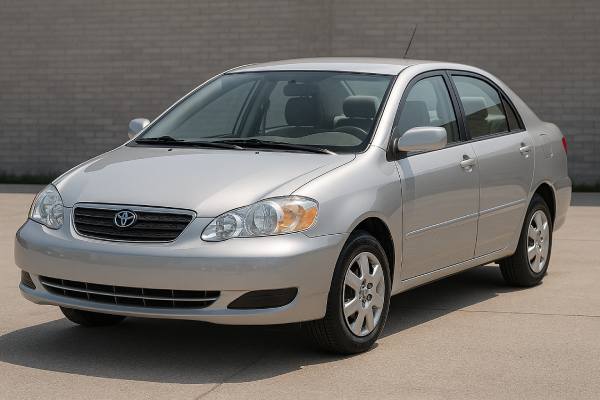
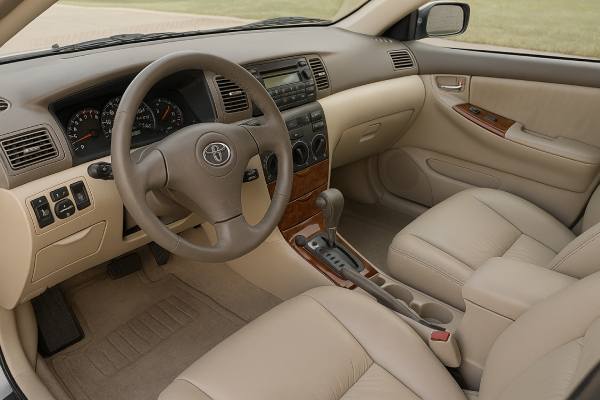
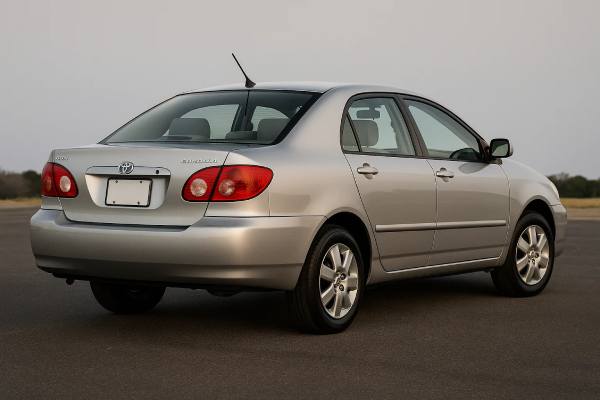
The Corolla XRS (ZZE131) takes the ninth-generation Corolla’s solid platform and adds Toyota/Yamaha’s 2ZZ-GE—an 8,200-rpm, chain-driven DOHC four with VVTL-i “lift”—plus a close-ratio C60 six-speed, rear disc brakes, firmer suspension, and supportive seats. Output is rated at 170 hp (127 kW) with about 127 lb-ft (172 Nm) of torque, and the car feels distinctly different above ~6,200 rpm when the high-lift cam comes alive. You still get everyday Corolla virtues—space, visibility, and low running costs—but with a more focused chassis and gearing that rewards precise driving. Compared with base trims, the XRS uses different wheels/tires, larger front brakes, and unique instrumentation. It remains simple to service (no timing belt) yet expects premium fuel and regular oil level checks to keep lift consistent. If you want a durable commuter that can genuinely entertain on a back road, this 2004–2006 performance variant deserves a hard look.
Fast Facts
- High-rev 2ZZ-GE with VVTL-i, 6-speed manual only; redline near 8,200 rpm.
- Factory upgrades: firmer springs/dampers, rear discs, 16-inch alloys, bolstered seats, unique gauges.
- Still practical: roomy trunk (≈14 ft³ / 396 L) and good cruising stability.
- Watch items: oil level and quality (lift depends on pressure); synchro wear if abused.
- Typical service rhythm: engine oil and filter every 5,000–7,500 miles (8,000–12,000 km) / 6 months.
Navigate this guide
- Corolla XRS 2ZZ-GE essentials
- Corolla XRS Technical Specs
- Trims, Options and Safety
- Reliability and Known Issues
- Maintenance and Buyer’s Guide
- Driving and Performance
- Corolla XRS vs Rivals
Corolla XRS 2ZZ-GE essentials
The ZZE131 XRS is the enthusiast’s outlier in the 2004–2006 Corolla family. It pairs the aluminum 2ZZ-GE 1.8-liter with Yamaha-developed cylinder head and VVTL-i (Variable Valve Timing and Lift with intelligence). Below ~6,200 rpm it behaves like a tractable, efficient four; above that, high-lift cam lobes and revised mapping sharpen the engine’s character. The 2ZZ’s 82.0 mm bore and 85.0 mm stroke (1,796 cc total) are matched to an ~11.5:1 compression ratio, forged-style behavior at sustained rpm, and a chain-driven valvetrain—no belt service needed. Power is 170 hp (127 kW) in this tune due to intake/exhaust and calibration differences versus sport coupes that advertised 180 hp.
The C60 six-speed manual is mandatory and contributes to the car’s personality. Short gearing keeps the 2ZZ on cam, yet sixth settles highway cruise. The final drive is performance-biased, and the clutch is light with a distinct engagement point. Compared to mainstream CE/S/LE trims, the XRS adds firmer springs and dampers, thicker front anti-roll bar, a rear disc conversion (most other trims used drums), and 16-inch alloys with lower-profile tires. Steering remains hydraulic rack-and-pinion; alignment and tire choice have an outsized effect on feel.
Inside, the XRS receives a tachometer redlined near 8,200 rpm, unique seat fabric with more lateral support, and available moonroof. Packaging is unchanged: excellent sightlines, usable rear legroom for the class, and a square trunk. Sound deadening is modestly sportier—more induction note near lift, but cabin noise is controlled on quality tires.
Safety mirrors the rest of the line: strong moderate-overlap frontal protection on post-December-2002 builds and improved side-impact results when front side-torso airbags are fitted (optional in this era). Advanced driver-assistance features common today were not yet present; ABS may be included depending on package, and stability control was not widely available on these years.
Two ownership realities define the XRS. First, oil is everything: the lift mechanism depends on oil pressure and cleanliness. Keep level topped to the full mark and change on time with a proper viscosity. Second, driveline longevity correlates with driver technique; clutch dumps and rushed 2–3 shifts punish synchros. Treated as the quick, rev-happy commuter it is—not a track toy—the car is durable, economical, and satisfying.
Corolla XRS Technical Specs
Engine and Performance
| Item | Specification |
|---|---|
| Code | 2ZZ-GE (aluminum block/head) |
| Layout & valvetrain | Inline-4, DOHC, VVTL-i; 4 valves/cyl |
| Bore × stroke | 82.0 × 85.0 mm (3.23 × 3.35 in) |
| Displacement | 1.8 L (1,796 cc) |
| Induction | Naturally aspirated |
| Fuel system | Multi-point electronic fuel injection |
| Compression ratio | ~11.5 : 1 |
| Max power | 170 hp (127 kW) @ ~7,600 rpm |
| Max torque | 172 Nm (127 lb-ft) @ ~4,400 rpm |
| Redline/fuel cut | ~8,200 rpm (lift engages ~6,200 rpm) |
| Timing drive | Chain (no scheduled replacement) |
| Recommended fuel | Premium unleaded (91 AKI) |
| Rated economy (EPA) | Approx. 26/34 mpg US city/hwy (9.0/6.9 L/100 km) |
| Real-world highway @75 mph | ~31–34 mpg US (7.6–6.9 L/100 km), tire/alignment dependent |
| Emissions standard | LEV/ULEV depending on equipment |
| Aerodynamics | Cd ≈ 0.30–0.31 (trim and options) |
Transmission and Driveline
| Item | Specification |
|---|---|
| Transmission | 6-speed manual, code C60 |
| Final drive ratio | ~4.53 |
| Drive type | FWD |
| Differential | Open (aftermarket LSDs available; not factory) |
| Clutch | Single-plate, hydraulic actuation |
Chassis and Dimensions
| Item | Specification |
|---|---|
| Front suspension | MacPherson strut, coil springs, anti-roll bar (sport calibration) |
| Rear suspension | Torsion beam axle, coil springs (sport calibration) |
| Steering | Hydraulic rack-and-pinion |
| Brakes | Front ventilated discs; rear solid discs (XRS) |
| Wheels/tires | 195/60 R16 on 16×6.5 in alloys (typical) |
| Ground clearance | ~150 mm (5.9 in) |
| Length/Width/Height | ~4,530 / 1,700 / 1,485 mm (178.3 / 66.9 / 58.5 in) |
| Wheelbase | ~2,600 mm (102.4 in) |
| Turning circle (curb-to-curb) | ~10.4–10.8 m (34–35.5 ft) |
| Curb weight | ~1,200–1,250 kg (2,645–2,755 lb), equipment dependent |
| GVWR | ~1,650–1,700 kg (3,637–3,748 lb) |
| Fuel tank | 50 L (13.2 US gal / 11.0 UK gal) |
| Cargo volume (SAE) | ≈396 L (14.0 ft³) |
Performance and Capability
| Metric | Estimate/Typical Test Result |
|---|---|
| 0–60 mph (0–97 km/h) | ~7.5–7.9 s (conditions/tires vary) |
| Top speed | ~200–210 km/h (124–130 mph) |
| 100–0 km/h braking | ~38–41 m (125–135 ft), tire dependent |
| Payload | ~385–430 kg (850–950 lb), trim dependent |
| Towing | Not rated for heavy towing; keep very light if permitted locally |
| Roof load | ~45–50 kg (100–110 lb) with proper crossbars |
Fluids and Service Capacities
| System | Specification | Capacity |
|---|---|---|
| Engine oil | API SL/SN; 5W-30 (quality synthetic recommended) | ~4.2 L (4.4 US qt) with filter |
| Coolant | Toyota Super Long Life Coolant (SLLC), 50/50 | ~6.5–7.0 L (6.9–7.4 US qt) |
| Manual transmission | API GL-4/GL-5 75W-90 (per service literature) | ~1.9–2.0 L (2.0–2.1 US qt) |
| A/C refrigerant | R-134a | ~430–500 g (15–18 oz) |
| A/C compressor oil | ND-Oil 8 | ~120–150 mL (4–5 fl oz) |
| Fuel | Premium unleaded (91 AKI) | 50 L (13.2 US gal) |
Essential torque references (typical):
- Wheel lug nuts: ~103 Nm (76 lb-ft)
- Spark plugs: ~18–22 Nm (13–16 lb-ft) into aluminum head
- Oil drain plug: ~30–40 Nm (22–30 lb-ft)
Electrical
| Item | Specification |
|---|---|
| Alternator | ~90 A |
| 12 V battery | ~45–55 Ah, Group 35 common (CCA varies) |
| Spark plugs | Long-life iridium (e.g., IFR series), gap ~1.1 mm (0.043 in) |
Safety and Driver Assistance
| Item | Detail |
|---|---|
| Crash ratings (period tests) | Strong moderate-overlap frontal for post-Dec-2002 builds; side impact improves notably with optional side-torso airbags fitted |
| Airbags | Dual front standard; front side-torso optional; curtains added after this window on later years |
| ABS | Typically included via package on XRS; verify at key-on lamp |
| Stability/traction | Not widely available on 2004–2006 |
| Child restraints | LATCH lower anchors (rear outboard), top tether anchors across rear shelf |
| Headlights | Halogen reflector; proper aim markedly improves performance |
Trims, Options and Safety
Trim context
Mainline Corolla trims in this era were CE, S, and LE. The XRS sits above them as a performance derivative, sold primarily for 2005–2006 model years in North America (calendar 2004–2006 availability varies by region and dealer inventory). All XRS cars use the 2ZZ-GE with the C60 six-speed and distinct chassis tuning; automatic transmission was not offered.
What makes an XRS an XRS
- Powertrain: 2ZZ-GE with VVTL-i, 6-speed C60, numerically higher final drive, sport exhaust.
- Chassis: Specific springs/dampers, rear disc brakes, thicker front anti-roll bar.
- Rolling stock: 16-inch alloys (usually 195/60 R16 all-seasons); some cars delivered on performance-oriented tires.
- Cabin: Bolstered seats, unique tach with higher redline, leather-wrapped wheel on many, aluminum-style trim accents.
- Exterior tells: Subtle fog lamps, trunk badge, and stance; no flamboyant body kit from the factory.
Packages and options commonly seen
- ABS package: Strongly recommended for a daily in mixed weather.
- Side-torso airbags: Optional; check seat labels and VIN build sheet.
- Moonroof and audio upgrades: Frequent on LE/S; present on many XRS cars too.
- All-disc brakes are standard on XRS; ensure rear calipers slide freely (age-related sticking can occur).
Year-to-year notes affecting equipment and safety
- 2004 calendar-year builds: Early cars may be titled as 2005s; confirm model year by VIN.
- 2005–2006: Side-torso airbags remain optional; curtain airbags were introduced for 2005 on some Toyota compacts but not broadly fitted to the Corolla until later trims outside this XRS window.
- Takata inflator campaigns: Broadly affect 2003–2004 Corolla/Matrix; always run a VIN recall check on any 2004 builds and dealer-serviced cars.
Safety snapshot
Corolla sedans of this generation tested well in moderate-overlap frontal evaluations after Toyota’s late-2002 floorpan padding update. Side-impact results are highly contingent on the presence of side-torso airbags—cars without them trend significantly worse. Head restraints are acceptable for the period. Stability control was not prevalent; winter tire fitment and brake maintenance do more for safety than any electronic aids you are likely to find on these trims.
Quick identifiers and build clues
- VIN engine code “2ZZ”: Confirms the high-rev engine.
- Instrument cluster: 8,000+ rpm redline.
- Rear brakes: Visual check for discs (XRS) vs drums (most other trims).
- Gear pattern: 6-speed shift knob with reverse lock-out ring.
Reliability and Known Issues
The XRS inherits Corolla durability but layers on high-rev hardware. Most cars age very well with attentive care. Prioritize full service history and an oil-consumption/lift-engagement check on any prospect.
Common (frequent) / Low–Medium cost
- Oil level and lift engagement
- Symptoms: Lift fails to engage at ~6,200 rpm; power feels flat above 6k; intermittent VSC/idle flare not typical here.
- Likely cause: Low oil level or varnished oil control passages/solenoid.
- Remedy: Top to the full mark; change oil with quality 5W-30; clean/verify VVTL-i oil control valve and screen if needed.
- Intake MAF/throttle body deposits
- Symptoms: Hesitation, hunting idle, slightly elevated fuel consumption.
- Remedy: Clean MAF with proper spray; remove and clean throttle body; perform idle relearn as required.
- Rear caliper slider seizure (age/salt)
- Symptoms: Uneven pad wear, hot wheel, soft pedal feel.
- Remedy: Free and lubricate sliders or replace bracket/caliper; bleed with fresh DOT 3/4 fluid.
Occasional / Medium cost
- C60 synchro wear (driver-dependent)
- Symptoms: Grind on 2–3 upshift at high rpm; notchiness cold.
- Root cause: High-rpm shifts on old fluid; worn brass synchros.
- Remedy: Fresh 75W-90 GL-4/GL-5 per service literature; gentle technique. Rebuild if persistent.
- Engine mount deterioration
- Symptoms: Driveline shunt, idle vibration.
- Remedy: Replace worn mounts; torque to spec with the car settled at ride height.
- Accessory belt/tensioner aging
- Symptoms: Chirp/squeal, belt wander.
- Remedy: Replace belt and tensioner; verify pulley alignment.
Rare / Higher consequence
- Lift bolt fatigue (mostly early 2ZZs, addressed by running changes)
- Symptoms: Loss of high-lift cam operation; metallic tick.
- Remedy: Inspect/replace cam follower “lift” bolts with the later, stronger design; verify cam lobe condition.
- Catalyst efficiency decline due to prolonged misfire or oil use
- Symptoms: P0420/P0430 codes after misfire history; sulfur odor.
- Remedy: Correct root cause (ignition, oil), then catalyst replacement if below threshold.
Corrosion hotspots
Front subframe mounting points and rear underbody seams can show surface rust in salted climates. Brake/fuel hard lines deserve a visual. Rocker pinch welds and wheel arch lips should be checked by hand.
Recalls, TSBs, extended coverage—how to verify
Run the VIN through the manufacturer’s recall portal and retain printed proof of zero open campaigns. Airbag inflator actions were heaviest on 2003–2004 sedans and Matrix; any 2004-built XRS or dealer-transferred vehicle should be checked. Keep dealership invoices for any ECU/TCU reflash (rare on this model) or airbag/inflator replacement.
Pre-purchase requests
- Complete service file with oil change intervals/brand/viscosity.
- Proof of brake fluid changes (2–3 years) and any transmission fluid service.
- Battery test printout and alternator output check.
- Cold-start video: listen for chain/tensioner noise and idle quality.
- Long test drive to exercise lift repeatedly and observe clutch/2–3 shifts.
Maintenance and Buyer’s Guide
Practical maintenance schedule (distance/time = first reached)
- Engine oil & filter: 5,000–7,500 miles (8,000–12,000 km) / 6 months. Keep level topped; lift needs oil pressure.
- Engine air filter: Inspect 12 months/12,000 miles; replace 30,000–45,000 miles (48,000–72,000 km), sooner in dust.
- Cabin filter: 12 months/15,000 miles (24,000 km).
- Spark plugs (iridium): 90,000–120,000 miles (145,000–193,000 km). Confirm correct heat range and gap ~1.1 mm.
- Coolant (SLLC): First at 100,000 miles (160,000 km) or 10 years; then 50,000 miles (80,000 km) or 5 years.
- Manual transmission fluid (C60): 60,000–90,000 miles (96,000–145,000 km), sooner with hard use.
- Brake fluid: Replace every 2–3 years.
- Brake pads/rotors: Inspect at each rotation; rear sliders need periodic cleaning.
- Serpentine belt & tensioner: Inspect at 60,000 miles (96,000 km); replace on cracks/noise.
- PCV valve: Inspect/replace at 60,000 miles (96,000 km).
- Alignment & tire rotation: Rotate with oil service; align annually or when wear appears.
- Timing chain: No routine replacement; investigate only for correlation faults, tensioner leaks, or rattle.
- 12 V battery: Load test annually after year 4; typical life 4–6 years.
Fluid notes and capacities (decision-making quick list)
- Oil: API SL/SN 5W-30; ~4.2 L with filter.
- Coolant: Toyota SLLC; ~6.5–7.0 L total fill.
- Gear oil: 75W-90 GL-4/GL-5 per service literature; ~1.9–2.0 L.
- A/C: R-134a ~430–500 g; ND-Oil 8 ~120–150 mL.
- Fuel: Premium 91 AKI recommended for full performance.
Buyer’s checklist
- Engine: From cold, listen for chain/tensioner noise. Warm, run to 7,500–8,000 rpm in 2nd/3rd: confirm lift engagement. Inspect for oil seepage at chain tensioner and valve cover.
- Gearbox/clutch: Feel for notch or grind 2→3 on a quick but not abusive shift; check clutch take-up and any chatter in 1st.
- Brakes: Verify rear caliper slide; confirm straight, vibration-free stops.
- Suspension: Pay attention to sway-bar links and strut mounts over sharp bumps.
- Electronics: Check all cluster lamps at key-on (ABS should prove-out), HVAC, audio backlighting, and sunroof drains if fitted.
- Body: Inspect rocker seams, rear subframe, and brake/fuel lines in rust-belt cars.
- Paperwork: VIN recall print, service history, and any plug/coolant/transmission fluid receipts.
Which cars to target
- 2005–2006 XRS with side-torso airbags and ABS, stock ride height, unmodified intake/exhaust, and documented oil services. Avoid heavily modified examples (short-ram intakes with poor filtration, lowered on cut springs, or cheap coilovers) unless you plan to recondition.
Long-term outlook
The 2ZZ-GE is robust when kept on fresh oil and quality filters. The C60 lasts if not abused; fresh gear oil and sane shifts go far. Expect periodic wear items (struts, mounts, sliders, bearings) befitting a 20-year-old compact. Keep the cooling system clean and the MAF/throttle body spotless, and the XRS remains a quick, inexpensive classic to own.
Driving and Performance
Ride, handling, and NVH
Compared with a standard Corolla, the XRS is taut but not punishing. Body roll is reduced, transient response is sharper, and straight-line stability is calm at interstate speeds. Hydraulic steering is light in town and gains reassuring weight on the highway; feedback is modest but trustworthy. Tire choice transforms the car: a good 200-treadwear summer compound wakes up the front end while adding only a little roar on coarse asphalt. Brakes resist fade well for spirited street use; a fluid flush and decent pads unlock the best pedal feel.
Powertrain character
Below 4,000 rpm, the 2ZZ is polite and tractable; above ~6,200 rpm, the high-lift cam lobes engage and the soundtrack hardens. Throttle response is crisp, especially in the lift range. The six-speed’s ratios are close, so keeping the engine in the sweet spot is easy; clutch take-up is light, and rev-matching is straightforward. On a tight two-lane, third gear covers most work; highway merging is confident if you downshift decisively.
Real-world efficiency
Driven lightly, mixed consumption in the 27–31 mpg US (8.7–7.6 L/100 km) band is achievable; steady-state freeway at 70–75 mph (113–120 km/h) often returns 31–34 mpg US (7.6–6.9 L/100 km) with proper alignment and tire pressures. Winter use, short trips, and sticky summer tires can trim those figures by 10–20%. Premium fuel is recommended to maintain knock margin in the high-lift range.
Key metrics that matter
Typical independent tests peg 0–60 mph around 7.5–7.9 seconds on all-season tires, with quarter-mile in the mid-16s near 88–90 mph. Passing from 50–80 mph (80–129 km/h) is strong if you select fourth; third is even more immediate but noisy. Braking from 100–0 km/h in roughly 38–41 m depends heavily on pad compound and tire grip.
Traction, grades, and loads
FWD traction is predictable; the open differential means hard exits from tight corners will spin the inside tire on poor surfaces. In snow, decent winter tires and gentle throttle beat any electronic stability substitute this vintage lacks. Under full passenger load, the car remains composed but braking distances lengthen; refresh the fluid and pads before mountain road trips.
Corolla XRS vs Rivals
Honda Civic Si (EP3, 2002–2005)
The Si’s K-series is similarly rev-happy, but the hatchback body is more versatile and the shifter (dash-mounted) divides opinion. The Corolla rides quieter and looks more understated; both require good oil and driver sympathy to keep their high-rev personalities happy. Parts support is excellent for both.
Mazda3 2.3 (2004–2006)
Heavier steering and a more communicative chassis make the Mazda3 rewarding at the limit, but fuel economy trails and rust vigilance is essential in snow belts. The Corolla’s engine is happier near redline, and its long-term maintenance costs usually edge lower.
Nissan Sentra SE-R Spec V (B15)
Similar headline power with a torque-richer delivery, but the gearbox and interior refinement lag. The Toyota’s cabin materials and NVH are stronger; resale tends to be kinder to the XRS.
Ford Focus ST/ZX4 ST (Duratec 2.3)
Outstanding steering feel and balance, soft spots in reliability as miles add up. The Corolla gives up some playfulness for durability and quieter daily use.
Bottom line
If you want a sleeper that can run to 8,000 rpm, haul groceries, and go a full season on basic consumables, the Corolla XRS threads a rare needle. It’s not as extroverted as some rivals, but as a driver’s Corolla with long-term dependability, it stands tall.
References
- Fuel Economy of the 2005 Toyota Corolla 2005 (EPA Fuel Economy)
- 2005 Toyota Corolla 2005 (Safety Rating)
- 2005 Corolla – Owner’s Manual 2005 (Owner’s Manual)
- 2005 Corolla Specifications 2005 (Manufacturer Specifications)
- Look up Safety Recalls & Service Campaigns by VIN 2024 (Recall Database)
Disclaimer
This guide is for informational purposes only and is not a substitute for professional diagnosis or repair. Specifications, torque values, fluids, and service intervals can vary by VIN, year, market, and equipment. Always confirm procedures and numbers against your vehicle’s official service information. If this article helped you, please consider sharing it on Facebook or X/Twitter to support xcar’s work.