
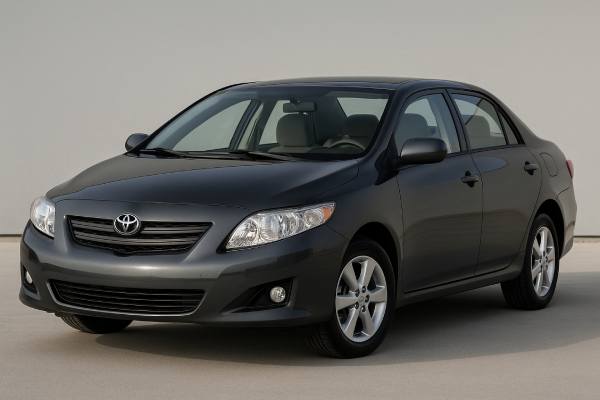
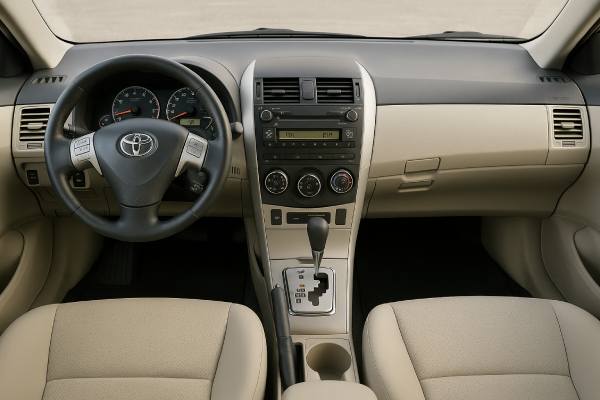
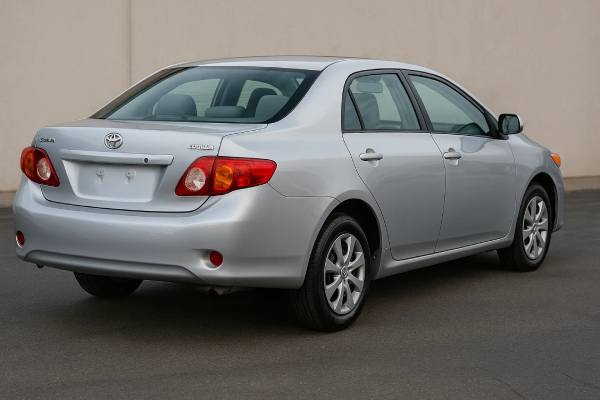
The 2009–2010 Toyota Corolla with the 1NR-FE 1.33-litre petrol engine targets buyers who value dependability over drama. It pairs Toyota’s compact E150 chassis with a light, chain-driven Dual VVT-i four-cylinder, a slick 6-speed manual, and simple, durable hardware. You do not get headline performance, yet you do get a calm, efficient sedan that is inexpensive to run and straightforward to service. Cabin space and boot size are competitive for the class, and parts availability is excellent across Europe thanks to Corolla’s wide footprint and shared components with the Auris and other NR-family models. The 1NR-FE’s aluminium block, compact packaging, and integrated exhaust manifold help it warm up quickly and return good real-world economy. As a used buy, the car’s value rests on complete service records, healthy timing-chain data (noise and correlation), and clean emissions hardware. Get those right and the Corolla 1.3 is a faithful, low-stress companion.
Fast Facts
- Proven Dual VVT-i 1.33 petrol with timing chain; simple, low-cost servicing.
- Comfortable ride, quiet motorway manners, and large boot for the class.
- Rust resistance is good; suspension and brakes are inexpensive to renew.
- Watch for early chain-drive noise, PCV clogging, and carbon in EGR/throttle.
- Oil change every 10,000–15,000 km (6,000–10,000 miles) or 12 months, whichever comes first.
What’s inside
- Corolla 1.3 overview
- Corolla 1.3 specs and data
- Trims, options, and safety
- Reliability and service actions
- Maintenance and buyer’s guide
- Driving and performance
- How it compares to rivals
Corolla 1.3 overview
The NRE150-series Corolla is the European four-door sedan on Toyota’s E150 platform (the hatchback is the Auris). In 2009–2010, the entry petrol engine was the 1NR-FE: an all-aluminium 1.33-litre inline-four with Dual VVT-i (variable inlet and exhaust cam phasing), multi-point injection, and a maintenance-friendly timing chain. Rated at about 101 hp (75 kW), it emphasises low-to-mid-range drivability and economy rather than outright speed. Buyers typically find a 6-speed manual transmission; an automated manual or classic 5-speed appears in a few markets, but the 6-speed is the sweet spot for relaxed cruising.
Design priorities were efficiency and simplicity. The compact cylinder head, integrated exhaust manifold, and fast-light-off catalytic converter help the engine reach operating temperature quickly, improving emissions and fuel use in short-trip European driving. The NR family’s low reciprocating mass contributes to smoothness. On the chassis side, the E150 uses MacPherson struts front and a torsion-beam rear—robust, predictable, and inexpensive to refurbish. Steering is electric power assist, calibrated for light effort in town and gentle self-centering on the motorway. Brakes are ventilated front discs with solid rear discs (drums in some low trims), supplemented by standard ABS and stability control on later builds.
Packaging is a Corolla strength. The sedan body offers generous rear legroom and a large, square boot, plus a 60/40 split-fold seat on most trims. Sound insulation is better than you might expect in this class; tyre roar is well contained on 195- or 205-section tyres. Interior materials favour durability—hard-wearing fabrics, simple climate controls, dependable switchgear—and the infotainment is basic but unfussy, often with steering-wheel controls and Bluetooth on mid/high trims. Ownership is straightforward: inspection points are accessible, parts are plentiful, and there is excellent technical documentation.
Corolla 1.3 specs and data
Engine and Performance (ICE)
| Item | Value |
|---|---|
| Code | 1NR-FE |
| Layout & cylinders | Inline-4, DOHC, 4 valves/cyl, Dual VVT-i |
| Bore × stroke | 72.5 × 80.5 mm (2.85 × 3.17 in) |
| Displacement | 1.33 L (1,329 cc) |
| Induction | Naturally aspirated |
| Fuel system | MPFI (multi-point fuel injection) |
| Compression ratio | ~11.0–11.5:1 (market dependent) |
| Max power | 101 hp (75 kW) @ ~6,000 rpm |
| Max torque | ~132 Nm (97 lb-ft) @ ~3,800 rpm |
| Timing drive | Chain with hydraulic tensioner and guides |
| Emissions standard | Euro 4/5 (market dependent) |
| Rated economy (combined) | ~5.9–6.2 L/100 km (40–48 mpg US / 48–58 mpg UK) |
| Real-world highway @ 120 km/h | ~6.0–6.5 L/100 km (36–39 mpg US / 43–47 mpg UK) |
| Aerodynamics | Cd ≈ 0.29–0.30 (sedan) |
Transmission and Driveline
| Item | Value |
|---|---|
| Transmission | 6-speed manual (most common); 5-speed manual or automated-manual in some markets |
| Final drive ratio | ~4.06–4.31 (variant dependent) |
| Drive type | FWD |
| Differential | Open |
Chassis and Dimensions
| Item | Value |
|---|---|
| Platform | E150 |
| Suspension (front/rear) | MacPherson strut / Torsion beam |
| Steering | Electric power steering; ~3.1 turns lock-to-lock |
| Brakes | Front ventilated discs / rear discs (some drums) |
| Wheels/Tyres | 195/65 R15 or 205/55 R16 |
| Ground clearance | ~150 mm (5.9 in) |
| Length / Width / Height | ~4,540 / 1,760 / 1,460 mm (178.7 / 69.3 / 57.5 in) |
| Wheelbase | 2,600 mm (102.4 in) |
| Turning circle | ~10.4–10.8 m (34–35.5 ft) |
| Kerb (curb) weight | ~1,200–1,300 kg (2,645–2,865 lb) |
| GVWR | ~1,600–1,700 kg (3,527–3,748 lb) |
| Fuel tank | 55 L (14.5 US gal / 12.1 UK gal) |
| Cargo volume (boot) | ~450 L (15.9 ft³), VDA |
Performance and Capability
| Metric | Value |
|---|---|
| 0–100 km/h (0–62 mph) | ~12.0–13.0 s |
| Top speed | ~180–190 km/h (112–118 mph) |
| 100–0 km/h braking | ~38–40 m (125–131 ft) |
| Towing (braked/unbraked) | ~1,000 / 450 kg (2,205 / 992 lb) |
| Roof load | ~50 kg (110 lb) |
Fluids and Service Capacities
| System | Spec | Capacity |
|---|---|---|
| Engine oil | API SN/ILSAC, 0W-20 or 5W-30 (climate-based) | ~3.7–4.0 L (3.9–4.2 qt) w/ filter |
| Coolant | Toyota Super Long Life (pink), 50/50 mix | ~5.5–6.0 L (5.8–6.3 qt) |
| Manual transmission | Toyota Manual Transaxle Fluid (GL-4) | ~2.0 L (2.1 qt) |
| A/C refrigerant | R-134a | ~450–500 g (15.9–17.6 oz) |
| A/C compressor oil | ND-OIL8 (PAG) | ~120 mL (4.1 fl oz) |
Key torque values (typical):
- Wheel nuts: 103 Nm (76 lb-ft)
- Spark plugs: 18–22 Nm (13–16 lb-ft)
- Drain plug (engine oil): ~40 Nm (30 lb-ft)
- Front caliper slider pins: ~25–30 Nm (18–22 lb-ft)
Electrical
| Item | Value |
|---|---|
| Alternator | ~90–110 A |
| 12 V battery | 45–60 Ah (typical), H5/L2 form factor |
| Spark plug | Iridium, 0.9–1.0 mm (0.035–0.040 in) gap |
Safety and Driver Assistance
| Item | Details |
|---|---|
| Structure | High-strength steel passenger cell, energy-absorbing front/rear |
| Airbags | Dual front, side, and full-length curtains common; driver knee airbag on many trims |
| Child seats | ISOFIX/LATCH lower anchors; top-tether points on parcel shelf |
| ABS/ESC | ABS with EBD; stability control phased in across trims/years |
| Headlights | Halogen reflector; height adjustment on many markets |
| ADAS | Lane and AEB not typical; rear parking sensors and cruise common as options |
Trims, options, and safety
Typical European trims clustered around names such as Terra/Live (base), Luna/Sol (mid), and Executive/Prestige (top). Equipment varies slightly by country, but the pattern is consistent:
- Base (Terra/Live): 15-inch steel wheels, manual A/C, cloth seats, 4-speaker audio, front electric windows, remote locking, ABS/EBD, at least four airbags. Rear drums may appear here.
- Mid (Luna/Sol): 15- or 16-inch alloys, fog lamps, leather-trimmed steering wheel, 6-speaker audio with Bluetooth/USB, rear electric windows, split-fold rear seats, height-adjustable driver seat, cruise control in many markets. Rear discs become standard.
- Top (Executive/Prestige): 16-inch alloys, automatic climate control, upgraded instrument cluster, auto lights/wipers, front centre armrest, additional airbags, and optional navigation.
Option packs and identifiers
- Style packs add alloys, fog lamps, chrome trims.
- Protection packs add mud flaps, mats, boot tray, parking sensors.
- VIN/build clues: model code NRE150; engine code 1NR-FE on the VIN plate; axle/transmission codes identify gearing. Wheel style and presence/absence of rear discs help place a car in the trim ladder at a glance.
Year-to-year highlights (2009 → 2010)
- Stability control and additional airbags spread further down the range.
- Minor infotainment updates (USB/Bluetooth availability).
- Emissions updates for Euro 5 in some markets; no fundamental mechanical changes.
Safety ratings and systems
The E150-series sedan achieved strong occupant protection in contemporary European testing, aided by a stiff safety cell, efficient crumple zones, and front/side/curtain airbags. Isofix anchorages are easy to access, and the rear bench geometry accepts common child seats without drama. While advanced ADAS like autonomous emergency braking or lane keeping was not yet mainstream in this segment, the combination of stability control, predictable chassis tuning, and linear braking delivers confident everyday safety. Headlight performance is acceptable; aim and bulb quality matter.
Service and calibration considerations
Any windscreen, bumper, or steering-rack work demands proper alignment of ABS wheel-speed sensors and yaw-rate calibration via scan tool where specified. After brake hydraulic work, ensure ABS bleed procedures are followed. If a car has dealer-installed parking sensors or navigation, retain documentation for wiring routing during future repairs.
Reliability and service actions
Overall verdict: robust and inexpensive to keep healthy. The simple NR-engine architecture, tough cooling system, and conventional chassis mean most issues are wear-and-tear rather than systemic failures. Prioritise evidence of regular fluid changes and correct coolant.
Common (low–medium cost)
- PCV and breather clogging → oil weep/consumption: Long intervals and short trips can varnish the PCV. Symptoms include idle instability and oily throttle body. Fix: replace PCV valve and hose, clean throttle body/intake, use fresh 0W-20/5W-30 and a quality filter.
- Carbon in throttle/EGR path → rough idle, hesitation: City use and gentle driving allow deposits to build. Fix: clean throttle body and, where fitted, EGR passages; update ECM idle learn; new gasket.
- Front suspension wear (bushings/links) → knocks over bumps: Torsion-beam rear is durable; the front takes most punishment. Fix: anti-roll-bar links and lower-arm rear bushes are common DIY jobs; align afterwards.
- Rear caliper slider corrosion (disc-equipped cars) → uneven pad wear: Especially in coastal climates. Fix: clean and grease sliders with correct high-temp lubricant; replace boots if torn.
Occasional (medium cost)
- Timing-chain noise at cold start → chain/guide wear or tensioner bleed-down: Listen for rattling for 1–2 seconds on cold starts; persistent rattle warrants inspection. Fix: verify oil grade and pressure; if correlation codes or sustained noise are present, replace chain, guides, and tensioner as a kit.
- Oxygen sensor aging → poor economy and emissions lights: Upstream sensors are first to go. Fix: replace with OEM-quality part; clear trims and complete drive cycle.
- Clutch wear (6-MT) → high bite point and chatter: Urban duty cycles accelerate wear. Fix: new clutch kit; check rear main seal and gearbox input-shaft seal while in there.
Rare (higher cost)
- Head-gasket failure from severe overheating: Usually secondary to coolant neglect. Fix: pressure test, check for combustion gases in coolant; head skim and MLS gasket if confirmed; renew water pump and thermostat.
- Steering-column EPS torque sensor drift → off-centre feel or assist fluctuations: Fix: steering-angle calibration; replace EPS column assembly if outside spec.
Recalls and technical bulletins (representative)
- Floor-mat/accelerator-pedal interference (selected Toyotas): Check VIN for completed campaigns; official remedy reinforces pedal assembly and updates floor-mat fitment.
- Airbag and seatbelt pretensioner checks in specific VIN ranges: Confirm closure with a dealer VIN lookup and retain paperwork.
- ECM calibration updates: Driveability refinements (idle learn, cold-start fuelling), readiness monitors, and evap purge logic improvements may appear; request full calibration status in a pre-purchase inspection.
How to verify completion
- Perform an official VIN safety check with a Toyota dealer and keep the printout. Ask for the vehicle health check (VHC) report and ECM/TCM calibration IDs.
Maintenance and buyer’s guide
Service schedule (practical baseline)
- Engine oil and filter: every 10,000–15,000 km (6,000–10,000 miles) or 12 months. Use 0W-20/5W-30 meeting Toyota’s spec.
- Engine air filter: inspect 15,000 km (10,000 mi); replace 30,000–45,000 km (20,000–28,000 mi) or sooner in dusty climates.
- Cabin filter: 15,000–20,000 km (10,000–12,000 mi) or 12 months.
- Spark plugs (iridium): 90,000–100,000 km (55,000–62,000 mi) or 6 years.
- Coolant (S-LLC pink): first at 160,000 km (100,000 mi) or 10 years, then every 80,000 km (50,000 mi) or 5 years.
- Manual gearbox oil: inspect for leaks; change at 100,000–150,000 km (62,000–93,000 mi) if shifting degrades.
- Brake fluid: every 2 years regardless of mileage.
- Brake pads/rotors: inspect every 15,000 km (10,000 mi); clean and lube sliders annually in salted regions.
- Serpentine/aux belt: inspect at each service; replace ~100,000 km (62,000 mi) if cracked or noisy.
- PCV valve and hoses: inspect/clean every 60,000 km (37,000 mi).
- Cooling system hoses: inspect annually; replace at signs of swelling/cracks.
- Wheel alignment and tyre rotation: rotate every 10,000–15,000 km (6,000–10,000 mi); check alignment yearly or after impacts.
- 12 V battery: load-test annually from year 4; typical replacement window 5–7 years.
- Timing chain: no fixed interval; inspect by symptom (noise, correlation codes, cam/crank deviation). Replace chain kit when out of spec.
Fluid choices and notes
- Oil: high-quality synthetic 0W-20 for best cold-start lubrication and economy; 5W-30 acceptable in hotter climates or higher mileage engines.
- Coolant: only Toyota S-LLC pink (premix or concentrate with distilled water) to protect alloy components and water-pump seals.
- Brake fluid: DOT 4 from a sealed container; flush with proper sequence.
- Gear oil: GL-4 that meets Toyota manual transaxle requirements; avoid GL-5 with aggressive additives unless explicitly approved.
Buyer’s inspection checklist
- Cold start from stone-cold: listen for timing-chain rattle; observe idle stability and fast-idle drop.
- Service history: insist on stamped book or digital records; look for annual oil changes and regular coolant/brake-fluid entries.
- Emissions readiness: scan for pending codes and monitor fuel trims; check oxygen-sensor switching.
- Clutch and gearbox: smooth engagement, no chatter, and positive 2→3 upshift when hot.
- Brakes and suspension: straight, quiet stops; no pull; front-end knocks over speed humps suggest links/bushes.
- Steering: on-centre feel without assist “step”; confirm no EPS warnings.
- Cooling system: pressure-test; check reservoir for oil film and radiator end tanks for stress cracks.
- Body and corrosion: sills, rear wheel-arch lips, subframe mounts, and boot-lid seam; paint match and overspray tell stories.
- Tyres: even wear; budget for new tyres if over five years old.
- Keys and electronics: two working keys; all windows/mirrors/locks and HVAC modes verified.
What to seek or avoid
- Seek: later-build cars with stability control, rear disc brakes, and documented coolant and brake-fluid services.
- Avoid: cars with persistent cold-start rattle, heavy oil consumption, or incomplete recall/TSB paperwork.
Long-term outlook
With sensible intervals and OEM-quality parts, a Corolla 1.3 can exceed 200,000 km (124,000 mi) without major engine or chassis work. Most costs are predictable wear items, and insurance and taxation are low in many EU markets.
Driving and performance
On the road, the 1NR-FE is quiet and cooperative. Throttle response is clean, and the engine is happier above 2,000 rpm where Dual VVT-i has more authority. In town, the light clutch and accurate shift gate make stop-start traffic painless. On a motorway, the 6-speed’s taller top gear drops revs and cabin noise—think ~3,000 rpm near 120 km/h. It is not a fast car; confident merging requires using the gearbox and letting the engine spin. Once at speed, it tracks straight, resists crosswinds well, and isolates small bumps without float.
Steering effort is light at parking speeds and steadies as you roll, with predictable self-centering. There is modest body roll, but grip is progressive and the rear follows cleanly. The brake pedal is firm with good initial bite and repeatability; the car stops straight even on modest tyres. NVH is better than expected: engine note stays muted, and only coarse-chip surfaces bring noticeable tyre roar.
Observed efficiency
- City: ~7.0–7.5 L/100 km (31–34 mpg US / 37–41 mpg UK) with gentle driving.
- Mixed: ~6.2–6.8 L/100 km (35–38 mpg US / 42–46 mpg UK).
- Highway (100–120 km/h): ~5.8–6.5 L/100 km (36–41 mpg US / 43–49 mpg UK).
Cold weather and short trips can add 0.5–1.0 L/100 km; a clean air filter, proper tyre pressures (typically 2.3–2.5 bar / 230–250 kPa / 33–36 psi), and fresh plugs help maintain numbers.
Selective performance metrics
- 0–100 km/h: roughly 12–13 seconds with one driver and half tank.
- 80–120 km/h (5th): plan ~11–13 seconds; downshift to 4th for brisk passes.
- 100–0 km/h: high-30-metre stops on healthy tyres and brakes.
Traction control is unobtrusive; with winter tyres, snow starts are drama-free and the brake-based stability control gently trims yaw when provoked.
Load and towing
The Corolla tolerates family-holiday loads well. With two adults, two children, luggage, and a roof box, expect a 5–10% fuel-use penalty at 120 km/h and longer passing distances. Towing small utility trailers is possible within rated limits; keep speeds conservative and monitor temperatures on long grades.
How it compares to rivals
Volkswagen Golf/Jetta 1.4 MPI/TSI (Mk5/Mk6): The 1.4 TSI offers stronger torque and better motorway flexibility but introduces turbo and timing concerns (earlier chains and wastegate issues). The Corolla is slower yet simpler and, long-term, often cheaper to keep in prime condition. Cabin quality is tighter in the VW; Corolla counters with reliability and lower parts pricing.
Ford Focus 1.6 (Mk2): The Focus steers and handles better; it feels more eager on twisty roads. However, certain 1.6 petrols and autos have more check-list items as mileage climbs. Corolla’s running costs, corrosion resistance, and resale are generally stronger.
Opel/Vauxhall Astra H 1.4/1.6: Competitive pricing and decent motorway stability. Ageing interiors, electrical niggles, and rust appear more frequently than on the Toyota. The Corolla’s 6-speed gearing and robust brake/suspension hardware give it an advantage in ownership experience.
Hyundai i30 / Kia cee’d 1.4/1.6: Solid choices with good equipment. Later models rival Toyota’s reliability outright. For 2009–2010 cars, Corolla still tends to age more gracefully inside and retains value better in most markets.
Bottom line: If you want worry-free commuting with predictable bills, the Corolla 1.3 remains a benchmark. Rivals can be more engaging or quicker, but few match its blend of durability, comfort, and low-effort ownership.
References
- TechDoc New Generation 2025 (Service Manual)
- Recall checker 2025 (Recall Database)
- Euro NCAP Ratings & Rewards 2025 (Safety Rating)
- Check vehicle safety recalls 2025 (Recall Database)
Disclaimer
This guide is for informational purposes and is not a substitute for professional diagnosis or repair. Specifications, torque values, intervals, and procedures vary by VIN, market, and equipment. Always confirm details against your vehicle’s official service documentation and follow manufacturer instructions.
If you found this helpful, please consider sharing it on Facebook or X/Twitter to support xcar’s work.