
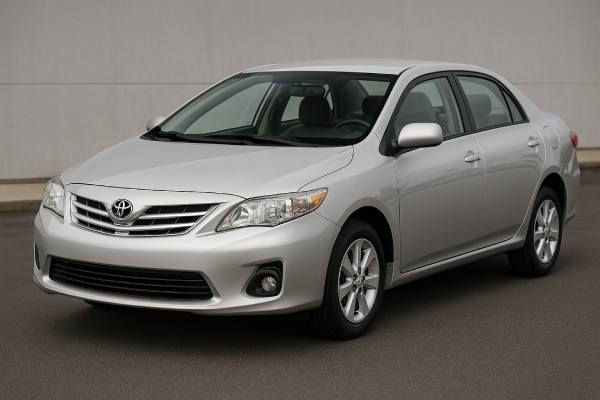
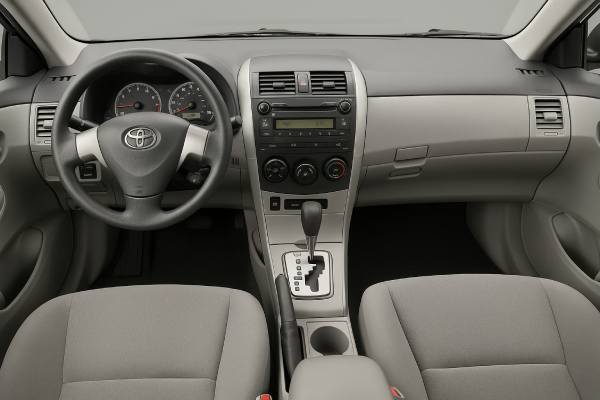
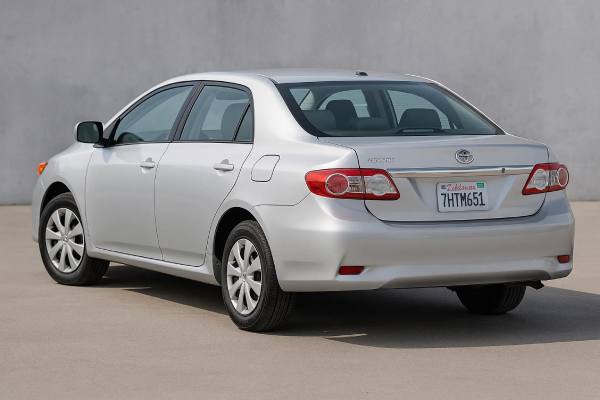
The 2011–2013 facelifted Toyota Corolla (ZRE142) is the pragmatic choice in a compact sedan: simple mechanicals, low operating costs, and an easy ownership experience. The 1.8-liter 2ZR-FE four-cylinder (132 hp) pairs with either a 5-speed manual or a 4-speed automatic. While not fast, it’s durable, frugal, and stress-free for everyday commuting. Updates for 2011 brought revised bumpers and lamps, a tidier cabin, and streamlined trims (ending the short-lived XRS). Ride quality is compliant, steering is light, and the cabin is quiet enough for long drives. Safety equipment was comprehensive for the time with standard stability control and multiple airbags; later model years earned strong crash-test scores. As a used-car bet, the Corolla’s reputation is well-deserved—provided you follow basic maintenance and check a few known trouble spots (water pumps and EVAP components lead the list). If you want a no-drama commuter that just works, this generation delivers.
At a Glance
- Proven 2ZR-FE 1.8L engine, low failure rate, inexpensive parts.
- Comfortable ride, simple controls, and excellent real-world fuel economy.
- Strong crash-test performance for the class; stability control standard.
- Watch for coolant seep at water pump and EVAP codes around 80–120k miles.
- Oil changes every 10,000 miles / 12 months with 0W-20 (shorten to 5,000 miles for severe use).
Navigate this guide
- Detailed Overview
- Specifications and Technical Data
- Trims and Options, Safety and Driver Assistance
- Reliability, Common Issues and Service Actions
- Maintenance and Buyer’s Guide
- Driving and Performance
- How Corolla Compares to Rivals
2011–2013 Corolla ZRE142 overview
Toyota’s 2011 refresh kept the proven tenth-generation Corolla formula intact: prioritize reliability, efficiency, and value. The facelift updated the exterior (bumpers, grille, tail lamps) and quietly improved cabin materials and feature content. In North America, all mainstream trims used the naturally aspirated 1.8-liter 2ZR-FE (Dual VVT-i) rated at 132 hp (98 kW) and 128 lb-ft (174 Nm), paired to a 5-speed manual or a 4-speed automatic. The punchier 2.4-liter XRS bowed out after 2010, so buyers in 2011–2013 chose among basic L/Base, comfort-oriented LE, and sport-styled S.
On the road, this Corolla majors in comfort. The suspension (MacPherson strut front, torsion-beam rear) is tuned for compliance and stability rather than sharp cornering. Steering is electrically assisted with a light, easy effort—pleasant around town and in parking lots. Brakes are straightforward: ventilated front discs and rear drums with ABS, brake assist, and electronic brake-force distribution.
Cabin packaging remains a strong point. Five adults fit in a pinch, with the rear bench best for two. Trunk volume is competitive for the class, and the 60/40 split-fold maintains utility. Controls are simple, HVAC knobs are glove-friendly, and visibility is excellent thanks to slim pillars by modern standards. Sound deadening is adequate; highway tire roar depends more on the chosen tire than the car.
Safety was a selling point. Stability control and traction control were standard, along with front, front-side, and full-length curtain airbags, and active front head restraints. This facelifted run achieved high marks in the prevalent crash tests of the era.
As a used buy, the 2011–2013 Corolla stands out for low cost per mile. Preventive maintenance is inexpensive, parts are widely available, and independent shops know the platform well. The short list of common faults is manageable and typically inexpensive to remedy. Choose a well-maintained example and it’s a car that disappears into the background—in a good way.
Corolla ZRE142 specs and data
Below are North American baseline figures for the 2011–2013 facelift 1.8L 2ZR-FE Corolla. Values may vary slightly by trim, transmission, and equipment.
Engine & Performance (ICE)
| Item | Specification |
|---|---|
| Code | 2ZR-FE (Dual VVT-i) |
| Layout & cylinders | Transverse inline-4, DOHC, 16 valves (4/cyl) |
| Bore × stroke | 80.5 × 88.3 mm (3.17 × 3.48 in) |
| Displacement | 1.8 L (1798 cc) |
| Induction | Naturally aspirated |
| Fuel system | Sequential multi-port fuel injection (PFI) |
| Compression ratio | ~10.0:1 |
| Max power | 132 hp (98 kW) @ ~6000 rpm |
| Max torque | 174 Nm (128 lb-ft) @ ~4400 rpm |
| Timing drive | Chain |
| Emissions/efficiency standard | EPA gasoline |
| Rated economy (EPA) | Manual: ~30 mpg US combined (7.8 L/100 km); Automatic: ~29 mpg US combined (8.1 L/100 km) |
| City/Highway (EPA) | Manual: ~27/33–35 mpg US (8.7/6.7–6.7 L/100 km) • Automatic: ~26/33–34 mpg US (9.0/6.9–7.0 L/100 km) |
| Real-world highway @ 120 km/h (75 mph) | ~7.1–7.6 L/100 km (37–33 mpg US / 44–40 mpg UK), tire and wind dependent |
Transmission & Driveline
| Item | Specification |
|---|---|
| Transmission (manual) | 5-speed (C59) |
| Gear ratios (5-MT) | 1st 3.17 • 2nd 1.90 • 3rd 1.31 • 4th 0.89 • 5th 0.73 • Rev 3.25 |
| Final drive (5-MT) | ~4.31 |
| Transmission (automatic) | 4-speed automatic (U341E) with overdrive |
| Gear ratios (4-AT) | 1st ~2.85 • 2nd ~1.55 • 3rd 1.00 • 4th ~0.70 • Rev ~2.34 |
| Final drive (4-AT) | ~4.24 (typical application) |
| Drive type | Front-wheel drive (open differential) |
| Refuel/replenishment time | Gasoline refuel: ~5 min (tank 13.2 US gal / 50 L) |
Chassis & Dimensions
| Item | Specification |
|---|---|
| Suspension (front/rear) | MacPherson strut / torsion beam |
| Steering | Electric power rack-and-pinion; ratio ~17.4:1 |
| Brakes | Front ventilated disc ~272–273 mm (10.7 in); rear drum ~229 mm (9.0 in) |
| Wheels/Tires (common) | 195/65 R15 (steel/alloy); LE/S with 205/55 R16; select packages with 215/45 R17 (availability varies) |
| Ground clearance | ~147 mm (5.8 in) |
| Length / Width / Height | ~4572 / 1763 / 1466 mm (180.0 / 69.4 / 57.7 in) |
| Wheelbase | 2601 mm (102.4 in) |
| Turning circle (curb-to-curb) | ~10.8 m (35.4 ft) |
| Curb weight | ~1240–1275 kg (2734–2810 lb), trim/trans dependent |
| Fuel tank | 50 L (13.2 US gal / 11.0 UK gal) |
| Cargo volume (trunk) | ~349 L (12.3 ft³), SAE |
Performance & Capability
| Item | Specification |
|---|---|
| 0–60 mph / 0–100 km/h | ~9–10 s (manual quicker than automatic) |
| Top speed | ~185–190 km/h (115–118 mph), governed by tires |
| Braking 100–0 km/h (62–0 mph) | ~38–42 m (125–138 ft) typical with fresh pads/tires |
| Towing capacity | 680 kg (1500 lb) (light towing only, brake controller recommended) |
| Roof load | 34–68 kg (75–150 lb) depending on rack system (verify kit rating) |
Fluids & Service Capacities
| System | Spec | Capacity |
|---|---|---|
| Engine oil | API SN or later, 0W-20 (synthetic preferred) | ~4.2 L (4.4 US qt) with filter |
| Coolant | Toyota Super Long Life Coolant (pink), 50/50 premix | ~6.0–6.6 L (6.3–7.0 US qt) total fill |
| ATF (4-AT U341E) | Toyota ATF WS | ~6.5–7.0 L (6.9–7.4 US qt) dry; ~3.0–3.5 L (3.2–3.7 US qt) drain/fill |
| MTF (5-MT C59) | Toyota Genuine Manual Transmission Gear Oil LV 75W | ~1.9 L (2.0 US qt) |
| Brake fluid | DOT 3 (DOT 4 acceptable) | Fill to MAX; flush interval-based |
| A/C refrigerant | R-134a | ~450–550 g (16–19 oz) |
| A/C compressor oil | ND-OIL 8 (PAG) | ~120–140 mL (4–5 fl oz) typical |
| Key torque specs | Wheel nuts 103 Nm (76 lb-ft); spark plugs ~18–22 Nm (13–16 lb-ft) |
Electrical
| Item | Specification |
|---|---|
| Alternator output | ~100 A |
| 12V battery | Group 35 (commonly), ~48–60 Ah (≈410–550 CCA) |
| Spark plug | Iridium long-life (e.g., ILKAR7B11/IFR5A11 equivalent); nominal gap 1.1 mm (0.043 in); do not re-gap |
Safety & Driver Assistance
| Item | Notes |
|---|---|
| Crash ratings (IIHS) | Good in moderate overlap front, side, roof strength, head restraints; Top Safety Pick for the period (select years) |
| Headlight rating (IIHS) | Not evaluated under later headlight protocol |
| ADAS suite | No AEB/ACC/Lane Keep; standard ABS, EBD, Brake Assist, Vehicle Stability Control (VSC), Traction Control (TRAC) |
| Airbags | Front, front-side, full-length curtains; active front head restraints |
| Child seats | LATCH anchors; ample rear outboard access |
Corolla trims, options, and safety tech
Trims (2011–2013, North America)
- Base/L (’11 Base; ’12–’13 L): Cloth, steel wheels, manual windows/locks on some early builds, basic audio with AUX, 195/65R15 tires. Manual standard; 4-AT optional.
- LE: Power windows/locks, keyless entry, upgraded audio (USB on later years), cruise control, 205/55R16 alloys optional, color-keyed mirrors/handles. 4-AT common.
- S: Sport body kit, rear spoiler, fog lamps, leather-wrapped steering wheel, sport gauge trim, often 205/55R16 alloys; select packages with 17-inch wheels and moonroof. Still comfort-biased suspension (no true sport hardware), rear drums remain.
Year-to-year highlights
- 2011: Facelift styling; streamlined trims; USB iPod connectivity arrives on more models; stability/traction control standard across the board.
- 2012: Base trim becomes L; incremental audio/connectivity tweaks; packaging changes (wheels, interior accents).
- 2013: Minor feature reshuffle; availability of Special Edition LE and S packages in some markets (unique colors, 16–17 in wheels, upgraded audio).
Options & packages (representative)
- Convenience/All-Weather: Heated mirrors, variable wipers, remote entry.
- Power & moonroof: Tilt/slide moonroof, upgraded audio.
- Wheel packages: 16-inch alloys on LE; 17-inch alloys on S (market-dependent).
- Audio: Steering-wheel controls, Bluetooth hands-free, USB/iPod (varies by year).
Quick identifiers
- VIN: “ZRE” series for 1.8L; check door-jamb build label for month/year.
- Exterior tells: L/Base with black mirrors/steel wheels; LE with alloys and body-color mirrors; S with fogs, spoiler, and sport fascia.
Safety and driver assistance
- Airbags: Front, front-side, and curtain bags standard; active front head restraints reduce whiplash risk.
- Passive/structural: Energy-absorbing steering column; crumple zones; high-strength roof structure (strong roof-crush score).
- Electronic safety: ABS with EBD and Brake Assist standard; Vehicle Stability Control (VSC) and Traction Control (TRAC) standard.
- Crash-test summary: Small-car class ratings were competitive, with high marks in the widely used moderate-overlap and side tests of the time.
- Child seats: Two LATCH positions (outboard), top tether anchors for all three rear positions; easy-to-reach lower anchors.
Service calibration/ADAS considerations
- No radar/camera ADAS requiring calibration. After front-end repairs or windshield replacement, standard mechanical/alignment checks suffice. If airbags or seat-belt pretensioners deploy, follow factory repair/inspection steps for SRS components and impact sensors.
Reliability, issues, and service actions
Overall verdict: The 2011–2013 Corolla with the 2ZR-FE is one of the least troublesome compact sedans of its era. Most problems are age- and mileage-related wear. Here’s what matters most for a used-car buyer:
Common (low–medium cost)
- Water pump seep/leak (60k–120k miles): Pink crust around the pump, occasional coolant smell; temperature stable until leak worsens. Fix: Replace pump and gasket; bleed cooling system.
- EVAP system faults (P0441/P0455/P0456): Loose cap, vent valve, purge valve, or charcoal canister cracks—more frequent in rust belts and dusty climates. Fix: Smoke test; replace the faulty valve/canister; clear codes.
- Front wheel bearings (90k–150k miles): Growl or humming increasing with speed; slight play. Fix: Press-in hub/bearing assembly.
- Engine mounts (age/heat): Idle vibration or clunk when shifting into gear. Fix: Replace collapsed mount(s).
- Coil-on-plug misfire (occasional): Intermittent misfire under load. Fix: Replace failing coil; use new iridium plugs if due.
Occasional (medium cost)
- O2/A/F sensors (age/contamination): Lean/rich codes, slight drop in mpg; more common past 100k–150k miles. Fix: Replace sensor(s), confirm no exhaust leaks.
- Struts/top mounts (100k+ miles): Clunks over bumps, floaty ride. Fix: Replace struts, bellows, and mounts as a set; align afterward.
- Steering intermediate shaft click (age): Minor clunk turning at low speeds. Fix: Lubricate or replace the shaft.
Rare (higher cost)
- Head gasket or significant oil consumption: Uncommon on 2ZR-FE in this period when maintained. If present, verify PCV function and service history before assuming major repair.
- Automatic transmission concerns: The 4-AT (U341E) is simple and robust. Irregular shifts are usually fluid-age related. Fix: Drain/fill with ATF WS (repeat cycles) and reset adaptives if needed.
Recalls and service actions to confirm (by VIN)
- Passenger airbag inflator (Takata expansions): Several waves affected older inflators on specific vehicles by region. Confirm completion.
- SRS airbag ECU/pretensioner non-deployment risk (2020 campaign): Noise filter installation/ECU inspection on certain 2011–2013 vehicles.
- Other campaign cleanups: Occasional notices for labels or minor hardware updates.
What to do: Run an official VIN recall check and ask the seller for dealer service proof—especially for the SRS campaigns.
Software/calibration updates
- No major engine/TCU reflash campaigns typical for this specific drivetrain. Some ECM calibrations exist for driveability or emissions readiness; a dealer can check by VIN.
Corrosion hotspots
- Rear subframe hardware and exhaust flanges in salt states; trunk-lip seams can accumulate debris. Undercarriage inspections are recommended for cars living in snowy climates.
Pre-purchase requests
- Full service history (oil, coolant, ATF/MTF, brake fluid).
- Recall/TSB completion proof.
- Charging/starting test for 12V battery and alternator.
- Recent brake and tire condition (age codes and tread).
- Suspension inspection (struts, bushings, wheel bearings).
- EVAP smoke-test results if there’s a CEL.
Maintenance schedule and buyer’s guide
Practical maintenance plan (time/distance, whichever comes first)
(Adjust for heavy city use, extreme temperatures, frequent short trips, or towing.)
- Engine oil & filter (0W-20): Every 10,000 miles / 12 months (shorten to 5,000 miles / 6 months for severe service, lots of cold starts, or dusty use).
- Engine air filter: Inspect at 15,000 miles; replace 30,000–45,000 miles or sooner if dirty.
- Cabin filter: Replace 15,000–20,000 miles (annually if pollen/dusty).
- Spark plugs (iridium): Replace 120,000 miles / 10 years; do not re-gap; torque correctly.
- Coolant (SLLC pink): First change at 100,000 miles / 10 years, then 50,000 miles / 5 years thereafter.
- Brake fluid: Flush every 3 years (humidity-dependent).
- Automatic transmission (U341E): Drain/fill with ATF WS every 60,000–90,000 miles; repeat 2–3 cycles over a few hundred miles for a higher refresh fraction.
- Manual transmission (C59): Replace MTF LV 75W every 60,000–75,000 miles.
- Serpentine/aux belt: Inspect every 30,000 miles; replace 60,000–90,000 miles or at first cracking/noise.
- PCV valve & throttle body: Inspect/clean 60,000 miles; replace PCV if stuck.
- Fuel filter: In-tank, generally lifetime; replace only if pressure/flow diagnostics indicate restriction.
- Valves: No periodic lash adjustment required on this engine unless symptoms.
- Brakes: Inspect pads/rotors/drums every 10,000–15,000 miles; lubricate slide pins; replace brake hardware as needed.
- Tires & alignment: Rotate every 5,000–7,500 miles; align annually or with new tires.
- 12V battery: Test annually after 4 years; typical life 5–7 years in moderate climates.
Fluid quick-reference (decision help)
- Oil: 0W-20 synthetic meeting current API spec; capacity ~4.2 L (4.4 qt) with filter.
- Coolant: Toyota SLLC pink; premixed; never mix with green or universal without full flush.
- ATF: Toyota ATF WS only; use level check at temperature.
- MTF: Toyota LV 75W; avoid GL-5 fluids that may harm synchronizers.
- Brake fluid: DOT 3 or 4; keep container sealed; avoid moisture contamination.
Buyer’s checklist
- Cold start: Listen for belt squeal, exhaust leaks, or misfire; idle should be smooth.
- Cooling system: Look for crusty pink residue around water pump; confirm stable temperature during test drive.
- Transmission:
- AT: Smooth upshifts; no flare/kick; verify ATF color isn’t burnt.
- MT: Easy engagement; no synchro grind (2nd when cold is the telltale).
- Steering & suspension: No clunks over speed bumps; steering should self-center consistently.
- Brakes & tires: Even wear; no shudder under braking; check age codes on tires.
- Electronics: All dash lights prove-out on key-on, then extinguish; no airbag or ABS warnings.
- Body & rust: Inspect rocker seams, rear subframe fasteners, exhaust flanges; trunk gasket seal for leaks.
- Records: Oil changes documented; coolant and fluid services done on time; recall letters/invoices saved.
What to buy
- Trim: LE for daily comfort and common equipment; S if you prefer the sport appearance.
- Transmission: The 4-AT is effortless and durable; the 5-MT is simpler to maintain and slightly more efficient.
- Year pick: 2012–2013 cars often have better connectivity and feature packaging; condition and records matter more than model year.
- Avoid? Modified examples with ride-height changes or oversized wheels (NVH and alignment wear), or cars with unresolved SRS recalls.
Durability outlook
With on-time fluids and mild use, 200,000–300,000 miles is realistic. Rubber and wear items (mounts, struts, bushings) and cooling components will be the main renewals along the way.
Driving impressions and economy
Ride, handling, and NVH
The Corolla favors comfort. The chassis keeps body motions in check over broken pavement, but deliberately avoids a “sporty” edge. Straight-line stability is very good, aided by the longer wheelbase than prior gens. Steering is light with modest on-center feel; highway lane-keeping is easy, if not engaging. Brake pedal travel is predictable and linear; panic-stop performance depends heavily on tire choice and pad condition. Cabin noise is well controlled at city speeds. On coarse highways, tire selection matters more than factory sound insulation; switching to a quieter grand-touring all-season often drops cabin dBA noticeably.
Powertrain character
The 2ZR-FE is smooth and eager above 3000 rpm. Throttle calibration is gentle; response builds progressively. The 5-speed manual extracts the best from the engine, keeping revs in the meat of the torque. Ratios are spaced for economy rather than sprinting, with a tall 5th for relaxed cruising. The 4-speed automatic shifts early and unobtrusively; it’s tuned to keep revs low and upshift promptly, occasionally hunting on rolling grades. Kickdown is modest but adequate for merging. There’s no turbo lag to discuss—just predictable, linear NA power.
Real-world efficiency
- City: Expect 8.5–9.5 L/100 km (28–25 mpg US / 34–30 mpg UK) with gentle driving and timely upshifts.
- Highway (100–120 km/h / 60–75 mph): Typically 6.5–7.6 L/100 km (36–31 mpg US / 43–37 mpg UK) depending on wind, temperature, and tires.
- Mixed: 7.6–8.4 L/100 km (31–28 mpg US / 37–34 mpg UK) is common for commuters.
Cold weather, short trips, and winter tires can reduce these by 10–20 percent. Using 0W-20, maintaining tire pressures, and replacing a clogged air filter restore much of the lost efficiency. The manual may deliver a slight advantage on rural routes; the automatic is more consistent in traffic.
Key performance notes
- 0–60 mph: Around 9–10 seconds (manual a bit quicker, lighter trims quicker than loaded).
- Passing (50–80 mph / 80–120 km/h): Plan ahead with the 4-AT; use a lower gear via kickdown or manual selector.
- Braking: Fresh pads and quality tires keep 100–0 km/h stops near the high-30-meter range; budget pads/old tires will lengthen this.
- Load/towing: With passengers and luggage, the Corolla remains composed but will require longer merge distances. Light trailers (≤1500 lb/680 kg) are within rating; monitor temperatures on long grades and anticipate longer stopping distances.
How Corolla compares to rivals
Honda Civic (2012–2013)
- Strengths: Crisper steering, higher-rev character, often better infotainment in later updates.
- Tradeoffs: Road noise can be higher; some early 2012s drew criticism for interior quality.
- Verdict: Civic is more engaging; Corolla is simpler and often cheaper to keep.
Mazda3 (2010–2013)
- Strengths: Best-in-class handling, precise steering, available hatchback utility.
- Tradeoffs: Firmer ride, higher road noise; rust vigilance needed in salt states.
- Verdict: Choose Mazda3 for driving fun; Corolla for comfort and low NVH.
Hyundai Elantra (2011–2013)
- Strengths: Stylish design, long warranty, strong feature content per dollar.
- Tradeoffs: Ride/steering refinement varies; real-world economy less consistent.
- Verdict: Elantra packs features; Corolla wins on long-term durability track record.
Nissan Sentra (2013)
- Strengths: Roomy rear seat, low noise at cruise.
- Tradeoffs: Early CVT calibration and reliability concerns on some units.
- Verdict: Corolla’s conventional powertrain is the safer long-term bet.
Bottom line
If your priorities are low cost of ownership, predictable maintenance, and an easy daily drive, the 2011–2013 Corolla is one of the safest used-car picks. If you crave sharp handling or modern active safety (AEB/ACC), you’ll want a newer generation or a different model.
References
- Gas Mileage of 2011 Toyota Corolla 2011 (EPA Fuel Economy)
- Gas Mileage of 2013 Toyota Corolla 2013 (EPA Fuel Economy)
- 2013 Toyota Corolla 2013 (Safety Rating)
- 2011 Toyota Corolla 2011 (Recall Database)
- 2011 Corolla Owner’s Manual (OM12D65U) 2011 (Owner’s Manual)
Disclaimer
This guide is for informational purposes and is not a substitute for professional diagnosis, repair, or official service literature. Specifications, torque values, and maintenance intervals can vary by VIN, market, options, and production date. Always verify procedures and figures against the official owner’s manual, service manual, and current technical bulletins for your vehicle.
If this article helped, please consider sharing it with fellow owners on Facebook or X/Twitter—your support helps us keep creating detailed, people-first guides.