
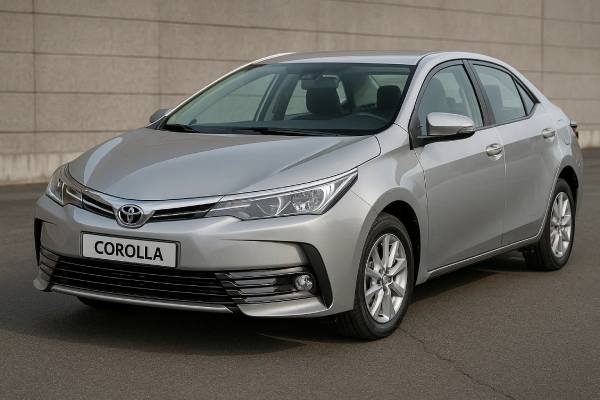
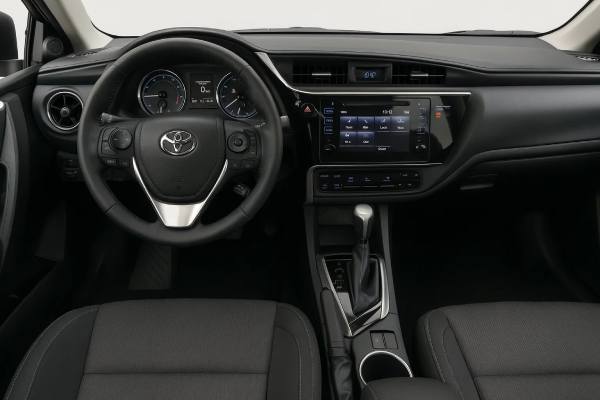
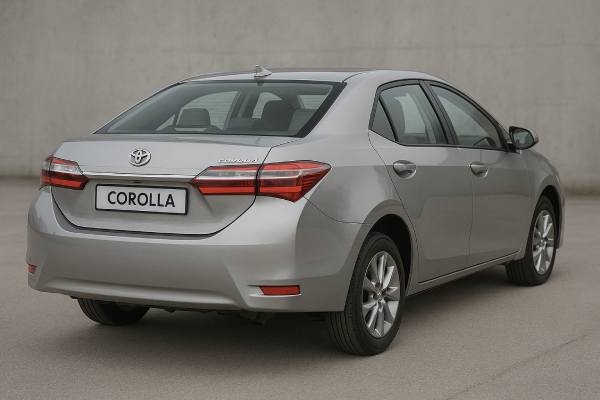
The 2016–2019 facelift Toyota Corolla with the 2ZR-FE 1.8-litre engine targets buyers who value low running costs, dependable hardware, and straightforward ownership. Rated at 132 hp, this naturally aspirated four-cylinder pairs with a CVT (or a rare six-speed manual) to prioritise smoothness and efficiency over outright speed. The facelift brought crisper styling and, crucially, the rollout of Toyota Safety Sense across trims, making active safety a strong selling point. Inside, the cabin offers generous rear legroom for the class, a comfortable driving position, and simple controls that hold up well over time. Mechanically, the 2ZR-FE uses port fuel injection and a timing chain—two decisions that reduce typical maintenance and long-term risk. It is not the quickest compact, and the CVT can drone under heavy throttle, but the combination of reliability, real-world economy, and robust resale keeps this Corolla high on used-car shortlists.
Fast Facts
- Proven 2ZR-FE engine (timing chain) with low upkeep and strong longevity.
- Spacious rear seat and compliant ride for daily commuting.
- Toyota Safety Sense driver aids widely available/standard from this facelift.
- Watch for CVT fluid service and software updates if shift quality degrades.
- Oil and filter: every 10,000 miles / 12 months (5,000-mile inspections recommended).
On this page
- Detailed Overview
- Specifications and Technical Data
- Trims and Options, Safety and Driver Assistance
- Reliability, Common Issues and Service Actions
- Maintenance and Buyer’s Guide
- Driving and Performance
- How Toyota Corolla Compares to Rivals
Detailed Overview
The facelifted eleventh-generation Corolla (chassis code ZRE172 for the 1.8-litre gasoline sedan) sharpened exterior styling and broadened active-safety availability while keeping the proven 2ZR-FE powerplant. This engine is a 1,798 cc, chain-driven, DOHC inline-four with variable valve timing on intake and exhaust. It makes 132 hp (98 kW) and 174 Nm (128 lb-ft) and is paired mainly with Toyota’s CVTi-S continuously variable transmission that simulates stepped ratios under acceleration. A six-speed manual appears in select trims and years but is uncommon on the used market.
Comfort and packaging remain standout strengths. The long 106.3-in (2,700-mm) wheelbase yields adult-friendly rear legroom, and the trunk offers a usable shape with a low liftover. Materials are simple but durable, and the infotainment interface—though basic—covers essentials. Ride tuning favours compliance over sport; the torsion-beam rear axle contributes to predictable, low-cost ownership without the complexity of multi-link hardware.
From a safety perspective, this update era is important: Toyota Safety Sense (with pre-collision functions, lane support, automatic high beams, and adaptive cruise on many trims) became widespread, boosting the Corolla’s credentials for new and young drivers. Efficiency is a major draw: typical owners see mid-30s mpg US on mixed routes and high-30s on steady highway runs, provided tyres are properly inflated and oil is the specified 0W-20. The trade-offs are modest acceleration and CVT character under heavy loads, but the Corolla’s core mission—reliable, affordable transportation—remains intact.
Specifications and Technical Data
Engine and Performance (2ZR-FE, gasoline)
| Item | Specification |
|---|---|
| Code | 2ZR-FE |
| Layout & cylinders | Inline-4, DOHC, 16 valves |
| Valvetrain | Dual VVT-i (intake/exhaust) |
| Bore × stroke | 80.5 × 88.3 mm (3.17 × 3.48 in) |
| Displacement | 1.8 L (1,798 cc) |
| Induction | Naturally aspirated |
| Fuel system | Sequential multi-port fuel injection |
| Compression ratio | ~10.0:1 |
| Max power | 132 hp (98 kW) @ 6,000 rpm |
| Max torque | 174 Nm (128 lb-ft) @ ~4,400 rpm |
| Timing drive | Chain (no routine replacement) |
| Emissions/efficiency standard | ULEV/SULEV (depending on state) |
| Rated economy (typical EPA class value) | ~7.8–8.4 L/100 km (28–30 mpg US / 34–36 mpg UK) combined |
| Real-world highway @ 120 km/h (75 mph) | ~6.0–6.7 L/100 km (39–35 mpg US / 47–42 mpg UK) |
| Aerodynamics (Cd / Frontal area) | — |
Transmission and Driveline
| Item | Specification |
|---|---|
| Transmission | CVTi-S continuously variable (most trims); 6-speed manual (limited availability) |
| Gear ratios | CVT: continuously variable; Manual: 6 forward + 1 reverse (ratios vary by year/trim) |
| Final drive | ~3.94–4.76 (varies by transmission/trim) |
| Drive type | Front-wheel drive (FWD) |
| Differential | Open |
Chassis and Dimensions
| Item | Specification |
|---|---|
| Front / rear suspension | MacPherson strut / torsion beam |
| Steering | Electric power assist; ~36.0-ft (11.0-m) turning circle |
| Brakes | Front vented discs; rear drums (L/LE) or solid discs (SE/XSE) |
| Wheels / tyres | 195/65R15 (steel); 205/55R16; 215/45R17 (SE/XSE) |
| Length / width / height | ~4,630 mm × 1,775 mm × 1,455 mm (182.3 in × 69.9 in × 57.3 in) |
| Wheelbase | 2,700 mm (106.3 in) |
| Curb weight | ~1,270–1,330 kg (2,800–2,930 lb) |
| Fuel tank | 50 L (13.2 US gal / 11.0 UK gal) |
| Cargo volume (SAE) | ~368 L (13.0 ft³) |
Performance and Capability
| Metric | Value |
|---|---|
| 0–100 km/h (0–62 mph) | ~10.0–10.8 s (CVT); ~9–10 s (manual) |
| Top speed | ~180 km/h (≈112 mph) |
| Braking 100–0 km/h (62–0 mph) | ~38–41 m (125–135 ft) depending on tyres |
| Towing / payload / roof load | Not rated for towing in many markets; check owner’s manual. |
Fluids and Service Capacities
| System | Specification / Capacity |
|---|---|
| Engine oil | SAE 0W-20 (API/ILSAC); ~4.0–4.2 L (4.2–4.4 US qt) with filter |
| Coolant | Toyota Super Long Life (pink), premixed 50/50; capacity varies by A/C and heater spec |
| Transmission (CVT) | Toyota Genuine CVT Fluid FE; service by temperature/level procedure (capacity varies) |
| A/C refrigerant | R-134a; charge approx. 450–500 g (15.9–17.6 oz) |
| A/C compressor oil | ND-OIL 8 equivalent; quantity per service procedure |
| Key torque values | Wheel nuts ~103 Nm (76 lb-ft); spark plugs ~18 Nm (13 lb-ft) |
Electrical
| Item | Specification |
|---|---|
| Alternator output | ~100–130 A (varies by equipment) |
| 12 V battery | Group 35/51R commonly fitted; ~45–60 Ah (CCA varies) |
| Spark plugs | Long-life iridium; gap ~1.0–1.1 mm (0.039–0.043 in) |
Safety and Driver Assistance
| Feature / Rating | Notes |
|---|---|
| Structural and airbags | Front, side, curtain, and driver knee airbags (availability by trim/year) |
| Toyota Safety Sense | Pre-collision with pedestrian detection, lane departure alert with steering assist, automatic high beams; adaptive cruise widely available |
| IIHS results | Good crashworthiness in most categories; headlight ratings vary by trim/option; Top Safety Pick on correctly equipped years |
| Headlight rating (IIHS) | Varies: from Poor/Marginal to Acceptable/Good depending on headlamp package |
| Child-seat provisions | LATCH anchors; accessible lower anchors, tether points behind rear seatbacks |
Trims and Options, Safety and Driver Assistance
Trim landscape (2016–2019, 132-hp models): The 2ZR-FE engine appears primarily in L, LE, XLE, SE, and XSE grades. LE Eco with the 2ZR-FAE (140 hp) sits adjacent but is outside this article’s scope; shoppers should verify the engine code in photos or the VIN data.
- L / LE: Steel wheels (15-in on L), cloth seats, basic infotainment with a small screen in earlier years, rear-view camera, and manual climate (LE often gains automatic A/C). LE moves to alloys on some years and offers more convenience features.
- XLE: A comfort-oriented specification with upgraded seat materials, added convenience (smart key, heated front seats in some markets), and typically rear disc brakes.
- SE / XSE: Sport-flavoured appearance (lower bumper design, rear spoiler), 17-inch wheels with wider 215/45 tyres, stiffer shock/spring tuning, sport seats, leather-wrapped steering wheel, and rear disc brakes. The XSE layers in comfort content (power driver seat, SofTex upholstery).
Quick identifiers:
- Engine code tag appears on the under-hood emissions label and on build sheets; look for “2ZR-FE.”
- Rear brakes: drums typically mean L/LE; discs point to SE/XSE (or XLE depending on market).
- Wheel/tire package: 17-inch alloys with 215/45 tyres are usually SE/XSE tells.
- Interior trim: Blue or contrast stitching and sport seat bolsters are SE/XSE signatures.
Options and packages:
- Moonroof packages were common on LE/XLE/SE/XSE.
- Infotainment increments include larger touchscreens and embedded navigation on higher trims/late years; Apple CarPlay appears later on other Toyota models but not widely on this generation sedan.
- Some regions offered a cold-weather package (heated seats/mirrors).
Safety and ADAS evolution:
This facelift ushers in broad standardisation of Toyota Safety Sense on most trims. Pre-collision warning/braking with pedestrian detection, lane departure alert with steering assist, automatic high beams, and dynamic radar cruise (vehicle-to-vehicle) appear widely. Headlight performance—and therefore IIHS headlight scoring—depends on the exact lamp type and aiming; SE/XSE projector or LED units may score better than entry reflectors. When shopping, confirm the presence of radar (Toyota badge “window”) and camera hardware at the top of the windscreen, and verify that warning lamps illuminate and self-check on startup.
Year-to-year notes:
- Minor feature reshuffles occur each model year; later cars benefit from infotainment refinements and, in some markets, expanded active-safety coverage across lower trims.
- Wheel design and colour changes are cosmetic; mechanical differences are limited mainly to brake hardware and spring/damper tuning on SE/XSE.
Reliability, Common Issues and Service Actions
The 2ZR-FE Corolla is widely regarded as a low-risk, low-drama used compact. Issues that do arise are typically inexpensive, and major engine internals are robust when serviced on time. Below is a practical map of prevalence and impact to guide inspections and budgeting.
Engine and fueling
- Water pump seepage (occasional / low–medium): Look for pink residue near the pump weep hole and faint coolant smell after shutdown. Remedy: replace pump and gasket; budget for fresh SLLC coolant.
- Coil-on-plug misfire (occasional / low): Rough idle and a flashing MIL under load. Read misfire counters and swap coils to confirm; use OE-quality coils and new iridium plugs if mileage is high.
- EVAP purge valve sticking (occasional / low): Hard restart after refuelling, EVAP-related DTCs. Replace purge valve and smoke-test if codes persist.
- Oil seep at valve cover (occasional / low): Damp gasket bead at rear; reseal with a new gasket and grommets.
Cooling and climate
- A/C weak at idle (occasional / low): Verify condenser fins are clear and fans operate; correct refrigerant mass is critical. System uses R-134a; recover/charge by weight.
Transmission/driveline
- CVT flare or drone (occasional / medium): Hesitation off the line or a flare under part throttle. First perform a CVT software update (where applicable); if symptoms persist, do a fluid exchange with Toyota CVT FE fluid and verify fill by temperature. Persistent whine may point to internal bearing wear (higher cost).
- Manual clutch wear (rare / medium): Mainly on urban cars or those taught on; engagement near the top of travel indicates imminent replacement.
Chassis and brakes
- Rear drum brake noise (common on L/LE / low): Dust glazing creates squeal. Clean/adjust or upgrade to OE-quality shoes; consider rear-disc trims if this bothers you.
- Sway-bar links and front strut mounts (occasional / low): Clicks over speed bumps; replace in pairs.
- Wheel bearing hum (occasional / medium): Grows with speed; confirm with a spectrum road test and replace hub assembly.
Electrical and infotainment
- Head unit glitches (occasional / low): Frozen screen or Bluetooth dropouts; update firmware or power-cycle.
- 12-V battery sensitivity (common / low): Short-trip cars experience early battery ageing. Load-test yearly after year 3; replace proactively before winter.
Corrosion hotspots (salt regions)
- Rear axle beam and brake backing plates: Inspect for rust scale; address early with treatment.
- Exhaust hangers and flanges: Check for pitting; clamp or replace as needed.
Recalls, TSBs, and extended coverage
- Airbag/ECU-related campaigns exist for certain years; verify completion with an official VIN recall check.
- CVT calibration updates improve driveability and responsiveness; ensure the latest software is installed after any transmission service.
- Fuel-system or emissions checks appear as TSBs in specific VIN ranges; a dealer can confirm with your build data.
Pre-purchase essentials
- Full service history (especially oil change intervals and coolant type), proof of recall completion, recent brake and tyre documentation, and a road test from cold (listen for cold-start ticks, CVT behaviour, and suspension clunks). On a CVT car, confirm smooth take-up, no delayed engagement when shifting from R→D, and steady-state cruising without surging.
Maintenance and Buyer’s Guide
Practical service schedule (time/distance, whichever comes first)
- Engine oil and filter: 10,000 miles / 12 months with 0W-20; inspect at 5,000 miles if mostly short trips or hot climates.
- Engine air filter: Inspect 15,000 miles; replace ~30,000 miles (sooner in dusty areas).
- Cabin filter: 15,000–20,000 miles (pollen season may dictate yearly).
- Coolant (SLLC): First replacement at 100,000 miles (160,000 km), then every 50,000 miles (80,000 km).
- Spark plugs (iridium): 120,000 miles (193,000 km).
- CVT fluid: Inspect condition from 60,000 miles; prudent refresh at 60,000–90,000 miles (temperature-based level set).
- Manual gearbox oil: 60,000–90,000 miles with GL-4/5 spec per manual.
- Brake fluid: Every 3 years; test annually with a copper/boiling-point strip in humid regions.
- Brake pads/rotors: Inspect every 5,000–10,000 miles; replace when friction material <3 mm or rotors below minimum.
- Serpentine belt and hoses: Inspect at 60,000 miles; replace 90,000–120,000 miles or at first cracking/glazing.
- Alignment and tyre rotation: Rotate 5,000–7,500 miles; align annually or after pothole impacts/tyre changes.
- 12-V battery: Test yearly after year 3; typical life 4–6 years.
Fluids and consumables quick guide
- Engine oil: 0W-20 API SP/ILSAC GF-6—full synthetic preferred.
- Coolant: Toyota SLLC (pink), pre-mixed; do not mix with green or universal coolants.
- CVT fluid: Toyota Genuine CVT FE only; correct level is set thermally with a scan tool.
- Brake fluid: DOT 3 or DOT 4 (check cap/manual); replace by time, not just mileage.
- Tyre pressures: Door-jamb sticker is the authority; many trims specify ~35 psi (240 kPa) cold.
Buyer’s checklist
- Engine bay: Dry pump/timing cover; no coolant crust.
- CVT behaviour: Smooth initial creep, no flare in light throttle, minimal whine.
- Brakes: Firm pedal, even stops; inspect rear drums for glazing or leaks.
- Suspension: Quiet over sharp bumps; no looseness in end links/ball joints.
- Electronics: All steering-assist/collision-avoidance lights self-test and go out; no stored DTCs.
- Tyres: Even wear; mismatched brands can mask alignment issues.
- Body: Consistent panel gaps; check under-trays and radiator support for curb damage.
Recommended configurations
- SE/XSE (CVT) for balanced daily use: Rear discs, 17-inch tyres, and firmer damping improve control without harming comfort.
- LE (CVT) for value: Lower insurance and tyre costs; simpler hardware.
- Manual seekers: Rare, but a 6MT SE pairs the light chassis with better throttle-to-speed response—confirm clutch feel and service history.
Durability outlook
With annual maintenance and sensible CVT care, these cars routinely clear 150,000–200,000 miles (240,000–320,000 km) with original major components. Consumables (brakes, dampers, tyres) are inexpensive, and parts availability is excellent.
Driving and Performance
Ride, handling, NVH
This Corolla rides softly and remains composed over broken city streets. The long wheelbase settles freeway expansion joints, and wind noise is modest at 70–75 mph (113–120 km/h). The torsion-beam rear axle is predictable; the car understeers progressively when pushed. SE/XSE trims feel more tied down thanks to firmer dampers and wider tyres, yet they remain comfortable for long commutes. Steering is light with enough accuracy for easy lane placement; feedback is limited but consistent.
Powertrain character
The 2ZR-FE prefers a measured driving style. Throttle response is clean off idle, and the engine is happiest between 2,000 and 4,000 rpm. The CVTi-S holds revs for efficiency, then mimics “shifts” under heavier throttle to reduce drone. Onramps reveal the Corolla’s modest output; plan passes and use ample throttle for the CVT to simulate a lower ratio. The 6MT, when found, wakes the car up and keeps revs in the engine’s sweet spot.
Observed economy
Owners commonly see 6.0–6.7 L/100 km (39–35 mpg US / 47–42 mpg UK) on steady highway runs at 120 km/h (75 mph), with mixed driving around 7.6–8.4 L/100 km (31–28 mpg US / 37–34 mpg UK). Winter tyres, short trips, and roof racks can trim 1–2 mpg US. Good tyres at the door-jamb pressures and fresh 0W-20 keep results consistent.
Selective metrics that matter
- 0–60 mph: ~10 s (CVT) on typical all-season tyres; ~9–10 s with 6MT.
- 50–80 mph passing: Deliberate; use Sport mode (if equipped) and anticipate CVT response.
- 100–0 km/h braking: ~38–41 m (tyre-dependent).
- Turning circle: ~36 ft makes tight parking easy.
Load and grades
With four occupants and luggage, highway grades demand earlier throttle; the cooling system copes well, but the CVT will raise revs to maintain speed. There is no factory tow rating in many markets; if a light utility hitch is fitted for bike racks, respect tongue-weight limits.
How Toyota Corolla Compares to Rivals
Honda Civic (2.0 NA / 1.5T): The Civic is quicker (especially with the 1.5T) and a bit sharper to drive, with a more modern cabin layout on later years. However, long-term concerns around direct-injection intake deposits and, on some years, oil dilution make the Corolla’s port-injected 2ZR-FE an appealing low-risk alternative for long ownership.
Mazda3 (2.0/2.5): The Mazda3 is the driver’s choice with precise steering and a more premium feel. Parts and tyres can be costlier, and the rear quarters are tighter. Corolla counters with easier maintenance and higher resale in many regions.
Hyundai Elantra: Strong warranty coverage and value pricing. Some years offer more features per dollar, but long-term resale and perceived durability still tilt toward the Toyota for many buyers.
Nissan Sentra: Comfortable ride and roomy rear seat, similar to Corolla. Powertrains in this era can be noisier, and some CVT generations are more failure-prone than Toyota’s.
Verdict: If you prioritise reliability, predictable costs, and active safety availability, the 132-hp Corolla remains a benchmark. Choose SE/XSE for better body control; choose LE/XLE for the lowest operating cost.
References
- 2017 Toyota Corolla Product Information 2016 (Press Kit)
- Gas Mileage of 2018 Toyota Corolla 2018 (Official Ratings)
- 2016 Toyota Corolla 4-door sedan 2016 (Safety Rating)
- Check for Recalls: Vehicle, Car Seat, Tire, Equipment | NHTSA 2025 (Recall Database)
Disclaimer
This guide is for informational purposes and is not a substitute for professional diagnosis or repair. Specifications, torque values, service intervals, and procedures vary by VIN, market, and equipment. Always verify details against your vehicle’s official owner’s manual and service documentation.
If this article helped, please consider sharing it on Facebook or X/Twitter to support xcar’s work.