
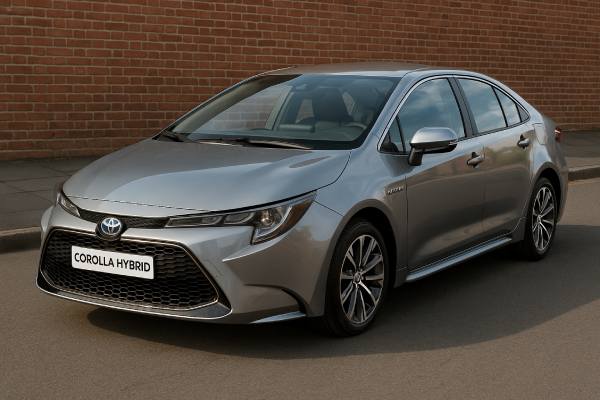
The Toyota Corolla Hybrid folds proven hybrid hardware into a familiar compact sedan, prioritizing real-world economy, durability, and low operating costs. Built on the TNGA-C platform, the ZWE211 pairs the 1.8-liter 2ZR-FXE Atkinson-cycle engine with a compact e-CVT transaxle and a small high-voltage battery. The result is effortless city mileage in the 50-mpg range, calm highway manners, and simple ownership. Ride comfort and cabin quietness are strong for the class, while the battery’s under-rear-seat location keeps trunk space usable for daily tasks. Standard Toyota Safety Sense driver assists and wide parts availability round out the value case. This guide focuses on the North American LE Hybrid configuration offered for model years 2020–2022 (with production starting in 2019). You will find concise specs, meaningful differences, reliability patterns, a practical maintenance plan, and buying pointers—so you can choose, inspect, and maintain a Corolla Hybrid that will run cheaply and reliably for years.
Fast Facts
- Consistently high economy: many drivers see 50–54 mpg mixed (4.7–4.3 L/100 km) with correct tires and pressures.
- Comfortable daily driver: quiet TNGA chassis, multi-link rear, and smooth e-CVT throttle response.
- Standard active safety on every car; strong crash performance when equipped with the better headlamps.
- Mind the details: keep the hybrid battery intake clear, service brake fluid every 3 years, and confirm recall completion by VIN.
- Routine oil service is 10,000 miles / 12 months on 0W-16; rotate tires every 5,000 miles (~8,000 km).
Guide contents
- Inside the Corolla Hybrid
- ZWE211 specifications and tech data
- Corolla Hybrid trims, options, safety
- Reliability notes and campaigns
- Maintenance plan and buyer guide
- On-road performance and economy
- Corolla Hybrid versus rivals
Inside the Corolla Hybrid
Toyota’s Corolla Hybrid arrives without drama or gimmicks—and that restraint is its edge. The ZWE211 platform uses a stiffer TNGA-C body with better noise isolation than prior Corollas, allowing the suspension to be tuned for both compliance and control. Around town, impacts are rounded off rather than thumpy, and at a steady cruise the car tracks straight with minimal steering correction. The multi-link rear suspension (new to this generation of Corolla sedan) preserves composure over broken pavement and keeps the rear planted in quick transitions. It is not a sport sedan, but it handles everyday commuting with an easy confidence that reduces fatigue.
Hybrid Synergy Drive does the heavy lifting. The 2ZR-FXE four-cylinder runs the efficient Atkinson cycle and spends much of its time at low rpm or off entirely in gentle traffic. Two motor-generators inside the e-CVT transaxle (one acting as a starter/generator, the other as the drive motor) blend power seamlessly, so you feel smooth, steady thrust rather than gear changes. A fixed reduction ratio replaces conventional gears, leaving the control electronics to select the most efficient operating point. Electric assist makes the first car-length off the line feel alert even though the combined output is a modest 121 hp (90 kW).
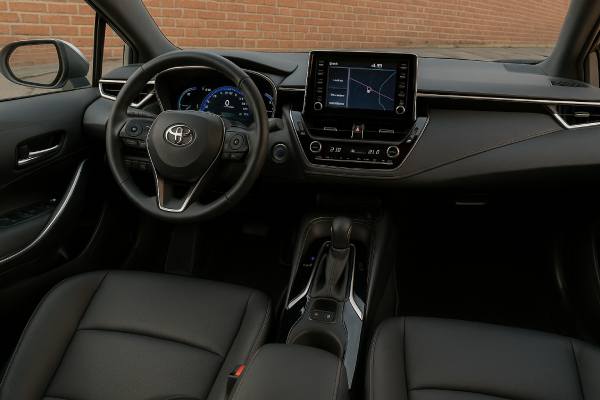
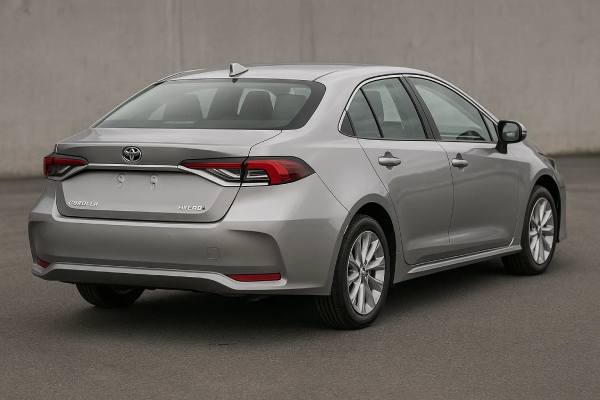
Practicality is baked in. The hybrid battery sits under the rear seat, not in the trunk, so you retain a conventional trunk with a wide opening and a 60/40 split-fold seatback. Most wear items—filters, pads, rotors, wipers—are common with the regular Corolla, which keeps parts prices low and availability high. The cabin’s control layout favors physical knobs and buttons for high-frequency tasks, and the 8-inch touchscreen responds quickly to inputs. Materials skew durable over flashy; high-wear surfaces hold up well under rideshare or family use if cleaned periodically.
Active safety is generous. Toyota Safety Sense 2.0 is standard, bringing automatic emergency braking with pedestrian detection, lane departure alert with steering assist, lane tracing assist (gentle centering on marked highways), automatic high beams, and adaptive cruise control. Blind spot monitoring with rear cross-traffic alert is commonly bundled as an option. Headlight performance varies by lamp type and trim package, so test night visibility—correct aim matters. Altogether, the Corolla Hybrid trades theatrics for a calm, efficient driving experience and a predictable ownership path, which is exactly what many buyers want.
ZWE211 specifications and tech data
Powertrain and Efficiency (HEV)
| Item | Specification |
|---|---|
| Engine code | 2ZR-FXE (Atkinson-cycle inline-4) |
| Valvetrain | DOHC, 16 valves, Dual VVT-i (VVT-iE on intake in some calibrations) |
| Displacement | 1.8 L (1,798 cc) |
| Bore × stroke | 80.5 × 88.3 mm (3.17 × 3.48 in) |
| Compression ratio | ~13.0:1 |
| Induction / fuel | Naturally aspirated; electronic fuel injection |
| Electric motor-generators | Two (PMSM) inside hybrid transaxle; one drive, one starter/generator |
| System voltage | ~200 V class |
| Battery chemistry | Nickel-metal hydride (pack under rear seat; market-dependent running changes exist) |
| Combined output | ~121 hp (90 kW) |
| Rated economy (typical LE Hybrid) | 53 / 52 / 52 mpg (city/hwy/combined) ≈ 4.4 / 4.5 / 4.5 L/100 km |
| Real-world 75 mph (120 km/h) | ~5.0–5.3 L/100 km (47–44 mpg US / 56–53 mpg UK) |
| Aerodynamics | Cd ~0.28–0.30 (wheel/tire dependent) |
Why it works: The Atkinson cycle trades peak torque for efficiency, then electric torque fills low-rpm gaps. The e-CVT keeps the engine in its efficient band and recovers energy under braking.
Transmission and Driveline
| Item | Specification |
|---|---|
| Transaxle family | P610 e-CVT hybrid transaxle (planetary gearset) |
| Drive | Front-wheel drive |
| “Gears” | Not applicable; electronic power split |
| Differential | Open; traction/stability control via brake actuators |
| Final reduction | Fixed within transaxle |
| Refuel time | ~5 minutes (gasoline) |
Chassis and Dimensions
| Item | Specification |
|---|---|
| Platform | TNGA-C (stiff, multi-path load architecture) |
| Suspension (front/rear) | MacPherson strut / Multi-link |
| Steering | Electric rack assist; calm on-center |
| Brakes | Front ventilated discs ~276 mm (10.9 in); rear solid discs ~260 mm (10.2 in) with regen blending |
| Wheels / tires (typical) | 195/65 R15; aero covers common |
| Ground clearance | ~135 mm (5.3 in) |
| Length / width / height | 4,630 / 1,780 / 1,435 mm (182.3 / 70.1 / 56.5 in) |
| Wheelbase | 2,700 mm (106.3 in) |
| Turning circle | ~10.9 m (35.8 ft) curb-to-curb |
| Curb weight | ~1,290–1,385 kg (2,840–3,050 lb), equipment-dependent |
| Fuel tank | ~43 L (11.4 US gal / 9.5 UK gal) |
| Cargo volume (trunk) | ~371 L (13.1 ft³), SAE |
Performance and Capability
| Metric | Value |
|---|---|
| 0–60 mph (0–97 km/h) | ~9.2–9.5 s |
| 0–100 km/h (0–62 mph) | ~9.5–9.8 s |
| Top speed | ~180 km/h (≈112 mph) |
| 100–0 km/h braking | ~36–39 m (118–128 ft), tire-dependent |
| Towing | Not rated (North America) |
| Roof load | Use Toyota-approved crossbars/accessory limits only |
Fluids and Service Capacities (owner-use essentials)
| System | Specification | Typical fill / torque |
|---|---|---|
| Engine oil | SAE 0W-16 (ILSAC/API); 0W-20 acceptable if 0W-16 unavailable, then return to 0W-16 next service | ~4.2 L (4.4 qt) with filter; drain plug ~27 Nm (20 lb-ft) |
| Coolant | Toyota Super Long Life (pink) 50/50 premix | Service by hybrid bleed procedure |
| Transaxle fluid | Toyota WS ATF | Fill to level at temp (no set interval listed) |
| Brake fluid | DOT 3 (DOT 4 acceptable if fully flushed) | Replace every 3 years |
| A/C refrigerant | R-1234yf; ND-OIL 12 compressor oil | Charge by label |
| Wheel lugs | — | 103 Nm (76 lb-ft) |
Electrical
| Item | Specification |
|---|---|
| 12-V supply | DC-DC converter from HV battery (no alternator) |
| 12-V battery | Compact AGM; trunk-adjacent location |
| Spark plugs | Long-life iridium; typical gap ~0.7–0.8 mm (0.028–0.031 in); ~120,000-mile service interval |
Safety and Driver Assistance
| Area | Details |
|---|---|
| ADAS suite | Toyota Safety Sense 2.0 standard: AEB (pedestrian), Lane Departure Alert w/ Steering Assist, Lane Tracing Assist, Adaptive Cruise Control, Road Sign Assist, Auto High Beams |
| Headlights | Performance varies by unit/aim; upgraded LED projectors score higher |
| Crash tests | High crashworthiness scores for this generation; Top Safety Pick applies to specific headlamp builds and test years |
| Child seats | LATCH anchors with good access; verify center-position borrowing rules in the manual |
Corolla Hybrid trims, options, safety
Trim structure (North America 2019–2022): The Corolla Hybrid arrives mainly as the LE Hybrid. Mechanicals are consistent: 2ZR-FXE, e-CVT, FWD, 195/65 R15 tires, and the hybrid battery under the rear seat. Toyota packages features via small options groups rather than multiple grades, which simplifies used-car shopping.
- LE Hybrid core equipment: automatic climate control, smart key with push-button start, 8-inch infotainment with Apple CarPlay (Android Auto added with running updates), LED exterior lighting, electronic parking brake with auto-hold, and Toyota Safety Sense 2.0. Cloth seats and a 60/40 split-fold rear bench are standard; a height-adjustable driver seat is typical.
- Convenience/driver-assist packages: commonly add Blind Spot Monitor with Rear Cross-Traffic Alert, more smart-key doors, heated mirrors, and sometimes heated front seats in colder regions.
- Audio upgrades: Audio Plus or JBL on select builds/years; extra USB ports on package cars.
- Wheels/tires: Most LE Hybrids run 15-inch steel wheels with aero caps and low-rolling-resistance all-seasons. A move to 16–17-inch aftermarket wheels is common but typically costs 1–3 mpg combined.
Mechanical/functional differences by configuration:
All North American Corolla Hybrids share the same basic drivetrain and suspension. There are no factory AWD or sport-tuned hybrid variants in this window. Brake hardware, steering ratio, and cooling layout remain consistent across packages. Headlamp units can differ (and matter for safety-award eligibility), so capture the headlamp part numbers during a pre-purchase inspection if night driving is a priority.
Safety ratings and headlines:
The twelfth-generation Corolla sedan tests very well in crashworthiness, with strong structure and restraint performance. The car earns a top insurance-industry safety award in specific years only when equipped with the higher-performing headlamps; trims with different lamps may receive lower headlight ratings. The standard front crash-prevention system performs at the top level in vehicle-to-vehicle testing and robustly in pedestrian scenarios for its era. Child-seat provisions are straightforward, with accessible LATCH anchors and clear top-tether routing points; always check seating-position restrictions in the owner’s manual.
Year-to-year notes (hybrid):
- 2019 build/2020 model year: Hybrid enters the lineup with TSS 2.0 and the familiar LE feature set.
- 2021: Android Auto integration rolls across production; minor multimedia refinements.
- 2022: Running software/feature adjustments before the mid-cycle refresh that followed; package content varies slightly by distributor and region.
Quick identifiers (used-car lot):
- “Hybrid” badging on trunk and front fenders, blue-tinted Toyota emblems, 195/65 R15 tires with aero covers, tachometer cluster graphics with hybrid power meter, EV-mode button near the shifter, and a trunk floor with standard compact spare (region-dependent). The VIN eighth character and the emissions label will reflect the hybrid engine family.
Reliability notes and campaigns
The Corolla Hybrid’s powertrain is mature and generally low-drama. Most examples reach high mileage with little beyond fluids, filters, and brake service. Still, patterns and official service actions are worth knowing so you can inspect confidently and keep the car in top shape.
Common / low cost
- 12-V battery aging (3–6 years): Hybrids rely on a healthy 12-V battery to “Ready.” Symptoms are random dash warnings or no-start. What to do: load-test annually after year three; replace with an AGM unit that matches the OE spec.
- Hybrid battery cooling path dust/pet hair: The intake at the rear seat can clog in rideshare or pet-owner cars, raising battery temps and fan noise. What to do: vacuum the intake grill and have the fan inspected/cleaned periodically.
- Brake surface rust/glaze: Because regen handles light decel, rotors can glaze or rust ridge in urban use. What to do: include deliberate firm stops weekly, lubricate slider pins at rotations, and replace pads/rotors when thickness or pulsation dictates.
Occasional / medium cost
- Infotainment resets or Bluetooth quirks: Early head-units may freeze or drop connections. What to do: apply the latest firmware; a battery reset can clear odd behavior after updates.
- Windshield replacement → ADAS camera calibration: Post-glass service, lane tracing and AEB require calibration. What to do: use a shop with Toyota calibration equipment; confirm no warning lights and proper lane-keeping behavior on a test drive.
- Electric water pump seep/noise (higher mileage): Listen at idle and watch for pink residue near the pump housing. What to do: replace the pump and bleed the hybrid cooling loop properly.
Rare / higher-severity but important
- Brake booster pump campaign (select early builds): Some vehicles were subject to inspection/replacement due to potential loss of assist under specific conditions. Action: verify campaign completion by VIN; proof should be in the service file.
- Occupant Classification System (OCS) sensor campaign (selected 2020–2021 vehicles): Affected cars receive inspection and sensor replacement to ensure correct passenger airbag deployment logic. Action: run an official recall check before purchase; repair is free when open.
- Airbag control ECU filtering improvements (broader Toyota action touching multiple models): Ensures proper deployment logic under electrical noise conditions. Action: confirm software or ECU campaign records by VIN.
Hybrid system durability
- The 2ZR-FXE engine uses a timing chain (no belt to replace) and generally shows low oil consumption with correct 0W-16 oil and change intervals.
- The transaxle is robust under normal duty; fluid is officially “lifetime,” but inspection and occasional drain/fill by condition are sensible at higher mileage.
- Traction batteries in this generation typically last many years when cooling paths stay clean. Temperature is the battery’s enemy—clean intakes and cabin filters help longevity.
Pre-purchase checklist to request
- Full maintenance records (oil changes by time, brake-fluid entries, cabin/engine filter replacements).
- VIN recall/campaign printout showing completion of any open actions.
- Brake measurements and rotor runout notes; evidence of slider pin lubrication.
- Cooling system inspection: leak-free, correct Toyota SLLC coolant.
- Scan for hybrid control DTCs, check HV battery temperature sensor plausibility, and verify the battery cooling fan runs quietly.
- Tire condition and match set; low-rolling-resistance types preserve mpg.
Maintenance plan and buyer guide
A simple, proactive service routine keeps the Corolla Hybrid efficient and drama-free. The schedule below is owner-friendly and aligns with typical North American guidance; always use the stricter severe-service plan if you drive frequent short trips, in extreme temps, or on dusty roads.
Service schedule (distance/time)
- Engine oil + filter: 10,000 miles / 12 months using SAE 0W-16. If most trips are under 10 minutes or in very cold weather, consider 5,000-mile interim changes. Replace the crush washer and torque the drain plug correctly.
- Tire rotation + inspection: 5,000 miles / 6 months. Check pressures (use the door-jamb label), look for edge wear that hints at under-inflation or toe misalignment, and reset the TPMS properly.
- Cabin air filter: Inspect at 10,000–15,000 miles; replace 15,000–20,000 miles (earlier with pets or rideshare).
- Engine air filter: Inspect 15,000 miles; replace 30,000–45,000 miles depending on dust load.
- Brake fluid: Replace every 3 years regardless of mileage to protect modulators and maintain pedal feel.
- Coolant (engine and hybrid loops): First replacement 100,000 miles / 10 years, then 50,000 miles / 5 years. Bleed hybrid circuits by procedure to avoid air pockets.
- Spark plugs (iridium): 120,000 miles (193,000 km) typical; torque on warm aluminum head and avoid anti-seize on plated plugs.
- e-CVT (Toyota WS): Inspect condition 60,000 miles; pragmatic drain/fill 90,000–120,000 miles if fluid is dark or contaminated.
- 12-V battery: Load-test annually after year 3; plan replacement years 4–6 depending on climate.
- Alignment: Annually or any time you see uneven wear or after curb impacts.
- HV battery cooling path: Inspect/clean intake and fan every 30,000–45,000 miles in dusty/pet environments.
Fluids, capacities, and essential torques
- Engine oil: 0W-16; capacity ~4.2 L (4.4 qt) with filter.
- Coolant: Toyota Super Long Life (pink) premix; do not mix types.
- Brake fluid: DOT 3 (DOT 4 acceptable if completely flushed).
- Transaxle fluid: Toyota WS ATF; fill to level at specified temp.
- Wheel lugs: 103 Nm (76 lb-ft); re-torque after tire service.
- Oil drain plug: ~27 Nm (20 lb-ft); replace washer.
DIY cautions for hybrids
- Always disable the Ready mode and observe HV safety labels. Do not probe orange-covered high-voltage cables.
- Use scan-tool service modes when working on the brake system (to avoid unexpected pump operation) and for parking-brake caliper service.
- After windshield or front-end work, complete ADAS calibrations and confirm lane-keeping and AEB behavior on-road.
Buyer’s guide: what to seek or avoid
- Best value: Any 2020–2022 LE Hybrid with documented oil and brake-fluid services, clean VIN recall status, and an unblocked HV battery intake.
- Nice-to-have options: Blind Spot Monitor with Rear Cross-Traffic Alert; upgraded LED headlamps where available; all-weather protection in snow regions.
- Red flags: Mismatched tires (hurts mpg and handling), warning lights (Ready system, ABS/VSC), rough brake feel (glaze/rust ridge), or poor night visibility (lamp damage/aim).
- Durability outlook: With routine care, 200,000-mile (320,000-km) lifespans are common. Expect mid-life replacements of 12-V battery, pads/rotors, and some suspension links; hybrid transaxle and traction battery issues are uncommon when cooling paths are clean and software is current.
On-road performance and economy
Ride, handling, NVH
The Corolla Hybrid feels mature for a compact. The TNGA-C body is rigid, so the suspension can be tuned for comfort without letting the car float or heave. It soaks up broken pavement at city speeds and stays composed over highway expansion joints. Steering is light in parking, calm on-center, and accurate enough to place the car precisely in lane. Tire noise depends on brand and tread; low-rolling-resistance tires are quieter on smooth asphalt, while some all-seasons hum on coarse concrete. Wind noise is low for the class. Overall noise levels are relaxed, which pairs well with the hybrid’s low-rev operating style.
Powertrain character
In normal driving, the hybrid system emphasizes smoothness and efficiency. Step-off is aided by electric torque, so the first car-length is alert; as speed builds, the e-CVT holds the engine where it makes power most efficiently. There are no gear changes—just a steady rise in road speed. Eco/Normal/Sport modes mainly change pedal mapping and climate logic; Sport is helpful for short merges, but peak output does not change. On long grades, the engine will hum at a constant rpm while speed holds; this is normal and not a sign of slipping.
Braking feel and consistency
Regenerative braking handles most deceleration below moderate pedal pressure, converting motion into battery charge. Toyota’s blending is well tuned; the handoff to friction brakes is hard to detect in daily use. Because regen reduces pad use, schedule periodic firm stops to keep the rotors clean, and bleed brake fluid every three years to protect the ABS/ESC modules and maintain a consistent pedal.
Observed fuel economy
- City: 53+ mpg (≤4.4 L/100 km) is common with gentle driving and warm weather.
- Highway (60–75 mph / 100–120 km/h): 44–50 mpg (5.3–4.7 L/100 km) depending on speed, wind, tires, and temperature.
- Mixed: 50–54 mpg (4.7–4.3 L/100 km) for many owners.
Cold weather, winter tires, and short trips can trim 10–20% from these figures; a tire pressure check and an unclogged battery-cooling intake help restore them.
Key performance metrics
- 0–60 mph (0–97 km/h): low-to-mid-9s, adequate for modern traffic.
- 50–70 mph passing: plan merges; Sport mode quickens pedal response but not peak power.
- Emergency braking: Stable and repeatable; high-quality tires make the biggest difference.
Load and towing
The hybrid is not tow-rated in North America. With a full cabin and trunk, the car remains composed and economical; expect a modest mpg penalty (5–10%). Maintain door-placard tire pressures, especially on long highway trips with luggage, and allow a longer stopping margin since friction brakes do more work at lower speeds and higher loads.
Corolla Hybrid versus rivals
Honda Insight (2019–2022)
Insight feels a notch more premium inside and can be a hair quicker in passing thanks to its two-motor system that can couple the engine directly at speed. The Corolla Hybrid counters with lower long-term parts pricing, simpler trunk packaging, and broadly similar mixed-use mpg. If you value a traditional sedan feel and Toyota’s dealer network depth for hybrids, the Corolla has the edge.
Hyundai Ioniq Hybrid (2017–2022)
The Ioniq’s sleek aero and dual-clutch gearbox help it post outstanding highway mpg, and the hatchback body is more flexible for cargo. Ride quality skews firmer and brake blending can be more noticeable. Corolla Hybrid rides quieter on rough surfaces and feels more conventional to drive; long-term residuals often favor Toyota.
Toyota Prius (Gen 4)
Prius remains the king of ultimate efficiency and offers more hybrid-specific features and displays. Corolla Hybrid delivers nearly the same everyday mpg with a traditional sedan trunk, lower insurance in many regions, and a familiar driving position—ideal if you want a “normal” car that quietly sips fuel.
Hyundai Elantra Hybrid (2021–)
A newer entry with strong feature content and attractive pricing. It’s efficient and quiet, but long-term reliability perceptions still tilt Toyota’s way. Corolla’s conservative tuning and parts commonality reassure high-mileage owners and fleets.
Bottom line
If you want a compact that simply works—cheaply, quietly, and safely—the Corolla Hybrid sits at the center of the target. It trades headline acceleration for predictability and very low operating costs, and it rewards owners who keep simple maintenance current.
References
- 2020 Toyota Corolla 2019 (Pressroom Overview)
- Fuel Economy of the 2020 Toyota Corolla Hybrid 2020 (EPA Data)
- 2020 Toyota Corolla 2020 (Safety Rating)
- Vehicle Detail Search – 2020 TOYOTA COROLLA HYBRID 2020–2025 (Recall Database)
Disclaimer
This article is for informational purposes and is not a substitute for professional diagnosis, service literature, or inspection. Specifications, torque values, intervals, and procedures vary by VIN, market, model year, and options. Always verify details against your vehicle’s official owner’s manual, service information, and recall status before performing maintenance or making a purchase decision.
If you found this guide helpful, please consider sharing it with fellow owners and shoppers on Facebook or X/Twitter—your support helps us keep producing detailed, owner-focused resources.