
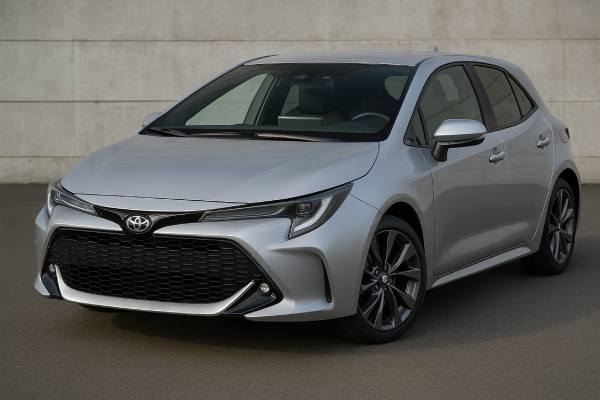
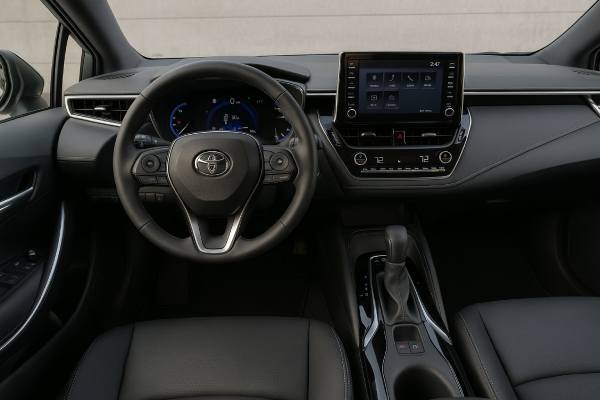
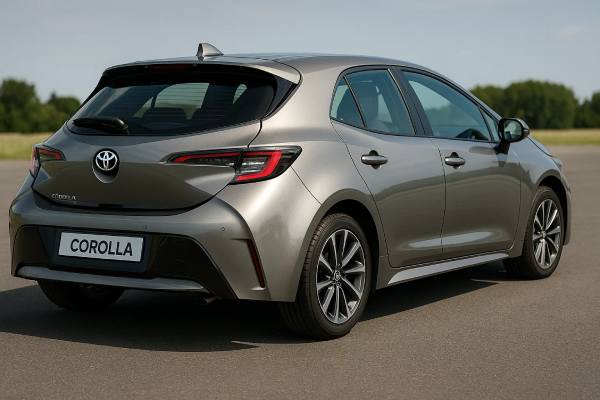
The facelifted Toyota Corolla Hatchback that arrived for the 2023 model year refines what owners already liked: a lively, efficient 2.0-liter “Dynamic Force” engine, a smarter Toyota Safety Sense 3.0 suite, and a cabin that finally gets the modern infotainment experience buyers expect. The launch-gear CVT (Toyota’s “Direct-Shift” K120) helps the 2.0 pull cleanly from a stop while keeping highway revs low for quiet cruising and strong economy. Underneath, the TNGA-C platform remains the star—rigid, predictable, and easy to place on a back road or an urban commute. Practicality is better than it looks: the rear seats fold flat and the hatch opening is wide. For 2024–2025 Toyota added the Nightshade and FX Special Edition flavors, but the core car stays honest: simple to own, light on fuel and brakes, and still fun enough that you will not dread a detour.
Fast Facts
- Strong economy for a non-hybrid: real-world 36–41 mpg highway (6.9–5.7 L/100 km) with steady driving.
- Launch-gear CVT responds quickly off the line and settles into low revs on the highway; calm, efficient cruising.
- Standard Toyota Safety Sense 3.0 with improved detection range and lane support; easy daily confidence.
- Watch tire and wheel choices: 18-inch packages ride firmer and raise tire replacement cost.
- Typical oil change interval: 10,000 miles / 12 months (16,000 km / 12 months) with 0W-16, under normal service.
Explore the sections
- Detailed Overview
- Specifications and Technical Data
- Trims and Options, Safety and Driver Assistance
- Reliability, Common Issues and Service Actions
- Maintenance and Buyer’s Guide
- Driving and Performance
- How Corolla Hatchback Compares to Rivals
Detailed Overview
Toyota’s 2023 refresh sharpened the Corolla Hatchback’s face, updated lighting signatures, and—more importantly—moved the car onto Toyota’s latest software platform. The 8-inch Toyota Audio Multimedia system is quicker, supports wireless Apple CarPlay and Android Auto, and adds cloud-based navigation and a more responsive voice assistant. Every hatch uses the same 2.0-liter M20A-FKS engine (169 hp / 126 kW; 151 lb-ft / 205 Nm) paired with the Direct-Shift CVT. A small mechanical first gear handles initial launch before handing off to the belt drive; you feel less “rubber-banding” than old CVTs and more of the immediate push you’d expect from a geared transmission. Sport mode and manual steps via paddles are included.
Chassis fundamentals carry over from the TNGA-C platform: strut front, multi-link rear, and a stiff body that allows relatively soft springs without letting the car flop around. Steering is quick on center and accurate as you add lock. Noise suppression is good for the class, helped by longer gear ratios on the highway and careful sealing around the rear hatch opening. In day-to-day use, the Corolla feels solid and cohesive; it filters small chatter but still tells you what the tires are doing.
Practical details matter in a hatchback. The cargo floor is low and flat with the seats folded, the liftover height is reasonable, and the opening is square enough to load a bicycle with the front wheel off. Rear leg room is adequate for two average adults; headroom is acceptable even with the sloping roof. Standard driver aids take the edge off commuting: adaptive cruise maintains gaps smoothly, lane centering is conservative, and the camera-radar fusion picks up pedestrians and cyclists earlier than the previous generation system.
Model cadence since the facelift is straightforward. For 2023, the manual transmission departed the North American lineup; all cars use the K120 CVT. SE remains the value play, XSE the feature leader. 2024 brought a Nightshade variant (black trim/wheels) and 2025 added the FX Special Edition look package. No AWD or hybrid hatch is offered here, keeping the Hatchback focused on light, simple, front-drive dynamics for drivers who want economy without a hybrid’s complexity.
Specifications and Technical Data
Engine and Performance (ICE-only)
| Item | Specification |
|---|---|
| Code | M20A-FKS (Dynamic Force) |
| Layout & valvetrain | Inline-4, DOHC; 4 valves/cyl; dual VVT-i (VVT-iE on intake) |
| Bore × stroke | 80.5 × 97.6 mm (3.17 × 3.84 in) |
| Displacement | 2.0 L (1,987 cc) |
| Induction | Naturally aspirated |
| Fuel system | D-4S dual injection (direct + port) |
| Compression ratio | 13.0:1 |
| Max power | 169 hp (126 kW) @ ~6,600 rpm |
| Max torque | 205 Nm (151 lb-ft) @ ~4,800 rpm |
| Timing drive | Chain |
| Emissions/efficiency standard | EPA (North America) |
| Rated economy (EPA, typical) | 35 mpg combined (32/41 city/hwy) — 6.7 L/100 km combined |
| Real-world highway @ 120 km/h (75 mph) | ~6.0–6.4 L/100 km (39–36 mpg US / 47–43 mpg UK) depending on wheel/tire |
| Aerodynamics (typical) | Cd ≈ 0.30–0.32; frontal area ~2.2 m² (23.7 ft²) |
Transmission and Driveline
| Item | Specification |
|---|---|
| Transmission | K120 “Direct-Shift” CVT with mechanical launch gear; selectable steps via paddles |
| Drive type | Front-wheel drive (FWD) |
| Final drive ratio | ~4.26 (varies slightly by grade) |
| Differential | Open |
| “Refuel to full” time | ~5 min (typical gasoline pump) |
Chassis and Dimensions
| Item | Specification |
|---|---|
| Platform | TNGA-C |
| Suspension (front/rear) | MacPherson strut / Multi-link |
| Steering | Electric power steering; quick ratio, ~2.6–2.8 turns lock-to-lock |
| Brakes | 4-wheel discs; ventilated front/solid rear |
| Wheels/Tires | 16–18 in; common sizes 205/55R16, 225/40R18 |
| Ground clearance | ~130 mm (5.1 in) |
| Length/Width/Height | ~4,370 mm / 1,790 mm / 1,435–1,450 mm (172.0 / 70.5 / 56.5–57.1 in) |
| Wheelbase | 2,640 mm (103.9 in) |
| Turning circle (curb-to-curb) | ~10.9 m (35.8 ft) |
| Curb weight (approx.) | 1,375–1,410 kg (3,030–3,110 lb) by trim |
| GVWR (approx.) | ~1,840–1,870 kg (4,050–4,120 lb) |
| Fuel tank | ~50 L (13.2 US gal / 11.0 UK gal) |
| Cargo volume (seats up) | ~504 L (17.8 ft³) SAE; seats down: ~1,300+ L (estimated) |
Performance and Capability
| Metric | Result (typical) |
|---|---|
| 0–100 km/h (0–62 mph) | ~8.2–8.8 s (tire/wheel dependent) |
| Top speed | ~195 km/h (121 mph), electronically limited |
| 100–0 km/h (62–0 mph) braking | ~36–39 m (118–128 ft) on all-season tires |
| Towing capacity | Not rated in North America |
| Payload | ~385–430 kg (850–950 lb), by build |
| Roof load | ~68–75 kg (150–165 lb), check crossbar rating |
Fluids and Service Capacities*
| System | Spec / Capacity |
|---|---|
| Engine oil | SAE 0W-16, API SP / ILSAC GF-6B; ~4.5 L (4.8 qt) w/filter |
| Coolant | Toyota Super Long Life (pink) 50/50; ~7–8 L (7.4–8.5 qt) total system |
| Transmission | Toyota CVT FE (K120); service drain/fill ~4–5 qt (total ~7–8 qt) |
| A/C refrigerant | R-1234yf; typical charge ~400–450 g (14–16 oz)** |
| Key torque example | Wheel lug nuts 103 Nm (76 lb-ft) |
- Always verify by VIN and under-hood labels.
** Charge amount varies; use the under-hood sticker as the authority.
Electrical and Ignition
| Item | Specification |
|---|---|
| 12V battery | AGM/Flooded, compact H4/140R form factor (typical 45–50 Ah, 390–430 CCA) |
| Spark plugs | Long-life iridium; gap ~0.8–0.9 mm (0.031–0.035 in) |
Safety and Driver Assistance
| Item | Details |
|---|---|
| Crash ratings (recent) | Strong results in IIHS crashworthiness; ratings can vary by headlight/trim year |
| Headlights (IIHS) | Ratings vary by grade/wheels; check year-specific result |
| ADAS suite (TSS 3.0) | Pre-Collision with pedestrian/cyclist detection, Lane Departure Alert with Steering Assist, Lane Tracing Assist (centering), Dynamic Radar Cruise Control, Road Sign Assist, Automatic High Beams; Blind Spot Monitor and Rear Cross-Traffic Alert available/grade-dependent |
Trims and Options, Safety and Driver Assistance
Trim walk (North America, facelift era): The streamlined lineup keeps the decision simple. The SE is the value leader with 16-inch wheels, cloth seating, single-zone climate, and the full Toyota Safety Sense 3.0 suite. The XSE adds 18-inch alloys, a sport-tuned suspension calibration, SofTex-trimmed seats with heating and power driver adjustments, upgraded instrumentation, and more ambient and convenience touches. Nightshade (2024) blacks out the grille surround, mirror caps, emblems, and wheels for a stealth look while retaining SE equipment. The 2025 FX Special Edition is an appearance and wheel/tire package inspired by 1980s Corolla FX—bronze-finish 18s and unique badging—layered on core hardware. All grades use the 2.0 + Direct-Shift CVT; the manual vanished with the facelift in this market.
Option structure and identifiers: Toyota keeps standalone options light. Common adds include a cold-weather pack (heated elements), premium audio, a moonroof, and convenience sensors (front/rear parking sonar). Quick visual tells: SE typically wears 16-inch tires and a simpler front bumper; XSE’s 18-inch 225/40 tires fill the arches, and the headlamp internals and bumper trim are more ornate. VIN/build codes confirm grade and equipment; door-jamb tire labels call out wheel sizes and factory pressures.
Mechanical or functional differences by trim: With the facelift, the primary mechanical variation is the wheel/tire package. XSE’s 18-inch setup brings slightly crisper initial turn-in and a shorter stopping distance in warm weather but adds ride firmness on broken pavement and increases replacement cost. Brake hardware and powertrain tune remain the same. Towing equipment is not offered from the factory; hatchback is not tow-rated here.
Year-to-year highlights:
- 2023 (facelift launch): New front/rear styling, updated colors, Toyota Audio Multimedia with wireless smartphone integration, Safety Sense 3.0, and CVT-only.
- 2024: Nightshade returns with blacked-out trim/wheels. Minor color and feature mix tweaks.
- 2025: FX Special Edition adds heritage-style wheels/graphics to the existing SE/XSE structure.
Safety ratings and child-seat provisions: Corolla Hatchback performs well in major crash tests for structure and restraints. Headlight performance ratings depend on trim/wheel/aim; verify the exact build because headlamp variations can swing an overall award. LATCH anchors are accessible in the outboard rear positions; belt geometry is friendly, though boosters may sit a bit high under the sloping roof. Standard ABS, stability control, brake assist, and a full complement of airbags (front, side, curtain, and driver’s knee) round out passive safety. After windshield, front-radar, or camera service, ADAS calibration is required; budget time at a capable shop for static/dynamic calibration sequences.
Reliability, Common Issues and Service Actions
The MZEA12 hatch with the M20A-FKS has a strong reliability record when serviced with the correct low-viscosity oil and high-quality fuel. Most issues owners encounter are low-severity and low-cost—often related to tires, alignment, or infotainment—rather than the engine or gearbox. Below is a practical map by prevalence and impact.
Common / low-to-medium cost
- Tire cupping or inner shoulder wear (18-inch fitments): Symptoms include humming at highway speeds and visible feathering. Causes are camber/toe settings plus stiff, low-profile sidewalls. Remedy: rotate every 5,000–6,000 miles (8,000–10,000 km), keep to factory pressures, request a four-wheel alignment with a touch more toe-in for highway commuters.
- Brake squeal in light rain or after washing: Semi-metallic pad behavior and surface rust can squeak on first stops. Remedy: a few firm stops to clean the rotors; use OE-equivalent pads; apply proper shim grease if servicing.
- Infotainment software quirks: Wireless connections occasionally drop or the assistant mishears commands after a phone OS update. Remedy: confirm head unit software is current; perform a full vehicle reboot; delete and re-pair devices; dealer can apply multimedia updates.
Occasional / medium cost
- 12V battery early fatigue (short-trip usage): Modern parasitic loads and short commutes can under-charge compact batteries. Symptoms: slow crank, intermittent warning lights. Remedy: test and charge monthly in winter; replace around year 4–5 in cold regions; use a battery maintainer if stored.
- Wheel bearing growl (high mileage, rough roads): A low droning that grows with speed. Remedy: confirm with a chassis ear; replace the hub assembly on the affected corner.
Rare / higher cost
- CVT fluid overheating under sustained mountain grades with heavy loads: The K120 is robust in commuting but, like any CVT, can heat-soak if pushed hard in hot weather. Symptoms: temporary performance reduction or warning; Remedy: back off, cool-down, ensure correct CVT FE fluid level and condition; consider earlier drain/fill intervals for severe service (see Maintenance).
Service actions and recalls (facelift era): Campaigns vary by VIN and build month; typical items involve sensor logic updates, occasional component checks, or hardware fastener inspections. Always run the official VIN tool and review dealer records before purchase; software reflashes for driver-assist or infotainment are common running changes that improve behavior.
Pre-purchase checklist (what to request)
- Full service history with oil weight and interval noted (0W-16, 10k-mile/12-month normal service).
- Proof of recall and service campaign completion (VIN printout).
- Recent brake and tire measurements; alignment sheet.
- Battery test printout (12V).
- Evidence of CVT fluid service if mileage >60k and used in severe service (mountain/hot climates).
- Underside inspection for leaks, splash-shield integrity, and rust at exhaust hangers/subframes (salt states).
Maintenance and Buyer’s Guide
Practical maintenance schedule (typical usage)
- Engine oil & filter: 10,000 miles / 12 months (16,000 km / 12 months) with SAE 0W-16; halve the interval for short-trip or dusty use.
- Engine air filter: Inspect at 15,000 miles (24,000 km); replace 30,000–45,000 miles (48,000–72,000 km) depending on environment.
- Cabin filter: 12 months or 15,000 miles (24,000 km).
- Coolant (SLLC pink): First at 100,000 miles (160,000 km) or 10 years, then every 50,000 miles (80,000 km) / 5 years.
- Spark plugs (iridium): 120,000 miles (192,000 km).
- Serpentine belt and hoses: Inspect at 60,000 miles (96,000 km); replace if cracked/noisy.
- CVT fluid (Toyota CVT FE): Not “lifetime” in severe duty; inspect at 60,000 miles (96,000 km); consider a drain/fill every 60,000–90,000 miles (96,000–145,000 km) if you tow cargo carriers, live in hot/hilly regions, or drive aggressively.
- Brake fluid: Replace every 3 years regardless of mileage.
- Brakes: Inspect pads/rotors every 10,000 miles (16,000 km); clean/lube slide pins in salt regions.
- Alignment & tire rotation: Rotate every 5,000–6,000 miles (8,000–10,000 km) and align annually on 18-inch packages.
- 12V battery: Test annually after 3 years; expect replacement around year 4–6.
Fluid references and helpful values
- Engine oil: SAE 0W-16 (API SP / ILSAC GF-6B); ~4.5 L (4.8 qt) w/filter.
- Coolant: Toyota Super Long Life (pink) 50/50; ~7–8 L (7.4–8.5 qt).
- Transmission: Toyota CVT FE; service fill ~4–5 qt; total ~7–8 qt.
- Torque examples: Wheel lugs 103 Nm (76 lb-ft); oil drain plug ~39 Nm (29 lb-ft) typical; always verify by VIN.
DIY tips that make life easier
- Use the factory jack points and never lift by the thin rear floor seam.
- When rotating 18-inch tires, mark direction and watch inner-edge wear; a small toe adjustment can double tire life.
- After windshield replacement or any front-end collision repair, plan on ADAS calibration; a proper aiming surface saves time.
Buyer’s guide insights
- Best value used: SE with driver aids and the base wheel/tire package. It rides better and tires cost less, with nearly the same real-world grip as 18s.
- Want more features: XSE adds heated SofTex seats and 18-inch wheels; consider a spare set of 16-inch winter wheels in cold regions to protect ride and rims.
- Years to seek (facelift): 2023+ for the updated electronics and TSS 3.0. 2024 Nightshade if you like the blacked-out look; 2025 FX Special Edition if you want the style package.
- Long-term outlook: The 2.0 Dynamic Force engine has a simple accessory layout, chain timing, and a cooling system that handles heat well. With regular fluids and filters, 200k+ miles (320k+ km) is realistic with only routine wear items.
Driving and Performance
Ride, handling, NVH: The hatchback’s shorter wheelbase versus the sedan gives it a willing turn-in and a tidy footprint in traffic. On 16-inch tires, the ride is supple and quiet over rough patches; the car breathes with the road and never feels brittle. The 18-inch setup tightens responses a notch, but you will feel expansion joints and pothole edges more clearly. At 70–75 mph (113–120 km/h) the cabin stays composed; wind noise comes mainly from the mirrors and roof rails (if fitted).
Powertrain character: The M20A-FKS likes midrange revs; between 3,000 and 5,000 rpm it pulls cleanly and sounds purposeful, not coarse. The Direct-Shift CVT’s little launch gear removes the old low-speed CVT “slip” sensation—tip-in is more immediate, then the transmission settles the engine near peak efficiency. Ask for full throttle and it will hold revs at the engine’s sweet spot; use the paddles and you get predictable stepped responses for downhill control.
Real-world efficiency: Owners routinely see mid-30s mpg combined even on mixed suburban routes. At steady 75 mph (120 km/h) with climate control on, expect ~36–39 mpg US (6.4–6.0 L/100 km) on the 16s and ~34–37 mpg US (6.9–6.4 L/100 km) on the 18s, weather and elevation depending. Cold temperatures and winter fuel can cut these by 10–15% until the drivetrain warms.
Key metrics that shape the verdict
- 0–60 mph (0–97 km/h): ~8.2–8.8 seconds, surface and tire dependent.
- 50–80 mph (80–129 km/h) passing: Confident with kickdown; paddle a downshift on short two-lane windows.
- Braking: Linear pedal with predictable bite; quality all-season tires are the limiting factor more than rotor size.
- Turning circle: About 35–36 ft (10.7–11.0 m), easy to slot into tight parking.
Weather and traction notes: There is no AWD option; snow performance depends entirely on tires. Fit quality winter tires and the hatch becomes composed and secure; stability control logic is conservative but allows a touch of wheelspin to get moving. Hill-hold works cleanly on steep ramps; the parking brake is strong and easy to modulate.
How Corolla Hatchback Compares to Rivals
Versus Honda Civic Hatchback (2.0 NA / 1.5T): The Civic offers a larger rear seat and a longer cargo bay; the 1.5T has stronger midrange punch but brings direct-injection maintenance considerations and, in some years, fuel-dilution concerns in cold climates. Corolla counters with simpler ownership, likely lower brake and tire costs (on 16s), and standard safety equipment across the board. If you want a manual, Civic still offers it on some trims; Corolla does not in this generation.
Versus Mazda3 Hatchback (2.5 / 2.5T AWD): The Mazda feels more premium inside, with heavier steering and a tauter ride; the 2.5T AWD is quicker but significantly thirstier and pricier. The Corolla rides more gently day-to-day, wins on lane-assist behavior, and costs less to keep in tires and pads. For drivers prioritizing steering feel and cabin design, Mazda3 is compelling; for pragmatic long-term value with balanced dynamics, Corolla is the safer bet.
Versus Subaru Impreza (2.0 AWD): Standard AWD and excellent winter traction are Subaru’s calling cards, but power is modest and economy lags. Corolla’s FWD efficiency advantage is substantial on long commutes; with proper winter tires, a Corolla covers most snow-belt needs while returning better fuel numbers and typically lower maintenance costs out of warranty.
Versus Volkswagen Golf (TSI): Golf’s chassis tuning is polished and the cabin is roomy, but infotainment usability and parts pricing can frustrate. Corolla’s infotainment is now straightforward, the safety suite is standardized, and long-term parts availability/cost in North America favors Toyota. If you want the enthusiast edge, Golf’s dynamics are sweet; if you value predictable cost of ownership, the Corolla is hard to beat.
References
- 2024 Toyota Corolla Hatchback – Toyota USA Newsroom 2023 (Model overview/specifications)
- 2023 Toyota Corolla 2023 (EPA Fuel Economy)
- 2023 Toyota Corolla 4-door hatchback 2023 (Safety Rating)
- 2.0-liter Dynamic Force Engine, a New 2.0-liter Direct-injection, Inline 4-cylinder Gasoline Engine | Toyota’s New Powertrain | TNGA | Mobility | Toyota Motor Corporation Official Global Website 2018 (Engine technical data)
Disclaimer
This article is for informational purposes and is not a substitute for professional diagnosis or repair. Specifications, torque values, fluid types/capacities, service intervals, and procedures vary by VIN, market, model year, and equipment package. Always confirm details in your vehicle’s official service documentation and under-hood labels before performing maintenance.
If you found this guide useful, please consider sharing it with fellow owners on Facebook, X/Twitter, and your favorite forums—your support helps xcar continue producing detailed, people-first guides.