
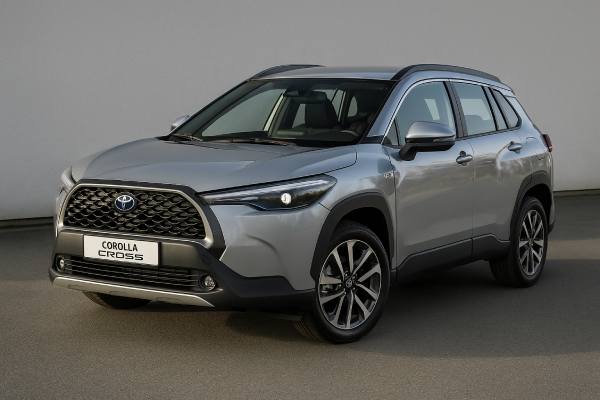
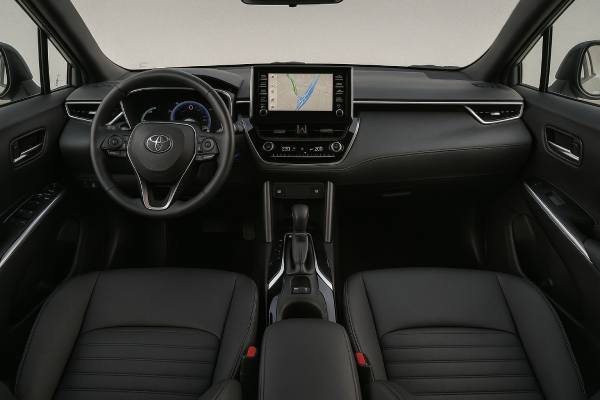
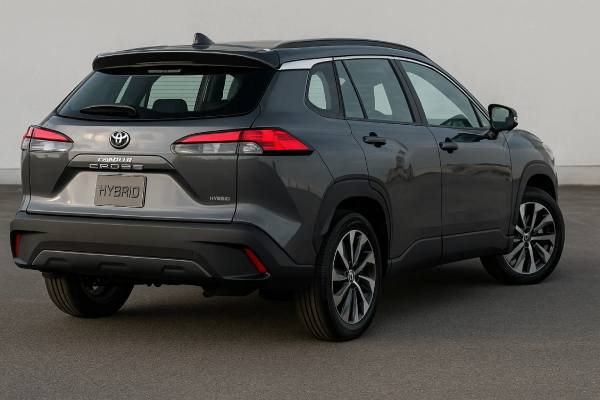
The Corolla Cross Hybrid FWD (chassis MXGH10) slots neatly between compact hatchbacks and family SUVs, pairing Toyota’s fifth-generation hybrid system with practical packaging and a calm, easygoing ride. In European markets, the 2.0-liter M20A-FXS Atkinson-cycle four teams with a high-output front motor and lithium-ion battery for a 197 hp (145 kW) system peak. You get brisk everyday performance, disciplined fuel use, and the feel of a “normal” automatic thanks to Toyota’s eCVT power-split. This guide focuses on the front-wheel-drive European specification (the FWD hybrid was not offered in North America), covering the 2022–2024 model years. Below you will find verified specs and capacities, crash-test outcomes, ownership costs, known issues, and what to check before buying—condensed into clear tables and checklists so you can make decisions quickly and confidently.
Fast Facts
- Strong real-world economy: WLTP combined 5.1–5.6 L/100 km (≈ 42–46 mpg US / 51–55 mpg UK) with smooth eCVT response.
- Family-friendly packaging: low load lip, wide hatch, 433 L VDA seats-up cargo, and easy child-seat access.
- High active-safety content standard (TSS with AEB, ACC, LTA) and five-star Euro NCAP rating.
- Watch for: noisy or worn 18-inch tyres increasing road roar; panel/radar sensor calibration required after front repairs.
- Typical service cadence: every 12 months / 15,000 km; hybrid battery health check annually to keep extended coverage active.
Explore the sections
- Corolla Cross Hybrid FWD Overview
- Specifications and Technical Data
- Trims, Options, Safety and ADAS
- Reliability, Issues and Service Actions
- Maintenance Schedule and Buyer’s Guide
- Driving Impressions and Performance
- Corolla Cross vs Key Rivals
Corolla Cross Hybrid FWD Overview
Toyota designed the Corolla Cross Hybrid to be “the Corolla for families”: familiar ergonomics and running costs, plus the extra ride height and load space people ask for. On the MXGH10 FWD variant covered here, propulsion comes from the M20A-FXS 2.0-liter Atkinson-cycle four working with a compact permanent-magnet synchronous motor and a lithium-ion battery. It is Toyota’s fifth-generation hybrid hardware, notable for a lighter transaxle, higher motor output density, reduced losses in the power control unit, and a smaller, better-cooled battery pack. System output is 197 hp (145 kW)—more than enough for a short on-ramp, yet the calibration is tuned to keep revs unobtrusive outside of heavy throttle.
Dimensionally the Corolla Cross sits in the heart of the C-SUV class: 4,460 mm long, 1,825 mm wide, 1,620 mm high on a 2,640 mm wheelbase. Think “hatchback parking footprint with SUV usefulness.” The seating position is upright with excellent outward visibility, and rear doors open wide to simplify loading child seats. Compared with many mild-hybrid rivals, the Toyota’s eCVT power-split avoids clutch wear and brings near-seamless engine-motor transitions in traffic. Suitcases are well-served: 433 L VDA seats-up volume (and over 1,300 L seats folded) plus a low liftover make weekly life easy.
For Europe, FWD uses an independent rear suspension tune that keeps roll in check without harshness on broken surfaces. Ride comfort is distinctly “Toyota”: quiet motions, good primary damping, and predictable body control rather than overt sportiness. Steering is light but consistent. Efficiency is the headline story—owners regularly see 5–6 L/100 km on mixed routes if tyres are kept at spec and cargo loads are sensible.
If you drive mostly urban/suburban routes, the powertrain’s EV creep and frequent engine stop windows keep the cabin calm and fuel bills low. Highway drivers will appreciate the long-legged gearing and mature sound insulation; the car is not fast, but the 7.5–7.7 s 0–100 km/h time means safe passing when needed. Toyota’s T-Mate / Toyota Safety Sense suite is comprehensive by class, and the platform scored five stars in Euro NCAP testing with strong vulnerable road-user protection. For families after a dependable, economical SUV with minimal learning curve, this particular Corolla Cross spec lands squarely on brief.
Specifications and Technical Data
Powertrain & Efficiency (HEV)
| Item | Corolla Cross Hybrid FWD (MXGH10) |
|---|---|
| Code | M20A-FXS (ICE) + front PMSM |
| Engine layout & cylinders | Inline-4, DOHC, 16-valve; Dual VVT-i (VVT-iE on intake) |
| Bore × stroke | 80.5 × 97.6 mm (3.17 × 3.84 in) |
| Displacement | 2.0 L (1,987 cc) |
| Induction | Naturally aspirated (Atkinson cycle) |
| Fuel system | D-4S (combined direct + port injection) |
| Compression ratio | 14.0:1 |
| ICE max power | 152 hp (112 kW) @ 6,000 rpm |
| ICE max torque | 190 Nm (140 lb-ft) @ 4,400–5,200 rpm |
| Electric motor (front) | Permanent-magnet synchronous (PMSM) |
| System voltage | High-voltage architecture (hundreds of volts), fifth-gen hybrid |
| Traction battery | Lithium-ion, 4.08 Ah, liquid-cooled |
| Total system output | 197 hp (145 kW) |
| Rated efficiency (WLTP combined) | 5.1–5.6 L/100 km (≈ 46–42 mpg US / 55–50 mpg UK) |
| Real-world highway @ 120 km/h | ≈ 5.6–6.3 L/100 km (≈ 42–37 mpg US / 50–45 mpg UK) depending on tyres, temp, load |
| Emissions standard | Euro 6 (latest applicable amendments) |
| Aerodynamics | Cd not officially published; frontal area typical for class |
Transmission & Driveline (HEV)
| Item | Data |
|---|---|
| Transmission | eCVT power-split (planetary) |
| Transaxle code | Toyota hybrid transaxle family (fifth-gen) |
| Gear ratios | Not applicable (continuously variable via power-split) |
| Final drive | Hybrid reduction/final drive integrated (model-specific) |
| Drive type | FWD |
| Differential | Open front differential |
| Replenishment | Refuel to full: ≈ 2–3 min (43 L tank) |
Chassis & Dimensions
| Item | Data |
|---|---|
| Platform | TNGA-C (GA-C) |
| Suspension (front/rear) | MacPherson strut / Independent rear (double-wishbone) |
| Steering | Electric rack-and-pinion (EPS) |
| Brakes | 4-wheel discs (front ventilated) |
| Wheels/Tyres (Tires) | 17- or 18-in alloys; typical sizes 215/60 R17 or 225/50 R18 |
| Ground clearance | Typical for class; varies with wheel/tire package |
| Length / Width / Height | 4,460 / 1,825 / 1,620 mm (175.6 / 71.9 / 63.8 in) |
| Wheelbase | 2,640 mm (103.9 in) |
| Turning circle (kerb-to-kerb) | 10.4 m (34.1 ft) |
| Kerb (Curb) weight | 1,435–1,550 kg (3,164–3,417 lb) |
| GVWR | ≈ 2,720–2,765 kg (5,997–6,096 lb) |
| Fuel tank | 43 L (11.4 US gal / 9.5 UK gal) |
| Cargo volume | 433 L (15.3 ft³) seats up / >1,300 L seats down (VDA) |
Performance & Capability
| Metric | Data |
|---|---|
| 0–100 km/h (0–62 mph) | 7.5–7.7 s |
| Top speed | 180 km/h (112 mph) |
| Braking distance | Class-typical; tyre-dependent |
| Towing capacity | 750 kg (1,653 lb) braked / 750 kg (1,653 lb) unbraked (market-dependent) |
| Payload | Model/trim dependent (typ. ~470–525 kg / 1,036–1,157 lb) |
| Roof load | Up to 75 kg (165 lb) with approved bars/accessories |
Fluids & Service Capacities (typical European data for M20A-FXS; verify by VIN)
| System | Spec | Capacity |
|---|---|---|
| Engine oil | 0W-16, API SP / ILSAC GF-6B | ≈4.6 L (4.9 US qt) with filter (earlier builds ~4.3–4.4 L) |
| Coolant (engine + inverter) | Toyota Super Long Life Coolant | ≈6.1 L + 1.6 L |
| Hybrid transaxle fluid | Toyota ATF WS / Toyota e-Transaxle fluid (per build) | ≈3.8 L (pre-MY2023), ≈3.0–3.7 L later |
| A/C refrigerant | R-134a or R-1234yf (market-dependent) | Charge per label |
| A/C compressor oil | ND-OIL (spec as labeled) | As specified |
| Key torques (examples) | Wheel nuts; oil drain plug; spark plugs | ~103 Nm (76 lb-ft); ~40 Nm (30 lb-ft); ~18–22 Nm (13–16 lb-ft) |
Electrical
| Item | Data |
|---|---|
| Alternator | None (DC-DC converter from HV battery) |
| 12 V battery | AGM/LN1 form factor typical; ~45–55 Ah depending on trim |
| Spark plug | Iridium long-life; gap ~0.7–0.8 mm (0.028–0.031 in) |
| HV battery warranty | Up to 10 years (or mileage cap) with annual Hybrid Battery Health Check (programme varies by country) |
Safety & Driver Assistance
| Category | Summary |
|---|---|
| Crash ratings | Euro NCAP: 5 stars; Adult 85%, Child 83%, VRU 87%, Safety Assist 82% |
| Headlights | LED; grade-dependent beam tech; performance varies by trim and aiming |
| ADAS suite | Pre-Collision (AEB car/ped/cyclist, junction assist), Adaptive Cruise (ACC), Lane Tracing Assist/Lane Departure Alert, Road Sign Assist, Automatic High Beam; Blind-Spot Monitor and Rear Cross-Traffic Alert commonly available; OTA-updatable functions on later builds |
| Child-seat provisions | ISOFIX/LATCH outboard rear with top tethers; wide-opening rear doors aid fitment |
Notes on figures: Dimensions, outputs, fuel consumption, acceleration, weights, and towing reflect European FWD hybrid data for 2.0-liter models. Some ranges depend on wheel size, equipment, and model-year calibrations.
Trims, Options, Safety and ADAS
Trims and options (Europe)
Toyota structures grades by market, but the pattern is consistent: a well-equipped entry trim and two uprated grades, often with a sport-styled derivative later in the cycle. Typical examples include Mid / Mid+ / High in continental markets or Icon / Design / Excel in the UK, with GR Sport appearance and chassis tweaks appearing in late-run updates. All FWD 2.0 hybrids share the same 145 kW system tune and eCVT; key differences are in wheels/tyres, lighting, upholstery, and convenience technology.
Quick identifiers:
- Exterior tells: 17-in alloys and standard LED headlamps on lower grades; 18-in machined alloys, privacy glass, roof rails, and sequential LED indicators on upper trims. GR Sport adds unique bumpers, badges, darker trim, and sport seats.
- Interior tells: 12.3-in digital cluster is widely standard; higher grades gain a 10.5-in central display with connected navigation, wireless charging, and more USB-C ports. Leather or part-synthetic upholstery and power driver’s seat appear on top trims.
- Options/packages: panoramic glass roof, power tailgate with kick sensor, premium audio, heated steering wheel, parking package with 360° camera and safe-exit assist.
Mechanical or functional differences by trim
Mechanicals are largely shared. The main functional changes come via tyre packages (17-in for comfort and economy; 18-in for sharper response but more road roar and a small fuel-economy penalty) and lighting (matrix/advanced beam logic where fitted). Towing prep and trailer stability assist are widely available; tow rating remains 750 kg braked in most markets.
Safety ratings
Euro NCAP tested the Corolla Cross with five stars overall. Adult occupant protection was 85%, child 83%, with strong vulnerable-road-user (87%) and driver-assist (82%) scores. Structurally, the body presents robust crash kinematics with effective restraint deployment and good whiplash metrics; lane support and AEB cyclist/night features contributed to the assist score. Ratings apply to vehicles matching the tested configuration; national equipment rules can alter details.
Safety systems and ADAS
Toyota’s T-Mate / Toyota Safety Sense brings a comprehensive baseline:
- AEB / Pre-Collision System: detects vehicles, pedestrians, and cyclists; adds Intersection Turn Assist to mitigate turning-across-traffic conflicts.
- Full-speed ACC: works with Lane Tracing Assist (LTA) for light steering support; driver attention remains mandatory.
- Lane Departure Alert (LDA) with steering assist and road-edge detection; Road Sign Assist (RSA) displays and can inform ACC setpoints.
- Automatic High Beam (AHB); some markets offer adaptive high-beam or matrix variants on top trims.
- Blind-Spot Monitor (BSM) and Rear Cross-Traffic Alert (RCTA) commonly available; Safe Exit Assist adds door-opening warnings using BSM sensors.
- Calibration implications: front radar, camera, and ultrasonic sensors require aiming/calibration after windscreen or fascia repairs. Wheel alignment influences LTA performance; restoring OE ride height and camera view angles is essential after suspension work.
Year-to-year changes (2022–2024)
- 2022 (launch year): fifth-gen hybrid debuts; 12.3-in cluster and 10.5-in infotainment roll in, with OTA capability for some TSS functions.
- 2023: incremental feature packaging and software refinements; accessory ecosystem expands.
- 2024: running updates to multimedia responsiveness, connected services, and optional GR Sport styling in more markets. Power and core mechanicals remain 197 hp for 2.0 FWD.
Reliability, Issues and Service Actions
The Corolla Cross Hybrid inherits Toyota’s well-proven hybrid architecture. Failures are uncommon when serviced on time, but no car is flawless. Below are patterns seen across mid-cycle 2.0-liter Toyota hybrids and this model’s European run.
Powertrain and hybrid system
- ICE timing chain and lubrication (rare, low–medium severity): The M20A-FXS uses a timing chain; no scheduled replacement. Chain rattle, cam/crank correlation faults, or metal in oil point to tensioner/guide wear from extended oil intervals or poor-quality oil. Remedy: borescope inspection, oil analysis, and timing set replacement if out of spec. Stick to 0W-16 API SP and the 12-month/15,000-km cadence.
- EGR/coolant passages (occasional, low severity): Hybrids do frequent cold starts; short-trip cars may see carbon accumulation in EGR passages. Symptoms: rough restart, fuel economy dip. Remedy: EGR circuit cleaning, software updates where applicable, insist on quality fuels.
- Inverter cooling circuit (rare, medium severity): Incorrect fill/bleed after service can allow aeration; inverter pump faults are rare but possible. Symptoms: hybrid faults, reduced power. Remedy: bleed with service procedure, pressure-test, replace pump under coverage if failed.
- HV battery health (rare within warranty, medium severity if neglected): The fifth-gen lithium-ion pack is durable; thermal management is improved. Dust-blocked intake grilles and pet hair can restrict cooling. Symptoms: fan noise, power limitations in heat. Remedy: clean intake paths, run the Hybrid Battery Health Check annually to maintain extended coverage (up to 10 years in many EU markets).
Transmission & driveline
- eCVT transaxle fluid (preventive): While Toyota does not require frequent changes, fluid aging is real under heavy towing or mountainous use. A 60,000–90,000 km drain-and-fill (using the correct Toyota fluid) is a sensible preventive measure.
- Front-end alignment sensitivity: Lane-keeping performance is sensitive to toe settings and steering angle sensor calibration. Always perform a thrust-angle alignment after suspension work.
Chassis & NVH
- Tyre roar on coarse asphalt (common with 18-in, low severity): The larger rolling stock looks great but raises cabin noise and can add a minor fuel-economy penalty. If you commute on rough surfaces, consider 17-inch wheels with touring tyres.
- Rear brake surface rust (occasional in wet climates, low severity): Hybrids lean on regen; rear steel discs can corrode if journeys are short. Remedy: periodic firm braking to scrub rotors; inspect at every service.
Electronics & ADAS
- Sensor alignment after repairs (occasional, medium severity): Radar/camera mounts behind emblem/windscreen require calibration after glass replacement or front-end work. Budget time and cost for calibration; misalignment triggers ACC/LTA faults.
- Infotainment updates (occasional, low severity): OTA updates improve stability and add features; ensure your car receives the latest revisions and that the dealer completes campaign updates.
Recalls, TSBs, and extended coverage
- Where to check: Use your country’s Toyota recall checker (VIN lookup) and your national safety authority’s database. Always ask the seller for a dealer printout showing completed campaigns.
- What to verify before purchase: Instrument panel/infotainment software at current level, any front radar/camera calibration records after glass or fascia work, and confirmation of the Hybrid Battery Health Check each year to keep extended HV coverage alive.
Prevalence & cost guide
- Common and low-cost: tyre noise (swap to quieter tyres), rear disc surface rust (driving style/service).
- Occasional, medium cost: EGR cleaning, ADAS calibration after repairs.
- Rare, high cost: HV battery modules outside coverage, damaged transaxle from fluid neglect (avoid with timely service), timing hardware from severe oil neglect.
Maintenance Schedule and Buyer’s Guide
Baseline maintenance (Europe; verify by VIN and service book)
- Engine oil & filter: Every 12 months / 15,000 km (whichever comes first). Use 0W-16 API SP / ILSAC GF-6B. Capacity ≈ 4.6 L with filter (earlier builds around 4.3–4.4 L).
- Engine air filter: Inspect every service; replace 30,000–45,000 km depending on dust.
- Cabin filter: Replace 12–24 months (more often if urban/pollen-heavy).
- Coolant: Toyota SLLC; first replacement typically 10 years/160,000 km, then 5 years/80,000 km—follow your local book; bleed inverter loop carefully.
- Spark plugs: Iridium long-life; inspect at 90,000–120,000 km, replace per service manual interval.
- Drive belt(s): Inspect each service; replace if cracked/noisy.
- Hybrid transaxle fluid: Not always scheduled; preventive 60,000–90,000 km change prudent if you tow or see high thermal loads.
- Brake fluid: Replace every 2 years regardless of mileage.
- Brake pads/rotors: Inspect each service; hybrids may glaze pads—occasional firm stops help.
- Tyre rotation & alignment: Rotate 10,000–15,000 km; check alignment annually or after pothole impacts.
- 12 V battery: Test yearly from year 3; typical replacement window 5–7 years.
- HV battery health check: Annually to keep extended battery coverage active (programme differs by country).
- Suspension & steering: Inspect bushes, links, and boots each service; replace worn items promptly to keep ADAS calibrated.
Essential fluid specs & torques (quick reference)
- Oil: 0W-16 API SP / ILSAC GF-6B; drain plug ≈ 40 Nm (30 lb-ft) with new gasket.
- Wheel nuts: ≈ 103 Nm (76 lb-ft).
- Spark plugs: iridium; ~18–22 Nm (13–16 lb-ft) on clean threads.
- Coolant: Toyota SLLC (pink); observe correct mix and bleed sequence for engine + inverter loops.
- ATF: Toyota ATF WS / Toyota e-Transaxle fluid as specified for the build.
Buyer’s checklist (used)
- Service history: Look for annual/15,000-km stamps and invoices; oil grade listed correctly; cabin and engine filters replaced on time.
- Hybrid Battery Health Check: Confirm yearly reports; they extend HV coverage and document pack condition.
- Recalls/campaigns: Run the VIN through the national Toyota recall checker; ask for a dealer completion statement.
- ADAS and glass: Any windscreen or front-end repair? Ask for camera/radar calibration paperwork. Confirm ACC/LTA operate cleanly on a test drive.
- Tyres and wheels: 18-in rims look smart but raise noise and replacement cost. Check for feathering or inner-edge wear (alignment).
- Brakes: Inspect rear discs for corrosion from light-use patterns; budget for pads/rotors if the lip is heavy.
- Fluids: Look for evidence of hybrid transaxle fluid service in harder-use cars; coolant reservoir level and clarity.
- Underside: Check the rear subframe, exhaust hangers, and pinch welds for impacts or corrosion (especially coastal climates).
- Towing: If a towbar is fitted, check loom integration and charging; confirm 750 kg tow rating in your registration and that cooling hardware is intact.
Which years/trims to target
- Best all-rounder: Mid+/Design with 17-in wheels for comfort, economy, and tyre longevity; add safety/parking pack.
- Want the look: High/Excel or GR Sport for cosmetics and features; accept more tyre roar.
- Avoid? No red-flag years. Prioritize cars with full records, recent 12-month service, and a clean Hybrid Battery Health Check.
Long-term durability outlook
With annual servicing and correct fluids, expect a decade of dependable operation. Hybrids reward gentle warm-up and even braking. The fifth-gen Li-ion pack is robust, and Toyota’s extended battery programmes incentivize keeping the health checks current.
Driving Impressions and Performance
Ride, handling, and NVH
The Corolla Cross Hybrid’s mission is comfort first. Spring/damper tuning filters broken edges cleanly, and the body stays settled over undulating B-roads. The independent rear keeps mid-corner bumps from upsetting the line. Steering is light but progressive, with a predictable self-centring that suits commuting. On 18-in wheels, coarse-chip roar can intrude; 17s reduce both noise and sharp-edge impact without dulling response for everyday use.
Powertrain character
In town, the hybrid often glides on electric torque, blending the engine in smoothly. Nudging the throttle yields linear push; ask for more and you’ll hear a brief flare as the eCVT chooses the most efficient ratio. Toyota’s latest calibration ties engine speed more closely to road speed than older hybrids, so the soundtrack feels more “conventional.” There is no turbo lag to manage; responses are immediate at low rpm thanks to the motor. The 152 hp engine’s plateau of 190 Nm arrives in the midrange, ideal for rolling traffic.
Performance metrics
- 0–100 km/h: 7.5–7.7 s with FWD and typical tyre packages.
- 80–120 km/h (50–75 mph) passing: Confident with a determined throttle; the eCVT drops to a high-power ratio quickly.
- Braking: Progressive, with a natural regen-to-friction handoff once warm; best consistency on 17-in tyres.
- Turning circle: 10.4 m, handy in old-town parking and multi-storeys.
Efficiency and range
- City: 4.7–5.5 L/100 km (≈ 50–60 mpg US / 60–72 mpg UK) is typical with gentle inputs and eco tyres.
- Highway (100–120 km/h): 5.6–6.3 L/100 km depending on temperature, wind, and tyre/wheel choice.
- Mixed: 5.1–5.6 L/100 km aligns closely with WLTP when driven smoothly.
- Cold-weather deltas: Expect +0.5–0.9 L/100 km in near-freezing conditions (engine runs more for cabin heat). Pre-conditioning via the app (where available) helps.
Load and towing
With 750 kg braked rating, the FWD hybrid handles small utility trailers or a pair of bikes on a light caravan. Keep speeds modest, fit a Type-approved towbar, and allow for ~10–20% fuel-use increase. Stability is good, but braking distances lengthen; use the trailer stability assist and leave a bigger gap.
Charging?
As a self-charging HEV, there is no plug-in charging. The battery is topped by regenerative braking and the engine. For drivers without home charging or who mostly drive mixed routes, this simplicity is a virtue.
Corolla Cross vs Key Rivals
Nissan Qashqai e-Power (FWD)
Nissan’s series-hybrid e-Power drives the wheels by motor only, with the engine acting as a generator. It feels torquier off the line and mimics stepped shifts, but motor-only at highway speeds can become buzzy under load. Efficiency is competitive; Toyota tends to beat it in suburban stop-and-go and match it at motorway pace. Toyota’s ADAS tuning is calmer; Nissan’s infotainment feels snappier.
Honda HR-V e:HEV / ZR-V e:HEV
Honda’s two-motor system prioritizes EV-like smoothness in town, and the chassis feels taut. The Toyota counters with more space, a lower load lip, and broader dealer coverage. At 120 km/h, Toyota’s cabin is quieter and the motor-to-engine changeovers are less noticeable.
Kia Niro Hybrid
Highly efficient with a roomy cabin and strong infotainment. Dual-clutch transmission brings a more “geared” feel but adds maintenance complexity versus Toyota’s eCVT simplicity. WLTP numbers are close; Toyota’s 5-star Euro NCAP and long hybrid battery programmes give it an after-sale advantage for cautious buyers.
Hyundai Tucson Hybrid (FWD)
Bigger and stronger, but heavier and dearer to run. If you need extra tow margin and a larger boot, it’s compelling; if you value running-cost predictability and city-friendly size, the Corolla Cross Hybrid is a better fit.
Bottom line
The Corolla Cross Hybrid FWD wins on low hassle ownership, predictable real-world economy, and safety credibility. Rivals might feel sportier or flashier, but few combine Toyota’s breadth of dealer support, hybrid maturity, and straightforward maintenance playbook.
References
- The all-new Corolla Cross 2022 (Press Release)
- Toyota Corolla Cross 2022 (Safety Rating)
- CorollaCross_Brochure_April2025.pdf 2025 (Brochure / Specs)
- Batteries 2025 (Hybrid Battery Programme)
- Recalls | Owners 2025 (Recall Checker)
Disclaimer
This guide is for informational purposes only and is not a substitute for professional diagnosis or repair. Specifications, torque values, service intervals, and procedures vary by VIN, market, model year, and equipment. Always verify details against your vehicle’s official owner’s manual and service documentation, and follow your country’s regulations and recall guidance.
If you found this useful, please share it with friends or fellow owners on Facebook, X/Twitter, or your favourite forum—thank you for supporting xcar’s work.