
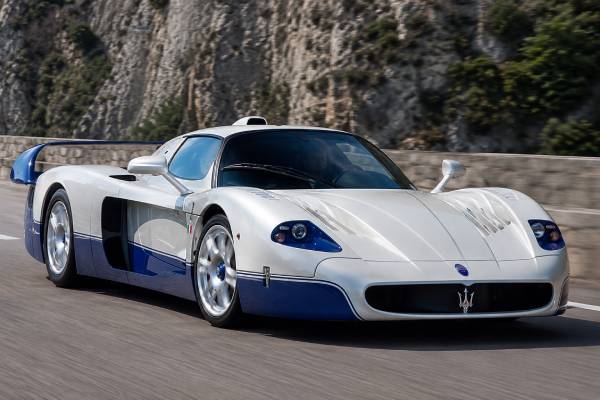
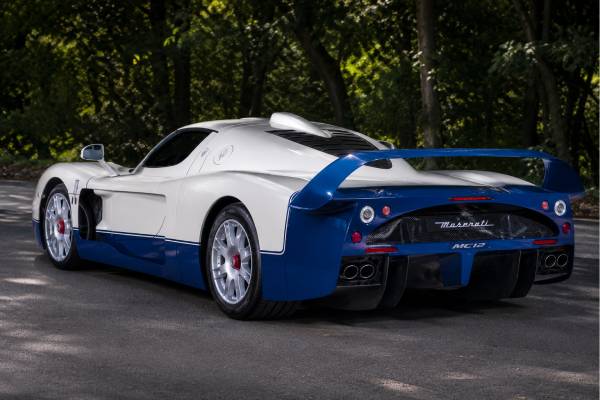
The Maserati MC12 Stradale is a road-legal homologation special created for one purpose: to put Maserati back at the front of international GT racing. Produced in 2004 and 2005, it combined a carbon-fiber structure, a naturally aspirated 6.0-liter V12, a paddle-operated transaxle, and bodywork shaped more like an endurance racer than a conventional supercar.
Although the MC12 shares important engineering with the Ferrari Enzo, it is not simply an Enzo wearing a Maserati badge. It is longer, wider, more aerodynamically focused, and tuned around high-speed stability. Its removable roof, enormous rear wing, roof-mounted intake, and lack of a rear window also make it less practical—and more theatrical—than most road cars.
Only 50 customer Stradales were built. That scarcity, combined with the successful MC12 GT1 racing program, has made the road car one of the most significant modern Maseratis. Buying one, however, requires more than checking mileage. Authenticity, structural condition, service history, component age, and specialist support matter far more.
Table of Contents
- Maserati’s GT1 Homologation Hero
- M144A V12, Chassis, and Key Specifications
- Fifty Road Cars and Authenticity
- Aerodynamics, Packaging, and Signature Design
- Road and Track Driving Character
- Service, Aging, and Ownership Risks
- MC12 Stradale Buyer Checklist
Maserati’s GT1 Homologation Hero
The MC12 matters because it was a competition program first and a road-car project second. Maserati needed a street-legal version to homologate its new GT1 racer, so the Stradale inherited proportions, cooling requirements, aerodynamic priorities, and packaging decisions normally reserved for the circuit.
Development began while Maserati was under Ferrari stewardship. The company had returned to financial and technical stability, its road-car range was improving, and a serious motorsport program offered a way to rebuild the competition reputation associated with historic cars such as the 250F and Tipo 61 Birdcage.
The project initially carried the MCC name, commonly understood as Maserati Corse Competizione. Its road-going counterpart was developed alongside the competition car rather than added as a styling exercise after the race car had been completed.
The Ferrari Enzo supplied a valuable engineering foundation. The MC12 used related carbon-composite architecture, a version of the 6.0-liter V12, and an electrohydraulic paddle-shift transmission. Maserati nevertheless changed the car’s suspension concept, engine calibration, cooling arrangement, gearing, aerodynamics, body structure, and overall character.
Externally, the relationship is difficult to spot. The windshield is the most obvious shared exterior component. Everything around it was reshaped into a car measuring more than five meters long and more than two meters wide.
The Stradale’s purpose becomes clearer when viewed beside the MC12 GT1. The road car provided the production basis needed for competition, while the racing version became one of the defining GT cars of its era. The MC12 program delivered major victories and championships, including success in the FIA GT series and at the 24 Hours of Spa.
That competition history transformed the Stradale’s reputation. At launch, some observers dismissed it as a less powerful and less usable Enzo derivative. With time, collectors increasingly valued what made it different:
- It represents Maserati’s return to top-level international GT racing.
- Its body and aerodynamic package were designed around a genuine competition objective.
- Production was limited to 50 customer road cars.
- The naturally aspirated V12 provides a direct link to an era before turbocharging, hybrid assistance, and dual-clutch transmissions became normal.
- Its successful racing counterpart gives the road car historical weight beyond rarity alone.
The MC12 was not intended to become Maserati’s everyday flagship. It was an extreme statement built to reconnect the road-car company with its racing identity. That focused purpose is why it remains relevant.
M144A V12, Chassis, and Key Specifications
The MC12 combines a 5,998 cc naturally aspirated V12 with rear-wheel drive, a six-speed automated manual transaxle, and a carbon-and-Nomex monocoque. Maserati quoted 630 PS, commonly described as 630 hp in European specifications; the equivalent output is approximately 621 bhp under the imperial measurement convention.
Engine and transmission
| Item | Specification |
|---|---|
| Engine code | M144A |
| Configuration | 65-degree naturally aspirated V12 |
| Displacement | 5,998 cc |
| Construction | Aluminum-alloy block and cylinder heads |
| Valve gear | DOHC, four valves per cylinder, 48 valves total |
| Lubrication | Dry-sump system |
| Fuel delivery | Electronic multipoint fuel injection |
| Compression ratio | 11.2:1 |
| Maximum output | 630 PS at 7,500 rpm, approximately 621 bhp |
| Maximum torque | 652 Nm at 5,500 rpm |
| Transmission | Six-speed Cambiocorsa electrohydraulic automated manual |
| Clutch | Twin-plate dry clutch |
| Drivetrain | Rear-wheel drive |
The engine is related to the Enzo’s Ferrari F140-family V12 but uses Maserati-specific calibration and detail changes. Power delivery is linear rather than explosive. Torque builds progressively, while the strongest acceleration arrives as the engine approaches the upper part of its rev range.
The Cambiocorsa transmission is a conventional manual gearbox operated by electrohydraulic actuators. It does not behave like a modern dual-clutch transmission. A computer and hydraulic system operate the clutch and select gears in response to the steering-column paddles.
Gear changes become cleaner when the driver slightly reduces throttle pressure during ordinary driving. Under heavy acceleration, the system delivers the forceful interruption expected from an early-2000s automated manual. Race mode quickens the shift strategy, firms the chassis response, and reduces traction-control intervention.
Structure, suspension, brakes, and tires
| Item | Specification |
|---|---|
| Primary structure | Carbon-fiber and Nomex honeycomb monocoque |
| Subframes | Aluminum front and rear structures |
| Front suspension | Independent double wishbones with pushrod-operated springs and dampers |
| Rear suspension | Independent double wishbones with pushrod-operated springs and dampers |
| Steering | Power-assisted rack and pinion |
| Front brakes | 380 mm cross-drilled steel discs, six-piston calipers |
| Rear brakes | 335 mm cross-drilled steel discs, four-piston calipers |
| Brake assistance | Bosch ABS with electronic brake-force distribution |
| Front tires | 245/35 ZR19 |
| Rear tires | 345/35 ZR19 |
Unlike the Enzo, the MC12 uses steel brake discs rather than carbon-ceramic rotors. The steel system offers strong cold response and is easier to assess and service, but repeated extreme-speed stops can generate considerable heat. Pad specification is therefore important when a car is prepared for track use.
The suspension includes a hydraulic front-lift function to raise the nose over ramps and road obstacles. It is essential rather than decorative because the car combines low ground clearance with a very long front overhang.
Dimensions and performance
| Measurement | Figure |
|---|---|
| Length | 5,143 mm |
| Width | 2,096 mm |
| Height | 1,205 mm |
| Wheelbase | 2,800 mm |
| Quoted weight | 1,335 kg |
| Static weight distribution | 41 percent front, 59 percent rear |
| Fuel capacity | Approximately 115 liters |
| 0–100 km/h | Approximately 3.8 seconds |
| 0–200 km/h | Less than 10 seconds in period factory figures |
| Maximum speed | 330 km/h |
Performance figures vary slightly among period tests because of surface condition, tire temperature, measurement method, and shift execution. The larger point is that the MC12 can accumulate speed with unusual ease. Its acceleration remains forceful well beyond the speeds at which ordinary performance cars begin to struggle.
Fifty Road Cars and Authenticity
There are 50 customer MC12 Stradales, generally described as two batches of 25 built across 2004 and 2005. Development cars, GT1 racers, and the later track-only Versione Corse belong to separate categories and should not be counted as ordinary Stradale production.
The standard MC12 Stradale is a left-hand-drive, two-seat road car with a removable roof panel. Its canonical appearance is Bianco Fuji white with blue aerodynamic sections and accents, a scheme inspired by the American Camoradi racing team’s historic Maseratis.
Individually specified colors and details can exist, but rarity alone does not prove factory authenticity. An unusual finish should be supported by build records, invoices, period photographs, correspondence, or confirmation from Maserati’s historical and certification resources.
Stradale, GT1, and Versione Corse
| Version | Primary purpose | Road legality | Key distinction |
|---|---|---|---|
| MC12 Stradale | Homologation road car | Road legal where originally approved | 630 PS V12, road interior, ABS, removable roof |
| MC12 GT1 | International GT racing | No | Competition chassis setup, racing body details, safety equipment, and restricted racing engine |
| MC12 Versione Corse | Private track use | No in original specification | GT1-derived configuration with approximately 755 PS and no road homologation |
A road-converted Versione Corse is not interchangeable with an original Stradale. Even when a conversion is legally registered, its specification, provenance, usability, maintenance needs, and market position remain different.
What establishes authenticity
A serious inspection should reconcile the car itself with its historical record. Important evidence includes:
- Chassis and identification numbers that agree across the car and documents
- Factory build information and original delivery records
- A continuous ownership chain
- Period registration and import documents
- Original paint-color evidence or documentation for factory personalization
- Matching interior materials and trim
- Original engine, gearbox, and major numbered components where records permit confirmation
- Documented accident or repair history
- Service invoices from recognized Maserati, Ferrari, or specialist facilities
- Manuals, keys, tools, roof accessories, covers, charging equipment, and delivery items
Mileage is only one factor. A slightly higher-mileage car with a transparent history, careful use, and regular specialist attention may be safer than an ultra-low-mileage example that has spent years stored with old fluids and neglected seals.
Restoration also requires judgment. Mechanical work that preserves safe operation is usually beneficial. Unrecorded cosmetic alterations, replacement carbon panels, changed upholstery, non-original paint, or undocumented structural repair can be more damaging to confidence.
Aerodynamics, Packaging, and Signature Design
The MC12’s appearance is dictated by airflow, cooling, and GT1 regulations rather than by conventional supercar proportions. Its long nose, extended tail, roof snorkel, wide rear wing, vented body surfaces, and smooth underfloor work as one aerodynamic system.
The design process involved extensive wind-tunnel development. Giorgetto Giugiaro is associated with the project’s early concept direction, while Frank Stephenson and the Ferrari-Maserati design organization developed the recognizable production form. Maserati’s official historical material attributes the completed design to Maserati Centro Stile.
The final body is smoother and more organic than the sharply faceted Enzo. Its rounded nose channels air through forward-mounted radiators, with heated air released through large upper outlets rather than trapped underneath the car.
A roof-mounted intake feeds the V12. The intake and plenum occupy the space where a conventional rear window would normally sit, leaving the driver dependent on the exterior mirrors. This arrangement works on a racetrack but creates a major blind spot in traffic, during reversing, and when changing lanes.
The fixed rear wing spans approximately two meters. Together with the flat floor and rear diffusers, it helps generate high-speed stability and aerodynamic load. The car was not designed merely to achieve a headline top speed; it was designed to remain stable through fast corners and under heavy braking.
Carbon-composite construction
The body panels and structural tub use carbon-composite materials, while aluminum subframes carry major mechanical components. Nomex honeycomb within the monocoque provides stiffness without the mass of a traditional metal structure.
This construction gives the MC12 its low quoted weight and immediate responses, but it also raises the stakes after an impact. Carbon damage may not resemble a simple dent in aluminum or steel. Delamination, crushed core material, fractured mounting points, and previous repairs require inspection by technicians familiar with composite structures.
The underside deserves particular attention. The front splitter, floor panels, diffuser, jacking areas, suspension pickups, and panel fasteners can suffer when the car meets steep ramps, transport equipment, road debris, or incorrect lifting methods.
A race-influenced cockpit
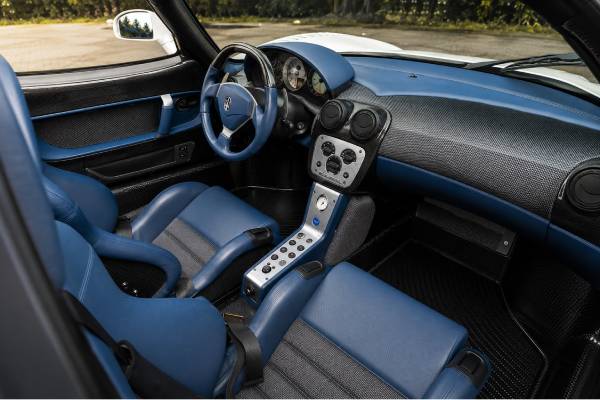
The interior mixes exposed carbon fiber, blue leather, perforated surfaces, and a soft silver material often called Brightex. A traditional Maserati oval clock sits in the center, providing an unusual visual link between the company’s luxury road cars and this competition-focused machine.
The driving position is more accommodating than the exterior dimensions suggest. Taller drivers can fit, and forward visibility is relatively good because of the broad windshield and visible front-fender shapes. Rearward visibility is extremely poor.
Practicality is minimal:
- The removable roof cannot be conveniently stored inside the car.
- There is no useful conventional luggage compartment.
- The cabin provides little everyday storage.
- The original specification lacks ordinary infotainment.
- The wide body complicates parking and narrow-road driving.
- The low nose requires constant attention even with the lift system.
These are not accidental omissions. They reflect the priority given to structure, airflow, cooling, and competition-derived packaging.
The result is visually unmistakable. Even among limited-production supercars, the MC12 looks like a racing machine that has been granted permission to use public roads rather than a road car dressed for the track.
Road and Track Driving Character
The MC12 feels fast, stable, and surprisingly progressive when driven with mechanical sympathy, but its size, limited visibility, and early-generation automated transmission demand concentration. It is most convincing on open roads and circuits where its aerodynamic stability and V12 power can work properly.
Throttle response is immediate because there are no turbochargers or electric motors between the pedal and the naturally aspirated engine. At lower speeds, the V12 is tractable but mechanically busy. As the revs rise, it becomes smoother, louder, and dramatically more urgent.
The sound experienced inside the cabin differs from the cleaner exhaust note heard outside. The structural tub, firewall, intake system, gears, pumps, and drivetrain produce layers of mechanical noise. It feels closer to an endurance racer than to a polished modern grand tourer.
The transmission needs a deliberate driving style. At parking speeds it may feel abrupt, particularly when reversing or creeping uphill. Holding the car on the throttle can overheat and wear the dry clutch. The better technique is to create space, move decisively, and avoid prolonged clutch slip.
During normal upshifts, a small lift of the accelerator can smooth the engagement. At high throttle openings, the shift produces a pronounced break in acceleration. This interruption is part of the car’s character, but shifting while heavily loaded in a corner can disturb the chassis.
Steering is direct and communicative without constantly kicking back through the wheel. The front end responds cleanly, and the visible fender shapes help the driver place the car. The greatest obstacle is psychological: the MC12 initially feels enormous.
That sense of width reduces as speed rises and the driver learns where the corners sit. The long body then becomes an advantage. High-speed stability is exceptional, and the car holds a chosen line with little body movement.
The rear-biased weight distribution means the driver must respect throttle application, surface condition, and tire temperature. The chassis is progressive by period-supercar standards, but 652 Nm sent through two rear tires can still overwhelm available grip.
Sport mode provides the default road setting. Race mode sharpens the car and allows more slip before the traction-control system intervenes. The MC12 predates the large menus of configurable launch, powertrain, brake, and stability settings found in modern hypercars. Driver judgment remains the main control system.
Braking and track use
The steel Brembo brakes provide strong initial response and substantial stopping force. They are well suited to road use, but pad choice matters during repeated high-energy stops. Road-oriented pads may overheat under sustained circuit work, while aggressive track pads can be noisy and less effective when cold.
A track inspection should include:
- Disc thickness, heat checking, cracking, and surface condition
- Pad compound, remaining material, and evidence of uneven transfer
- Brake-fluid age and boiling point
- Caliper seals, pistons, hoses, and mounting hardware
- Wheel-bearing play and center-lock condition
- Tire age, heat cycles, pressures, and sidewall condition
The MC12 is not a casual track-day car. Its performance, value, width, parts scarcity, and stopping speeds demand professional preparation. On the correct circuit, however, the car makes sense in a way it rarely can on public roads.
Road usability
Ride quality is firmer than a grand tourer’s but not brutally harsh. The greater concerns are access, visibility, road width, ground clearance, turning space, and clutch management.
City traffic exposes every compromise. Open highways reveal the car’s stability, although road noise and limited rear vision remain tiring. Fast mountain roads can be rewarding when they are wide and predictable, but narrow lanes and blind corners leave little margin.
The MC12 therefore works best as a destination car: driven on carefully chosen routes, supported by planning, and given enough space to reach operating temperature before being exercised.
Service, Aging, and Ownership Risks
An MC12 should be treated as an aging competition-derived exotic, not as a low-mileage modern car that needs only routine oil changes. The greatest risks come from long storage, deferred specialist work, obsolete components, hidden damage, and systems that have aged without accumulating many kilometers.
There is no meaningful mass-market reliability rating for a 50-car homologation special. Each example must be assessed individually through records, diagnostic data, physical inspection, fluid analysis, and a controlled road test.
Engine and cooling system
The V12 is a sophisticated dry-sump engine surrounded by tightly packaged cooling, intake, fuel, and electrical systems. Inspection should cover:
- Cold-start oil-pressure behavior
- Smoke, misfires, abnormal mechanical noise, and warning lights
- Stable coolant temperature during road and stationary operation
- Radiator condition and unobstructed cooling ducts
- Coolant hoses, dry-sump lines, seals, and unions
- Evidence of leaks around the engine, reservoirs, and heat shields
- Fuel hoses, pump operation, injectors, and stale-fuel contamination
- Exhaust manifolds, joints, catalysts, and mounting brackets
- Engine mounts and heat-related deterioration
A car that starts cleanly when cold may still reveal problems after a full heat cycle. The inspection must include a hot restart, cooling-fan operation, and a check for fluid loss after shutdown.
Old fuel is a particular concern in rarely used cars. Deposits can affect pumps and injectors, while deteriorated hoses or seals create safety risks. A storage history should explain how the fuel system was managed, not merely state that the engine was started occasionally.
CambioCorsa gearbox and clutch
The transmission’s condition cannot be judged from mileage alone. Clutch wear depends heavily on maneuvering, hill starts, traffic, driver technique, software setup, and hydraulic-system health.
A specialist should use compatible diagnostic equipment to examine clutch-wear estimates, engagement parameters, stored faults, hydraulic pressure behavior, actuator performance, and gear-selection consistency.
Warning signs include:
- Excessive slipping or shuddering during takeoff
- Slow engagement of first or reverse
- Missed shifts or unexpected neutral selection
- Hydraulic-pump operation that is unusually frequent
- Warning messages after the car becomes hot
- Harsh changes that remain abnormal after adapting driving technique
- Evidence of repeated adjustment without an underlying repair
A clutch replacement can become more than a friction-disc job. Access labor, flywheel condition, release components, sensors, hydraulic parts, seals, and calibration may all add cost.
Suspension, lift system, and steering
The hydraulic nose lift must raise and lower the car evenly, hold its position as designed, and return without fluid leakage or warning messages. Aging hoses, seals, valves, accumulators, or pumps can turn an occasional convenience fault into a larger repair.
Pushrod suspension components, dampers, bushings, ball joints, bearings, and mounting points should be inspected for play, corrosion, leakage, and deterioration. Low mileage does not prevent rubber and seal aging.
Alignment is equally important. Incorrect ride height or geometry can make the car nervous, damage expensive tires, and conceal previous impact repair.
Brakes, wheels, and tires
The MC12’s steel discs avoid some of the uncertainty associated with early carbon-ceramic rotors, but replacement parts are still specialized. Check the discs for cracks, heavy ridges, heat damage, and minimum thickness.
Center-lock wheels require correct procedures, tools, torque values, thread condition, and locking direction. Damage caused by poor workshop practice can affect both safety and originality.
Tires should be evaluated by production date and storage conditions, not tread depth alone. An old tire can look unused while offering little grip. Correctly sized high-performance replacements may require advance sourcing, so availability should be confirmed before purchase.
Carbon structure, bodywork, and electrical systems
Any evidence of accident damage deserves a composite-structure assessment. Uneven panel gaps, mismatched paint texture, disturbed fasteners, replacement undertrays, altered suspension geometry, or unusual tire wear may justify deeper investigation.
Electrical concerns often begin with low battery voltage. The car should have a correct maintenance-charging routine, a healthy battery, clean grounds, and stable system voltage before diagnosing control modules or sensors.
Test every available function, including:
- Instrument display and warning lamps
- Exterior lighting
- Cooling fans
- Air conditioning
- Door, window, and mirror controls
- Nose-lift operation
- Transmission modes and paddle inputs
- Alarm, immobilizer, keys, and remote functions
Parts availability is one of the largest ownership risks. Some mechanical items may share engineering ancestry with other Ferrari-Maserati products, but MC12-specific body, trim, aerodynamic, glass, and mounting components are exceptionally scarce. Repairs may require factory assistance, specialist rebuilding, or carefully documented fabrication.
A sensible maintenance program is calendar-based as well as mileage-based. Fluids, tires, seals, hoses, batteries, and braking components continue to age while the odometer remains still.
MC12 Stradale Buyer Checklist
The best MC12 is the car with the clearest identity, soundest structure, strongest specialist history, and most complete documentation—not automatically the one with the lowest mileage or brightest paint.
A normal pre-purchase inspection is not enough. The evaluation team should understand carbon-composite structures, Ferrari-Maserati V12 powertrains, electrohydraulic transmissions, high-value provenance research, and the legal requirements of the country where the car will be registered.
| Area | What to verify | Why it matters |
|---|---|---|
| Identity | Chassis numbers, build data, ownership records, registration history | Confirms the car is an original Stradale with a traceable history |
| Structure | Carbon tub, aluminum subframes, suspension pickups, floor and impact history | Hidden composite damage can be difficult and expensive to repair correctly |
| Bodywork | Original panels, paint, aerodynamic parts, splitter, wing and diffuser | MC12-specific exterior components are scarce and important to value |
| Engine | Cold start, hot restart, fluid pressure, temperatures, leaks and diagnostic faults | Identifies storage-related deterioration and major mechanical risk |
| Transmission | Clutch data, hydraulic pressure, actuator condition and shift quality | Repair cost can extend far beyond a simple clutch replacement |
| Suspension | Lift system, dampers, joints, alignment and ride height | Faults affect usability, tire life and handling safety |
| Brakes and tires | Disc condition, pad type, fluid age, tire dates and center-lock hardware | Condition directly affects safe operation at the car’s performance level |
| Completeness | Roof equipment, manuals, keys, tools, covers and delivery accessories | Missing original items can be extremely difficult to replace |
| Legal status | Title, taxes, import approval, emissions requirements and road registration | A legitimate car in one country may be difficult to register in another |
Documents to request
Ask for the complete file before arranging transport or committing funds:
- Factory or historical build confirmation
- Original sales and delivery documents
- Ownership and registration history
- Import and export paperwork
- Service invoices rather than stamped summaries alone
- Diagnostic reports and clutch readings
- Accident, paint, and structural-repair disclosures
- Tire and battery replacement dates
- Photographs documenting previous mechanical work
- Records for any non-original components or reversible modifications
A long gap in service history should trigger investigation. It does not prove neglect, but the seller should be able to explain where the car was stored, who maintained it, how often it was driven, and what recommissioning work followed extended inactivity.
How to approach the road test
The road test should begin with the engine fully cold. Observe starting behavior, smoke, warning lights, fluid pressure, exhaust note, and idle quality before moving the car.
Drive gently until temperatures stabilize. Test first and reverse engagement, low-speed clutch behavior, manual shifts, automatic functions where fitted, Sport and Race responses, steering, brakes, air conditioning, and the front-lift system.
After the drive, perform another visual inspection. Check for fresh leaks, fluid smells, abnormal heat, tire contact, brake discoloration, warning codes, and cooling-system behavior.
Do not treat a short demonstration around a dealer’s building as proof of condition. The car must reach full operating temperature and complete enough varied driving to expose hot-start, hydraulic, cooling, braking, and transmission problems.
Choosing between originality and usability
A fully untouched car may be desirable, but age-expired safety components should not remain in service simply to protect originality. Tires, fluids, flexible hoses, seals, batteries, brake parts, and other consumables must be renewed when condition demands it.
The strongest approach is reversible, documented maintenance using correct or approved parts. Keep every removed original component, record part numbers, photograph the work, and avoid unnecessary cosmetic modernization.
Non-original exhausts, suspension changes, upgraded pads, protective film, or modern charging equipment are not automatically disqualifying. Their quality, reversibility, documentation, and effect on original components determine whether they help or harm the car.
Finally, budget beyond the purchase. Allow for transport, secure climate-controlled storage, insurance, taxes, specialist inspections, annual servicing, tire replacement, recommissioning, and unexpected component sourcing.
The MC12 rewards this level of care. It is not merely one of the rarest modern Maseratis; it is a direct road-going expression of a successful GT1 program. The right car should feel historically coherent, mechanically prepared, and ready to operate—not simply ready to be displayed.
References
- MC12 Stradale | Klassische Autos | Maserati DE 2026 (Manufacturer Heritage Page)
- Is it time the Maserati MC12 emerged from its sibling’s shadow? | Classic & Sports Car 2021 (Technical Feature and Road Test)
- Maserati MC12 2005 (First Drive)
Disclaimer
This article is provided for informational purposes and is not a substitute for professional diagnosis, inspection, maintenance, or repair. Specifications, torque values, service intervals, components, and procedures may vary by VIN, market, production date, and equipment. Always verify technical work against the vehicle’s official service documentation and consult a qualified MC12 specialist.
Please consider sharing this article on Facebook, X/Twitter, or another enthusiast platform to support our work.