
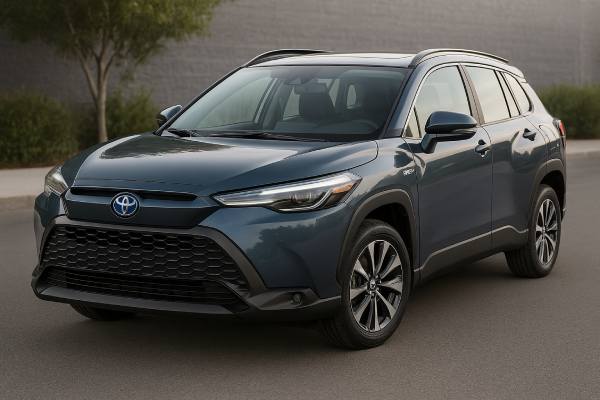
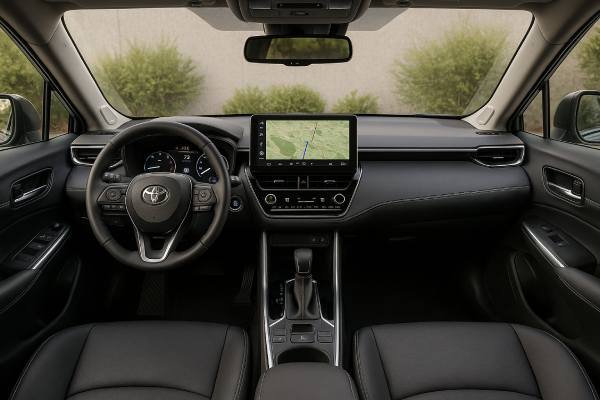
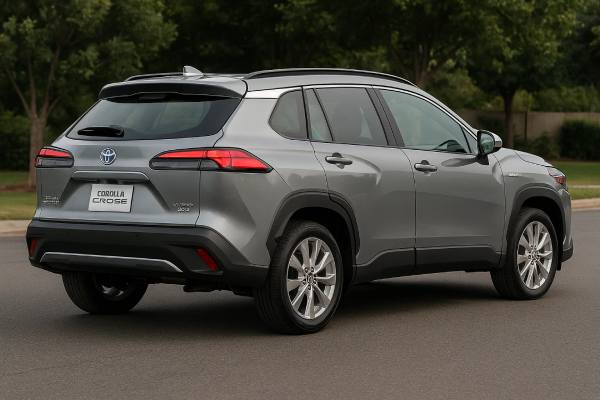
The 2025 facelift of the Corolla Cross Hybrid with Electronic On-Demand AWD (MXGH15) refines Toyota’s efficient TNGA-based small SUV with quieter cabin tuning, updated driver-assistance, and a cleaner interface, while keeping the fifth-generation hybrid system that owners value for real-world economy. Under the hood is the M20A-FXS 2.0-liter Atkinson-cycle four teamed with front and rear electric motors, a compact lithium-ion battery, and an eCVT. Total system output is 196 hp, and the rear axle is driven when the system predicts or detects slip, adding traction without a driveshaft or center differential. The ride is settled for daily commuting, the cabin packaging is practical for a young family, and the hybrid’s low running costs are compelling. This guide focuses on the North American model years from 2025 onward and covers specifications, maintenance, reliability signals, performance and efficiency, and how the Corolla Cross Hybrid AWD stacks up in a crowded subcompact SUV field.
Fast Facts
- Confident traction from Electronic On-Demand AWD with independent rear e-motor; no driveshaft adds efficiency.
- Real-world economy typically near 40–45 mpg US (5.2–6.0 L/100 km) in mixed driving when driven smoothly.
- Cabin is roomy for the class with straightforward controls and Toyota Safety Sense standard across trims.
- Watch for software updates (brake/ADAS) and keep tires matched; AWD calibration is sensitive to uneven wear.
- Oil service every 10,000 miles/12 months (0W-16), with tire rotation at 5,000 miles/6 months.
What’s inside
- Corolla Cross Hybrid AWD overview
- Corolla Cross Hybrid AWD specs
- Corolla Cross trims and safety tech
- Reliability and known issues
- Maintenance and buyer’s guide
- Driving impressions and efficiency
- How it compares to rivals
Corolla Cross Hybrid AWD overview
Toyota positioned the Corolla Cross Hybrid AWD to give buyers compact-car operating costs with small-SUV versatility and all-weather traction. The MXGH15 is the all-wheel-drive hybrid derivative of the Corolla Cross family on Toyota’s TNGA-C platform. It pairs the M20A-FXS 2.0-liter Atkinson-cycle four-cylinder with an electric front drive motor (in the transaxle) and a separate rear axle motor. There is no mechanical connection between the axles; software blends torque from the gasoline engine and both motors depending on speed, throttle, and road surface. The system’s compact lithium-ion battery sits beneath the rear seat to preserve cargo space.
The 2025 facelift focuses on refinement: quieter road noise treatment, updated infotainment with seamless smartphone integration, and incremental improvements to Toyota Safety Sense. Exterior changes are subtle—revised lighting signatures and fascia tweaks—so running costs, traction, and space continue to carry the value story. With 196 hp on tap, performance is adequate rather than sporty; the payoff is high efficiency in both city commuting and suburban highway loops. Drivers coming from non-hybrid subcompacts will notice smoother low-speed drivability and fewer fuel stops, while owners in snowbelt regions get the confidence of on-demand rear-axle assist without the weight and parasitic losses of a conventional AWD system.
Inside, seating is upright with good sightlines. Adults fit in back more comfortably than in many hatchbacks, and the load bay has a square opening that takes strollers or camping gear easily. The hybrid’s rear motor slightly reshapes underfloor cargo packaging compared with front-drive versions, but the day-to-day practicality remains intact. Toyota’s parts availability and long hybrid experience also translate into predictable ownership costs, routine maintenance intervals, and wide dealer support. For shoppers who want a trouble-light daily driver with genuine winter traction and top-tier fuel economy, the Hybrid Electronic On-Demand AWD Corolla Cross is purpose-built.
Corolla Cross Hybrid AWD specs
Powertrain & Efficiency
| Item | Specification |
|---|---|
| Code | M20A-FXS (Dynamic Force) + dual electric motors |
| Engine layout & cylinders | Inline-4, DOHC, 16-valve; VVT-iE (intake) / VVT-i (exhaust) |
| Bore × stroke | 80.5 × 97.6 mm (3.17 × 3.84 in) |
| Displacement | 2.0 L (1,987 cc) |
| Induction | Naturally aspirated (Atkinson cycle) |
| Fuel system | Direct + Port injection |
| Compression ratio | ~14.0:1 |
| Max system power | 196 hp (146 kW) |
| Max engine torque* | ~188 Nm (139 lb-ft) |
| Electric motors (HEV) | PMSM; front transaxle drive motor + independent rear axle motor |
| Battery | Lithium-ion, under-rear-seat placement |
| Rated efficiency (EPA est.) | ~42 mpg US combined (5.6 L/100 km) |
| Real-world highway @ 120 km/h (75 mph) | ~6.7 L/100 km (35 mpg US / 42 mpg UK), typical owner reports |
| Aerodynamics | Cd ≈ 0.33 (class-typical) |
*Toyota does not publish combined torque for the hybrid system; engine torque shown for reference.
Transmission & Driveline
| Item | Specification |
|---|---|
| Transmission | eCVT (planetary-gear hybrid transaxle, P7xx family) |
| Drive type | Electronic On-Demand AWD (e-AWD): motorized rear axle, no prop shaft |
| Final drive / gear ratios | eCVT blended; fixed reduction gears (not driver-selectable) |
| Differential | Open (front), electronically controlled rear e-axle |
| Refuel to full | ~5 minutes at pump |
Chassis & Dimensions
| Item | Specification |
|---|---|
| Platform | TNGA-C |
| Suspension (front/rear) | MacPherson strut / Multi-link |
| Steering | Electric power steering; compact turning circle |
| Brakes | 4-wheel discs with electronic brake-by-wire and regenerative blend |
| Wheels/Tires | 215/65 R17 (LE); 225/50 R18 (SE/XSE, depending on package) |
| Ground clearance | ~206 mm (8.1 in) |
| Length / Width / Height | ~4,480 mm × 1,825 mm × 1,645 mm (176.4 × 71.9 × 64.8 in) |
| Wheelbase | 2,640 mm (103.9 in) |
| Turning circle (curb-to-curb) | ~10.8 m (35.4 ft) |
| Curb weight | ~1,600 kg (3,500 lb), trim-dependent |
| Fuel tank | ~40 L (10.6 US gal / 8.8 UK gal) |
| Cargo volume | ~600 L seats up (≈ 21–24 ft³) / ~1,750 L seats folded (method varies) |
Performance & Capability
| Item | Specification |
|---|---|
| 0–100 km/h (0–62 mph) | ~8.0–8.3 s (instrumented tests vary by tire/trim) |
| Top speed | ~180 km/h (112 mph) governor-limited |
| Braking distance | Class-typical; regenerative + friction blending |
| Towing capacity | Not rated for towing (North America) |
| Payload / Roof load | Typical subcompact SUV class figures; follow placard |
Fluids & Service Capacities
| System | Specification |
|---|---|
| Engine oil | Toyota Genuine 0W-16 (API SP / ILSAC GF-6B); ~4.5 L (4.8 US qt) with filter |
| Coolant (ICE/inverter)* | Toyota Super Long Life Coolant (Pink) 50/50 premix; long-life interval |
| Transaxle (HEV) | Toyota ATF WS; service only if conditions warrant or per severe use |
| A/C refrigerant | R-1234yf (low-GWP) |
| A/C compressor oil | ND-11 equivalent for electric compressors |
| Wheel lug torque | 103 Nm (76 lb-ft), typical Toyota spec |
*Hybrid loops may be shared/separate depending on calibration; follow under-hood labels.
Electrical
| Item | Specification |
|---|---|
| 12V battery | AGM/absorbed glass mat; maintenance check annually |
| Spark plug (ICE) | Iridium, long-life; gap ~0.8 mm (0.031 in) |
Safety & Driver Assistance
| Item | Specification |
|---|---|
| Crash ratings | Strong IIHS performance in prior years; 2025 results pending at time of writing |
| Headlights | LED; rating varies by trim/pack (projector vs. reflector) |
| ADAS suite | Toyota Safety Sense (TSS): Pre-Collision with pedestrian/cyclist detection, Lane Departure Alert, Lane Tracing Assist, Full-Speed Adaptive Cruise, Road Sign Assist, Proactive Driving Assist; blind-spot monitor and rear cross-traffic alert widely available |
Corolla Cross trims and safety tech
For North America, the hybrid AWD range typically centers on LE, SE, and XSE grades, with appearance and convenience packages layered on top. LE is the value anchor: 17-inch wheels, fabric seating, an 8-inch touchscreen with wireless smartphone integration, and Toyota Safety Sense standard. SE steps up to 18-inch wheels, sport-styled seats, paddle-style shifter toggles for engine-braking simulation, and additional body trim. XSE is the premium play with SofTex-trimmed seating, power driver’s seat, available JBL audio, and a full roster of convenience features (heated front seats, power liftgate depending on package). Nightshade-style appearance editions rotate in some years, pairing black badges and unique wheels with SE content.
Mechanical differences between trims are modest; suspension tuning and steering calibrations are shared, and the AWD hardware is identical. Wheel and tire packages—17s vs. 18s—have the most noticeable effect on ride/road noise. Larger wheels look sharp but transmit more impact harshness and slightly trim efficiency. If you live in a snowbelt, budget for a true winter tire set (the AWD system excels when paired with proper rubber).
Toyota Safety Sense is standard across the board and grows more capable with each software revision. Key features include Pre-Collision System (vehicle, pedestrian, cyclist), Lane Departure Alert with steering assist, Lane Tracing Assist that centers the car within the lane while adaptive cruise is active, Road Sign Assist, and Proactive Driving Assist to gently adjust speed and following distances in everyday traffic. Blind Spot Monitor and Rear Cross-Traffic Alert are widely available and standard on upper trims. When windshield glass or forward-facing cameras are replaced, plan on ADAS recalibration at a qualified shop; alignment checks and correct ride height are prerequisites for accurate camera/radar performance.
Safety ratings have been favorable. The Corolla Cross has scored well in IIHS testing in previous model years, with ratings varying by headlight package and incremental test changes. Side-impact and updated moderate overlap protocols are stricter beginning in 2023–2024; vehicles may gain or lose “Top Safety Pick” depending on headlights and seatbelt reminders. For child seats, lower anchors (LATCH) are easy to reach on the outboard rear seats, and there’s adequate fore-aft space for rear-facing seats with the front passenger seat in a mid-track position. Every grade includes eight or more airbags (front, side, curtain, and often a front-center unit), stability control with traction logic, and antilock brakes with electronic brake-force distribution. Keep tires matched in brand, size, and tread depth; the e-AWD logic monitors speed deltas and works best with evenly worn tires.
Reliability and known issues
Toyota’s fifth-generation hybrid hardware is proven, and the M20A-FXS engine family has a solid service record when maintained with the correct 0W-16 oil. Most owners experience little beyond routine wear items, but the following patterns are worth noting:
Common / low severity (maintenance-level)
- 12V battery fatigue (3–5 years): Short-trip city use and heavy accessory loads can age the small AGM battery early. Symptom: slow crank, intermittent warnings on cold mornings. Remedy: load test annually; replace proactively before winter.
- Brake pad corrosion and glazing: Hybrids rely on regenerative braking, so friction brakes may see less heat. Symptom: light surface rust ridges, low-speed squeal after storage. Remedy: periodic spirited stops to clean rotors; inspect sliders; service pads/rotors as needed.
- Windshield ADAS camera alignment after glass work: Symptom: lane-keeping or pre-collision warnings post-replacement. Remedy: perform static/dynamic calibration with proper targets; verify alignment and tire size pressures.
Occasional / medium severity
- Software updates (brake/ADAS/hybrid ECU): Toyota periodically issues calibrations that improve brake feel transitions between regenerative and friction braking, refine adaptive cruise logic, or address specific DTCs. Remedy: ensure ECU/TCU/ADAS software is current at service visits; many updates are applied during routine warranty care.
- Noises from rear e-axle (rare): A faint whirring can be normal under light load; abnormal growl at steady speeds may indicate bearing wear. Remedy: dealer inspection; replacement under powertrain warranty if out of spec.
Rare / higher severity
- Cooling system leaks at hoses or inverter fittings: Symptom: pink residue (coolant dye), low reservoir level, or inverter temperature warnings under load. Remedy: pressure test; replace affected hoses/clamps; bleed per hybrid coolant procedure.
- Hybrid battery fault codes: Uncommon on this generation at low mileage; typically linked to connector/corrosion issues or damage. Remedy: warranty diagnosis; module/battery service as directed by Toyota.
Recalls / service actions
Toyota has issued safety recalls and campaigns on some recent Corolla Cross Hybrid model years related to brake software and other calibrations. Always run the VIN on the official recall portal and confirm dealer records before purchase. After any recall involving the brake system or ADAS sensors, verify proper pedal feel, straight-line stops on a safe road, and correct function of adaptive cruise and lane tracing.
Pre-purchase checklist
- Full maintenance history with oil changes at 10k miles/12 months using 0W-16.
- Proof of recall/TSB completion and ECU software updates.
- Even tire wear and matched sets (important for AWD logic).
- Brake service records (slider pins, pad lubrication).
- Cabin and engine air filters, coolant changes on schedule.
- Scan for stored/pending DTCs; verify ADAS calibration status after glass or bumper repairs.
Maintenance and buyer’s guide
A simple, consistent service rhythm keeps hybrid ownership easy and affordable. The intervals below reflect typical North American guidance; always confirm against your vehicle’s maintenance schedule by VIN.
Core intervals
- Engine oil & filter: Every 10,000 miles / 12 months (0W-16, API SP / ILSAC GF-6B). Severe service (short trips, extreme cold/heat): 5,000 miles / 6 months.
- Tire rotation & inspection: 5,000 miles / 6 months. Keep pressures at placard values; AWD logic prefers matched tread depth.
- Cabin air filter: Inspect 15,000 miles / 12 months; replace 15–30k miles depending on environment.
- Engine air filter: Inspect 15k; replace 30–45k miles or sooner in dusty areas.
- Brake fluid: Test annually; replace every 3 years regardless of mileage.
- Coolant (engine/inverter): First replacement typically at 100,000 miles / 10 years, then 50,000 miles / 5 years thereafter.
- Spark plugs (iridium): 120,000 miles / 12 years.
- Hybrid system inspection: Visual checks for coolant leaks, harness routing, and under-floor shielding at every service.
- 12V battery test: Annually after year 3; typical replacement window 3–5 years.
- Alignment check: Annually or after impacts/tire changes; preserves ADAS calibration geometry.
Fluids and specs (at a glance)
- Oil: Toyota 0W-16 (4.5 L / 4.8 qt with filter).
- Coolant: Toyota SLLC (Pink), premixed 50/50.
- Transaxle: Toyota ATF WS (service “as needed” unless severe duty).
- A/C: R-1234yf; ND-11 compressor oil.
- Wheel lug torque: 103 Nm (76 lb-ft).
DIY notes
- Use proper insulated tools and follow Toyota’s HEV disable procedures before any work near orange-sheathed cables.
- Coolant bleeding requires the hybrid system’s dedicated procedure to avoid air pockets in the inverter loop.
- After windshield or radar service, ADAS recalibration is mandatory; a merged alignment + calibration appointment saves time.
Buyer’s guide: what to look for
- Best value trims: LE for budget/efficiency; XSE if you want heated seats, power driver’s seat, and nicer interior without sacrificing mpg.
- Avoidance criteria: None specific, but skip cars with mismatched tires, unresolved warning lights, or missing recall proof.
- Reconditioning plan: Fresh cabin/engine filters, oil service, brake service (pad/slider clean), 12V battery test, and ADAS calibration verification.
- Durability outlook: With routine service, expect 200k-plus miles from the hybrid system; Toyota’s hybrid components historically age gracefully if coolant and software are kept current.
Driving impressions and efficiency
On the road, the Corolla Cross Hybrid AWD drives like a calmer, roomier Corolla hatch with a taller seating position. The steering is light at parking speeds and gains reassuring weight on the highway. Straight-line tracking is secure, and crosswind stability is better than you might expect for a short-wheelbase SUV. Ride quality is composed on 17-inch tires; 18s sharpen initial turn-in but pass more impact texture into the cabin. Toyota’s brake-by-wire tuning is among the smoother hybrid implementations: everyday stops blend regeneration and friction with predictable pedal effort. Under hard braking, the SUV remains straight and controlled.
Power delivery is linear, with an eCVT that keeps the engine in its efficiency band. In routine driving the rear e-motor engages seamlessly when you pull away on slick surfaces or when the front tires start to slip, and it disengages again to save fuel. Passing performance from 50–80 mph (80–130 km/h) is acceptable; plan downshift-like throttle for confident merges on short on-ramps. Noise, vibration, and harshness are low for the class; the 2025 updates further quiet road roar on coarse asphalt.
Real-world economy is the headline. In mixed suburban use, many owners report 40–45 mpg US (5.2–6.0 L/100 km) with no special techniques. In steady 65–75 mph highway cruising, expect ~35–40 mpg US (6.0–6.7 L/100 km) depending on wind, grade, and wheel/tire choice. Cold weather narrows the gap versus EPA ratings; preheating and seat heaters help reduce defrost loads. City efficiency remains strong thanks to frequent engine shutoff and regenerative braking. With loads aboard, consumption rises modestly; unlike a turbo engine, the hybrid stays efficient under light-to-moderate throttle.
AWD behavior is transparent. There are no off-road low ranges or lockers, but the Electronic On-Demand AWD adds confidence on wet leaves, packed snow, and gravel. Stability control cuts early on all-season tires; switching to dedicated winter tires dramatically improves launch and stopping performance. The Corolla Cross Hybrid is not rated to tow in North America; carrying a full cabin of people and gear is its design brief, and it stays composed with a full cargo bay as long as tires are properly inflated.
How it compares to rivals
In the subcompact SUV space, the Corolla Cross Hybrid AWD’s closest cross-shop targets include the Kia Niro (hybrid), Subaru Crosstrek (AWD, non-hybrid), Mazda CX-30 (non-hybrid), Hyundai Kona (gas; hybrid availability varies by market), and Honda HR-V (non-hybrid in North America). Each offers a distinct trade-off:
- Kia Niro Hybrid (FWD): Superior mpg on paper in city cycles and a more wagon-like shape that maximizes cargo length, but no AWD in North America. If you live where winters are mild, it’s a compelling efficiency play; in snow country, Toyota’s e-AWD advantage is decisive.
- Subaru Crosstrek: Excellent ride/seat comfort and standard mechanical AWD with generous ground clearance. The Toyota counters with much better fuel economy and lower routine running costs; Subaru offers a more adventurous chassis with the 2.5-liter engine.
- Mazda CX-30: The driver’s choice with standout steering and available turbo power. It drinks more fuel and prefers premium when turbocharged. Corolla Cross wins on ownership cost and rear-seat practicality.
- Hyundai Kona: Tech-forward cabin and brisk turbo trims; hybrid versions are not widely offered in North America. The Corolla Cross Hybrid’s economy and Toyota resale typically offset Kona’s gadget count.
- Honda HR-V: Spacious, refined ride, and Honda reliability, but no hybrid option (NA) and slower acceleration. The Toyota’s mpg edge is significant over a typical 5-year cost-of-ownership horizon.
For shoppers who prioritize AWD + efficiency, the Corolla Cross Hybrid’s proposition is unusually clean: real traction when needed, compact exterior size, predictable maintenance, and class-leading fuel economy without plug-in complexity. Choose 17-inch wheels and a trim with the headlight package that scores best in safety testing, and you’ll have one of the most fuss-free daily drivers in the segment.
References
- Fuel Economy of the 2025 Toyota Corolla Cross 2025 (FuelEconomy.gov)
- 2024 Toyota Corolla Cross 4-door SUV 2024 (Safety Rating)
- 2026 Toyota Corolla Cross Adds Styling, Tech and Safety Features 2025 (Press Release)
- Corolla Cross HV Owner’s Manual 2024 (Owner’s Manual)
- NHTSA Vehicle Details: 2024 Toyota Corolla Cross Hybrid 2024 (Recall Database)
Disclaimer
This guide is for informational purposes and is not a substitute for professional diagnosis, repair, or your vehicle’s official service documentation. Specifications, torque values, capacities, safety ratings, and service intervals can vary by VIN, model year, trim, market, and equipment. Always confirm procedures and values in the official owner’s manual, repair information, or a qualified service facility before performing any work. If you found this helpful, please consider sharing it on Facebook or X/Twitter to support xcar’s work.