
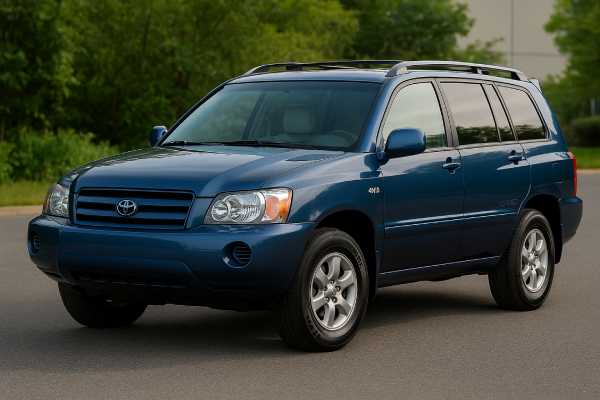
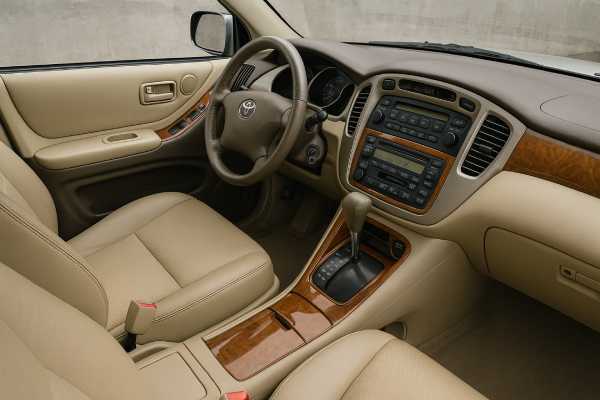
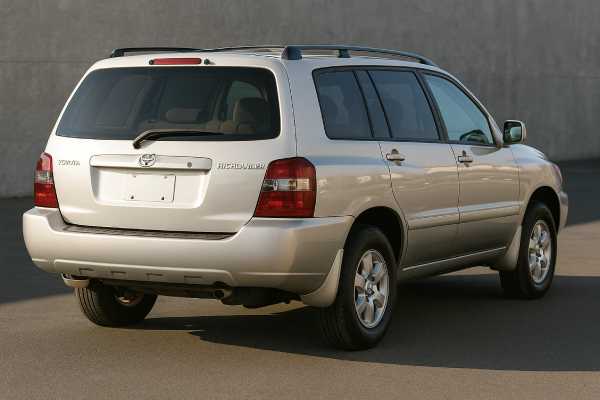
The first-generation Toyota Highlander with the 2.4-liter 2AZ-FE and full-time 4WD (chassis code ACU25) represents the practical, durable end of early-2000s crossovers. It pairs car-like manners with honest utility: a smooth DOHC four-cylinder, a simple 4-speed automatic, and a mechanical center differential with a viscous coupling. Owners value its roomy cabin, low running costs, and track record for high mileage when serviced on time. While the 155-hp output is modest, gearing and torque delivery suit daily use, winter driving, and light towing. Compared with truck-based SUVs of its era, the Highlander rides quietly, steers predictably, and requires less upkeep. Key ownership considerations include cooling-system care, front suspension wear items, and monitoring for oil seepage as miles accrue. If you want a straightforward, long-lived family SUV with real all-weather traction, the ACU25 4WD four-cylinder is a smart, budget-friendly pick.
Fast Facts
- Proven longevity, straightforward 2AZ-FE with timing chain; easy parts availability.
- Full-time 4WD with viscous center coupling adds confident winter traction without driver input.
- Big cabin for footprint; fold-flat rear seats and low cargo floor improve daily usability.
- Watch cooling system: radiator, hoses, and thermostat as vehicles age; address leaks early.
- Typical oil and filter service every 5,000–7,500 miles (8,000–12,000 km) or 6–12 months, based on use.
What’s inside
- ACU25 4WD overview
- Highlander 2.4 4WD specs
- Highlander trims and safety
- Reliability and known issues
- Maintenance and buyer’s guide
- Driving and performance
- How it compares
ACU25 4WD overview
The ACU25 Highlander (model years 2001–2003 for the four-cylinder AWD/4WD) was one of the earliest crossovers to blend car-based construction with SUV practicality. It rides on a Camry-derived platform, so the structure is unibody, the suspension is fully independent, and the driving position is more upright than a sedan without the bulk of body-on-frame trucks. The 2AZ-FE 2.4-liter engine uses aluminum block and head construction, four valves per cylinder, variable valve timing on the intake side, and a maintenance-free timing chain. Power is sent through a 4-speed electronic automatic to a full-time 4WD system with an open center differential and a viscous limited-slip coupling that progressively locks when front or rear wheels slip. There is no low range; the calibration prioritizes all-weather stability and dry-road transparency over off-road rock crawling.
Inside, the Highlander emphasizes ease of use: big doors, generous glass area, low lift-over for cargo, and simple controls. Early models commonly seat five; a compact third row appeared later in the generation on certain configurations but was limited in space. The 2.4-liter’s output (155 hp, 221 Nm) is adequate for daily commuting and highway cruising, with the 4WD system adding peace of mind on wet, snowy, or gravelly surfaces. Factory tow ratings of up to 3,000 lb (braked, with the proper equipment and cooling) make it viable for small trailers or utility loads, though staying within tongue-weight and cooling-system limits is critical.
What set the Highlander apart in this period was its low overall ownership friction: long fluid intervals for the era, readily available parts, and a reputation for going well past 200,000 miles when basic maintenance is followed. For shoppers considering an older SUV, the ACU25 is compelling because it balances durability with fuel economy that’s respectable for a 4WD midsize crossover, plus crashworthiness that tested well for its time. The trade-offs are predictable: not quick, modest tow headroom compared with V6 trims, and age-related service items that should be planned into the budget (cooling, suspension bushings, brake hydraulics).
Highlander 2.4 4WD specs
Engine and performance (ICE-only)
| Item | Detail |
|---|---|
| Code | 2AZ-FE |
| Layout & cylinders | Inline-4, DOHC, 4 valves/cyl, VVT-i (intake) |
| Displacement | 2.4 L (2,362 cc) |
| Bore × stroke | 88.5 × 96.0 mm (3.48 × 3.78 in) |
| Compression ratio | ~9.6:1 |
| Induction & fuel | Naturally aspirated; multi-point electronic fuel injection |
| Max power | 155 hp (116 kW) @ ~5,600 rpm |
| Max torque | 221 Nm (163 lb-ft) @ ~4,000 rpm |
| Timing drive | Chain |
| Emissions/efficiency standard | LEV/ULEV era calibration (varies by state) |
| Rated economy (EPA, 2003 4WD 2.4) | 12.4 L/100 km (19 mpg US / 22 mpg UK combined); 13.8/10.7 L/100 km city/highway (17/22 mpg US) |
| Real-world highway @ 120 km/h (75 mph) | ~10.7–11.8 L/100 km (22–25 mpg US), weather/load dependent |
| Aerodynamics (Cd / A) | ~0.36–0.37 / frontal area ~2.6 m² (est., package-dependent) |
Transmission and driveline
| Item | Detail |
|---|---|
| Transmission | 4-speed automatic, electronically controlled |
| Typical code | U241F (AWD/4WD variant) |
| Gears (1st/2nd/3rd/4th/Rev) | ~3.94 / 2.20 / 1.41 / 1.02 / 3.15 (typical for U24x family) |
| Final drive ratio | ~2.928 (rear differential), front/transfer matched |
| Drive type | Full-time 4WD with open center differential and viscous limited-slip coupling |
| Differential(s) | Open front and rear; viscous coupling across center |
| Refuel to full (typical) | ~5 min (gasoline) |
Chassis and dimensions
| Item | Detail |
|---|---|
| Platform | Unibody, MacPherson struts front and rear |
| Steering | Power rack-and-pinion |
| Brakes | Front ventilated discs; rear drums or discs depending on trim/option; ABS standard |
| Wheels/Tires | 225/70 R16 common; 17-inch packages available later |
| Ground clearance | ~185 mm (7.3 in) |
| Length / Width / Height | ~4,690 mm / 1,825 mm / 1,685 mm (184.6 / 71.9 / 66.3 in) |
| Wheelbase | ~2,715 mm (106.9 in) |
| Turning circle (curb-to-curb) | ~11.0 m (36.1 ft) |
| Curb weight (AWD 2.4) | ~1,640–1,720 kg (3,615–3,790 lb), equipment-dependent |
| GVWR | ~2,200–2,300 kg (4,850–5,070 lb) |
| Fuel tank | ~72 L (19.0 US gal / 15.8 UK gal) |
| Cargo volume (SAE) | ~1,206 L seats up / ~2,247 L seats down (42.6 / 79.3 ft³) |
Performance and capability
| Metric | Value |
|---|---|
| 0–100 km/h (0–62 mph) | ~11.5–12.5 s (AWD 2.4) |
| Top speed (governed/typical) | ~180–190 km/h (112–118 mph) |
| 100–0 km/h (62–0 mph) braking | ~39–43 m (128–141 ft), tire-condition dependent |
| Towing (braked) | Up to ~1,360 kg (3,000 lb) with equipment |
| Payload | ~410–520 kg (900–1,150 lb), configuration-dependent |
| Roof load | ~68–75 kg (150–165 lb) including rack hardware |
Fluids and service capacities
| System | Specification | Approx. capacity |
|---|---|---|
| Engine oil | API SJ/SL 5W-30; later SN acceptable | ~4.1–4.5 L (4.3–4.8 qt) with filter |
| Engine coolant | Ethylene-glycol long-life (red/pink); 50/50 premix | ~6.5–7.5 L (6.9–7.9 qt) total fill |
| Automatic transmission | Toyota ATF Type T-IV | ~7.6–8.2 L (8.0–8.7 qt) total; 3–4 L (3–4 qt) drain/fill |
| Rear differential | 75W-90 GL-5 | ~0.9–1.1 L (0.95–1.2 qt) |
| Transfer case | ATF Type T-IV | ~0.9–1.1 L (0.95–1.2 qt) |
| A/C refrigerant | R-134a | ~500–600 g (17.6–21.2 oz) |
| A/C compressor oil | ND-8 (PAG46) | ~120–150 mL (4.1–5.1 fl oz) |
| Key torque values | Wheel lugs ~103 Nm (76 lb-ft); spark plugs ~18 Nm (13 lb-ft) |
Electrical
| Item | Detail |
|---|---|
| Alternator | ~80–100 A depending on equipment |
| 12V battery | Group 35/24F common; 550–650 CCA typical |
| Spark plugs | Long-life iridium (e.g., SK20R11/IFR6T11); gap ~1.0–1.1 mm (0.039–0.043 in) |
Safety and driver assistance
| Item | Detail |
|---|---|
| Crash ratings | Moderate-overlap frontal test: Good (applies 2001–2007) |
| Head restraints/seats | Good/Adequate depending on seat/headrest generation |
| Airbags | Dual front; side airbags optional in period; curtain airbags introduced later in generation |
| ABS/traction | 4-channel ABS; traction control on some trims; stability control appeared mid-generation on select models |
| Child-seat provisions | Lower anchors and tether anchors (LATCH) on second row |
Notes: Figures vary by model year, trim, equipment, and market compliance. Always verify by VIN/build plate and official documentation.
Highlander trims and safety
Trims and options (2001–2003, four-cylinder focus)
- Base: Cloth seats, manual HVAC, power windows/locks, 16-inch wheels, ABS, keyless entry on many units. Some early 4WD four-cylinders have rear drum brakes; many later builds use rear discs.
- Limited (availability varies with 2.4 vs. V6): Leather, power driver seat, upgraded audio, alloy wheel designs, optional sunroof, and convenience packages. Many Limited units are V6; four-cylinder Limiteds exist in smaller numbers in some regions.
Option packages and identifiers
- Cold-weather pack (heated mirrors, wiper de-icer).
- Towing prep (trans cooler, wiring pigtail on certain builds; confirm equipment).
- Side airbags optional in early years—check the seat airbag tag and airbag indicator.
- Quick tells for AWD: rear differential housing, prop shaft, “4WD” badging (varies by year), and the absence of a 2WD “TRAC OFF” switch on some configurations (calibration differs by model year).
- VIN/build codes: ACU25 denotes 2.4-liter with 4WD; ACU20 denotes 2.4-liter FWD.
Year-to-year highlights (2001–2003)
- 2001 launch: 2.4 I-4 and optional 3.0 V6; full-time 4WD system with viscous center coupling; ABS standard.
- 2002: Incremental feature availability; audio and minor trim updates.
- 2003: Broader availability of curtain/side airbags and rear disc brakes depending on package; tire pressure placard and maintenance messaging updates; EPA economy labeling unchanged for the I-4 AWD.
Safety ratings (period context)
- Crash test performance: The Highlander earned a Good rating in the IIHS moderate-overlap frontal test using a 4WD 2001 test vehicle, with ratings applying through 2007. Side and small-overlap tests were introduced later industry-wide, so many early models lack official ratings in those modes.
- Child-seat and restraints: LATCH anchorages are present on the second row; check for tether anchor covers on the seatbacks.
- ADAS: Advanced active safety (AEB/ACC/LKA) predates this generation; buyers should not expect modern driver-assist suites. ABS is standard; traction control and later stability control appear on some configurations as the generation progressed.
Calibration implications after service
- Airbag/SRS: If seats are removed or airbags replaced, ensure squib connectors and spiral cable are re-latched and codes cleared with the correct scan tool.
- Wheel-speed sensors/ABS: Rust scale at the sensor seat or tone ring cracks can trigger ABS lights after brake or bearing work; clean mounting faces and verify sensor air-gap.
- Alignment: Strut service alters camber/caster; require a 4-wheel alignment afterward, especially on 4WD models to preserve stability under power.
Reliability and known issues
Overall outlook
When maintained on schedule, the ACU25 four-cylinder Highlander is among the more durable early-2000s midsize crossovers. Powertrain internals are robust; most age-related issues are ancillary (cooling, seals, mounts) or chassis consumables.
Common (low–medium cost)
- Cooling system aging → Symptoms: seepage at radiator end tanks, hose bulges, intermittent overheating at highway speeds. Root cause: plastic tank fatigue, old coolant. Remedy: radiator and hose replacement; thermostat and cap as needed; full coolant exchange and bleed.
- Front suspension wear → Clunks, wander, tire edge wear. Cause: strut mounts/bearings, control-arm bushings, stabilizer links. Fix: replace mounts/bushings/links; align.
- Engine oil seepage → Burnt-oil smell, damp valve cover area. Cause: valve cover gasket hardening; front crank seal misting at high mileage. Fix: reseal; verify PCV function.
- Exhaust heat-shield rattle → Buzzing at specific rpm. Cause: rusted shield tabs. Fix: replace fasteners or shields; do not remove shields near catalytic converters.
Occasional (medium cost)
- Motor mounts → Vibration at idle in gear. Cause: collapsed hydraulic mounts. Fix: replace front/right side mount; inspect torque mount.
- Wheel-bearing hum → Road-speed growl. Cause: bearing wear. Fix: hub/bearing assembly replacement; torque axle nuts to spec.
- HVAC blend door actuator → Clicking, temperature stuck. Fix: actuator gear/assembly replacement.
Rare or mileage-dependent (medium–high cost)
- Head gasket seep (very high miles/overheat history) → Coolant loss, hydrocarbon trace. Fix: machine/repair or long block; preventive: cooling maintenance and early overheat shutdown.
- Rear differential or viscous coupling noise → Whine or binding in tight turns. Cause: fluid neglect, mixed tire circumferences, internal wear. Fix: fluid service; matched tires; carrier repair if noisy.
Electrics
- Alternator output drop at high mileage → dim lights/charging light flicker; test under load.
- Door-lock actuators slow or intermittent; replace motor or latch assembly.
Recalls/service actions (2001–2003 Highlander)
- Airbag inflator campaigns applied to many early-2000s vehicles; verify by VIN.
- Periodic service bulletins covered shift feel (solenoid/valve-body), idle quality (ECU updates), and HVAC noise; ask for documentation of calibrations or TSB-guided repairs.
- Always confirm completion via the official VIN recall check and dealer records.
Pre-purchase checks
- Full fluid service history (engine oil intervals, coolant exchange dates, ATF/diff/transfer service).
- Cooling system: pressure test, check for crusting at radiator seams and water pump weep hole.
- Tires: all four same brand/size/tread depth to protect the viscous coupling.
- Underside: surface rust at subframe seams and exhaust flanges; verify prop-shaft joints/center support.
- Test drive: cold start, idle smoothness in gear, gentle and hard accelerations, lock-to-lock parking-lot turns for binding/noise, straight-line brake test for pulsation.
Maintenance and buyer’s guide
Practical maintenance schedule (time/distance—whichever comes first)
- Engine oil + filter: 5,000–7,500 mi / 6–12 mo; severe use at 5,000 mi. 5W-30 (synthetic acceptable).
- Engine air filter: Inspect 12 mo / 15,000 mi; replace 30,000–45,000 mi depending on environment.
- Cabin filter: 12 mo / 15,000–20,000 mi (more often in dusty or urban stop-and-go).
- Coolant: Toyota long-life; first exchange around 100,000 mi/10 years if original red; thereafter every 50,000 mi/5 years, or 5 years/80,000 km for pink SLLC patterns.
- Spark plugs (iridium): ~120,000 mi (190,000 km); inspect sooner if misfire counters rise.
- Fuel filter: In-tank strainer; replace only if pressure/volume issues or during pump service.
- Serpentine belt + hoses: Inspect every 12 mo; replace 90,000–120,000 mi or on condition.
- ATF (Type T-IV): Drain/fill 30,000–60,000 mi depending on heat/load; pan service with filter screen cleaning during valve-body work.
- Transfer case + rear diff: 30,000–60,000 mi, sooner for towing or mixed tire history.
- Brake fluid: Flush every 2–3 years; inspect caliper slide pins and hose integrity annually.
- Brakes: Pads/rotors on condition; check rear drums (if equipped) for shoe wear and wheel-cylinder seepage.
- Alignment + rotation: Rotate 5,000–7,500 mi; alignment annually or with any tire/suspension change.
- Valve lash: Hydraulic lifters—no periodic adjustment; investigate ticking only if persistent.
- 12V battery: Load test yearly after year 4; typical life 4–6 years depending on climate.
Fluid quick-reference (decisions at the counter)
- Oil: 5W-30, API current spec supersedes earlier SJ/SL; capacity ~4.3–4.8 qt with filter.
- ATF: Toyota T-IV only; avoid mixing with Dexron-III unless emergency; do not use WS on this vintage.
- Diff/transfer: 75W-90 GL-5 (diff); T-IV (transfer).
- Coolant: Toyota red/pink long-life; avoid silicate-heavy green universal unless fully flushed.
Buyer’s guide—what to look for
- One-owner or documented service history beats mileage alone.
- Even tire wear and matched sets; mismatches hint at diff stress.
- Dry underside: damp axle seals or ATF at the case seam suggests near-term reseal.
- Cooling-system freshness: new radiator/hoses on a 20-year-old trucklet is a good sign.
- Equipment fit: Many 4-cyl 4WDs are base-spec; if you want ABS+side airbags+rear discs, verify in person.
Durability outlook
Expect 200,000+ miles (320,000+ km) with routine maintenance, conservative warm-ups in winter, and timely fluid care for the transmission, transfer case, and rear differential.
Driving and performance
Ride, handling, and NVH
The ACU25 drives like a tall Camry: supple low-speed ride, composed body control on the highway, and light steering. The structure feels tight for its age when bushings and struts are fresh, and wind/road noise are modest on stock 16-inch tires. On broken pavement the tall sidewalls protect the cabin from sharp impacts better than many contemporaries. Under quick lane changes, the chassis responds predictably; stability control was not universal in these years, so good tires and alignment matter.
Powertrain character
The 2AZ-FE is tuned for midrange torque. Throttle response is linear, and the 4-speed automatic prefers early upshifts in gentle driving but kicks down promptly for passing. There’s no turbo lag to consider; instead, the limiting factor is total horsepower when fully loaded or at altitude. The 4WD viscous-coupling system works invisibly in normal conditions; in snow or on wet leaves you’ll feel the truck pull forward cleanly with less front wheelspin than a FWD. There’s no driver-selectable lock; traction is automatic and progressive.
Efficiency in the real world
Expect around 19 mpg US combined (12.4 L/100 km) for a healthy 2.4-liter 4WD Highlander on all-season tires, with 1–3 mpg swings based on temperature, tire compound, and roof-rack use. At a steady 65–75 mph (105–120 km/h), most owners report 22–25 mpg US (10.7–11.8 L/100 km). Winter blends and short trips can drop numbers into the mid-teens; well-maintained ignition and a fresh air filter help.
Key performance notes
- 0–60 mph is generally in the low-to-mid-11-second range with 4WD, stretching to ~12 seconds with cargo and grades.
- Braking feel is confident when rotors are true and slide pins are lubed; older hoses may add a spongy pedal—flush/replace as needed.
- Traction: Snow tires transform stopping and turning; the 4WD system helps you go but does not override physics under braking.
Towing and load
With the correct towing prep and fresh cooling system, the ACU25 can handle small trailers up to 3,000 lb (≈1,360 kg). Plan longer stopping distances, observe tongue-weight limits, and consider an auxiliary trans cooler for sustained mountain grades. Expect a 15–30% fuel-economy penalty when towing or carrying full roof loads.
How it compares
Versus Honda CR-V (2nd gen, AWD)
CR-V is lighter and more efficient but smaller inside, with a simpler dual-pump rear drive that engages only on slip. Highlander rides more quietly, has more tow headroom, and offers a third-row option later in the generation.
Versus Subaru Outback/Forester (AWD)
Subaru’s full-time AWD and boxer engines bring winter confidence and car-like efficiency. Highlander counters with a larger cabin, higher tow rating, and a simpler maintenance regimen (no timing belt on the 2AZ-FE).
Versus Ford Escape/Mazda Tribute (V6/AWD)
The Ford/Mazda pair feel quicker in V6 guise but age-related transmission concerns are more common. The Highlander’s 2.4 4WD is slower yet typically more durable and easier to keep on the road at high mileage.
Versus Nissan Xterra (body-on-frame 4×4)
Xterra is tougher off-road with low range and ladder-frame strength, but it rides rougher and drinks more fuel. The Highlander is the better daily and long-trip companion unless rock crawling is the mission.
Bottom line
If you want an early-2000s all-weather family hauler that prioritizes reliability, cabin space, and gentle running costs, the ACU25 four-cylinder 4WD Highlander remains one of the safest bets—provided you verify maintenance and cooling health.
References
- Gas Mileage of 2003 Toyota Highlander 2003 (EPA Fuel Economy)
- 2001 Toyota Highlander 2001 (Safety Rating)
- Vehicle Detail Search – 2001 TOYOTA HIGHLANDER | NHTSA 2001–2003 (Recall Database)
- 2001 – 2007 Toyota Highlander [First (1st) Generation] 2011 (Manufacturer Images/Archive)
Disclaimer
This article is for informational purposes and does not replace professional diagnosis or repair. Specifications, torque values, fluid capacities, and service intervals vary by VIN, model year, market, and equipment. Always verify against your vehicle’s official service documentation and labels before purchasing parts or performing maintenance.
If this guide helped, please consider sharing it with fellow owners on Facebook or X/Twitter to support xcar’s work—thank you.