
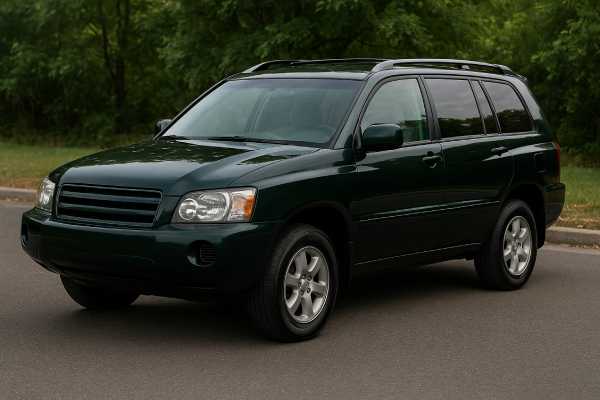
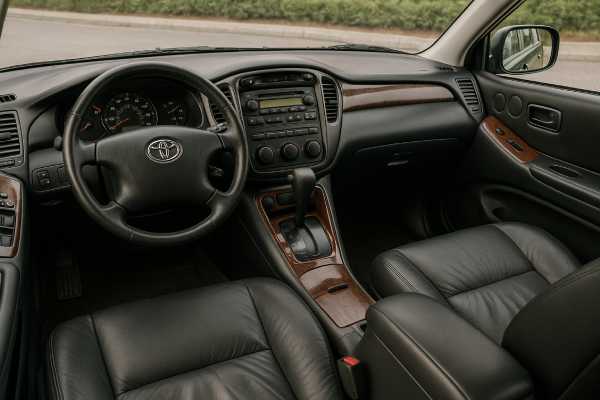
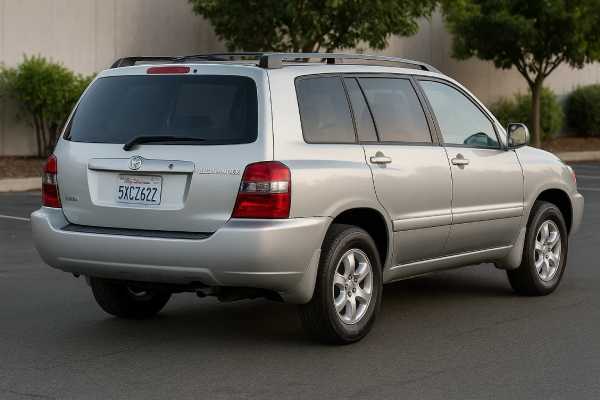
The first-generation Toyota Highlander in front-wheel-drive V6 form (MCU20) distilled minivan practicality, sedan manners, and SUV space into a single, dependable package. Its 1MZ-FE 3.0-liter V6 is smooth, quiet, and durable when serviced on time, while the unibody chassis and independent suspension deliver a relaxed, carlike ride. Inside, the cabin is straightforward and comfortable, with easy-fold rear seats and cargo space that suits family duty. Safety tech is basic by today’s standards, but structural performance in its era was strong. Owners value the model for low running costs, long service life, and parts availability. Shoppers should prioritize documented timing-belt service and cooling-system health; both are central to avoiding big-ticket repairs on the V6. If you want a midsize crossover that feels simple, robust, and unintimidating to maintain, the 2001–2003 Highlander V6 FWD remains a smart, people-first choice.
At a Glance
- Smooth, proven 1MZ-FE V6 (220 hp/164 kW) with relaxed highway manners.
- Spacious, flexible cargo area (≈1,089 L / 38.5 ft³ seats up; ≈2,304 L / 81.4 ft³ seats down).
- Straightforward maintenance; excellent parts support and repairability.
- Watch for overdue timing-belt/water-pump service; verify coolant and oil-leak history.
- Typical oil change: every 5,000–7,500 miles (8,000–12,000 km) or 6–12 months, based on usage and oil type.
Quick navigation
- MCU20 FWD overview
- Highlander 3.0 FWD specs
- MCU20 trims and safety
- Reliability and service actions
- Care schedule and buying tips
- On-road performance
- Rivals and alternatives
MCU20 FWD overview
The 2001–2003 Highlander V6 FWD (internal code MCU20) helped define the modern midsize crossover formula: a unibody platform with independent suspension on all four corners, a transversely mounted V6 paired to a 4-speed automatic, and a quiet, easygoing cabin focused on real-world usability. Compared with truck-based SUVs of its day, the Highlander rides softer, steers lighter, and feels more like a roomy Camry than a rugged 4×4—precisely why so many families gravitated to it.
Under the hood sits Toyota’s 1MZ-FE 3.0-liter DOHC V6 with VVT-i. Output is rated at 220 hp (164 kW) around 5,800 rpm and roughly 301 Nm (222 lb-ft) near 4,400 rpm. The engine’s character is classic Toyota V6: quiet idle, linear pull from low revs, and a relaxed, low-effort cruise at highway speeds. Aisin’s U140E 4-speed automatic is tuned for smoothness over sportiness; short gearing in lower ratios helps takeoff, while an overdrive fourth calms revs on the interstate.
Practicality is another core strength. With the second row folded, the cargo bay is long, flat, and square, making it easy to load strollers, bikes, or DIY supplies. The rear seat reclines and splits 60/40, and the low load floor is kinder to backs than many truck-based contemporaries. Cabin materials are durable rather than plush; switchgear is simple; outward visibility is excellent.
Safety reflects its era but was competitive when new: strong frontal crash performance, standard ABS, and widely available side airbags on later years. Advanced driver assistance (AEB, lane keep, etc.) was not yet common. Real-world ownership highlights include long service life with routine care, excellent parts availability, and broad independent-shop familiarity. The main caveats for shoppers are maintenance timing (belt-driven V6) and age-related wear items (suspension rubber, cooling system, and fluids). When those are in good order, the MCU20 remains a hardworking, confidence-inspiring daily.
Highlander 3.0 FWD specs
Below are focused, scannable tables for the 2001–2003 Highlander V6 FWD (MCU20) with the 1MZ-FE.
Engine and Performance (ICE)
| Item | Detail |
|---|---|
| Code | 1MZ-FE (VVT-i) |
| Layout & cylinders | Transverse V6 (60°), DOHC, 24 valves (4 per cyl) |
| Bore × stroke | 87.5 × 83.0 mm (3.44 × 3.27 in) |
| Displacement | 3.0 L (2,995 cc) |
| Induction | Naturally aspirated |
| Fuel system | Multi-port fuel injection (PFI) |
| Compression ratio | ≈10.5:1 |
| Max power | 220 hp (164 kW) @ ~5,800 rpm |
| Max torque | 301 Nm (222 lb-ft) @ ~4,400 rpm |
| Timing drive | Belt (to cams) |
| Emissions/Efficiency std. | U.S. EPA era standards (LEV) |
| EPA economy (typical) | ~13.1 L/100 km (18 mpg US / 21.6 mpg UK) combined; ~13.8/11.2 L/100 km city/hwy (17/21 mpg US) for 2003 V6 2WD |
| Real-world highway @ 120 km/h (75 mph) | ~10.7–11.8 L/100 km (20–22 mpg US / 24–26 mpg UK), load/tires/wind dependent |
| Aerodynamics | Cd ≈ 0.36–0.37 (period estimate) |
Transmission and Driveline
| Item | Detail |
|---|---|
| Transmission | Aisin U140E, 4-speed automatic (ECT) |
| Gear ratios | 1st 3.94; 2nd 2.19; 3rd 1.41; 4th 1.02 (overdrive); Rev 3.14 |
| Final drive | ~3.29 |
| Drive type | Front-wheel drive (FWD) |
| Differential | Open front (traction via brake-based control when equipped) |
| Refuel to full | ≈3–5 min (typical station) |
Chassis and Dimensions
| Item | Detail |
|---|---|
| Structure | Unibody |
| Suspension (front/rear) | MacPherson strut / MacPherson strut |
| Steering | Rack-and-pinion, power assist |
| Brakes (F/R) | Ventilated disc / solid disc; ABS standard |
| Wheels/Tires (typical) | 16×6.5 in rims; P225/70R16 all-season |
| Ground clearance | ~175 mm (6.9 in) |
| Length / Width / Height | ~4,686 / 1,826 / 1,677 mm (184.4 / 71.9 / 66.1 in) |
| Wheelbase | 2,715 mm (106.9 in) |
| Turning circle (curb-to-curb) | ≈11.4 m (37.4 ft) |
| Curb weight | ~1,685–1,730 kg (3,715–3,815 lb), equipment dependent |
| Fuel tank | ~75 L (19.8 US gal / 16.5 UK gal) |
| Cargo volume (seats up/down) | ≈1,089 / 2,304 L (38.5 / 81.4 ft³), SAE |
Performance and Capability
| Item | Detail |
|---|---|
| 0–100 km/h (0–62 mph) | ≈9.5–9.9 s (V6 FWD) |
| Top speed | ≈180 km/h (≈112 mph), electronically limited/gear limited |
| Braking 100–0 km/h (62–0 mph) | ≈41–44 m (135–145 ft), tire-condition dependent |
| Towing capacity | 907 kg (2,000 lb) standard; up to 1,588 kg (3,500 lb) with Tow Prep + hitch |
| Payload | ≈500–600 kg (1,100–1,325 lb), build dependent |
| Roof load | ≈68–75 kg (150–165 lb), crossbar/accessory dependent |
Fluids and Service Capacities
| System | Specification | Capacity (approx.) |
|---|---|---|
| Engine oil | API SJ/SL; SAE 5W-30 (0W-30/10W-30 per climate) | ~4.7–5.0 L (5.0–5.3 US qt) incl. filter |
| Coolant | Toyota Genuine Long Life (red), 50/50 mix | ~8.5–9.5 L (9.0–10.0 US qt) system total |
| Automatic transaxle (U140E) | Toyota ATF Type T-IV | ~6.8–7.2 L (7.2–7.6 US qt) total fill; ~3.0–4.0 L (3.2–4.2 qt) drain-and-fill |
| Differential/transfer | Integrated in transaxle (FWD) | — |
| A/C refrigerant | R-134a | ~500–600 g (18–21 oz) |
| A/C compressor oil | ND-OIL8 (PAG) | ~120–150 mL (4.1–5.1 fl oz) |
| Key torque values | Wheel lugs 103 Nm (76 lb-ft); oil drain ~39 Nm (29 lb-ft); spark plugs ~18 Nm (13 lb-ft) |
Electrical
| Item | Detail |
|---|---|
| Alternator output | ~100–120 A (equipment dependent) |
| 12V battery | Group 24F (common fit), ~55–65 Ah, ~550–650 CCA |
| Spark plugs | Long-life iridium (e.g., SK20R11); gap 1.1 mm (0.044 in) |
Safety and Driver Assistance
| Area | Detail |
|---|---|
| Crash ratings (period) | Strong frontal performance in moderate-overlap tests for 2001–2003 models; side ratings may depend on side-airbag fitment |
| Headlights | Halogen reflectors; aim and lens clarity affect real-world results |
| Passive systems | Dual front airbags; available front side-torso airbags; 3-point belts for all seats; LATCH anchors (rear outboard) |
| Active systems | ABS standard; traction control and Vehicle Skid Control (stability control) available on many V6 builds; brake assist/EBD fitted per package/year |
MCU20 trims and safety
Trims and options (North America, 2001–2003). The V6 FWD Highlander was typically offered in Base and Limited grades, with meaningful equipment steps and several option bundles:
- Base V6 FWD. Core features include ABS, air conditioning, cruise control, power windows/locks/mirrors, tilt steering, and 16-inch wheels. Common options: power driver’s seat, keyless entry, roof rack, and upgraded audio. Tow Prep (additional cooling, alternator output, pre-wiring) and privacy glass often appear on V6 builds.
- Limited V6 FWD. Adds leather seating (many), automatic climate control, alloy wheels, premium audio, power driver (and often passenger) seat, fog lamps, and cosmetic upgrades. Heated seats and side-torso airbags are frequent Limited options in later years.
- Wheel/tire packages. Most MCU20 V6 FWDs run P225/70R16. Period-accessory 17-inch alloys exist but were less common in 2001–2003.
- Seating. Five seats were standard; select markets and later builds offered a compact third row, but U.S. V6 models of these early years are most commonly five-seat.
Mechanical/functional differences by trim. With the V6, many Base models could be optioned to near-Limited spec, but Limited more often includes upgraded audio, automatic climate control, and cosmetic items. Towing equipment (prep vs full hitch), fog lights, and side-airbag presence are the easiest mechanical/functional differentiators to verify. VIN build sheets and door-jamb option stickers help confirm packages.
Year-to-year notes. Minor feature shuffles occurred across 2001–2003. Later models are more likely to have side airbags and traction/stability control. A 2004 refresh brought the 3.3-liter 3MZ-FE and 5-speed automatic, which are outside this article’s scope but relevant to shoppers cross-shopping early vs mid-cycle models.
Safety ratings and systems. Structurally, the first Highlander performed well in frontal moderate-overlap testing for its day. Side-impact outcomes vary based on whether a given vehicle has the optional side airbags; verify by inspecting the seat tags and the vehicle’s build sheet. LATCH anchors simplify child-seat installation. ABS is standard; brake assist and EBD were commonly packaged with ABS on higher-spec vehicles. Vehicle Skid Control (stability control) and traction control were widely available on V6 configurations, improving slippery-road confidence, though calibration and thresholds reflect early-2000s tech.
Calibration implications after service. If the vehicle has stability control, wheel-speed sensors, steering-angle sensors, and yaw sensors must be handled carefully during brake/suspension work. After alignments or steering-column repairs, a steering-angle reset (scan tool) may be required. If airbags or seat-belt pretensioners have been triggered or replaced, follow proper SRS initialization procedures and verify DTC-free status before delivery.
Quick identifiers. Base vs Limited are easiest to spot via wheel style, fog lamp presence, interior trim, and climate-control panel (manual vs automatic). On Limiteds, “Limited” exterior badging and leather are common tells. Lift the hood: a factory coolant reservoir sticker and fan-shroud labels can reveal Tow Prep. Inside, the audio head-unit codes and presence of side-airbag tags on front seatbacks help decode options.
Reliability and service actions
Overall reliability profile. The MCU20 V6 earns its reputation for longevity when serviced on time. The 1MZ-FE is smooth and durable; the Aisin 4-speed is conservative and robust. After two decades, age-related items (rubber, sensors, and coatings) matter more than inherent design flaws. Below is a prioritized map of what to check.
Common → rare issues (with cost/severity context).
- Timing belt overdue (common; medium–high). Toyota specifies a timing-belt service interval for the 1MZ-FE; best practice is to replace the belt, water pump, tensioner, and idlers together. Symptoms of overdue service are belt age beyond time/mileage, pump seepage, or noise. Remedy: renew full kit with quality parts; consider cam/crank seals if seeping.
- Water pump seep/leak (common; medium). Frequently discovered during timing-belt jobs. Catch early to avoid bearing failure and overheating.
- Valve cover gasket and cam seal seepage (common; low–medium). Look for oil weep at the rear bank; fix with new gaskets/seals and PCV inspection.
- PCV and oil-change neglect (occasional; medium). Extended intervals with conventional oil can increase varnish. Remedy: 5k–7.5k-mile oil changes, correct PCV function, and quality filters.
- Cooling system fatigue (common; low–medium). Radiators, hoses, thermostat, and cap age out. Use Toyota red long-life coolant, flush on schedule, and verify fans/relays.
- Ignition components (occasional; low–medium). Coil-on-plug boots and coils can fail with heat cycles; misfires under load are typical. Remedy: test coils, replace boots, use correct iridium plugs (SK20R11).
- A/F (air-fuel) and O2 sensors (occasional; low–medium). Aging sensors trigger efficiency and drivability codes. Quality OE-equivalent replacements restore fuel trims.
- U140E service neglect (occasional; medium). The transaxle appreciates periodic ATF drain-and-fills. Symptoms of neglected fluid include harsh cold shifts or flare. Remedy: staged drain-and-fills with Toyota T-IV; inspect mounts and throttle-body cleanliness.
- Front suspension wear (common; low–medium). Strut mounts/bearings, sway-bar links/bushings, and control-arm bushings are wear items. Listen for clunks over low-speed bumps.
- Wheel bearings (occasional; medium). Age and contamination can produce front-wheel hum; a press-in bearing with proper torque and alignment solves it.
- HVAC blend/actuator quirks (occasional; low). Stepper-motor actuators may click or stick; recalibration or replacement cures the noise.
Corrosion hotspots. Subframe attachment points, exhaust flanges, and rear brake backing plates (dust shields) can corrode in rust-belt use. Inspect brake hardlines and fuel-filler neck carefully; address surface rust before it grows.
Recalls, TSBs, and extended coverage highlights (2001–2003 relevance).
- Child Protection Lock (rear door) recall. Certain 2001–early-2004 Highlanders were recalled to modify the child-lock lever to prevent unintended unlocking if the door was slammed with the lock engaged. Remedy involved revising/shortening the lever. Verify completion via VIN and dealer records.
- ORVR breather-hose clamp campaign. Some early models had a campaign to rotate the breather-hose clamp on the fuel tank ORVR valve to avoid interference under specific crash conditions. Confirm VIN status and repair documentation.
- Field diagnostics. Post-repair steering/suspension geometry may require steering-angle sensor calibration on vehicles equipped with stability control. After SRS work, complete health checks for DTCs and initialize occupant sensors as specified.
Pre-purchase requests. Ask sellers for: proof of timing-belt/water-pump replacement (time and mileage), coolant flush date/type, ATF service history (drain-and-fills preferred), brake fluid age, and recall completion printouts. A cold-start test, a long highway drive, and a steep-grade pull will surface most driveline or cooling-system concerns.
Care schedule and buying tips
Practical maintenance schedule (distance/time, whichever occurs first). Adjust for severe duty (short trips, towing, extreme temps, dusty roads).
- Engine oil and filter: 5,000–7,500 miles (8,000–12,000 km) or 6–12 months; use quality 5W-30 meeting API spec.
- Engine air filter / cabin filter: Inspect every 12 months/15,000 miles (24,000 km); replace as needed (more often in dusty areas).
- Coolant: Replace every 5 years/100,000 miles (160,000 km) for long-life coolant; then every 3 years/50,000 miles (80,000 km). Use Toyota red premix or correct concentrate mix.
- Spark plugs: Long-life iridium typically 90,000–120,000 miles (145,000–190,000 km). Inspect earlier if misfire history.
- Fuel filter: In-tank filter is designed for life; replace only if pressure/contamination issues are evident.
- Timing belt/drive belts: Timing belt plus water pump, tensioner, idlers around 90,000–105,000 miles (145,000–170,000 km) or 7–9 years. Accessory (serpentine) belt: inspect each oil change; replace on cracks/noise.
- ATF (U140E): Drain-and-fill ~3–4 qt (≈3–4 L) every 30,000–60,000 miles (50,000–100,000 km); pan service and filter screen when feasible.
- Brake fluid: Flush every 2–3 years; test with a copper/boiling-point strip if in doubt.
- Pads/rotors/slide pins: Inspect each tire rotation; clean/lube slide pins yearly where winters are harsh.
- Alignment/tires: Rotate every 5,000–7,500 miles (8,000–12,000 km); check alignment yearly or after pothole/curb strikes.
- Steering/suspension: Annual inspection for bushing tears, ball-joint play, and strut leaks.
- 12V battery: Test yearly after 4 years in service; many last 4–6 years depending on climate.
- A/C service: Replace cabin filter regularly; if performance drops, inspect condenser/evap cleanliness and verify correct charge by weight.
Fluid specs and helpful numbers.
- Engine oil: 5W-30, ~5.0 qt with filter; drain plug ~29 lb-ft (39 Nm).
- ATF: Toyota Type T-IV; staged drain-and-fill preferred to avoid shock to old fluid.
- Coolant: Toyota Long Life (red), 50/50; total capacity near 9–10 qt.
- Spark plugs: SK20R11, 0.044 in (1.1 mm) gap; torque ~13 lb-ft (18 Nm).
- Wheel lugs: 76 lb-ft (103 Nm).
Buyer’s checklist.
- Powertrain: Cold-start misfires, coolant smell, and visible seepage at pump/timing cover. Confirm belt/pump service date and mileage.
- Transmission: Smooth 1–2 upshift when warm and cold; no flare. Confirm ATF color (cherry to reddish-brown), not burnt.
- Cooling system: Radiator end-tanks (age cracks), hose condition, cap seal, fan operation.
- Brakes/suspension: Even braking with no steering wheel shimmy; listen for low-speed clunks; inspect slide pins and rear backing plates.
- Body/corrosion: Subframe, pinch welds, and rear brake lines in rust-belt vehicles.
- Safety equipment: Presence of side-airbag tags; LATCH anchor condition; recall completion.
- Road test: Straight tracking at 60–70 mph (100–115 km/h), no vibration; check cruise-control operation and HVAC blend direction.
- Desirables: Documented timing-belt service within the last 5–7 years, Tow Prep (if you plan to tow), stability control, and side airbags.
Durability outlook. With belt service, cooling-system upkeep, and fresh fluids, the MCU20 V6 FWD routinely exceeds 200,000 miles (320,000 km). The biggest differentiator between examples is prior care, not an inherent weak design. Choose on history and current condition.
On-road performance
Ride and handling. This Highlander favors comfort. The unibody platform and long wheelbase deliver a settled, quiet highway ride, with modest body motions over heaves and expansion joints. MacPherson struts front and rear keep the footprint predictable; the steering is light around center with a gentle on-center deadband typical of early-2000s tuning. Cornering balance is mild understeer, and stability control (if fitted) intervenes early and smoothly on wet pavement. Noise levels are low for its class and age; worn door and window seals, cupped tires, or roof-rack crossbars add the most wind/road hiss.
Powertrain character. The 1MZ-FE’s strengths are smoothness and civility. Off-idle response is easy, and the engine prefers a short-shift style—use the torque peak around midrange rather than revving to redline. The 4-speed auto prioritizes seamless upshifts; kickdown is unhurried but consistent. Passing from 80–120 km/h (50–75 mph) is adequate when you plan ahead; dropping to third gives a useful surge. The powertrain is happiest in relaxed commuting and cruising.
Metrics that matter. Expect 0–60 mph in the high-8s to low-9s in FWD V6 trim on good fuel with a healthy driveline. Braking to a stop from 60 mph occurs in roughly the mid-130-ft range on fresh all-seasons with clean slide pins. The turning circle near 37–38 ft (≈11.4–11.6 m) makes parking simple for a midsize footprint.
Real-world efficiency. The EPA combined figure for a typical 2003 V6 2WD automatic is around 18 mpg US (13.1 L/100 km). Owners commonly see 17–19 mpg US mixed (13–14 L/100 km). At a steady 65–70 mph (105–113 km/h), 20–22 mpg US (11–10.7 L/100 km) is typical if tires are properly inflated and load is light. Winter blend fuel, short trips, roof racks, and aggressive snow tires reduce economy by several mpg.
Load and towing. With the factory Tow Prep and proper hitch, the Highlander V6 FWD is rated up to 3,500 lb (1,588 kg). Keep tongue weight within spec (often 10–11%), use trailer brakes beyond about 1,000–1,500 lb, and downshift early on long grades to manage transmission temperatures. Plan for a 15–30% fuel-economy penalty when towing or hauling near the top of its payload.
Traction notes. FWD traction on slick grades depends heavily on tires. Quality all-seasons or dedicated winter tires transform wet/snow confidence. If stability control is present, it helps keep the vehicle straight but cannot overcome worn tires or poor throttle discipline.
Rivals and alternatives
When new, the Highlander V6 FWD competed directly with the Honda Pilot (introduced later), Ford Escape V6 (smaller class), Subaru Outback H6 (wagon-crossover), and its luxury cousin, the Lexus RX 300. Here is how the MCU20 stacks up for today’s shopper:
- Versus Lexus RX 300. Same core platform and 1MZ-FE V6, but the RX is plusher and costlier to buy; maintenance is broadly similar. The Highlander is simpler inside and often cheaper to source parts for.
- Versus Honda Pilot (first gen). The Pilot seats more and tows similarly, with a 3.5-liter V6 and a 5-speed auto (later). Early automatic-transmission concerns on some Pilots contrast with the Highlander’s conservative Aisin 4-speed.
- Versus Subaru Outback H6. The Subaru offers AWD traction and wagon versatility, but cargo height/volume favors the Highlander. Subaru head-gasket reputation in that era drives many buyers toward Toyota for peace of mind.
- Versus Ford Explorer (early-2000s). Body-on-frame Explorer tows more and can be tougher off-road. The Highlander rides softer, is easier to maneuver, and typically proves less costly to keep over 10+ years.
- Versus Toyota Highlander I4 (ACU20). The 2.4-liter four is thriftier and simpler (timing chain) but slower when loaded. The V6 FWD MCU20 is the sweet spot for effortless highway use, hills, or light towing without jumping to AWD.
Who should buy this. Families wanting a calm, low-stress daily driver; students or new drivers needing something forgiving and predictable; anyone who prioritizes reliability and low operating costs over cutting-edge tech. If you prefer modern ADAS, look to later generations; if you value simplicity and proven hardware, the 2001–2003 V6 FWD Highlander is hard to beat.
References
- Gas Mileage of 2003 Toyota Highlander 2003 (EPA Fuel Economy)
- 2001 Toyota Highlander 4-door SUV 2001 (Safety Rating)
- Vehicle Detail Search – 2001 TOYOTA HIGHLANDER 2001 (Recall Database)
- 2003 Highlander – Owners’s Manual 2003 (Owner’s Manual)
Disclaimer
This article is for informational purposes only and is not a substitute for professional diagnosis or repair. Specifications, torque values, service intervals, and procedures can vary by VIN, market, production date, and installed equipment. Always confirm details against your vehicle’s official service information and owner’s literature, and follow all safety procedures.
If this guide helped you, please share it with friends or on your favorite forums and social channels to support xcar’s work. Thank you!