
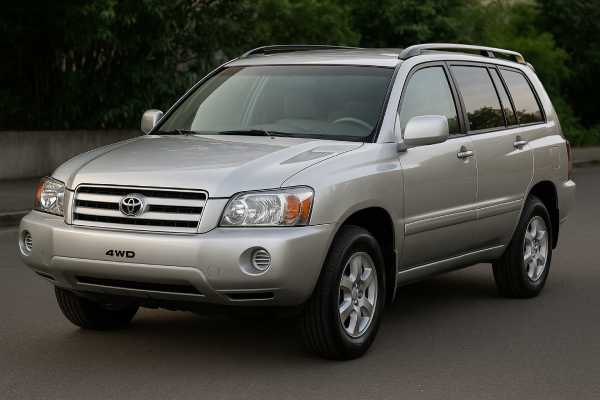
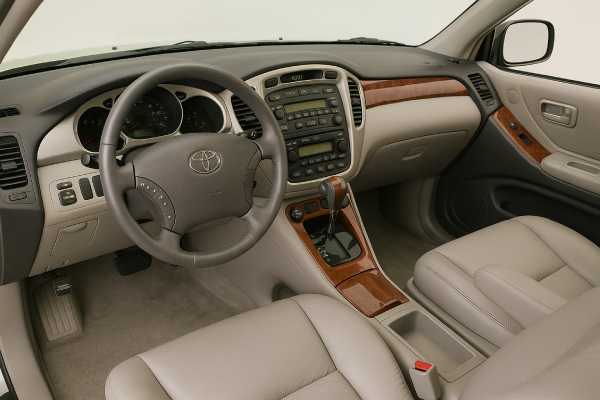
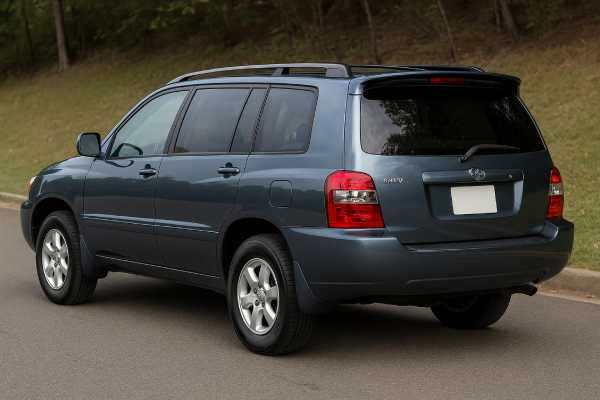
The 2004–2005 Toyota Highlander 4WD with the 3.3-liter 3MZ-FE V6 arrived with the facelift that added a third-row option, revised styling, and a stronger five-speed automatic. It kept the Highlander’s core promise: the space and confidence of a midsize SUV with the civility of a Camry-based unibody. The all-wheel-drive layout uses a center viscous coupling and stability control to deliver surefooted winter traction without the noise and harshness of truck-based 4×4 systems. Owners value this generation for smooth power delivery, a straightforward cabin, and long-term durability when maintenance is kept current—particularly the timing-belt service on the V6. If you want a practical, quiet family hauler that can shrug off bad weather, tow a small trailer, and hold its value, this model is a smart, budget-friendly pick on the used market. This guide focuses on the facelifted 2004–2005 3.3 V6 AWD (MCU25), using North American specifications, features, and test data.
Top Highlights
- Smooth, quiet V6 (230 hp) and refined 5-speed automatic; confident all-weather 4WD.
- Versatile cabin with optional third row and up to ~80 ft³ max cargo; easy step-in height.
- Proven Toyota reliability when serviced on schedule; strong resale.
- Watch for timing-belt age/mileage, minor oil seepage, and tired suspension bushings.
- Typical oil and filter service every 5,000 miles / 6 months (severe) or 7,500 miles (normal).
Start here
- Highlander 3.3 AWD overview
- Highlander 3.3 AWD specs
- Highlander trims and safety tech
- Reliability, issues and actions
- Maintenance and buyer guide
- Driving and performance
- Highlander vs rivals
Highlander 3.3 AWD overview
The facelifted 2004–2005 Highlander 4WD (internal code MCU25) is the sweet spot of the first generation for many buyers. It pairs Toyota’s 3.3-liter 3MZ-FE V6 with a five-speed automatic transmission (U151F) and a full-time, on-demand all-wheel-drive system tuned for everyday traction rather than rock crawling. The combination prioritizes smoothness, quick step-off, and good highway passing reserves. Compared with earlier 3.0-liter models, the 3.3 brings a fatter torque curve and slightly better real-world efficiency thanks to the extra gear.
Underneath, the Highlander rides on a unibody platform closely related to the Camry of its era. That means a lower center of gravity than body-on-frame SUVs of the time, lighter steering, and less head toss on rough pavement. MacPherson struts at all four corners keep the layout simple and affordable to maintain; it is more minivan-like to service than truck-like. Brakes are four-wheel discs with ABS, electronic brake-force distribution, and brake assist, backed by stability and traction control to keep the vehicle composed in slippery conditions.
Practicality is a major draw. The facelift added an available third row, giving occasional seven-passenger flexibility without making the Highlander feel bulky. With rows folded, the long, flat load floor is easy to use; with only the third row up, the rear space is small but workable for short trips. Seating is chair-height and visibility is excellent, aided by large glass and thin pillars for the era. Cabin materials are typical early-2000s Toyota: soft-touch in key places, durable fabrics or leather on Limited, and clear, simple controls.
Ownership costs are predictable when you follow service intervals. The V6 uses a timing belt and long-life iridium spark plugs. Toyota’s pink Super Long Life Coolant extends the first coolant service to 100,000 miles before shorter follow-ups, and the five-speed automatic is robust if its fluid is kept clean (especially with towing). Common age-related items—strut mounts, control arm bushings, sway-bar links—are straightforward to replace. Add winter tires and the MCU25 becomes a dependable all-season family tool that still feels surprisingly modern to drive.
Highlander 3.3 AWD specs
Below are core specifications for the 2004–2005 Toyota Highlander 4WD with the 3.3-liter V6. Figures reflect typical North American configurations and the facelifted model years.
Engine and Performance
| Item | Value |
|---|---|
| Code | 3MZ-FE |
| Configuration | 60° V6, DOHC, 24 valves, VVT-i (intake) |
| Displacement | 3.3 L (3,311 cc) |
| Bore × Stroke | 92.0 × 83.0 mm (3.62 × 3.27 in) |
| Compression ratio | ~10.8:1 |
| Induction | Naturally aspirated |
| Fuel system | Sequential multi-port electronic fuel injection |
| Max power | 230 hp (172 kW) @ ~5,800 rpm |
| Max torque | 328 Nm (242 lb-ft) @ ~3,600 rpm |
| Timing drive | Belt (replace at interval) |
| Emissions/efficiency standard | U.S. EPA era standards |
| Rated economy (AWD V6, EPA) | ~19 mpg combined (17/22 city/hwy) • ~12.4 L/100 km combined |
| Real-world highway @ 75 mph | ~22 mpg (10.7–11.8 L/100 km), weather/tires dependent |
| Aerodynamics (approx.) | Cd ~0.36–0.37 |
Transmission and Driveline
| Item | Value |
|---|---|
| Transmission | 5-speed automatic (U151F) |
| Drive type | Full-time AWD with center viscous coupling |
| Final drive ratio | ~3.48 (typical) |
| Differential | Open front/rear, electronic brake-based traction aid |
| Towing (braked) | Up to 3,500 lb (1,588 kg) with tow prep; 2,000 lb (907 kg) standard |
| Fuel tank | ~19.8 U.S. gal (75 L) |
| Refuel to full (typical) | <5 minutes at pump |
Note: Gear-ratio details vary slightly by calibration; verify by VIN if you need exact figures.
Chassis and Dimensions
| Item | Value |
|---|---|
| Platform | Unibody (Camry-based) |
| Suspension (front/rear) | MacPherson strut / MacPherson strut, coil springs, anti-roll bars |
| Steering | Power rack-and-pinion |
| Brakes | 4-wheel disc with ABS, EBD, BA |
| Wheels/Tires | 16 in standard; available 17 in; typical sizes 225/70R16 or 225/65R17 |
| Ground clearance | ~185 mm (7.3 in) |
| Length × Width × Height | ~4,690 × 1,825 × 1,705 mm (184.6 × 71.9 × 67.1 in) depending on roof rails |
| Wheelbase | 2,715 mm (106.9 in) |
| Turning circle (curb-to-curb) | ~11.4 m (37.4 ft) |
| Curb weight (AWD V6) | ~1,730–1,840 kg (3,815–4,055 lb) |
| GVWR | ~2,395–2,495 kg (5,280–5,500 lb) |
| Cargo volume (SAE) | ~10–11 ft³ (third row up); ~39.7 ft³ (second row up); ~80.6 ft³ (max) |
Performance and Capability
| Metric | Typical result |
|---|---|
| 0–60 mph / 0–100 km/h | ~8.0–8.5 s (all-season tires, unladen) |
| 50–70 mph passing | ~5.0–5.5 s |
| Top speed | Governed; highway-legal |
| 100–0 km/h braking | ~38–40 m (125–131 ft), tire-dependent |
| Towing stability | Good within 2,000–3,500 lb; use weight-distributing hitch near max |
Fluids and Service Capacities (guidance)
| System | Spec and notes |
|---|---|
| Engine oil | API SL/SM; 5W-30; capacity ~4.7–5.0 L (5.0–5.3 qt) with filter |
| Coolant | Toyota Super Long Life Coolant (pink); 50/50 mix; capacity ~8–9 L (8.5–9.5 qt) |
| ATF | Toyota Type T-IV (for U151F); service on condition or 60–90k miles if towing |
| Transfer case | GL-5 75W-90; change ~60–90k miles (severe) |
| Front/Rear diff | GL-5 75W-90; change ~60–90k miles (severe) |
| A/C refrigerant | R-134a (charge quantity varies by option; verify underhood label) |
| Spark plugs | Iridium (e.g., Denso SK20R11 / NGK IFR6A11); 1.1 mm (0.044 in) gap |
| Key torque values | Wheel lugs ~103 Nm (76 lb-ft); spark plugs ~18–22 Nm (13–16 lb-ft); oil drain ~39 Nm (29 lb-ft) |
Safety and Driver Assistance
| Area | Details |
|---|---|
| Structure and restraints | Front airbags, available side torso/curtain airbags (model/option-dependent); front seatbelt pretensioners |
| Stability and traction | VSC stability control, TRAC; 4-channel ABS with EBD and brake assist |
| Child-seat provisions | LATCH lower anchors and top tethers (second row outboard positions) |
| Lighting | Halogen reflectors (period correct); aim and lens clarity affect performance |
| Crash-test context | Strong moderate-overlap frontal performance for the era; side-impact results depend on fitment of side airbags |
Highlander trims and safety tech
Trims and option structure. In 2004–2005, the 3.3 V6 AWD was offered across popular trims, typically Base, Limited, and special-package variants. The Base brought cloth seats, manual HVAC, and 16-inch wheels; common convenience options included keyless entry, power driver’s seat, and roof rails. The Limited typically added leather seating, heated front seats, power moonroof, automatic climate control, premium audio, and wood-tone trim; 17-inch alloys were often bundled. A third-row seat became widely available with the facelift; it folds flat into the cargo floor. A tow-prep package (aux cooler, wiring) is worth seeking for regular towing.
Mechanical differences worth noting. All V6 AWD models use the U151F five-speed automatic. Packages could include larger wheels and tires (225/65R17) that subtly sharpen steering response at the cost of a touch more impact feel. Towing prep adds trans cooling that helps longevity in hot climates or hilly regions. Brake hardware is common across trims; the most meaningful difference is tire package and suspension wear state on a given used example. AWD calibration is identical across grades.
Feature identifiers and codes. VIN decoding confirms engine and drive (3MZ-FE / AWD). On the build plate, MCU25 identifies a V6 AWD Highlander; U151F is the trans family. Quick interior tells for Limited: leather with perforations, automatic climate control, steering-wheel audio controls, and often a JBL-branded head unit. Exterior tells include 17-inch wheels and body-color cladding.
Year-to-year changes (facelift focus). For 2004, the 3.3 V6 replaced the 3.0 V6 and the five-speed automatic arrived. The optional third row broadened the Highlander’s appeal. Minor running changes in 2005 mostly involved trim and package reshuffles, with stability and traction control common across V6 AWD models, and side curtain airbags more frequently included or packaged.
Safety ratings and equipment. Moderate-overlap frontal crash performance for the first-gen Highlander tested well for the time. Side-impact outcomes are option-dependent: vehicles without the side torso/curtain airbags score noticeably worse than those with the side airbags. If safety is a top priority, look for examples equipped with the side and curtain airbags and ensure the LATCH anchors are present and undamaged. Halogen headlamps vary with bulb age and lens clarity; restoring hazed lenses can materially improve nighttime visibility. As with all used vehicles, confirm that all recalls and service campaigns are closed by checking the VIN and saving the confirmation in your records.
ADAS context. Advanced driver aids as we know them today (AEB, lane keep assist, adaptive cruise) were not fitted. The Highlander’s “active safety” is stability control, ABS/EBD/BA, and predictable chassis tuning. Good winter tires and healthy brakes make a larger difference than any add-on electronics for this generation.
Reliability, issues and actions
Overall picture. The 3.3-liter Highlander AWD has an excellent long-term reputation when serviced on schedule. Powertrain failures are rare; most issues relate to age, mileage, and climate rather than design flaws. Below is a practical map of what to look for and how to address it.
Common (high prevalence / low-to-medium cost).
- Timing-belt overdue → Symptoms: no noise until failure; belt age >9–10 years or mileage >90k. Cause: deferred service. Remedy: replace timing belt, tensioner, idler, and water pump in one visit; renew coolant and accessory belts.
- Seepage at cam, crank, or valve-cover gaskets → Symptoms: mild oil smell, dampness on timing cover or block. Cause: age-hardened seals. Remedy: reseal at next timing-belt service for efficiency.
- Strut mounts, control-arm bushings, sway-bar links → Symptoms: clunks over bumps, vague steering, inner-edge tire wear. Remedy: replace worn components; align; consider fresh struts around 120–160k miles.
- Warped or uneven front rotors (driver feel) → Symptoms: brake pulsation. Cause: heat spots or uneven pad transfer. Remedy: quality pads/rotors, proper lug-nut torque (cross-pattern, ~103 Nm), bed-in procedure.
Occasional (medium prevalence / medium cost).
- Power steering rack seep → Symptoms: slow fluid loss, damp boots. Remedy: monitor; rebuilt or new rack if seep worsens. Check high-pressure hose condition.
- HVAC blend door actuator noise → Symptoms: clicking on mode changes. Remedy: replace faulty actuator; recalibrate if needed.
- Wheel bearing growl → Symptoms: speed-dependent hum that changes in turns. Remedy: replace affected hub/bearing; verify tire cupping first.
Rare but notable (low prevalence / severity varies).
- Transmission flare/shudder under load → Symptoms: flare on 2–3 shift or shudder when hot. Root causes: old ATF, overheating from towing without service. Remedy: staged ATF drain-and-fills with T-IV; inspect cooler; adapt shift strategy via proper throttle/kickdown use. Persistent issues may need valve-body work.
- ABS/VSC sensor faults → Symptoms: warning lamps, deactivated stability control. Remedy: scan for wheel-speed sensor or yaw-rate sensor codes; repair harness/sensor; recalibrate yaw sensor after repair.
Software and calibrations. While this generation predates wide OTA/ADAS updates, ECM/TCM reflashes exist for driveability or shift refinements. If you experience hunting shifts or odd idle behavior, ask a dealer to check for calibration updates by VIN.
Corrosion hotspots (rust-belt awareness). Look at the rear subframe mounts, front subframe leading edges, exhaust flanges, and the lower door seams. A neglected tailgate latch area can trap moisture. Undercarriage inspections and rustproofing go a long way in snowy climates.
Recalls, TSBs, and verification. Campaign coverage varies by VIN. Use the official VIN recall lookup and print a completion report for your records. Typical items for early-2000s Toyota SUVs include floor-mat/accelerator-pedal retention improvements and selected airbag or seatbelt service actions on certain VIN ranges. If a seller claims “all recalls done,” ask for the dealer repair order or confirmation page and keep it with the vehicle file.
Pre-purchase checklist.
- Full fluid history (coolant first at 100k, timing-belt at ~90k, ATF serviced if towing).
- Cold start, hot idle, and a full-throttle kickdown test (check for flare/shudder).
- Suspension/bushings, strut tops, and alignment/tire wear pattern.
- AWD function check on low-mu surface (no binding noises; traction control behaves predictably).
- VIN recall search printout and any ECM/TCM calibration notes.
Maintenance and buyer guide
Service schedule (practical). Toyota’s official guidance distinguishes “normal” and “severe” service; many used Highlanders now live a severe-ish life (short trips, cold starts). This hybrid schedule balances longevity and cost:
- Engine oil and filter: 5,000 miles / 6 months severe; up to 7,500 miles / 12 months normal. Use quality 5W-30 and OEM-grade filter; reset maintenance reminder.
- Engine air filter: Inspect at 15,000 miles; replace ~30,000 miles (more often in dust).
- Cabin air filter: 15,000–20,000 miles or annually (keeps HVAC clean).
- Coolant (SLLC pink): First change at 100,000 miles (160,000 km) or 10 years, then every 50,000 miles (80,000 km) or 5 years.
- Spark plugs (iridium): 120,000 miles (192,000 km). Confirm iridium type and gap.
- Timing belt (3MZ-FE): 90,000 miles (144,000 km) or 9 years. Include water pump, tensioner, idlers.
- Serpentine/aux belt and hoses: Inspect every 15,000 miles; replace at 90,000–120,000 miles or on condition.
- ATF (U151F): Inspect level/condition every service; change at 60,000–90,000 miles if towing/heat exposure; otherwise on condition. Use Toyota Type T-IV.
- Transfer case and diffs (AWD): 60,000–90,000 miles in severe service; GL-5 75W-90.
- Brake fluid: Flush every 2–3 years regardless of mileage.
- Brake pads/rotors: Inspect every 10,000–15,000 miles; replace on thickness or if pulsation persists after bed-in.
- Alignment and tire rotation: Rotate every 5,000–7,500 miles; align annually or with any tire wear pattern.
- 12V battery: Test annually after year 3; replace at 4–6 years typical.
- PCV valve: Inspect at 60,000–90,000 miles; replace if sticky.
- Fuel filter: In-tank strainer; normally no routine service—address on symptom.
Fluid specs and quick capacities (owner-useful).
- Engine oil: 5W-30, API SL/SM; ~4.7–5.0 L (5.0–5.3 qt) with filter.
- Coolant: Toyota SLLC (pink), premixed 50/50; ~8–9 L total.
- ATF: Toyota Type T-IV for U151F.
- Front/Rear differentials & transfer case: GL-5 75W-90.
- Power steering: ATF-type fluid per cap label.
- Torque check: Wheel lugs ~103 Nm (76 lb-ft); drain plug ~39 Nm (29 lb-ft).
Buyer’s guide—what to seek.
- Service records: Look for documented timing-belt/water pump, coolant first service, and regular oil changes.
- Tow prep package: Extra trans cooling for those who tow or live in hot/hilly regions.
- Airbags: Prefer examples with side and curtain airbags.
- Tires and alignment: Even wear across all four corners suggests healthy suspension.
- Rust inspection: Lift points, subframes, and exhaust flanges in salt-belt cars.
- Road test: Smooth upshifts, no flare; quiet at 70–75 mph; no drivetrain binding in tight circles.
Durability outlook. With timely belt service, fluids, and suspension refresh items, the MCU25 often surpasses 200,000+ miles with original major powertrain components. The straightforward design and parts availability keep running costs sensible compared with European rivals of the same era.
Driving and performance
Ride and refinement. The Highlander 3.3 AWD feels like a tall family sedan. The unibody structure resists shudder over potholes; struts soak up sharp edges without float. Cabin noise is low for the age thanks to conservative tire sizes and extensive glass seals. On coarse highway surfaces you hear some tire roar, which drops with fresh quality tires and intact wheel-well liners.
Handling and stability. Steering is light at parking speeds and gains reassuring weight on the highway. Body roll is present but well-controlled; stability control is tuned to step in early on slick roads, trimming power and braking individual wheels. AWD traction helps the Highlander track straight out of snowy intersections—winter tires make an outsized difference.
Powertrain character. The 3MZ-FE V6 is buttery at idle and makes strong mid-range torque. The five-speed automatic chooses ratios smartly and rarely hunts, using the extra gear to keep revs down at 70–75 mph. Kickdown is decisive; passing from 50 to 70 mph is confident. Use of regular 87-octane fuel is fine. In heat, towing, or long grades, the transmission prefers a lower gear for cooling—normal behavior in this era.
Efficiency. Expect ~19 mpg combined in mixed driving for the AWD V6 (roughly 12.4 L/100 km). Highway numbers around 22 mpg (10.7 L/100 km) at 65–70 mph are common; winter, roof racks, and aggressive tires can trim 1–2 mpg. City short-trip use in cold climates can fall to the mid-teens (mpg). Correct tire pressure (placard) and clean air filters meaningfully help.
Braking feel. Pedal travel is short with progressive bite; ABS activation is predictable on loose surfaces. If you feel pulsation, check rotor thickness variation and lug-nut torque history—over-torqueing can distort rotors. Quality pads matched to typical use (commuter vs. towing) make a noticeable difference.
Load and towing. With the tow package, 3,500 lb (1,588 kg) is realistic for small boats and utility trailers. Keep tongue weight within spec, distribute cargo, and consider a weight-distributing hitch near the limit. Plan for a 10–25% fuel-economy penalty when towing, and change ATF more frequently after heavy summers.
All-weather confidence. The center viscous coupling, open diffs, and brake-based traction assist are tuned to get you moving and keep the Highlander pointing straight rather than for off-road play. Deep mud and sand exceed its brief; snow, rain, and gravel are its comfort zone. Clearance (~7.3 in) is enough for rutted cottage roads if you pick a careful line.
Highlander vs rivals
Honda Pilot (2003–2005). The Pilot offers a roomier third row and a more overtly SUV stance. Its V6 and five-speed auto are competitive, but the ride is firmer and road noise higher on some trims. Real-world mpg is similar; AWD logic differs (front-biased with clutch pack). For quietness and easy driving, Highlander edges it; for people-moving, Pilot has the space advantage.
Ford Explorer (2002–2005). The Explorer of this era uses body-on-frame construction, with more towing and off-road hardware options. It’s heavier, thirstier, and can feel truckish around town. Maintenance costs trend higher as mileage accrues. If you need 5,000-7,000 lb tow ratings, Explorer wins; for commuting and light family duty, Highlander is the calmer daily partner.
Subaru Outback (2005). The Outback is lower and more carlike, with excellent AWD calibration and nimble handling. Cargo height is limited versus the Highlander, and the optional turbo brings complexity. If you want wagon dynamics and don’t need a tall cabin, Outback charms; if you want easier ingress and a higher driving position, Highlander fits better.
Nissan Murano (2003–2005). The Murano’s VQ V6 is strong, but the early CVT can be a long-term wildcard. Interior design is bolder; ride is firmer. The Highlander’s conventional five-speed and calmer chassis tuning often prove easier to live with over 10+ years.
Lexus RX 330 (2004–2005). Mechanically related to the Highlander with a more luxurious interior and added insulation. Pricing on the used market is higher; maintenance expectations are similar. If you want the plushest version and can stretch budget, RX 330 is appealing; if you want simpler trim and lower insurance costs, Highlander is the value play.
References
- 2005 Toyota Highlander 4WD 2005 (Fuel Economy)
- 2003 Toyota Highlander 4-door SUV 2003 (Safety Rating)
- 2004 – Scheduled Maintenance Guide 2004 (Owner’s Maintenance Guide)
- Check for Recalls: Vehicle, Car Seat, Tire, Equipment 2025 (Recall Database)
Disclaimer
This guide is for informational purposes and is not a substitute for professional diagnosis or repair. Specifications, torque values, fluid capacities, and maintenance intervals can vary by VIN, model year, market, and equipment. Always confirm against your vehicle’s official service documentation and under-hood labels before performing any work.
If this resource helped, please consider sharing it with fellow owners on Facebook or X/Twitter to support xcar’s work. Thank you!