
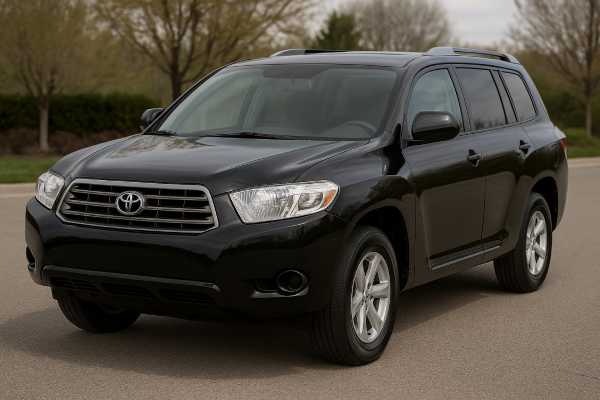
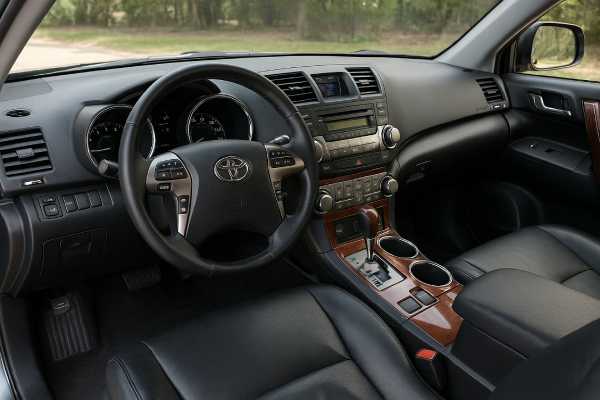
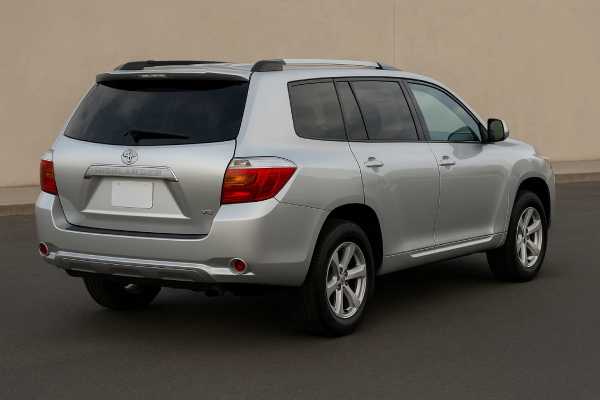
The 2009–2010 Toyota Highlander with the 2.7-liter 1AR-FE four-cylinder is the most fuel-efficient non-hybrid version of the second-generation Highlander. It pairs a durable chain-driven DOHC engine and a six-speed automatic with front-wheel drive to deliver family-friendly space, a quiet ride, and lower running costs than the V6. While it does not sprint like the 3.5-liter 2GR-FE, the 2.7 keeps pace in everyday traffic, tows modestly with the right package, and returns highway economy that rivals smaller crossovers. Inside, you get Toyota’s straightforward controls, abundant storage, and flexible cargo room; safety tech of the era—stability control, seven airbags—was standard, and crash scores were strong. This guide focuses on the ASU40 (FWD 2.7) sold in 2009–2010, covering specs and dimensions, real-world performance, reliability patterns, service intervals, safety ratings, and what to check before you buy.
At a Glance
- Efficient highway cruiser: up to 27 mpg (8.7 L/100 km) with calm NVH and long-legged gearing.
- Roomy, flexible cabin: 42.3 ft³ (1,197 L) behind row two; up to 95.4 ft³ (2,703 L) max.
- Toyota longevity: chain-driven 1AR-FE and simple FWD driveline reduce complexity and cost.
- Watch for age-related items: water pump seep, coil-on-plug misfires, and strut mounts after 100k mi.
- Typical service anchor: engine oil and filter every 5,000 mi / 6 months (0W-20).
Navigate this guide
- Highlander ASU40 overview
- ASU40 specifications and technical data
- Highlander 2.7 trims and safety
- Reliability and known issues (ASU40)
- Maintenance and buyer’s guide
- Driving impressions and performance
- How it compares to rivals
Highlander ASU40 overview
The ASU40-chassis Highlander represents the front-wheel-drive, four-cylinder configuration sold during model years 2009 and 2010. Toyota added the 1AR-FE 2.7-liter engine to broaden value and efficiency within the second-generation Highlander lineup. It arrived with a six-speed automatic (sequential manual mode) and an EPA highway rating in the mid-20s mpg—impressive for a midsize three-row crossover of the time.
Space and packaging are the Highlander’s calling cards. The cabin is quiet, seating is supportive for long trips, and cargo solutions are thoughtful: a sliding second row, lots of small storage bins, and a low liftover for bulky items. Most 2.7-liter models were delivered as five-seaters; a third row was more common on V6 trims, though regional content and options varied. Standard stability control, traction control, anti-lock brakes, and seven airbags were baked in, and the platform posted strong safety scores for its era.
On the road, the 2.7-liter favors smoothness and economy over outright punch. It pulls cleanly through the midrange, aided by widely spaced gearing that keeps rpm low at highway speeds. Routine merging and passing are fine with planning; the six-speed’s manual mode helps hold gears on grades. Towing is respectable for a four-cylinder—up to 3,500 lb (1,588 kg) when equipped with the tow prep package—while ride quality remains supple on 17-inch tires, with the 19-inch package trading a little compliance for steering response.
Ownership costs trend lower than V6 or hybrid siblings. The 1AR-FE uses long-life iridium spark plugs, Toyota Super Long Life coolant, and 0W-20 oil; the timing set is chain-driven, so there’s no belt service. Common age-related items—struts, sway-bar links, brake hardware—are inexpensive and widely available. For shoppers prioritizing reliability, fuel economy, and cabin quiet over acceleration and heavy towing, the ASU40 Highlander 2.7 is a smart, durable pick.
ASU40 specifications and technical data
Engine and Performance (ICE)
| Item | Detail |
|---|---|
| Code | 1AR-FE |
| Layout & cylinders | Inline-4, DOHC, Dual VVT-i; 4 valves/cyl |
| Bore × stroke | 90.0 × 98.0 mm (3.54 × 3.86 in) |
| Displacement | 2.7 L (2,672 cc) |
| Induction | Naturally aspirated |
| Fuel system | Sequential multi-port fuel injection |
| Compression ratio | 10.0:1 |
| Max power | 187 hp (140 kW) @ 5,800 rpm |
| Max torque | 252 Nm (186 lb-ft) @ 4,100 rpm |
| Timing drive | Chain |
| Emissions class | ULEV II / Tier 2 Bin 5 (era-typical) |
| Rated economy (FWD) | 22 mpg combined; 20/27 mpg (city/hwy) → 10.7 / 11.8 / 8.7 L/100 km |
| Real-world highway (75 mph) | ~24–26 mpg (9.4–10.0 L/100 km), tire/wind/grade dependent |
Transmission and Driveline
| Item | Detail |
|---|---|
| Transmission | 6-speed automatic (ECT-i) with sequential mode (U760E) |
| Drive type | Front-wheel drive (FWD) |
| Differential | Open (front) |
| Final drive | ~4.36:1 (typical for U760E/ASU40 calibration) |
| Refuel to full | ~5–7 min (pump/venting dependent) |
Chassis and Dimensions
| Item | Detail |
|---|---|
| Suspension (front/rear) | MacPherson strut / Independent double-wishbone |
| Steering | Electric power rack-and-pinion |
| Brakes | Ventilated front discs; solid rear discs; ABS, EBD, BA |
| Wheels/Tires | 245/65R17; optional 245/55R19 |
| Ground clearance | ~197 mm (7.8 in) typical FWD |
| Length / Width / Height | ~4,785 / 1,910 / 1,730 mm (188.4 / 75.2 / 68.1 in) |
| Wheelbase | 2,790 mm (109.8 in) |
| Turning circle (curb-to-curb) | ~11.8 m (38.7 ft) |
| Curb weight (approx.) | ~1,750–1,820 kg (3,860–4,010 lb) depending on equipment |
| GVWR | ~2,290 kg (5,050 lb) |
| Fuel tank | 72.5 L (19.1 US gal / 15.9 Imp gal) |
| Cargo volume (SAE) | 292 L (10.3 ft³) behind row 3; 1,197 L (42.3 ft³) behind row 2; 2,703 L (95.4 ft³) max |
Performance and Capability
| Item | Detail |
|---|---|
| 0–60 mph / 0–100 km/h | ~9.7–10.5 s (vehicle load, tire package) |
| Top speed | ~180 km/h (112 mph), speed-limited |
| Braking 100–0 km/h | Typical class performance with quality tires; inspect pads/rotors for age |
| Towing capacity | Up to 1,588 kg (3,500 lb) with tow prep; base ~907 kg (2,000 lb) |
| Payload | Equipment-dependent; verify on door-jamb label |
| Roof load | ~75 kg (165 lb) with OE rails/crossbars |
Fluids and Service Capacities (essentials)
| System | Spec / Capacity |
|---|---|
| Engine oil | SAE 0W-20 (ILSAC); ~4.4–4.6 L (4.6–4.9 US qt) with filter |
| Coolant | Toyota Super Long Life (pink); premixed 50/50; capacity varies—bleed per manual |
| Automatic transmission | Toyota WS ATF; drain-and-fill ~3.5–4.0 L (3.7–4.2 US qt); total higher |
| Power steering | Electric assist (no fluid service) |
| A/C refrigerant | R-134a; charge by weight per label (underhood decal) |
| Torque (wheel nuts) | 103 Nm (76 lb-ft) typical |
| Torque (drain plug) | ~39 Nm (29 lb-ft) typical for Toyota aluminum pan with gasket |
Electrical
| Item | Detail |
|---|---|
| Alternator | ~100–130 A class (equipment dependent) |
| 12V battery | Group 24/24F common; ~55–70 Ah; CCA as equipped |
| Spark plugs | Iridium long-life; gap ~1.0–1.1 mm (0.039–0.043 in) |
Safety and Driver Assistance
| Area | Detail |
|---|---|
| Crash ratings | Top Safety Pick with Good ratings in moderate overlap front, side, roof, and head restraints for 2010 |
| Headlights | No IIHS headlight rating in this era |
| Standard systems | ABS, EBD, Brake Assist, Vehicle Stability Control, Traction Control |
| ADAS availability | No factory AEB/ACC/lane centering on 2009–2010; rear camera optional/trim-specific |
Highlander 2.7 trims and safety
Trims and key equipment (2009–2010, four-cylinder focus):
- Base (FWD, 2.7 standard): cloth seating, manual front seats, 17-inch alloys with 245/65R17 tires, stability and traction control, seven airbags, basic audio with 6 speakers and AUX input, manual climate control. Typical five-passenger configuration in 2.7 models; third row availability varied by region and package content.
- Sport and Limited (primarily paired with V6): 19-inch wheels/tires, sport-tuned suspension (Sport), leather and additional comfort/tech (Limited). A 2.7 in these grades was uncommon in this period.
Packages and mechanical differences:
- Tow Prep (2.7): auxiliary engine oil cooler and wiring, enabling 3,500 lb (1,588 kg) rating; without it, expect ~2,000 lb (907 kg).
- Wheel/tire packages: 17-inch setup maximizes ride comfort and winter performance; 19-inch improves steering response with a slight noise/impact penalty.
- Brakes and suspension: hardware is shared across powertrains; Sport’s calibration reduces roll a touch but does not materially change towing or GVWR.
Year-to-year changes that matter for buyers (2.7):
- 2009: 2.7-liter introduced; six-speed automatic; FWD only.
- 2010: Added options on Base grade (e.g., power moonroof availability). Backup camera availability broadened across trims.
Safety notes and ratings overview:
- Crash tests: The platform achieved Good results in moderate overlap front, side, roof strength, and head restraints, earning Top Safety Pick status for 2010 when criteria focused on these tests. This reflects robust occupant protection for the period.
- Airbags/restraints: Advanced dual-stage front airbags, front seat-mounted side airbags, full-length curtain airbags for all rows, and a driver’s knee airbag were standard. Active head restraints up front reduce whiplash risk.
- Child-seat provisions: Lower anchors and top tethers (LATCH) in outboard second-row positions; check fitment on wider child seats—Toyota’s sliding second row helps but mind buckle access.
- Driver assistance (ADAS): Automatic emergency braking, lane-keeping, and adaptive cruise were not offered on 2009–2010 Highlanders. Stability control and traction control were standard; a rear camera was optional on Base and standard on higher trims.
Identifiers and quick tells:
- VIN/Build plate: Engine code 1AR-FE and FWD configuration confirm ASU40.
- Visual cues: Most 2.7 models ride on 17-inch wheels with more sidewall; underhood, the intake manifold is clearly an I-4 layout vs. the V6’s wider plenum.
- Transmission shifter: Gate with “S” manual mode indicates the six-speed automatic fitted to the 2.7.
Reliability and known issues (ASU40)
Overall, the ASU40 Highlander with the 1AR-FE enjoys a strong reliability record. The powertrain is simple, well-proven, and tolerant of mileage when serviced on time. Below is a practical map of issues by prevalence and cost.
Common (low–medium cost):
- Water pump seep/leak (90k–140k mi / 145k–225k km): Coolant track marks at the pump weep hole, intermittent squeal, or pink crusting. Remedy: Replace pump, new SLLC coolant, and inspect belt and idlers.
- Ignition coil misfire (any mileage, more frequent past 120k mi): Single-cylinder misfire under load, MIL on. Cause: Aging coil-on-plug and/or worn iridium plugs. Remedy: Replace the faulty coil; renew all plugs (long-life iridium) if due.
- Strut mounts and front sway-bar links (100k+ mi): Clunk over bumps or during low-speed steering. Remedy: Replace mounts/links; consider full strut assemblies if dampers are tired.
Occasional (medium cost):
- Thermostat slow-warm or overcooling: Cabin heat weak, coolant temp fluctuates. Remedy: Replace thermostat and gasket; bleed cooling system fully (air pockets can mimic symptoms).
- Brake rotor vibration (warping from heat or rust scale): Steering shake on highway braking. Remedy: Quality rotors/pads; verify slide pins and torque; check rear parking-brake shoes for drag.
Rare (higher cost or critical):
- Torque converter shudder / shift flare in U760E (high mileage, neglected ATF): Felt at 35–55 mph light throttle or 2–3 upshift. Remedy: WS ATF drain-and-fill in stages; software reset/adaptation; in persistent cases, converter replacement.
- Evaporative emissions faults (vent/valve): Difficult refueling or EVAP codes. Remedy: Smoke test the system; repair/replace canister purge/vent valves as indicated.
Corrosion hotspots (age/climate dependent):
- Rear hatch garnish and license-plate area: Hairline cracks and trap dirt/moisture. Remedy: Clean, seal, or replace garnish.
- Underbody hardware and rear subframe mounts (rust belts): Inspect for scale and seized fasteners before exhaust or suspension work.
Software/TSB considerations:
- Transmission control modules may receive updates to improve shift quality or converter lockup behavior; infotainment and instrument cluster logic updates are far less common on these years. If shifts feel harsh or hunt at steady throttle, ask a dealer to check for calibration updates after basic health checks.
Recalls and service campaigns (2009–2010 Highlander family):
- Accelerator pedal and floor-mat interference: Campaigns addressed pedal reinforcement and floor-mat retention. Confirm recall completion by VIN and review dealer paperwork.
- Best practice: Always run an official VIN recall search and keep recall proof with the vehicle history file.
Pre-purchase checks to request:
- Full service history with oil changes every 5k mi/6 mo and coolant at the correct interval.
- VIN recall printout showing all campaigns closed.
- Recent brake service measurements and rotor condition.
- Suspension inspection (struts, mounts, sway-links, control-arm bushings).
- Transmission health (no shudder/hunting; consider ATF sampling or proof of recent WS drain-and-fill).
- Cooling system (no pump seep; steady operating temperature).
- Tire age and match (all four, correct load rating, no cupping).
Maintenance and buyer’s guide
Owner-friendly maintenance schedule (practical, distance/time):
- Engine oil and filter: Every 5,000 mi / 6 months (0W-20). Short-trip or dusty use: consider 3,750 mi.
- Engine air filter: Inspect every 15,000 mi / 1 year; replace at 30,000 mi / 3 years (earlier if dusty).
- Cabin air filter: 15,000–20,000 mi / 1–2 years, more often in urban/pollen seasons.
- Spark plugs (iridium): 120,000 mi / 12 years. Replace sooner if misfires occur.
- Coolant (SLLC pink): First at 100,000 mi / 10 years, then 50,000 mi / 5 years.
- Automatic transmission (WS ATF): Not always listed for routine service; drain-and-fill every 60,000–90,000 mi is a prudent preventative, especially for mixed urban/hot climates or towing.
- Brake fluid: Replace every 3 years regardless of mileage.
- Brake pads/rotors: Inspect at each tire rotation; typical life 30–60k mi depending on use.
- Serpentine/aux belt: Inspect annually; typically 90k–120k mi replacement, earlier with cracking or noise.
- PCV valve and throttle body: Inspect/clean at 60k–90k mi to stabilize idle quality.
- Tires: Rotate every 5,000 mi, align annually or with tire replacement.
- 12V battery: Test annually after 4 years; typical replacement window 5–7 years.
Fluid specs recap (decision-making essentials):
- Oil: SAE 0W-20 ILSAC; capacity ~4.4–4.6 L (4.6–4.9 qt) with filter.
- Coolant: Toyota Super Long Life Coolant (pre-mixed).
- ATF: Toyota WS; service by measured refill at temp.
- Brake fluid: DOT 3/4 quality fluid; flush methodical bleed sequence.
- A/C: R-134a; charge strictly by weight from the under-hood label.
Essential torques (dozens exist; these matter most to DIYers):
- Wheel lug nuts: 103 Nm (76 lb-ft), star pattern.
- Engine oil drain plug: ~39 Nm (29 lb-ft) with fresh gasket.
- Spark plugs: Follow plug maker spec; typically 18–22 Nm (13–16 lb-ft) on aluminum head with crush washer.
Buyer’s checklist (what to inspect in person):
- Road test: Cold start smoothness, no belt squeal, transmission upshifts without flare, steady cruise without shudder.
- Under-hood: Pump weep, crusted coolant, oil leaks at valve cover/timing cover junctions.
- Suspension: Clunks over speed bumps (strut mounts/links), rear bounce (tired dampers).
- Brakes: Straight stops, no pulsing; parking brake holds.
- HVAC and A/C: Quick cool-down, no blend-door ticking.
- Electrical: All windows/locks, backup camera (if equipped), TPMS warning status.
- Body: Liftgate garnish cracks, windshield chips, underbody rust scale on hardware.
- Tires: Even wear, correct size/load, date codes under six years.
Which years/trims to target:
- Best value: 2010 Base 2.7 with documented maintenance and the tow-prep package if you plan light towing.
- Avoid? None categorically—condition and history trump year. Skip neglected examples with shuddering transmissions or cooling-system neglect.
Durability outlook: With basic care, the 1AR-FE routinely exceeds 200,000+ mi (320,000+ km). Suspension refresh around 120k–160k mi is normal and restores near-new ride quality. Parts availability and independent-shop familiarity keep lifetime costs in check.
Driving impressions and performance
Ride, handling, and NVH:
The 2.7 FWD Highlander is tuned for quiet cruising. On 17-inch tires it rides with a gentle initial stroke and well-controlled secondary motions. Impacts are rounded off, body motions settle quickly, and the cabin keeps wind and road noise low at 70–75 mph (113–121 km/h). The electric steering is light at parking speeds and steady on the highway; on-center stability is confident, with minor corrections in crosswinds. Braking feel is progressive when the system is fresh—quality pads and clean slide pins make a noticeable difference in pedal consistency on long descents.
Powertrain character:
Throttle response is clean and linear; the 1AR-FE’s broad torque curve helps in city work. The six-speed holds taller gears to save fuel, but kickdown is prompt enough for short merges; using the manual gate to pre-select fourth or fifth before a grade reduces hunting. Compared with the V6, passing from 50–70 mph (80–113 km/h) demands a bit more planning, but the overall refinement suits family duty and long commutes.
Real-world efficiency (observed ranges):
- City: 19–21 mpg (12.4–11.2 L/100 km) with gentle driving; heavy stop-and-go can dip lower.
- Highway 60–70 mph (100–113 km/h): 26–28 mpg (9.0–8.4 L/100 km) when unloaded, 17-inch tires, fair weather.
- Highway 70–75 mph (113–121 km/h): 24–26 mpg (9.4–10.0 L/100 km) typical.
- Mixed: 21–24 mpg (11.2–9.8 L/100 km), sensitive to climate control use, elevation, and tire type.
Cold weather, roof racks, and winter tires can trim 1–3 mpg; heavy cargo or towing has a larger effect.
Key metrics and use cases:
- 0–60 mph / 0–100 km/h: ~9.7–10.5 s depending on load and tire.
- Passing (50–80 mph / 80–129 km/h): Adequate with multi-gear kickdown; pre-select a lower gear on two-lane roads.
- Braking repeatability: Keep rotors fresh and torque lugs correctly; oscillation often traces to rust scale or uneven pad deposition, not just “warped” rotors.
- Traction and control: FWD traction is fine on all-seasons; for snowbelt use, winter tires transform takeoff and braking confidence. Stability control is tuned to step in early on slick surfaces.
- Towing and load: With the tow-prep package, a small boat or pair of ATVs is realistic. Expect a 15–25% fuel-economy penalty when towing in rolling terrain; use the manual gate to limit hunting and watch trans temperatures on long grades.
How it compares to rivals
Versus Honda Pilot (V6, same era):
Pilot offers stronger acceleration and available eight seats across more trims. The Highlander 2.7 counters with better highway economy and a quieter cabin at cruise. If you need routine eight-passenger capacity and brisker passing, Pilot has the edge; if you prioritize fuel spend and NVH, the Highlander is calmer.
Versus Ford Edge (V6, two-row):
Edge is sportier to steer and accelerates harder, but it lacks the Highlander’s third-row flexibility and cargo depth. The Toyota’s long-term maintenance costs and interior packaging are stronger plays for family duty.
Versus Mazda CX-9 (V6):
CX-9 drives with more verve and has adult-friendly third-row space, but it is thirstier. The Highlander trades some dynamic sharpness for efficiency and lower ownership overhead. For frequent highway trips with moderate loads, the 2.7 Highlander wins on fuel and noise.
Versus Chevrolet Traverse/GMC Acadia (V6):
GM triplets provide abundant space and tow ratings, yet their size and weight hurt economy. The Highlander is easier to park, quieter over time as bushings age, and simpler to own—especially as mileage climbs.
Bottom line:
If you rarely tow near 5,000 lb, carry five most days, and care about fuel economy and long-term durability, the ASU40 Highlander 2.7 delivers a balanced package. If you regularly haul seven with cargo or tow heavy, step to the V6 Highlander or consider larger body-on-frame SUVs.
References
- Toyota Highlander Adds New Options on Base Grade Models For 2010 2009 (Press Release)
- Gas Mileage of 2010 Toyota Highlander 2010 (Fuel Economy)
- 2010 Toyota Highlander 4-door SUV 2010 (Safety Rating)
- 2010 Highlander & Highlander Hybrid Specifications 2010 (Specifications)
- Check for Recalls: Vehicle, Car Seat, Tire, Equipment 2018 (Recall Database)
Disclaimer
This article is for informational purposes only and is not a substitute for professional diagnosis, repair, or official service procedures. Specifications, torque values, capacities, and maintenance intervals vary by VIN, production date, region, and equipment. Always verify details against your vehicle’s owner’s manual, service literature, and official technical publications before performing work.
If you found this guide useful, please share it with fellow owners on Facebook or X/Twitter to support xcar’s work. Thank you.