
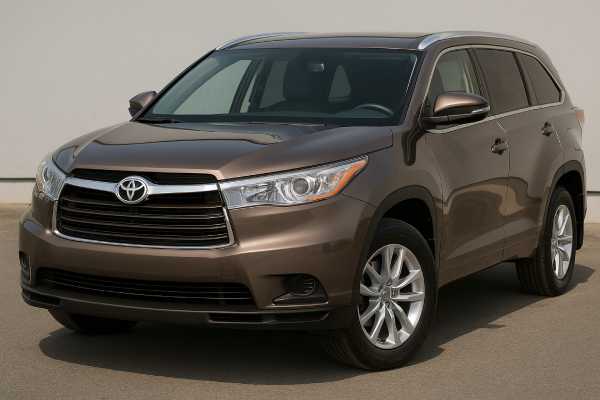
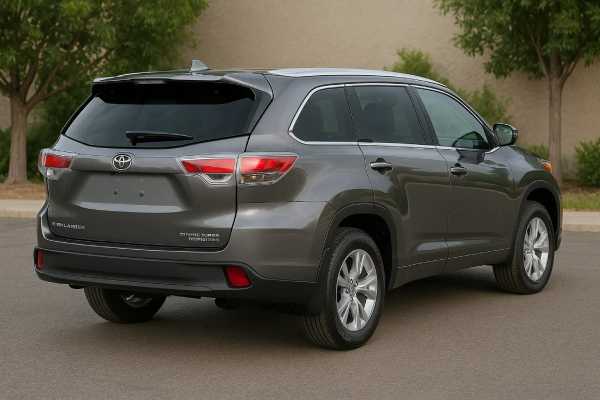
The 2014–2016 Toyota Highlander with Dynamic Torque-Control AWD (GSU55) pairs Toyota’s proven 2GR-FE 3.5-litre V6 with a 6-speed automatic and an on-demand AWD system that’s tuned for changing weather and mixed surfaces. This generation moved the Highlander decisively into family-SUV territory: quieter cabin, standard three rows, and a longer wheelbase for better ride and space. Owners value its straightforward controls, durable drivetrain, and 5,000-lb (2,268-kg) tow rating when equipped. While it’s not a rock crawler, the AWD logic pre-emptively sends torque rearward under acceleration and when slip is detected, giving confident snow-belt manners. Safety performance is strong for the era, with available active safety tech and excellent crash scores. As with any aging SUV, fluids, bushings and cooling components deserve attention, but routine care is simple and parts are widely available. If you want long-term ease of ownership rather than flash, this Highlander is a smart, family-first pick.
At a Glance
- Smooth, durable 2GR-FE V6 (270 hp/201 kW) with relaxed highway gearing and real 5,000-lb (2,268-kg) tow capacity when properly equipped.
- Quiet ride, adult-friendly second row, and usable third row with 83.7 ft³ (2,370 L) max cargo.
- AWD is predictive and transparent; good snow traction for an on-demand system.
- Watch for aging water pumps, wear on rear suspension bushings, and seepage at differential/transfer case plugs after 10+ years.
- Typical service rhythm: engine oil 10,000 mi/12 months (0W-20), tire rotation every 5,000 mi/6 months.
Navigate this guide
- Highlander AWD 2014–2016 Overview
- Highlander GSU55 Specifications
- Trims, Options and Safety
- Reliability, Issues and Service Actions
- Maintenance and Buyer’s Guide
- Driving and Performance
- How It Compares to Rivals
Highlander AWD 2014–2016 Overview
Toyota redesigned the Highlander for model year 2014 and kept the core formula for 2015 and 2016: a unibody, three-row family SUV with a naturally aspirated V6 (2GR-FE), 6-speed automatic, and an electronically controlled, on-demand AWD system branded Dynamic Torque-Control AWD. The AWD hardware uses an electromagnetically controlled coupling ahead of the rear differential to apportion torque rearward as needed. The control logic is proactive under hard launches and responsive when the front wheels slip; it can also lightly brake an inside wheel to help the vehicle track in corners. A simple snow-friendly setup, it favors surefootedness over off-road articulation. Downhill Assist Control was fitted on many AWD trims to stabilize low-speed descents.
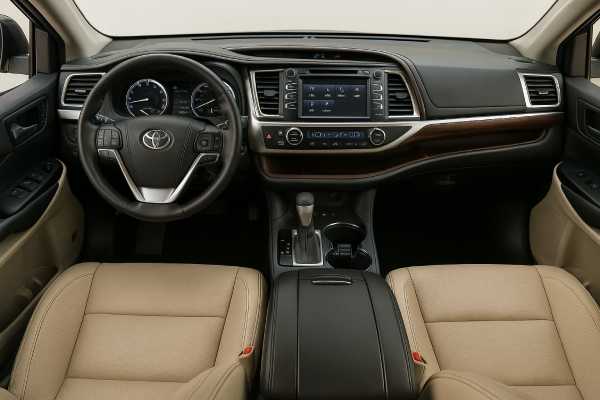
Cabin priorities are comfort and usability. The third row is acceptable for shorter adults and teens; the second row is genuinely roomy, with either a bench (8-passenger) or available captain’s chairs (7-passenger). Usability upgrades from this generation—like the long dash shelf for phones and a wide, quiet cabin—stand out even today. With the seats folded, the Highlander offers up to 83.7 ft³ (2,370 L) of cargo volume, and with the right hitch/tow package the platform is rated to tow 5,000 lb (2,268 kg), adequate for a small camper or pair of ATVs.
Safety was a selling point. Structural performance in crash testing is strong for the time, and when optioned with Toyota’s Pre-Collision System and radar cruise, it earned top awards. Owners often cite calm long-trip manners: the V6 cruises at low rpm in 6th, road noise is modest on touring tires, and the ride smooths broken pavement without feeling floaty. Expect real-world fuel economy around 18–23 mpg US (13.1–10.2 L/100 km) depending on speed, temperature, tire choice, and load—respectable for a three-row AWD V6.
Typical weak spots after a decade include seepage at diff/transfer case plugs if the crush washers are reused, aging water pumps (external leaks from the weep hole), worn rear control arm bushings, and corrosion at fasteners in salt states. None are model-killing defects; they’re predictable wear items you can budget for. The 2GR-FE uses a timing chain (no belt), and with regular oil changes it is known to exceed 200k miles (320k km) without internal work.
Highlander GSU55 Specifications
Engine and Performance (ICE)
| Item | Value |
|---|---|
| Code | 2GR-FE |
| Layout & cylinders | Transverse V6, DOHC, 24 valves (4 per cyl), Dual VVT-i |
| Bore × stroke | 94.0 × 83.0 mm (3.70 × 3.27 in) |
| Displacement | 3.5 L (3,456 cc) |
| Induction | Naturally aspirated |
| Fuel system | Sequential multi-port injection (SFI) |
| Compression ratio | 10.8:1 |
| Max power | 270 hp (201 kW) @ 6,200 rpm |
| Max torque | 336 Nm (248 lb-ft) @ 4,700 rpm |
| Timing drive | Chain |
| Emissions/efficiency standard | ULEV-II / EPA gasoline |
| Rated economy (AWD V6) | 13.1/9.8/11.8 L/100 km city/hwy/combined (18/24/20 mpg US; 22/29/24 mpg UK) |
| Real-world hwy @ 120 km/h (75 mph) | ~10.7–11.8 L/100 km (22–25 mpg US; 26–30 mpg UK), temperature and tires dependent |
Transmission & Driveline
| Item | Value |
|---|---|
| Transmission | 6-speed automatic (ECT-i) with lock-up converter and sequential mode |
| Typical transmission code | U660F (V6 AWD application) |
| Final drive ratio | ~4.15:1 (front; rear differential paired accordingly) |
| Drive type | Dynamic Torque-Control AWD (on-demand; pre-emptive under acceleration) |
| Differential | Open front/rear; selective brake-based torque control |
| Refill to full (fuel) | ~5 min (conventional gasoline) |
Note: Gear ratios vary slightly by calibration; Toyota did not publish full ratio tables in consumer spec sheets for these years.
Chassis & Dimensions
| Item | Value |
|---|---|
| Suspension (front/rear) | MacPherson strut / Double-wishbone |
| Steering | Electric rack-and-pinion (EPS), variable assist |
| Brakes | Ventilated front discs, solid rear discs |
| Wheels/Tires | 18 in or 19 in alloys; typical tires P245/60R18 or P245/55R19 |
| Ground clearance | 203 mm (8.0 in) |
| Length × Width × Height | 4,855 × 1,925 × 1,730–1,780 mm (191.1 × 75.8 × 68.1–70.1 in) |
| Wheelbase | 2,790 mm (109.8 in) |
| Turning circle | 11.8 m (38.7 ft) |
| Curb weight (AWD V6, trim-dependent) | ~1,995–2,045 kg (4,398–4,508 lb) |
| Fuel tank | 72.5 L (19.1 US gal / 15.9 imp gal) |
| Cargo volume (seats up → max) | 390 L / 13.8 ft³ → 2,370 L / 83.7 ft³ (SAE/market method) |
Performance & Capability
| Metric | Value |
|---|---|
| 0–60 mph (0–97 km/h) | ~7.3–7.8 s (AWD V6, typical test spreads) |
| 0–100 km/h (0–62 mph) | ~7.7–8.2 s |
| Top speed (governed) | ~180+ km/h (~112+ mph), tire-limited |
| 100–0 km/h braking | ~39–42 m (varies with tire/pad condition) |
| Towing capacity | 2,268 kg (5,000 lb) with tow package; otherwise ~907 kg (2,000 lb) |
| Payload (typical window) | ~600–700 kg (1,320–1,540 lb), trim-dependent |
Fluids & Service Capacities (typical for 2GR-FE AWD Highlander)
| System | Specification | Capacity (approx.) |
|---|---|---|
| Engine oil | SAE 0W-20 (API SN/SN Plus or newer) | ~6.1 L (6.4 qt) w/ filter |
| Engine coolant | Super Long Life Coolant (pink), 50/50 premix | ~9–10 L (9.5–10.6 qt) total system |
| Automatic transmission | Toyota WS ATF | Service drain/fill ~3–4 L (3.2–4.2 qt) |
| Transfer case | Toyota gear oil LV 75W (GL-5 equivalent) | ~0.6–0.7 L (0.6–0.7 qt) |
| Rear differential | 75W-85 GL-5 | ~1.0–1.2 L (1.1–1.3 qt) |
| A/C refrigerant | R-134a | ~600–700 g (21–25 oz) |
| A/C compressor oil | ND-Oil 8 (PAG) | ~120–150 mL (4–5 fl oz) |
| Key torque specs | Wheel lugs ~103 Nm (76 lb-ft); drain plugs ~39–49 Nm (29–36 lb-ft); spark plugs ~18–22 Nm (13–16 lb-ft) |
Always confirm capacities and torque values for your exact VIN/market; minor variations exist by year/trim and running change.
Electrical
| Item | Value |
|---|---|
| Alternator output | ~130–150 A (trim/option dependent) |
| 12V battery | Group size appropriate for SUV; ~65–70 Ah typical (check label), ~550–700 CCA |
| Spark plugs | Iridium (e.g., DENSO SK20HR11 equivalent); gap 1.0–1.1 mm (0.039–0.043 in) |
Safety & Driver Assistance
| Item | Summary |
|---|---|
| Crash ratings | Strong results for the era; award-level performance when equipped with front crash prevention |
| Headlights | Era-typical halogen/HID; upgraded assessments began later (post-2016) |
| ADAS suite (availability) | Pre-Collision System (forward collision warning/mitigation), Dynamic Radar Cruise Control, Lane Departure Alert, Blind Spot Monitor with Rear Cross-Traffic Alert; standard/optional varied by trim and package |
Trims, Options and Safety
Trims and options (2014–2016): LE, LE Plus, XLE, and Limited were the core gasoline grades in North America, all available with the V6 AWD. A four-cylinder 2.7L existed but was front-drive only and outside this AWD scope. Key mechanical commonalities across AWD V6 trims include the 2GR-FE engine, 6-speed ECT-i automatic, on-demand AWD with an electronically controlled rear coupling, and disc brakes. Wheel/tire packages step from 18-inch on LE/LE Plus to 19-inch designs on Limited (with unique finishes). Seating is eight-passenger (bench) on most grades; seven-passenger (captain’s chairs) commonly appears on Limited and select XLE configurations. A factory tow package enables the 5,000-lb (2,268-kg) rating and bundles a receiver hitch, wiring, and, depending on market, additional cooling.
Feature highlights and packages:
- LE AWD: Cloth seats, 18-in wheels, backup camera, basic audio.
- LE Plus AWD: Adds power liftgate, tri-zone climate, upgraded display audio; a popular value sweet spot.
- XLE AWD: Leather, heated front seats, power moonroof, navigation, smart key; many used examples carry roof rails and captain’s chairs.
- Limited AWD: Perforated leather, ventilated front seats (in many builds), 19-in wheels, premium JBL audio, driver-seat memory, and access to the Advanced Technology Package (often bundling Pre-Collision System with radar cruise, Lane Departure Alert, and a panoramic glass roof).
Functional differences: The tow package changes your Highlander’s use case; if you plan to tow regularly, seek a truck with the factory hitch and wiring (and verify operation). Limited’s 19-inch tires sharpen turn-in but add a touch of impact harshness and cost more to replace. Captain’s chairs improve access to the third row at the expense of one seat. In snowy climates, 18-inch wheels with taller sidewalls and touring winter tires are the most comfortable and surefooted combination.
Safety ratings and structure: The redesigned 2014 Highlander performed well in key crash tests for the period, and with the available Pre-Collision System it reached award status. Structure and restraint performance remained consistent through 2016 with running refinements. The front crash prevention system was rated “Advanced” for its time. These vehicles predate today’s mandatory comprehensive ADAS suites, so verify your candidate’s equipment list carefully—two outwardly similar Highlanders can differ significantly in collision-avoidance capability depending on options.
Child seats and practicality: Lower anchors are accessible in the second row; the third row is tight for rear-facing seats but works with select boosters. Always confirm belt routing and tether anchor positions before purchase if this is critical to your family setup.
Service and calibration implications: If you buy one with the Pre-Collision System, radar sensor alignment after front-end repairs or windshield replacement requires calibration with the proper targets. Similarly, Blind Spot Monitor radar units need alignment if rear quarter panels are repaired. Keep this in mind when considering vehicles with accident history.
Reliability, Issues and Service Actions
The 2GR-FE V6 and U660-series 6-speed are known quantities. With routine fluid care, many examples cross 200,000 miles (320,000 km) without major engine or transmission work. That said, age and mileage bring patterns worth checking:
Common (predictable wear / low–medium cost):
- Water pump seep/leak: Pink crust near the weep hole or coolant smell at idle. The 2GR-FE uses a belt-driven external pump; replacement is straightforward but parts access is tight. Combine with fresh coolant and a serpentine belt.
- Rear suspension bushings/control arms: Firmer thumps over sharp edges, rear tire feathering, or instability in crosswinds can point to worn bushings.
- Differential/transfer case plug seepage: If crush washers are reused, small leaks can appear. Fresh washers and correct torque usually resolve it.
- Front strut mounts/top hats (age-related): Groans over speed bumps; replacement restores quietness.
Occasional (medium cost):
- Axle seals (front/rear) sweating: Especially on vehicles that towed or saw frequent deep-cold starts; monitor during services.
- Radiator end-tank seep (older plastic tanks): Tiny coolant loss without external puddles; watch for crust at seams.
- Starter wear (high-mileage): Slower cranking or intermittent engagement.
Rare but notable (plan/inspect):
- Torque converter shudder or flare (neglected fluid): More likely on vehicles that never saw ATF service under tow/heat. Often improved with a proper WS fluid exchange; chronic cases may need converter work.
- Steering column/EPS noises: Clunks at low speed in parking maneuvers are usually intermediate shaft play rather than rack failure.
Software and calibrations: Periodic ECU/TCU updates smooth part-throttle shifts and refine idle behavior. Ask a dealer to check your VIN for the latest calibration during any visit. Vehicles with the Pre-Collision System may receive updates that refine radar logic; windshield or radar replacements require ADAS calibration.
Corrosion hotspots: In salt states, check fasteners at exhaust flanges, rear subframe mounts, and the lower edges of doors/hatch. The body structure itself resists rust fairly well, but brackets and shields age.
Recalls and service campaigns: This generation saw routine safety actions typical of the era. Early 2014 build-year vehicles had a seat-belt anchor campaign and other minor running fixes; always verify completion through an official VIN recall check. For any used Highlander, confirm every campaign/recall is closed before purchase and keep records with the title.
Pre-purchase checklist to request:
- Full service history with dates/mileage (oil/filter, coolant, brake fluid, spark plugs).
- Proof of differential/transfer case fluid services (especially for tow use).
- Documented ATF service if the vehicle towed or lived in hot climates.
- Alignment and tire replacement history (look for even wear).
- ADAS calibration paperwork if windshield/front-end was replaced.
- Official recall/TSB printouts tied to the VIN.
- Battery health test (12 V) within the last 12 months.
Maintenance and Buyer’s Guide
Practical maintenance schedule (baseline; confirm by VIN/market):
- Engine oil/filter: 0W-20 synthetic, every 10,000 miles/12 months under normal driving; 5,000 miles/6 months if lots of short trips, towing, or cold starts.
- Engine air filter: Inspect 15,000 miles/12 months; replace ~30,000 miles (sooner in dusty areas).
- Cabin filter: Every 12 months or 15,000–20,000 miles.
- Coolant: Toyota Super Long Life (pink). Initial long interval (≈100,000 miles/10 years), then roughly every 50,000 miles/5 years. Replace the thermostat proactively after ~10 years if you’re refreshing hoses.
- Spark plugs: Long-life iridium, ~120,000 miles (193,000 km).
- Serpentine/aux belt: Inspect every service; replace around 90,000–120,000 miles or at first sign of cracking/noise.
- ATF (Toyota WS): “Lifetime” under normal use, but for best longevity service every 60,000–90,000 miles if towing, mountain driving, or high heat. Use correct level procedure with ATF temperature monitoring.
- Rear differential & transfer case oils: Every 60,000 miles (96,000 km) under mixed use; 30,000 miles if frequent towing or deep cold.
- Brake fluid: Every 3 years, regardless of mileage.
- Brake pads/rotors: Inspect at every tire rotation; clean/grease slide pins annually in salt states.
- Tire rotation & alignment: Rotate every 5,000 miles/6 months; alignment check annually or at the first sign of drift/uneven wear.
- 12 V battery: Load-test annually from year 4; typical replacement window is 5–7 years.
- AWD inspection: Each service—check coupler, rear diff, and transfer case for leaks; verify boots and axle seals.
Fluid specs, capacities, and torque values are summarized in the Fluids & Service Capacities table above. Use new crush washers at every drain/fill, follow the service manual torque windows, and re-check for seepage after the first heat cycle.
Buyer’s Guide: What to look for
- Paperwork & fit: Favor one-owner or dealer-maintained examples with verifiable fluids and a recent multi-point inspection.
- Underbody: Look for fresh fluid residue at the transfer case/diff plugs and axle seals. Light dampness isn’t unusual on older trucks; active drips need attention.
- Cooling system: Inspect water pump area for crust and listen for bearing noise with the engine idling warm.
- Tires and wheels: Uneven wear at the rear may indicate bushing wear or alignment needs; budget for alignment and possibly rear arms.
- Brakes: Pulsation suggests rotor thickness variation; check for seized sliders if from a salt region.
- HVAC & electronics: Test all modes, rear HVAC, power liftgate, and camera; confirm no ADAS warnings on equipped models.
- Towing setup: Seek the factory tow package if you’ll pull regularly; confirm hitch integrity and 7-/4-pin connector function.
Recommended years/trims: For value, LE Plus AWD balances equipment and tire costs (18-inch). XLE AWD adds comfort features many families want. Limited AWD appeals if you want ventilated seats/JBL and the Advanced Technology Package—and you’re comfortable with 19-inch tire costs. All three model years are solid; buy on condition, history, and equipment rather than year alone.
Long-term outlook: With routine fluids, occasional suspension refresh, and attention to the cooling system, the AWD V6 Highlander is a 12–15-year/200k-mile platform with few surprises. Parts availability is excellent, and most maintenance is driveway-friendly for a competent DIYer.
Driving and Performance
Ride, handling, and NVH: The third-gen Highlander rides quietly and filters small impacts effectively—particularly on 18-inch tires. Body motions are well controlled; mid-corner bumps rarely unsettle it. Steering is light at parking speeds and weights up naturally on the highway. You won’t get sports-SUV feedback, but straight-line stability is excellent, and wind noise is low for a big, upright vehicle. On 19-inch wheels, steering gains a touch of immediacy while ride compliance takes a small step down over sharp edges.
Powertrain character: The 2GR-FE’s charm is its linearity. It idles smoothly, responds crisply off-idle, and pulls cleanly from 2,000 rpm to redline. Paired with the 6-speed ECT-i, it prefers gentle upshifts in normal mode; prod the throttle and it kicks down decisively to the meat of the V6’s torque. In steady 6th-gear cruising at 70–75 mph (113–120 km/h), the engine turns low rpm for quiet, efficient travel. There’s no turbo lag to manage and no CVT “rubber band” feel—just a conventional automatic that behaves predictably. A manual-shift gate helps on grades or when towing to hold a lower gear.
AWD behavior and traction: Dynamic Torque-Control AWD runs front-drive in steady cruise to save fuel, then pre-loads the rear coupling during take-off and when wheel-speed sensors detect slip. On snow with all-season tires, you’ll feel the system quietly shuffle torque rearward as the front begins to slip; stability control trims wheelspin and the Highlander tracks straight. Downhill Assist Control (when equipped) maintains a slow, controlled descent on steep, loose surfaces. For heavy off-pavement or deep ruts, this isn’t a low-range system—but for winter commuting, muddy trailheads, and boat ramps, it’s confidence-inspiring.
Efficiency (real-world): Owners typically see 18–21 mpg US (13.1–11.2 L/100 km) around town and 22–25 mpg US (10.7–9.4 L/100 km) at 65–75 mph (105–120 km/h), with winter tires and sub-freezing temps cutting figures by ~10–20%. Roof boxes and bike racks cost a few mpg at highway speed; so does towing. The V6’s relaxed gearing means small throttle movements keep it in high gear on flat ground, aiding steady-state economy.
Key metrics that shape the verdict: A clean AWD V6 Highlander will run 0–60 mph in the mid-7s, stop from highway speeds in a straight line with minimal fade on quality pads/rotors, and feels unfazed by crosswinds. When towing 3,000–5,000 lb (1,360–2,268 kg) on rolling grades in summer, expect +30–60% fuel-use versus solo, and plan for transmission temperature management with smart gear selection (downshift early, keep revs in the 2,500–3,500 rpm band).
Tire packages: Touring all-seasons on 18-inch wheels are the quietest and best-riding choice. If you want quicker response, a quality 19-inch grand-touring all-season works well; in snow belts, a dedicated winter tire transforms take-off and braking distances on ice/snow.
How It Compares to Rivals
Honda Pilot (2013–2015, prior gen) & 2016 redesign: The 2014–2015 Pilot is boxier and feels more truck-like; fuel economy trails the Highlander, and cabin noise is higher. The 2016-on Pilot narrows the gap with a smoother V6 and better economy, but some early 9-speed autos had drivability quirks. Highlander’s interior fit/finish and long-term drivetrain durability are competitive strengths.
Ford Explorer (2014–2016): The Explorer offers a broad engine range (including turbocharged options) and a composed ride, but turbo four/six variants can see higher maintenance costs out of warranty. Highlander’s naturally aspirated V6 and simpler AWD are easier to live with long-term, though Explorer’s feature content can be attractive on the used market.
Chevrolet Traverse/GMC Acadia (first gen refresh): Big space and calm highway ride, but curb weights and 3.6L timing-chain issues on poorly serviced examples damp appeal. The Highlander trades a little max space for stronger reliability perceptions and better resale.
Nissan Pathfinder (R52, 2013–2016): Comfortable and efficient in gentle use, but the CVT of this era draws mixed reviews for longevity under heat/tow. If you tow or keep vehicles a long time, the Highlander’s conventional 6-speed is the safer bet.
Mazda CX-9 (first gen to 2015): Sportier steering and feel, but thirstier and tighter third row. Post-2016 turbo CX-9 is a different proposition—quieter and more premium—but used prices reflect that. Highlander is the conservative choice: less engaging but easier to own.
Bottom line: If your priorities are reliability, quiet comfort, all-weather traction, and usable towing in a three-row family SUV, the 2014–2016 Highlander AWD remains a standout. It trades flash for confidence and keeps ownership simple.
References
- 2014 Toyota Highlander Product Information 2014 (Product Information)
- 2016 Toyota Highlander Product Information 2015 (Product Information)
- Gas Mileage of 2014 Toyota Highlander 2014 (EPA Fuel Economy)
- 2014 Toyota Highlander 2014 (Safety Rating)
- Look up Safety Recalls & Service Campaigns by VIN | toyota.com 2025 (Recall Database)
Disclaimer
This guide is for informational purposes only and is not a substitute for professional diagnosis, repair, or the official service literature for your exact VIN. Specifications, torque values, fluid capacities, and maintenance intervals vary by year, VIN, market, and equipment. Always verify against your vehicle’s owner’s manual, warranty and maintenance guide, and official service documentation before performing any work.
If this article helped you, consider sharing it with fellow owners on Facebook or X/Twitter to support xcar’s work.