
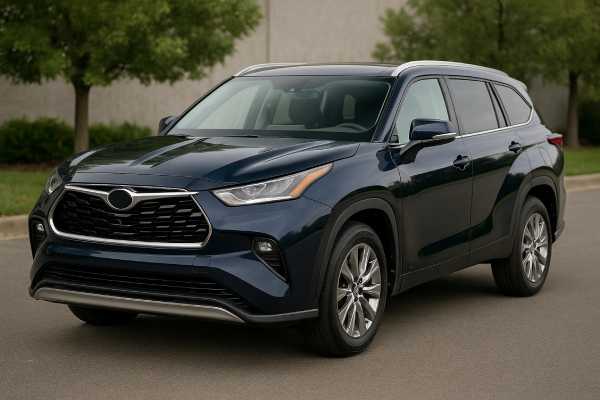
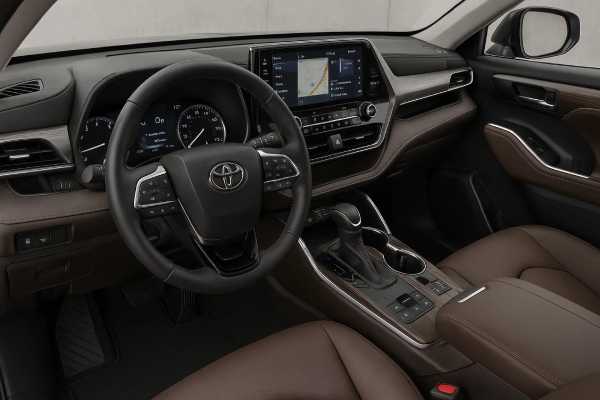
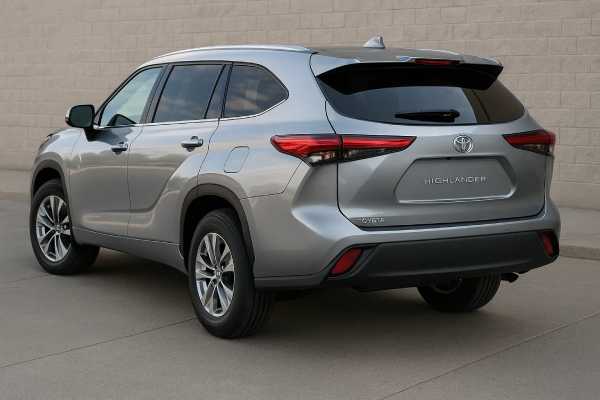
The fourth-generation Toyota Highlander (GSU70) pairs a proven 295-hp 3.5-liter 2GR-FKS V6 with an 8-speed automatic and a lighter, stiffer TNGA-K platform. In FWD form, it’s the value and efficiency play of the lineup: quieter on the highway than the outgoing model, more composed over broken pavement, and notably easier to park thanks to a tightened turning circle. Families will appreciate an intuitively laid-out cabin, flexible seating for seven or eight, and a real-world 24 mpg combined rating—strong for a three-row V6 crossover. Safety tech took a step forward in this generation, with Toyota Safety Sense standard and further upgrades beginning in 2021. The Highlander isn’t about drama; it’s about dependable daily miles, straightforward ownership costs, and confidence in poor weather when shod with good all-season tires. If you want a durable, refined people-mover that still tows 5,000 lb with the proper package, the FWD V6 makes a compelling case.
Fast Facts
- Quiet, refined TNGA-K ride; confident 8-speed tuning; 0–60 mph ~6.7 s.
- Practical cabin with 16.1 / 40.6 / 73.3 ft³ cargo flexibility; easy third-row access.
- Strong value retention and broad parts availability lower long-term costs.
- Watch for software updates/TSBs that improve shift quality; inspect for water-pump seepage around 60–90k mi.
- Typical oil service: every 10,000 mi or 12 months with 0W-20 (rotate tires at 5,000 mi).
Explore the sections
- Highlander FWD 2020–2022 Briefing
- GSU70 Technical Specifications
- Grades, Options, and Safety Tech
- Reliability, Issues, and Actions
- Maintenance and Buyer Guidance
- Driving Character and Economy
- Highlander FWD versus Rivals
Highlander FWD 2020–2022 Briefing
Toyota redesigned the Highlander for 2020 on the TNGA-K architecture, which brought a stiffer body, better isolation from wind and road noise, and improved crash performance. The FWD gas models use the familiar 2GR-FKS V6 (D-4S direct+port injection) rated at 295 hp (220 kW) and 263 lb-ft (357 Nm), paired with an 8-speed “Direct Shift” automatic. Compared with the previous generation, the fourth-gen’s cargo area grew behind the third row (16.1 ft³), and second-row fore-aft travel increased, making third-row access easier. Practical touches abound: wide-opening rear doors, a low cargo floor, and thoughtful storage cubbies up front.
From 2020 onward, all Highlanders include Toyota’s Safety Sense suite; for 2021 the system advanced to TSS 2.5+, refining pedestrian detection, lane-centering, and adaptive cruise logic. Headlights also improved on most trims, which matters for night driving confidence and insurance costs. Even in FWD form, traction off the line is predictable with quality tires, and hill-start assist plus trailer-sway control are standard. The chassis tuning is family-friendly—more controlled than softly sprung rivals, but never harsh. Steering is light at low speeds and reassuringly steady on the highway.
Ownership highlights include low routine service costs, widely available parts, and excellent resale. Common buyer questions center on the V6 versus the newer 2.4-liter turbo (introduced for 2023). If you prefer a naturally aspirated powerband, the 2020–2022 V6 FWD is the last of its kind in the Highlander—smooth, reliable, and easy to service. With the factory tow package, this FWD V6 also handles a 5,000-lb trailer, provided tongue weight and cooling requirements are respected. For families that prioritize quiet comfort, predictable handling, and straightforward maintenance, the GSU70 FWD is a sweet spot.
GSU70 Technical Specifications
Engine and Performance (ICE-only)
| Item | Specification |
|---|---|
| Code | 2GR-FKS (V6, Dual VVT-i, D-4S) |
| Layout & cylinders | Transverse V6; DOHC; 4 valves/cyl |
| Bore × stroke | 94.0 × 83.0 mm (3.70 × 3.27 in) |
| Displacement | 3.5 L (3,456 cc) |
| Induction | Naturally aspirated |
| Fuel system | D-4S (direct + port fuel injection) |
| Compression ratio | 11.8:1 |
| Max power | 295 hp (220 kW) @ ~6,600 rpm |
| Max torque | 357 Nm (263 lb-ft) @ ~4,700 rpm |
| Timing drive | Chain |
| Emissions/efficiency standard | EPA (U.S.) |
| Rated economy (FWD V6) | 21/29/24 mpg US (city/hwy/comb) = 11.2/8.1/9.8 L/100 km |
| Real-world highway @ 75 mph | ~9.4–10.2 L/100 km (25–23 mpg US), wind/grade dependent |
| Aerodynamics | Cd ~0.33; frontal area ~2.8 m² (est.) |
Transmission and Driveline
| Item | Specification |
|---|---|
| Transmission | 8-speed automatic (Direct Shift) |
| Drive type | FWD |
| Final drive | ~3.00 (varies slightly by trim) |
| Differential | Open (front); brake-based torque vectoring |
Chassis and Dimensions
| Item | Specification |
|---|---|
| Platform | TNGA-K |
| Suspension (front/rear) | MacPherson strut / multi-link |
| Steering | Electric power steering; ~14–15:1 ratio |
| Brakes | 4-wheel discs (vented front) |
| Wheels/Tires | 18 in (235/65R18) to 20 in (235/55R20) |
| Ground clearance | ~203 mm (8.0 in) |
| Length/Width/Height | ~4,950/1,930/1,730 mm (194.9/76.0/68.1 in) |
| Wheelbase | 2,850 mm (112.2 in) |
| Turning circle | ~11.4 m (37.4 ft) |
| Curb weight | ~1,880–1,980 kg (4,145–4,365 lb) |
| GVWR | ~2,630–2,700 kg (varies by trim) |
| Fuel tank | 67.8 L (17.9 US gal / 14.9 UK gal) |
| Cargo volume (SAE) | 456 / 1,150 / 2,076 L (16.1 / 40.6 / 73.3 ft³) — 3rd up / 3rd down / max |
Performance and Capability
| Metric | Value |
|---|---|
| 0–100 km/h (0–62 mph) | ~7.0 s (0–60 mph ~6.7 s) |
| Top speed | ~185 km/h (115 mph) limited |
| Braking 100–0 km/h | ~37–39 m (typical instrumented tests) |
| Towing capacity | 2,268 kg (5,000 lb) with factory tow package |
| Payload | Trim-dependent; typically ~600–750 kg (1,300–1,650 lb) |
| Roof load | Check label; dynamic ratings vary by rails/crossbars |
Fluids and Service Capacities
| System | Specification / Capacity |
|---|---|
| Engine oil | SAE 0W-20, API SN Plus or later; approx. 5.5 L (5.8 US qt) with filter |
| Coolant | Toyota Super Long Life (pink) 50/50; approx. 11–12 L (11.6–12.7 US qt) |
| ATF (8-speed) | Toyota WS; typical drain-fill ~3.5–4.0 L (3.7–4.2 US qt) |
| A/C refrigerant | R-1234yf; charge ~600–700 g (21–25 oz) |
| A/C compressor oil | ND-11; ~120 mL (4.1 fl oz) |
| Key torque values | Wheel lug nuts ~103 Nm (76 lb-ft); oil drain plug ~39–40 Nm (29–30 lb-ft) |
Capacities vary by VIN and residual fluid; verify against the vehicle’s under-hood labels and service literature.
Electrical
| Item | Specification |
|---|---|
| Alternator | ~150 A |
| 12V battery | Group 24F (typical), ~60–65 Ah |
| Spark plugs | Long-life iridium; gap ~1.0–1.1 mm (0.039–0.043 in) |
Safety and Driver Assistance
| Area | Summary |
|---|---|
| Crash ratings | IIHS: strong overall with updates during the run (TSP/TSP+ depending on year/trim); NHTSA: 5-Star Overall Rating (model-line). |
| Headlight performance | Improved for 2021+ on most trims; specific headlamp units affect IIHS headlight grade. |
| ADAS suite | TSS 2.0 (2020) → TSS 2.5+ (2021–2022): AEB w/ pedestrian detection, full-speed adaptive cruise, lane departure alert, lane tracing assist, road sign assist. Blind-spot monitoring and rear cross-traffic alert widely available; parking sonar/brake support optional. |
Grades, Options, and Safety Tech
2020 lineup (gas, FWD available): L, LE, XLE, Limited, Platinum. All include Toyota Safety Sense, Apple CarPlay, Android Auto, three-zone climate control, and seating for seven (captain’s chairs) or eight (bench). LE adds blind-spot monitoring with rear cross-traffic alert. XLE brings SofTex-trimmed seating, heated fronts, power moonroof, and a larger instrument display. Limited upgrades to leather, ventilated seats, JBL audio, and available 20-inch wheels. Platinum adds a panoramic moonroof, 12.3-inch touchscreen, birds-eye view camera, and HUD. The towing package (HD radiator, engine oil cooler, enhanced fan) unlocks the 5,000-lb rating—confirm equipment on the build sticker if towing matters.
2021 additions/changes: The XSE grade joined the gas lineup, slotting between XLE and Limited. It features firmer springs, a stiffer rear stabilizer bar, retuned shocks, and a recalibrated EPS for a sportier feel, plus unique bumpers and 20-inch wheels. Toyota also rolled out TSS 2.5+, refining AEB logic and lane-centering, and improved headlamps on many trims—changes that helped the Highlander achieve higher safety accolades in 2021.
2022 model year notes: Carry-over powertrain and packaging for the gas FWD models. Minor feature shuffle and expanded availability of the larger touchscreen and connected services on upper trims. If you want the most tech and the most readily available lighting improvements while staying with the V6, 2021–2022 builds are sweet spots.
Quick identifiers:
- XSE: twin-tip exhaust, honeycomb grille, black exterior accents, red-stitched interior, and tighter steering feel.
- Limited/Platinum: chrome grille accents, 20-inch wheels (model-specific designs), JBL audio availability, and panoramic roof (Platinum).
- Tow-package vehicles: larger engine-cooling hardware and factory 4-/7-pin wiring at the hitch.
Safety highlights:
- Structure and restraints testing for the 2020 redesign scored well in IIHS evaluations; 2021 saw headlight updates and advanced driver-assist refinements.
- Front crash prevention (vehicle-to-vehicle and pedestrian) performance is strong when properly calibrated. After windshield or front-radar service, expect an ADAS calibration—build time and cost into repair planning.
- LATCH anchors are accessible in the outboard second-row seats; the third row is tighter, but workable with narrow seats.
Reliability, Issues, and Actions
The 2GR-FKS V6 and 8-speed automatic are well-proven. Most owners experience years of uneventful service with routine fluids and filters. Still, smart buyers and technicians look out for a short list of patterns:
Common (low–medium cost):
- Water-pump seepage (60–100k mi). Symptom: sweet smell, pink crust near pump housing, slow coolant loss. Fix: replace pump and gasket; refresh SLLC coolant; inspect belt and idlers.
- Brake vibration (urban use / light towing). Symptom: shimmy under highway braking. Fix: torque wheels correctly; check pad imprinting; resurface or replace rotors; consider higher-friction pads on heavier trims with 20-inch wheels.
- Infotainment quirks (early 2020 builds). Symptom: intermittent Bluetooth/CarPlay drops. Fix: head unit reflash and updated firmware; ensure clean grounds and correct USB cables.
Occasional (medium cost):
- 8-speed shift feel on gentle throttle. Symptom: low-speed hunting or a 2–3 flare. Fix: ECU/TCU software update; verify mounts; road-test hot and cold.
- Rear HVAC blend-door actuator noise. Symptom: clicking behind quarter panel. Fix: replace actuator; inspect foam seals.
Rare (higher cost):
- Evaporative emissions leaks (loose cap or cracked purge/vent lines). Symptom: EVAP codes, fuel odor. Fix: smoke test; replace affected valve/line; clear monitors.
- Direct-injection carbon is mitigated by the D-4S port injectors, but short-trip use can still leave deposits on intake valves over long intervals. Prevention: quality fuel, regular highway runs; Remedy: walnut-shell clean if misfire/rough idle persists at high mileage.
Service bulletins/recalls to check:
- Low-pressure fuel pump (broad Toyota campaign in the 2018–2020 era, VIN-specific). Confirm completion in official databases.
- Head unit and camera software (select 2020 vehicles). Ensure the latest calibration is flashed.
- ADAS calibration requirements after windshield or radar/bumper service. Improper alignment can degrade lane-centering and AEB.
Pre-purchase checklist:
- Scan for codes/monitors; review VIN recall status; confirm tow package if you need 5,000 lb.
- Inspect coolant pump area and under-tray for crusting; check transmission pan for seepage.
- Evaluate brake thickness/rotor runout; feel for steering kickback over speed bumps (bushings).
- Verify even tire wear and alignment; measure tread on all four corners.
- Test ADAS functions on a well-marked road; confirm no windshield-camera fault codes after glass replacement.
Maintenance and Buyer Guidance
Practical maintenance schedule (U.S. pattern; always verify by VIN):
- Engine oil/filter (0W-20): every 10,000 mi / 12 months; 5,000 mi tire rotation and multipoint inspection.
- Engine air filter: 30,000 mi (15–20k in dusty areas).
- Cabin filter: 15,000–20,000 mi or annually.
- Coolant (SLLC pink): first at 100,000 mi / 10 years, then 50,000 mi / 5 years.
- Spark plugs (iridium): 120,000 mi; inspect coil boots at plug service.
- Brake fluid: test annually; replace ~3 years as best practice.
- ATF (Toyota WS): inspect at services; for longevity, consider a drain-and-fill every 60,000–90,000 mi under towing, hot climates, or heavy urban use.
- Drive belt/hoses: inspect every 30,000 mi; replace at signs of cracking/glazing or age-out (~8–10 years).
- Wheel alignment: check annually or after impacts/tire changes.
- 12-V battery: load-test before winter after 3–4 years; clean/secure grounds.
- Brake hardware and sliders: clean/lube at 15–20k mi intervals to prevent tapered pad wear.
Fluid quick-refs (decision-making):
- Oil: SAE 0W-20, API SN Plus/SN-RC or newer.
- ATF: Toyota WS only (do not mix).
- Coolant: Toyota Super Long Life (pink) premix 50/50.
- A/C: R-1234yf, ND-11 oil.
- Lug torque: ~103 Nm (76 lb-ft).
- Tow setup: factory hitch, wiring, HD cooling, brake controller for heavier trailers; keep tongue weight ~10% of trailer mass.
Buyer’s guide—what to seek/avoid:
- Best bets: 2021–2022 XLE for value (heated seats, roof, driver aids) or Limited for JBL and ventilated seats.
- Sporty pick: XSE for firmer damping and sharper steering (mind the 20-in tire replacement cost).
- Check carefully: early-build 2020 infotainment firmware; any vehicle with aftermarket glass—ensure camera calibration docs; tow-package confirmation for 5,000-lb rating.
- Durability outlook: Excellent. With conservative maintenance and quality fluids, the 2GR-FKS/8-speed combo regularly exceeds 200,000 mi with minimal major repairs.
Driving Character and Economy
Ride, handling, NVH: The TNGA-K chassis is the star: it filters small bumps without float, resists head toss over speed humps, and stays settled in long sweepers. Road roar is subdued on 18-inch tires; 20-inch packages add a touch more impact feel and tire thrum, but steering precision improves. Straight-line stability is strong—crosswinds and truck wash are non-events—helped by the longer wheelbase and improved body sealing. Brake feel is linear with meaningful initial bite; repeated downhill stops benefit from downshifts via the console gate.
Powertrain character: The naturally aspirated V6 is smooth and willing, with clean throttle tip-in and a satisfying pull above 4,000 rpm. Around town, the 8-speed shuffles to higher gears quickly for economy; in rolling terrain, using Normal or Sport mode reduces hunting. Passing response from 50–80 mph is confident when the transmission drops two gears; the kickdown is prompt, and the engine note stays refined.
Real-world economy: Expect 23–25 mpg US combined (9.4–10.2 L/100 km) for most drivers; 29 mpg US highway (8.1 L/100 km) is attainable at legal speeds on flat ground with low winds. Short trips in winter can dip to the high teens; summer highway family road trips often return mid-20s. The Highlander’s tall gearing helps; so does its low-drag shape and under-floor aero. A roof box or bikes will cost 2–4 mpg; a 3,500-lb trailer can halve highway economy—plan fuel stops accordingly.
Towing and load: With the tow package, the FWD V6 tows 5,000 lb confidently on level ground. Watch the tongue weight, keep transmission temperatures in check with appropriate gearing, and leave margin on long grades in hot weather. Braking with a properly adjusted trailer brake controller is stable, but tire pressures and pad condition matter—check both before trips.
Traction and control: FWD Highlanders behave predictably on all-seasons; in snowbelt regions, a set of quality winter tires transforms takeoff traction and steering precision. Stability-control tuning is conservative but transparent, gently trimming power when front tires spin on slick intersections.
Highlander FWD versus Rivals
Honda Pilot (V6): Spacious and smooth, but interior noise and transmission feel lag the Toyota, and resale typically trails. Pilot’s boxier cargo area is handy; Highlander counters with better material fit/finish and slightly higher highway economy.
Kia Telluride / Hyundai Palisade (V6): Cabin space and third-row comfort favor the Koreans, along with long warranties and tech value. The Highlander’s advantages are long-term reliability, resale strength, and broader parts availability. In FWD form, the Toyota is typically quieter at 70–75 mph and maintains higher trade-in values.
Ford Explorer (2.3T/10-speed): RWD-based packaging improves towing dynamics, but fuel economy swings more with driving style and the cabin can feel busier over sharp impacts. Toyota’s naturally aspirated V6 delivers steadier real-world economy and lower long-term complexity.
Subaru Ascent (2.4T): Standard AWD and strong safety credentials impress. The Highlander’s V6 feels smoother and less taxed at full load; Toyota’s interior wear-resistance and infotainment stability are plusses over a six- to eight-year horizon.
Nissan Pathfinder (V6/9-speed, 2022-): Upsized and improved, but resale and dealer network depth favor Toyota. Highlander’s steering and cabin quietness feel more mature; Pathfinder’s cargo space is competitive.
If you value an easy ownership experience, predictable efficiency, and a refined, quiet cabin over maximum third-row space, the Highlander FWD V6 remains a smart, low-drama choice.
References
- Gas Mileage of 2020 Toyota Highlander 2020 (EPA Database)
- World Premiere of All-New 2020 Highlander at New York International Auto Show 2019 (Press Release)
- Toyota Highlander Adds XSE Grade + Toyota Safety Sense 2.5+ for 2021 2020 (Press Release)
- 2020 Toyota Highlander 2020–2025 (Safety Rating)
- 2020 TOYOTA HIGHLANDER SUV AWD 2020 (Safety Rating)
Disclaimer
This article is for informational purposes and is not a substitute for professional diagnosis, repair, or official service documentation. Specifications, torque values, fluid types, and maintenance intervals can vary by VIN, model year, trim, and market equipment. Always confirm details in the vehicle’s owner’s manual and service literature, and follow all safety procedures. If you found this helpful, please share it with friends on Facebook or X to support xcar’s work.