
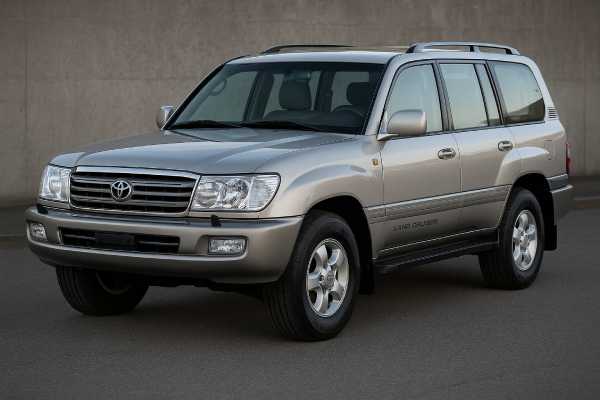
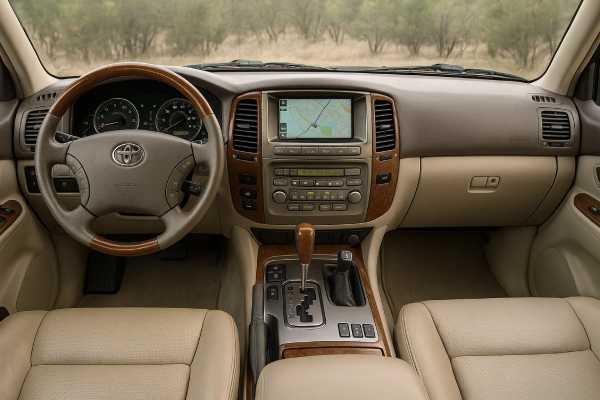
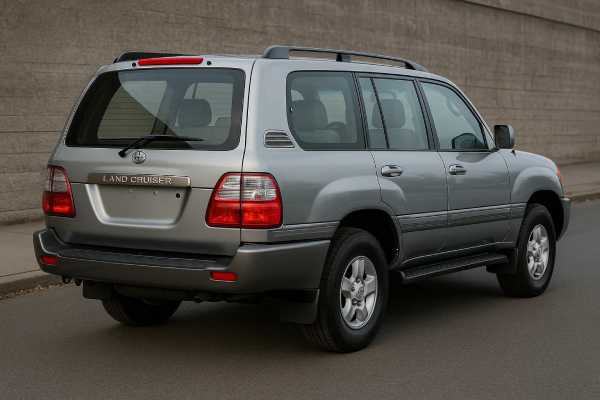
The 2003–2005 Toyota Land Cruiser (UZJ100) represents the sweet spot of the 100-Series in North America: a robust 4.7-liter V8, full-time four-wheel drive with a lockable center differential, and the first widespread availability of a 5-speed automatic in this generation. It keeps the truck-like backbone—body-on-frame construction, low-range gearing, serious approach and departure angles—while offering long-trip comfort, eight-passenger seating, and luxury touches that age well. Owners prize these years for their balance of mechanical simplicity and durability, with a timing-belt V8 that runs quietly and delivers strong low-rpm torque. Compared with later 275-hp updates, the 235-hp UZJ100 is slightly less urgent but still confident, especially on highway grades and towing within its rating. Fuel economy is the main trade-off, and regular preventive service is essential for a heavy SUV that often sees family, towing, and adventure duty. If you are shopping used, these facelift years are standouts for capability and longevity.
At a Glance
- Proven 2UZ-FE V8, quiet and long-lived; full-time 4×4 with locking center differential and low range.
- Comfortable highway ride from independent front suspension; supportive seats and durable interior materials.
- Strong tow rating (6,500 lb / 2,948 kg) and useful cargo space (up to 90.8 ft³ / 2,572 L seats down).
- Watch for timing-belt age (6 years/90,000 miles) and hydraulic brake booster wear as the miles climb.
- Typical service touchpoint: engine oil 5,000 miles / 6 months with 5W-30; diff and transfer fluids 60,000 miles in normal use.
Explore the sections
- UZJ100 2003–2005 overview
- Land Cruiser UZJ100 specs and data
- UZJ100 trims, options, safety
- Reliability, issues, and service actions
- Maintenance and buyer’s guide
- Driving and performance
- UZJ100 vs rivals
UZJ100 2003–2005 overview
The facelifted 100-Series (model code UZJ100) refined the Land Cruiser formula without losing its core. A ladder frame supports an independent double-wishbone front suspension and a four-link, coil-sprung solid rear axle. This layout smooths highway ride and sharpens steering compared to the solid-axle 80-Series, yet maintains the articulation and strength that matter off-road. Power comes from Toyota’s 2UZ-FE, a 4.7-liter DOHC 32-valve V8 known for smoothness and longevity. In these years, output is 235 hp (175 kW) and 320 lb-ft (434 Nm). It pairs to an electronically controlled automatic—already a 5-speed by 2003 in North America—feeding a two-speed transfer case (high 1.000:1, low 2.488:1). Full-time 4WD includes a lockable center differential for difficult surfaces; A-TRAC brake-based traction, ABS with EBD, Brake Assist, and Vehicle Stability Control (VSC) are standard.
Inside, eight seats (with removable/fold-away third row), simple ergonomics, and quality switchgear age gracefully. Optional features of the period—factory navigation with backup camera, rear DVD, and 18-inch wheels—were offered alongside standard JBL audio, leather, and a power moonroof. The facelift brought revised lighting, minor exterior trim updates, and meaningful convenience upgrades like Bluetooth integration on navigation-equipped models.
Capability remains the headline. Skid plates protect the front suspension, transfer case, and fuel tank; minimum running ground clearance is 9.8 in (250 mm), with approach/breakover/departure angles around 31°/24°/24°. Payload is roughly 1,470 lb (667 kg), and towing is rated at 6,500 lb (2,948 kg) with the proper hitch and equipment. On the road, the UZJ100 is quiet and steady at speed. Off the road, it crawls predictably in low range, and A-TRAC helps keep forward progress when cross-axled. The trade-offs are curb weight (about 5,390 lb/2,445 kg) and thirst: expect mid-teens mpg in mixed U.S. driving. For many owners, the blend of comfort, honesty of construction, and real 4×4 hardware defines why these years are still sought after.
Land Cruiser UZJ100 specs and data
Engine and Performance (ICE)
| Item | Specification |
|---|---|
| Code | 2UZ-FE |
| Layout & cylinders | V8, DOHC, 32 valves, aluminum heads/iron block |
| Bore × stroke | 94.0 × 84.0 mm (3.70 × 3.31 in) |
| Displacement | 4.7 L (4,663 cc) |
| Induction | Naturally aspirated |
| Fuel system | Sequential multi-port electronic fuel injection |
| Compression ratio | ~9.6:1 |
| Max power | 235 hp (175 kW) @ 4,800 rpm |
| Max torque | 434 Nm (320 lb-ft) @ 3,400 rpm |
| Timing drive | Belt (interference-safe design; replace on schedule) |
| Emissions class | Tier-1/LEV era calibrations (state-dependent) |
| Rated economy (EPA) | ~13 mpg city / 16 mpg hwy / 14 mpg combined (18.1 / 14.7 / 16.8 L/100 km) |
| Real-world highway @ 75 mph | ~15–16 mpg US (14.7–14.0 L/100 km), stock tires, light load |
Transmission and Driveline
| Item | Specification |
|---|---|
| Transmission | 5-speed ECT automatic (A750F) |
| Gear ratios | 1st 3.52, 2nd 2.04, 3rd 1.40, 4th 1.00, 5th 0.716, Rev 3.224 |
| Final drive ratio | 4.10:1 (front/rear) |
| Transfer case | HF2A, full-time 4×4, lockable center diff; high 1.000:1 / low 2.488:1 |
| Differential type | Open front/rear with A-TRAC brake-based traction; lockable center |
Note: Some early literature describes the 5-speed ECT from the start of the facelift. Marketplace vehicles in North America from 2003–2005 commonly have the A750F 5-speed.
Chassis and Dimensions
| Item | Specification |
|---|---|
| Suspension (front/rear) | Double-wishbone with torsion bars / 4-link solid axle with coils |
| Steering | Power-assisted rack-and-pinion |
| Brakes | 4-wheel ventilated discs; ABS with EBD and Brake Assist |
| Wheels/Tires | 17×7.5 in wheels with P275/65R17; 18×8 in with P275/60R18 optional |
| Ground clearance | 250 mm (9.8 in) |
| Angles (approach/departure/breakover) | ~31° / 24° / 24° |
| Length / Width / Height | 4,889 / 1,941 / 1,859 mm (192.5 / 76.4 / 73.2 in) |
| Wheelbase | 2,850 mm (112.2 in) |
| Turning circle (curb-to-curb) | 12.1 m (39.7 ft) |
| Curb weight | ~2,445 kg (5,390 lb) |
| GVWR | ~3,112 kg (6,860 lb) |
| Fuel tank | 96 L (25.4 US gal / 21.1 UK gal) |
| Cargo volume (SAE) | 2,572 / 1,110 / 589 L (90.8 / 39.2 / 20.8 ft³) — behind 1st/2nd/3rd rows |
Performance and Capability
| Metric | Value |
|---|---|
| 0–60 mph / 0–100 km/h | ~9.5–10.5 s (stock tires; unladen) |
| Top speed | ~180–190 km/h (112–118 mph), governed |
| Braking 100–0 km/h (62–0 mph) | ~39–43 m (128–141 ft), dependent on pads/tires |
| Towing capacity (braked) | 2,948 kg (6,500 lb) |
| Payload | ~667 kg (1,470 lb) |
| Roof load | ~75 kg (165 lb) with appropriate crossbars |
Fluids and Service Capacities
| System | Specification / Capacity |
|---|---|
| Engine oil | API SL+ 5W-30 (or later spec that supersedes) • ~6.6–6.8 L (7.0–7.2 qt) with filter |
| Coolant | Toyota Long Life / Super Long Life (phosphated HOAT) • ~12.0–12.5 L (12.7–13.2 qt) mix per label |
| Automatic transmission | Toyota ATF Type T-IV • drain/fill ~3–4 L (3.2–4.2 qt); total ~10–11 L (10.5–11.6 qt) |
| Transfer case | Toyota ATF Type T-IV • ~1.5–1.6 L (1.6–1.7 qt) |
| Front differential | 75W-90 GL-5 • ~1.5–1.6 L (1.6–1.7 qt) |
| Rear differential | 75W-90 GL-5 • ~3.0–3.3 L (3.2–3.5 qt) |
| A/C refrigerant | R-134a • ~0.95 kg (33.5 oz) |
| A/C compressor oil | ND-OIL8 (equiv. PAG 46) • ~120 mL (4.1 fl oz) |
| Essential torques | Wheel lugs 131 Nm (97 lb-ft) • Spark plugs 25 Nm (18 lb-ft) • Oil drain 39 Nm (29 lb-ft) |
Always confirm by VIN in the factory manual for your exact build year and options.
Electrical
| Item | Specification |
|---|---|
| Alternator | ~100–130 A, model/year dependent |
| 12 V battery | Group 27F typical • ~70 Ah / ~700+ CCA |
| Spark plugs | Iridium (e.g., Denso SK20R11) • 1.1 mm (0.044 in) gap |
Safety and Driver Assistance
| Area | Details |
|---|---|
| Crash ratings | No IIHS tests for this generation; U.S. star-ratings were limited/incomplete for these years. Verify by VIN. |
| Headlights | Not IIHS-rated for these model years. |
| Passive safety | Dual front airbags; seat-mounted side airbags and side curtain airbags available/packaged in 2003–2004, widely equipped by 2005. LATCH anchors for second row. |
| Active safety | ABS with EBD and Brake Assist, VSC stability control, TRAC/A-TRAC traction, center diff lock; TPMS appears with certain packages by 2004. |
| Calibration notes | After any steering/suspension work or yaw-rate sensor replacement, follow the specified VSC/ABS zero-point calibration procedure. |
UZJ100 trims, options, safety
Trims and equipment (North America):
The Land Cruiser is essentially a single, fully equipped grade for 2003–2005, with options packaged rather than traditional trims. Core features include leather seating, power moonroof, JBL premium audio, full-time 4WD with a lockable center differential, skid plates, 17-inch wheels, and seating for eight. Option highlights:
- Navigation/Infotainment packages: Voice-activated DVD navigation with a 7-inch display; backup camera; Bluetooth (on navigation-equipped trucks from the mid-facelift); integrated climate/audio controls; rear-seat DVD entertainment system.
- Wheel packages: 18-inch alloys with 275/60R18 tires available.
- Convenience/appearance: Roof rails with crossbars and running boards package; privacy glass.
- Safety packages: Front seat-mounted side airbags and full-length side curtain airbags were optional in 2003–2004 and widely equipped by 2005. TPMS availability increases toward 2004.
Mechanical distinctions by year:
- 2003: Facelift styling and interior updates. 5-speed ECT automatic commonly specified; 235-hp V8 continues. Optional 18-inch wheels arrive.
- 2004: Navigation package adds backup camera and early Bluetooth integration; tire options expand; safety packaging more widely ordered.
- 2005: Same 235-hp 2UZ-FE; five-speed automatic continues; equipment mixes and colors updated. (A jump to ~275 hp occurs for 2006, outside this article’s scope.)
Quick identifiers:
- Wheels/tires: 17-inch 5-spokes standard; 18-inch 5-spokes optional.
- Badging/interior: Leather with JBL and moonroof standard; navigation-equipped trucks have the larger center screen and integrated controls.
- VIN/build: UZJ100 designator; option codes in the door-jamb build label can confirm wheel and airbag packages.
Safety ratings summary:
This generation lacks the granular IIHS ratings buyers now expect. NHTSA testing coverage was limited; consult the official database by VIN for star-ratings where available. A notable factory campaign (curtain-shield airbag control module programming) covers 2003–2006 Land Cruisers; ensure completion is recorded. Side/curtain airbags—if fitted—provide meaningful added protection for family use; verify with the build sheet.
ADAS and service implications:
These Land Cruisers predate modern camera/radar suites. Active safety centers on VSC stability control and TRAC/A-TRAC traction. After alignment, rack replacement, or significant suspension work, zero-point calibration for yaw/accel sensors is required; an uncalibrated vehicle may display warning lamps and altered stability control thresholds.
Reliability, issues, and service actions
Owners seek these years because the major systems are stout and well-understood. With age and mileage, expect wear in predictable places. Below, problems are grouped by prevalence and cost.
Common (typical with age/miles):
- Timing belt/water pump due or overdue → Symptom: age-cracked belt, seep at pump weep hole, dried idler bearings. Cause: maintenance interval passed. Remedy: replace belt, tensioner, idlers, and pump together; renew thermostat/coolant; reset base timing marks.
- Hydraulic brake booster/accumulator fatigue → Symptom: longer pedal travel, frequent pump cycling, or ABS/VSC lights. Cause: internal wear in electro-hydraulic master cylinder/accumulator. Remedy: replace complete booster/master assembly; bleed per procedure; inspect for leaks at lines.
- Radiator top-tank seep or plastic brittleness → Symptom: sweet smell, crust at tank seam. Cause: age/heat cycling. Remedy: replace radiator; use correct coolant; inspect trans cooler lines and fan clutch.
- Driveshaft slip-yoke “thud” → Symptom: clunk after stops/starts. Cause: dry slip joint. Remedy: flush and pack with high-moly grease; inspect U-joints; repeat at intervals.
- Oxygen sensors / catalytic converter aging → Symptom: MIL on (P013x/P015x), reduced economy. Cause: sensor age; catalyst efficiency. Remedy: replace upstream O2 sensors proactively near 150k miles; diagnose catalyst per emissions test data.
- Steering rack seep/leak and bushing wear → Symptom: assist whine, play on-center. Cause: seal wear; bushing degradation. Remedy: rebuild/replace rack; align; consider poly rack bushings.
Occasional:
- Front wheel bearings and hub seals → Symptom: growl, grease weep. Cause: heavy tires/off-road use. Remedy: replace bearings/seals; set correct preload.
- Rear axle seal/diff breather issues → Symptom: gear oil at brake backing plate. Cause: clogged vent elevates housing pressure. Remedy: replace seal; clean/extend breather; verify bearing.
- Heater T-pipes and rear heater lines (rust belt) → Symptom: coolant odor, visible coolant at steel lines. Cause: corrosion. Remedy: replace with updated or stainless parts; protect with rust inhibitor.
- Door lock actuators → Symptom: slow/no lock. Cause: motor brushes. Remedy: replace actuators or motor inserts.
Rare but important:
- ABS pump motor failure → Symptom: multiple brake warnings, hard pedal. Remedy: assembly replacement; confirm relay power and grounds.
- ECM/VSC calibrations needed after sensor/module replacement → Symptom: persisting lights; odd VSC behavior. Remedy: perform zero-point calibration and ECM relearns with a capable scan tool.
Recalls/TSBs to confirm (by VIN):
- Curtain-shield airbag (CSA) control module programming/replacement (2003–2006): unintended deployment shortly after startup under specific motions; remedy is module replacement/programming.
- Review for seatbelt component and airbag inflator campaigns applicable by VIN and state.
Pre-purchase checklist:
- Documented timing belt/pump replacement within time/mileage.
- Brake booster/master pump cycle behavior; warning lights scan; accumulator health.
- Cooling system: radiator condition, heater T-pipes, rear heater lines.
- Underbody corrosion: frame rails, rear crossmember, fuel tank straps, brake/fuel hard lines.
- Driveline: front diff and transfer case fluid service history; slip-yoke lubrication; U-joints.
- Electrical: charging voltage under load; condition of battery/grounds; actuator operation.
- Full VIN recall check and dealer service history where available.
Maintenance and buyer’s guide
Baseline maintenance schedule (typical North America use):
- Engine oil/filter: 5W-30 (or superseding Toyota spec), every 5,000 miles / 6 months. Severe use (towing, short trips, dust) may require shorter intervals.
- Engine air filter: inspect 15,000; replace 30,000 miles (earlier if dusty).
- Cabin filter: 15,000–20,000 miles.
- Fuel filter: in-tank on these years; service only when indicated or during pump work.
- Spark plugs (iridium): 120,000 miles / 10 years; verify part/heat range by VIN.
- Timing belt, idlers, tensioner, water pump: 90,000 miles or 6 years (whichever first). Replace accessory belts concurrently; inspect fan clutch.
- Coolant: Toyota SLLC typical service—100,000 miles / 7 years initial, then 50,000 miles / 3 years. If older red LLC is present, use 30,000 miles / 2 years; never mix types.
- ATF (Type T-IV): drain-and-fill 60,000 miles; more often if towing or hot-climate use.
- Transfer case (ATF T-IV): 60,000 miles.
- Front/Rear differentials (75W-90 GL-5): 60,000 miles normal; 30,000 miles if towing/water crossings.
- Brake fluid: DOT 3/4, every 2–3 years; pressure bleed to protect the hydraulic booster.
- Power steering fluid: ATF Dexron III equivalent; 60,000 miles or on condition.
- Alignment/tyre rotation: rotate 5,000–6,000 miles; align annually or with any steering/suspension work.
- 12 V battery: test annually after year 4; typical life 4–6 years.
- Chassis and driveline lube: grease slip yokes and prop-shafts at every oil change if possible.
Fluid references (for planning):
- Engine oil capacity: ~6.6–6.8 L (7.0–7.2 qt) with filter.
- Cooling system: ~12–12.5 L (12.7–13.2 qt).
- ATF drain/fill: ~3–4 L (3.2–4.2 qt); total ~10–11 L (10.5–11.6 qt).
- Transfer case: ~1.5–1.6 L (1.6–1.7 qt).
- Front diff: ~1.5–1.6 L (1.6–1.7 qt). Rear diff: ~3.0–3.3 L (3.2–3.5 qt).
Essential torque values (decision-grade):
- Wheel lugs 131 Nm (97 lb-ft); spark plugs 25 Nm (18 lb-ft); engine oil drain 39 Nm (29 lb-ft). Always verify per VIN.
Buyer’s guide (what to look for):
- Corrosion: Pay special attention to frame rails, rear crossmember, fuel/brake lines, and the spare-tire hoist.
- Cooling system: Radiator top tank and heater hard lines; look for pink crust or staining.
- Brakes: Listen for frequent booster pump cycling with key-on; ensure pedal feel is consistent.
- Steering/suspension: Rack seepage, torn boots, worn lower ball joints (check play), shocks tired at this age.
- Driveline: Slip-yoke clunk, U-joint lash, diff noise on coast.
- Electrical: All power features, HVAC blend doors, door lock actuators.
- Configuration: If you need the third row, ensure seats and mounts are present—many are removed for cargo space.
- Preferred trucks: Documented belt/pump service within time, fresh fluids throughout, no warning lamps, clean underbody.
- Avoid or budget for: Significant rust, neglected belt service, ABS/booster warnings, overheated/towing-abused units.
Durability outlook:
With routine fluids and attention to the timing belt, these Land Cruisers regularly cross 250,000–300,000 miles (400,000–480,000 km). The big-ticket risks—hydraulic brake booster and neglected cooling system—are manageable with proactive service.
Driving and performance
On the road, the UZJ100 feels like what it is: a solid, heavy, well-damped SUV that prioritizes stability and comfort. The independent front suspension improves straight-line tracking and reduces head toss over patched pavement. Steering is light but predictable; the rack-and-pinion layout brings better on-center feel than older recirculating-ball trucks. Brake feel is reassuring, with a firm pedal and consistent bite; the electro-hydraulic booster assists panic stops. Cabin noise is low for an off-road-capable SUV—wind and tire noise dominate over engine sound at highway speeds, and the V8 hums quietly around 1,900–2,100 rpm in fifth at 65–70 mph.
Powertrain character: The 2UZ-FE makes its best torque down low, which is ideal for towing and climbing. Throttle response is smooth, and the 5-speed ECT’s spacing keeps the V8 in its comfortable midrange; kickdown is decisive without hunting. In daily use, expect 0–60 mph in roughly 9.5–10.5 seconds on stock tires. Passing from 50–70 mph is confident; the gearbox drops to third or fourth and the truck surges without drama.
Efficiency: Real owners typically see 13–15 mpg US mixed (18–16 L/100 km). On steady freeway runs at 60–70 mph (100–113 km/h), 15–16 mpg US (14–15 L/100 km) is common. At 75 mph (120 km/h) with roof gear or larger AT tires, consumption can worsen by 1–2 mpg. Cold weather and remote starts further reduce economy.
Traction and control: Full-time 4×4 with a lockable center differential gives confident winter manners; A-TRAC quietly clamps a spinning wheel to shift torque across the axle. On gravel or snow, VSC intervenes early; selecting low range and locking the center diff loosens the reins for controlled progress. Stock tires are the limiting factor off-road—quality all-terrains transform trail performance without a comfort penalty.
Load and towing: Within the 6,500-lb (2,948-kg) tow rating, the UZJ100 feels composed. The long wheelbase and weight help stability, and transmission temps remain reasonable with fresh ATF and a healthy radiator. Braking confidence is strong; budget extra distance and keep trailer brakes in top shape. Plan for a 25–40% fuel-use penalty when towing moderate loads or running fully laden in mountain terrain.
UZJ100 vs rivals
Cross-shopping a 2003–2005 Land Cruiser means weighing reliability, capability, and ownership costs across several full-size SUVs.
- Lexus GX 470 (J120): Smaller and lighter with the same 4.7-liter V8, plus a live rear axle and available KDSS. It feels nimbler and can be more efficient by 1–2 mpg. Cargo space and third-row practicality favor the Land Cruiser, and the UZJ100’s frame and overall mass deliver superior long-distance comfort with a full load.
- Lexus LX 470 (UZJ100): Mechanically similar but with Active Height Control (AHC) and more sound insulation. The LX rides more softly and is quieter, but AHC adds maintenance complexity. If you want the simpler suspension and a more understated spec, the Land Cruiser is the pick.
- Chevrolet Tahoe/Suburban (GMT800): Lower running costs and plentiful parts; towing and interior volume are competitive. Off-road hardware and long-term durability generally favor the Toyota, and interior materials in the Land Cruiser tend to age better.
- Ford Expedition (U222): Independent rear suspension improves third-row comfort; ownership costs are lower. Reliability is mixed versus the Toyota’s strong record.
- Range Rover L322 (BMW-era V8): Excellent ride and luxury; strong all-terrain capability. However, long-term reliability and repair costs are the trade-off.
- Nissan Armada / Infiniti QX56 (first gen): Big V8 power and tow ratings, but early build quality and brake issues are common. The Toyota’s resale value and drivetrain longevity remain stronger.
Bottom line: If your priorities are longevity, parts availability, and real 4×4 hardware in a comfortable package, the facelift UZJ100 remains a benchmark. It is not the cheapest to fuel, but it is often the least eventful to own over very high mileage.
References
- 2003 Land Cruiser eBrochure 2003 (Brochure)
- 2004 Land Cruiser eBrochure 2004 (Brochure)
- 2005 Land Cruiser eBrochure 2005 (Brochure)
- Gas Mileage of 2005 Toyota Land Cruiser 2005 (EPA Data)
- After Seven Decades, Toyota’s Legendary Land Cruiser Keeps Rolling Along 2019 (Historical Specifications)
- Safety Recall G0C (Interim G1C) – Curtain-Shield Airbag (CSA) Airbag Control Module 2016 (Recall)
Disclaimer
This article is for informational purposes and is not a substitute for professional diagnosis, service procedures, or safety guidance. Specifications, capacities, torque values, calibration requirements, and maintenance intervals vary by VIN, model year, market, and installed equipment. Always verify details against your vehicle’s official service documentation and applicable technical bulletins.
If you found this guide useful, please consider sharing it with fellow enthusiasts and owners on Facebook, X/Twitter, or your favorite forum—your support helps xcar continue producing detailed, owner-focused resources.