
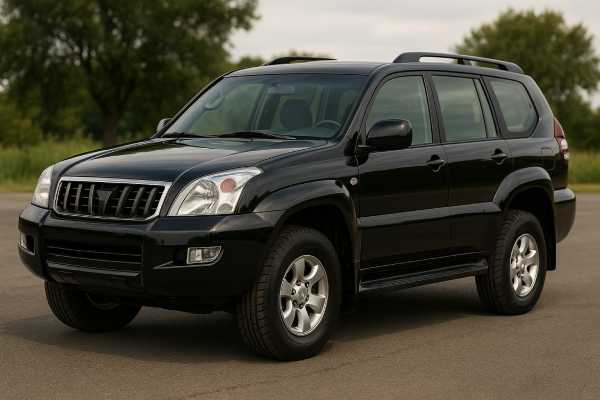
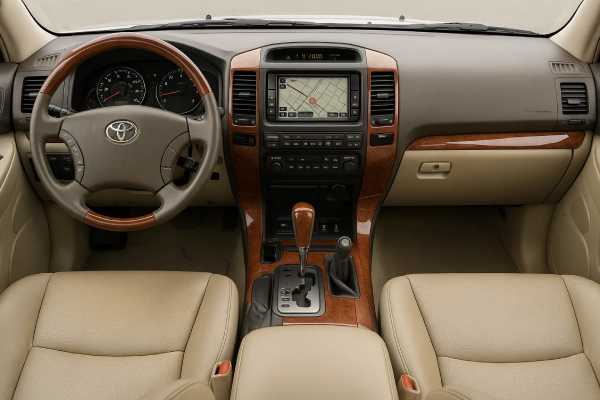
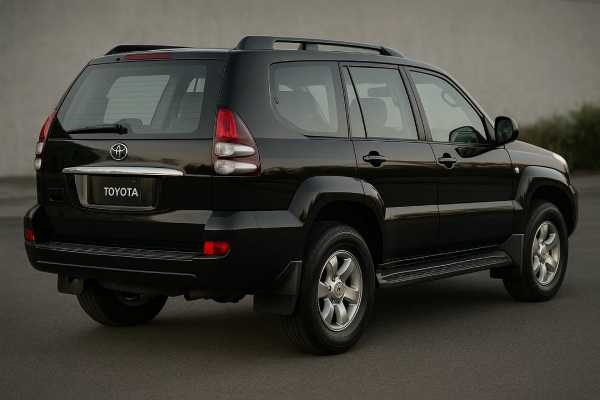
The GRJ120-generation Toyota Land Cruiser (known widely as the Land Cruiser 120/Prado) pairs Toyota’s 1GR-FE 4.0-litre V6 with a rugged ladder frame and full-time four-wheel drive. In Europe (the baseline market for this guide), it arrived in 2003 with coil-spring suspension all round, a two-speed transfer case, and electronic traction aids such as A-TRC, VSC, HAC, and DAC. This combination gives the 120 a rare dual personality: quiet and composed on the motorway, yet deeply capable on steep, broken tracks. The 2005 model-year update brought a 5-speed automatic and 6-speed manual, improving drivability and efficiency. If you are weighing an older premium SUV for mixed family, long-distance, and trail use, this V6 Land Cruiser is one of the safest bets for longevity, parts availability, and residual value. Below, you will find a focused breakdown of specs, equipment, reliability patterns, maintenance guidance, and how it stacks up against rivals.
Fast Facts
- Proven 4.0-litre V6 with strong mid-range torque and smooth highway manners; full-time 4×4 with low range and electronic aids for steep climbs/descents.
- Comfortable, quiet cabin for long trips; eight-airbag protection and stability control on most higher trims.
- Robust towing and payload for its class: up to 2,800 kg braked; roof load 80 kg (market/trim dependent).
- Watch for age-related cooling, suspension bushings, and 4×4 driveline wear; many issues are preventative with timely fluids.
- Typical oil change cadence: every 15,000 km / 12 months (or sooner under severe duty).
Navigate this guide
- GRJ120 Land Cruiser overview
- GRJ120 specs and data
- Trims, options, and safety
- Reliability and known issues
- Maintenance and buying guide
- Driving impressions and efficiency
- Rivals and comparisons
GRJ120 Land Cruiser overview
Toyota’s GRJ120 Land Cruiser (2003–2006) is the European-market evolution of the long-running Land Cruiser mid-size wagon, replacing the Colorado with a stiffer frame, wider track, and modernized safety systems. Power comes from the 1GR-FE 3,956 cc aluminum-block V6 with dual overhead camshafts and variable valve timing (VVT-i). It’s matched to full-time 4×4 with a Torsen-type center differential and a two-speed transfer case (high and low). Electronic helpers—Active Traction Control (A-TRC), Vehicle Stability Control (VSC), Hill-start Assist Control (HAC), and Downhill Assist Control (DAC)—were designed to make off-road driving calm and predictable while keeping the on-road experience serene.
Body styles include a three-door (short-wheelbase) and a five-door (long-wheelbase) with “wide-body” variants on certain trims. Suspension is coil-sprung all around: double-wishbone up front and a four-link rear, with Toyota Electronic Modulated Suspension (TEMS) and height-adjustable rear air springs fitted to upper trims. Brakes are sizable ventilated discs with multi-piston front calipers, chosen as much for repeatability down alpine passes as for single-stop numbers.
Performance numbers published in Europe rate the 4.0 V6 at 245 bhp (183 kW) at 5,200 rpm and 382 Nm at 3,800 rpm, with 0–62 mph (0–100 km/h) in about 9.5 seconds and a top speed around 175 km/h (109 mph), depending on body style and gearbox. You may see 249 hp quoted in sales literature; the difference reflects rating conventions and rounding—official European figures are the ones used throughout this guide.
In 2005, Toyota introduced a 5-speed automatic (replacing the earlier 4-speed) and a 6-speed manual, both improving cruising rpm and response. Trim hierarchy (LC2 through LC5 in the UK) defined chassis tech and equipment: stability/traction systems and DAC/HAC concentrated on LC4/LC5, while LC5 added TEMS with rear air suspension. Across the range, the emphasis was longevity: serviceable mechanicals, conservative tuning, and protection measures underbody and in cooling/induction—factors that explain why many examples still feel tight after high mileage.
GRJ120 specs and data
Engine and Performance (ICE)
| Item | Value |
|---|---|
| Code | 1GR-FE (VVT-i) |
| Layout & cylinders | V6, DOHC, 24 valves |
| Displacement | 3.956 L (3,956 cc) |
| Bore × stroke | 94 × 95 mm (3.70 × 3.74 in) |
| Induction | Naturally aspirated |
| Fuel system | Sequential multi-port injection |
| Compression ratio | 10.0:1 |
| Max power | 245 bhp / 183 kW @ 5,200 rpm (official EU figure; 249 hp often quoted) |
| Max torque | 382 Nm (282 lb-ft) @ 3,800 rpm |
| Rated economy (combined, indicative)** | Five-door petrol A/T ~ 20.8 mpg UK (~17.3 mpg US / 13.6 L/100 km) |
| Real-world highway @ 120 km/h | Typically 12.0–13.5 L/100 km (17–20 mpg US / 20–24 mpg UK), tyre and roof-rack dependent |
| Aerodynamics | Boxy body; focus on cooling and underbody protection vs drag |
**EU period test cycles differ from today’s WLTP; use as a period reference rather than a buying guarantee.
Transmission and Driveline
| Item | Value |
|---|---|
| Drive type | Full-time 4×4, Torsen-type center differential |
| Transfer case | 2-speed, high 1.000 / low 2.566 |
| Early automatic (A/T, 4-speed)** | 1st 2.804, 2nd 1.531, 3rd 1.000, 4th 0.705, Rev 2.393; final 3.909 |
| 2005+ automatic (A/T, 5-speed)** | Wider ratio spread; lower cruise rpm; lock-up in more gears |
| Manual gearboxes | 5-speed (early), 6-speed (2005+), low-range lever or switch depending on trim |
| Differentials | Open front/rear with brake-based A-TRC simulating lock; center Torsen with lock function |
| Replenishment time | Refuel to full: typically 3–5 min at pump |
**Exact gearbox fitment varies by model year and market; verify by VIN/plate.
Chassis and Dimensions
| Item | Three-door | Five-door |
|---|---|---|
| Overall length (wide-body) | 4,365 mm (171.9 in) | 4,810 mm (189.4 in) |
| Overall width (wide-body) | 1,790 mm (70.5 in) (1,875 mm with flares) | 1,790 mm (70.5 in) (1,875 mm with flares) |
| Overall height (roof rails) | 1,850 mm (72.8 in) | 1,850 mm (72.8 in)** (~1,895 mm with TEMS/air) |
| Wheelbase | 2,455 mm (96.7 in) | 2,790 mm (109.8 in) |
| Ground clearance (min, wide-body) | 207 mm (8.1 in) | 207 mm (8.1 in) |
| Approach / departure / breakover (5-door wide-body) | — | 31° / 26° / 19° |
| Turning circle (kerb-to-kerb) | 10.4 m (SWB) | 11.4 m (37.4 ft) |
| Brakes (front/rear) | 338 mm vented discs / 312 mm vented discs | |
| Steering | Rack-and-pinion, variable ratio; ~15.6:1; ~3.0 turns lock-to-lock | |
| Wheels/tyres (typical) | 17×6J (or 17×7J) / 225/70R17 (or 265/65R17) | |
| Kerb (curb) weight (range) | — | ~1,990–2,180 kg (4,387–4,806 lb)*** |
| GVWR (GVW) | 2,600 kg (3-door) | 2,850 kg (6,283 lb) |
| Fuel tank | 87 L (22.98 US gal / 19.14 UK gal) | |
| Cargo volume (max)** | 403 L (3-door) | 620 L (21.9 ft³) |
**Roof rails/TEMS can alter overall height slightly.
***Indicative; varies with trim, body, and tyre package.
Performance and Capability
| Metric | Value |
|---|---|
| 0–100 km/h (0–62 mph) | ~9.5 s (petrol A/T, period figure) |
| Top speed | ~175 km/h (109 mph) |
| Braking distance (100–0 km/h) | Strong, fade-resistant for class; multi-piston fronts help on grades |
| Towing capacity (braked/unbraked) | 2,800 kg / 750 kg (6,173 / 1,653 lb) |
| Payload (typical window) | ~600–700 kg depending on spec |
| Roof load | 80 kg (176 lb) |
Fluids and Service Capacities (guide, verify by VIN)
| System | Specification | Notes (capacity varies by build) |
|---|---|---|
| Engine oil | 5W-30 API SL/SM (high-detergent) | Replace filter each service; typical capacity ~5.5–6.0 L (5.8–6.3 qt) |
| Coolant | Toyota Super Long Life (pink), 50/50 | Replace at age/mileage; bleed heater circuits thoroughly |
| Automatic transmission | Toyota ATF Type T-IV (early 4-spd) / Toyota ATF WS (2005+ 5-spd) | Check fill spec by trans code |
| Manual transmission | GL-4/GL-5 75W-90 (Toyota spec) | Capacity differs 5MT vs 6MT |
| Transfer case / diffs | GL-5 75W-90 | Low-range use benefits from fresh oil intervals |
| A/C refrigerant | R134a | Typical charge band ~650–750 g; UV-dye optional for leak tracing |
| A/C compressor oil | ND-Oil 8 equivalent | Charge quantity per compressor label |
| Key torque examples | Wheel nuts ~ 131 Nm (97 lb-ft); drain/fill plugs ~ 39–49 Nm—verify per model-year bulletin |
Electrical (key items)
| Item | Value |
|---|---|
| Alternator | Typically ~90–100 A depending on trim/equipment |
| 12 V battery | ~70–80 Ah; DIN/H6 form factor common |
| Spark plugs | Long-life iridium; typical gap ~1.1 mm (0.043 in) |
Safety and Driver Assistance
| Item | Content / Notes |
|---|---|
| Structure | Ladder frame with reinforced body mounts; crumple-zone design; side-impact beams |
| Restraints | Eight airbags (front, side, curtain) on many trims; three-point belts for all seats |
| Stability | VSC, A-TRC widely available/standard on upper trims |
| Hill aids | HAC (hill-start) and DAC (downhill) on selected auto models |
| Child seats | ISOFIX/LATCH anchor points on rear seats; check positions per seating layout |
| Lighting | Projector headlamps on certain trims; headlamp washers on higher grades |
| Crash ratings | No widely published Euro NCAP score specific to 2003–2006 120-series; treat as unrated in EU consumer testing; focus on equipment and driver-assist availability when comparing |
Trims, options, and safety
European trim logic (UK illustration): LC2, LC3, LC4, LC5.
All versions share the core ladder frame, full-time 4×4 with low range, and disc brakes. The trim walk primarily changes cabin tech, driveline electronics, and suspension sophistication.
- LC2 (entry): Cloth upholstery, manual air-con, part-time feature content. Mechanical core intact; ideal for buyers prioritizing simplicity.
- LC3 (mid): Adds convenience features (alloy wheels, enhanced audio, possibly rear air-con depending on market).
- LC4 (upper): Stability control (VSC) and Active Traction Control (A-TRC) standard; HAC and DAC typically bundled when automatic. More comprehensive safety and towing kit, upgraded interior trims.
- LC5 (range-topper): TEMS semi-active suspension with height-adjustable rear air springs; premium audio and navigation; leather; more acoustic insulation.
Mechanical/functional differences to note
- Transmissions: Early models offered a 4-speed A/T; 2005 facelift introduced a 5-speed A/T and 6-speed M/T that lower cruise rpm and sharpen low-range control.
- Differentials: Brake-based A-TRC simulates locking front/rear diffs; centre diff lock selectable. After heavy off-road use, A-TRC calibration and wheel-speed sensor condition impact performance—ensure clean sensors and correct tyre sizes.
- Brakes: Large ventilated discs with multi-piston front calipers; LC5 often has the most heat capacity due to weight and tyre spec.
Year-to-year highlights (Europe)
- 2003: Launch; 1GR-FE V6 joins diesel later in Q1; LC2–LC5 grades; large safety feature leap vs prior Colorado.
- 2004: Running refinements; options/packages adjusted regionally.
- 2005: Powertrain update with 5-speed A/T and 6-speed M/T; equipment and interior trim upgrades; chassis tuning revisions for ride control.
- 2006: Final pre-facelift year with matured feature mix.
Safety systems and child-seat notes
- Airbags: Dual-stage front airbags; front side and full-length curtain airbags on many trims. Confirm curtain coverage pattern in the specific 7- or 8-seat layout.
- Child seats: ISOFIX anchorages on outer second-row seats (market dependent). The third row is often fold-flat jump-style seating; most child seats are incompatible there.
- ADAS calibration: Post-repair, a four-wheel alignment with steering-angle sensor zeroing helps VSC/A-TRC accuracy. After windscreen or front-bumper work, check sensor harnesses and wheel-speed sensors for correct routing and shield integrity.
Reliability and known issues
The 1GR-FE/GRJ120 combination is well-regarded for longevity. Age and use now dominate the fault pattern. Below, issues are grouped by prevalence (common/occasional/rare) and severity/cost (low/medium/high). Mileage figures are typical bands, not hard limits.
Engine and cooling
- Common / low–medium:
- Accessory belt noise or cracking (100–150k km): Age and heat. Remedy: Replace belt and inspect idlers/tensioner.
- Radiator end-tank seep (10–15 years): Plastic tank fatigue. Remedy: Preventive radiator replacement and coolant refresh; inspect ATF cooler if integrated.
- Occasional / medium:
- Water pump seep/weeping hole (100–180k km): Shaft seal wear. Remedy: Replace pump with gasket; bleed coolant carefully (heater core).
- Thermostat aging (stuck-open): Cool running and poor heat. Remedy: Replace thermostat and gasket; verify warm-up profile.
- Rare / medium–high:
- Head gasket failure under sustained overheating: Usually secondary to cooling neglect. Remedy: Correct root cause; pressure test, skim/replace as required. Prevention is key—use the correct coolant and interval.
Fuel/induction and ignition
- Common / low:
- Dirty throttle body / idle air passages: Rough idle. Remedy: Clean and relearn if necessary; ensure genuine gasket.
- Old spark plugs (≥100k km): Misfire under load. Remedy: Replace iridium plugs; torque to spec; confirm coil boots are clean and dry.
- Occasional / low–medium:
- MAF contamination: Hesitation and rich trims. Remedy: Clean with MAF-safe cleaner; recheck trims.
Driveline/4×4
- Common / low:
- Differential/transfer oils overdue: Whine or notchiness. Remedy: Replace with correct GL-5 and recheck for metal; listen after 500 km.
- Occasional / medium:
- Front CV boots split after off-road use: Grease fling; early clicking. Remedy: Reboot or replace axle; check upper/lower ball joints and alignment.
- A-TRC/VSC feeling “late” or intrusive: Tyre size/pressures mixed, or wheel-speed sensor issues. Remedy: Match tyre sizes/pressures; inspect/clean sensors; zero steering-angle sensor after alignment.
Suspension and steering
- Common / low–medium:
- Rear trailing-arm and panhard bush wear (120–200k km): Clunk/steer delay. Remedy: Press in quality bushes; align.
- Front lower-control-arm rear bush cracking: Vague braking/turn-in. Remedy: Replace bush or arm; align.
- Occasional / medium:
- Rear air-spring aging on TEMS LC5: Sagging or compressor over-cycle. Remedy: Replace air bags (in pairs) and check height sensors and lines; inspect dryer.
Brakes
- Common / low:
- Rust ridge on rear discs; sticky sliders in salted regions: Uneven wear. Remedy: Clean/grease sliders with high-temp silicone/PTFE grease; replace discs/pads as needed.
Body and corrosion
- Occasional / medium:
- Rear tailgate lower seam and underbody brackets: Scale/rust in wet climates. Remedy: Clean, treat, seal; underbody inspection annually.
- Rare / high (neglected examples):
- Frame scale at crossmembers or mounts: More common with heavy trailer use and poor washing. Remedy: Professional inspection, derust, coating; avoid severe cases.
Recalls and service actions
- Regional campaigns varied. For a European vehicle, use your official VIN check and dealer history to confirm completion of applicable campaigns (airbag inflators, seat belt anchors, or electronics harness routing where relevant). Keep documentation; some goodwill warranties required evidence of timely services.
Pre-purchase checklist
- Full service records (coolant, ATF, diff/transfer oils).
- Evidence of recent brakes and suspension bushing work.
- Smooth 4×4 engagement, quiet diffs, and no driveline shunt on throttle lift.
- Cooling system pressure test; radiator age.
- Underside corrosion inspection, especially fuel/brake lines and rear frame brackets.
- Matching, correct-load tyres; check for mixed sizes that confuse VSC/A-TRC.
Maintenance and buying guide
Service cadence (typical European practice; adjust for severe duty)
- Engine oil and filter: Every 15,000 km / 12 months; halve interval for short-trip, dusty, or towing use.
- Engine air filter: Inspect every 15,000 km; replace 30,000–45,000 km or sooner off-road.
- Cabin filter: 15,000–30,000 km depending on environment.
- Spark plugs (iridium): 90,000–120,000 km or 6–8 years.
- Coolant (SLLC pink): First replacement at 160,000 km or 10 years, then every 80,000 km or 5 years (typical SLLC guidance).
- Automatic transmission fluid: Inspect condition every 60,000 km; refresh 60,000–90,000 km under towing/hilly use (use T-IV or WS as applicable).
- Manual transmission/transfer/differentials: Replace oils every 60,000–80,000 km when used off-road or for towing.
- Brake fluid: Replace every 2 years.
- Brake pads/discs: Inspect each tyre rotation; expect rears to suffer more corrosion in light use.
- Serpentine belt and idlers: Inspect 30,000 km; replace on condition (cracks/noise).
- Suspension and alignment: Inspect bushes/ball joints at each service; align annually or after off-road trips.
- Tyre rotation and pressures: Rotate every 10,000–12,000 km; maintain load-appropriate pressures.
- 12 V battery: Test annually after year 4; replace proactively at 5–7 years in cold climates.
Fluids at a glance (decision-making)
- Oil: 5W-30, quality detergent oil; typical refill ~5.5–6.0 L with filter.
- ATF: Early 4-speed uses Type T-IV; 2005+ 5-speed uses WS.
- Gears: GL-5 75W-90 across diffs/transfer (check VIN notes).
- Coolant: Toyota SLLC 50/50 premix; bleed heater circuits.
- A/C: R134a; expect ~650–750 g system charges.
Buyer’s short list
- Powertrain: Cold start, listen for belt/roller noise; steady idle. On road, look for smooth upshifts and no flare; verify center diff lock engages and releases quietly.
- Cooling: Check radiator age and any coolant crust near end tanks; confirm cabin heat and stable temp on climbs.
- Driveline: On/off throttle in 2H (center open) and 4H-lock to feel for clunks; check CV boots.
- Suspension: Rear air-spring height stability (LC5); look for corner sag after parking overnight.
- Brakes: Even pull, no judder from corroded discs; quiet operation after several stops.
- Body: Tailgate lower seam, rear chassis brackets, fuel/brake lines; remove spare wheel to inspect.
- Electrics: All windows/locks, mirror heaters, rear heater/AC where equipped; ABS/VSC lamps extinguish after start.
- Tyres: Correct size and matching set; mis-matched diameters harm A-TRC/VSC logic.
Durability outlook
With routine fluids, cooling upkeep, and chassis bushings renewed at appropriate intervals, the V6 120-series routinely exceeds 300,000 km without major internal engine work. The limiting factors tend to be corrosion in harsh climates and neglected suspension/steering components—both manageable with proactive inspections.
Driving impressions and efficiency
Ride, handling, NVH
On the motorway the GRJ120 is settled and directional; the long wheelbase and multi-link rear keep lateral motions tidy, and the cabin isolation is excellent for its era. TEMS-equipped LC5 models float less over crests and recover more quickly from big dips, while non-TEMS versions already ride comfortably on 17-inch tyres. Wind and tyre noise are modest by early-2000s standards, helped by generous sealing and under-bonnet insulation.
Steering and braking
The rack-and-pinion steering is light at parking speeds and reassuring near straight-ahead. Brake feel is firm and progressive, and multi-piston front calipers give confidence on long descents with a trailer. Stability control intervenes gently; A-TRC can be felt “pinching” a spinning wheel off-road but remains unobtrusive on tarmac.
Powertrain character
The 1GR-FE wakes up above 2,500 rpm with a smooth surge to 5,500 rpm. Intake VVT-i gives decent low-end torque, so urban drivability is better than the figures suggest. The 2005+ 5-speed auto keeps revs lower at cruise and is less busy on rolling hills; early 4-speed autos are durable but cruise a bit higher in top gear. In low range, throttle mapping is gentle and predictable, and DAC/HAC take the drama out of steep, loose surfaces.
Real-world economy
Expect 12–15 L/100 km (19–24 mpg UK / 15–20 mpg US) in mixed European use, with steady 120 km/h motorway trips around 12–13.5 L/100 km. Roof boxes, all-terrain tyres, and lift kits can push consumption upward by 5–15 percent. Towing a mid-size caravan or boat typically adds another 20–35 percent depending on speed and terrain.
Towing and load
At up to 2,800 kg braked, the GRJ120 is stable and confidence-inspiring when properly loaded with 7–10 percent tongue weight. The long wheelbase and rear suspension geometry manage pitch well; TEMS air rear can level a heavy caravan, but even coil-spring models tow faithfully provided fresh shocks and correct tyre load ratings are in place.
Rivals and comparisons
Land Rover Discovery 3 (2004–2006): More sophisticated suspension and cabin tech, but higher running-cost risk as vehicles age. The Toyota trades some on-road suppleness for far stronger dependability and simpler maintenance.
Mitsubishi Pajero/Shogun (Gen 3): Similar body-on-frame honesty and low-range gearing. The Toyota’s V6 is smoother and the cabin generally quieter; Pajero parts are widely available but interiors feel more dated and road noise is higher.
Nissan Pathfinder (R51): Comfortable cruiser with competitive towing numbers. The Land Cruiser’s 4×4 calibration and braking confidence on long grades give it an edge for mountain towing and technical trails.
Overall, the GRJ120 V6 remains the conservative, durable choice: fewer surprises, simpler service, and excellent resale. If you want a long-distance family 4×4 that can also pass the “remote trail” test, it is still a benchmark.
References
- The All-New Toyota Land Cruiser 2002 (Press Release)
- Toyota Land Cruiser Powers Up For 2005 Model Year 2004 (Press Release)
- All-new vehicle, replacing Land Cruiser Colorado 2002 (Press Pack with Technical Specifications)
Disclaimer
This guide is for informational purposes and is not a substitute for professional diagnosis, service, or repair. Specifications, torque values, capacities, and maintenance intervals vary by VIN, model year, market, and equipment. Always verify details against your vehicle’s official service documentation and parts catalog.
If this article helped, consider sharing it with fellow enthusiasts on Facebook or X/Twitter to support xcar’s work.