
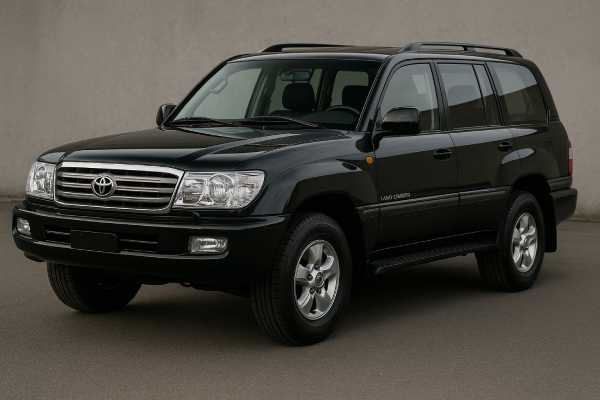
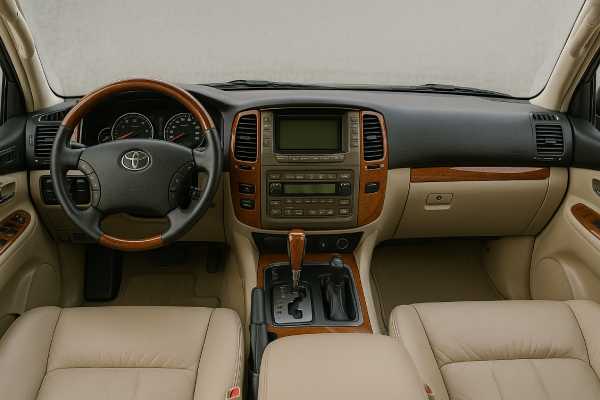
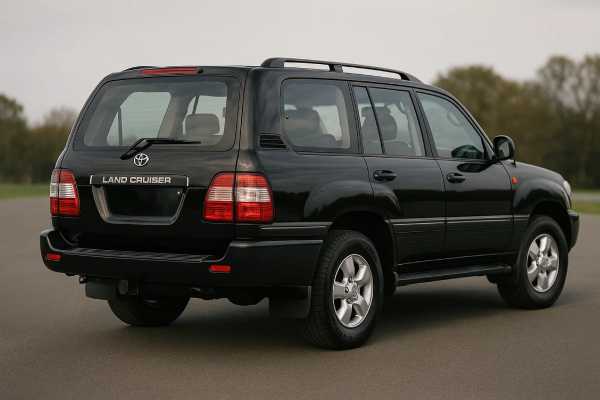
The 2003–2007 Land Cruiser HDJ100 facelift pairs Toyota’s overbuilt ladder frame and full-time 4×4 with the 1HD-FTE 4.2-litre turbodiesel—an inline-six known for low-rpm torque, long service life, and uncomplicated maintenance. This generation added subtle styling changes, improved NVH, and, in many European markets, a single high-spec seven-seat “Amazon” grade with locking centre and rear differentials and available height-adjustable suspension. If you want a large SUV that tows 3,500 kg (braked), cruises quietly, and tolerates rough conditions, the HDJ100 is still a benchmark. It is not a modern ADAS showcase—no automatic emergency braking or lane assist—but it counters with mechanical durability, predictable handling, and a cabin that wears mileage well. Ownership hinges on prudent care of the AHC (Active Height Control) system where fitted, timely timing-belt changes, and periodic fluid services across the driveline.
Fast Facts
- Strong 1HD-FTE: 201 hp (150 kW), 430 Nm from 1,400–3,200 rpm; relaxed towing and off-road control.
- Proven 4×4 hardware: full-time 4×4, centre and rear diff locks, 256 mm ground clearance, 3,500 kg tow rating.
- Caveat: AHC/TEMS spheres, height sensors, and lines age—budget for inspection, potential replacement or conversion.
- Typical timing belt: 100,000 km / 60,000 miles (or ~6 years) with idlers and water pump inspected/replaced as needed.
Navigate this guide
- HDJ100 1HD-FTE overview
- HDJ100 specs and technical data
- Trims, options, safety and driver aids
- Reliability, issues and service actions
- Maintenance and buyer’s guide
- Driving impressions and performance
- How it compares to rivals
HDJ100 1HD-FTE overview
The facelifted (2003–2007) Toyota Land Cruiser 100—badged “Amazon” in the UK—refined an already capable package. Externally, it gained a tidier grille and lamp updates; inside, many markets standardized navigation and high-grade trim. The star is the 1HD-FTE: a 24-valve, single-turbo, electronically controlled injection pump diesel with 201 hp and a broad 430 Nm plateau from 1,400 to 3,200 rpm. It’s tuned for longevity and real-world drivability, not headline speed, and is happiest pulling a trailer or climbing a pass at low revs.
The chassis formula remains classic Land Cruiser: boxed ladder frame, independent double-wishbone front suspension, a stout 4-link live rear axle, and full-time 4×4 with a locking centre differential. Many European cars also carry a lockable rear differential from the factory, a key advantage off-road. On-road, versions with Toyota’s AHC (Active Height Control) and TEMS (adaptive damping) ride with surprising composure for a solid-axle SUV, though those systems need periodic attention as the vehicles age.
The HDJ100 facelift keeps electronic aids simple—ABS and, on some petrol models, VSC/traction control. Diesels focus on mechanical traction: gearing, locks, and tyres. That simplicity, along with generous cooling and driveline margins, is why these trucks regularly see 300,000–500,000 km with routine care. The trade-offs are weight (≈2.5–2.7 tonnes curb), thirst relative to modern diesels, and a driving position rooted in early-2000s ergonomics.
HDJ100 specs and technical data
Engine and Performance (1HD-FTE)
| Item | Specification |
|---|---|
| Code | 1HD-FTE (EU diesel) |
| Layout and cylinders | Inline-6, SOHC, 24 valves (4 valves/cyl) |
| Bore × stroke | 94 × 100 mm (3.70 × 3.94 in) |
| Displacement | 4.164 L (4,164 cc) |
| Induction | Single turbocharger, air-to-air intercooler |
| Fuel system | Electronically controlled distributor-type injection pump (direct injection) |
| Compression ratio | 18.5:1 |
| Max power | 201 hp (150 kW) @ 3,400 rpm |
| Max torque | 430 Nm (317 lb-ft) @ 1,400–3,200 rpm |
| Timing drive | Belt (cam) with gear/belt ancillaries |
| Emissions class (typical) | Euro 3 (market dependent) |
| Rated efficiency (manual) | Urban 14.1 L/100 km (16.7 mpg US / 20.0 mpg UK); Extra-urban 9.29 L/100 km (25.3 mpg US / 30.4 mpg UK); Combined 11.12 L/100 km (21.1 mpg US / 25.4 mpg UK) |
| Rated efficiency (automatic) | Urban 15.78 L/100 km (14.9 mpg US / 17.9 mpg UK); Extra-urban 10.78 L/100 km (21.8 mpg US / 26.2 mpg UK); Combined 12.61 L/100 km (18.7 mpg US / 22.4 mpg UK) |
| Real-world highway @ 120 km/h (75 mph) | 12–13 L/100 km (19.6–18.1 mpg US / 23.5–21.7 mpg UK), stock tyres and roof-rack removed |
| Aerodynamics | Cd ≈ 0.40 |
Transmission and Driveline
| Item | Specification |
|---|---|
| Drive type | Full-time 4×4 with lockable centre differential |
| Differentials | Centre lock; rear lock (factory on many EU cars) |
| Manual transmission | 5-speed (factory documentation lists R151F) |
| Manual gear ratios | 1st 4.081; 2nd 2.294; 3rd 1.490; 4th 1.000; 5th 0.881; Rev 4.313 |
| Automatic (diesel) | A442F 4-speed (common EU diesel fitment) |
| Auto gear ratios (diesel) | 1st 2.950; 2nd 1.530; 3rd 1.000; 4th 0.765; Rev 2.678 |
| Final drive | Manual 3.90:1 (front/rear); Auto 4.10:1 (front/rear) |
| Transfer case | 2-speed, high/low with centre lock |
Chassis and Dimensions
| Item | Specification |
|---|---|
| Front suspension | Independent double-wishbone, coil springs, stabilizer |
| Rear suspension | 4-link live axle with lateral rod, coil springs, stabilizer |
| Steering | Rack and pinion; ratio 18.0:1 |
| Brakes | Front ventilated discs (4-piston), rear ventilated discs; parking brake: drum (in hat) |
| Wheels and tyres | 275/60 R18 (factory) |
| Ground clearance | 256 mm (10.08 in) |
| Approach/departure angles | 34° / 23° (typical EU spec) |
| Length / width / height | 4,890 / 1,940 / 1,850 mm (192.5 / 76.4 / 72.8 in) |
| Wheelbase | 2,850 mm (112.2 in) |
| Track (front/rear) | 1,620 / 1,615 mm (63.8 / 63.6 in) |
| Turning circle (kerb-to-kerb) | 5.9 m (19.36 ft) |
| Curb weight | 2,495–2,660 kg (5,501–5,864 lb) |
| GVWR | 3,260 kg (7,187 lb) |
| Fuel tank | 96 L (25.4 US gal / 21.1 UK gal) |
| Towing capacity (braked) | 3,500 kg (7,716 lb) |
Performance and Capability
| Item | Manual | Automatic |
|---|---|---|
| 0–100 km/h (0–62 mph) | 13.6 s | 13.1 s |
| Top speed | — | 109 mph (175 km/h) |
| Towing capacity (braked) | 3,500 kg (7,716 lb) | 3,500 kg (7,716 lb) |
| Payload (approx.) | 600–765 kg (1,323–1,687 lb) depending on spec | 600–765 kg (1,323–1,687 lb) |
Fluids and Service Capacities (typical EU HDJ100; verify by VIN)
| System | Spec | Capacity |
|---|---|---|
| Engine oil (1HD-FTE) | ACEA A3/B4 (or API CH-4/CI-4) 5W-40/10W-40 (climate dependent) | ~11.4 L (12.0 US qt) with filter; ~10.1 L (10.7 US qt) without; ~12.1 L (12.8 US qt) dry fill |
| Engine coolant | Toyota Long Life Coolant (red), 50/50 mix | ~12.8–13.3 L (13.5–14.1 US qt), variant and heater configuration dependent |
| Manual transmission | GL-4/GL-5 75W-90 | ~2.7 L (2.9 US qt) |
| Automatic transmission (A442F, pre-2004) | Dexron II/III | ~6.0 L (refill; full dry more) |
| Automatic transmission (later WS systems) | Toyota ATF WS (market/year dependent) | ~3.0 L (refill) |
| Transfer case | GL-4/GL-5 75W-90 | ~1.3 L (1.4 US qt) |
| Front differential | GL-5 80W-90 | ~1.6 L (1.7 US qt) |
| Rear differential (open/LSD) | GL-5 80W-90 (LSD additive if equipped) | ~3.3 L (3.5 US qt) |
| A/C refrigerant | R-134a | Charge varies by optioning; service to weight |
| AHC hydraulic fluid (if equipped) | Toyota AHC fluid | Fill per bleeding procedure; inspect/refresh per condition |
| Key torque (example) | Wheel lug nuts | ~131 Nm (97 lb-ft); confirm per owner’s/service manual |
Electrical
| Item | Specification |
|---|---|
| Alternator (typical) | ~120 A (market/equipment dependent) |
| 12 V battery | Often dual 12 V batteries in parallel (typical 80–95 Ah each); verify fitment |
| Spark plugs | Not applicable (diesel) |
Safety and Driver Assistance
| Item | Status |
|---|---|
| Crash ratings | No Euro NCAP or IIHS star ratings published for this generation in Europe/North America |
| Airbags | Front, side, and curtain airbags (market standardization from facelift) |
| Stability control | Fitted mainly to petrol models; diesels emphasize mechanical locks |
| ABS / EBD / BA | Standard |
| Child-seat provisions | ISOFIX/LATCH provision varies by market; check vehicle |
| ADAS (AEB/ACC/LKA etc.) | Not available on this generation |
Trims, options, safety and driver aids
Trims and options (Europe, facelift years 2003–2007). Many markets—UK included—rationalized to a single, high-spec seven-seat grade often known as “Amazon.” Equipment commonly included leather, powered and heated front seats with memory, DVD-based navigation with a touch-screen interface, a Rear Park Assist Monitor, Bluetooth telephony, climate control (dual zones up front), an electric sunroof, rain-sensing wipers, 18-inch alloys, side steps, and roof rails. Mechanical highlights that set the HDJ100 apart in this period:
- Full-time 4×4 with centre differential lock and factory rear differential lock on many EU diesels.
- Suspension: independent double-wishbone front and 4-link solid rear; AHC/TEMS (height control and adaptive damping) widely fitted—excellent comfort when fresh.
- Transmissions: 5-speed manual on diesels; 4-speed automatic (A442F) on many diesel cars; 5-speed automatics were more common with the V8 petrol in Europe.
- Tyres: 275/60 R18 OE; off-roaders often step to 265/70 R17 or 285/65 R18—note effects on gearing and speedometer.
Year-to-year changes that matter.
- 2003 model-year facelift: new grille and lamp details; updated interior electronics; standardization of curtain airbags in many markets; chassis retuning of AHC/TEMS; petrol models introduced VGRS (Variable Gear Ratio Steering).
- 2005 update (MY2006): minor styling refresh (grille, lens details), additional cabin tech and accessory options (rear entertainment).
- Running changes: market-specific alternator outputs, audio/nav hardware iterations, and minor trim colour shifts.
Safety features and calibration notes.
- Airbags: driver and passenger front, front side, and curtains (verify by VIN; some early builds may vary). If airbags deploy or SRS components are replaced, most systems require scan-tool initialization and SRS ECU DTC checks; no radar or camera calibrations exist on this generation.
- ABS/EBD/BA: standard; wheel speed sensors are robust but vulnerable to wiring damage during suspension work.
- VSC/TRC: more common on petrol models; diesels emphasize mechanical locking traction.
- Child seats: ISOFIX availability varies by seat and market—physically check anchor presence in the second row before purchase.
Quick identifiers.
- VIN and build codes: HDJ100 denotes the diesel inline-six; UK cars typically list “Land Cruiser Amazon.”
- Interior tells: AHC height switch and suspension mode selector (Comfort/Sport) near the shifter; rear diff lock switch by the steering column or centre stack (varies).
- Exterior tells: 18-inch factory alloys, updated grille and lamps post-facelift, roof rails and side steps on high-spec cars.
Reliability, issues and service actions
The HDJ100 with 1HD-FTE is one of Toyota’s most durable large SUVs. Age and mileage now drive most faults, not inherent design weaknesses. Prioritize inspection of the following, grouped by prevalence and severity/cost.
Common • Medium to High cost
- AHC/TEMS wear: Symptoms: sagging, slow height changes, “bouncy” ride, or AHC fluid contamination. Likely cause: tired nitrogen spheres (accumulators), corroded hard lines, sticky height sensors. Remedy: replace spheres as a set; flush and bleed the system; repair lines/sensors. Some owners convert to coil-spring non-AHC—ride quality changes and resale preferences vary.
- Rear diff lock actuator seizure: Rarely used actuators corrode. Remedy: remove and refurbish/replace; keep exercised post-repair.
- Front suspension consumables: Lower ball joints, control-arm bushes, and torsion bars (sag) wear under heavy loads and larger tyres. Remedy: quality OEM or reputable aftermarket replacements; align afterward.
Occasional • Medium cost
- Injection pump control (spill control valve / electronics): Rough idle, hard starts, or DTCs related to fuel control. Remedy: testing of the pump control valve and harness; cleaning/replacement as needed; confirm grounds and battery health.
- EGR/Intake soot build-up: Reduced performance and smoke. Remedy: clean EGR valve and intake; verify boost hoses and intercooler integrity; consider maintenance intervals shortened for urban duty cycles.
- Cooling system age: Radiator cores, plastic tanks, and hoses age out. Remedy: replace radiator, hoses, thermostat proactively around 15–20 years; confirm fan clutch operation; refill with correct Toyota LLC.
Occasional • Low to Medium cost
- Driveline oils past due: Whine or clunk from diffs/transfer after neglect. Remedy: drain/refill with correct GL-rated oils; inspect magnets for debris; address seals.
- Wheel bearings and hub seals (front IFS): Play/noise with heavy tyres and off-road use. Remedy: service or replace bearings and seals; verify 4×4 engagement after reassembly.
- Steering rack seep/leak: Age-related. Remedy: reseal or replace; align and bleed.
Rare • High cost (but important to check)
- Head gasket or turbo failure: Uncommon on stock engines with maintained cooling and oil service. Symptoms: pressurized coolant, white smoke, oil in charge pipes. Remedy: proper diagnostics; avoid parts-store fixes; refresh ancillary hoses and the intercooler if contaminated.
- Automatic transmission heat stress (towing/mountains): Old ATF and clogged coolers accelerate wear. Remedy: periodic ATF exchange; ensure cooler flow; consider auxiliary cooler if heavy towing is routine.
Recalls, service campaigns, and verification.
- Airbag/SRS-related campaigns affected many early-to-mid-2000s Toyotas. Campaign scope varies by VIN and market. Always run the VIN through your national recall checker and your local Toyota website’s recall portal. Keep printed proof of completion with the service records.
Pre-purchase checks to request.
- Full service history (oil, timing-belt with idlers and water pump, driveline fluids).
- AHC condition (if equipped): height function, sphere health, leaks.
- Differential lock engagement (centre and rear).
- Evidence of recall completion via official VIN tools.
- Corrosion: rear chassis rails, body seams, tailgate bottom, brake lines.
- Cooling: recent radiator/hoses; coolant type (Toyota LLC).
- Electrical: charging voltage and battery age, especially on dual-battery cars.
Maintenance and buyer’s guide
Practical service schedule (distance/time = whichever comes first).
Use this as a working plan; confirm specifics by VIN and service documentation.
- Engine oil and filter: Every 10,000 miles / 12 months (16,000 km / 12 months) on mixed use; shorten for heavy towing, dusty roads, or lots of short trips. Quality ACEA A3/B4 or API CH-4/CI-4, 5W-40 or 10W-40.
- Fuel filter and water separator: Inspect each oil service; replace every 20,000–30,000 miles / 2–3 years; drain water more often in winter or high-sulfur regions.
- Engine air filter: Inspect every 10,000 miles / 12 months; replace 20,000–30,000 miles (32,000–48,000 km) or sooner in dust.
- Cabin filter: 12–24 months depending on environment.
- Timing belt (1HD-FTE): Replace at 100,000 km / 60,000 miles or ~6 years. Inspect/replace idlers and tensioner; consider water pump if history unknown.
- Serpentine/aux belts and hoses: Inspect every service; replace 60,000–90,000 miles or when cracked/glazed.
- Coolant: Toyota Long Life Coolant (red), 50/50; refresh 3–5 years depending on history and test-strip results. Bleed thoroughly.
- Manual transmission oil: GL-4/GL-5 75W-90; replace every 60,000 miles / 5 years.
- Automatic transmission ATF: A442F with Dexron II/III—refresh every 40,000–60,000 miles (65,000–96,000 km) if towing or primarily city use; later WS systems per guidance but many owners refresh around 60,000 miles.
- Transfer case oil: GL-4/GL-5 75W-90 every 60,000 miles / 5 years.
- Diff oils: GL-5 80W-90 (LSD additive if applicable) every 60,000 miles / 5 years; check for water ingress after deep wading.
- Brake fluid: DOT 3 or DOT 4 every 2 years; test with a meter annually.
- Brake pads/rotors: Inspect every 10,000 miles; pay attention to rotor lip and pad taper with heavy towing.
- Wheel alignment and tyre rotation: Rotate every 5,000–7,500 miles; align annually or after suspension work.
- Valve clearances: The 1HD-FTE uses shim-over-bucket; inspect only if noisy or during major service.
- 12 V batteries: Test annually; replacement window typically 5–7 years; dual-battery cars prefer matched pairs.
- AHC fluid (if equipped): Inspect and bleed per condition; flush if contaminated; evaluate sphere charge by ride/response.
Fluid picks and capacities (quick reference).
- Engine oil: ~11.4 L with filter; use ACEA A3/B4 or API CH-4/CI-4 5W-40/10W-40 appropriate to climate.
- Coolant: ~12.8–13.3 L Toyota LLC.
- Manual gearbox: ~2.7 L GL-4/GL-5 75W-90.
- Auto (A442F): ~6.0 L refill Dexron II/III (full dry more).
- Transfer: ~1.3 L GL-4/GL-5 75W-90.
- Front/Rear diffs: ~1.6 L front; ~3.3 L rear GL-5 80W-90 (LSD additive if equipped).
Buyer’s checklist.
- Warm/Cold start quality and idle stability; no excessive smoke.
- 4×4 system: verify centre and rear diff locks engage (lamp on cluster and actual axle behaviour on a loose surface).
- AHC/TEMS: cycle height modes; listen for the pump; check for leaks on lines and spheres.
- Cooling system: steady temperature, no crusty radiator seams, fresh coolant.
- Gearbox: manual shifts cleanly; automatics engage smoothly, no flare/hunt.
- Chassis and body: rust at rear rails, inner arches, tailgate lower seam; inspect brake and AHC lines.
- Service records: documented timing belt and driveline fluids; recall letters/results printed.
- Tyres and alignment: even wear; oversized tyres can mask gearing stress and speedo error.
Durability outlook. With proper maintenance, the 1HD-FTE routinely clears 300,000 km without internal work; many go far beyond. The AHC system, if retained, is the cost swing factor. A well-maintained, stock-ish truck remains an excellent long-distance tow and overland platform.
Driving impressions and performance
Ride, handling, NVH. The HDJ100 is composed on broken pavement and motorway expansion joints. Independent front suspension calms the secondary motions you feel in older live-axle Toyotas. With AHC/TEMS, body control is better than the silhouette suggests; Comfort mode smothers sharp edges, Sport mode reins in roll without turning it brittle. The steering is steady on-centre and appropriately weighted—more touring-car than trail rig in feel. Brake pedal travel is medium with predictable bite; repeated downhill stops with a trailer benefit from downshifts and cooling pauses to preserve consistency.
Powertrain character. The 1HD-FTE wakes up by 1,400 rpm and pulls cleanly to ~3,400 rpm, where power peaks. There is little drama—just torque. The 5-speed manual has wide ratios but enough length in second/third for technical climbs. The A442F 4-speed automatic shuffles early and will hunt if asked to accelerate gently up longer grades; using the shift gate to hold 3rd helps. With stock tyres and 3.90/4.10 finals, motorway rpm is low enough for quiet cruise at ~120 km/h.
Efficiency and range. Expect mixed consumption around 11–13 L/100 km (21–18 mpg US) in a stock manual truck, 12–14 L/100 km (19.6–16.8 mpg US) for an automatic. At 120 km/h, a healthy truck on OE-size tyres typically returns ~12–13 L/100 km; roof racks, lifts, and all-terrain tyres can add 1–2 L/100 km. The 96-litre tank yields practical ranges of 650–800 km between fills depending on load and terrain.
Traction and control. Full-time 4×4 with a lockable centre differential makes winter and gravel driving straightforward. The rear diff lock transforms step-ups and cross-axle situations off-road; articulate the suspension slowly to protect CVs. Stability-control logic is minimal on diesel models; tyre choice and pressure discipline matter more than electronics here.
Towing and load behaviour. The chassis is inherently stable with 2,500+ kg trailers. Keep ATF fresh in automatics, use a load-distribution hitch where appropriate, and monitor temperatures on sustained grades. Braking remains linear but distances lengthen markedly with weight; set trailer brakes correctly. Fuel consumption with a mid-weight caravan (1,800–2,200 kg) typically rises 20–35 percent over solo figures.
How it compares to rivals
Land Rover Discovery 3 (2004–2009, TDV6). Far newer cabin tech and independent air suspension deliver a more modern drive and advanced traction programs. However, it is heavier on maintenance (air-suspension hardware, electronics, and some engine ancillaries) and less tolerant of neglect. The Toyota gives up infotainment polish but wins on long-term dependability and simple field service.
Nissan Patrol Y61 (3.0 Di). The Patrol is rugged and simple, with a stout live axle front and rear. The 3.0 Di’s earlier reputation for engine issues and lesser towing refinement hold it back. HDJ100’s 1HD-FTE is smoother, torquier, and more relaxed at motorway speeds; Patrol parts can be cheaper in some regions.
Mercedes-Benz G-Class W463 (G270 CDI/G320 CDI). Iconic and capable, but cramped and often far costlier to buy and maintain. The Toyota offers similar expedition credibility with greater interior space and much lower running costs.
Mitsubishi Shogun/Pajero (3.2 Di-D). Lighter and more agile with an excellent Super Select 4×4 system. It is a strong value, though overall cabin robustness, towing composure, and isolation fall behind the Land Cruiser on long trips.
Verdict on rivals. If you prize reliability, mechanical traction, and towing comfort, the HDJ100 1HD-FTE remains the pragmatic choice. If you need the latest driver aids or car-like dynamics, newer unibody SUVs are better—but they will not match the Land Cruiser’s longevity under tough use.
References
- Strong New Arguments For Toyota Land Cruiser Amazon 2002 (Press Release)
- Introducing The 2006 Model Year Toyota Land Cruiser Amazon 2005 (Press Release)
- Check if a vehicle, part or accessory has been recalled 2018 (Recall Database)
- Owner’s Manual 2025 (Portal for vehicle manuals)
Disclaimer
This guide is for informational purposes only and is not a substitute for professional diagnosis or repair. Specifications, capacities, torque values, and maintenance intervals vary by VIN, market, and equipment. Always verify against your vehicle’s official service documentation and follow manufacturer procedures.
If this article helped, feel free to share it on Facebook or X/Twitter to support xcar’s work.