
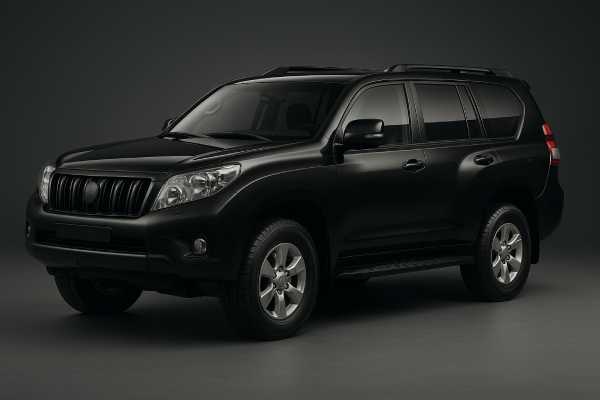
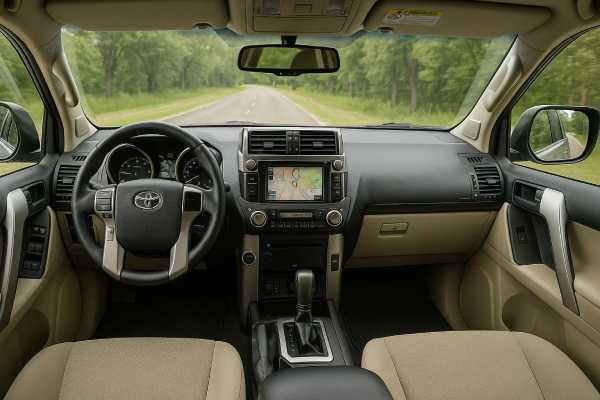
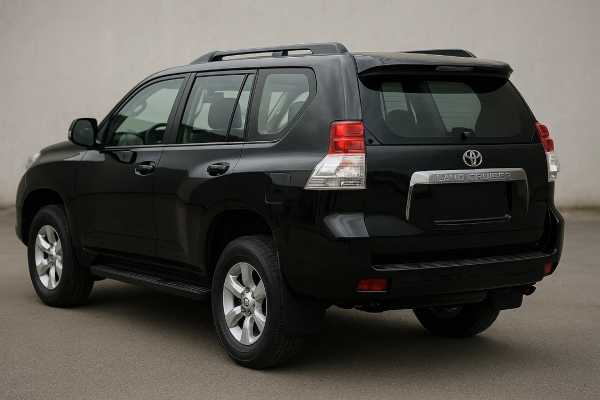
The 2009–2015 Toyota Land Cruiser (GRJ150) pairs the 1GR-FE 4.0-litre V6 with a heavy-duty ladder frame and a full-time four-wheel-drive system designed for real work. This petrol variant is quieter and smoother than the diesel alternatives while keeping the same transfer case with low range, a lockable centre differential, and a long-travel suspension that tolerates ruts, winter roads, and towing. Inside, the 150-series refined noise isolation and seat ergonomics over the 120-series, and most examples offer seven seats with a flat, practical load area. Owners choose the V6 for its clean throttle response, simpler emissions hardware, and predictable cold-weather manners. Expect higher fuel use than the 3.0-litre diesel, but also fewer short-trip complaints and an easy service rhythm built around oil, coolant, and spark-plug intervals. If you value a calm highway ride, genuine off-road traction, and long-term parts continuity, the GRJ150 remains a smart, low-drama buy in Europe’s used-SUV market.
Fast Facts
- Smooth 1GR-FE V6 (timing-chain driven) with broad mid-range and clean response; full-time 4×4 with low range and lockable centre differential.
- High-confidence towing and winter traction; stable steering and strong thermal capacity on long grades.
- Cabin and chassis durability are standouts; electrics and interior trim age well with routine care.
- Watch for water-pump seepage, front cover/valve-cover oil misting, and secondary-air injection faults on short-trip cars.
- Typical oil service: 10,000–15,000 km / 12 months (6,200–9,300 miles / 12 months), shorter if towing or frequent mountain work.
Quick navigation
- GRJ150 Land Cruiser overview
- GRJ150 specs and technical data
- Trims, options, and safety
- Reliability and service actions
- Maintenance and buyer’s guide
- Driving and performance
- How it compares to rivals
GRJ150 Land Cruiser overview
The GRJ150 designates the 150-series Land Cruiser with Toyota’s 1GR-FE petrol V6. In this period the engine delivers a headline 282 hp (≈210 kW) and roughly 385 Nm (284 lb-ft) of torque, tuned for relaxed touring rather than high-rpm fireworks. It is an all-aluminium DOHC 24-valve unit with Dual VVT-i and sequential multi-port fuel injection—simple, robust hardware with a timing chain (no scheduled belt replacement). The V6’s smooth idle and clean off-idle pull make the heavy Cruiser feel less strained in city traffic than the diesel, and it avoids the DPF-specific usage caveats that suit long commutes better than short, cold runs.
The driveline is familiar Land Cruiser territory: a full-time 4×4 system with a Torsen-type centre differential that can be locked, a dual-range HF2A transfer case, and (by market/trim) an optional rear differential lock. Gearing, cooling, and brakes are sized for continuous mountain work and towing. Suspension uses a double-wishbone front and a four-link solid rear axle with coils for wheel travel and durability; KDSS (Kinetic Dynamic Suspension System) appears on higher trims or option packs, hydraulically linking anti-roll bars for flatter cornering on road and more articulation off-road.
Compared with the 120-series, the 150 brings better body sealing, improved NVH isolation, stronger seat frames, and cleaner switch ergonomics. The five-door dominates in Europe, with five or seven seats and a cargo bay that goes wide and tall when the second row folds. The third row suits children or short trips. Most cars ride on 17-inch wheels with sensible tyre profiles; 18-inch packages look sharp but add road noise and can firm up sharp edges.
In daily use the GRJ150’s strengths are predictability and comfort. Steering is calmly weighted and tracks straight on motorways; brake feel is linear; the gearbox (mostly a 5-speed auto in Europe) upshifts early when you want quiet and holds gears on grades without fuss. Off-road, the centre-lock and low range take the anxiety out of steep or slippery sections, and the A-TRC traction logic does credible work simulating axle locks when you lift a wheel.
GRJ150 specs and technical data
Engine and Performance (ICE)
| Item | Detail |
|---|---|
| Code | 1GR-FE (Dual VVT-i) |
| Layout & cylinders | 60° V6, aluminium block/heads, DOHC, 4 valves/cyl |
| Bore × stroke | 94.0 × 95.0 mm (3.70 × 3.74 in) |
| Displacement | 3.956 L (3,956 cc) |
| Induction | Naturally aspirated |
| Fuel system | Sequential multi-port EFI |
| Compression ratio | ~10.4:1 |
| Max power | 282 hp (≈210 kW) @ ~5,600 rpm |
| Max torque | ≈385 Nm (284 lb-ft) @ ~4,400 rpm |
| Timing drive | Chains (no routine replacement) |
| Emissions baseline | Euro 4 early, Euro 5 later (market-dependent) |
| Rated economy (combined) | ~10.5–11.5 L/100 km (22–25 mpg US / 26–30 mpg UK) |
| Real-world @120 km/h (75 mph) | 11–13 L/100 km (18–21 mpg US / 22–25 mpg UK), tyre/roof-load dependent |
| Aerodynamics | Cd ~0.36; frontal area ~2.8 m² (30.1 ft²) |
Transmission and Driveline
| Item | Detail |
|---|---|
| Automatic | 5-speed Aisin A750F with AI-Shift & manual mode |
| Auto ratios | 1st 3.520, 2nd 2.042, 3rd 1.400, 4th 1.000, 5th 0.716, Rev 3.224 |
| Manual (availability varies) | 5- or 6-speed in limited markets |
| Transfer case | HF2A dual-range; high 1.000, low ≈2.566 |
| Final drive ratio | ~3.909:1 (varies by axle pack) |
| Drive type | Full-time 4×4 with Torsen centre diff; centre lock; optional rear locker |
| Refuel to full | ≈5–7 min at typical pump rates |
Chassis and Dimensions
| Item | Detail |
|---|---|
| Platform | 150-series ladder frame (body-on-frame) |
| Suspension (front/rear) | Double wishbone / Four-link solid axle with coils; KDSS available |
| Steering | Hydraulic rack-and-pinion; ratio ~16.6:1 |
| Brakes | Ventilated discs; approx. 338 mm (13.3 in) front / 312 mm (12.3 in) rear |
| Wheels/Tyres | 265/65 R17 (touring comfort) or 265/60 R18 (upper trims) |
| Ground clearance | ~215 mm (8.5 in) |
| Angles (5-door) | Approach ~31°, departure ~25°, breakover ~22° |
| Length / width / height | ~4,840 / 1,885 / 1,845 mm (190.6 / 74.2 / 72.6 in) |
| Wheelbase | 2,790 mm (109.8 in) |
| Turning circle (kerb-to-kerb) | ~11.6 m (38.1 ft) |
| Kerb (curb) weight | ~2,050–2,250 kg (4,519–4,960 lb) |
| GVWR | ~2,990–3,000 kg (6,592–6,614 lb) |
| Fuel tank | 87 L (23.0 US gal / 19.1 UK gal) |
| Cargo volume (5-door) | ~640 L seats up / ~1,833 L seats down (VDA) — 22.6 / 64.7 ft³ |
Performance and Capability
| Item | Detail |
|---|---|
| 0–100 km/h (0–62 mph) | ~10.0–10.8 s (tyre/load dependent) |
| Top speed | ~180–190 km/h (112–118 mph) |
| 100–0 km/h braking | ~39–42 m (128–138 ft) with healthy pads/rotors |
| Towing (braked/unbraked) | up to ~3,000 / 750 kg (6,614 / 1,653 lb), market-dependent |
| Payload | ~650–710 kg (1,433–1,565 lb) |
| Roof load | ~80 kg (176 lb) with approved bars |
Fluids and Service Capacities
| System | Specification | Capacity |
|---|---|---|
| Engine oil | API SN / ILSAC GF-5; 0W-20 preferred (5W-30 acceptable) | ~5.5–5.9 L (5.8–6.2 qt) w/ filter |
| Coolant | Toyota Super Long Life Coolant (pink), 50/50 premix | ~9.5–11.0 L (10.0–11.6 qt), rear heater adds volume |
| Auto transmission | Toyota ATF WS | ~10.2–10.8 L total; drain/fill ~3.5–4.0 L |
| Manual transmission | 75W-90 GL-4/GL-5 (confirm by VIN) | ~2.3 L (2.4 qt) |
| Transfer case | Toyota Transfer Gear Oil LF 75W (or 75W-85 GL-5) | ~1.5 L (1.6 qt) |
| Front differential | 75W-85 GL-5 | ~1.5 L (1.6 qt) |
| Rear differential | 75W-85/90 GL-5 (LSD-safe if applicable) | ~3.0 L (3.2 qt) |
| A/C refrigerant | R-134a; compressor oil ND-8 (PAG) | ~0.70–0.80 kg (25–28 oz); oil ~120 mL (4.1 fl oz) |
| Key torque specs | Wheel nuts ~131 Nm (97 lb-ft); spark plugs ~18 Nm (13 lb-ft); oil drain plug ~39 Nm (29 lb-ft) | — |
Electrical
| Item | Detail |
|---|---|
| Alternator output | ~130–150 A (equipment-dependent) |
| 12 V battery | ~80–95 Ah (≈700–800 CCA), DIN form factor by market |
| Spark plugs | Long-life iridium (e.g., Denso SK20HR11 or equivalent) |
| Plug gap | ~1.0–1.1 mm (0.039–0.043 in) |
Safety and Driver Assistance
| Area | Detail |
|---|---|
| Crash-test coverage | Not routinely tested by IIHS (not sold in U.S.); formal Euro NCAP publications for this exact variant are limited. |
| Passive safety | Typically 7 airbags (front, side-thorax, curtains, driver’s knee); ISOFIX/LATCH on second-row outboard seats. |
| Stability and traction | VSC stability control, A-TRC traction control, ABS/EBD/BA; hill-start assist; downhill assist (trim-dependent). |
| Off-road aids | Centre diff lock; low range; Crawl Control and Multi-Terrain Select on later/upper trims; optional rear diff lock. |
| Lighting | Halogen or HID depending on trim/market; ensure correct bulb spec and aim for best results. |
Trims, options, and safety
European grades. Naming varies by country, but a typical ladder is LC3 / LC4 / LC5 pre-facelift and Active / Icon / Invincible later. LC3/Active focuses on fundamentals—full-time 4×4 with centre diff lock, 17-inch wheels, cloth seats, dual-zone climate, and robust switchgear. LC4/Icon adds leather, heated seats, power features, navigation, parking sensors, sometimes seven seats, and often the 18-inch wheel package. LC5/Invincible sits at the top with features such as KDSS, HID headlamps, keyless entry, premium audio, a camera pack, Crawl Control/Multi-Terrain Select, and, in some markets, a rear locking differential. Three-door bodies exist but are rare; the five-door is the norm for families and touring.
Mechanical distinctions across trims. The 1GR-FE V6 is common to all petrol GRJ150s. Most five-door cars pair it with the A750F automatic; manuals are market-specific and limited. KDSS significantly reduces roll on B-roads and improves articulation off-road; if you tow or carry roof loads, it is worth seeking. Rear air suspension appears on some high trims; it preserves level stance under load but adds height-sensor and bag service considerations. Rear diff lock availability shifts by market; where absent, A-TRC is capable for snow, wet grass, and moderate cross-axle obstacles.
Year-to-year highlights (2009–2015). Early cars launch with halogen lamps, conventional audio, and the core terrain hardware. Mid-cycle updates bring the revised grille/bumper, improved cabin materials, added camera options, and the broader rollout of Crawl Control and Multi-Terrain Select on upper trims. Late-cycle cars may add improved audio/navigation and extra convenience touches, but active-safety tech (AEB, adaptive cruise, lane support) remains minimal versus newer rivals.
Safety context. The Land Cruiser’s value lies in structural robustness, predictable chassis balance, and comprehensive airbag coverage. Choose tyres with the correct load index and speed rating; the braking system’s consistency depends on healthy pads, rotors, and fresh fluid every 24 months. Child-seat friendliness is strong: ISOFIX points and top tethers are easy to access on the second row. For lamps, factory HID systems (where fitted) deliver a cleaner cut-off; halogen cars benefit from OE-spec bulbs, fresh housings or lenses, and careful aim.
Identification tips.
- Build code: GRJ150/155 confirms V6 petrol.
- Under-bonnet labels: list 1GR-FE, emissions family, and correct oil viscosity.
- Cabin cues: low-range selector and diff-lock switch; later/upper trims show Crawl/MTS dials ahead of the shifter.
Reliability and service actions
The GRJ150’s reputation comes from conservative engine calibration, simple emissions hardware, and heavy-duty driveline components. Most age-related issues are predictable wear or easy-to-spot leaks. Use the map below—prevalence (common/occasional/rare) and severity (low/medium/high)—to plan inspections and budgeting.
Engine (1GR-FE)
- Common • Low/Medium — Water-pump seepage.
Symptoms: pink traces at the weep hole, faint bearing noise when cold.
Remedy: replace pump and gasket; renew coolant; inspect idlers/belt. - Occasional • Medium — Front cover/valve-cover oil misting.
Symptoms: oily film at timing cover seams or cover edges; burnt-oil smell after drives.
Remedy: reseal leaking joints; new gaskets; proper torque sequence. - Occasional • Medium — Secondary air-injection faults (where fitted).
Symptoms: cold-start MIL, reduced power, codes for switching valves/pump circuits.
Remedy: inspect/replace air-pump and valves; verify vacuum lines and relay; fit updated components. - Occasional • Low — MAF/throttle deposits.
Symptoms: hesitant tip-in, unstable idle with A/C load.
Remedy: clean MAF and throttle body; check PCV operation and air-filter sealing. - Rare • High — Timing-chain noise/correlation faults.
Symptoms: rattle at warm restart, cam/crank correlation codes.
Remedy: inspect chain, guides, and tensioners; replace components if out of spec; oil quality discipline prevents most cases.
Fuel and ignition
- Occasional • Low — Coil-on-plug age failures.
Symptoms: single-cylinder misfire under load; roughness counters climb.
Remedy: replace the failing coil; fit new iridium plugs at interval; inspect plug-tube seals for oil. - Occasional • Low — Catalytic converter efficiency codes (high-mileage urban cars).
Symptoms: P0420/P0430-type codes; mild fuel-trim drift.
Remedy: verify exhaust leaks and O₂ sensor health before condemning cats.
Cooling and belts
- Common • Low — Accessory-drive belt/idler noise.
Symptoms: chirp/squeal at cold start; glazing or cracking.
Remedy: replace belt and noisy idlers; check alignment.
Transmission/driveline
- Common • Low — ATF ageing in A750F.
Symptoms: slightly harsh 1–2 when cold; flare on light throttle if fluid is very old.
Remedy: drain-and-fill with Toyota WS every 60,000–90,000 km under towing/hilly use; avoid power-flushes. - Occasional • Medium — Transfer case output-seal weep.
Symptoms: dampness at yokes, slight ATF level drop.
Remedy: reseal, then recheck fluid level; inspect prop-shaft U-joints. - Occasional • Medium — KDSS leaks (if fitted).
Symptoms: oily KDSS cylinders/lines, clunks on articulation.
Remedy: reseal or replace affected components; bleed system; inspect lines for corrosion.
Suspension and brakes
- Common • Medium — Front lower-arm rear bushes and ball joints.
Symptoms: shimmy on braking, inner-edge tyre wear, clunks over speed humps.
Remedy: refresh arms as assemblies; align to spec (with KDSS neutralisation if applicable). - Occasional • Low — Rear shock leaks and rear trailing-arm bushes.
Symptoms: floaty rear with loads; axle steer on throttle lift.
Remedy: replace worn shocks/bushes; reassess alignment under typical load.
Body and electrical
- Occasional • Low — Door-lock actuators and window regulators.
Remedy: replace with OE or quality aftermarket; verify harness integrity in doors/tailgate. - Occasional • Low — A/C condenser stone damage.
Remedy: inspect annually; consider mesh protection if you frequent gravel roads; renew condenser and evacuate/charge correctly.
Recalls and service actions (Europe context)
Coverage varies by country and VIN. Before purchase and annually during ownership, request an official VIN recall status printout and ensure ECU calibrations for drivability or emissions (if applicable) are current. Keep invoices for timing-cover reseals, water-pump replacement, and ATF/axle/transfer services; these tell the next owner the important work is done.
Pre-purchase requests
- Full service history (oil intervals, coolant, ATF, diffs/transfer).
- Evidence of spark-plug service by time/mileage.
- Cooling system pressure test; inspection for water-pump seepage.
- KDSS lines and cylinder inspection (if fitted).
- Underside photos: rails, rear cross-member, towbar mountings, brake-line clips.
- Tyre brand/age, alignment printout, and brake measurements.
- VIN recall/campaign printout.
Maintenance and buyer’s guide
Service schedule baseline (distance/time; whichever comes first). Adjust for severe service (towing, mountain routes, dusty tracks, short cold trips).
- Engine oil and filter: 10,000–15,000 km / 12 months. Use 0W-20 where approved, or 5W-30 of the correct spec when climate or approvals dictate. Shorten interval for heavy towing or short-trip duty.
- Engine air filter: inspect at 15,000 km; replace 30,000–45,000 km (sooner in dust).
- Cabin filter: 15,000–20,000 km or 12 months.
- Spark plugs (iridium): 120,000–150,000 km or 7–10 years; confirm part code by VIN.
- Coolant (SLLC, pink): first change at 160,000 km / 10 years, then 80,000 km / 5 years thereafter; bleed rear-heater circuit if fitted.
- Accessory belt and hoses: inspect each service; replace 60,000–90,000 km or on condition.
- Automatic transmission (A750F): drain-and-fill 60,000–90,000 km under load/grades; otherwise 100,000–120,000 km prudent. No power-flushes.
- Manual gearbox (if fitted): 60,000–90,000 km with correct GL grade.
- Transfer case and differentials: 60,000–90,000 km (shorten for water crossings or constant towing).
- Brake fluid: 24 months.
- Brakes: inspect pads and rotors each service; clean/lube slide pins annually in salted regions.
- Steering/suspension: check ball joints, bushes, KDSS lines and links (if fitted), rear air springs/height sensors (where fitted).
- Tyres: rotate 10,000–12,000 km; set pressures for load; align annually or after any suspension work.
- 12 V battery: load-test annually from year 4; plan replacement at 5–7 years depending on climate/use.
- A/C system: performance check each spring; inspect condenser and receiver-drier per service plan.
Fluid specs and quick capacities (owner-useful).
- Engine oil: API SN / ILSAC GF-5 0W-20 (or 5W-30 as specified); ~5.5–5.9 L with filter; drain plug ~39 Nm.
- Coolant: Toyota SLLC 50/50; ~9.5–11.0 L total.
- ATF WS: total ~10.2–10.8 L; drain/fill ~3.5–4.0 L; pan service as needed.
- Transfer/diffs: LF 75W or GL-5 75W-85; front ~1.5 L, rear ~3.0 L.
- Spark plugs: iridium, gap ~1.0–1.1 mm, torque ~18 Nm.
- Wheel nuts: ~131 Nm.
Buyer’s inspection checklist (quick-hit)
- Cold start: listen for secondary-air pump whirr (if equipped), misfire, or belt chirp. 2) Warm idle & drive: stable idle with A/C on, smooth 1–2 and 2–3 shifts, no flare/hunt on light throttle. 3) 4×4 checks: engage centre lock and low range on gravel; verify brake-based A-TRC does not chatter abnormally; rear locker (if fitted) should engage without codes. 4) Cooling system: check for coolant crust at water-pump weep; scan for historical overheat. 5) Underside: look for oil mist at timing cover, transfer-case seal weep, KDSS line corrosion, and exhaust shield rattles. 6) Brakes/tyres: even wear; rotor thickness; quality touring tyres with proper load index. 7) Electrics: windows, locks, mirrors, heater, camera, parking sensors, headlamp levelling. 8) Tow evidence: brake-controller wiring quality; ask for ATF/diff/transfer service receipts. 9) Paperwork: VIN recall status; spark-plug invoice; coolant interval dates; any KDSS repairs.
Which configuration to target.
- Touring and family use: five-door, 7-seat, 17-inch wheels, automatic, KDSS preferred for flatter cornering, camera pack for parking ease.
- Snow and trails: add rear diff lock; keep 17-inch wheels for taller winter tyres; consider heated mirrors/windscreen elements.
- Towing focus: automatic with cooling pack, OE tow electrics, fresh brakes and ATF, and weight-distribution hardware where appropriate.
Durability outlook. With fluids on schedule and sensible tyres, a GRJ150 comfortably clears 300,000 km without major engine or gearbox work. Expect periodic suspension bushings/ball joints, a water pump over the life of the vehicle, and age-related A/C or actuator fixes. The big running-cost variable is fuel; plan consumption honestly and the rest is predictable.
Driving and performance
Ride, handling, NVH. For a body-on-frame 4×4 the GRJ150 feels calm and tied down. Long-wave ride motions settle quickly; small-bump harshness is well filtered. Steering is light at parking speeds and gains reassuring weight by 100–120 km/h (60–75 mph). At motorway pace, cabin noise is mostly tyre pattern and mirror wind; the V6 fades into the background once at cruise. KDSS noticeably reduces roll without spoiling compliance over patched tarmac or corrugations.
Powertrain character. The 1GR-FE is about smooth delivery. Off-idle response is crisp; mid-range torque is sufficient to hold 5th on gentle grades and drop to 4th for steeper climbs without feeling strained. The A750F avoids busy hunting, executes decisive kickdowns, and will hold a lower gear on long descents if you tap downshifts and maintain light brake pressure. There is no turbo lag to manage, and the throttle is easy to modulate in low range.
Real-world economy. Plan on:
- City: 14–18 L/100 km (17–13 mpg US / 20–16 mpg UK) with gentle driving and stock tyres.
- Mixed: 12–14 L/100 km (20–17 mpg US / 24–20 mpg UK).
- Motorway at 110–120 km/h: 11–13 L/100 km (21–18 mpg US / 25–22 mpg UK).
Roof boxes, A/T tyres, winter fuel, headwinds, and short trips move the needle upward. A taller-profile highway tyre on 17-inch rims usually trims noise and keeps consumption steadier.
Metrics that matter. On 17-inch touring tyres a healthy example runs 0–100 km/h in ~10–11 s, stops from 100–0 km/h in ~39–42 m, and circles car parks more tightly than size suggests thanks to geometry and steering angle. The turning circle (~11.6 m) is handy off-road for zig-zagging rock steps or tight hairpins.
Traction and control. The Torsen centre diff is transparent in the wet; it quells wheelspin and straightens the vehicle out of greasy junctions. When you lock the centre and select low range, throttle and brake modulation are clean and progressive. Brake-based A-TRC works well on cross-axle obstacles; the rear locker (if fitted) gives the last 10 percent of progress in deep snow, clay ruts, or boulder steps. Crawl Control/Multi-Terrain Select (late/upper trims) can be useful on consistent loose surfaces; use with a light touch to avoid digging.
Load and towing. With a braked trailer up to ~3,000 kg, the GRJ150 is composed and keeps transmission and coolant temperatures under control on long grades. Expect a 15–30% consumption penalty at motorway speeds with a mid-weight caravan or boat. Use genuine tow electrics so trailer-stability aids integrate cleanly; confirm nose-weight setup and tyre pressure adjustments before long hauls.
How it compares to rivals
Mitsubishi Pajero/Shogun (2007–2015). Monocoque with subframe keeps weight down and can feel nimbler in town. The 3.8 V6 petrol is simpler but thirstier and noisier; ride on broken surfaces is busier. The Toyota counters with a calmer cabin, stronger parts availability, and a more sophisticated off-road traction stack (centre-lock, A-TRC, optional rear locker, and KDSS on some trims).
Jeep Grand Cherokee WK2 (2011–2015 petrol V6). The Jeep’s cabin materials and highway isolation impress; the Pentastar V6 has more top-end but less low-rpm torque feel in a tall gear. Air-suspension and electronics add complexity with age. The Land Cruiser is the steadier long-horizon ownership bet if you tow and travel far from dealers.
Land Rover Discovery 4 (2009–2016 petrol V6/V8, where offered). Peerless ride comfort and visibility with the bonus of air suspension and strong drivetrains. Ownership costs—notably suspension, electronics, and cooling ancillaries—are higher over 10-year horizons. The Toyota is plainer inside but wins on predictability and underbody durability.
Nissan Pathfinder (R51 petrol V6). Good packaging and value used. Corrosion on earlier frames and more brittle interior trim age the experience. Off-road the Nissan’s hardware is competent, but the Toyota’s centre-lock/low-range tuning and KDSS option give it the edge on technical climbs and when heavily loaded.
Bottom line. If you want quiet petrol smoothness, true low-range capability, and long-term reliability, the GRJ150 remains near the top of the class. Rivals may offer more gadgets or sharper on-road handling, but few match the Toyota’s robustness and stress-free ownership over a decade.
Disclaimer
This article is for informational purposes only and is not a substitute for professional diagnosis, repair, or homologation advice. Specifications, torque values, fluid types/capacities, and service intervals vary by VIN, model year, market, and equipment. Always verify details against your vehicle’s official owner’s manual and service documentation and follow local regulations for towing and modifications. If this guide helped, please consider sharing it with fellow owners on Facebook or X/Twitter to support xcar’s work.