
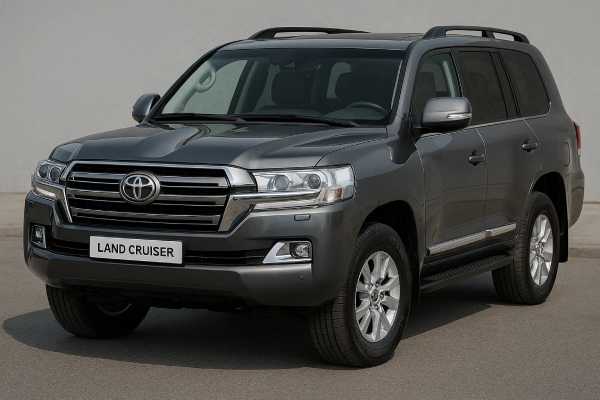
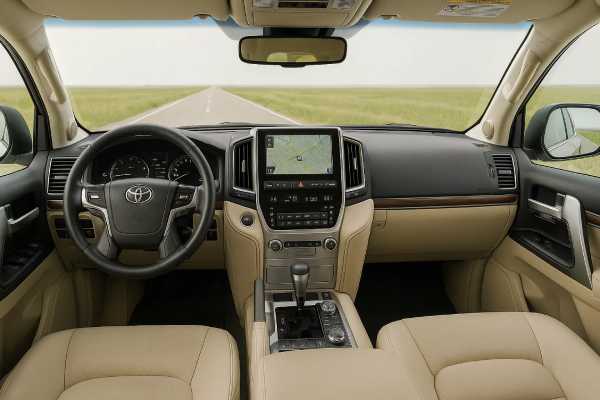
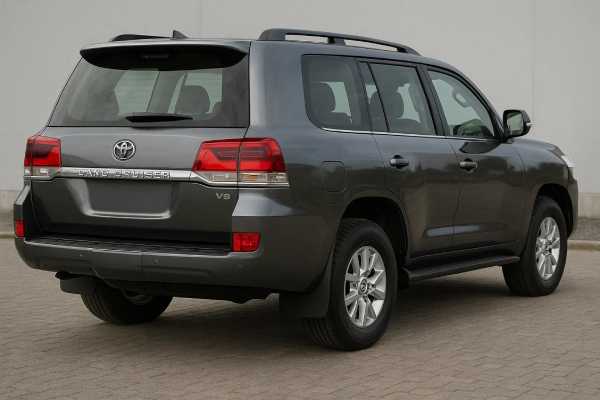
The 2015–2018 facelift of the 200-Series Land Cruiser refined a proven formula: a quiet, chain-driven 4.6-litre V8 (1UR-FE), a full-time 4×4 system with a locking centre differential and low range, and a heavy-duty ladder frame designed to work for decades. This update brought a stronger front clip, better cabin tech, and subtle NVH improvements while keeping the big-inch, naturally aspirated character that owners prize for towing, mountain roads, and cold starts. In Europe-market form, the 1UR-FE is rated at 318 hp with a broad torque curve, paired mainly to a 6-speed automatic and generous cooling. It is not the quickest luxury SUV, but it is calm, predictable, and easy to service with sensible intervals. If your priorities are long-horizon reliability, real off-road hardware, and dignified ride comfort for seven people, the facelifted URJ200 sits at the sweet spot of the 200-Series lifecycle.
Fast Facts
- Smooth, durable 1UR-FE V8 (timing chain) and full-time 4×4 with centre diff lock and low range.
- Heavy-duty cooling, stable steering, and strong brakes make it a confident towing platform.
- Cabin and chassis materials age gracefully; parts support is deep and long-term.
- Watch for water-pump seepage, accessory-belt noise, and secondary-air injection faults on short-trip cars.
- Typical oil service cadence: 10,000–15,000 km / 12 months; shorten for towing or frequent alpine routes.
Guide contents
- URJ200 overview (2015–2018)
- Specifications and technical data
- Trims, options, and safety
- Reliability and service actions
- Maintenance and buyer’s guide
- Driving and performance
- How it compares to rivals
URJ200 overview (2015–2018)
The facelifted URJ200 (2015–2018) represents the most mature iteration of the 200-Series before the final model-year runout. Externally, the update brought a new bonnet, grille, lamps, and bumpers for better cooling airflow and a cleaner lighting signature. Inside, the dashboard gained improved switch ergonomics, clearer instrumentation, and updated infotainment. The core engineering remained reassuringly familiar: a naturally aspirated 4.6-litre V8 (1UR-FE) with Dual VVT-i and multi-port injection, a 6-speed automatic tuned for light throttle at speed and confident downshifts on grades, and a full-time 4×4 system using a Torsen-type centre differential that can be locked for slippery surfaces. A dual-range HF2A transfer case gives the Land Cruiser the crawl control you expect from the nameplate.
The 1UR-FE’s character defines the ownership experience. It starts cleanly in sub-zero weather, idles quietly, and pulls with a wide, linear torque band. There is no turbo lag to manage off-road, and throttle modulation is precise in low range. The timing chain avoids belt replacement cycles, and the emissions hardware is simple compared with diesel DPF/EGR systems. If you often do short, urban journeys, the petrol V8 avoids the incomplete-regeneration issues that can frustrate diesel owners while still returning reasonable motorway economy for its size.
Chassis tuning is long-trip oriented. The double-wishbone front and four-link solid rear axle deliver generous wheel travel and a settled, unflustered ride over patched tarmac. Steering is calm on the motorway and predictable on wet roundabouts. Brake sizing and cooling are generous for repeated mountain descents with passengers and luggage. KDSS (Kinetic Dynamic Suspension System) appears on high trims in some markets, reducing roll on road and allowing more articulation off-road by hydraulically linking the anti-roll bars. Later high trims added camera-based off-road aids and a more sophisticated multi-terrain traction logic.
Practicality is strong. Most European-market cars are seven-seat five-doors with a flat load floor when the second row is folded; the third row is best for children or occasional adults. The cargo area is high and wide; the side-hinged tailgate makes curbside access easy. In day-to-day use, owners value the noise isolation, seat comfort, straightforward controls, and the sense that the vehicle has abundant thermal and structural headroom—hallmarks of the Land Cruiser badge.
Specifications and technical data
Engine and Performance (ICE)
| Item | Detail |
|---|---|
| Code | 1UR-FE (Dual VVT-i) |
| Layout & cylinders | 90° V8, aluminium block/heads, DOHC, 4 valves/cyl |
| Bore × stroke | 94.0 × 83.0 mm (3.70 × 3.27 in) |
| Displacement | 4.608 L (4,608 cc) |
| Induction | Naturally aspirated |
| Fuel system | Sequential multi-port EFI |
| Compression ratio | ≈10.2–10.4:1 (market calibration) |
| Max power | 318 hp (237 kW) @ ~5,600 rpm |
| Max torque | ≈460 Nm (339 lb-ft) @ ~3,400 rpm |
| Timing drive | Chains (no fixed belt interval) |
| Emissions baseline | Euro 5 (varies by market) |
| Rated economy (combined) | ≈12.0–13.5 L/100 km (19–21 mpg US / 23–26 mpg UK) |
| Real-world @120 km/h (75 mph) | ≈12.5–14.5 L/100 km (17–19 mpg US / 20–23 mpg UK) |
| Aerodynamics | Cd ≈0.35–0.36; frontal area ≈3.0 m² (32.3 ft²) |
Transmission and Driveline
| Item | Detail |
|---|---|
| Automatic | 6-speed Aisin A760F (typical pairing) with manual mode |
| Gear ratios (A760F) | 1st 3.538; 2nd 2.060; 3rd 1.404; 4th 1.000; 5th 0.716; 6th 0.586; Rev 3.168 |
| Transfer case | HF2A dual-range; high 1.000, low ≈2.566 |
| Final drive ratio | ≈3.91:1 (varies by axle package) |
| Drive type | Full-time 4×4 with Torsen centre diff; centre diff lock |
| Rear differential | Open or locking (trim/market dependent) |
| Refuel to full | ≈5–7 minutes at standard pump rates |
Chassis and Dimensions
| Item | Detail |
|---|---|
| Platform | 200-Series ladder frame (body-on-frame) |
| Suspension (front/rear) | Double wishbone / 4-link solid axle with coils; KDSS on upper trims |
| Steering | Hydraulic rack-and-pinion |
| Brakes | Ventilated discs; approx. 340 mm (front) / 345 mm (rear) depending on market |
| Wheels/Tyres (Tires) | 285/60 R18 or 285/65 R17 common; winter-friendly 17-inch packages ride best |
| Ground clearance | ≈225–230 mm (8.9–9.1 in) |
| Angles (5-door) | Approach ≈30°, departure ≈20–24°, breakover ≈22–23° |
| Length / Width / Height | ~4,950 / 1,980 / 1,880 mm (194.9 / 78.0 / 74.0 in) |
| Wheelbase | 2,850 mm (112.2 in) |
| Turning circle (kerb-to-kerb) | ~11.8–12.6 m (38.7–41.3 ft) |
| Kerb (Curb) weight | ~2,535–2,700 kg (5,588–5,952 lb) |
| GVWR | ~3,300–3,350 kg (7,275–7,385 lb) |
| Fuel tank | 93 L (24.6 US gal / 20.5 UK gal); sub-tank available in some markets |
| Cargo volume (5-door) | ≈450–480 L seats up (SAE); >2,000 L seats down (method dependent) |
Performance and Capability
| Item | Detail |
|---|---|
| 0–100 km/h (0–62 mph) | ~8.9–9.5 s (setup dependent) |
| Top speed | ~195 km/h (121 mph) |
| 100–0 km/h braking | ~40–42 m (131–138 ft) with healthy pads/rotors |
| Towing (braked / unbraked) | up to 3,500 / 750 kg (7,716 / 1,653 lb), market/fitment dependent |
| Payload | ~650–750 kg (1,433–1,653 lb) |
| Roof load | ~100 kg (220 lb) with approved crossbars |
Fluids and Service Capacities
| System | Specification | Capacity |
|---|---|---|
| Engine oil | API SN/SM, ILSAC GF-5; 0W-20 preferred, 5W-30 acceptable (per climate) | ≈6.6–7.5 L (7.0–7.9 US qt) w/ filter |
| Coolant | Toyota Super Long Life Coolant (pink), 50/50 | ≈12–14 L (12.7–14.8 US qt) incl. rear heater |
| Automatic transmission | Toyota ATF WS | ≈10–12 L total; ≈3.5–4.0 L typical drain/fill |
| Transfer case | Toyota LF 75W (or GL-5 75W-85) | ≈1.5 L (1.6 US qt) |
| Front differential | GL-5 75W-85 | ≈1.5–1.6 L (1.6–1.7 US qt) |
| Rear differential | GL-5 75W-85/90 (LSD-safe if fitted) | ≈3.0 L (3.2 US qt) |
| A/C refrigerant | R-134a; compressor oil ND-8 (PAG) | ≈0.90–1.10 kg (32–39 oz); oil ≈120–150 mL |
| Key torque specs | Wheel nuts ≈131 Nm (97 lb-ft); spark plugs ≈18 Nm (13 lb-ft); drain plugs ≈39–49 Nm (29–36 lb-ft) |
Note: Capacities and torque values vary by VIN, cooling pack, and rear heater fitment. Always confirm on the under-bonnet label and service data before filling.
Electrical
| Item | Detail |
|---|---|
| Alternator output | ≈150–180 A (equipment dependent) |
| 12 V battery | ≈90–105 Ah (≈800–950 CCA), DIN form factor varies by market |
| Spark plugs | Long-life iridium (service life ~120,000–150,000 km) |
| Plug gap | ≈1.0–1.1 mm (0.039–0.043 in) |
Safety and Driver Assistance
| Area | Detail |
|---|---|
| Crash-test coverage | Limited Euro NCAP publications for this variant; not an IIHS programme vehicle. |
| Passive safety | Typically 10 airbags (front, side, curtains, driver/passenger knee) depending on trim; ISOFIX/LATCH on second-row outboard seats. |
| Stability and traction | VSC stability control, A-TRC traction control, ABS/EBD/BA; hill-start assist; downhill assist (trim dependent). |
| Driver assistance (late trims/markets) | Pre-collision system (AEB), lane departure alert, automatic high beam, adaptive cruise (availability varies). |
| Lighting | Projector halogen or LED/bi-LED (market/trim); headlight performance depends on lamp spec and aim. |
Trims, options, and safety
European-market grades (typical). Naming differs by country, but the ladder generally runs entry / mid / high with increasing luxury and off-road aids. Entry-grade cars carry the essentials: full-time 4×4 with centre diff lock and low range, 17- or 18-inch wheels, dual-zone climate, heated seats, and robust fabrics. Mid-grade adds leather, powered front seats, navigation, camera/parking sensors, and sometimes a seven-seat layout. High-grade brings KDSS, upgraded audio, LED or bi-LED headlamps (market-dependent), keyless entry, and advanced off-road software (Multi-Terrain Select, Crawl Control). A rear locking differential is standard or optional by country; where absent, the brake-based A-TRC is competent for snow, mud ruts, and wet grass.
Mechanical/equipment distinctions. The 1UR-FE V8 and 6-speed auto are the default pairing. KDSS is the notable chassis option, flattening roll without the harshness trade-off of stiffer bars. Rear air-assisted springing appears on certain high trims to maintain level stance under trailer tongue weight or full loads; it adds height-sensor and bag service considerations as the vehicle ages. Tow packages include larger coolers and OE-integrated electrics—prefer these to aftermarket wiring for clean trailer-stability integration.
Year-to-year updates (2015–2018). The facelift year introduced the revised nose, updated lamps, and infotainment revisions, plus the rollout of off-road camera views and terrain selectors on upper trims. Later model years added incremental infotainment changes and widened availability of driver-assistance features in some countries. Active safety (AEB, lane support, radar cruise) remains lighter than on newer platforms but is sufficient for touring if kept correctly calibrated.
Safety ratings and context. A formal Euro NCAP score for this exact, late petrol variant is not widely published; regardless, the Land Cruiser delivers a strong passive-safety baseline (multi-airbag coverage, strong shell) and stable accident-avoidance behaviour. For best braking, use fresh fluid every two years, OE-spec pad compounds, and ensure proper calliper slide lubrication at annual services. Child-seat fitment is straightforward thanks to ISOFIX/LATCH points and accessible top tethers, though the tall floor means rear-facing shells should be trial-fitted.
Calibration after service. Windshield replacement, ride-height sensor work (air-assisted rear), camera or radar service, and KDSS line repairs can require basic calibrations. Wheel alignment must be performed with the correct KDSS neutralisation procedure when equipped; otherwise you may chase a steering pull or off-centre wheel.
Quick identifiers.
- Build code: URJ200 confirms the 4.6-litre petrol V8.
- Console: low-range selector and centre diff-lock switch; terrain dials/switches on late high trims.
- Under-bonnet label: 1UR-FE engine family, oil viscosity, refrigerant charge.
Reliability and service actions
This facelifted 200-Series is among the most durable large SUVs you can buy, provided you respect fluids and rubber components. The map below lists issues by prevalence (common/occasional/rare) and severity/cost (low/medium/high), along with symptoms → likely cause → remedy to guide diagnosis and budgeting.
Engine (1UR-FE)
- Common • Low/Medium — Water-pump seepage.
Symptoms: faint coolant smell, pink deposits at the weep hole, light bearing noise on cold start.
Remedy: replace pump/gasket; renew coolant; inspect idlers and belt. - Occasional • Medium — Front cover or valve-cover oil misting.
Symptoms: oily film along front timing cover seams or rocker-cover edges; occasional burnt-oil odour.
Remedy: reseal affected joints; new gaskets; follow torque sequence carefully. - Occasional • Medium — Secondary air-injection faults (where fitted).
Symptoms: cold-start MIL, reduced power; codes for air-pump/valve operation.
Remedy: verify pump, switching valves, fuses/relays, and vacuum circuits; replace with updated parts when necessary. - Occasional • Low — Throttle body/MAF deposits.
Symptoms: hesitant tip-in or unstable idle with A/C load.
Remedy: clean MAF and throttle body; check PCV function and air-filter sealing. - Rare • High — Timing-chain rattle/correlation codes.
Symptoms: rattle on hot restart, cam/crank misalignment codes.
Remedy: inspect chain, guides, tensioners; replace components if out of spec; disciplined oil changes prevent most cases.
Fuel and ignition
- Occasional • Low — Coil-on-plug age failures.
Symptoms: intermittent misfire under load.
Remedy: replace failing coil; install fresh iridium plugs at interval; inspect plug-tube seals. - Occasional • Low — Catalyst efficiency codes (urban, high-mileage cars).
Symptoms: P0420/P0430-type codes.
Remedy: rule out exhaust leaks and lazy O₂ sensors before condemning catalysts.
Cooling and belts
- Common • Low — Accessory-belt chirp/idler whine.
Symptoms: cold-start squeal or chirp.
Remedy: replace belt and noisy idlers; check pulley alignment.
Transmission and driveline
- Common • Low — ATF ageing in A760F.
Symptoms: slightly firm 1–2 shifts when cold, light flare if fluid is old.
Remedy: drain-and-fill with WS at 60,000–90,000 km when towing/hilly use; avoid power flushes. - Occasional • Medium — Transfer-case output-seal weep.
Symptoms: damp yokes, light ATF loss.
Remedy: reseal; confirm prop-shaft U-joint play and alignment. - Occasional • Medium — KDSS seepage/leaks (if fitted).
Symptoms: oily cylinders or lines, clunks on articulation, roll change.
Remedy: repair/replace leaking components; bleed and verify neutral position.
Suspension and brakes
- Common • Medium — Front lower-arm rear bushes and ball joints.
Symptoms: shimmy on braking, inner-edge tyre wear, clunks over humps.
Remedy: renew arms as assemblies; align to spec (with KDSS neutralisation if applicable). - Occasional • Low — Rear shock leaks and trailing-arm bush wear.
Symptoms: floaty rear with loads; axle steer on throttle transitions.
Remedy: replace shocks/bushes; re-evaluate alignment under typical load.
Body and electrical
- Occasional • Low — Door-lock actuators and window regulators tire with age.
Remedy: replace with quality components; verify door-loom integrity. - Occasional • Low — A/C condenser stone damage.
Remedy: inspect yearly; consider discrete mesh protection if you frequent gravel; renew condenser and evacuate/charge to spec.
Recalls and campaigns (Europe context). Coverage varies by country/VIN. Before purchase and annually, request an official VIN recall status printout. Keep records of ECU/TCU calibration updates, water-pump replacement, and ATF/axle/transfer services. These verify that the important life-cycle work has been done and help resale.
Pre-purchase requests
- Full service history: oil, coolant, spark plugs, ATF, diff/transfer.
- Cooling-system pressure test; inspection for water-pump seepage.
- KDSS lines/cylinders inspection (if fitted).
- Underside photos: rails, rear crossmember, tow-bar mounts, brake line clips.
- Tyre brand/age, alignment printout, brake measurements.
- VIN recall/campaign report.
Maintenance and buyer’s guide
Service schedule baseline (distance/time—whichever comes first). Adjust for heavy towing, mountain routes, dust, or short cold trips.
- Engine oil & filter: 10,000–15,000 km / 12 months. Use 0W-20 where approved or 5W-30 per climate/approvals. Shorten interval for frequent towing or alpine use.
- Engine air filter: check 15,000 km; replace 30,000–45,000 km (sooner in dust).
- Cabin filter: 15,000–20,000 km or 12 months.
- Spark plugs (iridium): 120,000–150,000 km or 7–10 years; confirm part code by VIN.
- Coolant (SLLC, pink): first at 160,000 km / 10 years, then 80,000 km / 5 years. Include rear-heater circuit bleed if fitted.
- Accessory belt & hoses: inspect every service; replace 60,000–90,000 km or on condition.
- Automatic transmission (A760F): drain-and-fill 60,000–90,000 km in towing/hilly duty; 100,000–120,000 km prudent otherwise; avoid power-flushes.
- Transfer case & differentials: 60,000–90,000 km; shorten for water crossings or constant towing.
- Brake fluid: 24 months.
- Brakes: inspect pads/rotors each service; clean/lube slide pins annually (especially in salted regions).
- Steering/suspension: check arms, ball joints, bushes, KDSS lines and links (if fitted); check ride-height sensors on air-assisted rears.
- Tyres: rotate 10,000–12,000 km; align annually or after any suspension work; set pressures for load/tongue weight.
- 12 V battery: load-test annually from year 4; plan replacement at 5–7 years.
- A/C system: performance check each spring; inspect condenser and receiver-drier.
Owner-useful fluid specs and quick capacities.
- Oil: API SN/GF-5 0W-20 (or 5W-30) | ≈6.6–7.5 L with filter | drain plug ≈39 Nm.
- Coolant: Toyota SLLC 50/50 | ≈12–14 L total.
- ATF WS: total ≈10–12 L | typical drain/fill ≈3.5–4.0 L.
- Transfer/diffs: LF 75W or GL-5 75W-85; front ≈1.5–1.6 L, rear ≈3.0 L.
- Spark plugs: long-life iridium | gap ≈1.0–1.1 mm | torque ≈18 Nm.
- Wheel nuts: ≈131 Nm.
Buyer’s inspection checklist (quick-hit).
- Cold start: listen for secondary-air pump whirr (if fitted), belt chirp, or misfire.
- Warm drive: stable idle with A/C on; smooth 1–2–3 shifts; no hunting at light throttle.
- 4×4 functions: engage centre lock and low range on gravel; verify clean engagement with no codes.
- Cooling: look for coolant crust at water-pump weep; scan for historical overheat.
- Underside: check rails, crossmembers, tow mounts, KDSS lines, transfer-case output seals.
- Brakes/tyres: even wear; rotor thickness; quality touring tyres with correct load index.
- Electrics: windows, locks, mirrors, heated elements, cameras, parking sensors, headlamp levelling.
- Tow history: inspect electrics; ask for ATF/diff/transfer service receipts.
- Paperwork: VIN recall printout; invoices for coolant, plugs, water pump, and KDSS work (if equipped).
Which configuration to target.
- Touring/family: seven-seat, 17- or 18-inch wheels, automatic, KDSS for flatter cornering, camera pack for parking.
- Snow/trails: add rear diff lock; keep 17-inch wheels for taller winter tyres; heated mirrors and screen elements help.
- Towing focus: automatic with OE tow electrics and cooling pack; fresh brakes and ATF; quality brake controller where required.
Durability outlook. With fluids on time and sensible tyres, a facelifted URJ200 is a strong 300,000 km candidate without major engine or transmission work. Expect bushing refreshes, a water pump over the life of the vehicle, and age-related A/C or actuator repairs. Fuel is the largest running-cost variable; plan honestly and the rest is predictable.
Driving and performance
Ride, handling, NVH. The URJ200 has an easygoing gait that makes long journeys simple. Secondary ride is better controlled than many body-on-frame rivals, and the cabin remains hushed at 120 km/h thanks to careful isolation of the drivetrain and tyre cavities. KDSS (where fitted) tightens roll without turning sharp-edged; on a series of linked bends it keeps the body noticeably flatter while preserving bump compliance.
Powertrain character. The 1UR-FE trades drama for smooth, elastic torque. It eases away from stops without revs, settles into top gear on gentle motorway grades, and drops one or two gears promptly when you ask for more. There is no turbo to spool, so throttle modulation in low range is precise and predictable on rocks or snow. The 6-speed automatic’s calibration prefers early upshifts in town but will hold a lower gear on long descents when you request engine braking.
Real-world efficiency. Expect 12.5–14.5 L/100 km at a steady 120 km/h with stock tyres and no roof gear. City use pushes into the high-teens (L/100 km). Mixed commuting often lands around 13–15 L/100 km. Big all-terrain tyres, a roof box, winter fuel, and headwinds all move the number upward; a quiet highway-terrain tyre on 17s usually helps both noise and consumption.
Key metrics that matter. On touring tyres a healthy example runs 0–100 km/h in ~9 seconds, stops from 100–0 km/h in ~40–42 m, and circles tight car parks more easily than its size suggests thanks to useful steering angle. Turning circle of ~11.8–12.6 m is manageable off-road for switchbacks and hairpins.
Traction and control. The Torsen centre diff distributes torque transparently on wet tarmac; centre lock and low range transform the vehicle on steep or low-friction surfaces. Brake-based A-TRC capably mimics axle locks for cross-axle obstacles, and a rear locker (where fitted) gives the final push in deep snow, boggy ruts, or rock steps. Late high trims add Multi-Terrain Select and Crawl Control, which simplify throttle/brake modulation—use with restraint to avoid digging holes in soft surfaces.
Load and towing. With a braked trailer up to 3,500 kg, the Land Cruiser is calm and well-mannered. Transmission and coolant temperatures stay in range if you respect gear choice and airflow. Plan a 15–30% fuel-use penalty at motorway speeds with a mid-weight caravan or boat. Use OE tow electrics so trailer-stability logic integrates cleanly; confirm nose-weight and tyre-pressure adjustments before long hauls.
How it compares to rivals
Land Rover Discovery 4 (2015–2016, petrol where offered). Exceptional ride quality and visibility with air suspension and strong drivetrains. Ownership costs—suspension, electronics, cooling ancillaries—tend to rise with age. The Toyota is plainer inside but wins on robustness and underbody durability over a ten-year horizon.
Jeep Grand Cherokee WK2 (2015–2018, petrol V6/V8). The Jeep’s on-road poise and cabin materials impress, and high-spec trims pack modern ADAS. Air-suspension/electronics complexity climbs with age. Off-road hardware is capable but lacks the Land Cruiser’s centre-lock/low-range tuning and KDSS option for heavily loaded trails.
Mercedes-Benz GLE/GLS (petrol V6/V8). Quieter at 130 km/h with more tech and luxury features. However, complexity and running costs can exceed the Toyota’s, and underbody layout is less forgiving of rough tracks. If your travel includes long, remote stretches, the Land Cruiser’s simpler hardware and parts access matter.
Mitsubishi Pajero/Shogun (run-out years). Lighter and sometimes thriftier in town, but its ride on broken surfaces is busier and interior materials feel older. The Toyota’s steering stability, brake sizing, and off-road traction logic are better suited to towing and alpine routes.
Bottom line. If you want quiet V8 smoothness, true low-range 4×4, and whole-life dependability, the facelifted URJ200 is tough to beat. Rivals may offer more gadgets or sharper handling; few match the Toyota’s breadth of ability and stress-free ownership.
References
- Owner’s Manual 2024 (Owner’s Manual Portal)
- Newsroom 2015 (Model Update Overview)
- Check if a car has a safety recall 2017 (Recall Database)
Disclaimer
This article is for informational purposes only and is not a substitute for professional diagnosis, repair, or homologation advice. Specifications, torque values, fluid types/capacities, and service intervals vary by VIN, model year, market, and equipment. Always verify details against your vehicle’s official owner’s manual and service documentation and follow local regulations for towing and modifications. If this guide helped, please consider sharing it on Facebook or X/Twitter to support xcar’s work.