
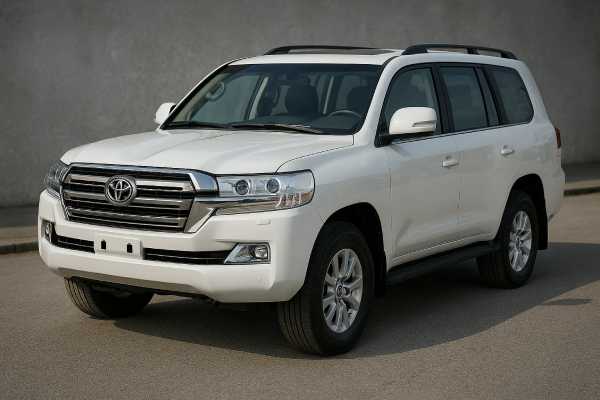
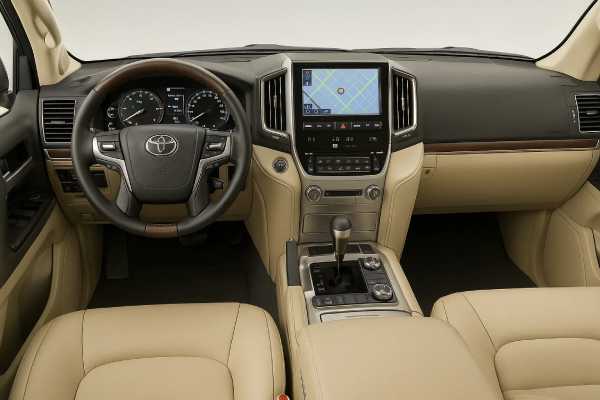
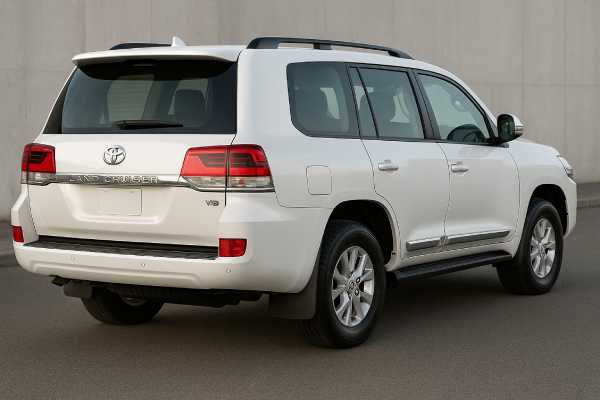
The 2015–2018 facelift of the VDJ200 Land Cruiser is the diesel you buy when you want quiet authority rather than drama. Its 1VD-FTV 4.5-litre, twin-turbo V8 is tuned for long-range torque and low-stress cruising, backed by a full-time 4×4 system with a lockable centre differential and a dual-range transfer case. The facelift sharpened cooling and lighting, refined the cabin, and expanded camera-based off-road aids—without compromising the core ladder-frame durability that makes the 200-Series a favourite for towing, mountain winters, and remote touring. In European tune you typically see 249 hp and about 650 Nm, fed through a 6-speed automatic with sensible ratios. Day to day it feels settled and predictable, with strong brake sizing and generous thermal headroom on grades. Ownership discipline is straightforward: fuel filtration, oil and ATF on time, and periodic attention to EGR/DPF health if most of your trips are short. Treat it like the long-distance tool it is and it repays you with decade-scale reliability.
What to Know
- Twin-turbo 1VD-FTV V8 delivers broad low-rpm torque and relaxed long-grade climbs; full-time 4×4 with centre lock and low range.
- Heavy-duty chassis, strong brakes, and calm steering make it a confident 3,500 kg tow rig.
- Cabin materials and driveline components age slowly with regular fluids; parts support is excellent.
- Watch for DPF/EGR soot loading on short-trip usage and water-pump seepage at higher mileage.
- Typical engine-oil service: 10,000–15,000 km / 12 months (shorten for towing, dust, or lots of city heat cycles).
What’s inside
- VDJ200 diesel overview
- Specifications and technical data
- Trims, options, and safety
- Reliability and service actions
- Maintenance and buyer’s guide
- Driving and performance
- How it compares to rivals
VDJ200 diesel overview
The facelifted VDJ200 is the most polished expression of Toyota’s 200-Series diesel formula. Externally, the 2015 update brings a stronger front clip, reshaped bonnet and grille for airflow, revised lamps, and detail aero tweaks that also reduce wind noise. Inside you get clearer instruments, a tidier centre stack, improved camera views on upper trims, and incremental NVH work that makes the big Cruiser quieter at a steady 120 km/h.
Under the bonnet sits the 4,461 cc 1VD-FTV: an aluminium-head, compacted-graphite-iron block V8 with two variable-geometry turbochargers (one per bank), common-rail direct injection, and chain-driven cams. In European calibration for this period it’s typically 249 hp (186 kW) and ~650 Nm (479 lb-ft), delivered from just above idle through the mid-range. The character is all about easy surge: pulling away with little throttle, holding top gear on motorway undulations, and climbing long grades without fuss. There is no frantic spool-and-surge behaviour—just steady, predictable thrust that works equally well creeping over wet rocks in low range or passing at 80–120 km/h.
Driveline hardware remains full-time 4×4 with a Torsen-type centre differential that can be locked, plus the HF2A dual-range transfer case. A rear differential lock appears by market/trim, and where absent the brake-based A-TRC system credibly simulates axle locks for cross-axle obstacles. On high trims you may see KDSS (Kinetic Dynamic Suspension System), hydraulically linking the anti-roll bars to reduce body roll on road and increase articulation off-road. Suspension is classic 200-Series: double-wishbone front and a four-link solid rear axle with coils, tuned for long-wave control and durability.
Practicality remains a strong suit. Most European examples are seven-seat five-doors, with a wide, high cargo area and a flat load floor when the second row folds. The tall seating position, big mirrors, and available camera pack reduce the intimidation factor around town. Owners value the easygoing motorway gait, the sense of thermal and structural headroom, and the way the diesel V8 settles into a quiet lope on long trips. If you do frequent short, cold journeys, you will need a little more discipline around DPF health; otherwise, the 1VD-FTV rewards methodical maintenance with outstanding longevity.
Specifications and technical data
Engine and Performance (ICE)
| Item | Detail |
|---|---|
| Code | 1VD-FTV (twin-turbo, common-rail) |
| Layout & cylinders | 90° V8, CGI block, aluminium heads, DOHC, 4 valves/cyl |
| Bore × stroke | 86.0 × 96.0 mm (3.39 × 3.78 in) |
| Displacement | 4.461 L (4,461 cc) |
| Induction | Two variable-geometry turbos (one per bank) |
| Fuel system | High-pressure common-rail DI |
| Compression ratio | ≈16.8:1 |
| Max power | 249 hp (186 kW) @ ~3,600 rpm |
| Max torque | ≈650 Nm (479 lb-ft) @ ~1,600–2,600 rpm |
| Timing drive | Chains (no fixed belt interval) |
| Emissions baseline | Euro 5/Euro 6 transition by market; DPF fitted |
| Rated economy (combined) | ~10.0–11.5 L/100 km (24–21 mpg US / 29–26 mpg UK) |
| Real-world @120 km/h (75 mph) | ~10.5–12.5 L/100 km (22–19 mpg US / 26–23 mpg UK) |
| Aerodynamics | Cd ≈0.35–0.36; frontal area ≈3.0 m² (32.3 ft²) |
Transmission and Driveline
| Item | Detail |
|---|---|
| Automatic | 6-speed Aisin AB60F/A760F (market-dependent) with manual mode |
| Gear ratios (typical 6-AT) | 1st 3.333–3.538, 2nd 1.960–2.060, 3rd 1.353–1.404, 4th 1.000, 5th 0.728–0.716, 6th 0.588–0.586; Rev ≈3.06–3.17 |
| Transfer case | HF2A dual range; high 1.000, low ≈2.566 |
| Final drive ratio | ≈3.91:1 (axle package dependent) |
| Drive type | Full-time 4×4 with Torsen centre diff; centre lock |
| Rear differential | Open or locking (trim/market) |
| Refuel to full | ≈5–7 min at typical pump rates |
Chassis and Dimensions
| Item | Detail |
|---|---|
| Platform | 200-Series ladder frame (body-on-frame) |
| Suspension (front/rear) | Double wishbone / 4-link solid axle with coils; KDSS on upper trims |
| Steering | Hydraulic rack-and-pinion |
| Brakes | Ventilated discs; approx. 340 mm front / 345 mm rear |
| Wheels/Tyres (Tires) | 285/60 R18 or 285/65 R17 common OEM sizes |
| Ground clearance | ≈225–230 mm (8.9–9.1 in) |
| Angles (5-door) | Approach ≈30–32°, departure ≈20–24°, breakover ≈22–23° |
| Length / Width / Height | ~4,950 / 1,980 / 1,880 mm (194.9 / 78.0 / 74.0 in) |
| Wheelbase | 2,850 mm (112.2 in) |
| Turning circle (kerb-to-kerb) | ~11.8–12.6 m (38.7–41.3 ft) |
| Kerb (Curb) weight | ~2,600–2,760 kg (5,732–6,085 lb) |
| GVWR | ~3,300–3,350 kg (7,275–7,385 lb) |
| Fuel tank | 93 L (24.6 US gal / 20.5 UK gal); sub-tank available in some markets |
| Cargo volume (5-door) | ~450–480 L seats up (SAE); >2,000 L seats down (method dependent) |
Performance and Capability
| Item | Detail |
|---|---|
| 0–100 km/h (0–62 mph) | ~9.5–10.2 s (tyres/load dependent) |
| Top speed | ~190–195 km/h (118–121 mph) |
| 100–0 km/h braking | ~40–43 m (131–141 ft) with healthy pads/rotors |
| Towing (braked / unbraked) | up to 3,500 / 750 kg (7,716 / 1,653 lb) by market/fitment |
| Payload | ~650–750 kg (1,433–1,653 lb) |
| Roof load | ~100 kg (220 lb) with approved crossbars |
Fluids and Service Capacities
| System | Specification | Capacity |
|---|---|---|
| Engine oil | ACEA C3/A3/B4 (DPF-compatible); 5W-30 or 0W-30 as approved | ~9.5–10.0 L (10.0–10.6 US qt) w/ filter |
| Coolant | Toyota Super Long Life Coolant (pink), 50/50 | ~14–16 L (14.8–16.9 US qt); rear heater adds volume |
| Automatic transmission | Toyota ATF WS | ~10–12 L total; ~3.5–4.0 L typical drain/fill |
| Transfer case | Toyota LF 75W (or GL-5 75W-85) | ~1.5 L (1.6 US qt) |
| Front differential | GL-5 75W-85 | ~1.5–1.6 L (1.6–1.7 US qt) |
| Rear differential | GL-5 75W-85/90 (LSD-safe if fitted) | ~3.0 L (3.2 US qt) |
| A/C refrigerant | R-134a; compressor oil ND-8 (PAG) | ~0.95–1.10 kg (34–39 oz); oil ~120–150 mL |
| Key torque specs | Wheel nuts ~131 Nm (97 lb-ft); drain plugs ~39–49 Nm (29–36 lb-ft) | — |
Note: Always confirm by VIN and the under-bonnet emissions/charge labels; rear heater circuits and tow-cooling packs change totals.
Electrical
| Item | Detail |
|---|---|
| Alternator output | ~150–180 A (equipment-dependent) |
| 12 V battery | ~95–105 Ah (≈800–950 CCA), DIN form factor varies |
| Glow plugs | Ceramic glow plugs (ECU-controlled after-glow) |
| Spark plugs | Not applicable (diesel) |
Safety and Driver Assistance
| Area | Detail |
|---|---|
| Crash-test coverage | Limited Euro NCAP publications for this exact diesel/phase; not an IIHS programme vehicle. |
| Passive safety | Typically 10 airbags (front/side/curtain/knee by trim); ISOFIX/LATCH on second-row outboard seats. |
| Stability and traction | VSC stability control, A-TRC traction control, ABS/EBD/BA; hill-start assist; downhill assist (trim-dependent). |
| ADAS (late/upper trims) | Pre-collision (AEB), lane departure alert, automatic high beam, adaptive cruise (availability varies). |
| Lighting | Halogen projector or LED/bi-LED by trim; headlamp performance tracks lamp spec and aim. |
Trims, options, and safety
European-market grades. Naming shifts by country, but equipment steps up from an entry level (full-time 4×4, centre diff lock, dual-zone climate, 17/18-inch wheels, cloth) through a mid grade (leather, power seats, navigation, parking sensors/camera, 7-seat option) to a high grade with KDSS, upgraded audio, LED/bi-LED lighting (where offered), keyless entry, and advanced off-road software (Multi-Terrain Select, Crawl Control). A rear differential lock is standard or optional depending on market; where absent, A-TRC is effective for wet grass, snow, and cross-axle bumps.
Mechanical distinctions by trim. The 1VD-FTV + 6-AT pairing is universal. KDSS is the big chassis differentiator for on-road roll control and off-road articulation. Certain high trims add rear air-assisted suspension to maintain level stance under towing or full loads; it’s helpful for caravans but brings height-sensor and air-spring service considerations after a decade. Factory tow packs integrate extra cooling and OE trailer-stability logic—prefer these to spliced aftermarket looms.
Year-to-year highlights (2015–2018). The facelift introduces the new nose, lamp tech, updated infotainment, and expands the terrain-camera/selector systems on upper trims. Later years spread light ADAS features in some markets. Compared with newer platforms, active safety remains modest; the Land Cruiser leans on a strong shell, predictable chassis balance, and large-margin brake sizing.
Safety context and calibration. Brake performance is consistent with OE-spec pads and biennial brake-fluid changes. ISOFIX/LATCH anchors and top tethers are straightforward; the tall floor means rear-facing seats should be trial-fitted. If you replace the windscreen or perform ride-height or camera/radar work, plan on basic calibrations. With KDSS, alignments must be carried out with the system neutralised; skipping this can leave a steering pull or off-centre wheel.
How to identify a well-specced car.
- Build code: VDJ200 on the VIN/plate confirms the V8 diesel.
- Switchgear: look for centre diff-lock, low-range selector, and (where fitted) MTS/Crawl dials.
- Under-bonnet labels: list the 1VD-FTV family, approved oils, and the refrigerant charge.
- Tow package: factory socketry and module, auxiliary coolers, and documented trailer-stability integration.
Reliability and service actions
The VDJ200’s strength is conservative calibration and heavy-duty hardware. Treat fuel and soot management seriously and it delivers a very long service life. Below are typical issues by prevalence and severity/cost, with symptoms → likely cause → remedy.
Engine and induction (1VD-FTV)
- Common • Low/Medium — Water-pump seepage.
Symptoms: faint coolant smell; pink crystals at the weep hole; mild bearing noise on cold start.
Remedy: replace pump/gasket; renew coolant; inspect belt and idlers. - Occasional • Medium — DPF loading/short-trip stress.
Symptoms: frequent regens, rising oil level from post-injection, DPF light on urban duty.
Remedy: complete a proper regen drive; check differential-pressure sensor and exhaust leaks; ensure correct low-ash oil; investigate usage pattern and software updates. - Occasional • Medium — EGR cooler and intake soot.
Symptoms: sluggish response, elevated fuel trims, MIL for flow codes.
Remedy: clean EGR valve/cooler/intake; verify cooler integrity; consider catch-can only where legal and without upsetting crankcase ventilation. - Occasional • Medium — Charge-air leaks.
Symptoms: hiss under load, oily mist at hose joints, lower-than-expected boost.
Remedy: pressure/smoke test; renew intercooler hoses/clamps; inspect end tanks. - Occasional • Medium — Injector balance drift/noise.
Symptoms: light clatter when hot, rough idle, balance rates out of bounds.
Remedy: run balance checks; confirm rail pressure and return rates; replace offenders; code injectors.
Fuel and filtration
- Common • Medium — Filter neglect/contamination.
Symptoms: hard starting, reduced power, water-in-fuel warnings.
Remedy: replace the filter on schedule; drain water trap; consider an upstream water-separator if you fuel in remote areas.
Cooling and belts
- Common • Low — Accessory-belt chirp/idler whine.
Symptoms: cold-start squeal; glazing/cracking.
Remedy: belt and idler replacement; check pulley alignment.
Transmission and driveline
- Common • Low — ATF ageing in 6-AT.
Symptoms: firmer 1–2 when cold; light flare on very old fluid.
Remedy: drain-and-fill with WS at 60,000–90,000 km for towing/hilly use; avoid power-flushes. - Occasional • Medium — Transfer-case output-seal weep.
Symptoms: damp yokes; small ATF loss.
Remedy: reseal; verify prop-shaft U-joint play and alignment. - Occasional • Medium — KDSS seepage (if fitted).
Symptoms: oily KDSS cylinders/lines; clunks on articulation; roll change.
Remedy: repair/replace affected components; bleed and neutralise before alignment.
Suspension and brakes
- Common • Medium — Front-lower-arm bushes/ball joints.
Symptoms: shimmy on braking; inner-edge tyre wear; clunks over speed humps.
Remedy: refresh arms as assemblies; align to spec (with KDSS procedure if equipped). - Occasional • Low — Rear shocks/trailing-arm bushes.
Symptoms: floaty rear when loaded; axle steer on throttle transitions.
Remedy: replace worn components; reassess alignment with typical load.
Body and electrical
- Occasional • Low — Door-lock actuators/window regulators.
Remedy: replace with OE/quality parts; inspect loom sections in door/tailgate boots. - Occasional • Low — A/C condenser stone damage.
Remedy: annual inspection; discreet mesh if you run gravel; evacuate/charge to spec after replacement.
Recalls, TSBs, and coverage. Campaigns vary by country/VIN. Always obtain an official VIN recall status printout and keep records of ECU calibrations, water-pump replacement, and ATF/axle/transfer services. This paperwork materially improves resale and simplifies future diagnostics.
Pre-purchase requests
- Full service history: oil, fuel filter, coolant, ATF, diff/transfer.
- DPF data: ash/soot load, regen frequency, differential-pressure readings.
- Cooling-system pressure test; water-pump inspection.
- KDSS lines/cylinders (if fitted) for corrosion/leaks.
- Underside photos: rails, rear crossmember, tow-bar mounts, brake-line clips.
- Tyre age/brand, alignment printout, brake measurements.
- VIN recall/campaign report.
Maintenance and buyer’s guide
Service schedule baseline (distance/time—whichever comes first). Adjust for towing, dust, short cold trips, or mountain routes.
- Engine oil & filter (low-ash): 10,000–15,000 km / 12 months; shorten for short-trip/DPF-heavy use.
- Fuel filter: 20,000–30,000 km or 12–24 months; drain water trap at every service. Carry a spare for remote trips.
- Engine air filter: inspect 15,000 km; replace 30,000–45,000 km (earlier in dust).
- Cabin filter: 15,000–20,000 km or 12 months.
- Coolant (SLLC, pink): first at 160,000 km / 10 years, then 80,000 km / 5 years.
- Accessory belt & hoses: inspect each service; replace 60,000–90,000 km or on condition.
- Automatic transmission (6-AT): drain-and-fill 60,000–90,000 km when towing/hilly; 100,000–120,000 km otherwise (no power-flush).
- Transfer case & differentials: 60,000–90,000 km; shorten after water crossings or deep mud.
- Brake fluid: 24 months.
- Brakes: inspect pads/rotors each service; lube slide pins annually (especially in salted regions).
- Steering/suspension: check arms, bushes, ball joints; KDSS lines and links if equipped; rear air-assisted components where fitted.
- Tyres: rotate 10,000–12,000 km; align annually or after suspension work; set pressures for load/tongue weight.
- 12 V battery: load-test annually from year 4; typical replacement 5–7 years.
- A/C system: performance check each spring; inspect condenser and receiver-drier.
- DPF health: verify differential-pressure sensor, regen frequency, and ash load at major services; investigate rising oil level or frequent passive regens.
Fluid references and quick capacities (owner-useful).
- Engine oil: ACEA C3/A3/B4 5W-30 (DPF-safe) | ~9.5–10.0 L | drain plug ~39 Nm.
- Coolant: Toyota SLLC 50/50 | ~14–16 L total.
- ATF WS: ~10–12 L total | typical drain/fill ~3.5–4.0 L.
- Transfer/diffs: LF 75W or GL-5 75W-85; front ~1.5–1.6 L, rear ~3.0 L.
- Wheel nuts: ~131 Nm.
Buyer’s inspection checklist (quick-hit).
- Cold start: listen for belt chirp, injector tick, and ensure glow-plug light behaviour is normal.
- Warm drive: steady idle with A/C on; smooth 1–2–3 shifts; no hunting at light throttle; check for driveline vibration at 80–100 km/h.
- DPF data: pull soot/ash load and regen history; investigate frequent regens or rising oil level.
- 4×4 functions: on gravel, engage centre lock and low range; confirm clean engagement and no warning lights; test rear locker if fitted.
- Cooling: look for coolant crust at water-pump weep; scan for historical overheat events.
- Underside: check rails, crossmembers, tow mounts; KDSS lines for corrosion/leaks.
- Brakes/tyres: even wear; rotor thickness; quality highway-terrain tyres with the proper load index.
- Tow history: assess electrics; ask for ATF/diff/transfer service receipts post-towing.
- Paperwork: VIN recall printout; invoices for fuel-filter services, coolant, and any KDSS or DPF work.
Which configuration fits what use.
- Touring/family: seven-seat, 17- or 18-inch wheels, camera pack, KDSS for flatter cornering.
- Snow/trails: add rear diff lock; keep 17-inch wheels for taller winter tyres; heated mirrors/screen elements help.
- Towing focus: OE tow electrics and cooling pack; fresh brakes and ATF; ensure correct nose-weight and tyre pressures.
Long-term outlook. With disciplined fluid care and clean fuel, a VDJ200 routinely clears 300,000 km without major engine or transmission intervention. Expect the usual suspension bushes/ball joints, one water pump over life, and age-related A/C or actuator repairs. Your largest running-cost lever is fuel and tyre choice; pick quiet highway-terrains for best economy and NVH.
Driving and performance
Ride, handling, NVH. For a body-on-frame SUV, the VDJ200 rides with a calm, long-legged feel. Secondary motions are well controlled, and cabin noise at 110–120 km/h is mostly tyre pattern and airflow—both highly sensitive to tyre choice and roof gear. KDSS (where fitted) trims roll markedly without corrupting bump absorption; on broken tarmac the chassis stays composed rather than busy.
Powertrain character. The twin-turbo V8 makes effortless, off-idle torque. It eases into traffic with little throttle and holds top gear on gentle grades. The 6-speed automatic prefers early upshifts in town but downshifts promptly for overtakes; on long descents a manual tap holds lower gears for engine braking. There’s no peaky surge—just consistent thrust that makes towing or trail crawling straightforward.
Real-world efficiency. Plan around 10.5–12.5 L/100 km at a steady 120 km/h on stock tyres with no roof loads; city use often lands in the 12–15 L/100 km bracket. Mixed touring typically sits between 11–13 L/100 km. All-terrain tyres, a roof box, winter diesel, and headwinds add drag and consumption; lighter highway-terrains on 17-inch wheels usually improve both noise and economy.
Key metrics that change the verdict. Expect 0–100 km/h in ~9.5–10.2 s and 100–0 km/h in ~40–43 m with fresh pads/rotors. The ~11.8–12.6 m turning circle is manageable off-road for hairpins and switchbacks; steering has useful on-centre stability at motorway pace.
Traction and control. The Torsen centre diff is transparent on wet tarmac; centre lock and low range transform the vehicle on steep, low-friction surfaces. Brake-based A-TRC works well on cross-axle obstacles; a rear locker (if fitted) adds the last 10 percent in deep snow, ruts, or rock steps. Multi-Terrain Select and Crawl Control (upper trims) take the edge off throttle/brake modulation on consistent surfaces; use with restraint in sand/mud to avoid digging.
Load and towing. With up to 3,500 kg braked trailers (market/fitment), the VDJ200 remains composed. Transmission and coolant temperatures stay in range if you respect airflow and gear selection. Budget a 15–30% fuel-use penalty at motorway speeds with a mid-weight caravan/boat. OE tow electrics integrate trailer-stability aids cleanly; confirm nose-weight and tyre-pressure adjustments before long hauls.
How it compares to rivals
Land Rover Discovery 4 (run-out years, diesel V6). Supremely comfortable ride and visibility with air suspension and strong towing manners. Ownership costs—suspension, electronics, cooling ancillaries—tend to rise with age. The Toyota is plainer but wins on underbody durability and whole-life reliability.
Jeep Grand Cherokee WK2 (3.0 V6 diesel). Nice cabin and on-road poise; more modern ADAS in later trims. Air-suspension and electronics add complexity as mileage builds. The Toyota’s centre-lock/low-range tuning and KDSS option give it the edge when loaded on rough tracks.
Mercedes-Benz GLE/GLS (diesel V6/V8). Quieter at 130 km/h and richer tech, but complexity and running costs can exceed the Land Cruiser’s. Off-road geometry and underbody packaging are less forgiving of repeated trail use.
Mitsubishi Pajero/Shogun (final years). Lighter and sometimes thriftier in town, but busier ride on broken surfaces and older interior. The Toyota counters with calmer high-speed stability, stronger brake sizing, and more sophisticated off-road traction logic.
Takeaway. If your brief reads long-distance diesel, true low-range 4×4, and decade-scale dependability, the facelifted VDJ200 remains the safe, stress-free choice. Rivals may offer sharper on-road handling or more gadgets; few match the Toyota’s breadth of ability and serviceability far from home.
References
- Owner’s Manual 2024 (Owner’s Manual Portal)
- Newsroom 2015 (Model Update Overview)
- Check if a vehicle has a safety recall 2017 (Recall Database)
Disclaimer
This article is for informational purposes only and is not a substitute for professional diagnosis, repair, or homologation advice. Specifications, torque values, fluid types/capacities, and service intervals vary by VIN, model year, market, and equipment. Always verify details against your vehicle’s official owner’s manual and service documentation and follow local regulations for towing and modifications. If this guide helped, please consider sharing it with fellow owners on Facebook or X/Twitter to support xcar’s work.