
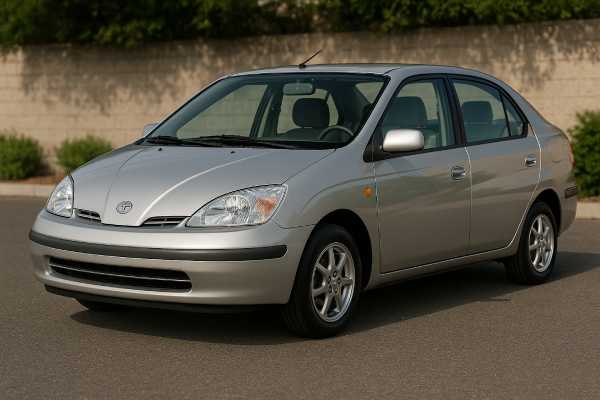
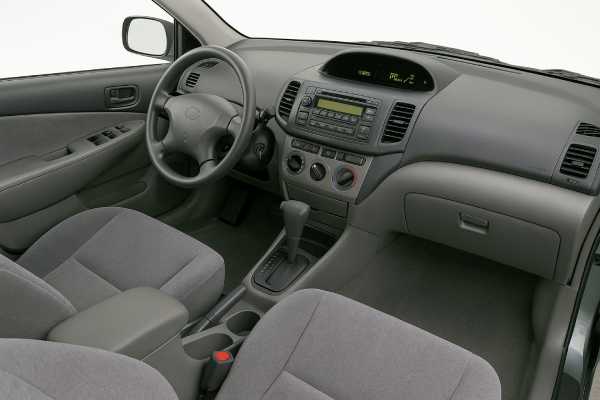
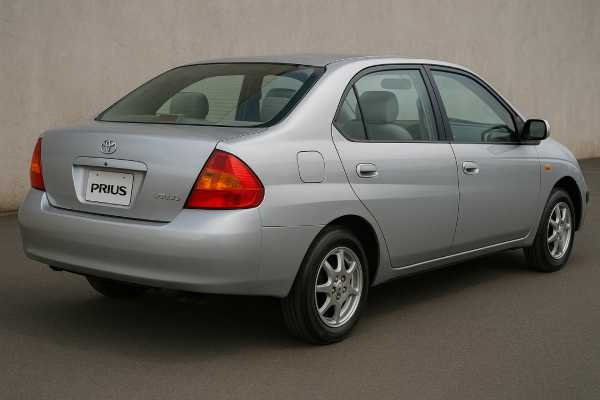
The first-generation Toyota Prius (chassis NHW11 for North America/Europe) is the hybrid that made hybrids mainstream. Sold here for model years 2001–2003, it pairs Toyota’s 1NZ-FXE 1.5-liter Atkinson-cycle four with a permanent-magnet traction motor and an eCVT transaxle. What keeps the NHW11 interesting today isn’t just fuel economy; it’s the way the system is engineered for durability and simplicity—no conventional starter, alternator, or belts driving accessories. For shoppers, that means a compact sedan with low running costs and a powertrain that’s easy on consumables. For DIYers, most service points are straightforward and parts availability remains good. You’ll still want to shop carefully: high-voltage (HV) battery age, steering recall completion, inverter/transaxle fluid condition, and general cooling health matter more than cosmetics. Get those right and a tidy NHW11 can be a frugal, teachable, and surprisingly pleasant daily driver.
At a Glance
- Proven hybrid system with simple, belt-free accessory drive and excellent city economy.
- Compact footprint, roomy cabin (≈ 89 ft³) and conventional sedan trunk (≈ 12 ft³).
- Steering gear recall and aging HV battery are the two biggest ownership checks.
- Engine oil: 5,000–7,500 miles (8,000–12,000 km) or 6–12 months depending on use.
Explore the sections
- Toyota Prius NHW11: Detailed Overview
- NHW11 Specifications and Technical Data
- NHW11 Trims, Options and Safety
- Reliability, Issues and Service Actions
- Maintenance Schedule and Buyer’s Guide
- Driving Experience and Efficiency
- Prius NHW11 versus Rivals
Toyota Prius NHW11: Detailed Overview
The NHW11 Prius is the second iteration of Toyota’s early hybrid sedan and the first widely sold in North America. Under the hood is the 1NZ-FXE—a 1.5-liter, 16-valve, chain-driven DOHC four designed from the outset for Atkinson-cycle operation (late intake valve closing to reduce pumping losses). It’s coupled with a permanent-magnet traction motor and a generator motor inside a compact transaxle (Toyota Hybrid System/THS). There’s no conventional alternator—12-volt power comes from a DC-DC converter—and no belt-driven starter; the engine is spun by a motor-generator. Those choices reduce parasitic losses and remove several parts that commonly wear out on non-hybrids.
Packaging is traditional: a four-door sedan with a fairly tall roof, soft seats, and an upright driving position. The high-voltage NiMH pack (38 modules, nominal ~273.6 V) sits behind the rear seat, protected by a sheet-metal enclosure with a dedicated cooling path. The trunk remains usable and square—an advantage over some later hatchback hybrids if you prefer a separate cargo compartment.
On the road, the NHW11 prioritizes calm progress. Acceleration is modest but adequate for city commuting; the hybrid system shines in stop-and-go where the car can glide on electric assist and recapture energy under braking. Highway cruising is more about steadiness than speed. The eCVT holds engine revs where load and efficiency dictate; at moderate throttle the engine note is unobtrusive, and the lack of conventional shifting reduces driveline shunt.
Ownership virtues are pragmatic. Consumables last: pads and rotors benefit from regenerative braking, and there’s no timing belt to replace. Fluids are standard Toyota fare (engine oil 5W-30, Toyota coolant for engine and inverter loops, ATF in the transaxle). Where age matters most is the HV battery and a handful of hybrid peripherals (coolant pumps, sensors). The steering gear on this generation also has a well-known campaign to secure pinion-shaft nuts—easy to check by VIN. For buyers who appreciate simple ergonomics, tangible fuel savings, and a teachable hybrid system, a well-kept NHW11 remains a solid entry point into hybrid ownership.
NHW11 Specifications and Technical Data
Powertrain & Efficiency
| Item | Specification |
|---|---|
| Code | 1NZ-FXE (Atkinson-cycle) + permanent-magnet traction motor |
| Engine layout & cylinders | Inline-4, DOHC, 4 valves/cyl; variable valve timing (intake) |
| Bore × stroke | 75.0 × 84.7 mm (2.95 × 3.33 in) |
| Displacement | 1.5 L (1497 cc) |
| Induction | Naturally aspirated |
| Fuel system | Multi-point fuel injection (MPI) |
| Compression ratio | ~13.0:1 |
| Max engine power | ≈ 70 hp (52 kW) @ ~4,500 rpm |
| Max engine torque | ≈ 113 Nm (83 lb-ft) @ ~4,200 rpm |
| Traction motor (MG2) | Permanent-magnet synchronous; ≈ 33 kW (44 hp) |
| Generator (MG1) | Permanent-magnet synchronous (starter/generator role) |
| System net output | ≈ 98 hp (73 kW) (North America rating method) |
| HV battery | NiMH, ~273.6 V nominal, ~6.5 Ah (38 modules) |
| Emissions/label economy | EPA adjusted ≈ 5.7 L/100 km (41 mpg US / 49 mpg UK) combined |
| Real-world highway @ 120 km/h (75 mph) | ≈ 6.2–6.7 L/100 km (38–35 mpg US) depending on conditions |
| Aerodynamics | Cd ≈ 0.29 (approximate) |
Notes: Ratings and rpm values are representative for the U.S. NHW11. “System net” reflects hybrid power blending rather than a simple sum of engine and motor peaks.
Transmission & Driveline
| Item | Specification |
|---|---|
| Transmission | eCVT hybrid transaxle (P111), planetary power-split |
| Gear ratios | Continuously variable (no discrete steps) |
| Final drive ratio | ≈ 3.905 : 1 (typical for NHW11) |
| Drive type | Front-wheel drive (FWD) |
| Differential | Open front differential |
Chassis & Dimensions
| Item | Specification |
|---|---|
| Suspension (front/rear) | MacPherson strut / torsion-beam axle |
| Steering | Electric power steering (rack-and-pinion) |
| Brakes | Front ventilated disc / rear drum with ABS and regen coordination |
| Wheels/Tires | Typically 175/65 R14 (14-in steel wheels with covers) |
| Length / Width / Height | ~ 4,315–4,275 mm (169.9–168.3 in) / 1,695 mm (66.7 in) / ~1,490 mm (58.7 in) |
| Wheelbase | ~ 2,550 mm (100.4 in) |
| Turning circle (curb-to-curb) | ≈ 9.6 m (31.5 ft) |
| Curb weight | ~ 1,240–1,270 kg (2,734–2,800 lb) depending on equipment |
| GVWR | ~ 1,640–1,650 kg (≈ 3,615 lb) |
| Fuel tank | ~ 50 L (11.9 US gal / 10.9 UK gal) |
| Cargo volume | ≈ 340 L (12 ft³) — SAE |
Performance & Capability
| Metric | Value |
|---|---|
| 0–100 km/h (0–62 mph) | ≈ 13.0–13.5 s (typical tests) |
| 0–60 mph | ≈ 12.5–13.0 s |
| Top speed | ~ 160 km/h (99 mph) |
| Braking (62–0 mph) | Typical compact-sedan distances; regen reduces pad wear |
| Towing / Payload / Roof load | Towing not rated; payload modest (check door-jamb sticker); roof load low |
Fluids & Service Capacities
| System | Specification | Capacity |
|---|---|---|
| Engine oil | API SL (or later superseding spec), SAE 5W-30 | ≈ 3.7–3.9 US qt (≈ 3.5–3.7 L) with filter |
| Engine coolant | Toyota Long Life Coolant (red), 50/50 premix | ≈ 5.2 L (≈ 5.5 US qt) |
| Inverter/drive coolant | Toyota Long Life Coolant (red), dedicated loop | ≈ 2.6 L (≈ 2.7 US qt) |
| Transaxle (eCVT) | Toyota ATF Type T-IV | ≈ 4.5–4.9 US qt (≈ 4.3–4.6 L) |
| A/C refrigerant | R-134a | ≈ 500 g (17.6 oz) |
| A/C compressor oil | ND-OIL 8 (PAG), hybrid-safe | As specified during service |
| Key torque specs (select) | Wheel lug nuts | ~103 Nm (76 lb-ft) typical Toyota spec |
Hybrid A/C: The electric compressor uses non-conductive oil; avoid generic PAG oils and contamination.
Electrical
| Item | Specification |
|---|---|
| Alternator | Not fitted (DC-DC converter from HV system) |
| 12-V battery | JIS S46B24R form factor; AGM recommended; ~28–45 Ah, ~325–370 CCA typical |
| Spark plugs | Denso SK16R11 or NGK IFR5A11; gap 1.0–1.1 mm (0.039–0.043 in) |
Safety & Driver Assistance
| Area | Details |
|---|---|
| Crash ratings | Limited public U.S. test coverage for 2001–2003; verify per VIN. |
| Airbags | Dual front SRS standard; front seat-mounted side airbags optional on many cars. |
| Child seats | Lower anchors (LATCH) for outboard rear positions; top tethers for all rear seats. |
| ABS/traction | ABS standard; brake assist integrated; traction control availability varies by region/trim. |
| Headlights | Halogen reflector; aim and bulb type per owner’s manual. |
| ADAS | Pre-modern era; no AEB/ACC/LKA on NHW11. |
NHW11 Trims, Options and Safety
Trims and options (North America focus). The NHW11 sold here as a single mechanical spec with option packages that primarily added comfort and safety items. Typical factory options included:
- Side torso airbags (front seats) — highly recommended if present.
- Cruise control and remote keyless entry — common on higher packages.
- Audio upgrades — cassette/CD options and additional speakers.
- Alloy wheels were not a mainstream NHW11 feature in this market (steel wheels with covers were typical).
Quick identifiers.
- VIN and build labels: confirm model year and plant/build month on the driver’s door jamb.
- Airbag tags: look for “SRS AIRBAG” side tags on seatbacks (presence signals optional side airbags).
- Steering-recall completion: check for dealer campaign stickers or invoices; verify by VIN online.
- HV battery: service labels or part numbers on pack covers can show replacement history; many packs have been replaced over time.
Year-to-year changes (U.S.) were modest. Toyota refined software and minor interior details, while the underlying hybrid hardware remained consistent. The most relevant differences for buyers today are the presence of optional side airbags and whether a given car has comprehensive service records.
Safety ratings. Formal U.S. crash-test results for the NHW11 are sparse compared with later Prius generations. The best approach is to treat safety as equipment-driven: prioritize cars with optional side airbags, ensure that all seat belts retract and lock correctly, and verify child-seat anchors and tethers are present and undamaged. Remember that NHW11 predates the era of stability control mandates and modern ADAS suites.
Safety systems and ADAS.
- Airbags: dual front standard; front seat-mounted side airbags optional (no side curtains on NHW11).
- Braking & stability: four-channel ABS with electronic brake distribution; brake assist integrated. Regeneration blends with friction braking via the hybrid control ECU.
- Child restraints: LATCH lower anchors for the two outboard rear positions, tethers for all three; the center seat typically lacks dedicated lower anchors—install with seat belt in the center if desired.
- Head restraints: adjustable for outboard rear seats; center rear may lack a head restraint (check car).
- Lighting: halogen reflectors; ensure clear lenses and correct aim for best night performance.
Calibration implications after service. Steering and SRS work on this generation is conventional: ensure clockspring alignment if the wheel is removed; clear DTCs after repair and verify no airbag or EPS warning lamps remain. Wheel-speed sensors and yaw sensors are less of a concern here than on later stability-control cars, but ABS DTCs should be investigated promptly.
Reliability, Issues and Service Actions
Toyota engineered the NHW11 for longevity, and many examples still commute daily. Age, heat, and neglected fluids are the biggest threats. Below is a practical map of issues, ranked by prevalence and severity/cost for a typical higher-mileage car.
High-voltage (HV) battery — common / medium–high
- Symptoms: Triangle warning, battery fan running frequently, uneven state-of-charge bars, DTCs (e.g., P3006).
- Root cause: NiMH module aging and imbalance after 15–25 years; heat accelerates degradation.
- Remedy: Pack replacement (new OEM or quality reman), or module-level repair with balancing as a stopgap. Confirm pack cooling path is clean; replace pack fan if noisy.
Steering gear pinion-shaft nuts (safety recall) — common (campaign) / medium
- Symptoms: Heavier steering effort especially on left turns; EPS warnings possible.
- Root cause: Inadequate fixation of pinion-shaft nuts in the EPS steering gear can allow loosening with repeated full-lock turns.
- Remedy: Campaign installs updated double-nut arrangement and torque procedure. Verify completion by VIN and dealer paperwork.
eCVT/transaxle fluid neglect — occasional / medium–high
- Symptoms: Whine, overheating, or failure from contaminated fluid and clogged internal screen.
- Root cause: Lifetime-fill assumptions on early hybrids meet real-world wear and thermal cycles.
- Remedy: Preventive ATF changes (drain/fill) at sensible intervals (see maintenance section). If symptoms are present, avoid aggressive driving and service fluid promptly; advanced faults may require transaxle replacement.
Inverter and engine cooling — occasional / medium
- Symptoms: Overheat warnings, reduced power, or HV system shutdown; no visible turbulence in inverter coolant reservoir.
- Root cause: Aged coolant, air entrapment after service, or weak/failed inverter-loop pump; debris in caps and hoses.
- Remedy: Replace inverter-loop pump if flow is poor; vacuum-fill or carefully bleed both coolant loops; renew coolant at time-based intervals.
Ignition and fuel metering — occasional / low–medium
- Symptoms: Rough starts, misfires, poor economy, P030x, MAF codes.
- Root cause: Aging iridium plugs near end of life, coil degradation, dirty MAF sensor or throttle body.
- Remedy: Replace plugs with correct long-life iridium type; inspect coils under load; clean MAF and throttle body with approved cleaners; check PCV.
12-V auxiliary battery — common / low–medium
- Symptoms: No-ready condition, flickering cluster, communication DTCs; short trip use accelerates aging.
- Root cause: Small AGM battery in trunk; deep cycling or age.
- Remedy: Replace with correct S46B24R AGM; verify DC-DC charging; keep cargo-area vents clear.
Brake hardware age (despite regen) — occasional / low–medium
- Symptoms: Pulsation, uneven pad deposits, rear shoe glazing, sticky slide pins.
- Root cause: Light friction-brake use and time.
- Remedy: Clean/lube slides annually, bed pads if glazing occurs, replace aged rubber components.
Software updates (ECU/combination meter) — rare / low
- Symptoms: Intermittent warnings or drivability quirks that align with older calibrations.
- Remedy: Ask a dealer to check for historical calibration bulletins; not all updates apply to every VIN.
Corrosion hotspots — occasional / medium (salt states)
- Areas: Rear subframe mounts, brake lines, lower door seams, exhaust flanges.
- Remedy: Inspect on a lift; treat early; budget for line repairs if heavily corroded.
Recalls, TSBs, and extended coverage (high-level):
- EPS pinion-shaft nuts (2001–2003) — inspection and double-nut installation with torque validation.
- Early torque-sensor contact concern (select vehicles) — steering effort increase and EPS lamp; addressed by recall/TSB depending on VIN.
- Hybrid system updates — periodic software improvements on later models; for NHW11, emphasis is on hardware maintenance and recall completion.
Always confirm by VIN using official recall lookup and retain dealer documentation.
Pre-purchase checks to request:
- Full service file with mileage/time stamps.
- Proof of steering campaign completion (and any power-steering-related repairs).
- Evidence of recent fluid replacements (engine oil, coolant loops, transaxle ATF).
- HV battery state-of-health or proof of replacement (date, supplier, warranty).
- Inverter-loop coolant movement visible at the reservoir with READY on (after warming).
- A clean hybrid-battery cooling path (grilles and ducting free of lint/pet hair).
Maintenance Schedule and Buyer’s Guide
Practical maintenance schedule (distance/time = whichever comes first). Intervals below reflect typical North American usage for an aging hybrid; adjust for severe service (extreme temps, short trips, dusty roads).
- Engine oil & filter: every 5,000–7,500 miles (8,000–12,000 km) / 6–12 months using 5W-30 meeting API SL or later. Hybrids tend to dilute oil less during long cruises but may accrue short-run moisture—time matters.
- Engine air filter: inspect 12 months/15,000 miles; replace as needed.
- Cabin filter: inspect 12 months/15,000 miles; replace annually in dusty or urban environments.
- Spark plugs: inspect around 60,000 miles (96,000 km); replace by 120,000 miles (192,000 km) or 10 years with Denso SK16R11/equivalent iridium at 1.0–1.1 mm gap.
- Cooling systems: drain/fill engine and inverter/drive loops every 5 years/60,000 miles (100,000 km), then 3–4 years/30,000–50,000 miles; use Toyota red Long Life Coolant. Bleed carefully.
- Transaxle ATF (eCVT): drain/fill every 50,000–60,000 miles (80,000–100,000 km) with Toyota ATF Type T-IV; clean magnet; do not overfill.
- Brake fluid: flush every 2–3 years; moisture control preserves ABS modulator.
- Brake hardware: inspect/clean slides and shoe hardware annually; expect longer pad life due to regeneration.
- Serpentine/aux belts: none—accessories are electric (benefit of THS).
- PCV valve and throttle body: inspect/clean every 60,000 miles.
- 12-V battery: load-test annually after 4–5 years; replace proactively with correct AGM (S46B24R footprint).
- HV battery: perform a basic health check during annual service—scan for block voltage deltas, ensure fan is clean/quiet; no fixed replacement interval.
- Wheel alignment and tires: rotate 5,000–7,500 miles; align yearly or after impacts; keep tires at the pressures on the door label for best economy and wear.
- A/C service: evacuate/charge only with R-134a and hybrid-safe oil; avoid adding generic dyes/oils.
Fluid references & capacities (decision-making quick list).
- Engine oil: ~3.7–3.9 qt (3.5–3.7 L) with filter; 5W-30.
- Engine coolant: ~5.2 L (5.5 qt) red Toyota LL.
- Inverter coolant: ~2.6 L (2.7 qt) red Toyota LL.
- Transaxle ATF: ~4.5–4.9 qt (≈4.3–4.6 L) Type T-IV.
- A/C R-134a: ~500 g (17.6 oz).
- A/C compressor oil: ND-OIL 8 (use hybrid-compliant equipment).
Buyer’s guide checklist (what to look for):
- Hybrid essentials
- READY behavior is crisp; no master warning triangle.
- HV battery fan is quiet; ducting and rear-seat intake are clean.
- Inverter reservoir shows visible coolant movement at idle (warm, READY).
- DC-DC charging voltage stable (≈ 13.5–14.5 V) with loads on.
- Steering and brakes
- VIN shows steering campaign completed; steering effort is even in both directions.
- Brake-pedal feel is firm and consistent; ABS test on loose surface is smooth (no harsh pulsing or warning lights).
- Powertrain
- No eCVT whine beyond a gentle, even turbine sound; ATF color healthy (not burnt).
- Engine starts/stops smoothly; no flares or stalls on warm restarts.
- Chassis & body
- Rear subframe/brake lines free of heavy corrosion; lower door seams intact.
- Tire wear is even; car tracks straight; no clunks over speed bumps.
- Paperwork & extras
- Proof of coolant and ATF services within the last 30–50k miles.
- Spark plug age known; use correct iridium parts.
- Two keys present; keyless entry works.
- Child-seat anchors/tethers intact if relevant to your use case.
Durability outlook. With fluids managed and the HV battery in good shape (newer pack or verified SOH), an NHW11 can remain a cheap-to-run commuter. Expect occasional age-related rubber/plastic replacements (coolant hoses, bushings) and plan a budget line for HV battery work sometime in long-term ownership if it has not been replaced.
Driving Experience and Efficiency
Ride, handling, NVH. The NHW11 rides softly with a clear focus on comfort and low-speed refinement. Body motions are well-controlled at city speeds; larger undulations can produce a secondary float typical of compact sedans with a compliance bias. The torsion-beam rear axle behaves predictably; mid-corner bumps don’t upset the car if the dampers are healthy. Steering is light but consistent, and the car tracks calmly on the highway. Wind and road noise are modest for the era; at urban speeds, engine-off coasting and electric pull-aways make the cabin feel quiet and relaxed.
Powertrain character. Off the line, the traction motor helps the 1.5 wake up cleanly; at light throttle you’ll often move on electric assist with the engine joining seamlessly as load rises. There’s no shifting in the conventional sense—just an eCVT holding rpm where it’s efficient. Press deeper and the engine note is audible but not coarse; passing requires planning, though 50–80 mph (80–130 km/h) acceleration is adequate on level ground. Transitions between EV assist and engine power are smooth when the cooling system and ignition components are healthy.
Braking feel and consistency. Regenerative braking does much of the work at lower decelerations; the handoff to friction brakes is generally transparent, with ABS tuning aimed at stability. Pedal feel depends heavily on clean, lubricated caliper slides and fresh brake fluid. A short, controlled bedding drive after pad service helps set a crisp initial bite.
Real-world efficiency.
- City: 4.7–5.6 L/100 km (50–42 mpg US; 60–50 mpg UK) depending on climate, hills, and trip length.
- Highway (100–120 km/h / 60–75 mph): 5.6–6.7 L/100 km (42–35 mpg US; 50–42 mpg UK).
- Mixed: Expect 5.3–6.0 L/100 km (44–39 mpg US).
Cold weather trims economy notably (battery chemistry and cabin heat loads); grille-blocking in harsh winters and good tires at spec pressures help.
Load and grades. With four adults and luggage, the car will still climb long grades without drama, but acceleration is measured and the eCVT will hold higher rpm to sustain speed. Coolant system health (both loops) is crucial when working the hybrid system hard—watch for stable inverter-reservoir flow.
Tires and behavior. Low-rolling-resistance (LRR) all-seasons preserve economy and steering lightness. Upsizing wheels/tires compromises ride and mpg without meaningful dynamic gains; this chassis responds best to fresh OEM-like dampers and bushings rather than big tire changes.
Prius NHW11 versus Rivals
Honda Insight (2000–2006, first-gen). The early Insight is lighter, two-seat, and manual-friendly; its Integrated Motor Assist (IMA) is assist-only, so it can’t propel the car in EV mode. It delivers stellar highway numbers thanks to its aerodynamics and gearing, but cargo and seating are limited. For a daily with rear seats and a conventional sedan feel, the Prius is the more practical choice. Prius parts support and repair familiarity are also broader in North America.
Honda Civic Hybrid (2003+). The first Civic Hybrid adds rear seats and a more mainstream body than Insight, but early IMA packs also age. Civic dynamics are slightly tighter; Prius counters with smoother low-speed operation, EV creep, and a roomier trunk opening. In today’s market, condition and service history matter more than badge—both can be sensible if the HV battery is strong.
Conventional compacts (Corolla, Sentra, Civic non-hybrid of the era). Gas-only rivals are simpler on paper and can be just as durable. However, the Prius wins in city economy and brake/pad longevity thanks to regeneration, and removes belt/alternator service from the equation. If most of your miles are urban, the Prius’s hybrid advantages show up every week at the pump.
Bottom line. An NHW11 in good health is still a thrifty commuter. If you want manual control, more passing muscle, or a sportier chassis, look elsewhere. But for simple, reliable transportation that teaches hybrid fundamentals and sips fuel, this early Prius remains compelling.
References
- Fuel Economy of the 2001 Toyota Prius 2025 (EPA Ratings)
- Vehicle Detail Search – 2001 TOYOTA PRIUS | NHTSA 2025 (Recall Database)
- Microsoft Word – B0G TI v2.docx 2016 (Technical Instructions — EPS Pinion Shaft Nuts)
- 2001 Prius – manuals & warranties 2025 (Owner’s Resources)
- Denso 3324 SK16R11 Iridium Long Life Spark Plug 2025 (Spark Plug Specification)
Disclaimer
This article is for informational purposes and does not replace professional diagnosis or repair. Specifications, torque values, capacities, and service intervals vary by VIN, market, and equipment. Always verify against your vehicle’s official service information and recall status by VIN. If this guide helped you, consider sharing it on Facebook or X to support xcar’s work. Thank you!