
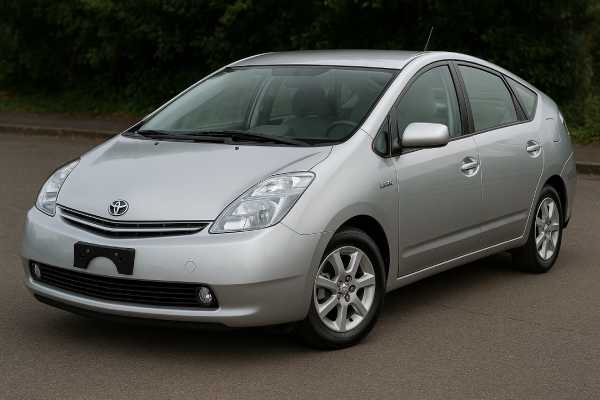
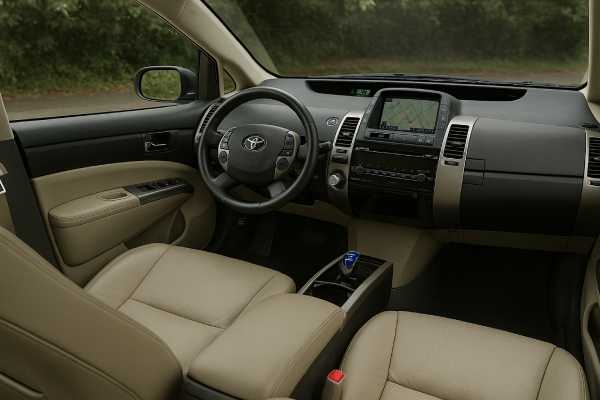
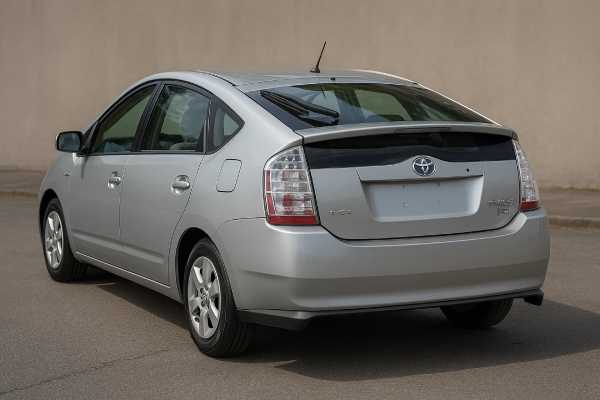
The facelifted Toyota Prius (NHW20, 2006–2009) cemented the model’s reputation as a practical, low-cost hybrid that just works. It pairs the 1NZ-FXE 1.5-liter Atkinson-cycle four with a high-torque AC motor and a planetary eCVT for a smooth 110 hp system output. The long 106.3-inch wheelbase delivers a settled ride, while the five-door hatchback layout provides real cargo flexibility. Compared with earlier years, these later cars benefit from more widely available side and curtain airbags (standard from 2007), additional option packages, and incremental software refinements. Real-world fuel economy remains the headline: high 40s mpg (US) in mixed use is achievable without hypermiling. Ownership is straightforward if you follow the fluids and keep cooling paths clean—this platform does not use a conventional alternator or hydraulic power steering pump, which reduces wear items but places more importance on correct coolant and bleeding. For commuters and families, the 2006–2009 Prius is still a rational, durable choice.
Top Highlights
- Consistent 4.9–5.6 L/100 km (48–42 mpg US) in mixed driving; excels in city use.
- Spacious five-door hatch with low load floor and easy ingress; big-car room in a compact footprint.
- Proven hybrid components and parts availability keep total ownership costs low.
- Watch for aging inverter and engine coolant pumps, and brake actuator noise on high-mileage cars.
- Routine touchpoint: engine oil and tire rotation every 5,000–7,500 mi (8,000–12,000 km) or 6–12 months.
Explore the sections
- Prius NHW20 2006–2009 Overview
- Prius NHW20 Specs and Data
- Trims, Options and Safety Tech
- Reliability and Service Actions
- Maintenance and Buyers Guide
- Driving and Real-World Performance
- How Prius Compares to Rivals
Prius NHW20 2006–2009 Overview
Toyota’s NHW20 Prius matured into the mainstream during 2006–2009 thanks to its well-sorted hybrid drive and cleverly packaged interior. The gasoline side is the 1NZ-FXE 1.5-liter inline-four operating on the Atkinson cycle, optimized for efficiency with late intake valve closing and a high geometric compression ratio. Electric propulsion is handled by a permanent-magnet traction motor (MG2) fed by a nickel-metal hydride battery pack (nominal 201.6 V). A planetary power-split device blends engine and motor output through the P112 transaxle so the car can creep on electric power, cruise with the engine in its sweet spot, or capture energy during deceleration.
The facelift cars continue the second-generation body: a low nose, fast windshield, and Kamm-back tail. With a drag coefficient around 0.26 and narrow 185-section low-rolling-resistance tires, the Prius slips through the air efficiently at highway speeds—key to seeing high-40s mpg on longer trips. The 106.3-inch (2,700 mm) wheelbase yields rear legroom competitive with larger sedans, and the upright hatch swallows everyday cargo that would stump many compact sedans.
Electric accessories replace traditional belt-driven components: there is no alternator and no hydraulic power steering pump. A DC-DC converter keeps the 12-volt system charged, and an electric rack handles steering assist. Two coolant loops—one for the engine and one for the inverter/motor electronics—need correct Toyota Super Long Life Coolant and proper bleeding after service. Get those basics right and the hybrid hardware typically delivers a long, uneventful life.
Safety content improved through the run. Side torso and side curtain airbags were optional at launch but became standard from 2007, and stability control (VSC) was widely available via option packages. The structure performs well in moderate-overlap frontal tests, and the car’s predictable balance suits daily driving and winter tires nicely.
In practice, ownership comes down to routine service and a short list of age-related watch items: inverter coolant pump reliability (addressed by recall), occasional brake actuator wear, and infotainment display modules that may need rework or replacement. With documented maintenance and completed recalls, the 2006–2009 Prius remains one of the least-costly ways to cover a lot of ground.
Prius NHW20 Specs and Data
Powertrain and Efficiency
| Item | Specification |
|---|---|
| Engine code (ICE) | 1NZ-FXE |
| Engine layout and cylinders | Inline-4, DOHC, 4 valves/cyl |
| Bore × stroke | 75.0 × 84.7 mm (2.95 × 3.33 in) |
| Displacement | 1.5 L (1,497 cc) |
| Induction | Naturally aspirated (Atkinson cycle) |
| Fuel system | Multi-point fuel injection (PFI) |
| Compression ratio | ~13.0:1 |
| Max engine power | ~76 hp (57 kW) @ ~5,000 rpm |
| Max engine torque | ~115 Nm (85 lb-ft) @ ~4,000 rpm |
| Traction motor (MG2) | ~67 hp (50 kW); ~400 Nm (295 lb-ft) at low rpm |
| System output | 110 hp (82 kW) |
| Battery | NiMH, 201.6 V nominal, ~6.5 Ah (~1.3 kWh gross) |
| System voltage range | ~200–500 V operating |
| Timing drive | Chain |
| Rated economy (combined) | ~4.9 L/100 km (46 mpg US / 55 mpg UK) |
| City / Highway (typical EPA) | ~4.9 / 5.2 L/100 km (48 / 45 mpg US) |
| Real-world @ 120 km/h (75 mph) | ~5.0–5.6 L/100 km (47–42 mpg US / 56–50 mpg UK) |
| Aerodynamics | Cd ≈ 0.26; frontal area ~2.2 m² (23.7 ft²) |
System horsepower reflects power blending through the eCVT; it is not a simple sum of ICE and motor ratings.
Transmission and Driveline
| Item | Specification |
|---|---|
| Transmission | Planetary eCVT (P112) hybrid transaxle |
| Drive type | Front-wheel drive |
| Final drive | Fixed reduction within transaxle |
| Differential | Open |
| Refuel to full | ~3–5 min (gasoline) |
Chassis and Dimensions
| Item | Specification |
|---|---|
| Suspension (front/rear) | MacPherson strut / torsion beam |
| Steering | Electric power rack-and-pinion |
| Brakes | Front ventilated disc ~255 mm (10.0 in); rear drum ~228 mm (9.0 in) |
| Wheels and tires | 185/65 R15 (15-in rim), low-rolling-resistance |
| Ground clearance | ~130 mm (5.1 in) |
| Length / Width / Height | 4,445 / 1,725 / 1,490 mm (175.0 / 67.9 / 58.7 in) |
| Wheelbase | 2,700 mm (106.3 in) |
| Turning circle (curb-to-curb) | ~10.4 m (34.1 ft) |
| Curb weight | ~1,325–1,350 kg (2,921–2,976 lb) |
| GVWR | ~1,760–1,790 kg (3,880–3,950 lb) |
| Fuel tank | 45 L (11.9 US gal / 9.9 UK gal) |
| Cargo volume (seats up) | ~408 L (14.4 ft³) SAE; seats down ~1,100+ L (~39 ft³) |
Performance and Capability
| Metric | Value |
|---|---|
| 0–100 km/h (0–62 mph) | ~10.5–11.0 s (tire and load dependent) |
| Top speed | ~166–170 km/h (103–106 mph) |
| Braking 100–0 km/h | ~38–41 m (125–135 ft) on LRR all-season tires |
| Towing capacity | Not rated (0 kg / 0 lb recommended) |
| Payload | ~375–430 kg (825–950 lb) |
| Roof load | Not rated (light crossbars/accessories only if specified) |
Fluids and Service Capacities
| System | Specification / Capacity |
|---|---|
| Engine oil | API SL/SM 5W-30; 3.5 L (3.7 US qt) with filter |
| Engine coolant loop | Toyota Super Long Life Coolant (pink); ~5.5–6.0 L (5.8–6.3 US qt) after full bleed |
| Inverter/motor coolant loop | Toyota SLLC (pink); ~2.5–3.5 L (2.6–3.7 US qt) after bleed |
| Hybrid transaxle | Toyota ATF WS; ~3.5–4.0 L (3.7–4.2 US qt) drain/fill |
| A/C refrigerant | R-134a; ~450 ± 30 g (16.0 ± 1.1 oz); compressor oil ND-11 (~130 mL / 4.4 fl oz) |
| Key torque examples | Wheel nuts 103 Nm (76 lb-ft); transaxle drain/fill ~39 Nm (29 lb-ft); spark plugs ~14 Nm (10 lb-ft) |
Electrical
| Item | Specification |
|---|---|
| Alternator | None (DC-DC converter from HV battery) |
| 12-V battery | AGM/JIS S46B24R, ~45 Ah; rear-mounted with vent tube |
| Spark plugs | Iridium (e.g., Denso SK16R11 / NGK IFR5A11); gap 1.1 mm (0.043 in) |
Safety and Driver Assistance
| Category | Details |
|---|---|
| Crash ratings (IIHS) | Moderate overlap front Good; side Good with side/curtain airbags; without side airbags Poor (2004–2006). Head restraints/seats Marginal. Ratings apply to 2004–2009. |
| Headlight rating (IIHS) | Not evaluated for these years |
| ADAS suite | ABS, EBD, Brake Assist standard; traction control standard; Vehicle Stability Control (VSC) widely available, standard on some packages from 2007; no AEB/ACC/lane support in this era |
| Child-seat provisions | Rear LATCH anchors; generous rear door opening for install |
Trims, Options and Safety Tech
Trim and package logic (2006–2009)
These years were sold as one mechanical specification with tiered option packages rather than distinct trims. The hybrid powertrain (1NZ-FXE + MG2 + P112 eCVT) and 185/65R15 wheel/tire package are common to all. Equipment differences are primarily comfort, infotainment, visibility, and safety content:
- Convenience and comfort: Smart Key System (proximity entry/start) typically included on mid/high packages; automatic climate control across the board; illuminated entry; rear wiper standard; some cars carry 15-in alloy wheels while others have steel wheels with covers.
- Infotainment: The standard MFD (multi-function display) shows energy flow and fuel economy, and controls HVAC/audio. Higher packages add navigation integrated into the MFD; JBL audio with an external amplifier brings better clarity and output.
- Cameras and lighting: A backup camera is available on 2006–2009 cars when paired with navigation; HID headlamps with auto-leveling are included in specific packages. HID ballasts/igniters are wear items at this age; halogens are simpler to maintain.
- Safety content: Side torso and curtain airbags are optional on 2006 but standard from 2007, an important difference for side-impact protection. Vehicle Stability Control (VSC) is optional on 2006–2009 and worth seeking in snowbelt regions.
Quick identifiers for buyers
- VSC presence: Look for a VSC indicator during cluster self-test or a VSC button (varies by year).
- Side/curtain airbags: Airbag tags on seat bolsters and roof rails; verify on the build sheet or via VIN options.
- HID vs halogen: Projector housing with leveling motors signals HID; halogens use simpler reflectors.
- Backup camera: Present on many navigation-equipped cars (image appears on MFD when shifted into Reverse).
Year-to-year highlights in this window
- 2006: Option reshuffle; backup camera availability expands with navigation.
- 2007: Side and curtain airbags become standard; package mixes adjusted; more cars on the used market have VSC.
- 2008–2009: Running changes to audio/nav software and minor trim/color updates; mechanicals remain consistent.
Safety ratings snapshot and implications
The structure performs well in moderate-overlap frontal tests. Side-impact ratings hinge on airbag content: 2006 cars without side/curtain airbags score poorly in the original side test, while cars with those airbags (and all 2007–2009 cars) perform well. If you have a choice, prioritize 2007–2009 or a 2006 with the full airbag suite and VSC.
ADAS and calibration notes after service
No camera/radar ADAS to calibrate in this era. After a windshield replacement you do not need camera alignment, but steering angle sensor initialization is advised after alignment or steering work. If the brake actuator is replaced, a proper hybrid bleed procedure with the pump active is mandatory.
Reliability and Service Actions
Big picture
These Priuses are durable when fluids are correct and cooling is healthy. Typical age-related glitches are predictable and repairable. Below are common issues mapped by prevalence and cost tier, with symptoms and best-practice remedies.
Common (widespread) / Low–Medium cost
- Inverter coolant pump wear
Symptoms: red triangle warning, inverter reservoir with no visible swirl, limp-home behavior under load.
Root cause: electric pump internal failure.
Remedy: replace inverter (HV) water pump with the improved part; bleed inverter loop fully. A safety recall covered 2004–certain 2009 cars—confirm completion by VIN. - 12-V auxiliary battery weakness
Symptoms: intermittent warning lights, no-READY event, clock/audio resets.
Root cause: aging small-case AGM battery.
Remedy: test annually after ~4 years; replace with correct AGM S46B24R; confirm vent tube routing and DC-DC charging at READY (~13.8–14.0 V). - Rear drum brake corrosion or grab
Symptoms: grabby low-speed stops after rain; parking brake binds.
Root cause: light friction use due to strong regen, moisture.
Remedy: periodic clean/adjust; refresh hardware and shoes if glazed or corroded.
Occasional / Medium–High cost
- Brake actuator/accumulator wear
Symptoms: frequent pump cycling, ABS/VSC lights, mushy pedal, DTCs for accumulator pressure.
Root cause: internal leaks or valve body wear in the actuator assembly.
Remedy: replace actuator, then perform Techstream bleed and system calibrations; verify 12-V health before condemning hardware. - Combination meter (instrument cluster) failure
Symptoms: cluster dark, odometer/speedometer inoperative; car may not power down normally.
Root cause: aged voltage regulators and cold solder joints.
Remedy: repair or replace the combination meter; ensure odometer handling complies with local regulations; confirm immobilizer sync.
Occasional / Low–Medium cost
- Engine water pump seepage
Symptoms: pink crusty residue at pump, slow coolant loss, slight belt noise.
Root cause: mechanical seal wear.
Remedy: replace belt-driven engine water pump and belt; refill with Toyota SLLC and bleed. - MFD (touchscreen) intermittent input
Symptoms: HVAC/audio controls lag or drop touches; screen occasionally blank.
Root cause: cracked solder joints on early boards; aging resistive touch layer.
Remedy: board repair or replacement; update software if applicable; verify harness connectors.
Rare / Medium–High cost
- HV battery module imbalance (P0A80)
Symptoms: rapid state-of-charge swings, battery fan at high speed, reduced power.
Root cause: one or more NiMH modules out of spec after many years/heat exposure.
Remedy: quality remanufactured or new pack; clean cooling fan and duct; check sense harness for corrosion. - Transaxle bearing noise
Symptoms: road-speed-related whine unrelated to engine rpm.
Root cause: bearing wear.
Remedy: fluid inspection for metal, then rebuild/replace transaxle if confirmed; refill with ATF WS.
Recalls and service campaigns (headline items)
- Steering intermediate shaft (early build 2004–early 2006): potential cracking under certain loads; replacement of shaft/related components. Verify by VIN for 2006-build cars.
- Hybrid electric (inverter) water pump (2004–certain 2009): coil-wire defect may stop the pump or open a fuse; remedy replaces the pump with an improved part. Confirm the recall is closed on any candidate car.
Software updates worth confirming
- Engine/Hybrid ECU updates were issued through the run to refine diagnostics and drivability. Ask sellers for printouts of calibration IDs or dealer history, especially after any hybrid cooling or actuator repair.
Pre-purchase asks
- VIN recall check printout, recent coolant service receipts (engine and inverter loops) using Toyota SLLC, brake fluid change (every 2–3 years), HV battery health report (module voltages/resistance), and proof of any combination meter/MFD work. Inspect for subframe corrosion in road-salt regions and verify the hatch well is dry.
Maintenance and Buyers Guide
Practical maintenance schedule (distance/time)
(Use these as planning numbers; verify by VIN and local conditions.)
- Engine oil and filter: every 5,000–7,500 mi (8,000–12,000 km) / 6–12 months with 5W-30 meeting Toyota spec; monitor consumption on high-mileage engines.
- Engine air filter: inspect 15,000 mi (24,000 km); replace ~30,000 mi (48,000 km) or sooner in dusty use.
- Cabin air filter: 15,000–20,000 mi (24,000–32,000 km) or 12–18 months.
- Coolant (engine loop): first 100,000 mi (160,000 km) / 10 years, then every 50,000 mi (80,000 km) / 5 years; Toyota SLLC only.
- Inverter/motor coolant: same interval and coolant; confirm swirl at reservoir with key-on (pump run).
- Spark plugs (iridium): 120,000 mi (192,000 km) / ~10–12 years; torque ~14 Nm (10 lb-ft).
- Hybrid transaxle fluid (ATF WS): often “lifetime” in book; best practice 60,000–100,000 mi (96,000–160,000 km) drain/fill to manage wear metals.
- Brake fluid: every 2–3 years; DOT 3/4 acceptable per shop standard; hybrid bleed procedure required.
- Brake hardware: inspect at each rotation; clean/adjust rear drums periodically to prevent grab.
- Serpentine/aux belt: inspect each oil change; replace 60,000–90,000 mi (96,000–145,000 km) or with noise/cracks (drives engine water pump).
- 12-V AGM battery: test yearly after 4 years; expect 5–7 years service life.
- HV battery cooling: inspect/clean fan and duct every 60,000–90,000 mi; pet hair/dust reduce airflow.
- Tires/alignment: rotate 5,000–7,500 mi; maintain pressures; LRR tires help preserve economy.
Fluids, specs, and essentials
- Oil: 5W-30 API SL/SM; 3.5 L (3.7 qt) with filter.
- Coolant: Toyota Super Long Life Coolant (pink) for both loops; avoid mixing types.
- Transaxle: Toyota ATF WS only; ~3.5–4.0 L (3.7–4.2 qt) for a drain/fill.
- A/C: R-134a with ND-11 oil (electric compressor); do not use PAG oils.
- Key torques: wheel nuts 103 Nm (76 lb-ft); oil drain plug ~39 Nm (29 lb-ft); transaxle plugs ~39 Nm (29 lb-ft).
Buyer’s inspection checklist
- Hybrid cooling health: visible swirl in inverter reservoir at key-on, no red triangle during a long test drive, clean HV battery fan intake.
- Electronics: MFD touch response (all corners), cluster lights at start-up, Smart Key proximity unlock, 12-V charge voltage at READY.
- Brakes: listen for frequent accumulator pump cycling; ensure smooth regen-to-friction transition, no ABS/VSC lights.
- Steering and suspension: no clunks on lock-to-lock turns (recall completion matters on early 2006 builds); check lower control arm bushings and rear beam bushings.
- Leaks and hoses: pink residue at engine pump, brittle inverter hoses, aged clamps.
- Body/corrosion: front subframe and rear beam rust in salt regions; verify dry spare well and intact hatch weatherstrip.
- Tires: even wear pattern; set expectations if switching away from LRR tires (economy can drop).
What to seek
- 2007–2009 cars or 2006 with side/curtain airbags and VSC.
- Documentation for inverter pump replacement (recall) and recent coolant services.
- Evidence of combination meter repair (or flawless function) and clean brake fluid history.
Durability outlook
With basic care and quality parts, hybrid components commonly exceed 200,000–300,000 mi (320,000–480,000 km). Expect periodic 12-V battery, water pump(s), and suspension wear items; an HV battery will eventually age out by calendar years rather than mileage in many climates.
Driving and Real-World Performance
Ride, handling, and noise
On its stock 15-inch LRR tires and comfort-biased damping, the Prius is composed over broken pavement and quiet in stop-and-go. The long wheelbase helps straight-line stability at motorway speeds; crosswinds can still nudge the light tail, but proper tire pressures and fresh shocks keep it planted. Road noise rises on coarse asphalt; engine noise during heavy acceleration is a steady, well-damped hum rather than a growl.
Powertrain character
From rest, MG2’s torque makes the first car length clean and quiet. As speed builds, the 1.5-liter engine joins smoothly and settles into its most efficient band; the eCVT holds revs where the engine is happiest. The Atkinson-cycle trade-off is mid-range pull: passing from 50–80 mph (80–120 km/h) takes a plan and firm throttle, but the response is consistent. Transitions between engine-off coasting and engine-on power are unobtrusive when coolant systems are bled correctly and pumps are healthy.
Brakes and control
The brake-by-wire system offers strong regenerative braking at light pedal, blending into friction as needed. Initial pedal feel can seem numb, but modulation is predictable. Stopping distances are competitive for the class, and fade is a non-issue in daily use. VSC is a valuable safety net on wet or icy roads—interventions are early but effective, especially on all-season tires.
Observed economy
Mixed-route owners routinely report ~4.9–5.6 L/100 km (48–42 mpg US) without special technique. City routes often beat highway numbers thanks to regeneration and engine-off time at lights. At steady 100–120 km/h (60–75 mph), expect ~5.0–5.6 L/100 km (47–42 mpg US) depending on temperature, terrain, and wind. Winter operation with snow tires and heavy HVAC use can trim economy by 10–20%; maintaining tire pressures and using seat heaters instead of blasting cabin heat helps.
Loads, grades, and towing
The Prius carries four adults and luggage comfortably, but on long grades it will hold revs to maintain speed—normal behavior. Healthy coolant flow is critical for sustained climbs; an aging inverter pump can trigger warnings, so verify recall completion. The model is not tow-rated in the baseline market; roof boxes and hitch trays are fine but cost ~10–15% in fuel use at highway speed due to aero drag.
How Prius Compares to Rivals
Honda Civic Hybrid (2006–2009)
Honda’s Integrated Motor Assist is simpler and lighter but cannot propel the car independently with the engine off at speed. In practice the Prius is more efficient in city driving, rides more softly, and offers vastly better cargo flexibility thanks to the hatch. Civic Hybrid’s battery longevity in this era is more variable; the Prius enjoys broader aftermarket and OE parts support.
Honda Insight (Gen 1 carryover to 2006; Gen 2 from 2010)
The original two-seat Insight remains the hypermiler’s hero, but it lacks practicality and parts are scarce. The 2006–2009 Prius delivers five seats, better safety content, quieter cruising, and lower real-world ownership friction.
Ford Escape Hybrid (2008–2009)
A small SUV with available AWD, upright seating, and better visibility—but higher fuel consumption and more tire/brake wear in urban duty. Choose the Escape if you need tow rating or ground clearance; choose the Prius if you value best-in-class city mpg and simple service.
Toyota Corolla (1.8L, 2006–2009)
The Corolla is a low-cost benchmark with simple maintenance. The Prius counters with markedly better city efficiency, a roomy hatch, and calmer stop-and-go behavior. Over high annual mileage, fuel and brake-wear savings tip the total cost of ownership to the Prius, especially for urban commuters.
Takeaway
For buyers who prioritize low running costs, reliable hybrid hardware, and real cargo space in a compact footprint, the facelifted NHW20 Prius remains hard to beat. Focus your search on cars with side/curtain airbags, VSC, documented coolant service, and closed recalls for the cleanest ownership experience.
References
- Fuel Economy of the 2009 Toyota Prius 2025 (EPA/DOE Database)
- 2004 Toyota Prius 4-door hatchback 2025 (Safety Rating)
- Vehicle Detail Search – 2009 TOYOTA PRIUS 2025 (Recall Database)
- Vehicle Detail Search – 2006 TOYOTA PRIUS 2025 (Recall Database)
- Toyota Safety Recall 12V-536 – Dealer Notification – Remedy 2013 (Recall Notice)
Disclaimer
This article is for informational purposes only and is not a substitute for professional diagnosis or repair. Specifications, torque values, service intervals, and procedures vary by VIN, market, options, and production date. Always verify details against your vehicle’s official service documentation and current technical bulletins before performing maintenance or repairs.
If this guide helped, please consider sharing it on your social channels (Facebook, X/Twitter, etc.). Your support helps xcar continue producing clear, useful resources for owners and shoppers.