
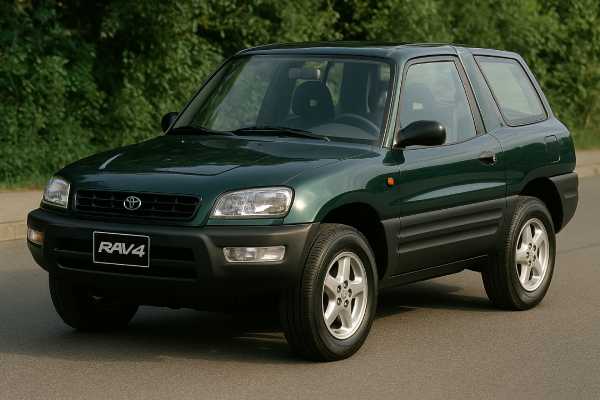
The first-generation Toyota RAV4 helped invent the compact crossover segment by blending a light monocoque body with full-time four-wheel drive and car-like manners. In 1996–1997, the 4WD model in North America used Toyota’s durable 3S-FE 2.0-liter four-cylinder rated at 120 hp, paired to either a 5-speed manual or 4-speed automatic. What makes this XA10 RAV4 stand out today is how simple and rugged it feels without being punishing to drive: strut front/double-wishbone rear suspension, a viscous center differential with a manual lock button on many trims, and a compact footprint that’s easy to place in traffic or on a trailhead access road. Ownership is equally straightforward—timing-belt service, sensible fluids, and a chassis that resists corrosion well if cared for. This guide focuses on the 1996–1997 4WD models, giving you the essential specs, performance notes, maintenance intervals, reliability patterns, and buyer tips that matter if you’re shopping or preserving one.
Fast Facts
- Honest, light SUV feel: unibody, full-time 4WD with center-diff lock delivers all-weather traction without trucklike weight.
- 3S-FE engine is long-lived and tolerant of mileage with regular belt, fluids, and valve-cover/seal care.
- Cabin and cargo space are generous for the footprint; rear bench folds flat for a near-level load floor.
- Caveat: automatic (A540H) can feel busy on grades; inspect for fluid condition and smooth engagement when warm.
- Typical service anchor: timing belt every ~60,000 mi (96,000 km) or 6 years, whichever comes first.
Navigate this guide
- RAV4 XA10 4WD overview
- Toyota RAV4 3S-FE specs
- RAV4 1996–1997 trims and safety
- Reliability, issues, and fixes
- Maintenance and buying advice
- Driving, economy, and performance
- RAV4 vs rivals
RAV4 XA10 4WD overview
The 1996–1997 Toyota RAV4 4WD sits at the intersection of two worlds: car-based packaging and suspension, combined with a true full-time four-wheel-drive system designed for all-weather traction and light trail use. Unlike body-on-frame small SUVs of the era, the XA10 rides on a stiff monocoque shell. That keeps curb weight reasonable, improves crash energy management for its day, and gives the RAV4 a tidy, tossable feel. The 3S-FE 2.0-liter four is an iron-block, aluminum-head DOHC design with a non-interference valvetrain and a belt-driven cam—an old-school recipe that’s durable and easy to service. Power is modest at 120 hp, but delivery is smooth, and the engine tolerates mileage well if leaks and cooling are kept in check.
Toyota paired the engine with either a 5-speed manual transaxle (E250F) or a 4-speed electronically controlled automatic (A540H). Both send power through a center differential; most 4WD XA10s include a manual center-diff lock switch that mechanically locks the front and rear outputs to improve traction on slippery surfaces. Front suspension is MacPherson strut, while the rear uses a compact double-wishbone layout that preserves cargo room and articulation. Brakes are ventilated front discs with rear drums—reliable and inexpensive to service—backed by optional ABS. Wheels were 16-inch with 215/70R16 tires on most 4WDs.
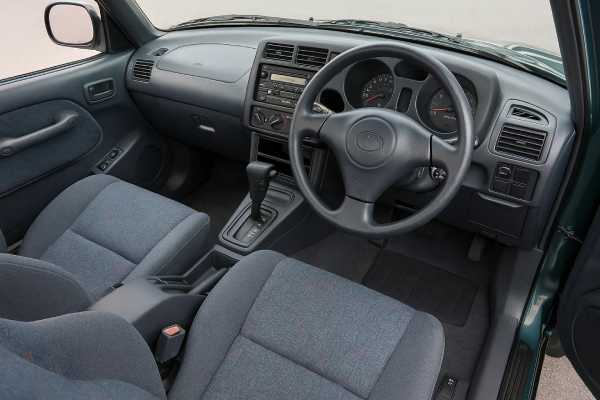
Inside, the RAV4 maximizes space with upright seating, large glass area, and a low cargo floor accessed via a side-hinged rear door. Fabric upholstery and simple materials have aged better than many late-90s plastics, and major controls are logically placed. Ergonomically it feels like a compact hatchback from the period, only with more visibility and ground clearance.
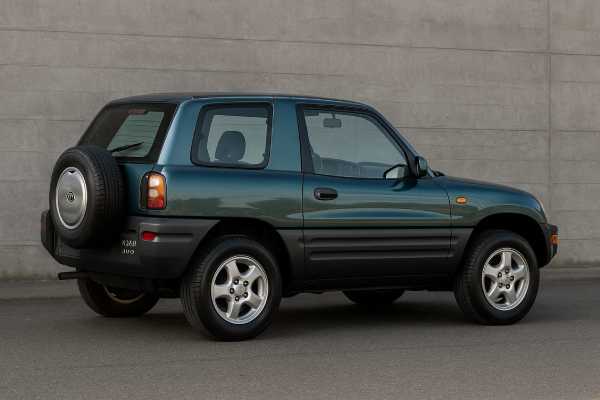
For ownership, this generation is appealing precisely because it’s straightforward: conventional fluids, no turbo or direct injection, no complex driver-assist systems to calibrate, and a timing-belt service that sets the rhythm for preventive care. The most meaningful decisions for shoppers are choosing between the manual’s more direct feel and the automatic’s convenience, and deciding whether you want a 3-door’s shorter wheelbase agility or the 5-door’s superior daily practicality. Either way, the XA10 4WD’s balance of simplicity, traction, and packaging is the reason so many examples are still moving people through winters and weekends nearly three decades on.
Toyota RAV4 3S-FE specs
Engine and Performance (ICE)
| Item | Detail |
|---|---|
| Code | 3S-FE |
| Layout & cylinders | Inline-4, DOHC, 16 valves (4 per cyl) |
| Bore × stroke | 86.0 × 86.0 mm (3.39 × 3.39 in) |
| Displacement | 2.0 L (1,998–1,998 cc class) |
| Induction | Naturally aspirated |
| Fuel system | Multi-port EFI |
| Compression ratio | 9.8:1 |
| Max power | 120 hp (≈ 89 kW) @ 5,400 rpm |
| Max torque | ≈ 169 Nm (125 lb-ft) @ 4,600 rpm |
| Timing drive | Belt |
| Rated economy (EPA) | Typically 21–22 mpg combined; ~19–22 mpg city / ~24–27 mpg highway (11.2–10.7 L/100 km combined) |
| Real-world highway @ 75 mph | Low- to mid-20s mpg (US) is typical with stock tires and healthy alignment |
Transmission and Driveline
| Item | Detail |
|---|---|
| Manual (5-MT) | E250F full-time 4WD transaxle |
| E250F gear ratios | 1st 3.833 • 2nd 1.913 • 3rd 1.258 • 4th 0.918 • 5th 0.775 • Rev 3.583 |
| Final drive (5-MT) | ~4.93:1 (varies by build) |
| Automatic (4-AT) | A540H electronically controlled 4-speed |
| A540H gear ratios | 1st 2.810 • 2nd 1.549 • 3rd 1.000 • 4th 0.734 • Rev 2.296 |
| Final drive (4-AT) | ~4.40:1 |
| Drive type | Full-time 4WD (center differential; viscous coupling; manual lock on many trims) |
| Differentials | Open front/rear; rare rear LSD option in some markets |
| Refuel to full | ≈ 5 minutes at a typical pump |
Chassis and Dimensions (5-door 4WD)
| Item | Detail |
|---|---|
| Suspension (F/R) | MacPherson strut / Double-wishbone |
| Steering | Power rack-and-pinion |
| Brakes (F/R) | Ventilated discs / Drums |
| Wheels/Tires | 215/70R16 on 16-in rims (typical) |
| Ground clearance | ≈ 190 mm (7.5 in) |
| Length / Width / Height | ≈ 4,160 mm × 1,695 mm × 1,660 mm (163.8 × 66.7 × 65.3 in) |
| Wheelbase | 2,410 mm (94.9 in) |
| Curb weight (range) | ~1,170–1,320 kg (≈ 2,580–2,910 lb) depending on body and transmission |
| Fuel tank | 58 L (15.3 US gal / 12.8 UK gal) |
Performance and Capability
| Metric | 5-MT | 4-AT |
|---|---|---|
| 0–60 mph (0–100 km/h) | ~10.5–11.5 s | ~11.5–12.5 s |
| Top speed (typical) | ~100–105 mph (160–169 km/h) | |
| Towing capacity (braked) | Up to 1,500 lb (680 kg) when equipped and within ratings | |
| Roof load | Modest crossbar loads suitable for period racks; stay within accessory ratings |
Fluids and Service Capacities (selected)
| System | Specification | Capacity (approx.) |
|---|---|---|
| Engine oil | API SH/SJ or ILSAC multigrade; SAE 5W-30/10W-30 per climate | ~3.9–4.1 qt (3.7–3.9 L) with filter |
| Engine coolant | Ethylene-glycol, proper corrosion inhibitors | ~8.0 L (MT) / ~7.7 L (AT) |
| Manual trans (E250F) | GL-4/GL-5 75W-90 gear oil | ~5.0 L (4WD) |
| Automatic (A540H) | Toyota ATF Type T (per manual) | Drain-and-fill ~3.3 L |
| Transfer | GL-5 75W-90 | ~0.7 L |
| Rear differential | GL-5 hypoid 80W-90 | ~0.9 L |
| A/C refrigerant | R-134a (period spec) | Charge quantity varies—recover/weight in service |
| Key torque | Drain plug (engine oil) ~37 Nm (27 lb-ft); wheel nuts ~103 Nm (76 lb-ft) typical Toyota |
Figures above reflect period North American specifications or official manuals where available; always verify by VIN and under-hood labels.
Electrical (selected)
| Item | Detail |
|---|---|
| Alternator output | Adequate for factory loads; confirm charging voltage 13.8–14.4 V |
| 12V battery | Group size varies; check tray and terminals for clean fit |
| Spark plugs | Nickel or platinum equivalents; gap ~1.0–1.1 mm (0.039–0.043 in) |
Safety and Driver Assistance (period)
| Area | Detail |
|---|---|
| Crash ratings | Moderate overlap (IIHS) rated Marginal for similar-year 4-door RAV4; no small-overlap test in era |
| Airbags | Dual front airbags |
| ABS | Optional on many trims |
| ADAS | None (no AEB/ACC/LKA); basic cruise control available |
RAV4 1996–1997 trims and safety
Trims and options (North America). Toyota offered the RAV4 in 3-door and 5-door body styles. Equipment varied by year and package, but the 4WD drivetrain, 16-inch wheels with 215/70R16 tires, and the viscous-coupling full-time 4WD system were the mechanical signatures. A 5-speed manual was common in early builds; the A540H 4-speed automatic was widely chosen in urban markets. Option packages typically added power windows/locks, upgraded audio, roof racks, alloy wheels, and—in some cases—sunroofs on 3-door models. A center differential lock switch was present on many 4WDs; check for the button on the console, and confirm operation on a loose surface. Interiors were cloth with simple patterns; higher packages added leather-wrapped steering wheels and more speakers.
Quick identifiers. Early 3-doors have shorter wheelbases and distinct door frameless glass. Five-doors carry longer rear doors and more cargo room. Under the hood, a timing belt cover at the front of the engine confirms belt-driven cams. Manuals use a cable shifter into the E250F transaxle; automatics have a gated PRND2L shifter. The rear suspension’s double wishbone arms are visible with the vehicle on a lift—useful for bushing checks.
Year-to-year notes. Between 1996 and 1997 the fundamentals remained the same, with minor trim and audio updates. Early ABS availability widened, and some markets saw subtle upholstery and color changes. Mechanically the 3S-FE calibration and 4WD hardware persisted. If you’re decoding equipment from a VIN tag or build plate, the engine code “3S-FE” and transaxle codes (E250F or A540H) are the main tells.
Safety ratings. In period testing, the first-gen RAV4 earned a Marginal rating in the IIHS moderate-overlap frontal test for 4-door configurations common to 1997. That result reflects the era’s structures; there is no small-overlap or side-curtain data for these early years. When comparing, remember the test protocols evolved, and basic occupant protection has since improved industry-wide.
Safety systems and child-seat provisions. Dual front airbags were standard; side airbags and curtains were not offered. ABS was optional; traction or stability control were not available. These pre-LATCH vehicles rely on seatbelts and top-tether provisions where fitted—plan to use approved retrofit kits or anchored tethers for forward-facing seats per local rules, and always consult a certified child-passenger technician if you’re using modern seats in a 1990s SUV. After any collision repair or airbag deployment, airbag system diagnostics and sensor mounting checks are essential, as is headlamp aim on cars with replaced front components.
ADAS and calibration implications. There are no camera/radar systems on this generation, so windshield or bumper replacement doesn’t require ADAS recalibration. But ABS wheel-speed sensors and their wiring can be disturbed during suspension work—route and clip them correctly.
Reliability, issues, and fixes
Overall story. With regular maintenance, the 3S-FE and XA10 driveline routinely surpass 200,000 miles. Most issues stem from age: rubber seals, bushings, radiators, and grounds. Below is a practical map of what to watch, ordered by prevalence and cost.
Common (low–medium cost).
- Oil seepage at valve-cover gasket and distributor O-ring → Burning oil smell, dampness at the back of the head. Cause: hardened rubber. Fix: replace gasket and O-ring; clean breather system; verify torque.
- Exhaust leaks at flex joint → Raspy note on cold start. Cause: fatigue. Fix: section replacement; inspect hangers.
- Radiator plastic end-tank cracking (age/heat) → Sweet odor, slow coolant loss. Fix: replace radiator; renew hoses and cap; refill with correct coolant mix; bleed thoroughly.
- Front strut mounts and rear control-arm bushings → Clunks/creaks over speed bumps. Fix: mounts and bushings; align afterward.
- Door latch and window regulator wear → Sluggish windows, intermittent latching. Fix: lubricate or replace as required; clean grounds.
Occasional (medium cost).
- Timing-belt overdue, belt glaze or tensioner wear → Belt squeal, sloppy timing, poor power. Fix: belt kit with idler/tensioner and water pump; inspect crank seal/cam seals.
- A540H shift flare or delayed engagement when hot → Old or contaminated ATF, internal wear. Fix: careful drain-and-fills with the correct fluid; band/accumulator checks; if symptoms remain, specialist diagnosis.
- E250F manual noise in 2nd or 5th → Bearing wear or gear wear on higher-mileage units. Fix: fluid service with proper GL-rating first; rebuild if noisy under load.
- Rear drum wheel cylinder seepage → Soft pedal, uneven braking. Fix: replace cylinders, shoes, and springs; flush fluid.
Rare (higher cost).
- Head-gasket seep (external) on neglected cooling systems → Milky oil is uncommon; more often there’s external weeping. Fix: proper diagnosis; head-set if confirmed; check flatness.
- Center-diff viscous coupling degradation → Binding at tight turns on dry pavement with center diff unlocked (or misuse of the lock on dry surfaces). Fix: service differentials and transfer oils, verify tire rolling radius match; overhaul if persistent.
Corrosion hotspots. Rear control-arm mounts, front subframe edges, and the seam where the tailgate meets the quarter panel can collect salt. Inspect brake and fuel lines along the underbody, especially at clips. The unibody resists rust well if washed, but 25+ years means diligence matters.
Electrical fundamentals. Grounds at the radiator support and engine block can oxidize. Symptoms include dim lights or erratic sensor behavior. Remove, clean, and reinstall with dielectric grease. Window/lock switch packs also benefit from cleaning.
Recalls, TSBs, and coverage. First-gen RAV4s have relatively few North American safety recalls compared with later generations. Nevertheless, always run a VIN through the official recall portals and dealer databases; some campaigns (e.g., lighting compliance for certain lamps or general service communications) may affect specific vehicles. Documented maintenance and recall completion add confidence to any purchase.
Pre-purchase checklist.
- Cold start from overnight: listen for accessory-belt noises, lifter tick (should settle), and idle quality.
- Cooling system pressure test; verify fans cycle correctly.
- Transmission behavior hot: no flare (AT), no pop-out under decel (MT).
- Center-diff lock function on gravel; confirm ABS light self-checks.
- Suspension: look for bushing cracks, ball-joint play, and shock leakage.
- Underbody and seams: rust, especially northern vehicles; check brake/fuel lines.
- Tires: match brand/size and similar wear (mismatched circumferences stress the 4WD driveline).
Maintenance and buying advice
Baseline schedule (distance/time, whichever comes first).
- Engine oil and filter: 5,000–7,500 mi (8,000–12,000 km) / 6–12 months with API SH/SJ or better; shorten interval for city/short-trip duty.
- Engine air filter: Inspect at each oil change; replace ~15,000–30,000 mi (24,000–48,000 km) depending on environment.
- Cabin filter: Not fitted on many early XA10s; retrofit kits exist—service per product guidance.
- Coolant: Replace every 2–3 years (time-based matters more on older plastics).
- Spark plugs: Nickel: ~30,000 mi (48,000 km); platinum/iridium equivalents: up to ~60,000 mi (96,000 km). Gap ~1.0–1.1 mm.
- Fuel filter: Replace around 60,000–90,000 mi (96,000–145,000 km) if external; some are in-tank strainers—inspect screen when the pump is serviced.
- Timing belt (3S-FE): Replace ~60,000 mi (96,000 km) or 6 years. Include tensioner/idler and water pump; renew cam/crank seals if weeping.
- Serpentine/aux belts and hoses: Inspect each service; typically 60,000–90,000 mi replacement windows depending on condition.
- Manual transaxle oil (E250F): Change every 30,000–60,000 mi with GL-4/GL-5 75W-90; check level after off-road use or water crossings.
- Automatic (A540H): Drain and fill every 30,000–50,000 mi with the correct ATF; consider multiple drain-fills to renew more fluid.
- Transfer and rear diff oils: Replace every 30,000–60,000 mi with proper GL-5 gear oil.
- Brake fluid: Flush every 2–3 years; inspect shoes, pads, and drums/rotors each tire rotation.
- Tire rotation and alignment: 5,000–7,500 mi; maintain even rolling radius on all four tires for the 4WD system’s health.
- Valve clearances: Hydraulic lifters not used—clearances generally stable; listen for persistent tick and inspect if noisy.
- 12-volt battery: Load-test annually after year 3–4; clean grounds and terminals during seasonal service.
Fluid specs and handy numbers.
- Engine oil: API SH/SJ/ILSAC multigrade; 5W-30 or 10W-30 per climate; ~3.9–4.1 qt with filter.
- Coolant: Ethylene-glycol; ~8.0 L (MT) / ~7.7 L (AT).
- Manual gearbox: GL-4/GL-5 75W-90; ~5.0 L (4WD).
- Automatic: Toyota ATF Type T (period); drain-fill ~3.3 L.
- Transfer: GL-5 75W-90; ~0.7 L.
- Rear diff: GL-5 hypoid 80W-90; ~0.9 L.
- Fuel tank: 58 L (15.3 US gal).
- Torque highlights: Oil drain plug ~37 Nm (27 lb-ft); wheel nuts ~103 Nm (76 lb-ft) typical; spark plugs ~18 Nm (13 lb-ft).
Buyer’s guide: what to seek or avoid.
- Seek: Straight, rust-free shells with full maintenance folders; smooth hot shifts (AT) or quiet bearings (MT); intact diff-lock function; cooling system renewed in the last 5 years; quality tires in a matching set.
- Approach with caution: Modified suspensions without alignment documentation; mismatched tires; fluid “lifetime” claims; unexplained ABS lights; oil-soaked timing covers.
- Recommended picks: 5-door 4WD with manual for lighter feel and efficiency; automatic is fine if fluid service is documented and engagement is crisp when hot.
- Durability outlook: Excellent with age-appropriate refresh work. Expect routine rubber and cooling-system renewals and some drivetrain seals by 150k–200k miles.
Driving, economy, and performance
Ride, handling, NVH. The XA10’s light unibody and relatively soft springs give it a friendly, compliant ride over broken pavement. Strut front and double-wishbone rear geometry keep body control tidy at moderate speeds. Steering is light with good on-center stability for the era; feedback is filtered but predictable. With 215/70R16 all-seasons at correct pressures, straight-line tracking on the highway is confident. Cabin noise is mainly tire and wind; the tall profile and roof racks can add a bit of whoosh at 65–75 mph, but conversation remains easy.
Powertrain character. The 3S-FE is smooth and unhurried. Throttle response is linear with its cable throttle; the engine wakes up above 3,000 rpm. The 5-speed manual makes the most of the 120 hp—ratios are well-spaced, and 5th is suitably long for cruising. The A540H automatic prefers a gentle foot: it will hold gears on grades to keep the engine in the meat of its torque, but kickdown can feel deliberate rather than snappy. On snowy starts or gravel, the full-time 4WD makes the RAV4 feel planted; engaging the center-diff lock on loose surfaces improves stability pulling out of ruts or wet grass. Remember to unlock it on dry pavement to prevent driveline wind-up.
Real-world efficiency. Expect mid-20s mpg (US) on the highway at 60–65 mph in mild weather with the manual, dropping to low-20s at 70–75 mph or with the automatic. In mixed duty, 21–22 mpg combined is typical when maintained and aligned; winter tires and cold weather will lower this a few mpg. City figures fall in the high teens to low 20s depending on trip length. Running proper tire pressures, fresh filters, and correct fluids helps the XA10 meet or beat period ratings.
Key metrics that shape the verdict.
- 0–60 mph: roughly low-11s (manual) to mid-12s (automatic).
- Passing (50–70 mph): Adequate but plan ahead on two-lanes; kickdown is smooth, not aggressive.
- Braking: Solid, confidence-inspiring pedal once drums are adjusted and fluid is fresh; ABS engagement is early on loose surfaces.
- Traction: With matched tires, the full-time 4WD and center-diff lock deliver surefooted winter manners. All-terrain tires improve dirt/snow bite at a small fuel-economy penalty.
Load and light towing. The RAV4’s short wheelbase keeps it nimble but limits heavy towing. When properly equipped, 1,500 lb (680 kg) is the ceiling; keep tongue weight conservative, ensure brakes on heavier trailers, and expect a noticeable drop in fuel economy. For cargo, the fold-flat rear bench makes the 5-door surprisingly useful for bikes, camping gear, or home-center runs; the side-hinged tailgate clears tall items under carports.
RAV4 vs rivals
When new, the XA10 RAV4’s closest rivals were the Honda CR-V (launched for 1997), Subaru’s emerging Forester (1998), and carry-over small SUVs like the Suzuki Sidekick/Geo Tracker. Each brought a different take on the small-SUV brief.
- Honda CR-V (’97–’98): Honda’s 2.0-liter B-series makes slightly more power on paper (126 hp) and pairs exclusively with an automatic in early North American models. The Real Time 4WD system is on-demand with a dual-pump rear differential rather than the RAV4’s full-time center diff. The CR-V counters with a roomier cargo hold and a very smooth highway demeanor; the RAV4 feels lighter and more playful, especially with the manual gearbox and diff lock for loose surfaces.
- Subaru Forester (’98): Subaru’s boxer four and full-time AWD deliver strong traction and the most car-like ride of the set, while power (up to ~165 hp in some trims) outguns the Toyota. Against that, the RAV4’s simplicity, lower parts costs in many regions, and available manual with center-diff lock make it attractive to owners who prioritize straightforward upkeep and light off-pavement capability.
- Suzuki Sidekick/Geo Tracker: Body-on-frame and low-range capability give the Suzuki genuine trail chops, but it rides and handles like a small truck. The RAV4’s unibody, independent rear suspension, and better NVH make it far more comfortable in daily use, and its powertrain is generally more refined and durable.
Why choose the RAV4 XA10 4WD today?
It’s the sweet spot for owners who want near-bulletproof running gear, true full-time 4WD with a lockable center differential, and a cabin that wears age well—all in a package that’s easy to park, cheap to keep, and still enjoyable on a winding back road. If you want modern ADAS and highway-quiet, look newer. If you want a simple, trustworthy winter and weekend companion with real heritage, this one still delivers.
References
- Fuel Economy of 1997 Toyota RAV4 4WD 2025 (EPA Ratings)
- 1997 Toyota RAV4 4-door SUV 2025 (Safety Rating)
- 1996 Toyota RAV4 Owner’s Manual PDF (175 Pages) 2016 (Owner’s Manual)
- 1998 Toyota Rav4 CN.pdf 1998 (Brochure/Specifications)
- Toyota A transmission 2025 (Technical Reference)
Disclaimer
This guide is for informational purposes only and is not a substitute for professional diagnosis, repair procedures, or your vehicle’s official service information. Specifications, torque values, and maintenance intervals can vary by VIN, market, and installed equipment. Always verify measurements, fluid types/capacities, and procedures against the owner’s manual, factory service manual, or an authorized dealer.
If this article helped, consider sharing it with fellow owners on Facebook or X/Twitter—your support helps xcar keep producing detailed, model-specific guides.