
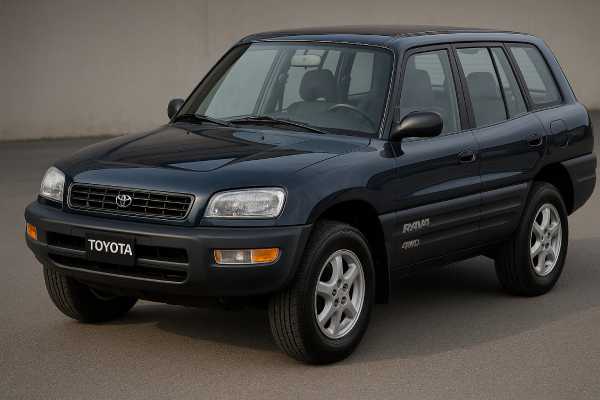
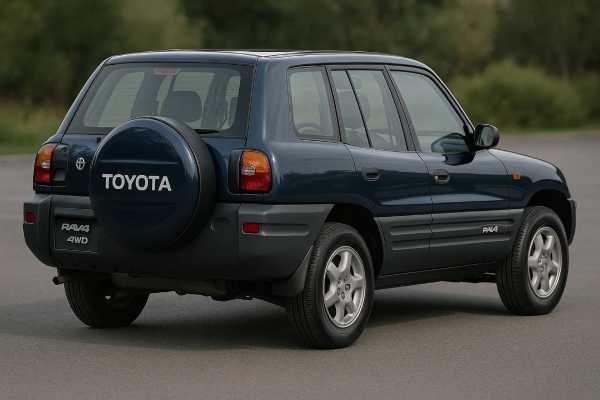
The first-generation Toyota RAV4 put crossovers on the map by blending car-like construction with genuine four-season capability. In 4WD form (XA10), it used Toyota’s tough 3S-FE 2.0-liter DOHC four, a full-time four-wheel-drive system with a lockable center differential, and independent suspension at all four corners. Early European/Japanese calibrations are commonly listed at 129 hp, while North American models are officially rated at 120 hp due to emissions and rating standards. Either way, the character is the same: simple, smooth, long-lived, and easy to service. This guide focuses on 1994–1997 with North America as the baseline for specs and terminology where applicable, while noting the key differences for earlier non-North American years (1994–1995). If you want a compact SUV you can park anywhere, commute daily, and trust in winter, the XA10 4WD still makes a compelling case—providing you choose a sound shell and bring age-related items current.
Key Takeaways
- Full-time 4WD with viscous center diff (lockable) gives confident winter traction without trucklike weight.
- 3S-FE engine is robust and well-supported; timing-belt service and cooling refreshes keep it happy past 200k mi (320k km).
- Practical cabin with flat load floor; 5-door carries people and cargo better than most period rivals.
- Caveat: aging radiators, bushings, and rear drum hydraulics are common refresh items on 25-year-old examples.
- Anchor interval: timing belt every ~60,000 mi (96,000 km) or ~6–7 years, including idler/tensioner and water pump.
On this page
- RAV4 XA10 4WD summary
- RAV4 3S-FE technical specs
- RAV4 trims, options, safety
- Reliability, faults, service actions
- Maintenance plan and buyer tips
- Driving impressions and performance
- Rivals and alternatives
RAV4 XA10 4WD summary
Toyota launched the RAV4 in 1994 as a new idea: a light, unibody SUV with independent suspension and the manners of a compact hatchback. The 4WD version, which this guide covers, is the one that gives the model its year-round confidence. Under the hood sits the 3S-FE—an iron-block, aluminum-head, 16-valve four—driven by a timing belt and fed by multi-port fuel injection. It’s not quick by modern standards, but it’s smooth, tolerant of mileage, and easy to keep in tune. Early non-North American listings show 129 hp; North American 1996–1997 cars are rated at 120 hp. In practice, the difference is more about certification and calibration than day-to-day feel.
The driveline is the heart of the XA10’s usefulness: a full-time 4WD transaxle with a center differential that’s viscously coupled and, on many trims, manually lockable. Leave it unlocked on dry pavement and you get smooth, all-weather traction without binding. On snow, mud, or a slick boat ramp, tapping the center-diff lock (on a loose surface) sends equal torque front and rear for noticeably better bite. Unlike truck-based small SUVs of the era, there’s no heavy ladder frame or live rear axle here; instead you get strut front suspension and a compact double-wishbone rear that preserve ride comfort and cargo room. The result is a vehicle that feels nimble in town and steady enough at highway pace, with a turning circle that makes parking simple.
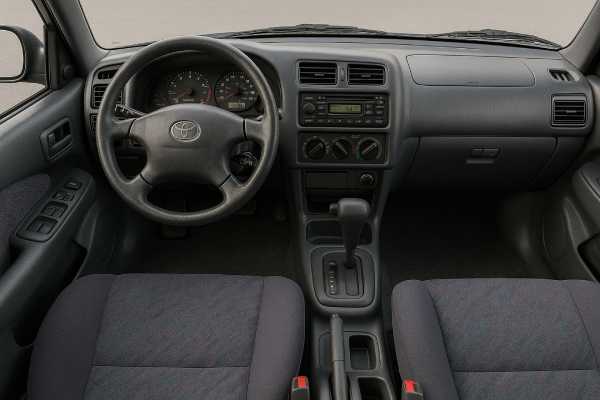
Packaging is a standout. In 5-door form, the RAV4 has an upright seating position, big glass area, and a low, flat load floor accessed via a side-hinged rear door. The cabin is simple—durable plastics, basic cloth, and clear controls that age better than ornate 1990s designs. Most cars have rear drums and optional ABS; airbags are dual front only. You won’t find modern driver-assist features, but maintenance is refreshingly straightforward: fluids, belts, bushings, and occasional seals. If you’re choosing between manual and automatic, the 5-speed makes the most of the 3S-FE and reduces heat load on long grades; the 4-speed automatic is dependable when serviced regularly with the specified fluid. Either way, the 4WD’s extra weight versus FWD is modest, and the added confidence in bad weather is what many owners buy it for.
For shoppers today, the winning recipe is a rust-free shell, clean hot-idle behavior, even tire wear, and documented timing-belt and cooling-system service. Once refreshed, an XA10 4WD can still be the small, honest SUV that starts every morning, goes anywhere you reasonably ask, and fits in any parking space you find.
RAV4 3S-FE technical specs
Below you’ll find scannable tables for 1994–1997 RAV4 4WD (XA10). Where figures differ by region/year, baseline North American numbers are listed first, with short notes for early non-North American data.
Engine and Performance (ICE)
| Item | Specification |
|---|---|
| Engine code | 3S-FE |
| Layout & valvetrain | Inline-4, DOHC, 16 valves (4 per cyl) |
| Displacement | 2.0 L (1,998 cc) |
| Bore × stroke | 86.0 × 86.0 mm (3.39 × 3.39 in) |
| Compression ratio | ~9.8:1 |
| Induction / fuel | Naturally aspirated / multi-port fuel injection (MPFI) |
| Rated power (1996–1997 NA) | 120 hp (89 kW) @ ~5,400 rpm |
| Rated power (1994–1995 EU/JP) | ~129 hp (96 kW) @ ~5,400 rpm |
| Rated torque (typical) | ~125 lb-ft (169 Nm) @ ~4,600 rpm |
| Timing drive | Belt (non-interference valvetrain; replace on time) |
| Recommended fuel | Regular unleaded (87 AKI / 91–92 RON) |
| EPA economy (1997 4WD) | 19/24 mpg city/hwy (21 mpg combined) ≈ 12.4/9.8 L/100 km |
| Real-world highway @ 75 mph | ~22–25 mpg US (10.7–9.4 L/100 km), tire/alignment dependent |
| Aerodynamics | Drag coefficient ~0.35–0.36 (typical period range) |
Transmission and Driveline (4WD)
| Item | Specification |
|---|---|
| Manual transmission | E250F 5-speed full-time 4WD transaxle (cable shift) |
| E250F gear ratios | 1st 3.833 • 2nd 1.913 • 3rd 1.258 • 4th 0.918 • 5th 0.775 • Rev 3.583 |
| Final drive (5-MT) | ~4.93:1 (varies by build) |
| Automatic transmission | A540H 4-speed electronically controlled full-time 4WD |
| A540H gear ratios | 1st 2.810 • 2nd 1.549 • 3rd 1.000 • 4th 0.734 • Rev 2.296 |
| Final drive (4-AT) | ~4.40:1 |
| Driveline layout | Full-time 4WD with center differential (viscous coupling) |
| Center diff lock | Console button on many trims (use on loose/low-μ surfaces only) |
| Axle differentials | Open front/rear (rear LSD rare in some markets) |
| Refuel to full | ~5 minutes at a pump (no special procedures) |
Chassis and Dimensions (5-door 4WD shown)
| Item | Specification |
|---|---|
| Suspension (front/rear) | MacPherson strut / double-wishbone with trailing links |
| Steering | Power rack-and-pinion |
| Brakes (front/rear) | Ventilated discs / drums; ABS optional |
| Wheels & tires (typical) | 16×6 in rims; 215/70R16 all-season |
| Ground clearance | ~190 mm (7.5 in) |
| Length × width × height | ~4,160 × 1,695 × 1,660 mm (163.8 × 66.7 × 65.3 in) |
| Wheelbase | 2,410 mm (94.9 in) |
| Turning circle (curb-to-curb) | ~11.0 m (36.1 ft) |
| Curb weight (range) | ~1,240–1,320 kg (2,734–2,910 lb), body/transmission dependent |
| GVWR | ~1,780–1,860 kg (3,924–4,100 lb), by trim |
| Fuel tank | 58 L (15.3 US gal / 12.8 UK gal) |
| Cargo volume (5-door) | Seats up ≈ 760 L (26.8 ft³); seats folded ≈ 1,600 L (56–58 ft³), method varies |
Performance and Capability
| Metric | 5-MT | 4-AT |
|---|---|---|
| 0–60 mph (0–100 km/h) | ~10.5–11.5 s | ~11.5–12.5 s |
| Top speed (typical) | ~100–105 mph (160–169 km/h) | ~100–105 mph (160–169 km/h) |
| Braking 100–0 km/h | ~40–43 m (131–141 ft), tire/condition dependent | — |
| Towing (braked) | Up to 1,500 lb (680 kg) when properly equipped | Same |
| Payload | ~400–450 kg (880–990 lb) | Same |
| Roof load | ~45–50 kg (100–110 lb) with factory crossbars | — |
Fluids and Service Capacities (selected, typical)
| System | Spec | Capacity (approx.) |
|---|---|---|
| Engine oil | API SJ/SL 5W-30 (or 10W-30 per climate) | 3.9–4.1 qt (3.7–3.9 L) with filter |
| Engine coolant | Ethylene-glycol HOAT-compatible | ~8.0 L (MT) / ~7.7 L (AT) |
| Manual transaxle (E250F) | GL-4/GL-5 75W-90 | ~5.0 L (4WD transaxle) |
| Automatic (A540H) | Dexron III-spec / Toyota Type T-IV successors (per label) | Drain-fill ~3.0–3.5 L (total higher) |
| Transfer/rear diff | GL-5 75W-90 / GL-5 hypoid 80W-90 | ~0.7 L / ~0.9 L |
| A/C refrigerant | R-134a | ~500–650 g (18–23 oz) |
| A/C compressor oil | ND-Oil 8 equivalent | ~120 mL (4 fl oz) |
| Key torque examples | Wheel lugs ~103 Nm (76 lb-ft); oil drain ~37 Nm (27 lb-ft); spark plugs ~18 Nm (13 lb-ft) |
Electrical (selected)
| Item | Specification |
|---|---|
| Alternator | ~70–80 A output (equipment dependent) |
| 12V battery | Group 35/26R common; ~45–60 Ah; 500–600 CCA typical |
| Spark plugs | Nickel/platinum equivalents; gap 1.0–1.1 mm (0.039–0.043 in) |
Safety and Driver Assistance (period context)
| Area | Detail |
|---|---|
| Crash tests | Moderate-overlap frontal test for 4-door models rates Marginal in period methodology |
| Airbags | Dual front |
| ABS | Optional on many trims |
| Headlights | Halogen reflectors (aim and lens condition crucial) |
| ADAS | None (no AEB/ACC/lane support on XA10) |
RAV4 trims, options, safety
Trims and packaging (North America). The 4WD XA10 was offered in 3-door and 5-door bodies with “Base” equipment plus popular options. Equipment groups typically bundled power windows/locks, cruise control, alloy wheels, roof racks, sunroofs on some 3-doors, and audio upgrades. Mechanically, 4WD hardware and 16-inch wheels with 215/70R16 tires were the signatures. The 5-speed manual appealed to buyers who wanted maximum control and slightly better economy, while the 4-speed automatic won in urban markets. Expect cloth interiors with durable fabrics; higher packages added leather-wrapped wheels and additional speakers. Outside North America (1994–1995), trim names such as “RAV4 J/L/G” appeared; content broadly mirrored equipment bundles rather than materially different hardware, though option penetration (e.g., rear LSD) varied by country.
Functional differences that matter. The must-check mechanical feature on 4WD cars is the center-differential lock switch, present on many trims. Confirm the button is present on the console and test function on a loose surface: engagement should be prompt, with improved launch bite; unlock on high-grip pavement to avoid wind-up. ABS availability varied by package; verify the ABS lamp cycles at key-on and that tone rings/sensors are intact after any prior suspension work. Tires have an outsized effect on this platform—period-correct all-seasons are fine for commute duty, while a modern all-terrain in 215/70R16 meaningfully improves gravel/snow traction at a small economy penalty.
Year-to-year notes (1994–1997). The fundamentals didn’t change: same 3S-FE, same 4WD layout, and the same basic suspension. Minor updates touched colors, upholstery patterns, and audio head units. The big “difference” most shoppers notice is the published power rating: early non-North-American literature lists ~129 hp, while North American guides show 120 hp—a product of certification and calibration rather than major mechanical changes. If you’re hunting specific build information, the VIN/option plate in the driver’s jamb will list engine and trans codes (3S-FE; E250F for 5-MT, A540H for 4-AT).
Safety ratings (period). Four-door first-gen RAV4s scored Marginal in the moderate-overlap frontal test of the era. There was no small-overlap or side-curtain testing for these years. Compared with today’s crossovers, cabin structures and restraint systems from the 1990s are simpler and less forgiving; factor that into usage (especially if the vehicle will carry teens or new drivers).
Child-seat provisions and restraints. These pre-LATCH vehicles rely on seatbelts and, in some markets, factory top-tether points or dealer retrofits. If you plan to fit contemporary child seats, consult current child-passenger guidance and consider professional installation help. As with any vehicle this age, check seatbelt webbing for fray and latch/retractor function; replace suspect belts with OE-grade parts.
Lighting and visibility. Headlamp performance depends heavily on lens clarity and aim. Restoring cloudy lenses and installing quality halogen bulbs (correct wattage) materially improves night driving. As with all 1990s vehicles, adding auxiliary lamps should be done within electrical limits to avoid alternator/wiring stress.
Reliability, faults, service actions
Big picture. Properly serviced, the XA10 4WD powertrain regularly clears 200,000 miles (320,000 km). Most failures today trace to age: plastics, rubber, and corrosion. Below is a practical, severity-aware map of issues, with symptoms, likely causes, and remedies.
Common (low–medium cost)
- Cooling system aging → Seepage at radiator end-tanks, brittle hoses, erratic warm-up. Cause: heat-cycled plastics and rubber. Fix: radiator, hoses, thermostat, cap; proper bleed with the specified coolant.
- Valve cover and distributor O-ring leaks → Oil smell or dampness at the back of the head. Cause: hardened seals. Fix: replace gasket and O-ring; inspect PCV/breathers and renew if restricted.
- Front strut mounts and rear control-arm bushings → Clunks over bumps, loose steering feel. Cause: rubber fatigue. Fix: OE-style mounts/bushings; align afterward.
- Rear drum wheel cylinders → Spongy pedal, one-sided grab. Cause: seal wear/corrosion. Fix: new cylinders, shoes/springs as needed; flush fluid.
- Exhaust flex-joint fatigue → Raspy cold starts. Fix: section replacement; check hangers and cat shield integrity.
Occasional (medium cost)
- Timing-belt overdue wear/tensioner noise → Belt glaze, chirp, wandering idle. Fix: belt kit with idler/tensioner and water pump; renew cam/crank seals if weeping.
- A540H (4-AT) hot shift flare/delayed engagement → Old fluid/varnish. Fix: staged drain-and-fills with correct ATF; inspect solenoids/valve body; add external cooler if towing.
- E250F (5-MT) bearing noise in 2nd/5th → High-mile wear. Fix: correct GL-rated oil service first; rebuild if growl persists.
- Electrical grounds → Dim lights, odd sensor behavior. Fix: clean engine/body grounds; dielectric grease on reassembly.
Rare (higher cost)
- Head-gasket seep (often external) after overheating → Coolant staining at block/head join; hydrocarbon test may be negative early. Fix: machine-shop inspection, MLS gasket, new head bolts, and full cooling refresh.
- Center viscous coupling degradation → Binding sensation in tight, dry turns with center diff unlocked. Cause: internal wear or mismatched tire circumferences. Fix: confirm tire match and pressures; renew fluids; rebuild coupling if binding persists.
Corrosion watchpoints. In salt climates, inspect rear subframe mounts, rockers/pinch welds, the seam under the tailgate spare-carrier, and brake/fuel lines at clips. Structural rust is the main purchase risk.
Recalls/field actions (era). The 1994–1997 XA10 has relatively few safety recalls compared with later generations. Always run a VIN check via official portals before purchase and keep proof of completion in the service file. After collision repairs, verify airbag system health with scan-tool checks and ensure headlamp aim is correct.
Pre-purchase test script. Start cold after an overnight sit; listen for belt squeal and top-end tick that should settle quickly. Confirm radiator fans cycle, heater output is even, and there’s no coolant odor. On the road, check straight-line tracking, brake pull, and hot-idle quality. In a gravel lot, engage the center-diff lock to confirm function, then disengage. Finish with a full lift inspection for leaks, bushing play, and underbody corrosion.
Maintenance plan and buyer tips
Baseline schedule (distance/time; adapt to climate and duty cycle).
- Engine oil & filter: 5,000–7,500 mi (8,000–12,000 km) or 6–12 months; severe use → 5,000/6 months.
- Engine air filter: Inspect every 12 months/12,000 mi (20,000 km); replace as needed.
- Cabin filtration: Early XA10s often lack a serviceable cabin filter; clean cowl drains annually or retrofit a kit if fitted.
- Coolant: Replace every 5 years/60,000 mi (100,000 km) or when test strips indicate depletion.
- Spark plugs: Standard nickel ~30,000 mi (48,000 km); long-life platinum ~60,000 mi (96,000 km); gap 1.0–1.1 mm.
- Fuel filter: About 60,000–90,000 mi (96,000–145,000 km) if external; inspect in-tank strainer when pump service occurs.
- Timing belt: 60,000–90,000 mi (96,000–145,000 km) or 6–8 years; include idler/tensioner, water pump, and cam/crank seals if weeping.
- Accessory belts/hoses: Inspect at each oil change; replace at signs of cracking or glazing (often 6–8 years).
- Manual transaxle (E250F): GL-4/GL-5 75W-90 every 60,000 mi (96,000 km) severe or 100,000 mi (160,000 km) normal.
- Automatic (A540H): Drain-and-fill 30,000–60,000 mi (48,000–96,000 km); use specified ATF; consider auxiliary cooler if towing.
- Transfer & rear diff oils: Replace every 30,000–60,000 mi (48,000–96,000 km) with GL-5.
- Brake fluid: Flush every 2–3 years; inspect shoes/pads, drums/rotors each rotation.
- Power steering fluid: Inspect yearly; exchange if dark or aerated.
- Tires & alignment: Rotate 5,000–7,500 mi; align annually or after suspension work.
- 12V battery: Load-test annually after year 4–5; clean/secure terminals and grounds.
- A/C system: Inspect condenser for debris; recover/evac/recharge only when performance drops or components are replaced.
Fluid quick reference (decision-ready).
- Engine oil: API SJ/SL 5W-30 preferred; ~3.9–4.1 qt (3.7–3.9 L) with filter.
- Coolant: Ethylene-glycol HOAT-compatible; ~8.0 L total system typical.
- Manual transaxle: GL-4/GL-5 75W-90; ~5.0 L.
- Automatic: Dexron III-spec/Type T family per label; staged drain-fills preferred on old units.
- Torque highlights: Wheel lugs ~103 Nm (76 lb-ft); spark plugs ~18 Nm (13 lb-ft); oil drain ~37 Nm (27 lb-ft).
Buyer’s checklist (what to inspect).
- Rust & structure: Rear subframe mounts; rocker/pinch seams; tailgate seam near spare; brake/fuel lines. Walk away from perforation in structural zones.
- Cooling: Radiator end-tanks (hairline cracks), heater-core smell, clean coolant, proper fan cycling.
- Driveline: Smooth hot shifts (AT), quiet bearings/no pop-out (MT), center-diff lock function on loose surfaces.
- Suspension & steering: Front control-arm bushings, inner/outer tie-rods, rear trailing-arm and lateral-link bushings.
- Brakes: Even wear, rear wheel-cylinder seep, firm pedal with recent fluid flush.
- Electrical: Charging voltage 13.8–14.4 V, clean grounds, healthy starter draw; headlamp connector integrity.
- Documentation: Timing-belt and coolant history, brake-fluid flushes, and recall-status printouts.
Durability outlook. With basic preventive care and a clean shell, an XA10 4WD can run well past 200,000 miles. The cost curve stays gentle if you refresh cooling, rubber, and fluids proactively and keep the exhaust/fuel lines free of corrosion. Parts supply is strong, interchange is good across Toyota lines, and most work is DIY-friendly or a one-day job at an independent shop.
Driving impressions and performance
Ride and NVH. The XA10 feels like a compact hatchback on longer-travel suspension. Around town it absorbs potholes and speed bumps without the head toss common to truck-based small SUVs. On the highway, wind and tire noise are noticeable by modern standards but rarely tiring; fresh door/hatch seals and modern touring tires reduce cabin boom. The tall stance invites crosswind nudges, yet straight-line tracking is reassuring when alignment is current.
Handling and steering. With independent suspension all around and modest weight, the RAV4 turns in eagerly and remains predictable at everyday speeds. Baseline behavior is mild understeer; replacing aged struts, top mounts, and front control-arm bushings restores crispness. The steering is light with reasonable on-center feel; new inner/outer tie-rods and a careful toe/caster setup bring it back to period-correct tautness. Tire choice is decisive: a quality 215/70R16 touring tire improves wet braking and ride; an all-terrain pattern trades a touch of economy for gravel/snow bite that suits the 4WD hardware.
Powertrain character. The 3S-FE’s strengths are smoothness and reliability. Throttle response is linear with its cable throttle; the engine wakes up above ~3,000 rpm. The 5-speed manual lets you keep it in the meat of its torque; the 4-speed automatic is calm and decisive if the fluid is healthy. There’s no turbo lag to manage and no direct-injection carbon to worry about—just basic ignition and fuel systems that respond well to fresh plugs, leads, cap/rotor (where fitted), and a clean throttle body.
Efficiency in the real world. Expect ~21 mpg combined (≈11.2 L/100 km) for 4WD models under EPA methodology, with mid-20s mpg US on steady highway runs at 60–65 mph (≈9–10 L/100 km). At 70–75 mph (113–120 km/h), aero drag and gearing trim a few mpg. Winter fuel, snow tires, and roof accessories can subtract 2–4 mpg; conversely, correct pressures, synthetic fluids, and a clean alignment can add 1–2 mpg.
Braking and control. Pedal feel is solid when pads/rotors are fresh and drums adjusted. A biennial fluid flush pays off on long descents. Without stability control, limit behavior on wet leaves or gravel is all about tires and driver smoothness; the full-time 4WD helps you launch straight, but it won’t defy physics mid-corner.
Traction and light off-pavement use. The full-time 4WD system with center-diff lock is ideal for snow, rain, and trailhead approaches. Lock the center diff on loose surfaces to claw out of ruts or wet grass; unlock on high-grip surfaces to avoid driveline wind-up. Ground clearance (≈190 mm) and approach/departure angles are fine for fire roads, not rock crawling. Skid plates, recovery points, and aggressive tires extend its envelope if you need more trail confidence.
Load and towing. Properly equipped, the XA10 4WD is rated up to 1,500 lb (680 kg) for light trailers. Keep tongue weight conservative, verify lighting, and consider a trans cooler on automatics. With five aboard and camping gear, plan for downshifts on long grades. Expect a 10–20% fuel-economy penalty when towing or with a roof box fully loaded.
Rivals and alternatives
Honda CR-V (1997–1998). Honda’s first CR-V arrived with slightly higher published power, a smooth ride, and an on-demand dual-pump rear drive. It’s roomy and cleverly packaged, but it lacks the RAV4’s full-time center differential with manual lock. The Toyota feels lighter and more playful with the 5-speed, and its 3S-FE is renowned for longevity.
Subaru Forester (1998). Standard full-time AWD and a low center of gravity give the Forester excellent all-weather stability. However, aging boxers may need head-gasket and exhaust attention. The RAV4 counters with simpler service needs and typically lower corrosion rates outside severe salt zones.
Suzuki Sidekick/Geo Tracker. Body-on-frame with low range brings true off-road ability, but on-road comfort, safety, and NVH trail the RAV4 by a generation. For daily commuting and light trails, the Toyota’s unibody and independent rear suspension make it the more pleasant companion.
Why pick the XA10 4WD today? It remains the small SUV that “just works”: starts, steers, and stops predictably; hauls kids and camping gear; shrugs off winter with proper tires; and asks only for timely fluids and a belt kit every few years. If you need modern ADAS or highway-quiet, look newer. If you want honest engineering and low running costs, this one still delivers.
References
- Gas Mileage of 1997 Toyota RAV4 2025 (EPA Ratings)
- 1997 Toyota RAV4 2025 (Safety Rating)
- Vehicle Detail Search – 1997 TOYOTA RAV4 4 DR 2025 (Recall Database)
- Toyota Launches New RAV4 in Japan 2005 (Manufacturer Newsroom—Model History Context)
Disclaimer
This article is for informational purposes only and is not a substitute for professional diagnosis or repair. Specifications, torque values, service intervals, and procedures can vary by VIN, production date, body style, market, and installed equipment. Always verify against your vehicle’s official service documentation and under-hood labels before performing maintenance or ordering parts.
If this guide helped, please consider sharing it with fellow owners on Facebook or X/Twitter—your support helps xcar continue producing detailed, model-specific guides.