
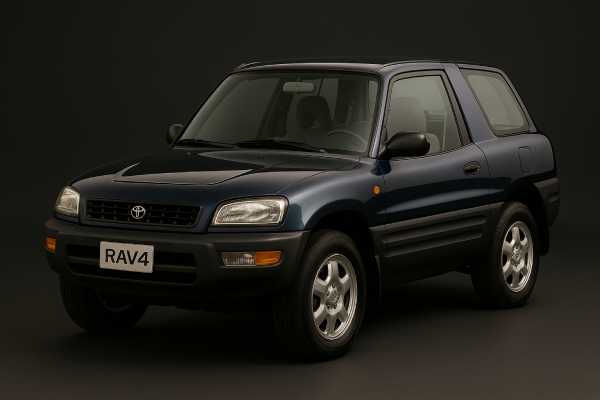
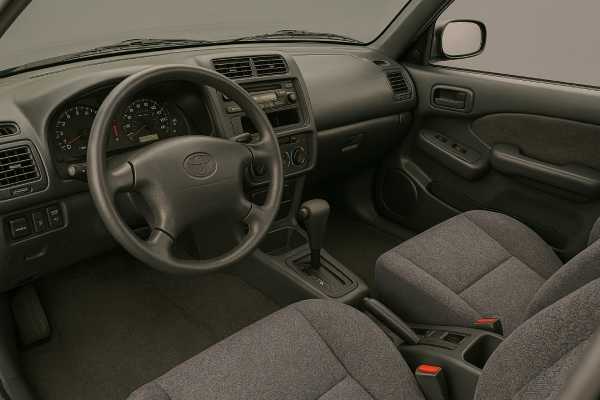
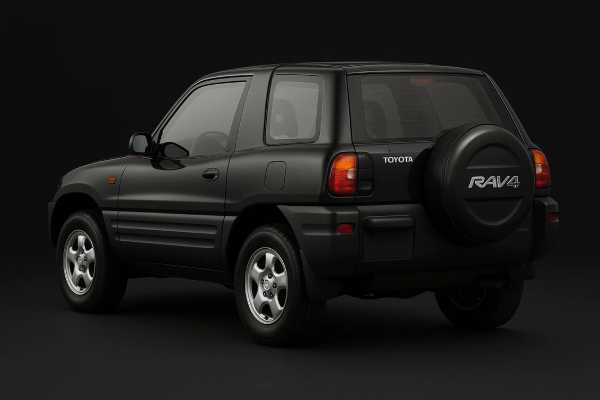
The first-generation Toyota RAV4 in front-wheel-drive form distilled the original “car-like SUV” idea into the simplest, lightest package you could buy. For 1994–1997, all models used Toyota’s 3S-FE 2.0-liter DOHC four-cylinder. Early non-North American listings quote 129 hp; North American 1996–1997 cars were rated at 120 hp under local certification. Either way, the character is the same: smooth, durable, and easy to service. The FWD layout removes the rear differential and prop shaft, trimming weight and maintenance while keeping the tall seating position, versatile load floor, and tidy urban footprint that made the XA10 a hit. This guide sets North America as the baseline for specs and features where applicable (1996–1997) and notes key differences for 1994–1995 cars sold in Europe. You will find the hard data owners care about—dimensions, economy, fluids, capacities—plus reliability patterns, a practical maintenance plan, and buying pointers to help you land a clean, long-lived example.
At a Glance
- Light FWD layout returns better economy and simpler upkeep than 4WD, without sacrificing everyday versatility.
- 3S-FE timing-belt engine is renowned for longevity with basic fluids and belt service.
- Cabin packaging is excellent for the footprint; split-fold bench creates a long, flat load floor.
- Caveat: after ~100k–150k mi (160k–240k km), expect cooling system and suspension rubber refreshes.
- Interval anchor: timing belt every ~60,000 mi (96,000 km) or ~6–7 years, including tensioner, idler, and water pump.
Guide contents
- RAV4 XA10 FWD explained
- RAV4 3S-FE specs
- RAV4 FWD trims and safety
- Reliability and service actions
- Maintenance and buyer guide
- Driving, economy, performance
- RAV4 versus rivals
RAV4 XA10 FWD explained
Toyota’s first RAV4 (chassis code XA10) was one of the earliest compact crossovers to pair a stiff unibody and independent rear suspension with SUV-like ride height and cargo utility. The FWD variant—in production from 1994 in Europe and from 1996 in North America—was the most affordable and mechanically straightforward version. Removing the rear driveline saves weight and future service items, yet the car retains the tall seating position, generous glass area, and city-friendly sizing that defined the nameplate.
Under the hood lives the 3S-FE, a square-bore (86 × 86 mm) 2.0-liter inline-four with an iron block and aluminum head. It uses a timing belt to drive dual overhead cams (four valves per cylinder), a cable-operated throttle, and multi-port fuel injection. Early European/Japanese ratings list 129 hp (≈96 kW) and ~125 lb-ft (≈169 Nm), while North American ratings for 1996–1997 are 120 hp (≈89 kW) with similar peak torque. On the road the difference is academic: both feel smooth and tractable in everyday use, especially with the 5-speed manual. A 4-speed electronically controlled automatic was widely chosen for urban duty and remains reliable when its fluid is kept fresh.
Packaging is where the XA10 still shines. The 5-door version offers adult-friendly rear seating and a low, flat cargo floor once the split bench folds and tumbles. The side-hinged rear door opens wide for tall loads, and the upright driving position gives great sight lines. The FWD car’s steering feels a shade lighter than the 4WD, with a trace less driveline inertia at tip-in. Suspension is long-travel MacPherson strut front and compact double-wishbone rear with trailing links, tuned for absorbency rather than sharpness—ideal for broken city pavement and winter heaves.
Owning one today is mostly about age-aware care. Rubber parts (bushings, mounts, hoses), plastic radiator end tanks, and drum-brake hydraulics are well into their third decade; freshening these yields a disproportionate improvement in how the car drives and stops. Because the 3S-FE is a belt-driven non-interference design, a timely belt kit (with tensioner/idler and water pump) sets the rhythm for preventive maintenance. Buyers should prize clean, rust-free shells with documented cooling and belt service over low miles alone.
RAV4 3S-FE specs
The tables below reflect 1996–1997 FWD baseline data for North America, with short notes for 1994–1995 European-market cars where helpful.
Engine and Performance (ICE)
| Item | Specification |
|---|---|
| Code | 3S-FE |
| Layout & valvetrain | Inline-4, DOHC, 16 valves (4 per cyl) |
| Bore × stroke | 86.0 × 86.0 mm (3.39 × 3.39 in) |
| Displacement | 2.0 L (1,998 cc) |
| Compression ratio | ≈9.8:1 |
| Induction / fuel | Naturally aspirated / multi-port fuel injection |
| Max power (EU ’94–’95) | 129 hp (96 kW) @ ≈5,400 rpm |
| Max power (NA ’96–’97) | 120 hp (89 kW) @ ≈5,400 rpm |
| Max torque (typical) | 125 lb-ft (169 Nm) @ ≈4,600 rpm |
| Timing drive | Belt (non-interference valvetrain) |
| Recommended fuel | Regular unleaded (87 AKI; ≈91–92 RON) |
| EPA economy (NA FWD) | ≈22/27 mpg city/hwy (≈10.7/8.7 L/100 km); combined ≈24 mpg |
| Real-world @ 75 mph | ≈25–27 mpg US (9.4–8.7 L/100 km), tire/alignment dependent |
| Aerodynamics | Cd ≈0.35–0.36 (period typical) |
Transmission and Driveline (FWD)
| Item | Specification |
|---|---|
| Manual transmission | 5-speed FWD transaxle (S-series family; verify by VIN/build plate) |
| Automatic transmission | 4-speed electronically controlled FWD transaxle (A24xE family; verify by VIN) |
| Gear ratios (5-MT, typical) | 1st 3.23–3.45 • 2nd ≈1.90 • 3rd ≈1.31 • 4th ≈0.97 • 5th ≈0.76 (varies by box) |
| Final drive | ≈3.9:1 (gearbox dependent) |
| Differential | Open front |
| Drive type | Front-wheel drive |
| Refuel to full | ≈5–7 minutes at a typical pump |
Chassis and Dimensions (5-door shown)
| Item | Specification |
|---|---|
| Suspension (F/R) | MacPherson strut / double-wishbone with trailing links |
| Steering | Power rack-and-pinion |
| Brakes (F/R) | Ventilated discs / drums; ABS availability by package |
| Wheels / tires | 16×6 in rim; 215/70R16 all-season typical |
| Ground clearance | ≈190 mm (7.5 in) |
| Length × width × height | ≈4,150 × 1,695 × 1,655 mm (163.4 × 66.7 × 65.2 in) |
| Wheelbase | ≈2,410 mm (94.9 in) |
| Turning circle | ≈11.0 m (36.1 ft) |
| Curb weight | ≈1,240–1,290 kg (2,734–2,844 lb) body/trans dependent |
| GVWR | ≈1,780–1,820 kg (3,924–4,012 lb) |
| Fuel tank | 58 L (15.3 US gal / 12.8 UK gal) |
| Cargo volume (5-door) | Seats up ≈760 L (26.8 ft³) • seats down ≈1,600 L (56–58 ft³), method varies |
Performance and Capability
| Metric | Figure |
|---|---|
| 0–60 mph (0–100 km/h) | ≈10.0–11.0 s (5-MT) • ≈11.0–12.0 s (4-AT) |
| Top speed | ≈165–170 km/h (≈102–105 mph) |
| Braking 100–0 km/h | ≈40–43 m (≈131–141 ft), tire/condition dependent |
| Towing capacity (braked) | ≈680 kg (1,500 lb) when properly equipped |
| Payload | ≈400–450 kg (≈880–990 lb) |
| Roof load | ≈45–50 kg (≈100–110 lb) with factory crossbars |
Fluids and Service Capacities (typical)
| System | Specification | Capacity (approx.) |
|---|---|---|
| Engine oil | API SJ/SL 5W-30 (10W-30 per climate) | 3.9–4.1 qt (3.7–3.9 L) with filter |
| Engine coolant | Ethylene-glycol, phosphate-compatible | ≈7.7–8.0 L (8.1–8.5 qt) |
| Manual transaxle | GL-4/GL-5 75W-90 | ≈3.7–3.9 L (3.9–4.1 qt) |
| Automatic transaxle | Dexron III-spec | Service fill ≈2.5–3.0 L; total higher |
| A/C refrigerant | R-134a | ≈500–650 g (18–23 oz) |
| A/C compressor oil | ND-Oil 8 equivalent | ≈120 mL (4 fl oz) |
| Key torque values | Wheel lugs ≈103 Nm (76 lb-ft) • oil drain ≈35–40 Nm (26–30 lb-ft) • spark plugs ≈18 Nm (13 lb-ft) |
Electrical (selected)
| Item | Specification |
|---|---|
| Alternator output | ≈70–80 A (equipment dependent) |
| 12V battery | Group 35/26R typical; ≈45–60 Ah; ≈500–600 CCA |
| Spark plugs | Nickel or platinum; gap 1.0–1.1 mm (0.039–0.043 in) |
Safety and Driver Assistance (period context)
| Area | Detail |
|---|---|
| Airbags | Dual front airbags |
| ABS | Optional/packaged |
| Headlights | Halogen reflectors; aim and lens clarity critical with age |
| Crash testing | Four-door models of the era scored modestly in moderate-overlap frontal tests; no small-overlap or side-curtain data |
| ADAS | None (no AEB/ACC/lane support on XA10) |
| Child-seat provisions | Pre-LATCH; rely on belts/top-tether points where fitted or retrofitted |
RAV4 FWD trims and safety
How the trims worked. In North America (1996–1997), RAV4 equipment was organized around a Base model with popular option packages rather than elaborate trim ladders. The FWD layout could be had in both 3-door and 5-door bodies, with the 5-door dominating sales. Common factory options bundled power windows and locks, cruise control, alloy wheels, roof racks, and upgraded audio. Sunroofs appeared on some 3-doors. Cloth interiors were the norm, and most cars used rear drum brakes with optional ABS.
Mechanical and functional differences that matter.
- Transmissions: The 5-speed manual brings the most out of the 3S-FE, with shorter gearing that keeps the engine responsive in city use. The 4-speed automatic suits stop-and-go driving and flat commutes; its longevity hinges on periodic fluid exchanges with the correct Dexron III-spec fluid.
- Brakes and tires: 215/70R16 all-season tires were typical. A switch to modern touring rubber materially improves wet stopping and ride quality. ABS availability varied by package; confirm the ABS lamp cycles at key-on and that sensors/tone rings are intact after any suspension work.
- Seating and cargo: The split-fold/tumble rear bench creates a long, flat load floor. Some trims allowed removing the rear cushion to boost cargo height—useful for boxy loads.
- FWD identifiers: Under the rear floor there is no differential or prop shaft; the underbody aft of the fuel tank is notably simpler than 4WD cars.
1994–1995 European context. Prior to the 1996 North American launch, Europe offered FWD RAV4s with similar mechanical content. You may see different option names (e.g., J/L/G grades), upholstery patterns, or a wider mix of colors. The published power of 129 hp typically reflects differences in emissions equipment and certification rather than substantive hardware changes.
Safety snapshot. Compared with modern crossovers, late-1990s RAV4s have basic restraint and structure. Four-door models tested in the era earned modest results in moderate-overlap frontal tests. There were no small-overlap, side-curtain, or headlight performance ratings at the time. Child-seat installation relies on belts and, where present, top-tether provisions—plan accordingly if young passengers will ride regularly.
Calibration implications during service. This generation has no camera or radar systems to recalibrate, simplifying windshield and bumper repairs. Do note, however, that ABS wheel-speed sensor routing is easy to disturb during strut or control-arm work; clip harnesses exactly as designed to avoid intermittent ABS faults. After collision or front-end parts replacement, verify headlamp aim and that airbag systems pass a scan-tool self-check.
Quick identifiers and build tags. The driver-door jamb plate lists engine (3S-FE) and transaxle family details. North American FWD cars typically share interior switchgear and cluster design across years, with minor audio updates from 1996 to 1997. Verify wheel/tire size and axle ratio on the build plate when ordering parts.
Reliability and service actions
The 3S-FE/FWD combination is one of the most forgiving drivetrains of the 1990s, provided the car hasn’t been neglected or rusted out. The patterns below prioritize prevalence and cost/impact, with concise symptom → cause → fix guidance.
Common (low–medium cost)
- Cooling system age-out → Slow coolant loss, sweet odor, or high temps on grades. Likely cause: cracked radiator end tanks, tired hoses, sticking thermostat. Fix: radiator, hose kit, thermostat, cap; refill with the correct ethylene-glycol mix and bleed thoroughly.
- Oil seepage at valve-cover and distributor O-ring → Burnt-oil smell, dampness at the back of the head. Cause: hardened rubber seals. Fix: replace gasket and O-ring; clean PCV/breather paths; confirm bolt torque.
- Suspension rubber wear → Clunks over bumps, vague steering, tire edge wear. Cause: strut top mounts, front control-arm bushings, rear trailing-arm/lateral-link bushings. Fix: OE-style bushings/mounts; align afterward.
- Rear drum hydraulics → Soft pedal, uneven rear braking. Cause: wheel-cylinder seepage or shoe contamination. Fix: new cylinders and shoes/springs; flush fluid.
- Exhaust heat-shield buzz → Metallic rattle at certain rpm. Cause: fatigued spot welds. Fix: band clamps or replacement of affected sections.
Occasional (medium cost)
- Timing-belt overdue or noisy tensioner → Chirp/squeal, erratic idle, or visible belt glazing. Fix: belt kit with idler/tensioner and water pump; renew cam/crank seals if weeping.
- Automatic transaxle delay when hot → Hesitation selecting Drive/Reverse after long drives. Cause: varnished fluid/valve-body wear. Fix: staged drain-and-fills with correct ATF; check line pressure and solenoids; fit an auxiliary cooler if you tow.
- Manual transaxle bearing growl (high miles) → Whine in 2nd/5th. Cause: bearing wear. Fix: fluid service with proper GL-rated oil; rebuild if noise persists under load.
- Electrical grounds → Dim lights, intermittent sensors. Fix: clean body/engine grounds; use dielectric grease; inspect battery cables for resistance/heat.
Rare (higher cost)
- Head-gasket seepage following overheat → External coolant staining near the head/block join rather than classic milkshake oil. Fix: machine-shop check, MLS gasket, new head bolts; pair with a complete cooling refresh to prevent repeat.
- Fuel-pump/in-tank strainer restriction → Long crank or stumble on hot restarts. Fix: fuel-pressure test; renew pump/strainer; inspect tank for debris.
Corrosion hotspots
Rear subframe mounts, rocker/pinch seams, brake/fuel lines at clips, and the tailgate seam beneath the spare-wheel carrier are the places that decide whether a car is worth saving. In heavy-salt regions, structural perforation is usually a walk-away.
Recalls and field actions
This generation saw relatively few North American safety recalls compared with later RAV4s. Still, run a VIN check through official portals before purchase and keep proof with the service folder. After any airbag deployment or front-end repair, verify SRS diagnostics and headlamp aim.
Pre-purchase checklist to request
- Timing-belt kit and water pump date/mileage; coolant service records.
- Proof of recent brake-fluid flush and even pad/shoe wear.
- Transmission fluid history (auto) or clutch inspection (manual).
- Rust photos of subframe mounts, rockers, and brake/fuel lines on a lift.
- Cold-start video and hot-idle video (listen for accessory-belt squeal and steady idle).
Maintenance and buyer guide
A practical schedule for a 1990s daily driver should be time-anchored as much as mileage-anchored. Use the intervals below as a conservative baseline; shorten for short-trip, dusty, hot, or mountainous use.
Core service rhythm
- Engine oil and filter: Every 5,000–7,500 mi (8,000–12,000 km) or 6–12 months; lean to 5,000/6 months for short-trip or winter use.
- Engine air filter: Inspect every 12 months/12,000 mi (20,000 km); replace as needed.
- Cabin filtration: Many XA10s lack a serviceable cabin filter; clean the cowl and blower intake annually. Retrofit kits exist—service per kit guidance.
- Coolant: Replace every 5 years/60,000 mi (100,000 km) or when pH/freeze protection is out of spec.
- Spark plugs: Nickel ≈30,000 mi (48,000 km); platinum/iridium ≈60,000 mi (96,000 km). Gap 1.0–1.1 mm.
- Fuel filter: Replace around 60,000–90,000 mi (96,000–145,000 km) if externally serviceable; inspect in-tank strainer when the pump is serviced.
- Timing belt: 60,000–90,000 mi (96,000–145,000 km) or 6–8 years, including tensioner/idler and water pump; renew cam/crank seals if weeping.
- Serpentine/aux belts and hoses: Inspect every oil change; replace at first signs of cracking, glazing, or swelling (often 6–8 years).
- Manual transaxle oil: GL-4/GL-5 75W-90 every 60,000 mi severe or 100,000 mi normal.
- Automatic transaxle fluid: Drain-and-fill every 30,000–60,000 mi (48,000–96,000 km) depending on heat/towing; use Dexron III-spec fluid.
- Brake fluid: Flush every 2–3 years; inspect pads/rotors and drum adjustment each tire rotation.
- Power steering fluid: Inspect yearly; exchange if dark or aerated.
- Tire rotation and alignment: Rotate 5,000–7,500 mi; align annually or after any suspension work.
- 12V battery: Load-test annually after year 4–5; clean and tighten grounds and terminals.
- A/C health: Inspect condenser for debris; recover/evac/recharge only after repairs or if performance falls off.
Fluid specifications and capacities (decision quick-ref)
- Engine oil: API SJ/SL 5W-30 preferred; ≈3.9–4.1 qt (3.7–3.9 L) with filter.
- Coolant: Ethylene-glycol (phosphate-compatible); ≈7.7–8.0 L total system.
- Manual transaxle: GL-4/GL-5 75W-90; ≈3.7–3.9 L.
- Automatic transaxle: Dexron III-spec; plan extra for staged exchanges.
- Brake fluid: DOT 3 or DOT 4 (never silicone DOT 5).
- Torque highlights: Wheel lugs ≈103 Nm (76 lb-ft); spark plugs ≈18 Nm (13 lb-ft); oil drain ≈35–40 Nm (26–30 lb-ft).
Buyer’s field checklist
- Structure and rust: Rear subframe mounts, inner rockers/pinch welds, tailgate seam beneath the spare, brake/fuel lines. Surface rust is manageable; perforation in structural areas is not.
- Cooling: Hairline radiator tank cracks, crust at hose necks, heater-core odor, even heater output, proper fan cycling.
- Driveline: For manuals—smooth clutch take-up and quiet bearings in all gears; for automatics—no flare when hot, prompt Reverse/Drive engagement after a highway run.
- Suspension/steering: Strut mounts, front control-arm bushings, inner/outer tie-rods, rear lateral links; plan on alignment with any bushing/strut work.
- Brakes: Even pad/shoe wear, no wheel-cylinder weep, firm pedal after a proper bleed.
- Electrical: Charging voltage 13.8–14.4 V; clean engine/body grounds; headlamp connectors not heat-damaged.
- Documentation: Proof of timing-belt and coolant service, brake-fluid flushes, and recall status printouts.
Long-term durability outlook
A rust-free FWD XA10 brought current on cooling, rubber, and fluids is a 200,000-mile (320,000 km) proposition. Parts availability is strong, interchange with other Toyotas helps, and most jobs—timing belt included—are weekend-DIY or one-day independent-shop work. The chief threats are structural rust in salt regions and the compounding effects of deferred maintenance.
Driving, economy, performance
Ride and NVH. The FWD RAV4 rides like a compact hatchback on longer-travel suspension. It glides over city heaves and speed bumps with an easy, controlled motion, and cruise-speed wind/tire noise—noticeable by modern standards—rarely becomes tiring when seals are fresh. The upright body invites some crosswind nudge, but straight-line tracking is good with a healthy alignment and tires at spec pressure.
Handling and steering. Everyday responses are friendly and predictable. Baseline balance is mild understeer; replacing aged struts and front control-arm bushings tightens turn-in and on-center feel. The steering is light, which suits parking and tight streets. A modern touring tire in 215/70R16 materially improves wet grip and braking without spoiling ride quality. If you frequently see gravel or snow, an all-terrain pattern gives a step-change in bite at the cost of a small fuel-economy hit.
Powertrain character. The 3S-FE prioritizes smoothness and consistency over drama. Throttle response is linear; the engine wakes up above ~3,000 rpm. The 5-speed manual keeps it in the sweet spot and feels livelier around town. The 4-speed automatic is calm and decisive with clean fluid; kickdowns arrive without fuss for merges and grades. Because the engine uses multi-port fuel injection and a cable throttle, common age-related driveability hiccups (weak spark, tired cap/rotor/wires, dirty throttle body, vacuum leaks) are easy to diagnose and cure.
Efficiency and range. In mixed driving, expect low-20s mpg US (≈10–11 L/100 km), with mid-20s mpg US on steady highway runs at 60–65 mph (≈9–10 L/100 km). At 70–75 mph (113–120 km/h), aero drag trims a few mpg. Winter fuel blends, snow tires, and roof racks can subtract 2–4 mpg; conversely, correct pressures, modern low-rolling-resistance tires, and fresh fluids can add 1–2 mpg.
Braking and stability. Pedal feel is confident with quality pads/rotors and a biennial fluid flush. Drum adjustment matters for rear contribution. Without modern stability control, the limit is set by tires and driver smoothness—particularly on wet leaves or gravel—so invest in good rubber and keep shocks and bushings healthy.
Load and light towing. Properly equipped, the FWD RAV4 can tow up to 1,500 lb (680 kg). Keep tongue weight conservative, verify trailer brakes where appropriate, and consider an auxiliary cooler if you tow with the automatic in hot climates. With five aboard and luggage, expect downshifts on long grades; cooling and brakes will be fine if maintained. A loaded roof rack or small trailer generally adds a 10–20% consumption penalty.
RAV4 versus rivals
Honda CR-V (first generation, 1997 launch). Honda’s entry landed with slightly higher published power, a smooth ride, and an on-demand dual-pump rear drive (on many trims). It’s roomier and cleverly packaged, but the RAV4 FWD counters with lighter feel, slightly better urban economy, and fewer driveline parts to age. Owners choosing simplicity and lower running costs often prefer the Toyota.
Subaru Forester (1998 launch). Standard AWD and a low center of gravity make the Forester stable in weather, and later models offered more power. Against that, aging boxers can bring head-gasket and exhaust needs. The FWD RAV4 is easier to live with mechanically if your roads are paved and winters are moderate; it also tends to rust less aggressively outside severe salt zones.
Suzuki Sidekick/Geo Tracker. These truck-based minis bring low range and real trail chops. On pavement they ride and handle like small trucks, with NVH and safety a generation behind. If your life includes long commutes and occasional dirt roads, the RAV4 is the more pleasant daily partner.
Bottom line. Choose the FWD XA10 if you want a small SUV that behaves like a hatchback in town, sips fuel modestly, and has a reputation for shrugging off years with ordinary care. If you need deep-snow traction with fewer compromises, the 4WD XA10 is the better fit; if you want modern driver-assist tech and highway hush, look to later generations.
References
- Gas Mileage of 1997 Toyota RAV4 2025 (EPA Ratings)
- 1997 Toyota RAV4 4-door SUV 2025 (Safety Rating)
- Vehicle Detail Search – 1996 TOYOTA RAV4 2025 (Recall Database)
- Vehicle Detail Search – 1997 TOYOTA RAV4 4 DR 2025 (Recall Database)
Disclaimer
This article is for informational purposes only and is not a substitute for professional diagnosis or repair. Specifications, torque values, service intervals, and procedures can vary by VIN, production date, market, and installed equipment. Always verify against your vehicle’s official service documentation and under-hood labels before performing maintenance or ordering parts.
If this guide helped, please consider sharing it with fellow owners on Facebook or X/Twitter—your support helps xcar continue producing detailed, model-specific guides.