
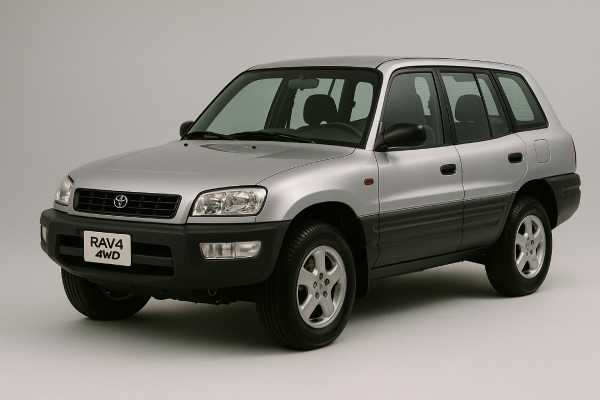
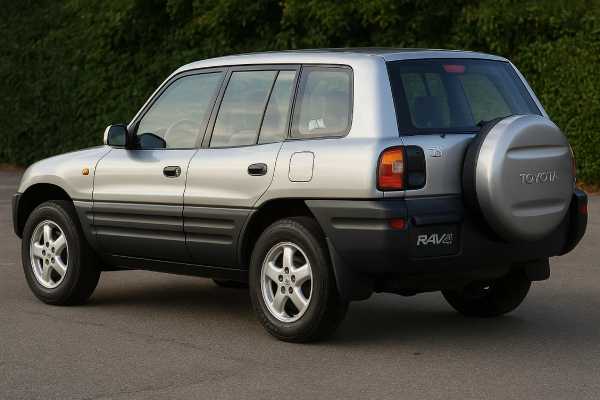
The facelifted first-generation Toyota RAV4 (1998–2000) helped define the compact SUV: car-like dynamics, upright seating, and just-enough off-pavement traction. In 4WD form it adds a viscous-coupled rear drive for confident all-weather grip while keeping the XA10’s low mass and simple, serviceable hardware. Power comes from Toyota’s 3S-FE 2.0-liter four—belt-driven DOHC, non-interference, built for longevity. The 4WD system is full-time with automatic torque transfer, so there are no levers to pull or modes to select, and it rewards good tires and smooth inputs. The 1998 refresh brought cleaner bumpers and lamps, minor NVH tweaks, and cabin improvements without complicating maintenance. If you want an approachable winter commuter, a reliable campus hauler, or a light-duty adventure rig, the facelift RAV4 4WD blends predictable running costs with honest utility—and it still feels small in modern traffic, which is part of its charm.
Fast Facts
- Proven 3S-FE engine and simple full-time 4WD with viscous coupling for all-weather confidence.
- Compact exterior, big square cargo bay; excellent sightlines and easy parking.
- Robust parts availability; straightforward DIY jobs (belts, plugs, fluids) keep costs low.
- Watch radiator end-tanks and aging timing-belt components; rear-drum adjustment affects pedal feel.
- Timing belt and water pump every 60,000–90,000 miles (96,000–145,000 km) or 7–9 years.
Navigate this guide
- RAV4 4WD 98–00 Overview
- RAV4 4WD Specs and Technical Data
- Trims, Options, and Safety
- Reliability, Issues, and Service Actions
- Maintenance and Buyer’s Guide
- Driving and Performance
- How It Compares to Rivals
RAV4 4WD 98–00 Overview
Toyota’s facelifted XA10 RAV4 4WD distills the early crossover recipe to three ideas: lightweight packaging, simple mechanicals, and predictable traction. The platform is monocoque (car-style), not body-on-frame, so it rides comfortably and turns tightly. Independent struts up front and a well-located double-wishbone rear end provide good compliance on broken pavement and washboard gravel. The full-time 4WD system uses a center viscous coupling to send torque rearward when the front wheels slip; there are no low-range gears, which keeps weight and complexity down.
Under the hood, the 3S-FE is an iron-block/aluminum-head 2.0-liter with a toothed timing belt, coil-and-distributor ignition, and multi-port fuel injection. It is tuned for midrange torque and durability rather than high-rpm power. In this era, most North American ratings list roughly 127 hp (95 kW), while many European brochures cite 129 hp (96 kW)—a small calibration difference that does not change real-world character. Pair it with the five-speed manual for the most responsive feel, or the Aisin four-speed automatic for relaxed commuting and straightforward upkeep.
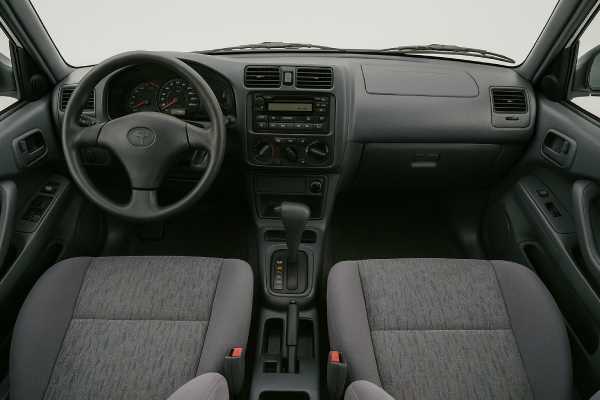
Cabin ergonomics are classic Toyota: big rotary HVAC knobs, clear dials, and seats that are upright enough to ease entry/exit and give visibility that modern crossovers sometimes lack. The side-hinged rear door, externally mounted spare, and low liftover make cargo tasks easy. Noise levels are period-correct—more wind and tire texture than today’s crossovers—but steady and not harsh when bushings and tires are healthy. Ownership is about predictability: routine fluids, a belt on time, and a cooling system in good shape are usually all it asks.
RAV4 4WD Specs and Technical Data
Engine and Performance (ICE-only)
| Item | Detail |
|---|---|
| Code | 3S-FE |
| Layout & cylinders | Inline-4 (I-4), DOHC, 16 valves |
| Bore × stroke | 86.0 × 86.0 mm (3.39 × 3.39 in) |
| Displacement | 2.0 L (1,998 cc) |
| Induction | Naturally aspirated |
| Fuel system | Multi-port fuel injection (MPFI) |
| Compression ratio | ~9.5:1 (calibration dependent) |
| Max power (baseline) | 127 hp (95 kW) @ ~5,400 rpm |
| Alternate rating (EU) | 129 hp (96 kW) @ ~5,400 rpm |
| Max torque | ~170 Nm (125 lb-ft) @ ~4,400 rpm |
| Timing drive | Belt (non-interference design) |
| Emissions/Efficiency standard | Period U.S. Tier-1/LEV calibrations |
| Rated economy (typical 4WD) | ~22 mpg US city / 27 mpg US hwy (10.7 / 8.7 L/100 km) |
| Real-world hwy @ 75 mph (120 km/h) | ~24–27 mpg US (9.8–8.7 L/100 km) |
| Aerodynamics | Cd ~0.36–0.38 (roof-rack and tire dependent) |
Transmission and Driveline (Full-time 4WD)
| Item | Detail |
|---|---|
| Transmissions | 5-speed manual (S-series) / 4-speed automatic (A-series) |
| Manual gear ratios | 1st 3.285 • 2nd 1.960 • 3rd 1.322 • 4th 1.028 • 5th 0.820 • Rev 3.153 |
| Manual final drive | ~4.17–4.24 (build dependent) |
| Automatic gear ratios | 1st 2.810 • 2nd 1.549 • 3rd 1.000 • 4th 0.700 • Rev 2.296 |
| Automatic final drive | ~3.94–4.10 (build dependent) |
| Center coupling | Viscous (automatic torque split) |
| Differentials | Open front/rear |
| Drive type | Full-time 4WD |
| Refuel to full (gasoline) | ~5–7 minutes (typical pump flow) |
Chassis and Dimensions
| Item | 3-Door | 5-Door |
|---|---|---|
| Suspension (front/rear) | MacPherson strut / Double wishbone with trailing links | MacPherson strut / Double wishbone with trailing links |
| Steering | Power rack-and-pinion | Power rack-and-pinion |
| Brakes | Ventilated front discs / rear drums; ABS available | Ventilated front discs / rear drums; ABS available |
| Wheels/Tires | 16-in rims; 215/70R16 typical | 16-in rims; 215/70R16 typical |
| Ground clearance | ~190 mm (7.5 in) | ~190 mm (7.5 in) |
| Length × width × height | ~3,900 × 1,695 × 1,645 mm (153.5 × 66.7 × 64.8 in) | ~4,115 × 1,695 × 1,650 mm (162.0 × 66.7 × 65.0 in) |
| Wheelbase | 2,200 mm (86.6 in) | 2,410 mm (94.9 in) |
| Turning circle (curb-to-curb) | ~10.2 m (33.5 ft) | ~10.6 m (34.8 ft) |
| Curb weight (typical) | ~1,240–1,305 kg (2,734–2,877 lb) | ~1,300–1,360 kg (2,866–2,998 lb) |
| GVWR | ~1,690–1,760 kg (3,726–3,880 lb) | ~1,740–1,800 kg (3,836–3,968 lb) |
| Fuel tank | ~58 L (15.3 US gal / 12.7 UK gal) | ~58 L (15.3 US gal / 12.7 UK gal) |
| Cargo volume (seats up / down) | ~320 / 1,000 L (11.3 / 35.3 ft³) | ~760 / 1,640 L (26.8 / 57.9 ft³) |
Performance and Capability
| Metric | Figure |
|---|---|
| 0–100 km/h (0–62 mph) | ~11.5–12.5 s (manual quicker) |
| Top speed | ~170 km/h (106 mph) |
| Braking 100–0 km/h (62–0 mph) | ~39–43 m (128–141 ft), tire-condition dependent |
| Towing capacity (max) | 680 kg (1,500 lb) |
| Payload (typical) | ~385–450 kg (850–990 lb) |
| Roof load | ~50–75 kg (110–165 lb); confirm rack rating |
Fluids and Service Capacities (verify by VIN/labels)
| System | Specification | Capacity (approx.) |
|---|---|---|
| Engine oil | API SJ or later; 5W-30 common | ~3.8–4.3 L (4.0–4.5 qt) with filter |
| Coolant | Toyota Long Life (red) 50/50 | ~5.5–6.5 L (5.8–6.9 qt) |
| Automatic transmission | Dexron III-spec ATF | ~2.6–3.2 L (2.7–3.4 qt) per drain |
| Manual transmission | GL-4/GL-5 75W-90 | ~2.1–2.5 L (2.2–2.6 qt) |
| Transfer case | GL-4/GL-5 75W-90 | ~0.5–0.8 L (0.5–0.8 qt) |
| Rear differential | GL-5 75W-90 | ~0.8–1.0 L (0.8–1.1 qt) |
| Brake fluid | DOT 3 (DOT 4 acceptable) | Fill to mark |
| A/C refrigerant | R-134a; ND-Oil 8 | ~550–650 g (19–23 oz) |
| Key torque specs | Wheel lugs ~103 Nm (76 lb-ft); oil drain ~39 Nm (29 lb-ft) | — |
Electrical
| Item | Detail |
|---|---|
| Alternator output | ~70–80 A |
| 12-V battery | Group 35/26R common; 45–60 Ah (CCA by climate) |
| Spark plugs | As specified (nickel/iridium); gap ~1.1 mm (0.043 in) |
Safety and Driver Assistance (period context)
| Topic | Detail |
|---|---|
| Crash-test context | Competitive results for the era; protocols differ from modern tests |
| Headlights | Halogen reflectors; lens clarity and aim are critical |
| Restraints | Dual front airbags; front pretensioners |
| Child seats | Factory top-tether provisions available; LATCH pre-dates 2001 standardization |
| ADAS | No AEB/ACC/LKA; ABS available; stability control generally not fitted in this generation |
Trims, Options, and Safety
Packaging and body styles
Facelift models were offered as three-door (some soft-top builds) and five-door wagons. Feature content was driven by convenience and cold-weather packages rather than performance variants. Power windows/locks, alloy wheels, roof rails, and ABS were commonly bundled. 4WD was full-time with a viscous coupling; there is no driver-selectable low range.
Quick identifiers
- Exterior: Revised bumpers and lighting (1998+), 16-inch wheels (steel or alloy), optional roof rails, externally mounted spare.
- Interior: Durable cloth, rotary HVAC, late-run audio and fabric tweaks; some leather-wrapped steering wheels depending on package.
- Badging: “RAV4” plus “4WD” or similar rear identifiers on many builds; door-jamb labels reveal transaxle codes.
Functional differences by configuration
- Manual vs automatic: The five-speed feels livelier around town and on grades; the four-speed holds taller gearing and keeps revs low on the highway.
- ABS option: Worth seeking in winter climates; rear drums require correct adjustment for best pedal feel.
- Wheel/tire packages: OE 215/70R16 all-seasons fit the chassis tune; upsizing can add grip but increases noise and may soften acceleration.
Year-to-year notes
- 1998: Cosmetic refresh, minor NVH enhancements, options reshuffled.
- 1999: Rising take-rate for ABS, minor trim changes.
- 2000: Color and audio updates ahead of the second-generation launch.
Safety and child-seat practicalities
These models pre-date modern side/curtain airbags and electronic stability control. Head-restraint geometry is basic. If you carry kids, verify top-tether points and belt-locking methods for your specific seat; many owners retrofit tethers where applicable via dealer kits. After any suspension, brake, or tire work, an alignment and proper headlight aim meaningfully improve real-world safety.
Calibration implications after service
There are no radar/camera modules to align. However, ABS wheel-speed sensor routing and tone ring integrity matter; avoid pinching harnesses during strut or axle replacement. If steering wheel is off-center after suspension work, recalibrate by physical alignment—there is no electronic steering angle sensor to program in this generation.
Reliability, Issues, and Service Actions
The facelift RAV4 4WD is known for low-drama ownership when serviced on schedule. Age and deferred maintenance now drive most faults. Use the map below to prioritize checks.
Engine (3S-FE)
- Timing-belt age (common • medium cost): Belts, idlers, and water pumps time out as well as wear out. Missed intervals risk sudden failure. Fix: Renew belt, tensioner/idlers, and pump every 60k–90k miles (96k–145k km) or 7–9 years; inspect cam/crank seals.
- Cam/valve-cover seep (common • low): Oil haze along the head/block seam. Fix: Replace seals and ensure PCV is clear.
- IAC/throttle carbon (occasional • low): Unstable idle or stalls when cold. Fix: Clean throttle plate and idle passages; reset base idle per procedure.
- Aging O2 sensors (occasional • low): Lazy switching hurts fuel economy. Fix: Replace with correct-spec sensor; check for upstream leaks.
Cooling system
- Radiator end-tank cracks (common • medium): Plastic crimps fatigue, causing seepage and sweet odor. Fix: Replace radiator; renew thermostat/cap and bleed carefully.
- Heater core/hoses (occasional • medium): Damp passenger footwell or fogging. Fix: Replace hoses and suspect valves; verify 50/50 coolant mix.
Fuel/ignition
- Distributor O-ring seep (occasional • low): Oil on distributor housing and harness. Fix: Reseal or replace distributor if shaft play exists; confirm base timing.
- Plug wires/plugs (common • low): Load-misfire and poor economy when aged. Fix: Replace with quality components; set plug gap correctly.
Transmission and 4WD
- 4AT shift flare/shudder with old ATF (occasional • medium): Friction modifiers degrade. Fix: Multiple drain/refills with Dexron III-equivalent; avoid aggressive flushes on unknown history.
- 5MT clutch wear (mileage-dependent • medium): Noticeable slip in higher gears. Fix: Replace clutch set; inspect rear main seal and flywheel.
- CV-boot splits (common • low): Outer boots crack with age. Fix: Reboot or replace half-shafts; inspect seals afterward.
- Rear-diff/transfer seep (occasional • low): Damp housings at seals. Fix: Replace seals; refill with correct GL-rated oil.
Chassis and brakes
- Rear drum long pedal (common • low): Misadjustment or glazed shoes. Fix: De-glaze and replace hardware; adjust properly; flush brake fluid every two years.
- Strut mounts/bushings (common • medium): Clunks over sharp edges. Fix: Replace mounts/bushes; perform alignment.
- Corrosion hotspots (climate-dependent • variable): Rear subframe mounts, brake/fuel lines, exhaust flanges, tailgate lower seam. Fix: Inspect on a lift; repair and protect.
Electrical
- Ground integrity (occasional • low): Random sensor codes or slow crank. Fix: Clean grounds; verify charging 13.8–14.6 V.
- Alternator fatigue (occasional • medium): Dim lights with accessories at idle. Fix: Test/replace alternator and belt.
Service actions to confirm
- Airbag inflators (VIN-specific campaigns): Confirm inflator status via an official VIN check.
- Seatbelt/seat anchor checks (market-specific): Dealer records should show completion where applicable.
- ABS sensor harness routing (rare): Inspect after axle/strut work to prevent chafing faults.
Pre-purchase must-haves
- Proof of timing-belt/water-pump service and coolant renewal.
- Photos of the underbody for corrosion and line condition.
- ATF history (automatic) or gearbox oil changes (manual).
- A clean recall report and dealer confirmation of any campaigns.
Maintenance and Buyer’s Guide
Service schedule (distance/time—whichever occurs first)
- Engine oil and filter: 5,000–7,500 miles (8,000–12,000 km) or 6–12 months; 5W-30 typically specified.
- Engine air filter: Inspect at 15,000 miles (24,000 km) / 12 months; replace as needed.
- Cabin filter: Early vehicles may not have an OE cabin element; inspect cowl screens annually and retrofit if desired.
- Spark plugs: Conventional ~30,000 miles (48,000 km); iridium 60,000–100,000 miles (96,000–160,000 km) if specified.
- Coolant: Replace every 2–3 years (or per long-life schedule); test annually for freeze protection and pH.
- Timing belt (with pump/idlers): 60,000–90,000 miles (96,000–145,000 km) or 7–9 years.
- Accessory belts/hoses: Inspect each oil change; replace at first signs of cracking, glazing, or swelling.
- Manual gearbox oil: 60,000 miles (96,000 km) or 5 years (GL-4/GL-5 75W-90).
- Automatic transmission ATF: Drain/refill every 30,000–50,000 miles (48,000–80,000 km), usage-dependent.
- Transfer case and rear diff oils: Inspect yearly; replace every 60,000 miles (96,000 km) or after deep-water exposure.
- Brake fluid: Flush every 2 years; inspect rear-drum hardware and shoe adjustment.
- Brake pads/shoes & rotors/drums: Inspect every 10,000–15,000 miles (16,000–24,000 km).
- Alignment and tire rotation: Rotate every 5,000–7,500 miles (8,000–12,000 km); align annually or after suspension work.
- 12-V battery: Load-test annually after year four; replace proactively in cold climates.
Fluid quick list (decision values)
- Engine oil: API SJ or later, 5W-30; ~4.0–4.5 qt with filter.
- Coolant: Toyota Long Life (red) / compatible; ~6 qt system capacity.
- ATF (4AT): Dexron III; ~2.7–3.4 qt per drain.
- Gear oil (5MT): GL-4/GL-5 75W-90; ~2.2–2.6 qt.
- Transfer case: GL-4/GL-5 75W-90; ~0.5–0.8 qt.
- Rear diff: GL-5 75W-90; ~0.8–1.1 qt.
- Brake fluid: DOT 3 (DOT 4 acceptable if system is clean).
- A/C: R-134a; ND-Oil 8; charge strictly by label.
Buyer’s inspection checklist
- Rust and structure: Rear subframe mounts, brake/fuel lines, tailgate lower seam, exhaust flanges; inspect seams for blistering.
- Cooling health: Check for crust at radiator crimps and pump weep hole; verify stable temperature at idle with A/C on.
- 4WD system: Look for diff/transfer leaks, listen for bearing growl, and verify equal tire sizes and tread depths on all four corners.
- Driveline: Inspect CV boots; no grease sling; drive in a tight circle to listen for outer-joint clicking.
- Brakes: Firm pedal with correct bite; rear drums properly adjusted; ABS lamp proves out at key-on.
- Suspension/alignment: Strut-mount clunks, rear trailing-arm bush play, and straight tracking at 50–70 mph (80–113 km/h).
- Electrical: Charging voltage 13.8–14.6 V; clean grounds; all lights and HVAC speeds working.
- Documentation: Timing-belt invoice, fluid history, and official VIN recall report.
Durability outlook
With clean fluids, a healthy cooling system, and an on-time belt, the XA10 RAV4 4WD commonly runs 200k–300k miles (320k–480k km). It remains a low-risk pick among late-1990s compact SUVs because its value lies in simplicity more than spec-sheet speed.
Driving and Performance
Ride, handling, and NVH
The RAV4’s independent suspension and compact size produce a compliant, well-controlled ride. Body roll is present but progressive; mid-corner bumps rarely upset the chassis. Steering is light at low speeds and settles predictably on center at highway pace. Cabin noise is mostly tire and wind rustle; fresh door seals, quality tires, and intact splash shields keep it civilized.
Powertrain character
The 3S-FE prefers midrange work (roughly 2,500–4,500 rpm). With the five-speed manual you can hold that band and the car feels eager; the four-speed automatic short-shifts to keep revs low, which suits daily commuting. There’s no turbo lag because there’s no turbo—just linear response and modest torque that pairs well with the vehicle’s low mass.
Real-world efficiency
Expect about 21–23 mpg US city / 26–29 mpg US highway (11.2–10.2 L/100 km city / 9.0–8.1 L/100 km highway) for healthy 4WD examples on stock-size tires. Winter blends, short trips, roof racks, and aggressive all-terrain tread can trim these numbers. A fresh air filter, correctly gapped plugs, and a responsive oxygen sensor can gain 1–2 mpg.
Traction and control
Full-time 4WD adds confidence on wet, snowy, or gravel surfaces. The viscous coupling quietly sends torque rearward when the fronts slip; there is no driver input required. Without modern stability control, driving on slick roads rewards smooth throttle, early braking, and—most of all—good winter tires. Ground clearance and approach/departure angles are modest; choose lines carefully on rutted tracks.
Key metrics (typical ranges)
- 0–60 mph (0–97 km/h): ~10.8–11.8 s (manual quicker; tire-dependent).
- 50–80 mph (80–129 km/h) passing: Best in 3rd/4th (manual) or kickdown to 2nd/3rd (automatic).
- 100–0 km/h braking: ~39–43 m (128–141 ft) on fresh pads/tires.
- Turning circle: ~10.6 m (34.8 ft) five-door; notably tidy for urban U-turns.
Load and towing
Rated to 1,500 lb (680 kg). Keep tongue weight conservative, leave extra braking margin, and use the manual’s lower gears (or early downshifts in the automatic) on grades to control temperatures. Plan for a 10–25% fuel-economy penalty when towing or carrying a full roof load.
How It Compares to Rivals
Honda CR-V (first generation, 1997–2001)
The CR-V offers slightly more interior space and, in many trims, rear disc brakes. Its reactive dual-pump AWD engages after slip, whereas the RAV4’s viscous coupling is always ready. Long-term, both are durable; the RAV4 often proves cheaper to keep if you value simpler hardware and a lighter feel.
Subaru Forester (first generation, 1998–2002)
Standard AWD and a low engine center of mass help handling on slick roads. However, some Foresters of this era are known for head-gasket concerns as mileage accrues. The RAV4 counters with fewer engine-bay headaches and a more compact footprint for city duty.
Isuzu Rodeo/Honda Passport (midsize, body-on-frame)
More towing and a tougher stance, but heavier, thirstier, and less maneuverable. Parts sourcing can be less convenient today. If you primarily commute, the RAV4’s comfort and economy win; if you tow or run rougher trails, the body-on-frame pair make sense.
Ford Escape/Mazda Tribute (arrived 2001)
These later entrants feel more modern inside and can be stronger performers, but early production had teething issues. An older RAV4 in good condition may be the lower-risk used buy if service history is uncertain.
Bottom line
Choose the RAV4 4WD facelift if you want simple, all-weather traction, city-friendly size, and predictable costs. Skip it if you need advanced driver assistance, very quiet long-haul cruising, or tow ratings beyond 1,500 lb (680 kg).
References
- 2000 Toyota RAV4 Owner’s Manual 2000 (Owner’s Manual)
- Fuel Economy of the 2000 Toyota RAV4 4WD 2025 (Fuel Economy)
- 1998 Toyota RAV4 2025 (Safety Rating)
- Vehicle Detail Search – 2000 TOYOTA RAV4 | NHTSA 2025 (Recall Database)
Disclaimer
This article is for informational purposes only and is not a substitute for professional diagnosis or repair. Specifications, capacities, torque values, and service intervals vary by VIN, market, equipment, and running changes. Always verify against your vehicle’s official service documentation, under-hood labels, and the latest manufacturer publications.
If this guide helped you, please consider sharing it with fellow owners on Facebook or X/Twitter to support xcar’s work. Thank you!