
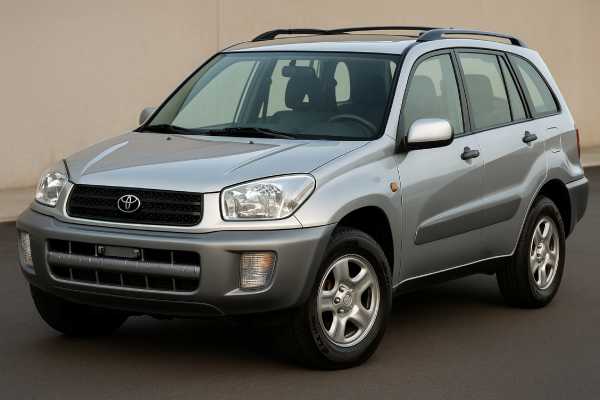
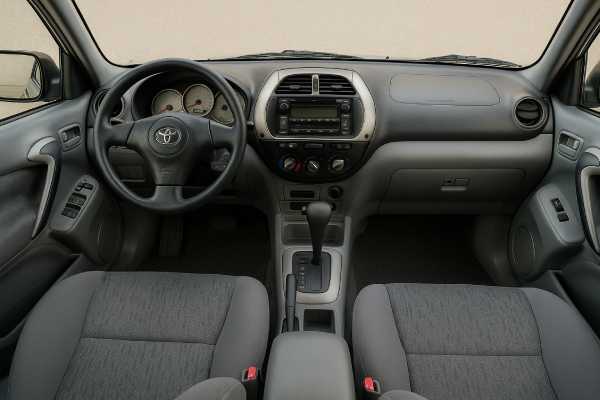
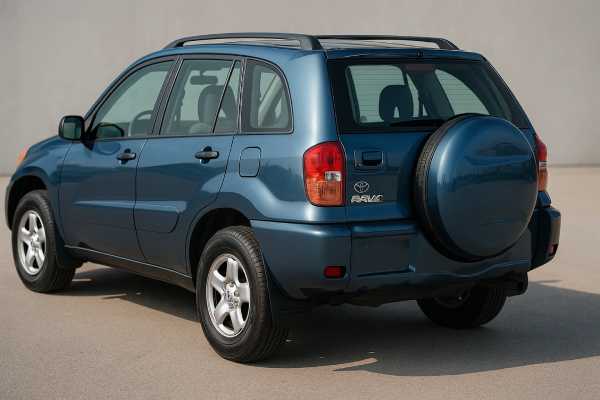
The second-generation Toyota RAV4 (XA20) in AWD form blends light-truck durability with car-like manners. Powered by Toyota’s 1AZ-FE 2.0-liter four-cylinder (148 hp), it uses a timing chain, multi-point fuel injection, and VVT-i for broad, predictable torque. The drivetrain is a full-time all-wheel-drive layout with a viscous-coupling center differential and an available rear limited-slip differential, giving confident traction on wet, snow-covered, or unpaved roads without driver input. The chassis is simple and robust: MacPherson-strut front suspension and a double-wishbone rear, with a compact unit-body shell that keeps weight down and cargo space high. Owners value its long service life, parts availability, and straightforward maintenance. This article focuses on the 2000–2003 AWD 2.0-liter models, using North American specifications and trim naming where applicable, and adds practical buying and maintenance guidance from real-world experience. If you want a durable, easy-to-own compact SUV with true mechanical AWD, this era of RAV4 remains a smart pick.
Fast Facts
- Full-time AWD with viscous coupling; optional rear limited-slip differential improves snowy-hill starts.
- Square-bore 1AZ-FE (86.0 × 86.0 mm) uses a timing chain and iridium plugs; low routine costs.
- Cabin and cargo versatility: sliding, reclining, and removable rear seats; 29.2/68.3 ft³ cargo (seats up/down).
- Watch for early-2000s ECM/shift concerns on 4-speed automatics; verify campaign/TSB completion.
- Typical oil and filter: every 5,000 mi / 8,000 km or 6 months (conventional schedule for this era).
What’s inside
- RAV4 XA20 AWD overview
- AWD 1AZ-FE specifications
- RAV4 trims, options, safety tech
- Reliability and service actions
- Maintenance and buying advice
- Driving, economy and traction
- RAV4 rivals and alternatives
RAV4 XA20 AWD overview
Toyota’s second-gen RAV4 (XA20) moved the compact SUV class forward by keeping the original’s agility while adding real everyday utility. The AWD 2.0-liter models covered here use a mechanical full-time all-wheel-drive system with a bevel-gear center differential and a viscous-coupling limiter, so torque constantly flows to both axles and reallocates when one axle slips. That “always-on” approach feels seamless versus on-demand systems that wait to engage the rear axle. It is also hardware-simple, with open differentials at each axle (a rear limited-slip was available on many AWD builds) and no driver switchgear to manage.
Under the hood, the 1AZ-FE is a square-bore inline-four with an aluminum block and head, DOHC, 16 valves, VVT-i on the intake cam, and a chain-driven timing system. Output is modest on paper—148 hp and 142 lb-ft—but the tuning prioritizes low-to-midrange torque, so the RAV4 steps off cleanly and holds speed on grades without drama. Toyota paired it with either a 5-speed manual or a 4-speed electronically controlled automatic. The automatic was by far the volume choice; most AWD autos use the U140F transaxle with an integrated center differential and transfer gearing to the prop shaft.
The cabin is where this generation wins long-term fans. The rear bench slides, reclines, tumbles, and can be removed altogether for big-item hauling. With the seats in place you get a square cargo bay and a low load floor; with the seats out, the RAV4 swallows gear that would stump many larger crossovers. Visibility is excellent thanks to upright glass and short overhangs. Safety tech for the period can include ABS with EBD and Brake Assist, traction control, and—to varying degrees—Vehicle Skid Control (stability control). The structure earned decent frontal crash results for its time, though side-impact protection lags later standards unless equipped with side airbags.
Daily living is easy: routine fluids are common and affordable; the engine is chain-timed; and access to service items is generally good. Parts availability remains strong and inexpensive. The main ownership watch-item on early-2000s automatics is the engine control module’s shift logic and related solenoid control—Toyota addressed this with service campaigns and TSB actions; confirm any car you’re considering has the updated module.
AWD 1AZ-FE specifications
Below are technical highlights specific to the AWD 2.0-liter (1AZ-FE) RAV4, with North American figures first and metric equivalents provided. Values reflect typical factory data for 2000–2003 models with common option packages of the period.
Engine and Performance (ICE-only)
| Item | Specification |
|---|---|
| Code | 1AZ-FE |
| Layout & cylinders | Inline-4, DOHC, 16 valves (4 per cyl) |
| Bore × stroke | 86.0 × 86.0 mm (3.39 × 3.39 in) |
| Displacement | 2.0 L (1,998 cc) |
| Induction | Naturally aspirated |
| Fuel system | MPFI (multi-point fuel injection) |
| Compression ratio | ~9.6:1 |
| Max power | 148 hp (110 kW) @ 6,000 rpm |
| Max torque | 192 Nm (142 lb-ft) @ 4,000 rpm |
| Timing drive | Chain |
| Rated economy (EPA period data) | 22 mpg combined / 20 city / 25 hwy (10.7 L/100 km combined) for 4WD auto (2001 example) |
| Real-world highway @ 75 mph | ~26–28 mpg US (9.0–8.4 L/100 km) in mild weather, stock tires |
| Aerodynamics | Short-wheelbase, upright body; Cd not officially quoted in period brochures |
Transmission and Driveline
| Item | Specification |
|---|---|
| Transmission (manual) | 5-speed |
| Transmission (automatic) | 4-speed ECT (U140F typical on AWD) |
| Gear ratios (U140F auto) | 1st 3.938 • 2nd 2.194 • 3rd 1.411 • 4th 1.019 • Rev 3.141 |
| Final drive (auto) | ~3.08 (typical U140F); application-specific |
| Drive type | Full-time AWD with bevel-gear center differential and viscous-coupling limiter |
| Differential(s) | Open front/rear; rear limited-slip differential available on many AWD models |
Chassis and Dimensions
| Item | Specification |
|---|---|
| Front suspension | MacPherson strut, coil spring, stabilizer bar |
| Rear suspension | Double wishbone, coil spring, stabilizer bar |
| Steering | Power rack-and-pinion; turning circle 35.4 ft (10.8 m) |
| Brakes | Ventilated front discs; rear drums (period spec), 4-wheel ABS available with EBD/Brake Assist |
| Wheels/Tires | 16-in rims; P215/70R16 standard; optional P235/60R16 with certain packages |
| Ground clearance | 6.7 in (170 mm) typical AWD |
| Approach/Departure | ~28°/29° (with specific tire packages) |
| Length/Width/Height | 166.2 in × 68.3 in × 66.1 in (4,223 × 1,735 × 1,679 mm) AWD on period spec |
| Wheelbase | 98.0 in (2,489 mm) |
| Curb weight | ~2,877–2,943 lb (1,305–1,335 kg) AWD manual/auto |
| GVWR | ~3,990 lb (1,810 kg) |
| Fuel tank | 14.7 US gal (55.6 L; 12.2 UK gal) |
| Cargo volume | 29.2 / 68.3 ft³ (827 / 1,934 L) seats up / removed (SAE) |
Performance and Capability
| Item | Specification |
|---|---|
| 0–60 mph (0–100 km/h) | ~9.8–10.8 s (manual quicker) |
| Top speed | ~115–118 mph (185–190 km/h), gearing-limited |
| Braking 62–0 mph | Typical compact SUV performance for the era; condition dependent |
| Towing | 1,500 lb (680 kg) braked with proper hitch and cooling |
| Payload | ~1,000–1,100 lb (455–500 kg) configuration-dependent |
Fluids and Service Capacities
| System | Specification |
|---|---|
| Engine oil | API SL (period) 5W-30; ~4.2 L (4.4 qt) with filter |
| Coolant | Toyota Long Life Coolant (red) in this era; ~6.4–6.8 L (6.8–7.2 qt) total system |
| ATF (U140F) | Toyota ATF Type T-IV; drain-fill ~3.5–4.0 L (3.7–4.2 qt); total service fill higher |
| Manual trans oil | 75W-90 GL-4/GL-5; ~2.1 L (2.2 qt) |
| Rear differential | 75W-90 GL-5; ~0.9 L (0.95 qt) |
| A/C refrigerant | R-134a; ~500–550 g (18–19 oz) |
| A/C compressor oil | ND-Oil 8; ~120 mL (4.1 fl oz) typical |
| Key torque examples | Wheel lug nuts 103 Nm (76 lb-ft); spark plugs ~18 Nm (13 lb-ft); oil drain plug ~40 Nm (30 lb-ft) |
Electrical
| Item | Specification |
|---|---|
| Alternator | ~80 A typical for 2.0L AWD models |
| 12V battery | Group 35 (common fit), ~550–650 CCA |
| Spark plug | Iridium (DENSO SK20R11 / NGK IFR6A11); gap 1.1 mm (0.043 in) |
Safety and Driver Assistance (period)
| Item | Notes |
|---|---|
| Crash ratings (IIHS) | Early-2000s tests: moderate overlap frontal acceptable; side (no side airbags) poor |
| Headlights (IIHS) | Headlight ratings not applied in that era |
| Airbags | Dual front standard; front side airbags availability varied by year/trim |
| ABS/EBD/BA | Optional 4-wheel ABS with Electronic Brake-force Distribution and Brake Assist |
| Stability and traction | Traction control and Vehicle Skid Control available/packaged on higher trims |
| Child seats | Rear LATCH lower anchors and top tether provisions |
RAV4 trims, options, safety tech
Trims and equipment (North America, 2.0 AWD, 2000–2003). Trims were typically Base and L, with the Sport package offered later. The defining differences were mostly comfort, exterior appearance, and safety/traction add-ons rather than core mechanicals.
- Base AWD: 16-inch steel wheels with P215/70R16 tires, sliding/reclining/removable rear seats, manual A/C (often package-bundled), 4-speaker audio, power steering, tilt wheel. ABS with EBD was often optional. Rear drums are common; some markets and years offered rear discs but most early U.S. AWD examples use drums.
- L Package: Color-keyed exterior trim, integrated fog lamps, hard-shell spare tire cover, privacy glass, upgraded audio, and availability of leather seating package. This is the configuration where VSC (stability control), Brake Assist, traction control, and the rear limited-slip differential were commonly available. The L is an easy spot on the street thanks to color-matched moldings and the hard-shell spare cover with “L” badging.
- Sport Package (later years): Blackout headlamp trim, hood scoop, tubular roof rack, unique seat fabric, and 16-inch alloy wheel options including wider 235/60R16 tires. The Sport’s wheel/tire setup slightly changes track width and approach/departure figures.
Quick identifiers:
- VIN/build tags on the driver’s jamb list transmission code (e.g., U140F for AWD automatic).
- Instrument cluster lamps will show TRAC/VSC indicators on trims equipped with traction/stability.
- Rear axle: many AWD examples have a tag on the differential housing indicating limited-slip if fitted.
Year-to-year notes (2000–2003 scope):
- 2001: Launch of XA20 in North America with 2.0-liter 1AZ-FE only. ABS optional, side airbags limited availability.
- 2002: Packaging shuffles: traction and VSC bundled more often with upper trims; audio and interior trims updated.
- 2003: Sport appearance package arrives in many markets; brochure specs show viscous-coupling center differential standard on AWD and limited-slip rear differential available. EPA figures for AWD auto commonly quoted at 22 mpg combined.
- (2004 update beyond this article’s cutoff introduced the 2.4-liter 2AZ-FE; not covered here.)
Safety systems and ADAS (period-correct):
- Airbags: Dual-stage front airbags; front seat side airbags available on some trims/years. No curtains in this era.
- Brakes and stability: ABS with EBD and Brake Assist widely available; VSC with traction control offered mainly with L and Sport packages. After collision or alignment repairs, yaw-rate/steering-angle sensor calibration may be required on VSC-equipped cars.
- Child restraints: Two rear LATCH lower anchor positions plus top tether anchors.
- Lighting: Halogen multi-reflector units; no factory HID.
Reliability and service actions
Overall take: The AWD 2.0 XA20 RAV4 is a durable, low-drama used SUV when maintained on time. The engine is chain-timed, the AWD system is mostly mechanical, and the suspension uses widely available wear parts. The most important check for 2001–2003 AWD automatics is the engine control module (ECM) and shift-quality campaign history.
Common → rare issues, with cost/severity guidance
Common (low–medium severity):
- ECM shift control / harsh shifting (automatic): Symptoms include harsh 2–3 or 3–4 shifts, flare, or failure to engage, often accompanied by DTCs (P0750–P0758, P1760). Root cause is early ECM calibration/hardware interacting with shift solenoids. Remedy is ECM replacement or reflash to the updated part number and inspection of solenoids; verify completion on any candidate vehicle.
- Oxygen sensors / catalyst efficiency code P0420: Age-related O2 sensor drift or exhaust leaks upstream of the catalyst trigger the code. Inspect for manifold and flange leaks; replace upstream sensor with OE-quality parts before condemning the catalyst.
- Front strut mounts and rear shock bushings: Clunks over sharp bumps; replace mounts/bushings as needed.
- Wheel bearings (front): Growl that changes with steering load; press-in bearings require proper tooling—replace in pairs if mileage is high.
Occasional (medium severity):
- Rear differential/viscous coupler noise: A howl or rumble that increases with speed can be worn diff bearings; a “binding” feel at low speeds after long drives may be viscous coupling wear. Remedy is bearing replacement or coupler assembly replacement. Check for mismatched tire sizes (which can overstress coupler and rear diff).
- Idle air / throttle body deposits: Rough idle or stalling on cold start; clean throttle body and IAC passages and perform idle relearn.
- Cooling system seepage at hoses/heater core joints: Age-related; use correct clamps and Toyota LLC.
Rare but noteworthy (medium–high severity):
- Head gasket seep / head-bolt thread pull (1AZ family): Far less common on RAV4 than on some contemporary sedans, but a careful pre-purchase inspection for combustion gases in coolant and external seep at block-to-head interface is wise. Proper repair requires thread insert work if present.
- ECU ground / harness corrosion in salted regions: Intermittent electrical gremlins traced to grounds; clean and reseal.
Driveline & chassis checkpoints for AWD:
- Prop-shaft U-joints and center bearing: Noise/vibration on throttle; inspect boot integrity and u-joint play.
- CV axles: Torn inner boots near transfer output will sling grease onto the exhaust.
- Subframe and rear suspension corrosion: Pay special attention at the rear crossmember mounts and brake line brackets in salt belts.
Recalls, TSBs, extended coverage to verify:
- ECM/automatic shift quality: Confirm the vehicle has the updated ECM/calibration and that any related service bulletins were performed. The documentation typically references harsh shifting with DTCs P0750/P0753/P0755/P0758/P1760 and specifies ECM replacement and confirmation of proper solenoid operation.
- VIN recall status: Always run the VIN through the official recall portal to ensure all safety campaigns are complete.
- Customer support programs (if any): Ask the seller for proof of ECM replacement or extended coverage paperwork, plus receipts for transmission fluid services.
Pre-purchase request list:
- Full, dated service history (oil/coolant/transaxle/diff/brake fluid).
- Proof of ECM/TSB work on automatics; scan for transmission DTC history.
- Tire set matched in brand/size and even wear (mismatches stress the viscous coupler).
- Cold-start inspection: no rattles, no coolant smell, steady idle.
- Rust underside photos, especially rear subframe and brake/fuel line routing.
- Road test: listen for front hub growl, check for shift flare or bang, verify straight tracking/brake feel.
Maintenance and buying advice
Service rhythm (practical schedule)
(If your manual specifies different intervals or fluids for your VIN/market, follow the manual.)
- Engine oil and filter: 5,000 mi / 8,000 km or 6 months (typical for this era on conventional oil). Many owners on full-synthetic extend to 7,500 mi / 12,000 km with UOA confirmation; the conservative interval helps aging seals.
- Engine air filter: Inspect each oil change; replace ~30,000–45,000 mi / 48,000–72,000 km sooner in dusty use.
- Cabin filter: 15,000–20,000 mi / 24,000–32,000 km.
- Coolant: Toyota Long Life (red) originally; many have been converted to Super Long Life (pink). If still on red, 2–3 years/30,000–50,000 mi is prudent; on pink, first at ~100,000 mi/160,000 km, then every 50,000 mi/80,000 km. Always confirm what is in your system before mixing.
- Spark plugs: Iridium DENSO SK20R11/NGK IFR6A11 typically 120,000 mi / 192,000 km; inspect sooner if misfire counts rise.
- Fuel filter: In-tank strainer—no routine replacement interval; replace if pressure/flow concerns or during pump service.
- Valve clearance: Shim-over-bucket; check only if symptoms (tick, rough idle) or head work.
- Serpentine/aux belt: Inspect every 15,000 mi / 24,000 km; replace at first cracking or glazing (often ~60,000–90,000 mi).
- ATF (U140F): There’s no “flush” requirement; drain-and-fill 3.5–4.0 qt every 30,000–60,000 mi (48,000–96,000 km) is a proven practice. Use Toyota T-IV.
- Manual trans oil (if equipped): 75W-90 GL-4/5 every ~60,000 mi / 96,000 km.
- Rear differential oil: 75W-90 GL-5 every 60,000 mi / 96,000 km (more often with towing).
- Brake fluid: 2–3 years regardless of mileage.
- Brake pads/rotors: Inspect at each tire rotation; rear drums require shoe and wheel-cylinder checks.
- Power steering fluid: Inspect annually; replace if dark/contaminated.
- A/C service: Replace cabin filter on time; system should cool 40–50°F (22–28°C) below ambient at the vents.
- Tires/Alignment: Rotate every 5,000–7,500 mi; maintain even wear to protect the viscous coupler; align annually or after pothole strikes.
- 12-V battery: Load test annually after year 3; typical life 4–6 years.
Fluid picks (decision quick-list):
- Engine oil: 5W-30 (API SL/SM/SN) year-round for most climates; high-mileage formulas can help minor seepage on older engines.
- Coolant: Use Toyota LLC/SLLC only; never mix with universal green unless fully flushed.
- ATF: Toyota T-IV; avoid “multi-vehicle” fluids unless explicitly compatible.
- Gear oils: Quality 75W-90 GL-5 (rear diff) and GL-4/5 (manual trans) from reputable brands.
Essential torque values: Wheel lug nuts 76 lb-ft (103 Nm), spark plugs ~13 lb-ft (18 Nm), oil drain plug ~30 lb-ft (40 Nm), rear diff drain/fill plugs typically ~36–40 lb-ft (49–54 Nm).
Buyer’s checklist (AWD 2.0):
- ECM/auto-shift campaign proof: photo of the ECM label/part number or dealer invoice.
- AWD health: matched tire set, no driveline bind in tight figure-eights after a highway drive; listen for rear diff/coupler rumble.
- Cooling system: look for crusted pink residue at hose joints or water pump weep hole.
- Exhaust and emissions: check for leaks at manifold and mid-pipe flanges; scan for pending P0420.
- Rust: rear subframe mounts, brake line brackets, muffler hangers.
- Suspension/brakes: front hub noise, rear drum wheel-cylinder seepage, strut top mounts.
- Interior and cargo: verify rear seat latches and slide/tumble mechanisms; inspect tailgate check strap.
Years/trims to target: Clean 2002–2003 AWD L examples with VSC/ABS and the rear LSD tend to offer the best winter traction and active-safety net, plus nicer interior trim. A well-documented 2001 is also a good buy once the ECM/auto shift campaign is confirmed. Manual-trans AWDs are rare and sought after by enthusiasts.
Durability outlook: With basic care, 200,000–300,000 miles is realistic. The engine tolerates age well if oil is changed on time, and the AWD hardware is long-lived if tires are matched and fluids are serviced.
Driving, economy and traction
Ride and handling: Short overhangs and a relatively low curb weight give the XA20 an easy, planted feel in town. The steering is light with predictable on-center tracking. Body roll is moderate, and the double-wishbone rear keeps the back end settled over broken pavement. With the wider 235/60R16 tires offered on Sport-package AWDs, initial turn-in is a touch crisper and mid-corner roll is slightly reduced. NVH at 60–70 mph is competitive for the era: wind noise from the upright mirrors and roof rack is the main contributor; engine and tire noise are modest if bushings and bearings are healthy.
Powertrain character: The 1AZ-FE’s best work is done below 4,500 rpm. Throttle response is linear, there’s no turbo to spool, and the intake VVT-i flattens the torque curve, so the car pulls steadily rather than urgently. The 4-speed ECT is tuned to upshift early for economy; kickdown is decisive but not harsh on healthy ECM calibrations. The 5-speed manual feels light with longish throws and a high clutch engagement—pleasant for commuting and winter driving.
AWD behavior: Full-time with a viscous-coupling center means the rear axle is always engaged. On wet leaves or snowy starts, you’ll feel the car step out less than a front-drive RAV4; the viscous unit quietly redirects torque to the axle with more grip. With the optional rear limited-slip differential, off-line traction on split-mu surfaces improves further. Stability/traction control (if equipped) trims wheelspin and yaw smoothly; it is conservative on slick uphill launches, so gentle throttle helps.
Real-world economy:
- City: 20–22 mpg US (11.8–10.7 L/100 km) stock tires, mixed stop-and-go.
- Highway (60–75 mph / 100–120 km/h): 25–28 mpg US (9.4–8.4 L/100 km), best around 65–70 mph.
- Mixed: ~23–26 mpg US (10.2–9.0 L/100 km).
Cold weather, roof racks with gear, and aggressive winter tires can cut those figures by 10–20 percent. A fresh O2 sensor and proper tire pressures make a noticeable difference.
Loads and towing: The 1,500-lb (680-kg) tow rating is honest when the cooling system and ATF are fresh; plan for 2–4 mpg US (0.9–1.7 L/100 km) economy penalties while towing or with a full camping load. The short wheelbase means crosswind stability is decent but not minivan-level; a properly distributed trailer load (10 percent tongue) keeps sway in check.
Braking and control: Pedal feel is firm, and straight-line stops are consistent if the rear drums are adjusted correctly. With ABS and Brake Assist, panic-stop distances align with the class average of the era; performance pads help if you routinely descend mountain passes.
RAV4 rivals and alternatives
Honda CR-V (2002–2004, 2.4L AWD): The CR-V’s K24 engine feels stronger above 4,000 rpm, and its tall cargo bay is excellent. Its on-demand AWD waits for slip before engaging the rear axle, which can mean more front-wheel spin on icy starts versus the RAV4’s full-time setup. Ride quality is comparable; maintenance costs are similar; parts availability is outstanding for both.
Subaru Forester (2001–2002, 2.5L): Subaru’s symmetrical AWD gives a similarly “always-on” feel. The boxer engine offers low-end pull but watch for head-gasket history on early 2.5s. Ground clearance and approach angles are slightly better stock-for-stock than the RAV4; cargo flexibility favors the Toyota’s removable seats.
Ford Escape/Mazda Tribute (2001–2004, 2.0/3.0L): Roomy and inexpensive to buy used. The optional V6 makes them quick, but early automatics have their own reliability cautions. AWD is on-demand. The RAV4’s interior quality and long-haul durability usually win over time.
Hyundai Santa Fe (first-gen 2.4/2.7L): Larger outside with more towing headroom when V6-equipped, but heavier and less economical. As a used buy, condition varies widely.
Why the RAV4 AWD (XA20) still makes sense:
- Mechanical, full-time AWD with available rear LSD for authentic traction.
- Proven 1AZ-FE with a chain and long-life iridium plugs.
- Unique cargo flexibility with removable rear seats.
- Excellent parts pipeline and repairability two decades on.
References
- Gas Mileage of 2001 Toyota RAV4 2001 (EPA Fuel Economy)
- 2001 Toyota RAV4 4-door SUV 2001 (Safety Rating)
- Harsh Shift and/or MIL “ON” DTC P0750, P0753, P0755, P0758 and/or P1760 2010 (TSB)
- Check for Recalls: Vehicle, Car Seat, Tire, Equipment 2025 (Recall Database)
- Toyota Manuals and Warranties | Toyota Owners 2025 (Owner’s Manual)
Disclaimer
This article is for informational purposes only and is not a substitute for professional diagnosis, service procedures, or safety guidance. Specifications, torque values, fluid types, and maintenance intervals vary by VIN, market, build date, equipment, and service campaigns. Always confirm details against your vehicle’s official owner’s manual, service information, and recall/TSB records.
If you found this guide useful, please share it with fellow owners and enthusiasts on Facebook, X/Twitter, or your favorite forum to support xcar’s work.