
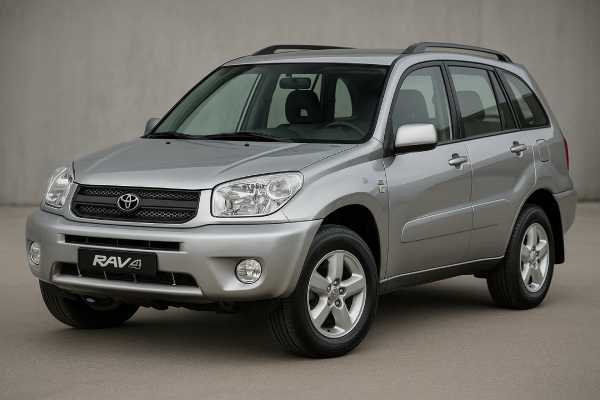
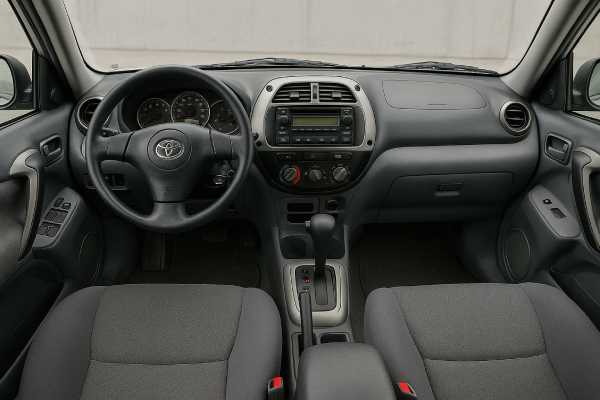
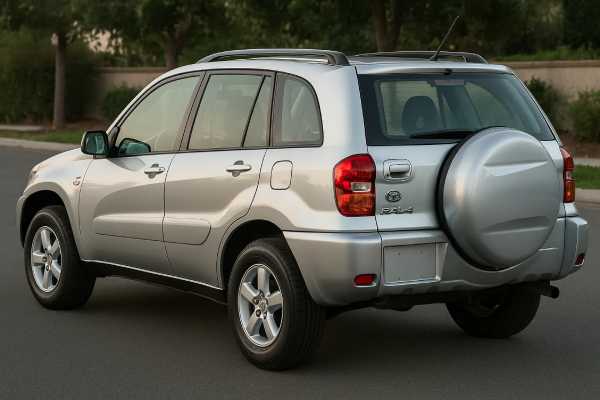
The facelifted second-generation Toyota RAV4 refined the formula that made the original so popular. For 2003–2005, the front-wheel-drive 2.0-litre 1AZ-FE received styling tweaks, cabin updates, and small NVH improvements while keeping the light, car-like feel owners value. With variable-valve timing (VVT-i), an efficient 16-valve four-cylinder, and either a five-speed manual or four-speed automatic, this RAV4 trades outright power for smooth delivery and good real-world economy. The chassis uses independent suspension at both ends, so it rides comfortably yet turns crisply for a tall vehicle. Inside, sliding/tumbling rear seats and a flat cargo floor make it easy to live with. Shoppers should confirm proper timing-chain health (noise checks and oil-change history), inspect for oil seepage at common gasket points, and verify that airbag and throttle software updates were done. Kept on schedule, the facelift XA20 is simple, durable, and inexpensive to maintain—ideal as a daily driver or first family SUV.
Quick Specs and Notes
- Flexible 1AZ-FE with VVT-i: smooth torque, modest thirst, low running costs.
- Practical interior: sliding/removable rear seats, square cargo bay, easy roof-rack fitment.
- Simple FWD layout lowers weight and complexity vs AWD; lighter steering in town.
- Watch for oil seep at timing cover/valve cover and idle-air/throttle deposits on high-milers.
- Service anchor: engine oil and filter every 10,000–15,000 km or 12 months.
Navigate this guide
- Facelift RAV4 2.0 FWD overview
- RAV4 1AZ-FE specs and data
- Trims, options, safety features
- Reliability and service actions
- Maintenance and buyer guide
- Driving and performance
- How it compares to rivals
Facelift RAV4 2.0 FWD overview
Toyota’s 2003 facelift for the XA20 brought cleaned-up bumpers and lamps, revised fabrics, updated audio, and quiet running tweaks, all while preserving the small-SUV agility that made the RAV4 easy to park and confidence-inspiring in traffic. The front-wheel-drive layout keeps weight down and steering light, and it suits temperate climates where winter traction demands are modest. With the 1AZ-FE 2.0-litre inline-four, the facelift model focuses on smooth drivability rather than headline numbers. Variable Valve Timing-intelligent (VVT-i) broadens the torque band, so short-shifting around town feels natural, and motorway cruising is relaxed.
Cabin practicality remains a highlight. Five-door models get sliding, tilt-fold, and tumble rear seats; many markets also allowed seat removal to unlock estate-car-like load length. The upright seating position and big glass deliver excellent visibility. Ergonomics are simple: large rotary HVAC controls, clear instruments, and durable plastics that age well if cleaned properly. Ride quality is quietly competent over patchy tarmac thanks to independent suspension at both ends (MacPherson strut front, double-wishbone rear).
Owning this RAV4 is straightforward. The 1AZ-FE uses a timing chain, so there is no routine belt replacement; instead, engine health hinges on regular oil changes with the correct viscosity and spec. The chain’s tensioners and guides are long-lived when oil quality is kept high. Throttle body and idle-air passages can accumulate varnish by higher mileage, but cleaning restores idle stability. The four-speed automatic is simple and durable with fresh ATF; the five-speed manual has a light clutch and clean shift action. Brakes are sized sensibly for the car’s weight and respond well to quality pads and fluid flushes on a two-year cadence.
In short, the facelift 2.0 FWD RAV4 offers city-friendly size, long-distance comfort, and low overall operating cost—provided you keep up with oil, filters, and periodic inspections for seepage and suspension wear.
RAV4 1AZ-FE specs and data
Engine and Performance (ICE)
| Item | Specification |
|---|---|
| Code | 1AZ-FE (VVT-i) |
| Layout & cylinders | Transverse inline-4, DOHC, 16-valve |
| Bore × stroke | 86.0 × 86.0 mm (3.39 × 3.39 in) |
| Displacement | 2.0 L (1,998–1,999 cc) |
| Induction | Naturally aspirated |
| Fuel system | Multi-point fuel injection (sequential) |
| Compression ratio | ~9.8:1 |
| Max power | 150 hp (112 kW) @ ~6,000 rpm |
| Max torque | ~190 Nm (140 lb-ft) @ ~4,000 rpm |
| Timing drive | Chain with hydraulic tensioning |
| Emissions / standard | Euro 3/4 (market/year dependent) |
| Rated efficiency (combined) | ~8.0–8.4 L/100 km (29–28 mpg US / 35–34 mpg UK) |
| Real-world highway @ 120 km/h | ~7.2–7.8 L/100 km (33–30 mpg US / 40–37 mpg UK) |
| Aerodynamics | Cd ≈ 0.35–0.36; frontal area ≈ 2.2 m² (23.7 ft²) |
Transmission and Driveline
| Item | Specification |
|---|---|
| Transmissions | 5-speed manual; 4-speed automatic |
| Typical 5-MT gear ratios* | 1st ~3.3 · 2nd ~1.9 · 3rd ~1.3 · 4th ~0.97 · 5th ~0.82; Rev ~3.5 |
| Final drive (FWD) | ~4.2–4.5:1 depending on gearbox |
| Drive type | Front-wheel drive |
| Differential | Open (front) |
| Refuel to full | ~5 minutes (petrol, 60 s fill neck venting) |
*Ratios vary by gearbox code; verify against VIN/label when ordering parts.
Chassis and Dimensions (facelift)
| Item | 3-door | 5-door |
|---|---|---|
| Suspension (F/R) | MacPherson strut / Double wishbone | Same |
| Steering | Rack-and-pinion, hydraulic assist | Same |
| Brakes (F/R) | Ventilated disc / solid disc or drum by market | Ventilated disc / solid disc |
| Wheels/Tyres | 215/70 R16 (std) or 235/60 R16 (wide) | Same |
| Ground clearance | ~180–190 mm (7.1–7.5 in) | ~190 mm (7.5 in) |
| Length × width × height | ~3,915–4,200 × 1,735–1,785 × 1,690–1,705 mm | 4,250–4,260 × 1,735–1,785 × 1,705–1,710 mm |
| Wheelbase | ~2,360–2,380 mm (≈93.0–93.7 in) | 2,490 mm (98.0 in) |
| Turning circle (kerb-to-kerb) | ~5.0 m (16.4 ft) | ~5.3 m (17.4 ft) |
| Kerb (curb) weight | ~1,200–1,320 kg (2,646–2,910 lb) | ~1,290–1,400 kg (2,844–3,086 lb) |
| GVWR | ~1,650–1,750 kg (3,638–3,858 lb) | ~1,800–1,900 kg (3,968–4,189 lb) |
| Fuel tank (petrol) | 57 L (15.0 US gal / 12.5 UK gal) | 57 L (15.0 US gal / 12.5 UK gal) |
| Cargo volume (VDA) | seats up/down: ~150 / 230–690 L | seats up/down: ~410 / ~1,500 L |
Performance and Capability
| Metric | Value |
|---|---|
| 0–100 km/h (0–62 mph) | ~10.8–11.5 s (5-MT quicker; 4-AT slower) |
| Top speed | ~180–185 km/h (112–115 mph) |
| Braking 100–0 km/h | ~38–41 m on quality tyres |
| Towing capacity (braked/unbraked) | Up to 1,500 kg / ~650 kg (3,307 / 1,433 lb)* |
| Payload | ~400–450 kg (880–990 lb) |
| Roof load | ~75 kg (165 lb) with approved bars |
*Observe national regulations and VIN plate limits; automatic gearboxes often have lower approvals.
Fluids and Service Capacities
| System | Specification | Capacity (approx.) |
|---|---|---|
| Engine oil | API SL/SM or newer, 5W-30 (market spec), ACEA A3/B4 where applicable | ~4.2–4.4 L (4.4–4.6 US qt) with filter |
| Coolant | Toyota LLC/SLLC (ethylene glycol OAT/HOAT) 50/50 | ~6.0–6.6 L (6.3–7.0 US qt) |
| Manual gearbox (FWD) | API GL-4 75W-90 | ~2.0–2.3 L (2.1–2.4 US qt) |
| Automatic (4-AT) | Toyota Type T-IV ATF (or specified equivalent) | ~6.5–7.2 L (total dry); drain-and-fill ~2.5–3.0 L |
| Power steering | Dexron III ATF (if hydraulic) | ~0.9–1.0 L |
| A/C refrigerant | R-134a | ~450–550 g (15.9–19.4 oz) |
| A/C compressor oil | ND-OIL 8 (PAG) | ~120 mL (4.1 fl oz) |
| Key torque specs | Wheel nuts 103 Nm (76 lb-ft); drain plug 39 Nm (29 lb-ft); spark plugs 18–22 Nm (13–16 lb-ft) |
Electrical
| Item | Specification |
|---|---|
| Alternator output | ~80–100 A (equipment dependent) |
| 12 V battery | ~60 Ah (CCA 500–600 A), DIN H5/L2 form factor common |
| Spark plug | Long-life iridium (heat range to spec); gap ~1.0–1.1 mm (0.040–0.044 in) |
Safety and Driver Assistance
| Area | Detail |
|---|---|
| Structure | Monocoque with front/rear crumple zones |
| Airbags | Dual front standard; side airbags available/standard by market/year |
| Brakes/controls | ABS with EBD standard; Brake Assist on higher trims |
| Stability/traction | Availability varies by market and year; FWD cars may have basic traction control |
| Child seats | ISOFIX/LATCH in later builds; verify anchor presence and spacing |
| Lighting | Halogen reflector headlamps; aim/levelling by market |
| Crash testing | Period ratings show strong frontal performance for the class; side and pedestrian reflect early-2000s norms |
Trims, options, safety features
Trim landscape (facelift). Naming varies by country, but the pattern is consistent: a value-focused base trim, a well-equipped mid-grade with alloys and convenience features, and a range-topper with wide-tyre package and cosmetic upgrades. FWD 2.0-litre cars were common in urban markets. Signature differences to look for:
- Base: cloth seats, manual air conditioning, steel wheels, roof rails, ABS with EBD, front airbags.
- Mid grade: 16-inch alloys, fog lamps, leather-wrapped wheel, improved audio, body-colour mirrors/handles.
- High grade / “wide pack”: 235/60 R16 tyres, sportier seat bolsters, privacy glass, sunroof availability, upgraded audio.
Option bundles.
- Comfort pack: automatic climate control, rear power outlet, armrest storage.
- Style pack: colour-keyed trim, fogs, alloy wheel design upgrade.
- Safety add-ons: side airbags; in some markets, traction/stability systems later in the cycle.
Functional differences by trim. Wheel/tyre packages subtly alter ride and steering: the “wide” 235 section improves lateral grip but adds a touch of road noise and can lengthen braking distances if tyres are budget grade. Braking hardware may differ rear-axle (disc vs drum) by market/trim.
Year-to-year changes (high level).
- 2003 facelift: exterior refresh; revised instrument cluster; audio and fabric updates; small NVH gains.
- 2004: option content shuffles (airbags more common, new audio head units, seat fabrics).
- 2005 run-out: value packages that bundle alloys, fogs, and convenience gear; no engine output change.
Safety ratings context. Protocols in the early 2000s differ from today’s, so compare like for like (body style, airbags, and test year). Real-world safety leans heavily on tyres, brakes, and lighting; fresh rubber and correctly aimed lamps do more than minor trim-to-trim differences.
Child-seat and calibration notes. Five-doors work best for family duties thanks to door aperture size and bench design. After a collision or steering work, perform an alignment and ABS/airbag scans; this generation has no camera- or radar-based ADAS to calibrate.
Reliability and service actions
The 1AZ-FE is generally long-lived with clean oil and sensible coolant service. Most age-related issues are predictable and manageable:
Common (low/medium cost).
- Valve cover and timing cover seep:
Symptom: faint oil smell, light film on engine front.
Cause: aged RTV/gaskets.
Remedy: reseal covers with correct sealant/gasket; clean breather; confirm PCV operation. - Throttle body/idle-air deposits:
Symptom: fluctuating idle, sticky throttle, occasional stalling when coasting to a stop.
Cause: varnish and carbon in throttle bore and IAC passages.
Remedy: clean throttle body/IAC with appropriate cleaner; perform idle relearn; ensure clean air filter. - Aux belt/idler noise:
Symptom: chirp or squeal on cold start.
Cause: glazed belt or tired tensioner bearing.
Remedy: replace belt and tensioner; verify pulley alignment.
Occasional.
- Oxygen sensor ageing: fuel economy dips, slow closed-loop entry; replace with spec’d sensors.
- Coil-on-plug misfire: intermittent misfire under load; swap-test and replace faulty coils; fit new iridium plugs to spec.
- Radiator end-tank seep: pink residue at seam; renew radiator, flush coolant, check cap.
Rare (watchlist).
- Head-gasket concern hot-soak (higher-mile, overheated engines): oil/coolant cross-talk or gradual coolant loss; verify with block-test and cooling-system pressure test; repair with updated gasket and correct torque steps if confirmed.
- Timing chain rattle on neglected oil: brief rattle at start-up on high-milers; improve with correct oil and filter; inspect tensioner/guide if persistent.
Driveline/chassis.
- Front drop links and lower arm bushes: clunks over sharp bumps; replace bushes/links; align afterwards.
- Rear suspension bushes: dull thump over expansion joints; renew and re-align.
- Wheel bearings: broadband hum rising with speed; replace with quality hub/bearing assemblies.
Electrical.
- Blower-motor resistor (manual HVAC): limited fan speeds; replace resistor pack.
- Window-switch wear: intermittent driver window operation; clean contacts or replace switch unit.
Recalls/TSBs and verification. Always run the official VIN recall check and review dealer records for airbag module updates and throttle-body/ECM calibrations relevant to drivability. Keep documentation for oxygen sensor and airbag work; it helps future diagnostics and resale.
Pre-purchase checks to request.
- Oil-change history (time and mileage), coolant replacement date, and ATF/gear-oil service.
- Idle quality (warm) and throttle response; evidence of throttle body service.
- Leak inspection around timing/valve covers; underside for seep at rear main.
- Suspension play, steering rack boots, and tyre wear pattern (alignment health).
- Brake fluid age and pad/rotor thickness; ABS lamp self-test.
- Two working keys and functioning remote; HVAC all fan speeds and blend/recirc doors.
Maintenance and buyer guide
Practical maintenance schedule (whichever comes first).
- Engine oil and filter: 10,000–15,000 km or 12 months (shorten for urban/short-trip duty).
- Engine air filter: inspect each oil service; replace 30,000–45,000 km (sooner in dust).
- Cabin filter: 15,000–20,000 km or annually.
- Spark plugs (iridium): 90,000–120,000 km or 6–8 years; gap to ~1.0–1.1 mm.
- Coolant: Toyota LLC/SLLC—first change at 5 years/100,000 km, then 3–5 years/50,000–100,000 km depending on coolant type.
- Aux/serpentine belt and tensioner: inspect annually; replace 90,000–120,000 km or if noisy/cracked.
- Manual gearbox oil: 80,000–100,000 km (GL-4 75W-90).
- Automatic ATF (4-AT T-IV): drain-and-fill 40,000–60,000 km; do not power-flush high-milers—use staged drain-and-fills.
- Brake fluid: flush every 2 years; inspect hoses and sliders; clean and lube pins.
- Brake pads/rotors: inspect each rotation; typical pad life 30,000–60,000 km based on duty.
- Tyre rotation and alignment: rotate 10,000–12,000 km; full alignment annually or after suspension/tyre changes.
- Battery: test annually from year 3; replace around 5–7 years as needed.
- Throttle body/IAC cleaning: inspect every 60,000–90,000 km; clean if idle becomes unstable.
Fluid specifications and quick capacities.
- Engine oil: 5W-30 meeting the appropriate API/ACEA spec; capacity ~4.2–4.4 L with filter.
- Coolant: Toyota LLC/SLLC 50/50 premix; capacity ~6.0–6.6 L.
- Manual gearbox: GL-4 75W-90 ~2.0–2.3 L.
- Automatic: Toyota T-IV ATF; staged drain-and-fill ~2.5–3.0 L each cycle.
- Power steering: Dexron III ATF ~1.0 L.
- A/C: R-134a ~0.45–0.55 kg; PAG oil ~120 mL.
Essential torque values (decision-grade).
- Wheel nuts 103 Nm (76 lb-ft);
- Engine drain plug 39 Nm (29 lb-ft);
- Spark plugs 18–22 Nm (13–16 lb-ft);
- Front caliper guide pins 25–35 Nm (18–26 lb-ft) (verify by VIN).
Buyer’s guide—what to look for.
- Engine: clean idle warm, no top-end ticking beyond normal injector noise, no oil smoke on over-run.
- Cooling: stable temperature gauge, heater hot at idle; no pink crust at radiator end-tanks.
- Transmission: manual—no synchro crunch into 2nd/3rd; automatic—smooth 2–3 shift hot.
- Steering and suspension: straight tracking, no kickback through the wheel, quiet over speed bumps.
- Brakes: linear pedal, no pull or vibration; handbrake holds firmly on an incline.
- Body and underbody: rear arch lips, rear floor seam sealer, brake-line clips, subframe mounts.
- Interior: smooth slider action on rear bench; tumbling latches intact; headliner tight.
- Paperwork: proof of coolant change, spark plugs, and ATF/gear-oil services; recall/TSB printout.
Durability outlook. With routine oil, timely coolant, and attention to minor seepage before it becomes leakage, a facelift 1AZ-FE RAV4 commonly exceeds 250,000–300,000 km with original long block and transmission. Parts availability is excellent, and most jobs are DIY-friendly or inexpensive at independents.
Driving and performance
Ride, handling, NVH. The facelift RAV4 feels planted for a tall hatchback-on-stilts. The steering is light at parking speeds and steady at motorway pace, with predictable on-centre behaviour. The rear double-wishbone keeps the back end composed over broken surfaces, so mid-corner bumps don’t upset the line. Tyre choice strongly affects cabin noise: the standard 215/70 R16 rides quietly, while 235-section “wide pack” tyres add grip and a touch more roar on coarse asphalt.
Powertrain character. The 1AZ-FE is smoother than it is punchy. It wakes up past 2,500 rpm and pulls cleanly to 6,000 rpm, with VVT-i helping mid-range response. The five-speed manual suits the engine’s character, rewarding short-shifts and steady throttle. The four-speed automatic is unobtrusive if you keep the fluid fresh; kickdown is decisive but not abrupt, and it holds gears sensibly on grades.
Real-world efficiency. Expect 8.0–8.5 L/100 km mixed driving with a manual on quality tyres, and 8.5–9.0 L/100 km with the automatic in urban use. Highway at 100–120 km/h returns ~7.2–7.8 L/100 km if you avoid roof bars and keep tyres at spec pressure. Cold weather, short trips, and soft snow tyres can add 10–20% to consumption.
Key metrics that change the verdict.
- 0–60 mph (0–100 km/h): roughly 10.5–11.5 s depending on gearbox and load.
- 50–80 mph (80–120 km/h): a neat, one-downshift pass in the automatic; manual responds best from 3,000 rpm.
- 100–0 km/h braking: high-30s to low-40s metres with fresh pads and tyres.
- Turning circle: ~5.3 m (5-door) keeps U-turns easy downtown.
Load and towing. With front-wheel drive, correct tongue weight (≈7–10%) and good tyres are critical for stability. Keep braked trailers close to 1,200–1,300 kg for margin, use lower gears on grades to manage ATF or coolant temps, and plan for a 15–25% fuel-use penalty when towing at motorway speeds.
How it compares to rivals
- Honda CR-V (early-2000s petrol): Roomier cargo bay and softer ride, but thirstier and larger outside. The RAV4 feels nimbler in tight streets and costs less to keep in fluids and tyres.
- Nissan X-Trail 2.0 petrol: Spacious and comfortable, yet heavier and less frugal; some early electronics niggles. The RAV4’s cabin materials and long-term durability age better.
- Hyundai Tucson (first gen): Strong value and kit, but chassis polish and interior wear resistance favour the Toyota.
- Suzuki Grand Vitara 2.0 petrol: Ladder-frame roots yield ruggedness, though the RAV4 rides/handles better on-road and is more efficient day-to-day.
Who the facelift 2.0 FWD suits. City and suburban drivers who want easy manoeuvring, low running costs, and a reliable, serviceable powertrain. If you regularly face snow, steep tracks, or tow near the limit, consider the AWD variant; otherwise, the FWD saves weight and fuel without sacrificing practicality.
References
- Owner Manuals 2003–2005 (Owner’s Manual Portal)
- RAV4 Facelift Europe Press Kit 2003 2003 (Press Pack)
- 2004 Toyota RAV4 2004 (Safety Rating)
- Road Vehicle Test Procedures 2003 (Standards Overview)
Disclaimer
This guide is for informational purposes only and is not a substitute for professional diagnosis or repair. Specifications, torque values, capacities, and service intervals vary by VIN, market, build date, and equipment. Always verify procedures and numbers against your vehicle’s official service documentation before performing any work.
If this article helped, please consider sharing it with fellow owners on Facebook or X/Twitter to support xcar’s independent guides.