
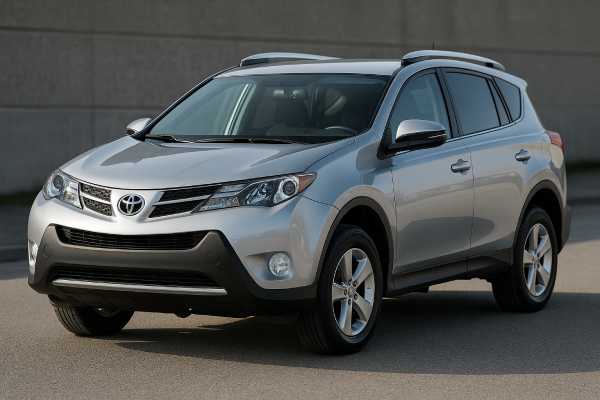
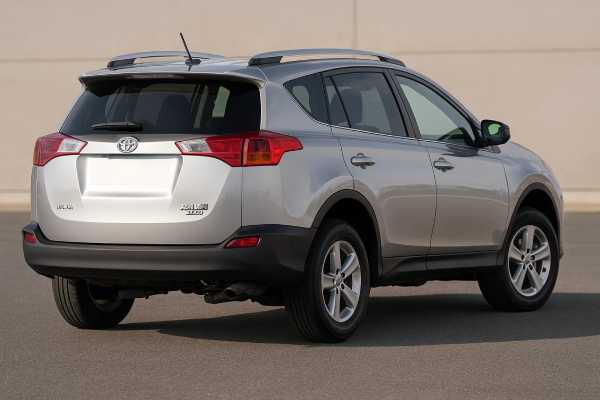
The fourth-generation Toyota RAV4 with all-wheel drive (2013–2015) pairs a familiar 2.5-liter 2AR-FE four-cylinder with a six-speed automatic and Toyota’s Dynamic Torque Control AWD. It arrived with a cleaner liftgate design, a more rigid structure, and a focus on space efficiency that vaulted cargo room near the top of the class. Owners value the consistent everyday economy, confident winter traction, and Toyota’s patient calibration of transmission logic for smooth commuting. Engineers traded the old V6 punch for lighter weight and better balance; what you get is steady, predictable acceleration, easy steering, and a cabin tuned for long-trip comfort. While advanced driver aids were limited in these years, the core safety structure tested well. Maintenance is straightforward, with long service intervals and widely available fluids. For shoppers prioritizing durability, cargo capacity, and low running costs—without wanting hybrid complexity—the 2013–2015 RAV4 AWD remains a sensible, proven choice.
At a Glance
- Strong space efficiency: 38.4 ft³ seats up, 73.4 ft³ seats down; flat load floor and low lift-over.
- Winter-ready traction: predictive torque transfer, 50:50 Lock mode to ~25 mph, stable manners.
- Easy ownership: 0W-20 oil, long-life coolant, 120k-mile iridium plugs; widely available parts.
- Caveat: watch for power back door/control module quirks on equipped trims and EPS recall completion.
- Typical service rhythm: engine oil and tire rotation every 10,000 miles / 12 months (5,000 miles severe).
Guide contents
- RAV4 AWD (XA40) in Detail
- Engine and Technical Specs
- Trims, Options, and Safety Tech
- Reliability and Known Issues
- Maintenance and Buying Advice
- Driving Impressions and Efficiency
- RAV4 vs Key Rivals
RAV4 AWD (XA40) in Detail
Toyota’s fourth-generation RAV4 reset the formula for this nameplate: no third row, no outside-hung spare, and no V6—choices that reduced weight, improved packaging, and made the car easier to live with in tight parking. The AWD variant adds Dynamic Torque Control, an electronically managed coupling at the rear that can send up to half the engine’s torque rearward before slip occurs. It blends signals for speed, steering angle, yaw rate, and throttle to anticipate traction needs rather than merely reacting. In “Lock,” it fixes a 50:50 split under about 25 mph to pull through snow, mud, or steep driveways, and returns to automatic operation at higher speed.
The 2AR-FE engine (176 hp) is an aluminum, chain-driven DOHC four-cylinder with dual VVT-i that prioritizes midrange torque and smooth idle. It works through a six-speed automatic with closely set lower ratios for step-off and a tall overdrive for quiet cruising. Toyota revised the body-in-white with extensive high-strength steel, and the suspension pairs MacPherson struts up front to a compact double-wishbone rear that preserves cargo room while controlling secondary motions. Electric power steering keeps effort light in parking and calm on-center at highway speeds.
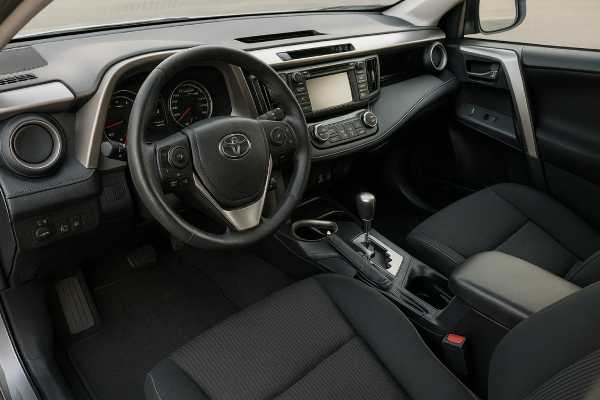
Inside, the driver-focused dash is simple, with clear blue illumination and physical controls for climate and audio. Practical touches—reclining rear seatbacks, a wide opening power liftgate on Limited, under-floor storage bins—underline the family brief. The RAV4 didn’t chase headline performance in these years; instead it targets repeatable results: consistent fuel economy, predictable winter behavior, strong resale, and minimal surprises at service time. For shoppers who value durability and convenience more than gadgets, it still hits the brief.
Engine and Technical Specs
Engine & Performance (ICE)
| Item | Specification |
|---|---|
| Code | 2AR-FE |
| Layout & cylinders | Inline-4, DOHC, Dual VVT-i, 4 valves/cyl |
| Bore × stroke | 90.0 × 98.0 mm (3.54 × 3.86 in) |
| Displacement | 2.5 L (2,494 cc) |
| Induction | Naturally aspirated |
| Fuel system | Sequential multi-port injection (SFI) |
| Compression ratio | ~10.4:1 |
| Max power | 176 hp (131 kW) @ 6,000 rpm |
| Max torque | 233 Nm (172 lb-ft) @ 4,100 rpm |
| Timing drive | Chain |
| Emissions/efficiency standard | EPA (U.S.) |
| EPA economy (AWD) | 22 mpg city / 29 mpg highway / 25 mpg combined (10.7 / 8.1 / 9.4 L/100 km) |
| Real-world highway @ 120 km/h (75 mph) | ~8.7–9.4 L/100 km (27–25 mpg US / 32–30 mpg UK) |
| Aerodynamics | Cd ~0.33; frontal area ~2.6 m² (28.0 ft²) |
Transmission & Driveline
| Item | Specification |
|---|---|
| Transmission | 6-speed automatic (ECT-i), U760F |
| Gear ratios | 1st 3.300 • 2nd 1.900 • 3rd 1.420 • 4th 1.000 • 5th 0.713 • 6th 0.608 • Rev 4.148 |
| Final drive ratio | 3.815 (AWD) |
| Drive type | Dynamic Torque Control AWD (front-biased, up to 50:50) |
| Differential | Open front/rear; electromagnetically controlled rear coupling |
| Replenishment | Refuel to full: ~3–5 min at pump |
Chassis & Dimensions
| Item | Specification |
|---|---|
| Suspension (front/rear) | MacPherson strut / double-wishbone |
| Steering | Electric rack-and-pinion (EPS) |
| Brakes (front/rear) | Ventilated disc ~296 mm (11.7 in) / solid disc ~281 mm (11.1 in) |
| Wheels/Tires | LE/XLE: 225/65 R17 • Limited: 235/55 R18 |
| Ground clearance | ~165 mm (6.5 in) |
| Length / Width / Height | ~179.9 in / 72.6 in / 65.4 in (4,570 / 1,844 / 1,661 mm) |
| Wheelbase | 104.7 in (2,660 mm) |
| Turning circle (curb-to-curb) | ~34.7 ft (10.6 m) |
| Curb weight (AWD) | ~1,600–1,640 kg (3,530–3,615 lb), by trim/equipment |
| GVWR | ~2,010 kg (≈4,435 lb) |
| Fuel tank | 60 L (15.9 US gal / 13.2 UK gal) |
| Cargo volume (SAE) | 1,088 L (38.4 ft³) seats up / 2,079 L (73.4 ft³) seats folded |
Performance & Capability
| Metric | Value |
|---|---|
| 0–60 mph / 0–100 km/h | ~8.8 s / ~9.2 s (AWD) |
| Top speed | ~180 km/h (112 mph), governed |
| 62–0 mph braking | ~39 m (≈128 ft), typical on all-season tires |
| Towing capacity | 680 kg (1,500 lb) braked |
| Payload | ~410–475 kg (900–1,050 lb), by build |
| Roof load (dynamic) | ~45 kg (100 lb), check crossbar rating |
Fluids & Service Capacities
| System | Spec / Capacity |
|---|---|
| Engine oil | 0W-20 API SN or later; ~4.4 L (4.6 qt) w/ filter |
| Coolant | Toyota Super Long Life (pink), 50/50; ~6.8 L (7.2 qt) total fill |
| ATF (U760F) | Toyota WS; ~3.3–3.7 L (3.5–3.9 qt) drain & fill; ~7.2–7.6 L (7.6–8.0 qt) overhaul |
| Rear differential | SAE 75W-90 GL-5; ~0.7 L (0.74 qt) |
| Transfer case | SAE 75W-90 GL-5; ~0.6 L (0.63 qt) |
| A/C refrigerant | R-134a; ~500 g (17.6 oz) |
| A/C compressor oil | ND-Oil 8 (PAG); ~120 mL (4.1 fl oz) |
| Essential torque values | Wheel nuts 103 Nm (76 lb-ft) • Oil drain 39 Nm (29 lb-ft) • Spark plugs ~18 Nm (13 lb-ft) |
Electrical
| Item | Specification |
|---|---|
| Alternator | ~100–130 A, by trim |
| 12V battery | Group 35 (approx 48–65 Ah, ~500 CCA) |
| Spark plugs | Iridium long-life; gap ~0.8 mm (0.031 in) |
Safety & Driver Assistance
| Area | Notes |
|---|---|
| Crash ratings | Structure and restraints test well; small-overlap driver less favorable in these years |
| Headlights | No IIHS headlight evaluation for 2013–2015 model years |
| ADAS availability | Blind Spot Monitor (BSM) with Rear Cross Traffic Alert (RCTA) and Lane Departure Alert (LDA) available on Limited (Tech Package); no AEB in this period |
| Child seats | LATCH anchors outboard rear; wide door opening and flat floor aid installation |
Trims, Options, and Safety Tech
Grades and driveline: The lineup is simple—LE, XLE, and Limited—with AWD optional on all. The mechanical hardware stays consistent (2.5-liter, six-speed auto, Dynamic Torque Control AWD), so you do not need a specific trim for snow-belt traction or tow rating. Lock mode and Sport/Eco drive logic are available across the board.
Quick identifiers:
- LE: 17-inch steel wheels with covers, fabric seats, manual HVAC, backup camera, Bluetooth audio/phone, simple gauge cluster.
- XLE: 17-inch alloys, dual-zone climate control, power moonroof, roof rails, fog lights, upgraded Entune Audio Plus.
- Limited: 18-inch alloys, SofTex-trimmed heated front seats, 8-way power driver seat with memory, Smart Key with push-button start, available power liftgate with memory height.
Option packages and features: The Technology Package (Limited) bundles Blind Spot Monitor with Rear Cross Traffic Alert, Lane Departure Alert, and Auto High Beam—useful additions for highway commuters. The power liftgate with memory height is available (standard on Limited, optional on XLE in later MY). Audio stacks scale from a 6.1-inch Entune touch unit to JBL Premium with Navigation (Limited), which improves microphone clarity and adds stronger amplification.
Year-to-year changes:
- 2013: Generation launch—major redesign, liftgate replaces swing door, increased cargo area, new Dynamic Torque Control AWD, six-speed automatic.
- 2014: Feature rationalization; backup camera and Bluetooth remain common; incremental infotainment updates.
- 2015: Cosmetic tweaks, wheel designs, and the Limited’s Technology Package expands active features (BSM/RCTA/LDA/AHB). If you want the broadest safety feature set without moving to a newer generation, target 2015 Limited with Tech Package.
Safety ratings and child-seat notes: The structure earns strong results in moderate overlap, side impact, roof strength, and head restraint tests. Small-overlap (driver-side) performance is a relative weak spot for the period. There was no factory automatic emergency braking in these years, so there’s no IIHS front-crash-prevention score to boost overall ratings. Families will appreciate the low cargo floor and wide tailgate opening; two child seats fit easily in the outboard positions, and the flat cushion base helps minimize tilt with LATCH. Always verify that the top tether anchors are accessible with your preferred seat backs reclined.
Towing and wheels/tires: U.S. rating remains 1,500 lb (680 kg) regardless of trim. The gearing and brakes are the same across grades, so differences in feel mostly trace to tire packages: 17-inch all-seasons ride softer and are quieter; 18-inch Limited tires add initial steering response but transmit a touch more chop on broken pavement.
Reliability and Known Issues
Overall durability is a core RAV4 strength. The 2AR-FE engine uses a chain-driven cam, wide bearing surfaces, and conservative ignition timing for long life on regular 87-octane fuel. Still, a few items deserve a close look:
Common to occasional (low to medium cost):
- Water pump seep/leak: A faint pink/white crust at the pump weep hole or dried coolant on the lower splash shield often shows up around 60k–120k miles. Symptom → cause → action: intermittent squeak or coolant odor → mechanical seal wear → replace pump and re-torque housing bolts; refill and bleed with SLLC.
- EVAP purge or vent valve faults: Rough hot starts or tank refueling stalls; EVAP codes (e.g., P0441/P0455). Cause: sticking purge valve or saturated canister. Action: smoke test, confirm valve operation, replace components and clear DTCs.
- Blower motor or cabin filter neglect: Reduced airflow and evaporator odor. Action: new cabin filter (15k–20k mi intervals), clean drain, inspect blower brushes.
Transmission and AWD (occasional):
- U760F shift flare/harshness after battery disconnect or repair: Cause: adaptive tables lost or clutch learn out of range. Action: perform line-pressure/shift adapts with a capable scan tool; if fluid is dark, complete a drain-and-fill with Toyota WS and retest.
- Rear differential/prop-shaft noise under load: Cause: aged gear oil or slight coupling chatter. Action: replace transfer/differential oils with GL-5 75W-90; verify tires match (brand/size/tread depth) to minimize coupling slip heat.
- AWD coupling overheat in deep sand/mud: Cause: extended slip on street all-seasons. Action: cool-down, consider all-terrain tires if frequent soft-surface use.
Body/electrical (occasional):
- Power back door module behavior (equipped): Erratic stop/reverse or inoperative after obstruction. Action: recalibration via switch sequence; if recurrent, updated liftgate ECU on later bulletins; verify smooth strut operation and harness integrity at hinge.
- Wind noise at A-pillar/mirror: Action: door seal seating and mirror triangle foam pads; minor alignment helps.
Recalls and service actions to verify by VIN:
- Electric Power Steering (EPS) ECU recall (certain 2014–2015): Potential loss of assist due to ECU circuit board damage. Symptom: sudden heavy steering effort at low speeds; Remedy: ECU inspection/replacement.
- Always run an official VIN recall check and ask for dealer documentation showing completion (owner letter, RO with campaign code).
Pre-purchase checklist:
- Cold start, warm idle, and a full-throttle uphill pass to evaluate torque converter lock/unlock and 4–5–6 shift quality.
- Straight-line brake test from ~45 mph; verify no pull or ABS chatter on a smooth surface.
- AWD Lock engagement on loose gravel at low speed; check for clunks from the rear coupling.
- Power liftgate operation at multiple heights; confirm the memory stop works and the seals aren’t binding.
- Underbody corrosion at subframe mounts and rear suspension arms; inspect exhaust hangers and heat shields for rattles.
- Tire matching (brand/size/tread) on AWD to protect the coupling.
Maintenance and Buying Advice
Practical maintenance schedule (time/distance):
- Engine oil & filter: 0W-20 every 10,000 miles / 12 months (short-trip/severe: 5,000 miles / 6 months).
- Tire rotation & pressure check: every 5,000–6,000 miles; keep all four within 2/32 in tread on AWD.
- Engine air filter: inspect 15k, replace 30k miles (dusty regions sooner).
- Cabin filter: 15k–20k miles or annually.
- Coolant (SLLC): first at 100,000 miles / 10 years, then 50,000 miles / 5 years.
- Spark plugs (iridium): 120,000 miles; confirm gap on install.
- Serpentine belt & hoses: inspect 60k miles; replace if cracked/noisy by 90k–100k.
- ATF (WS): inspect condition; a 60k–90k drain-and-fill supports shift quality, especially with towing/hills.
- Rear diff & transfer case oils: 60k–75k miles service interval keeps the AWD coupling happy.
- Brake fluid: replace every 3 years; brake inspection at each tire rotation.
- Alignment: check annually or after pothole/curb hits; toe settings matter for tire life.
- 12V battery testing: yearly after year 3; typical replacement window 4–6 years.
Fluid quick-reference (decision-making):
- Oil: 0W-20 synthetic meeting API SN or later; ~4.6 qt with filter.
- ATF: Toyota WS only; verify temperature-based fill procedure.
- Gear oils: GL-5 75W-90 in both transfer and rear differential.
- Coolant: Toyota SLLC (pink) premix 50/50.
Essential torque values (frequently touched):
- Wheel nuts 103 Nm (76 lb-ft); oil drain 39 Nm (29 lb-ft); spark plugs ~18 Nm (13 lb-ft); front caliper pin bolts ~34 Nm (25 lb-ft) (verify by VIN).
Buyer’s guide—what to seek/avoid:
- Best value: 2015 XLE AWD for features per dollar, or Limited AWD with Technology Package if you want BSM/RCTA/LDA/AHB and a power liftgate.
- What to verify: EPS recall completion on 2014–2015, even tire wear on AWD, clean liftgate harness routing, and no water pump crust.
- Corrosion watch: wheel hubs, rear suspension arms, and exhaust clamps in salt states; surface rust is common but should not affect structure.
- Tires: prioritize high-quality all-seasons with a snow rating or true winters if you regularly use Lock mode—this protects the coupling and shortens stopping distances.
Long-term outlook: With timely fluids and gentle warm-ups, the 2AR-FE/U760F pairing frequently exceeds 200,000 miles with original internals. The chassis consumables—struts, bushings, wheel bearings—typically age gracefully and are widely available at reasonable cost.
Driving Impressions and Efficiency
Ride and handling: The XA40’s tuning favors calm responses. On city streets, ride motions are short and well-controlled; big hits are heard more than felt with 18-inch wheels, so 17-inch tires are the quietest choice. Highway stability is a strong point: the RAV4 tracks straight with a reassuring on-center, and crosswinds nudge but don’t unsettle it. The double-wishbone rear helps keep the body settled over undulating pavement, and mid-corner bumps don’t kick the tail. Steering is light at low speed and gains modest weight in Sport mode; feedback is filtered but predictable.
Powertrain character: Throttle mapping is gentle in Eco and more alert in Sport. The six-speed’s low gears make for clean step-offs in traffic; 3rd–4th and 5th–6th shifts are unobtrusive under part throttle. Kickdowns are prompt when passing, with a small flare that’s normal for this calibration. On grades, the transmission will hold gears rather than hunt; Sport also tweaks torque split to quell understeer on turn-in. NVH is subdued up to ~4,000 rpm; beyond that the 2.5-liter’s growl enters the cabin, but it’s brief during everyday driving.
Real-world efficiency: Expect about 22–23 mpg city, 28–30 mpg highway, and 24–26 mpg mixed on AWD depending on climate, tires, and traffic (≈ 10.7 / 8.0–7.8 / 9.8–9.0 L/100 km). At a steady 75 mph (120 km/h), many owners report ~27 mpg US (~8.7 L/100 km) on 17-inch tires. Winter blends, remote starts, and roof boxes can trim 2–4 mpg; conversely, careful driving at 60–65 mph can push highway figures past 30 mpg. Keep tires at door-jamb pressures and replace cabin filters on time—both measurably affect economy.
Braking and control: Pedal travel is linear with consistent bite; repeated highway-to-surface-street transitions don’t induce fade when rotors and pads are healthy. Stability control is conservative on split-mu surfaces but allows enough wheel-speed difference to pull through plowed ridges. The AWD Lock helps you start on an icy incline but isn’t a substitute for snow-rated tires; with proper rubber, traction and stopping distances improve dramatically.
Towing and load: The platform is comfortable pulling a 1,000–1,500 lb small trailer with surge brakes over rolling terrain. Watch ATF temperatures on long grades by moderating speed and selecting S mode to hold lower gears. Fuel economy penalties with a full family and gear run +10–20% in mixed driving; with a lightly loaded 4×8 utility trailer at 65 mph, expect +20–30%.
RAV4 vs Key Rivals
Honda CR-V (2013–2015): The CR-V counters with standout space and efficiency; 2015+ models gain a CVT that delivers excellent highway economy but can drone under load. Ride comfort is similar, and steering is slightly lighter. Honda added more driver aids earlier in the cycle, but some owners reported idle vibration and early transmission shudder on specific years. If you prefer a conventional geared automatic and steadier highway rpm, the RAV4 has the edge.
Subaru Forester (2014–2015): Standard AWD and 8.7-inch ground clearance give the Forester clear traction and clearance advantages. Its CVT is refined, and visibility is exceptional, but cabin noise is a touch higher and cargo floor not as flat when folded. The turbocharged 2.0XT is quicker than the RAV4 but demands premium fuel and more maintenance attention.
Mazda CX-5 (2013–2015): The driver’s choice: more steering feel and body control, with the 2.5-liter providing better punch than its 2.0. Interior space and cargo volume are tighter than the RAV4, and road noise can be higher on coarse pavement. If you want the sportiest dynamics, choose CX-5; if you need max cargo and a softer long-trip demeanor, pick RAV4.
Ford Escape (2013–2015): Turbo 1.6/2.0 EcoBoost engines out-accelerate the RAV4 and tow more, and the cabin is quiet. Reliability swings more widely; cooling and carbon buildup issues can offset performance benefits. The RAV4 typically costs less to keep on the road over a long horizon.
Hyundai Tucson/Kia Sportage (2014–2015): Attractive value and long warranties, with firmer ride tuning and smaller cargo holds in these years. Later redesigns closed the gap, but for 2013–2015 the Toyota’s space and resale are stronger.
Bottom line: Choose the 2013–2015 RAV4 AWD for space efficiency, predictable winter traction, and low running costs. If you need max driver aids or a quieter small-overlap result, consider moving to later years—or cross-shop CX-5 for handling or Forester for clearance.
References
- 2015 Toyota RAV4 Marks Two Decades as a Small SUV Pioneer 2014 (Product Information)
- 2013 Toyota RAV4 Product Information 2012 (Product Information)
- Gas Mileage of 2015 Toyota RAV4 2015 (Fuel Economy Database)
- 2015 Toyota RAV4 2015 (Safety Rating)
- Part 573 Safety Recall Report 15V-144 2015 (Recall Report)
Disclaimer
This article is for informational purposes and is not a substitute for professional diagnosis or repair. Specifications, torque values, fluid types, and service intervals can vary by VIN, model year, market, and installed equipment. Always verify procedures and values against your vehicle’s official owner’s manual, service manual, and technical bulletins.
If you found this guide useful, please share it with fellow owners on Facebook or X/Twitter to support xcar’s work.