
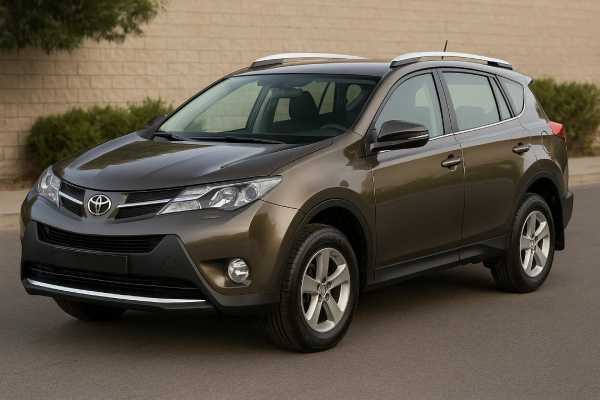
The fourth-generation Toyota RAV4 with the 2AD-FTV 2.2-litre D-4D diesel and all-wheel drive targets owners who want family practicality with long-distance economy and confident traction. Built on the XA40 platform, this model brought a bigger cabin, a quieter ride, and Toyota’s “Dynamic Torque Control” AWD that runs front-drive in steady cruising and seamlessly sends drive rearward when needed. The 150-hp diesel is tuned for real-world torque and relaxed motorway speeds, while a 6-speed manual or 6-speed automatic broadens use cases from commuting to towing. Day-to-day, the RAV4’s upright seating, wide cargo bay, and straightforward controls are the main wins. Long-term, owners value Toyota’s durable driveline and simple maintenance regime, yet diesel-specific items—EGR, DPF, and dual-mass flywheel—deserve attention as the miles add up. If you want a compact SUV that feels unburdened by tech fads and still covers ground efficiently in poor weather, this AWD 2.2 D-4D is worth short-listing.
Fast Facts
- Strong motorway pull: ~340 Nm (251 lb-ft) mid-range torque and stable high-speed manners.
- Useful utility: 60 L tank, up to ~2,000 kg (4,409 lb) braked towing when properly equipped.
- Winter-friendly: Dynamic Torque Control AWD and available heated features improve foul-weather confidence.
- Diesel caveat: Keep EGR/DPF clean with regular motorway runs; use low-SAPS oil to protect the DPF.
- Typical service touchpoint: Oil and filter every 15,000 km / 12 months (whichever comes first).
Explore the sections
- RAV4 2.2 D-4D overview
- Specifications and technical data
- Trims, options and safety tech
- Reliability and known issues
- Maintenance and buyer’s guide
- Driving and performance
- RAV4 vs rivals (2013–2015)
RAV4 2.2 D-4D overview
The XA40-series RAV4 grew up in 2013: more wheelbase and rear legroom, a larger cargo bay with a low lift-over, and a more refined suspension tune. The 2AD-FTV common-rail diesel (150 hp) is the sweet spot for European buyers who value range and towing. Peak torque arrives early, so the car steps away cleanly with light throttle and keeps pace on gradients without frequent downshifts. Toyota’s Dynamic Torque Control AWD runs primarily as FWD to save fuel; sensors pre-empt slip and can feed up to 50% torque rearward through an electronically controlled coupling. A lock function helps in deep snow or gravel at low speeds.
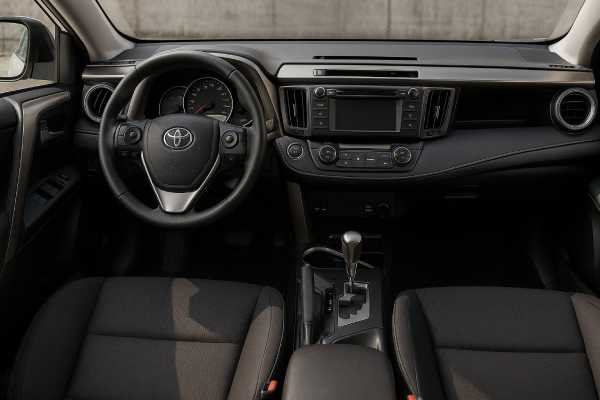
Cabin design emphasizes clarity: large analogue dials, physical HVAC knobs, and a straightforward infotainment stack. You sit upright with good outward visibility. The rear bench folds nearly flat (60:40), allowing easy loading of bikes and flat-pack furniture. NVH improvements over the prior generation are obvious: diesel clatter is better isolated at idle, and wind noise is subdued at motorway pace.
Two transmissions were offered: a 6-speed manual with a light, progressive clutch and a 6-speed torque-converter automatic geared for low-rpm cruising. Properly equipped, the 2.2-litre AWD variant tows confidently up to the rated limit and maintains coolant and ATF temperatures well when driven sensibly. Braking is predictable with a solid middle pedal; hill-descent behaviour is stable thanks to well-tuned ABS/ESP.
For safety, the platform scored strongly in independent tests at launch. Available driver aids varied by trim and year; the essentials—stability control, multiple airbags, ISOFIX/LATCH points—are standard, with options like lane alerts and blind-spot monitoring appearing in later model-year packs. Overall, this is a practical, efficient, and confidence-inspiring family SUV that rewards regular long drives and diligent diesel care.
Specifications and technical data
Engine and Performance (2AD-FTV, 2013–2015)
| Item | Detail |
|---|---|
| Code | 2AD-FTV (D-4D) |
| Layout & cylinders | Inline-4, DOHC, 16-valve |
| Displacement | 2.2 L (2,231 cc) |
| Induction | Turbocharged, intercooler |
| Fuel system | Common-rail direct injection |
| Compression ratio | 15.6:1 (typical for this tune) |
| Max power | 150 hp (112 kW) @ ~3,600 rpm |
| Max torque | ~340 Nm (251 lb-ft) @ ~2,000 rpm |
| Timing drive | Chain |
| Emissions standard | Euro 5 (DPF equipped) |
| Official combined economy | ~6.0 L/100 km (≈39.2 mpg US / 47.1 mpg UK) |
| Real-world highway @ 120 km/h | ~6.5–7.0 L/100 km (≈36–34 mpg US / 43–41 mpg UK) |
| Aerodynamics | Cd ≈ 0.33 |
Transmission and Driveline
| Item | Detail |
|---|---|
| Transmission | 6-speed manual or 6-speed automatic |
| Drive type | Dynamic Torque Control AWD (on-demand) |
| Center coupling | Electronically controlled multi-plate clutch |
| Differential | Open front/rear; brake-based torque vectoring via stability control |
| Final drive (typical) | ~3.9–4.1 (varies by gearbox) |
| Lock function | Low-speed AWD lock (up to ~40 km/h) |
Chassis and Dimensions
| Item | Detail |
|---|---|
| Platform | XA40 |
| Front / rear suspension | MacPherson strut / double-wishbone |
| Steering | Electric power steering; approx. 2.8–3.0 turns lock-to-lock |
| Brakes | Vented front discs (~296 mm) / solid rear discs (~281 mm) |
| Wheels/tyres | 225/65 R17 or 235/55 R18 (market/trim dependent) |
| Ground clearance | ~187 mm (7.4 in) |
| Length / width / height | ~4,570 / 1,845 / 1,660 mm (179.9 / 72.6 / 65.4 in) |
| Wheelbase | 2,660 mm (104.7 in) |
| Turning circle (kerb-to-kerb) | ~10.6 m (34.8 ft) |
| Curb weight | ~1,650–1,715 kg (3,638–3,780 lb), by spec |
| GVWR | ~2,180–2,250 kg (4,806–4,960 lb) |
| Fuel tank | 60 L (15.9 US gal / 13.2 UK gal) |
| Cargo volume | ~547 L seats up / ~1,746 L seats down (VDA) |
Performance and Capability
| Item | Detail |
|---|---|
| 0–100 km/h (0–62 mph) | ~9.6–10.0 s (manual quicker) |
| Top speed | ~185–190 km/h (115–118 mph) |
| Braking 100–0 km/h | ~38–40 m (typical for class/tyre) |
| Towing capacity (braked) | Up to ~2,000 kg (4,409 lb) when properly equipped |
| Unbraked towing | ~750 kg (1,653 lb) |
| Roof load | ~80 kg (176 lb) including rack/crossbars |
Fluids and Service Capacities
| System | Specification | Capacity |
|---|---|---|
| Engine oil | ACEA C2 low-SAPS; typical 0W-30 or 5W-30 meeting Toyota spec | ~5.9–6.3 L (6.2–6.7 qt US) with filter |
| Coolant | Toyota Super Long Life Coolant (pink), 50/50 | ~7–8 L (7.4–8.5 qt US) total system |
| Manual gearbox | GL-4/GL-5 per Toyota spec | ~2.0–2.3 L (2.1–2.4 qt US) |
| Automatic (6-AT) | Toyota WS ATF | Drain-fill ~3.5–4.0 L; total ~6–7 L |
| Rear differential | 75W-85 / 75W-90 per spec | ~0.8–1.0 L |
| Transfer case | Gear oil per spec | ~0.6–0.8 L |
| A/C refrigerant | R-134a | ~500–550 g (17.6–19.4 oz) |
| A/C compressor oil | ND-Oil 8 (PAG) | ~100 mL (3.4 fl oz) |
| Key torque values | Wheel nuts ~103 Nm (76 lb-ft); sump plug ~40 Nm (30 lb-ft); oil-filter cap (cartridge) ~25 Nm (18 lb-ft) |
Electrical
| Item | Detail |
|---|---|
| Alternator | ~130–150 A (variant dependent) |
| 12 V battery | ~70–80 Ah (DIN), 700+ CCA; H7/94R form factor common |
| Glow plugs | Ceramic/metal type per engine build; service when fault-coded |
Safety and Driver Assistance
| Area | Detail |
|---|---|
| Crash ratings | Strong 5-star performance in period tests; robust occupant protection |
| Headlights | Halogen projectors standard; HID/LED availability varies by trim; headlight test results vary with fitment |
| Airbags | Front, side, curtain, driver’s knee (fitment by market/trim) |
| Child seats | ISOFIX/LATCH outer rear seats; top tether mounts |
| ADAS suite (availability) | Stability control, hill-start assist; options/packs may add lane alerts, blind-spot monitoring, rear cross-traffic alert, and simple AEB on later MY packages |
Notes: Exact capacities, ratings, and ADAS availability vary by year, gearbox, and local homologation. Always confirm by VIN.
Trims, options and safety tech
Toyota packaged the AWD 2.2 D-4D across family-oriented grades, typically mirroring “Active/Business,” “Icon,” and “Invincible/Style” style names in key European markets. Mechanical hardware stayed consistent—2AD-FTV diesel, on-demand AWD, and either 6-MT or 6-AT—while equipment and styling cues escalated.
Trim highlights (typical examples by market):
- Entry/Active: 17-inch alloys, manual air-con or dual-zone climate (market-dependent), cruise control, reversing camera, fabric upholstery, 60:40 folding rear bench, roof rails.
- Mid/Icon: 17- or 18-inch wheels, privacy glass, touchscreen with navigation option, leather-trimmed steering wheel/shift knob, front parking sensors.
- Top/Invincible/Style: 18-inch wheels, smart entry and push-button start, power tailgate, partial or full leather seats (heated front), sunroof or panoramic roof option, power driver’s seat, enhanced audio, and additional safety packs.
Quick identifiers:
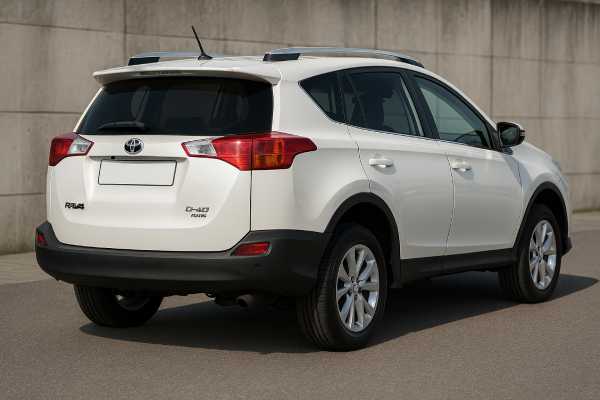
- Look for “D-4D” badging on the tailgate and an AWD emblem. 18-inch wheels and silver exterior trims typically denote upper grades. Inside, an instrument cluster with color MID and seat heating buttons near the shifter often indicate higher trims. VIN/build plate confirms engine code 2AD-FTV and drivetrain.
Year-to-year changes (2013–2015):
- 2013: Launch specification; AWD standard with the 2.2-litre diesel; manual and automatic offered by market.
- 2014: Package reshuffles and infotainment updates; availability of additional safety content in option packs increased in many countries.
- 2015: Late-cycle enhancements to multimedia and convenience items; cosmetic tweaks (wheels/trims) ahead of the 2016 facelift.
Safety ratings and systems:
Independent testing at introduction yielded a five-star result with strong adult and child occupant scores. Standard fit includes stability control, traction control, ABS with EBD, and multiple airbags; ISOFIX anchors are easy to access. Depending on trim and year, you may find lane departure alerts, blind-spot monitoring, and rear cross-traffic alert bundled in Technology/Safety packs. After collision or windscreen work, radar/camera alignment (where fitted) must be calibrated with the proper targets and scan tools.
Calibration and service implications:
- Vehicles with lane or camera-based alerts require ADAS calibration after windscreen replacement or camera removal.
- Automatic models may need TCM software updates to optimize shift timing and reduce harshness.
- Headlight performance depends heavily on lamp type and alignment; check aim during inspection.
Reliability and known issues
The 2AD-FTV diesel and XA40 chassis are generally robust when maintained correctly and driven regularly at operating temperature. The most common issues cluster around diesel emissions hardware and service neglect rather than core engine failure.
Common (watch early)
- EGR/Intake soot build-up → Symptoms: rough idle, hesitation, elevated fuel use; usually urban usage. Remedy: Clean EGR valve and intake tract; apply updated gaskets; use quality fuel and periodic motorway runs.
- DPF loading/regeneration frequency → Symptoms: frequent regens, warning lamp; short-trip driving. Remedy: Force regeneration and investigate upstream faults (EGR sticking, boost leaks, low-pressure EGR sensor). Keep ash low via correct low-SAPS oil.
- Dual-mass flywheel (DMF) wear (manual) → Symptoms: rattle at idle/shutdown, clutch judder. Remedy: Replace DMF and clutch kit; inspect rear main seal and gearbox input bearing while out.
Occasional
- Water pump weep → Pink crust or slow coolant loss around pump. Remedy: Replace pump and gasket; use genuine SLLC coolant; torque fasteners in sequence.
- Turbo actuator / boost control issues → Loss of power, over/under-boost codes. Remedy: Check vacuum lines/N75-equivalent valve, VNT mechanism movement; recalibrate actuator after repair.
- Injector sealing washers → Combustion blow-by (black death) on high-milers. Remedy: Remove injectors, clean seats with the correct reamer, fit new washers/bolts to spec.
- Rear wheel bearings → Growl increasing with road speed. Remedy: Replace hub/bearing assembly; torque axle nut precisely.
Rare but high-impact
- Head gasket failure (widespread on early 2ADs pre-2010; much rarer by XA40) → White smoke, pressurized coolant, misfire on cold start. Remedy: Pressure test, sniff test, borescope; if confirmed, machine head and fit updated gasket/bolts; flush EGR cooler.
- AWD coupling failure → Persistent FWD-only behaviour or driveline noise. Remedy: Diagnose coupling and rear diff; change fluids and check wiring/grounds before replacing the unit.
Software/TSB-type updates you may encounter
- Engine ECU calibrations to refine DPF regeneration logic and idle quality.
- Transmission (U660F) updates to improve 2–3 and 3–4 shift quality.
- Multimedia updates for Bluetooth/USB stability.
Recalls and service actions (typical for the period)
- Selected campaigns addressed seatbelt routing/anchorage and wiper motor concerns on certain VIN ranges; completion is verifiable via official VIN portals and dealer records.
- Market-specific emissions or airbag inflator actions may apply; always run a VIN check before purchase.
Pre-purchase requests
- Full service history with oil changes at ≤15,000 km/12 months and proof of DPF-compatible oil.
- Evidence of timely fuel-filter changes and coolant/Brake fluid renewals.
- Confirmation of recall completion and any ECU/TCM updates.
- For manuals: clutch/DMF replacement history after ~150–200k km; for automatics: ATF service history.
Maintenance and buyer’s guide
Practical maintenance plan (baseline; confirm by VIN/market)
- Engine oil and filter: Every 15,000 km / 12 months with ACEA C2 low-SAPS oil (0W-30 or 5W-30 as approved). Inspect for leaks at the cam cover and oil cooler.
- Fuel filter: Replace every 45,000–60,000 km / 3–4 years depending on fuel quality and climate. Prime the system correctly to avoid hard starts.
- Engine air filter: Inspect each 15,000 km; replace 30,000–45,000 km or sooner in dusty use.
- Cabin filter: Replace 12 months; more often with urban pollen/soot.
- Coolant (SLLC pink): First change around 160,000 km / 10 years, then 80,000 km / 5 years; check concentration and pH at each service.
- Serpentine/aux belt and pulleys: Inspect each service; replace 120,000–150,000 km or at first noise.
- Glow plugs: Test when cold-start performance degrades or after related DTCs; replace in sets to keep resistances matched.
- Manual gearbox oil: Inspect at 90,000 km; refresh by 120,000–150,000 km if shift feel degrades.
- Automatic (6-AT) ATF WS: Condition-based; drain-and-fill at 90,000–120,000 km if towing or urban use is frequent; always perform level-set procedure at temperature.
- Rear diff & transfer case oil: Replace 90,000–120,000 km; severe use earlier.
- Brake fluid: Replace 24 months; check slider pins for corrosion.
- Brake pads/rotors: Inspect every service; RAV4s often show rear pad wear first.
- Tyres: Rotate 10,000–12,000 km; keep all four within 2 mm tread depth to protect the AWD clutch.
- Wheel alignment: Check annually or after pothole impacts; uneven rear-tyre wear often points to toe change.
- 12 V battery: Test annually after year 4; typical replacement window 5–7 years.
- DPF health: If most trips are short, schedule an occasional 30–40 minute motorway run at steady speed to support passive regeneration.
Essential fluid specs and quick torques
- Engine oil: ACEA C2; typical fill ~6.0 L with filter.
- Coolant: Toyota Super Long Life Coolant (pink) 50/50.
- ATF: Toyota WS; level-set at temp with overflow tube method.
- Differential & transfer: 75W-85 / 75W-90 per Toyota spec.
- Wheel nuts: ~103 Nm (76 lb-ft).
- Fuel filter head: Re-prime per manual; avoid over-torque on banjo fittings.
Buyer’s checklist
- Cold start from overnight: listen for DMF rattle; check smoke and idle stability.
- DPF history: Ask for ash load readings (scan tool) and note regeneration frequency on a long test.
- AWD function: On loose gravel or wet grass, confirm rear drive engagement; no binding in tight turns.
- Cooling system: Look for pink residue around the water pump and radiator end tanks.
- Underbody: Inspect rear subframe, brake lines, and seam sealer for corrosion; check tow-bar wiring quality if fitted.
- Electrics: Verify power tailgate and camera operation; inspect headlight clarity/aim.
- Service records: Prioritize cars with regular oil/fuel-filter services, diff/transfer oil changes, and documented software updates.
Durability outlook
With correct oil, timely filter changes, and periodic high-speed drives to keep the DPF healthy, the 2.2 D-4D AWD RAV4 routinely surpasses 250,000–300,000 km with original major components. Expect routine suspension refreshes (bushes/bearings) after ~150–200k km and clutch/DMF replacements on manuals in that window.
Driving and performance
Ride and handling: The XA40’s longer wheelbase calms secondary motions on rough B-roads and motorways. The double-wishbone rear keeps the back axle planted over mid-corner bumps, and body roll is controlled without being harsh. Steering is light at parking speeds and gains natural weight as speed rises. Straight-line stability is excellent; crosswinds are handled with small inputs.
Powertrain character: The 2AD-FTV’s best asset is mid-range thrust. From 1,700 to 3,000 rpm, overtakes are easy and inclines are dispatched without drama. The manual has a longish 6th for economy; keep it in 5th on rolling A-roads. The 6-AT is smooth and decisive once warm; in hilly country, “S” mode holds gears longer to keep the turbo on-song. NVH is well managed: once cruising, you hear more road than engine.
Efficiency: In mixed use, owners commonly see 6.0–6.8 L/100 km (39–35 mpg US; 47–41 mpg UK). Urban-heavy use or short trips push it higher; long steady runs can dip into the fives. Winter with short cycles and active regens can add +0.5–1.0 L/100 km; fitting quality winter tyres and maintaining pressures helps.
Braking and control: Pedal feel is reassuring with good initial bite; repeated stops remain consistent provided discs and pads are quality parts. Stability control is unobtrusive and brake-based torque vectoring quietly trims understeer. On snowy starts, the AWD pre-engages the rear axle; with the low-speed lock active, the car pulls away predictably without wheelspin theatrics.
Towing & load: With a braked limit up to ~2,000 kg, the RAV4 handles small caravans or trailers capably. Use a quality tow-bar with proper cooling airflow, observe tongue-weight limits, and factor a +20–35% fuel-use penalty when towing at motorway speeds. Downhill braking remains stable; downshift proactively on long descents to protect the brakes.
RAV4 vs rivals (2013–2015)
RAV4 2.2 D-4D AWD vs Nissan Qashqai 1.6 dCi AWD
The Toyota is larger inside, rides more quietly at speed, and tows more. The Qashqai counters with lower running costs and a lighter feel in town, but rear legroom and boot space favour the RAV4.
RAV4 vs Honda CR-V 1.6/2.2 i-DTEC AWD
Honda’s seats and cabin ergonomics are excellent, and the 1.6 diesel is frugal. The Toyota’s AWD reacts more proactively on loose surfaces and the 2.2’s mid-range torque is stronger for towing. Toyota’s infotainment of the era lags Honda’s top-spec systems.
RAV4 vs Mazda CX-5 2.2 Skyactiv-D AWD
Mazda’s steering feedback and cornering balance are class-leading, and its 2.2 diesel is smooth. The Toyota answers with simpler controls, typically lower NVH on motorways, and broader dealer coverage. For frequent towing, the RAV4’s torque delivery and thermal management inspire confidence.
RAV4 vs Ford Kuga 2.0 TDCi AWD
Kuga’s chassis is more playful, and cabin tech can feel a generation newer. The RAV4 wins on boot size, ease of maintenance, and long-distance comfort. Ownership reports often credit Toyota with fewer niggles over time.
Bottom line: If your priorities are space, traction, and long-term dependability—plus strong towing for the class—the 2.2 D-4D AWD RAV4 remains a balanced choice. Choose the manual for maximum control and efficiency, the automatic for relaxed commuting and urban convenience.
References
- 2013 RAV4 Press Kit 2013 (Press Kit)
- Toyota RAV4 2013 2013 (Safety Rating)
- Even Better For 2014: Toyota RAV4 Range Expanded 2014 (Media Release)
- RAV4 Owner’s Manual (OM42873E) 2013 (Owner’s Manual)
Disclaimer
This guide is for informational purposes only and is not a substitute for professional diagnosis or repair. Specifications, torque values, service intervals, and procedures vary by VIN, market, model year, and equipment. Always verify details against your vehicle’s official service documentation and follow manufacturer safety procedures.
If you found this helpful, please consider sharing it on Facebook or X/Twitter to support xcar’s work.