
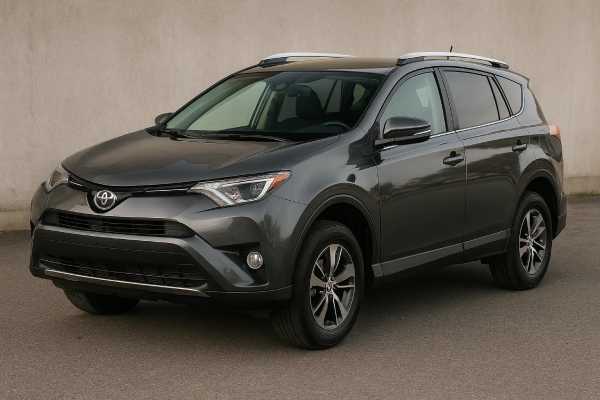
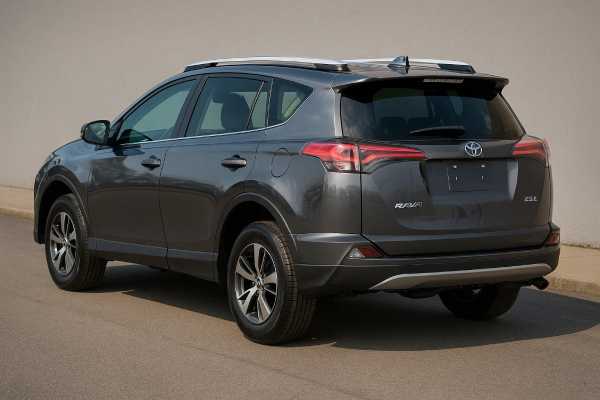
The facelifted fourth-generation Toyota RAV4 (model years 2015½–2018 in North America) pairs a proven 2.5-liter 2AR-FE four-cylinder with a 6-speed automatic and front-wheel drive. It became one of the segment’s most balanced daily drivers: roomy cargo bay, sensible running costs, and broad standard safety tech late in the run. The mid-cycle update sharpened the styling, added the SE trim with firmer suspension tuning and 18-inch wheels, and—most importantly—rolled out Toyota Safety Sense features widely across the range. Owners prize its straightforward mechanicals, consistent real-world economy, and high resale value. While not the quickest in class, the RAV4’s powertrain is durable and easy to service, and the cabin packaging is among the class leaders for family duty. If you want a compact SUV that simply works—without drama—the 2015–2018 FWD RAV4 deserves a close look.
Fast Facts
- Spacious and versatile: ~38.4 ft³ (1,088 L) seats up; ~73.4 ft³ (2,079 L) seats down.
- Predictable handling and comfortable ride; SE trim tightens body control.
- Strong ownership value: long-lived 2AR-FE engine and simple 6-speed automatic.
- Watch for: aging water pumps and occasional torque-converter shudder at higher mileages.
- Typical interval: 0W-20 oil every 10,000 miles / 12 months (5,000 miles if severe use).
Guide contents
- RAV4 2.5 FWD Overview
- RAV4 2.5 Specs and Data
- RAV4 Trims and Safety
- Reliability and Service Actions
- Maintenance and Buyer’s Guide
- Driving and Performance
- RAV4 Versus Rivals
RAV4 2.5 FWD Overview
Toyota’s fourth-gen RAV4 hit its stride after the 2015 refresh, running through the 2018 model year with crisper styling, more sound insulation, and broader active-safety availability. Under the hood sits the 2AR-FE, a naturally aspirated 2.5-liter aluminum inline-four with dual VVT-i on intake and exhaust cams. It is paired with the U760E six-speed automatic driving the front wheels. This setup emphasizes long-term reliability and consistent drivability rather than headline acceleration.
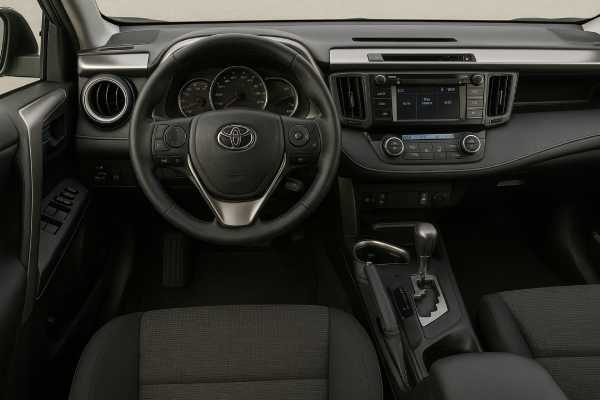
Practicality is the headline: a low liftover height, wide cargo opening, and flat load floor boost daily convenience. Rear seats recline and fold nearly flat, and the cabin’s squared-off roofline maximizes headroom. Ergonomics are simple—traditional gauge cluster, clear HVAC controls, and durable fabrics or SofTex upholstery depending on trim. The SE adds a slightly firmer ride, sport seats, and paddles without compromising comfort.
The mid-cycle update also brought meaningful noise, vibration, and harshness (NVH) improvements. Additional floor pan insulation, thicker door glass on select trims, and revised engine mounts give the RAV4 a calmer highway demeanor compared with early XA40 builds. Steering is electric-assist with a relaxed on-center feel; it favors stability over razor-sharp response, which most family buyers prefer.
Safety tech is a standout late in the run. Toyota Safety Sense P (pre-collision with pedestrian detection, lane departure alert with steering assist, automatic high beams, and adaptive cruise) became standard on all trims for 2017, a year or two before many rivals matched that breadth. Crash safety performance is strong for the class when equipped with the proper headlights and front-crash-prevention system.
If you’re shopping the 2015–2018 FWD RAV4, the value proposition is clear: predictable costs, simple maintenance, respectable fuel economy for a non-turbo crossover, and excellent cargo space. The trade-offs are modest—straight-line speed is average, and the base audio and infotainment age faster than the hardware elsewhere in the vehicle.
RAV4 2.5 Specs and Data
Engine and Performance (ICE)
| Item | Specification |
|---|---|
| Code | 2AR-FE |
| Layout & cylinders | Inline-4, aluminum block/head, DOHC, Dual VVT-i |
| Valves per cylinder | 4 |
| Bore × stroke | 90.0 × 98.0 mm (3.54 × 3.86 in) |
| Displacement | 2.5 L (2,494 cc) |
| Induction | Naturally aspirated |
| Fuel system | Port fuel injection (PFI) |
| Compression ratio | ~10.4:1 |
| Max power | 176 hp (131 kW) @ ~6,000 rpm |
| Max torque | 233 Nm (172 lb-ft) @ ~4,100 rpm |
| Timing drive | Chain |
| Emissions/efficiency standard | EPA (North America) |
| Rated economy (FWD 6AT) | 26 mpg combined (9.0 L/100 km); ~23–24 city / 30–31 highway mpg (10.2–9.0 / 7.8–7.6 L/100 km) |
| Real-world highway @ 75 mph (120 km/h) | ~28 mpg US (8.4 L/100 km), typical owner reports |
| Aerodynamics | Cd ≈ 0.33 (typical for body style) |
Transmission and Driveline
| Item | Specification |
|---|---|
| Transmission | 6-speed automatic, U760E |
| Gear ratios | 1st 3.300; 2nd 1.900; 3rd 1.420; 4th 1.000; 5th 0.713; 6th 0.608; Rev 4.148 |
| Final drive ratio | ~4.071 (FWD) |
| Drive type | Front-wheel drive |
| Differential | Open front |
| Refuel to full (typical) | ~5 minutes (gasoline) |
Chassis and Dimensions
| Item | Specification |
|---|---|
| Platform | XA40 (fourth generation RAV4) |
| Suspension (front/rear) | MacPherson strut / Double-wishbone |
| Steering | Electric power steering (EPS) |
| Brakes | Ventilated front discs ~296 mm (11.7 in); solid rear discs ~281 mm (11.1 in) |
| Wheels/Tires (common) | 225/65R17 (LE/XLE); 235/55R18 (SE/Limited/Platinum) |
| Ground clearance | ~165 mm (6.5 in) |
| Length × width × height | ~4,595 × 1,845 × 1,700 mm (181.0 × 72.6 × 66.9 in) |
| Wheelbase | 2,660 mm (104.7 in) |
| Turning circle (curb-to-curb) | ~10.6 m (34.8 ft) |
| Curb weight (FWD) | ~1,545–1,585 kg (3,406–3,495 lb) by trim |
| GVWR | ~2,090–2,135 kg (4,608–4,705 lb) |
| Fuel tank | 60 L (15.9 US gal / 13.2 UK gal) |
| Cargo volume (SAE) | 1,088 L / 2,079 L (38.4 / 73.4 ft³) seats up / down |
Performance and Capability
| Metric | Value |
|---|---|
| 0–100 km/h (0–62 mph) | ~9.6–10.0 s (FWD, typical test range) |
| Top speed | ~190 km/h (118 mph), governed |
| 100–0 km/h braking | ~37–40 m (121–131 ft), tire dependent |
| Towing capacity (FWD) | 680 kg (1,500 lb) braked; ~450 kg (1,000 lb) unbraked typical |
| Payload | ~385–465 kg (850–1,025 lb) depending on trim |
| Roof load | ~75 kg (165 lb) with Toyota crossbars (check accessory rating) |
Fluids and Service Capacities
| System | Specification | Capacity |
|---|---|---|
| Engine oil | SAE 0W-20 API SN+ or newer | 4.6 L (4.9 qt) with filter |
| Coolant | Toyota Super Long Life Coolant (pink), 50/50 mix | ~7.0 L (7.4 qt) total system |
| Transmission (ATF) | Toyota ATF WS | ~3.5–4.0 L (3.7–4.2 qt) drain/fill; ~6.8–7.2 L (7.2–7.6 qt) dry |
| A/C refrigerant | R-134a | ~520–560 g (18–20 oz) |
| A/C compressor oil | ND-8 (PAG46) | ~120 mL (4.1 fl oz) |
| Key torque specs | Wheel lugs 103 Nm (76 lb-ft); drain plug ~39 Nm (29 lb-ft); spark plug ~18 Nm (13 lb-ft) |
Electrical
| Item | Specification |
|---|---|
| Alternator | ~100–130 A, trim dependent |
| 12V battery | Group 35 (typical), ~65 Ah (≈ 550 CCA) |
| Spark plugs | Iridium (e.g., Denso FK20HR11 / NGK IFR6A-11); gap 1.0–1.1 mm (0.039–0.043 in) |
Safety and Driver Assistance
| Area | Details |
|---|---|
| Crash ratings (high level) | Strong overall performance for 2016–2018 when equipped with optional/appropriate features; see section on trims and safety for year specifics. |
| Headlights (IIHS) | Ratings vary by trim/headlamp: SE/Limited projectors fare better; earlier halogens often lower. |
| ADAS suite (TSS-P) | Pre-Collision with Pedestrian Detection, Lane Departure Alert with Steering Assist, Automatic High Beams, Dynamic Radar Cruise Control—standard on 2017–2018; optional packages on some 2016s. |
| Child restraints | LATCH anchors on outboard rear seats; top tethers for all three positions. |
| Passive safety | Front/side/curtain/knee airbags (count varies slightly by trim and model year). |
Notes: Exact figures vary slightly by model year and trim. Always verify by VIN for capacities and torque values.
RAV4 Trims and Safety
Trim walk (FWD, 2015½–2018):
- LE – Steel or basic alloy 17-inch wheels, cloth, manual HVAC, backup camera, basic Entune audio, cruise control. A great fleet or value pick with the same core powertrain.
- XLE – 17-inch alloys, dual-zone climate, sunroof (common), fog lamps, improved interior trim, leather-wrapped wheel.
- SE (added for facelift) – Sport-tuned suspension, 18-inch alloys, paddle shifters, sport seats with SofTex, unique exterior trim; slightly firmer ride and marginally quicker transient response.
- Limited – SofTex upholstery, power liftgate, premium Entune audio with navigation, blind-spot monitoring with rear cross-traffic alert, keyless start.
- Platinum (2017–2018) – Top-line content: bird’s-eye view camera, hands-free power liftgate, JBL audio, heated steering wheel, front/rear parking sonar, body-colored cladding.
Key option packages and identifiers
- Advanced Tech/Bird’s-Eye View (Limited/Platinum): surround-view cameras and parking sonar—look for cameras under the side mirrors and front grille.
- Blind-Spot Monitor (BSM) with RCTA: amber icons in mirror glass; common on XLE and up.
- Wheels/tires: 17-inch (225/65R17) on LE/XLE; 18-inch (235/55R18) on SE/Limited/Platinum.
- Interior tells: SE has larger bolsters and orange or contrast stitching; Limited wears softer dash pads and chrome accents.
Year-to-year changes impacting equipment
- 2015½ (facelift) – Exterior refresh, cabin material upgrades, SE trim introduced.
- 2016 – Broader availability of Toyota Safety Sense features; SE debuts in first full model year of facelift.
- 2017 – TSS-P becomes standard across all trims (pre-collision w/ pedestrian detection, lane departure alert w/ steering assist, automatic high beams, dynamic radar cruise).
- 2018 – Feature mix simplification; Platinum remains the fully loaded choice; minor audio and convenience tweaks.
Safety ratings snapshot
- IIHS: This generation earned strong crashworthiness marks; the RAV4 appeared on Top Safety Picks lists when properly equipped with front crash prevention and appropriate headlights in 2016 and later. Headlight ratings vary by trim and lamp type—SE/Limited projectors generally score better than base halogens.
- Front crash prevention: Available in 2016 and standard from 2017; capable of avoiding or mitigating collisions at city speeds and reducing impact speeds at higher speeds.
- Child-seat fitment: The outboard LATCH anchors are easy to access; center seating position uses seatbelt with top tether.
Calibration/repair notes for ADAS
- After windshield replacement or front bumper repairs, radar and camera calibrations may be required. Misalignment can lead to radar-cruise errors, lane-departure warnings, or pre-collision system deactivation.
- Wheel alignment integrity matters for lane-centering performance; ensure thrust angle is within spec after suspension work.
Reliability and Service Actions
Toyota’s 2AR-FE and U760E are long-lived when maintained, which is why high-mileage examples are common. Below is a practical field map of what owners and technicians typically encounter on 2015–2018 FWD models.
Common (low–medium cost)
- Water pump seep/leak (80k–140k miles): pink crust or coolant smell near the pump. Remedy: replace pump and gasket; refresh coolant.
- Front brake pulsation (40k–80k miles): rotor thickness variation from heat cycles. Remedy: road-force balance tires, bed pads; machine or replace rotors/pads with correct torque on lugs (103 Nm).
- Sway-bar end links/bushings (60k–120k miles): clunk over small bumps. Remedy: replace links/bushings; re-torque at ride height.
Occasional (medium cost)
- Torque converter shudder at ~40–55 mph under light throttle (high mileages): felt as a soft vibration on slight grades. Likely cause: TCC clutch wear or fluid shear. Remedy: drain/fill with Toyota WS; if severe, converter replacement and TCM update when applicable.
- EVAP system faults (charcoal canister/vent valve): check-engine light with small/large leak codes. Remedy: smoke test, inspect vent valve and lines; replace canister or valve as required.
- Rear hatch struts losing lift in cold weather. Remedy: replace struts in pairs.
Rare (higher consequence)
- ABS actuator noise or internal fault: spongy pedal, stored hydraulic unit codes. Remedy: confirm with active tests; replace/bleed per procedure.
- EPS steering rack noise: faint whine or notch near center. Remedy: verify with known-good tires and alignment first; rack replacement if confirmed.
Recalls and service campaigns affecting this generation
- 12-volt battery hold-down / overheating risk on certain 2013–2018 builds: improper clamping or movement under severe cornering could raise risk near the battery area. Action: inspect hold-down hardware and trays; dealers perform remedies per the official campaign.
- Airbag/occupant-classification software updates (select VINs): intermittent warning lights or incorrect passenger detection. Action: ECU reflash where applicable.
How to verify completion
- Run the VIN on the official manufacturer recall portal and government recall database. Ask the selling dealer for a full DMS service history printout and confirm recall closure codes. Look for campaign stickers or notations underhood when applicable.
Pre-purchase checks worth insisting on
- 100% service records with evidence of oil changes at or before 10k miles.
- Proof of ATF service (even though “lifetime,” fluid that’s black/burnt suggests future TCC issues).
- Cooling system health: no white crust around the pump or hose junctions; pressure test if in doubt.
- Suspension and tires: even wear across all four; no inside-edge feathering (alignment).
- ADAS functionality: cruise locks on smoothly, lane-departure assist works without warnings, and no windshield aftermarket camera misalignment.
Maintenance and Buyer’s Guide
Owner-friendly maintenance schedule (typical North America)
- Engine oil & filter: SAE 0W-20 full synthetic every 10,000 miles / 12 months; 5,000 miles if lots of short trips, dusty roads, or frequent towing.
- Engine air filter: inspect 15k; replace 30,000 miles (sooner if dusty).
- Cabin filter: 15,000–20,000 miles or annually; more often in pollen/dust regions.
- Coolant (SLLC pink): first at 100,000 miles / 10 years, then 50,000 miles / 5 years thereafter.
- Spark plugs (iridium): 120,000 miles / 12 years.
- Serpentine belt: inspect each service; replace 90,000–120,000 miles if cracked or noisy.
- ATF (WS): unofficial but wise drain/fill every 60,000–100,000 miles under mixed city/highway use; shorter if hot climates or heavy loads.
- Brake fluid: 3 years regardless of mileage.
- Brake inspection: at each tire rotation; measure rotor run-out and pad thickness; clean and lube slide pins.
- Tire rotation: 5,000–7,500 miles; re-torque lugs to 103 Nm (76 lb-ft).
- Wheel alignment check: annually or after tire/suspension work.
- 12V battery: test at each service; plan replacement years 4–6.
Fluid specs and quick capacities (decision-making)
- Engine oil: 4.6 L (4.9 qt) with filter; spec API SN+/SP, ILSAC GF-5/6; 0W-20.
- Coolant: Toyota Super Long Life Coolant (pink), pre-mix 50/50; ~7.0 L system.
- ATF: Toyota WS; ~3.5–4.0 L typical drain/fill.
- A/C: R-134a; ~520–560 g; oil ND-8 (PAG46).
- Torque highlights: wheel lugs 103 Nm, oil drain ~39 Nm, spark plugs ~18 Nm (always confirm by VIN).
DIY friendliness
- Oil filter is a cartridge type behind a splash shield with a 64 mm cap—budget an extra few minutes and the correct cap socket.
- Air filter and cabin filter are top-access and easy for beginners.
- ATF drain/fill follows a temperature-based level set; a scan tool or temperature-monitoring method is recommended.
Buyer’s inspection checklist
- Cooling system: check pump weep hole and lower radiator tank; no pink staining.
- Transmission: smooth steady-speed cruising without shudder; clean fluid (red, not brown/black).
- Suspension: end-link play and bushing cracks; even tire wear.
- Brakes: no vibration; even pad wear; no seized slide pins.
- Body and corrosion: look at rear subframe seams and front cradle; northern cars may have surface rust—scale is a red flag.
- Electronics: all camera views display; no ADAS warnings after self-checks.
- Accessories: power liftgate closes flush and without loud pops; weak struts are cheap to fix.
Recommended years/trims
- 2017–2018 XLE/Limited: sweet spot for value—standard TSS-P, better infotainment, and robust feature sets.
- SE: for drivers who prefer tighter body control and 18-inch stance; test ride for ride firmness on rough roads.
- LE: excellent budget pick if you can live without some amenities; still gets the core safety in 2017–2018.
Long-term durability outlook
- With routine fluids and gentle warm-up habits, the 2AR-FE often clears 200,000–300,000 miles with only peripheral component replacements (pumps, mounts, sensors). The six-speed automatic’s longevity hinges on heat control and fresh WS fluid at sensible intervals.
Driving and Performance
Ride, handling, and NVH
The facelifted XA40 is tuned for calm, predictable behavior. On broken city pavement it remains composed; on highways it tracks straight with minimal correction. Steering assistance is light with a relaxed on-center—great for commuting but less communicative than a Mazda CX-5. Wind noise is reasonably contained thanks to the refresh’s added insulation; aftermarket roof racks can raise roof boom, so check accessories if you hear whistle.
Powertrain character
Throttle response is linear and clean off idle. The 2AR-FE makes its best work above 3,000 rpm, and the U760E keeps ratios close; normal upshifts are early to save fuel, but kickdown is decisive when you need a pass. In the SE, the transmission logic holds gears slightly longer in Sport mode and responds quicker to paddle commands. There is no turbo lag (naturally aspirated), and the chain-driven cams avoid belt-service costs. Under full load, the engine note is present but not coarse.
Real-world efficiency
Expect around 26 mpg US combined (9.0 L/100 km). City-heavy usage dips toward 23–24 mpg (10.2–9.8 L/100 km), while steady 65–70 mph cruises can return 30–31 mpg (7.8–7.6 L/100 km). At 75 mph (120 km/h), most owners see ~28 mpg (8.4 L/100 km). Winter blends, short trips, and roof cargo can trim 2–4 mpg.
Key performance metrics
- 0–60 mph (0–100 km/h): mid-9-second range in typical conditions.
- 50–80 mph (80–129 km/h) passing: ~6.5–7.5 seconds depending on load and grade.
- 100–0 km/h braking: mid-to-upper-30-meter range on healthy all-season tires.
- Turning circle: ~34.8 ft keeps U-turns manageable downtown.
Load and towing
FWD models are rated to 1,500 lb (680 kg) with an aftermarket or Toyota accessory hitch; keep tongue weight within spec and use an auxiliary trans cooler only if routinely tow-heavy in hot climates. Expect ~10–20% fuel-economy penalty when towing small trailers or with a full cabin and cargo.
RAV4 Versus Rivals
Honda CR-V (2015–2016 2.4L; 2017–2018 1.5T)
The CR-V edges the RAV4 for rear-seat legroom and road noise suppression, especially in 2017–2018 Touring trims. The RAV4 counters with earlier standardization of advanced safety, simpler non-turbo power (no GDI-related dilution concerns), and historically excellent resale. If maximum fuel economy is your top goal, the CR-V 1.5T can win on paper—but cold-weather short-trip owners prefer the RAV4’s naturally aspirated simplicity.
Mazda CX-5 (2016–2018 2.5L)
The driver’s choice: sharper steering and more polished damping. However, cargo volume trails the RAV4, and long-term maintenance costs can be slightly higher for brakes and chassis wear items. The RAV4’s cabin storage and flat load floor are friendlier for family-gear duty.
Ford Escape (2015–2018 1.6T/1.5T/2.0T)
Turbo Escapes feel quicker, and the 2.0T tows more (up to 3,500 lb). The trade-off is greater complexity and, in certain years, higher rates of cooling and driveline issues. If you need brisk passing on mountain interstates, the Escape wins; for low-drama ownership, the RAV4 takes it.
Subaru Forester (2015–2018 2.5L)
Forester offers outstanding outward visibility and, when AWD, excels on snow. The RAV4 FWD is more frugal and quieter at highway speeds post-refresh. Cargo capacity is a near-wash; Toyota’s wider dealer network and parts availability are advantages in many regions.
Chevrolet Equinox (2016–2017 2.4L; 2018 redesign)
The RAV4’s resale, safety tech cadence, and day-to-day polish generally outpace pre-2018 Equinox models. The 2018 Equinox narrowed the gap with better powertrains; if cross-shopping, compare maintenance histories carefully.
Bottom line: The 2015–2018 FWD RAV4 is a conservative mechanical package wrapped in a very practical cabin, with segment-leading safety uptake and a depreciation curve many owners love. If you value predictable costs and cargo versatility over sportiness, it’s a top-tier pick.
References
- Fuel Economy of 2018 Toyota RAV4 2018 (EPA Data)
- 2016 Top Safety Picks 2016 (Safety Rating)
- 2016 Toyota RAV4 Hybrid Debut 2015 (Press Release)
Disclaimer
This article is for informational purposes and is not a substitute for professional diagnosis, repair, or official service literature. Specifications, torque values, capacities, and maintenance intervals vary by VIN, market, model year, and equipment. Always confirm procedures and values in the vehicle’s official owner’s manual, service manual, and technical bulletins.
If you found this guide useful, please share it on Facebook or X/Twitter to support xcar’s work—thank you.