
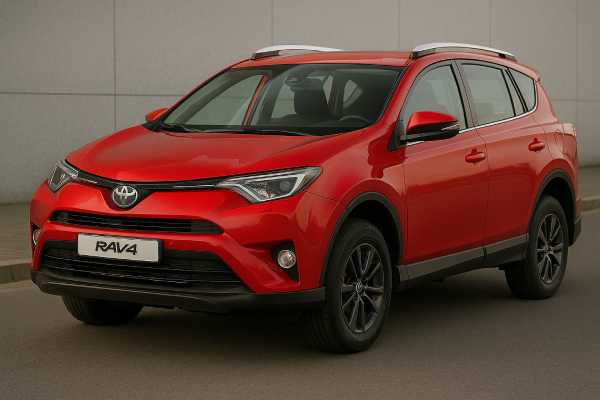
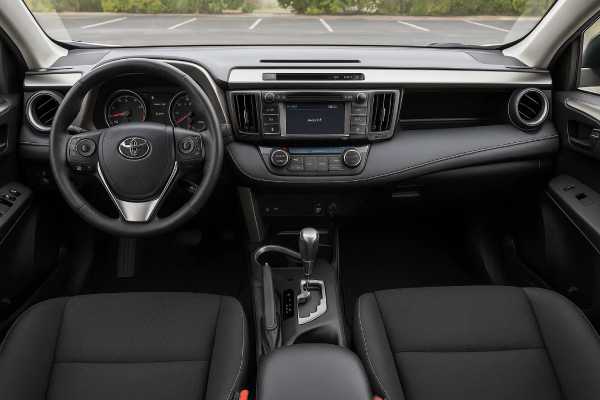
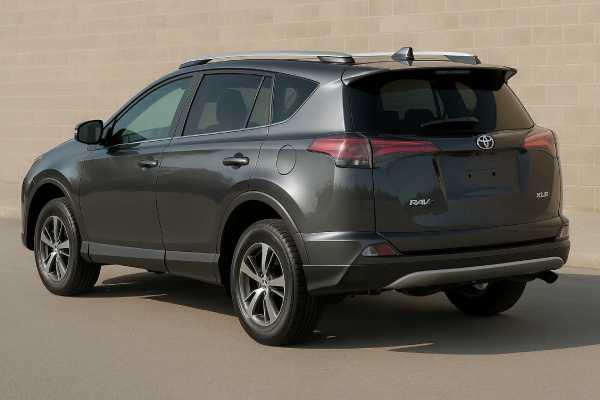
The facelifted fourth-generation Toyota RAV4 (2015–2018) paired Toyota’s 2.0-litre Valvematic petrol (3ZR-FAE) with an always-ready, electronically controlled all-wheel-drive system and a Multidrive S CVT. It is a simple formula that prioritises traction in bad weather, low running costs, and proven Toyota durability. The 2016 refresh brought quieter cabins, better ride isolation, and—importantly—standard Toyota Safety Sense on most grades, making active safety features widely available. While brochure and press figures often round the engine to “151 hp,” European technical sheets list 149 hp (111 kW) with 195 Nm, and real-world performance is brisk enough for daily use, especially at urban and motorway speeds. Compared with turbo rivals, the naturally aspirated 2.0 is smoother, easier to maintain, and tolerant of short-trip usage. The roomy luggage bay, 60-litre tank, and 1,500 kg braked tow rating further suit family and light-adventure roles. If you want a fuss-free AWD crossover that will start every morning and keep costs predictable, this RAV4 spec fits the brief.
Fast Facts
- Confident winter traction from mechanical AWD with automatic rear-axle engagement; stable and predictable on wet or loose surfaces.
- Low-stress 2.0 Valvematic: chain-driven DOHC, port injection, easy service access; typical economy mid-30s mpg (US) mixed.
- Practical cabin: flat load floor, 547 L boot; braked towing up to 1,500 kg (3,307 lb).
- Watch for CVT fluid neglect and uneven tyre wear; keep tyres matched and rotate every 10,000–12,000 km.
- Oil and filter every 12 months or ~10,000 miles (16,000 km), whichever comes first.
Guide contents
- RAV4 2.0 AWD overview
- RAV4 2.0 AWD specs
- RAV4 trims and safety
- Reliability and known issues
- Maintenance and buyer guide
- Driving and performance
- How it compares to rivals
RAV4 2.0 AWD overview
The facelifted XA40 RAV4 closed out the fourth generation with one of Toyota’s most “quietly excellent” configurations: the 2.0-litre Valvematic petrol paired to AWD and the Multidrive S CVT. This powertrain is aimed at owners who value reliability over outright speed, live in mixed climates, and prefer a naturally aspirated engine’s predictable response. The 3ZR-FAE uses Valvematic (continuously variable intake lift) and Dual VVT-i (variable timing on both cams) on a chain-driven DOHC head. Because it is port-injected, there is no routine intake-valve de-carbon cleaning—one fewer long-term maintenance variable than many direct-injection turbo rivals.
The AWD hardware is Toyota’s on-demand mechanical system with an electronically controlled coupling to the rear axle. In normal driving, the RAV4 behaves like a front-driver for efficiency; under slip, steering angle, or acceleration triggers, the coupling feeds torque rearward seamlessly. Snow, gravel, grass fields, a muddy campsite access road—these are the use-cases where owners notice the system earning its keep. Hill-start Assist and Downhill Assist Control (on automatic/CVT versions) smooth low-speed manoeuvres on slopes.
The 2016 update improved NVH with extra insulation, revised engine mounts, and retuned suspension. Cabin design is straightforward, with durable switchgear and excellent outward visibility. The luggage bay (547 L seats up; up to 1,735 L seats down) is among the class’s most useable because of its low floor, wide opening, and square shape. The 60-litre tank and realistic 35–38 mpg (US) mixed economy allow long stints between fills.
Safety content stepped up markedly during these years. Toyota Safety Sense (market-dependent) brought Pre-Collision braking, Lane Departure Alert, and Automatic High Beam, with Blind Spot Monitor and Rear Cross-Traffic Alert available on upper grades. Structurally, the RAV4 carried over its strong small-SUV shell that achieved top marks in European crash testing and solid ratings in North American protocols when configured similarly.
If you want a family crossover that delivers honest capability and gentle ownership demands, this AWD 2.0 sits in the sweet spot: simple, proven engineering; all-weather confidence; and a cabin that puts function ahead of flash.
RAV4 2.0 AWD specs
Engine and performance (ICE)
| Item | Detail |
|---|---|
| Code | 3ZR-FAE (Valvematic, Dual VVT-i) |
| Layout & valvetrain | Inline-4, DOHC, 16-valve, chain-driven |
| Bore × stroke | 80.5 × 97.6 mm (3.17 × 3.84 in) |
| Displacement | 1,987 cc (2.0 L) |
| Induction / fuel | Naturally aspirated / Electronic multi-point injection |
| Compression ratio | 10.0:1 |
| Max power | 149 hp (111 kW) @ 6,200 rpm* |
| Max torque | 195 Nm (144 lb-ft) @ 4,400 rpm |
| *Power note | Figures are European (DIN) and often rounded in brochures to 151 hp |
| Emissions/efficiency benchmark | NEDC-corr. from WLTP, market-dependent |
| Official combined economy | ~6.7 L/100 km (35.1 mpg US / 42.2 mpg UK) with 18-in wheels |
| Real-world highway @ 120 km/h (75 mph) | ~7.8–8.4 L/100 km (30–27 mpg US) depending on tyres/temp |
| Aerodynamics | Cd 0.34–0.36 |
Transmission and driveline
| Item | Detail |
|---|---|
| Transmission | Multidrive S CVT (stepped “Shiftmatic” modes) |
| Drive type | On-demand AWD (electronically controlled coupling) |
| Differential | Open differentials (front/rear); traction control via brakes |
| Final drive | Noted in hybrid tables 3.542 (rear, e-AWD); mechanical AWD uses model-specific ratios |
| AWD features | Auto torque transfer to rear axle; Hill-start Assist; Downhill Assist Control (availability by grade) |
Chassis and dimensions
| Item | Detail |
|---|---|
| Front / rear suspension | MacPherson strut / Double wishbone |
| Steering | Electric power steering; ratio 14.5:1; 2.83 turns lock-to-lock |
| Brakes (front/rear) | 296 × 28 mm vented discs / 281 × 12 mm solid discs (11.7 × 1.10 in / 11.1 × 0.47 in) |
| Wheels / tyres | 17 × 7J with 225/65 R17; optional 18 × 7.5J with 235/55 R18 |
| Ground clearance | ~165–190 mm (6.5–7.5 in), tyre-dependent |
| Length × width × height | 4,605 × 1,845 × 1,675 mm (181.3 × 72.6 × 65.9 in) |
| Wheelbase | 2,660 mm (104.7 in) |
| Turning circle (tyre/body) | 5.3/5.7 m on 17-in; 5.6/6.0 m on 18-in (17.4/18.7 ft; 18.4/19.7 ft) |
| Curb weight | 1,605–1,615 kg (3,538–3,559 lb) |
| GVWR | 2,110 kg (4,652 lb) |
| Fuel tank | 60 L (15.9 US gal / 13.2 UK gal) |
| Cargo volume | 547 L seats up; 1,735 L seats down (VDA, to roof) |
Performance and capability
| Metric | Figure |
|---|---|
| 0–100 km/h (0–62 mph) | 9.9 s |
| Top speed | 185 km/h (115 mph) |
| Braked towing | 1,500 kg (3,307 lb) |
| Unbraked towing | 750 kg (1,653 lb) |
| Indicative payload | ~495–505 kg (1,091–1,113 lb), by spec |
Fluids and service capacities (essentials for planning)
| System | Specification / guidance |
|---|---|
| Engine oil | Toyota-approved 0W-20 meeting current Toyota spec; change annually/10,000 miles (16,000 km). |
| Engine coolant | Toyota Super Long Life Coolant (pink), pre-mix; long-life change interval, then shorter thereafter. |
| CVT | Toyota CVT Fluid FE (use only approved fluid); inspect condition regularly and service proactively in severe use. |
| AWD/axles | High-quality GL-5 75W-90 in rear diff/transfer (verify by VIN). |
| A/C refrigerant | R-134a; charge mass varies by build year/options (label under bonnet). |
| Key torque refs | Wheel nuts: 103 Nm (76 lb-ft) typical Toyota spec; always confirm by VIN. |
Safety and driver assistance
| Item | Summary |
|---|---|
| Crash rating (Euro NCAP) | 5 stars; Adult 89%, Child 82%, VRU 66%; rating valid through 2018 facelift cycle under 2013 protocol. |
| Headlights (IIHS, comparable NA spec) | Trim-dependent Marginal–Acceptable on late XA40 with LED; earlier halogen units often Poor. |
| Airbags & structure | Front, side, curtain, driver’s knee; strong passenger cell; ISOFIX/LATCH on outboard rear seats. |
| ADAS suite | Toyota Safety Sense availability: Pre-Collision (AEB car; pedestrian availability by year), Lane Departure Alert, Automatic High Beam; Blind Spot Monitor and Rear Cross-Traffic Alert available on upper grades. Camera/radar calibration required after glass/sensor repairs. |
RAV4 trims and safety
Trims and options (Europe, facelift years). The late-cycle grade walk commonly included Icon (well-equipped base), Icon Tech (adds navigation and parking aids), Design (styling and larger wheels), and Excel (range-topper with leather, more ADAS, JBL audio where fitted). Earlier in the facelift run, some markets kept an “Active” entry grade. The 2.0 Valvematic AWD with Multidrive S was the petrol AWD option; it is easily identified by the “AWD” badge on the tailgate, CVT selector with manual-step “S” gate, and a VIN indicating ZSA44 (market coding varies). Wheel sets were 17-inch (225/65 R17) standard, with 18-inch (235/55 R18) typically bundled with Design/Excel styling packs.
Functional/mechanical differences by trim. Brakes and suspension hardware are largely common, but higher trims can pair bigger wheels/tyres (heavier, slightly firmer ride). ADAS content scales with grade and model-year: later cars more often include full Toyota Safety Sense as standard. Factory towing preparation (wiring/module) and a larger infotainment option appear at upper grades. Heated seats, power tailgate, and leather upholstery concentrate in Excel-type trims.
Year-to-year highlights (facelift span).
- 2016 MY: Exterior and interior refresh; improved NVH; Toyota Safety Sense availability broadens.
- 2017 MY: Grade structure update in several markets (Icon / Icon Tech / Design / Excel); greater standard ADAS fitment.
- 2018 MY: Final tweaks before the next generation; infotainment revisions and ADAS packaging improvements; end of XA40 run late in the year.
Safety ratings. Under the 2013 Euro NCAP protocol, the RAV4 achieved 5 stars with 89% adult and 82% child protection. That rating was carried through annual reviews and remained valid across the 2016 facelift window. North American IIHS evaluations on analogous petrol RAV4s from 2016–2018 show Good results in most crashworthiness categories, Superior/Advanced for optional front crash prevention, and headlight ratings varying by trim (halogen often Poor; later LED packages Marginal to Acceptable). For buyers, the practical takeaway is simple: choose cars with the fullest Toyota Safety Sense suite and LED headlights for best night visibility and active-safety performance.
Child-seat provisions. ISOFIX/LATCH anchors are fitted on the outer rear positions with clear lower-anchor access. The front passenger airbag can be disabled for a rear-facing seat where allowed.
Calibration considerations. After windscreen replacement, front bumper repairs, or front-end alignment work, the forward camera/radar requires calibration using factory procedures. Park-assist sensors and the rear camera likewise need proper re-aiming to avoid false alerts.
Reliability and known issues
Toyota’s 3ZR-FAE/Multidrive S AWD combination is durable when serviced on time. Below is a practical map of what to watch, sorted by prevalence and cost impact.
Engine and induction (ICE specifics)
- Common, low–medium cost: Coil-on-plug misfires after long intervals or moisture ingress. Symptoms: rough idle, flashing MIL, P030x codes. Remedy: replace the affected coil and plugs as a set if aged; inspect cowl drains for water leaks.
- Occasional, medium cost: Valvematic actuator position faults after many years. Symptoms: hesitation or limp mode with codes for valve lift control. Root cause: wear/contamination of the actuator. Remedy: actuator replacement and control-unit relearn; keep oil changes timely (0W-20) to minimise varnish.
- Rare, low cost: PCV valve clog elevating oil consumption after high mileage. Symptoms: rising oil use, oily throttle body. Remedy: PCV replacement and throttle clean; monitor between services.
- **What you generally *do not* see here:** DI-related intake carbon build-up (this engine is port-injected) or timing-belt service (it is chain-driven).
Cooling and HVAC
- Occasional, medium cost: Radiator or A/C condenser fin corrosion on coastal/salted-road cars. Symptoms: overheating in traffic or weak A/C. Remedy: pressure test; replace component; add condenser guard if you drive on gravel.
Fuel and exhaust
- Rare, low–medium cost: O2 sensor ageing causing rich/lean codes. Remedy: replace sensor; inspect for exhaust leaks upstream.
CVT, AWD, and driveline
- Common, low–medium cost if proactive: CVT fluid ageing on vehicles used for heavy city driving or hilly terrain. Symptoms: flare or droning at moderate throttle, delayed back-off. Remedy: proactive drain-and-fill with Toyota CVT FE fluid every ~60,000–90,000 km in severe service; ensure correct fluid and temperature-based fill procedure.
- Occasional, medium cost: Rear diff/transfer case seepage; often gasket or shaft seal. Symptoms: light misting around housings, faint whine at speed when low on fluid. Remedy: reseal and replenish with GL-5 75W-90; check breathers.
- Occasional, low cost: AWD coupling clunk after tyre mismatch. Symptoms: tight-turn shuffle, binding sensation. Remedy: always keep four tyres matched in brand/model/wear and rotate on time.
Suspension, steering, and brakes
- Common wear: Front drop-links and strut top mounts by 80–120,000 km on rough roads; rear anti-roll-bar bushes a little later.
- Occasional: Caliper slide pins sticking in salted climates. Clean and lubricate at each brake service to prevent inner-pad taper.
- Wheel bearings: Not a chronic fail item, but high-mileage cars on poor surfaces can develop hum by 120–180,000 km.
Electrical and body
- Battery clamp recall (2013–2018 RAV4). Replacement batteries with smaller top cases could shift under high cornering loads, risking short-circuit. Remedy: recall inspection and retrofit revised clamp/pad. Verify completion before purchase.
- Water ingress: Door-seal squeaks and occasional tailgate rattle—minor NVH items; adjust and lubricate.
Software and calibration
- Powertrain and ADAS modules occasionally receive updates for driveability, camera performance, and false alert reduction. During pre-purchase, ask the seller for a dealer print-out of ECU/ADAS calibration status.
Pre-purchase checks
- Full service history (annual/10,000-mile oil changes).
- Proof of recall completion (battery clamp campaign) and any CVT fluid service.
- Even tyre set with recent rotation; avoid mixed brands with AWD.
- Underside inspection for corrosion at rear suspension arms/subframe mounts.
- Smooth CVT behaviour on a hot test drive (no flare or shudder).
- ADAS operation test (lane alert, pre-collision warnings) and camera clarity after any windscreen work.
Maintenance and buyer guide
Practical maintenance schedule (distance/time = whichever comes first).
- Engine oil & filter: Every 12 months or ~10,000 miles (16,000 km) on normal use; sooner for short-trip or dusty duty. Use Toyota-approved 0W-20.
- Engine air filter: Inspect every 12 months; replace 30,000–40,000 miles (48–64,000 km) or sooner if dusty.
- Cabin/pollen filter: Replace annually; more often in urban/pollen-heavy regions.
- Spark plugs (iridium): Typically 60,000–100,000 miles (96–160,000 km) depending on plug type and conditions; inspect at major service.
- Coolant (SLLC pink): Long initial interval, then roughly 50,000 miles/5 years thereafter—verify by VIN label/manual.
- Serpentine/aux belt: Inspect at every service; replace if cracked/noisy (~90–120,000 km common).
- CVT fluid (Toyota CVT FE): Inspect condition; for best life, drain-and-fill every 60,000–90,000 km in severe use (city hills/towing).
- Rear differential/transfer oils (GL-5 75W-90): Inspect for level/condition at 60,000 km; refresh by 100,000–120,000 km.
- Brake fluid: Replace every 2 years.
- Brakes: Inspect pads/rotors each service; clean/lube slider pins.
- Tyres: Rotate 10,000–12,000 km; maintain even wear on all four for AWD coupling health.
- Alignment check: Annually or after pothole/kerb strike.
- 12-V battery: Load-test before winters after year 4; replace proactively at 5–6 years in harsh climates.
- Windscreen camera/radar: Calibrate after glass/front-end work or upon ADAS fault codes.
Fluid and torque essentials for decision-making (verify by VIN):
- Oil: 0W-20 Toyota-approved; filter cartridge element; drain-plug washer single-use.
- Coolant: Toyota Super Long Life Coolant (pink), pre-mixed.
- CVT: Toyota CVT FE only; strict temperature-based fill procedure.
- Diff/transfer: GL-5 75W-90; fill to bottom of plug hole; check breathers.
- Wheel-nut torque: ~103 Nm (76 lb-ft) typical Toyota spec; always confirm for your build code.
Buyer’s checklist
- Exterior/underbody: Check rear subframe and arm mounts for corrosion; look for stone damage on condenser/radiator.
- Engine bay: Cold-start and listen for abnormal chain rattle (rare). Inspect for coolant stains at radiator seams.
- Driveline test: From a slow, tight turn in a car park, listen/feel for binding—walk away if tyres are mismatched or it shuffles badly.
- CVT behaviour: On a hot drive, accelerate from 40–60 mph (64–96 km/h) and back off; healthy boxes transition smoothly with no “hunting.”
- Electronics: Confirm ADAS alerts, camera clarity, and parking sensors; ensure any windscreen replacement was calibrated.
- Paperwork: Ask for the recall report, ADAS calibration receipts, and proof of regular services (annually/10,000 miles).
Which years/trims to seek. Late-2017 and 2018 cars in Design or Excel trims strike a strong balance of LED lighting, fuller Safety Sense, and nicer cabin features. Choose 17-inch wheels if you prioritise ride comfort and winter performance; 18-inch if you prefer sharper turn-in and looks.
Long-term outlook. With regular oil changes, proper tyre rotation, and occasional CVT/diff fluid refreshes, the 3ZR-FAE AWD RAV4 routinely crosses 200,000+ miles (320,000+ km) without major powertrain work. Consumables (bushes, links, wheel bearings) are straightforward and widely available.
Driving and performance
Character and response. The 2.0 Valvematic’s calling cards are smoothness and consistency. Throttle mapping is gentle in Normal mode; select the CVT’s Sport/“S” mode for crisper step-off and better engine braking on descents. Because torque peaks at 4,400 rpm and there is no turbo surge, power builds predictably—useful for winter throttle modulation and roundabout gaps. The CVT’s programmed steps keep revs from “flaring” under steady acceleration and allow a familiar downshift feel on hills.
Ride, handling, NVH. The facelift’s added insulation and retuned suspension noticeably quieten coarse-surface roar. On 17-inch tyres, the RAV4 is supple over speed bumps and broken tarmac; 18-inch packages feel tauter but remain comfortable. Straight-line stability is a strong point; crosswinds are well managed. In corners, the chassis is safe and mildly understeery. Steering is light in town and weights up naturally at speed; precision is better than average for the class but still tuned for comfort. Braking is predictable with linear pedal travel; repeated emergency stops produce minimal fade on healthy pads/fluids.
All-weather traction. The on-demand AWD shuffles torque rearward quickly when front slip is detected. On fresh snow, the system limits wheelspin without harsh interventions, and traction control is tuned to allow just enough rotation to keep momentum on inclines. With a matched set of winter tyres, the RAV4 is a confident ski-trip partner. Hill-start Assist and Downhill Assist Control are pleasant extras on steep drives or when towing a small trailer on gravel.
Performance metrics (typical figures with 2.0 AWD CVT and 18-inch tyres):
- 0–62 mph (0–100 km/h): ~9.9 s.
- 50–75 mph (80–120 km/h) passing: ~7–8 s real-world with a decisive throttle angle.
- 100–0 km/h braking: strong, consistent stops if pads/rotors are fresh.
- Turning circle: ~5.3–5.6 m tyre-to-tyre, making tight parking easy.
Efficiency in practice. In mixed commuting, expect 6.9–7.6 L/100 km (34–31 mpg US / 41–37 mpg UK) with summer tyres and temperate weather. At motorway speeds (70–75 mph / 113–120 km/h), 7.8–8.4 L/100 km (30–27 mpg US) is typical; winter on snow tyres adds 0.5–1.0 L/100 km. Light towing (a small camping trailer) trims economy by 15–25%; plan fuel stops accordingly.
Load and towing. The RAV4 feels composed with bikes, camping gear, or a small trailer. Keep tongue weight balanced, allow longer braking distances downhill, and use the CVT’s “S” steps for controlled engine braking on grades. Cooling performance is adequate for European mountain passes provided the radiator/condenser fins are clean.
How it compares to rivals
Honda CR-V 2.0 i-VTEC AWD (contemporary EU-spec): The Honda’s naturally aspirated 2.0 manual/auto is similarly reliable and smooth. Toyota’s cabin is quieter post-facelift, and its AWD engages more transparently in slippery starts. The CR-V’s rear space is excellent; Toyota counters with a flatter load floor and a stronger 1,500 kg tow figure for this petrol spec.
Mazda CX-5 2.0 Skyactiv-G AWD: The Mazda feels sportier with crisper steering and a more eager throttle. Its cabin is more “premium,” but tyre roar can be higher on coarse surfaces. Mazda’s economy can edge the RAV4 on 17-inch wheels; Toyota tends to be cheaper to service long-term and has broader dealer coverage.
Nissan X-Trail 2.0 petrol AWD: The Nissan’s AWD lock mode is helpful off-tarmac, but the drivetrain can feel lazier and economy trails the Toyota. Cabin packaging is competitive; Toyota’s active-safety availability and residuals are stronger.
Hyundai Tucson / Kia Sportage 1.6 GDI/2.0 petrol AWD: Value-packed and quiet, with generous standard kit. The Toyota’s durability record, resale values, and straightforward port-injected engine give it the long-run advantage; Hyundai/Kia infotainment is more modern.
Bottom line: Pick the RAV4 AWD 2.0 if you value reliability, service simplicity, and all-weather confidence over class-leading acceleration or cutting-edge infotainment. Among non-turbo petrol AWD rivals of the period, it is one of the easiest to own for a decade.
References
- 180511M RAV4 Technical Specifications 2018 (Technical Specifications)
- 180511M – RAV4 full release 2018 (Press Pack)
- Official Toyota RAV4 2013 safety rating results 2013 (Safety Rating)
- TOYOTA 2023 (Recall Report)
Disclaimer
This guide is for informational purposes and is not a substitute for professional diagnosis, repair, or official service literature. Specifications, torque values, fluid types/volumes, safety-system content, and maintenance intervals vary by VIN, model year, market, and equipment. Always confirm details with your official owner’s manual, service manual, technical bulletins, and local regulations before performing work.
If you found this helpful, please consider sharing it with fellow owners on Facebook or X/Twitter—your support helps xcar keep creating detailed, independent guides.